
UNIT 1 NATURE OF SCIENCE SCIENTIFIC METHOD Georgia
- Slides: 13
UNIT 1: NATURE OF SCIENCE & SCIENTIFIC METHOD Georgia Performance Standards: • • SCSh 1. Students will evaluate the importance of curiosity, honesty, openness, and skepticism in science. SCSh 3. Students will identify and investigate problems scientifically. SCSh 4. Students will use tools and instruments for observing, measuring, and manipulating scientific equipment and materials. SCSh 5. Students will demonstrate the computation and estimation skills necessary for analyzing data and developing reasonable scientific explanations. SCSh 6. Students will communicate scientific investigations and information clearly. SCSh 7. Students analyze how scientific knowledge is developed. SCSh 8. Students will understand important features of the process of scientific inquiry. SCSh 9. Students will enhance reading in all curriculum areas Essential Questions: • • What is science? What are laws, theories, and hypotheses? How do scientists analyze biological data? How should data be displayed?
The Nature of Science: • What is Science? – An organized way of using evidence to learn about the natural world. • What is the Goal of Science? – To investigate and understand the natural world, to explain events in the natural world, and to use those explanations to make useful predictions.
Scientific Method: • How scientists work the organized process scientists use to investigate the natural world 1. Start with a question, or problem 2. Make observations to gather evidence (data) – Quantitative = numerical observations – Qualitative = descriptive observations
Interpret Evidence • – Scientists make inferences, or logical guesses to explain observations 3. Explaining Evidence (Data) by Forming a Hypothesis – Hypotheses, or educated guesses are used to explain the evidence (data) – A hypothesis can be tested through a controlled experiment
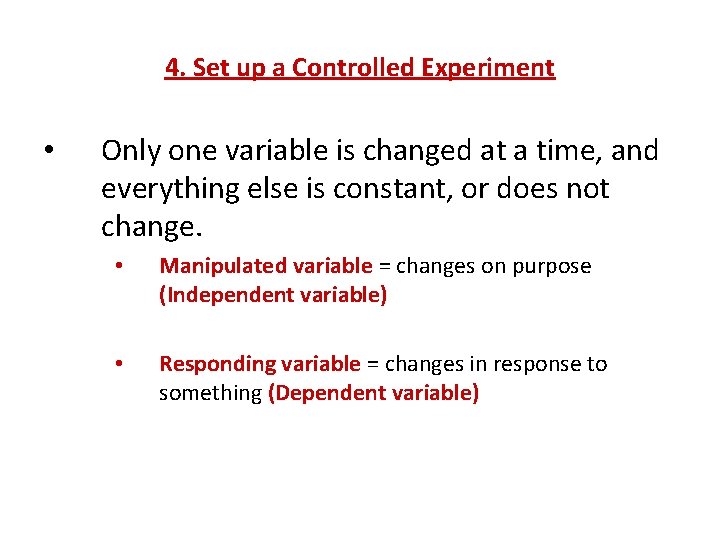
4. Set up a Controlled Experiment • Only one variable is changed at a time, and everything else is constant, or does not change. • Manipulated variable = changes on purpose (Independent variable) • Responding variable = changes in response to something (Dependent variable)
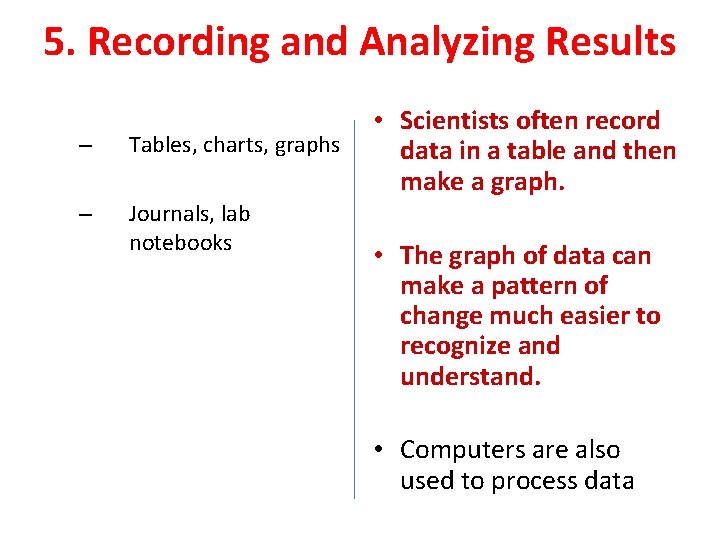
5. Recording and Analyzing Results – Tables, charts, graphs – Journals, lab notebooks • Scientists often record data in a table and then make a graph. • The graph of data can make a pattern of change much easier to recognize and understand. • Computers are also used to process data
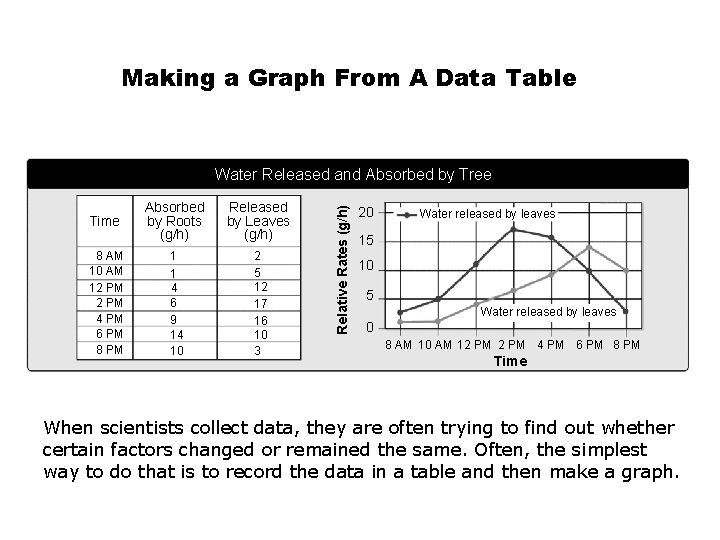
Making a Graph From A Data Table Section 1 -4 Time Absorbed by Roots (g/h) Released by Leaves (g/h) 8 AM 10 AM 12 PM 4 PM 6 PM 8 PM 1 1 4 6 9 14 10 2 5 12 17 16 10 3 Relative Rates (g/h) Water Released and Absorbed by Tree 20 Water released by leaves 15 10 5 Water released by leaves 0 8 AM 10 AM 12 PM 4 PM 6 PM 8 PM Time When scientists collect data, they are often trying to find out whether certain factors changed or remained the same. Often, the simplest way to do that is to record the data in a table and then make a graph.
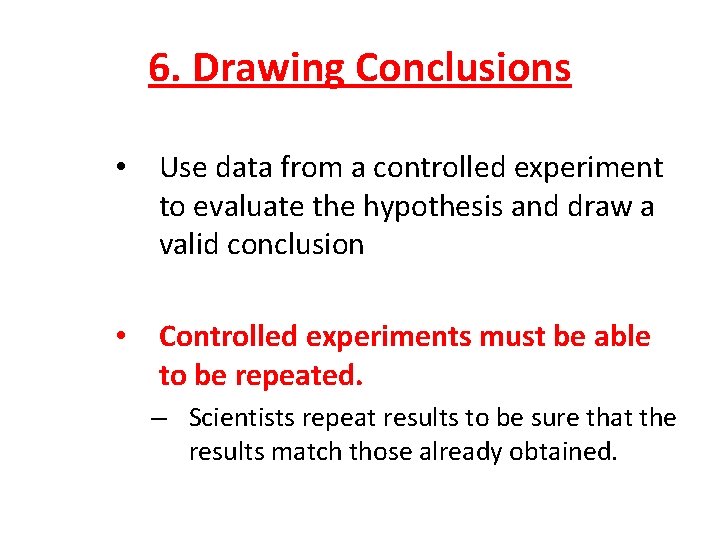
6. Drawing Conclusions • Use data from a controlled experiment to evaluate the hypothesis and draw a valid conclusion • Controlled experiments must be able to be repeated. – Scientists repeat results to be sure that the results match those already obtained.
Laws & Theories: • Theory (well-tested explanation that unifies a broad range of observations) – testing, revising and occasionally rejecting new and old theories never ends. – no theory is considered absolute truth
Activity • Finish Graphing Skills Lab Analysis & Conclusion Questions # 1 -5. Do not do going further. • Drawing: Using Graphs to Understand Biology WS • Identifying the controls and variables WS
Tools & Procedures • Tools play a major role in science. • A common system of measurement is replicate needed to replicate experiments. • Collect data to analyze whether certain factors changed or remained the same. • Biologists use a variety of techniques and tools to study cells. • Safe procedures are used when carrying out investigations.
A Common System of Measurement • Most scientist use the metric system when collecting data and performing experiments. – A decimal system whose units are based on certain physical standards and are scaled on multiples of 10. – – – – – 1 meter (m) = 100 centimeters (cm) 1 meter = 1000 millimeters (mm) 1000 meters = 1 kilometers (km) 1 liter (L) = 1000 milliliters (m. L) 1 liter (L) = 1000 cubic centimeters (cm 3) 1 kilogram (kg) = 1000 grams (g) 1 gram = 1000 milligrams (mg) 1000 kilograms = 1 metric ton (t) 0°C = freezing point of water 100°C = boiling point of water
Ticket Out the Door 1. Why do scientists use a common system of measurement? 2. What is the difference in the way light microscopes and electron microscopes produce images? 3. Describe the technique and purpose of cell fractionation. 4. What types of objects can be studied with a light microscope? What types can be studied with an electron microscope? 5. It has been said that many great discoveries lie in wait for the tools needed to make them. What does this statement mean to you? If possible, include an example in your answer.