
UNIT 1 More Grammar and Style More Vocabulary
UNIT 1 More Grammar and Style More Vocabulary Strategy More Vocabulary Practice
DIALOGUE �Spoken language differs from formal written language �Authors use realistic dialogue to make their characters sound real ◦ ◦ Informal Language Sentence Fragments Contractions Interjections
CONFUSING WORDS �Homophones: Words that sound the same but have different spellings AND meanings �Multiple Meaning Words: Words that are spelled the same but have multiple meanings ◦ Check dictionary for other definitions ◦ Use context clues to determine the part of speech and choose definition that matches
ETYMOLOGIES �Etymology refers to the history of a word, as presented in its dictionary entry �Use the symbols to identify the languages involved in the word’s history �The word panic comes from the Greek word panikos, “relating to Pan” (Pan was a god whose presence inspired sudden fear)
ROOT WORDS �A root is the part of the word that contains its core meaning �Knowing common root words help you determine a word’s meaning ◦ Identify the root ◦ Eliminate any suffix and/or prefix ◦ Think of other words with this root – what do they have in common? ◦ Use shared meaning to guess at definition
STRONG VERBS �Incorporate strong verbs to create action sequences �Create vivid images �Avoid verbs that are too general or overused; replace overused verbs below: �Gertrude and Amber were taken away by the floodwaters and had to hold onto debris. Both met people who wanted to help
VOCABULARY STRATEGY Prefix dis�Latin prefix that means “in different directions” �Use your knowledge of the base word and the prefix to understand words with this prefix �disengage, disabled, discontinued, disinvite, disband
VOCABULARY STRATEGY Connotation and Denotation �A word’s denotation is its basic dictionary meaning �A word’s connotation is the overtones of meaning the word has taken on �For example, the word conflagration means “a large fire, but it has negative connotations of total destruction, unlike the more neutral word flame
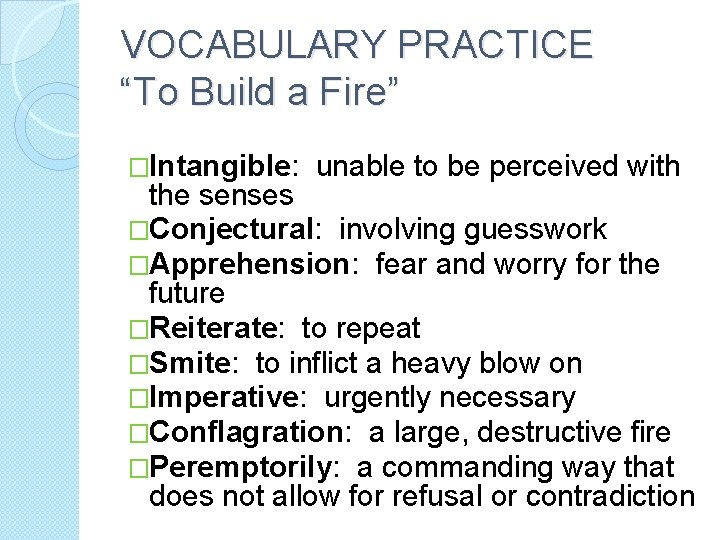
VOCABULARY PRACTICE “To Build a Fire” �Intangible: unable to be perceived with the senses �Conjectural: involving guesswork �Apprehension: fear and worry for the future �Reiterate: to repeat �Smite: to inflict a heavy blow on �Imperative: urgently necessary �Conflagration: a large, destructive fire �Peremptorily: a commanding way that does not allow for refusal or contradiction
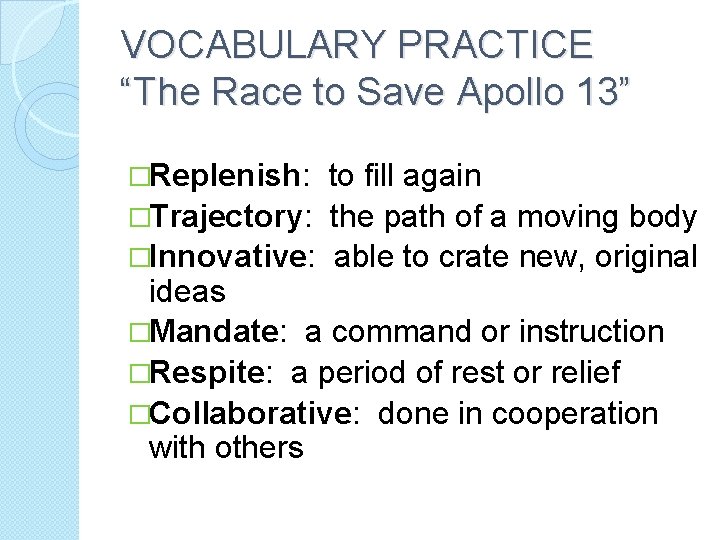
VOCABULARY PRACTICE “The Race to Save Apollo 13” �Replenish: to fill again �Trajectory: the path of a moving body �Innovative: able to crate new, original ideas �Mandate: a command or instruction �Respite: a period of rest or relief �Collaborative: done in cooperation with others
- Slides: 10