
Unit 1 Maps Projections Function of a Map
- Slides: 23
Unit 1: Maps & Projections
Function of a Map • Two purposes – As reference tools • To find locations, to find one’s way – As communications tools • To show the distribution of human and physical features
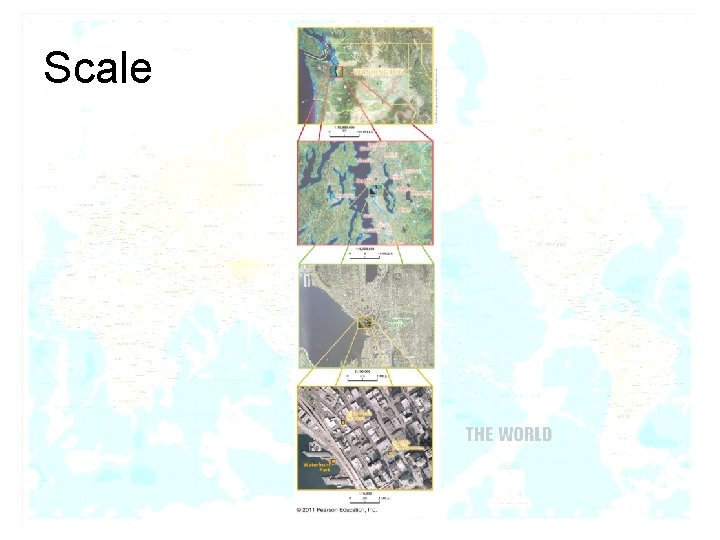
Scale • Ratio/fraction – shows the ratio of distance on a map compared to the real earth measurement. • Bar/graphic – shows the ratio of the distance on the map to the distance on the earth • Written – describes relation between map and Earth in words • Small scale – shows a large area without a lot of detail • Large scale – shows a small area with a lot of detail.
Scale
Questions • 1. In what way do you most often use a map? Reference or communication? • 2. Which map would have the largest scale?
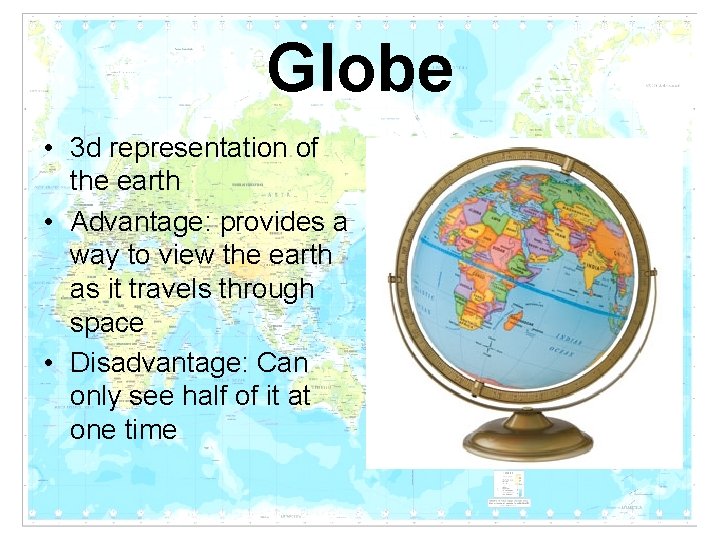
Globe • 3 d representation of the earth • Advantage: provides a way to view the earth as it travels through space • Disadvantage: Can only see half of it at one time
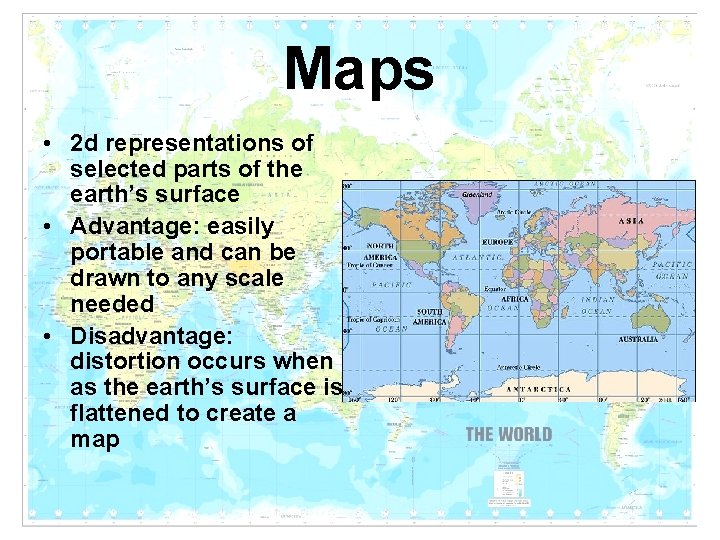
Maps • 2 d representations of selected parts of the earth’s surface • Advantage: easily portable and can be drawn to any scale needed • Disadvantage: distortion occurs when as the earth’s surface is flattened to create a map
Types of Maps • General reference or topographic map natural and man-made features on the earth • Thematic – emphasize specific kind of information • Navigational – help users plot a course through water or air.
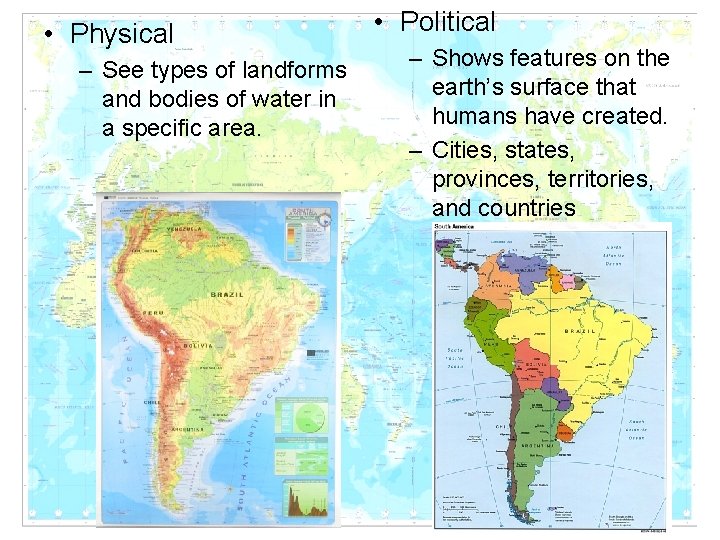
• Physical – See types of landforms and bodies of water in a specific area. • Political – Shows features on the earth’s surface that humans have created. – Cities, states, provinces, territories, and countries
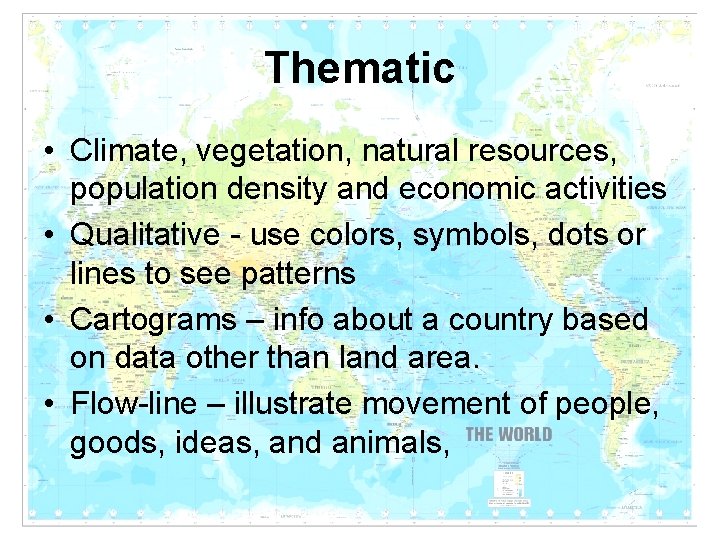
Thematic • Climate, vegetation, natural resources, population density and economic activities • Qualitative - use colors, symbols, dots or lines to see patterns • Cartograms – info about a country based on data other than land area. • Flow-line – illustrate movement of people, goods, ideas, and animals,
Questions • 3. Which are you more likely to use, a physical map or a political map? Explain your answer. • 4. Give one example of when a thematic is helpful and one example when it is not.
Map projections • A way of drawing the earth’s surface that reduces distortion caused by presenting a round earth on flat paper. • A cartographer will reduce some types of distortion by using different types of map projections • Distance, shape, direction, or area/size may be distorted.
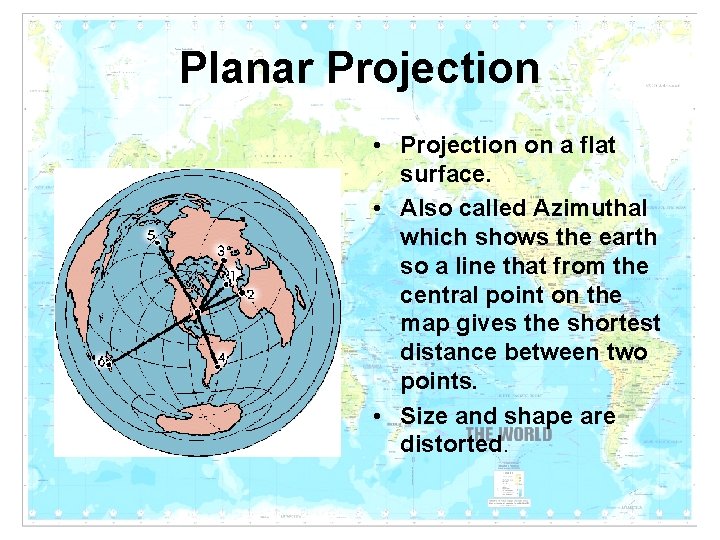
Planar Projection • Projection on a flat surface. • Also called Azimuthal which shows the earth so a line that from the central point on the map gives the shortest distance between two points. • Size and shape are distorted.
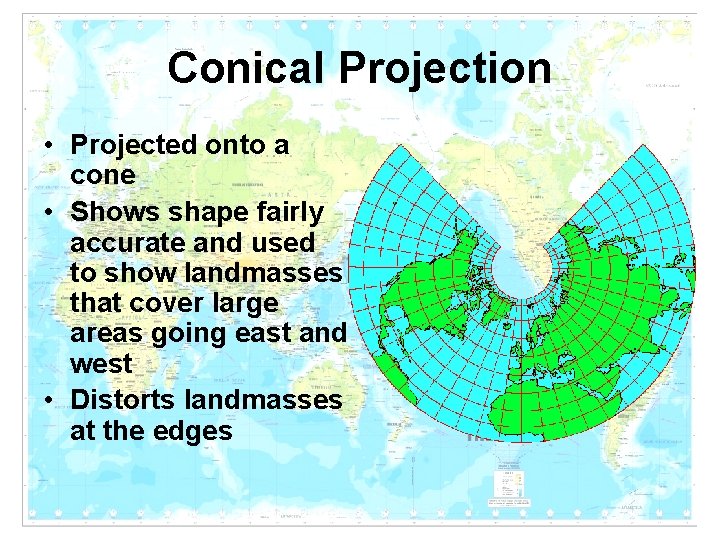
Conical Projection • Projected onto a cone • Shows shape fairly accurate and used to show landmasses that cover large areas going east and west • Distorts landmasses at the edges
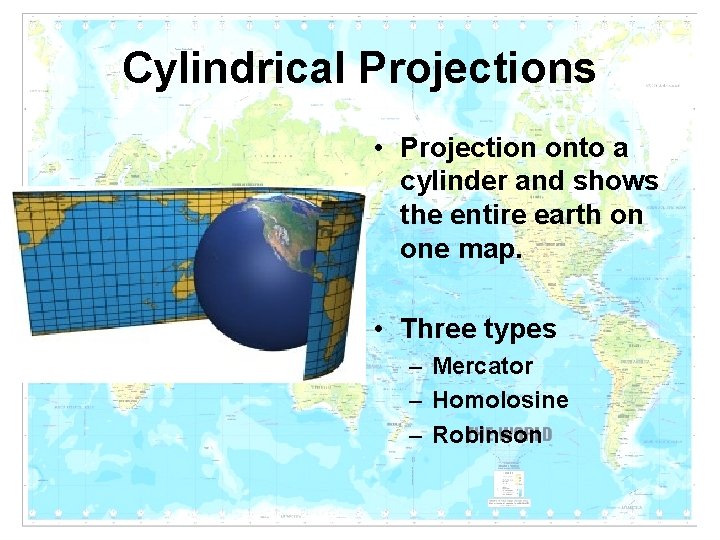
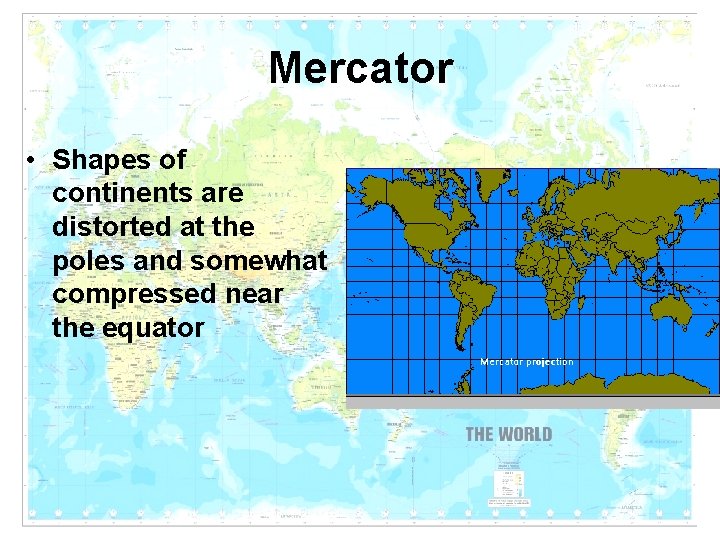
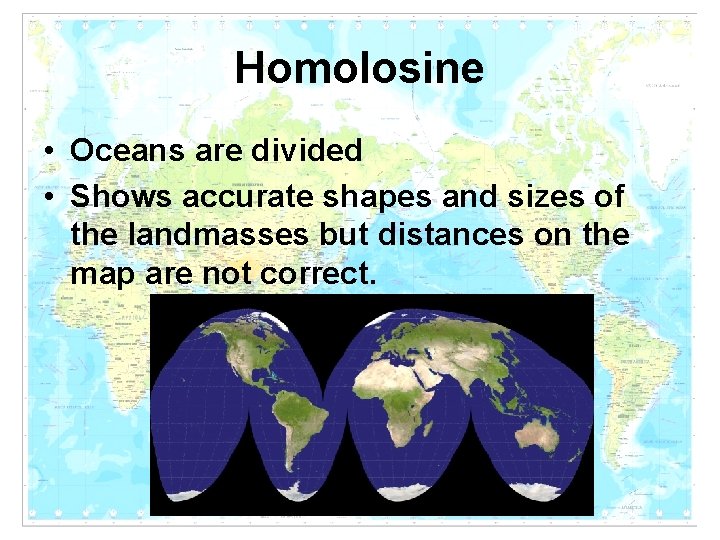
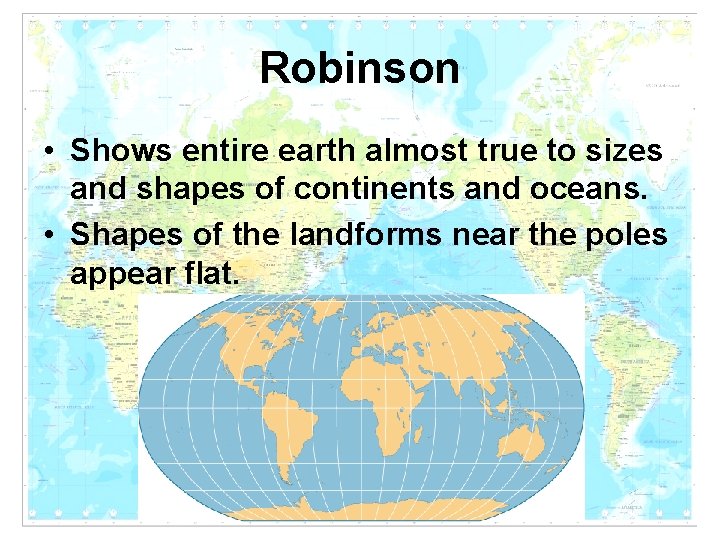
Cylindrical Projections • Projection onto a cylinder and shows the entire earth on one map. • Three types – Mercator – Homolosine – Robinson
Questions • 5. Why are map projections needed? • 6. What 4 things are distorted in a map projection?
Mercator • Shapes of continents are distorted at the poles and somewhat compressed near the equator
Homolosine • Oceans are divided • Shows accurate shapes and sizes of the landmasses but distances on the map are not correct.
Robinson • Shows entire earth almost true to sizes and shapes of continents and oceans. • Shapes of the landforms near the poles appear flat.
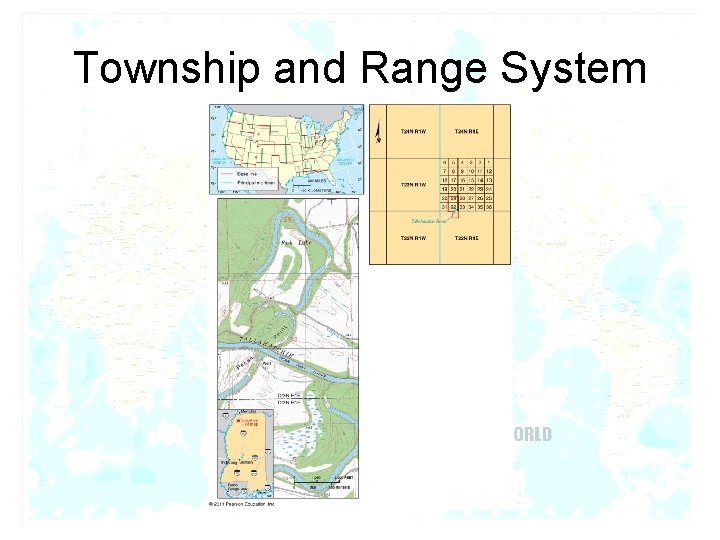
U. S. Land Ordinance of 1785 • Township and range system – Township = 6 sq. miles on each side • North–south lines = principal meridians • East–west lines = base lines – Range – Sections
Township and Range System
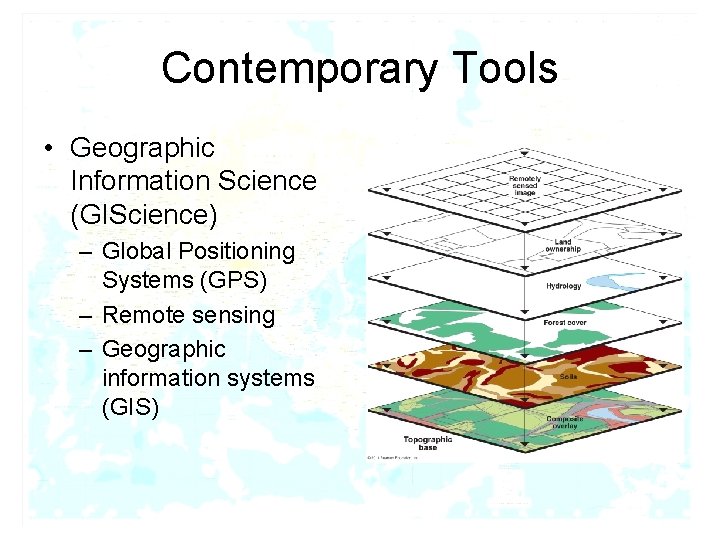
Contemporary Tools • Geographic Information Science (GIScience) – Global Positioning Systems (GPS) – Remote sensing – Geographic information systems (GIS)
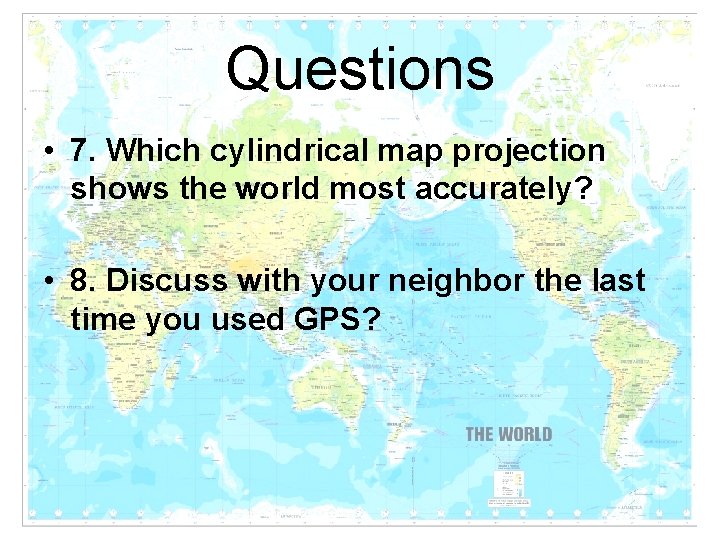
Questions • 7. Which cylindrical map projection shows the world most accurately? • 8. Discuss with your neighbor the last time you used GPS?