
Unit 1 Lesson 2 Use Rational Approximations of


- Slides: 10
Unit 1 Lesson 2 Use Rational Approximations of Irrational Numbers 8. NS. 2
Essential Question: How can you use a rational number to approximate the value of an irrational number? Vocabulary Square Root Objective: Find rational numbers that approximate irrational numbers. Use rational approximations to compare irrational numbers and simplify expressions that include irrational numbers.
Example 1: Approximate the side length of a square to the nearest hundredth. Look at book page 18 (or projected up front) When a whole number is NOT a perfect square, its positive square root is an irrational number. Since 2 is not a perfect square, the square root of 2 is irrational. This means you cannot find the exact value of the square root of 2, you can only find an approximations.
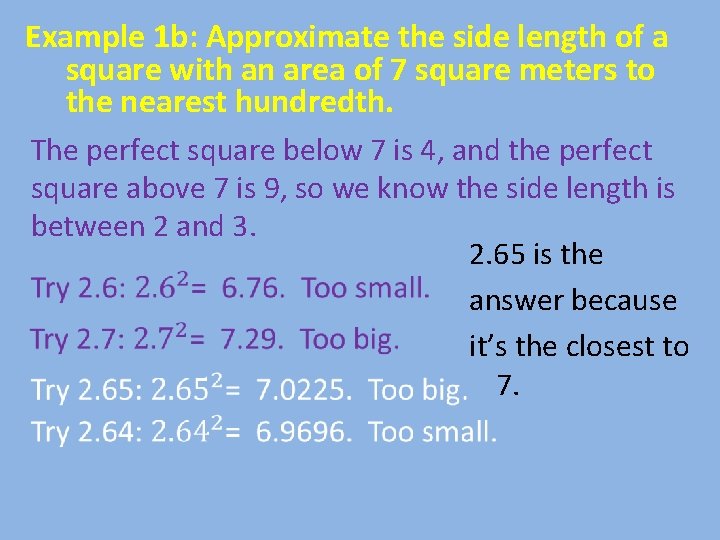
Example 1 b: Approximate the side length of a square with an area of 7 square meters to the nearest hundredth. The perfect square below 7 is 4, and the perfect square above 7 is 9, so we know the side length is between 2 and 3. 2. 65 is the answer because it’s the closest to 7.
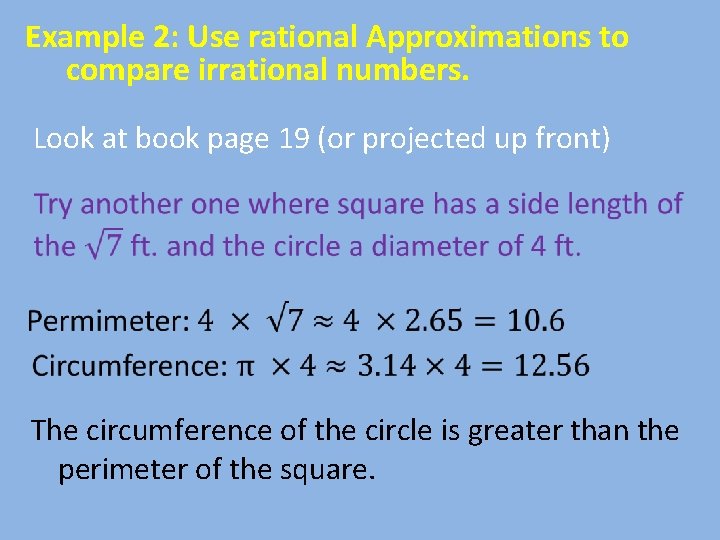
Example 2: Use rational Approximations to compare irrational numbers. Look at book page 19 (or projected up front) The circumference of the circle is greater than the perimeter of the square.
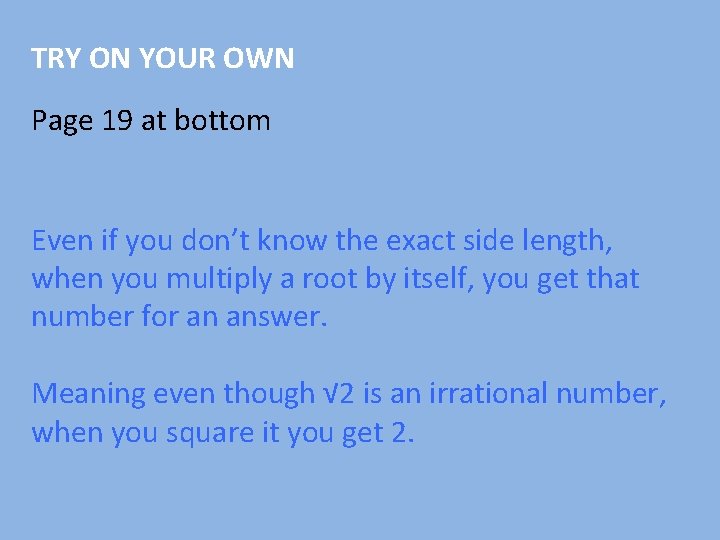
TRY ON YOUR OWN Page 19 at bottom Even if you don’t know the exact side length, when you multiply a root by itself, you get that number for an answer. Meaning even though √ 2 is an irrational number, when you square it you get 2.
Example 3: Estimate the square root on a number line. Look at page 20 of book (or at board)
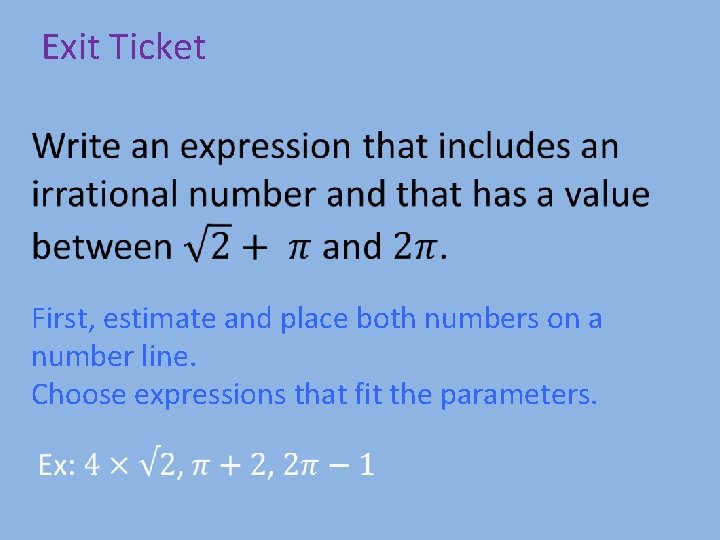
Exit Ticket First, estimate and place both numbers on a number line. Choose expressions that fit the parameters.
Assignments Class Work Page 21 Page 22 Page 23 Pages 23 -24 #1 – 8 (1 - 6 may already be complete) #1 – 13 #14 – 22 #23 – 26, 28