
Unit 1 Lesson 2 Health and Personal Wellness
- Slides: 13
Unit 1: Lesson 2
Health and Personal Wellness Lesson 2: The Biopsychosocial Model of Health
Making Every Contact Count Play your part in changing lifestyle behaviours and help prevent chronic disease
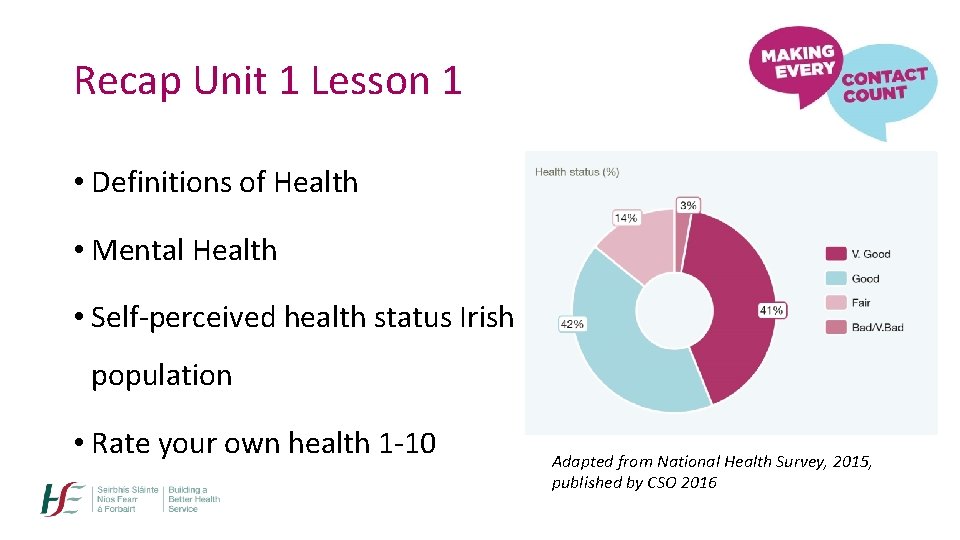
Recap Unit 1 Lesson 1 • Definitions of Health • Mental Health • Self-perceived health status Irish population • Rate your own health 1 -10 Adapted from National Health Survey, 2015, published by CSO 2016
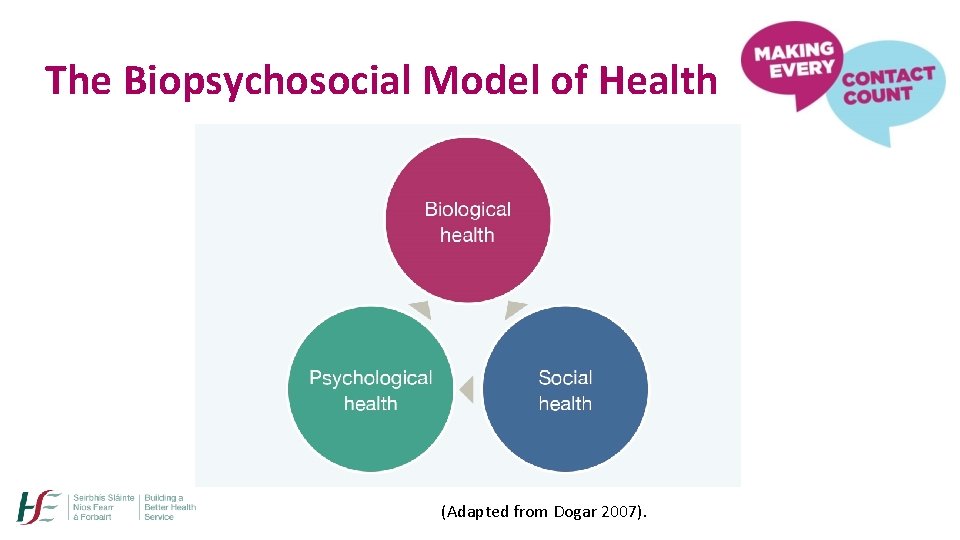
The Biopsychosocial Model of Health (Adapted from Dogar 2007).
Activity 1. 2: Self perceived dimensions of health Rate your Biological Health on a scale from 1 -10 Not at all Healthy 1 2 3 Reasons for your Health rating 4 5 6 7 8 9 ………………………………. . ……………………………… 10 Completely Healthy
Activity 1. 2: Self perceived dimensions of health Rate your Social Health on a scale from 1 -10 Not at all Healthy 1 2 3 Reasons for your Health rating 4 5 6 7 8 9 ………………………………. . ……………………………… 10 Completely Healthy
Activity 1. 2: Self perceived dimensions of health Rate your Psychological Health on a scale from 1 -10 Not at all Healthy 1 2 3 Reasons for your Health rating 4 5 6 7 8 9 ………………………………. . ……………………………… 10 Completely Healthy
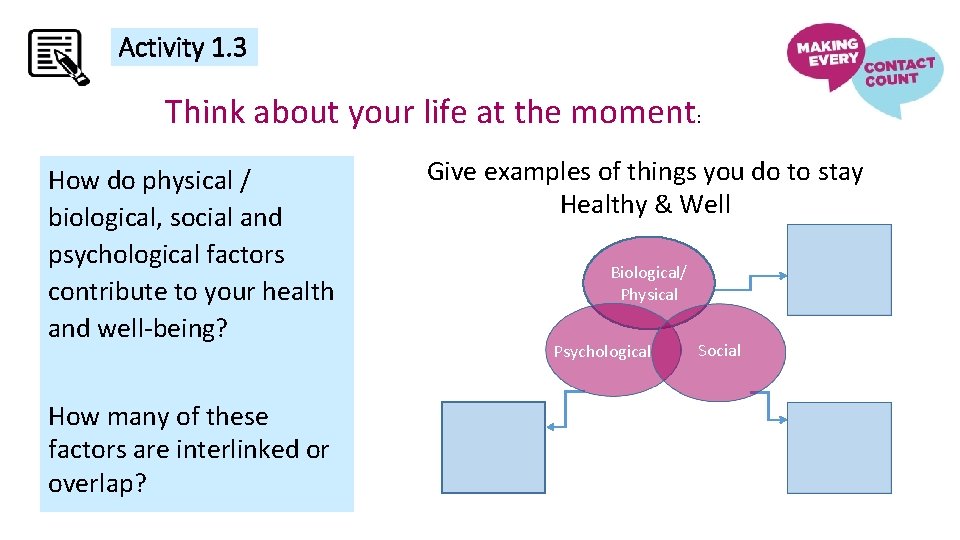
Activity 1. 3 Think about your life at the moment: How do physical / biological, social and psychological factors contribute to your health and well-being? How many of these factors are interlinked or overlap? Give examples of things you do to stay Healthy & Well Biological/ Physical Psychological Social
• How adequately do you think the biopsychosocial model of health captures all aspects of health that are important to you? • Are there other dimensions of health that you would add to this model?
Activity 1. 4: Case Study -John is 22 years old. He left school at 16 and has been working in construction since then; he is considered to be a good worker and gets on well with his colleagues and supervisors. Unfortunately, because of the recession, there has been a slow-down in work and John has been let go. Others who had formal qualifications and trades have been kept on. Since then John has been doing some part time work for other builders and neighbours. His old workmates have encouraged him to go back to college or to do a trade but John feels he cannot afford it and doesn’t want to bother his parents as his Dad is out of work and is suffering from depression. Due to his reduced income he has had to move in with his sister and her young family, John is helping her with child minding and general odd jobs. He used to regularly play football with friends a few times a week and go for a few pints afterwards but lately he has been attending less frequently as he feels unfit, he also can’t afford to socialise with this gang and instead finds it cheaper and easier to have cans at home with his brother in law. John goes to see his GP because he is having trouble sleeping but also says he feels constantly exhausted. He is also anxious about what he is going to do with his life. He says he sees no way out of his situation and is conscious that he is becoming a burden on his sister.
Activity 1. 4: Case Study -Tara is 19 years old, she is a first year student in university, undertaking a 4 year Nursing degree programme. She left home 10 weeks ago and moved in with other students in rented accommodation near to the college. Until now Tara has enjoyed the comfort of her parent’s home cooked meals after school, regular exercise with her school football team and a relatively structured study plan which she adhered to in the quiet of her home environment. Lately, Tara has found that she is snacking a lot throughout the day at college. She doesn’t always mean to but she doesn’t have time for breakfast and there are so many high calorie snacks available at the college restaurant. So she consoles herself that it’s not all her fault. Exercise is a thing of the past because she no longer plays football. She feels that she is beginning to get a bit stressed about college assignments and exams. She can’t seem to study in the noisy rented accommodation and she doesn’t want to stay out too late at the library. She is unable to sleep through the night and feels exhausted during the day.
1. What aspects of the case study seem most relevant to each dimension of health – biological/physical, social and psychological? 2. Do any of the factors impacting on health interact or overlap? 3. What solution(s) might you come up with for each situation? 4. What barriers to improving health might be encountered by John/Tara?