
Unit 1 Lecture 3 Set Operations Laws of
- Slides: 9
Unit 1 Lecture 3 Set Operations, Laws of set theory
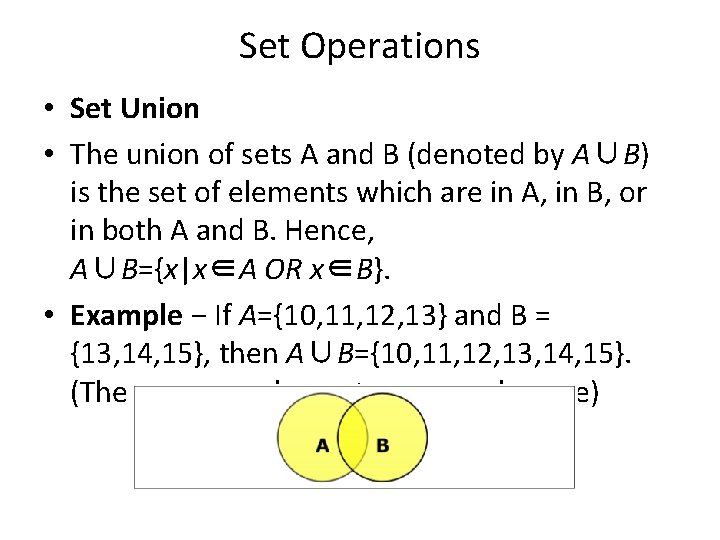
Set Operations • Set Union • The union of sets A and B (denoted by A∪B) is the set of elements which are in A, in B, or in both A and B. Hence, A∪B={x|x∈A OR x∈B}. • Example − If A={10, 11, 12, 13} and B = {13, 14, 15}, then A∪B={10, 11, 12, 13, 14, 15}. (The common element occurs only once)
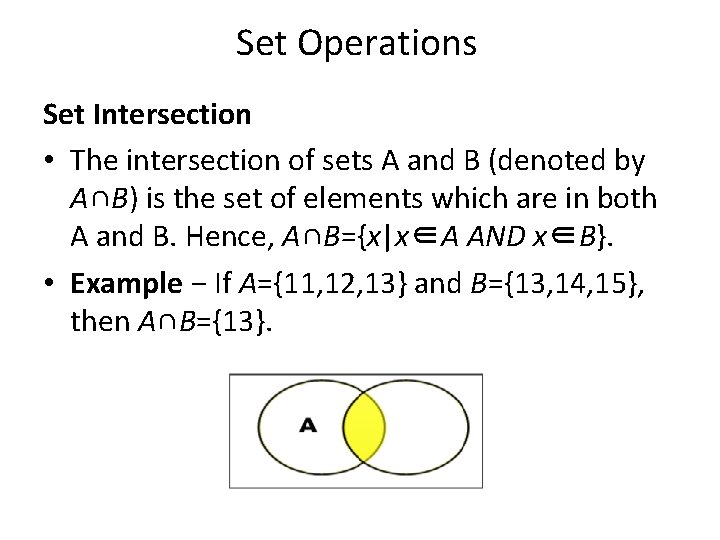
Set Operations Set Intersection • The intersection of sets A and B (denoted by A∩B) is the set of elements which are in both A and B. Hence, A∩B={x|x∈A AND x∈B}. • Example − If A={11, 12, 13} and B={13, 14, 15}, then A∩B={13}.
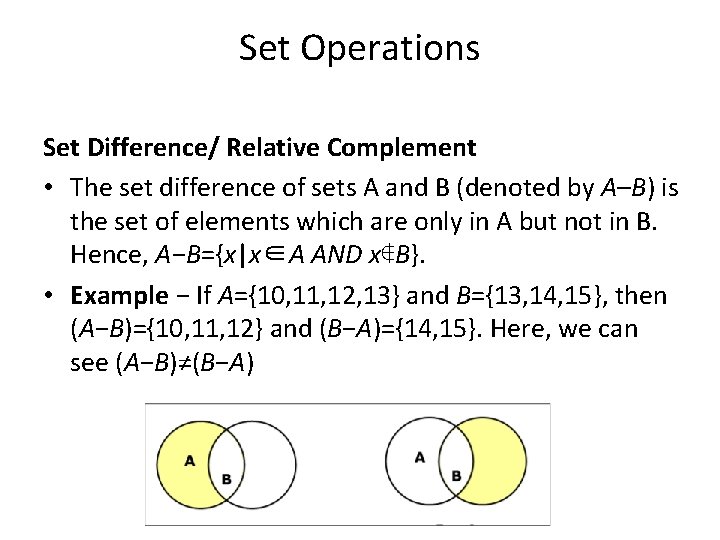
Set Operations Set Difference/ Relative Complement • The set difference of sets A and B (denoted by A–B) is the set of elements which are only in A but not in B. Hence, A−B={x|x∈A AND x∉B}. • Example − If A={10, 11, 12, 13} and B={13, 14, 15}, then (A−B)={10, 11, 12} and (B−A)={14, 15}. Here, we can see (A−B)≠(B−A)
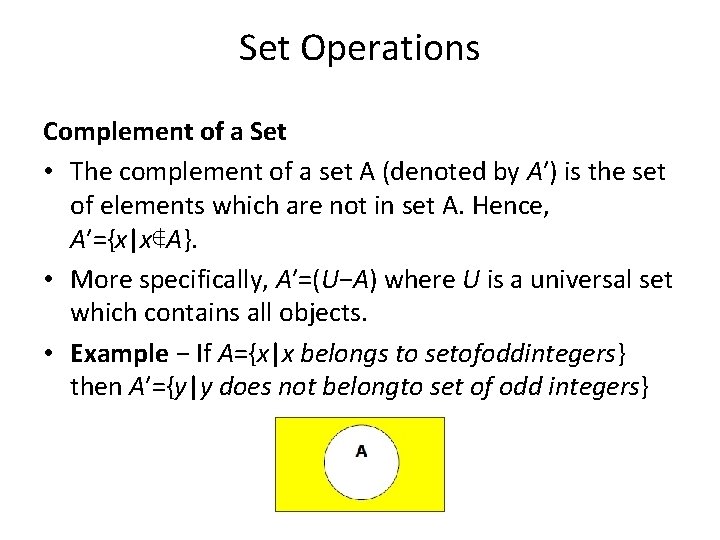
Set Operations Complement of a Set • The complement of a set A (denoted by A′) is the set of elements which are not in set A. Hence, A′={x|x∉A}. • More specifically, A′=(U−A) where U is a universal set which contains all objects. • Example − If A={x|x belongs to setofoddintegers} then A′={y|y does not belongto set of odd integers}
Set Operations Cartesian Product / Cross Product • The Cartesian product of n number of sets A 1, A 2, …An denoted as A 1×A 2⋯×An can be defined as all possible ordered pairs (x 1, x 2, …xn) where x 1∈A 1, x 2∈A 2, …xn∈An • Example − If we take two sets A={a, b} and B={1, 2}, • The Cartesian product of A and B is written as − A×B={(a, 1), (a, 2), (b, 1), (b, 2)} • The Cartesian product of B and A is written as − B×A={(1, a), (1, b), (2, a), (2, b)}
cardinality of set • Cardinality of a set S, denoted by |S|, is the number of elements of the set. The number is also referred as the cardinal number. If a set has an infinite number of elements, its cardinality is ∞. • Example − |{1, 4, 3, 5}|=4, |{1, 2, 3, 4, 5, …}|=∞ • If there are two sets X and Y, • |X|=|Y| denotes two sets X and Y having same cardinality. It occurs when the number of elements in X is exactly equal to the number of elements in Y. In this case, there exists a bijective function ‘f’ from X to Y. • |X|≤|Y| denotes that set X’s cardinality is less than or equal to set Y’s cardinality. It occurs when number of elements in X is less than or equal to that of Y. Here, there exists an injective function ‘f’ from X to Y. • |X|<|Y| denotes that set X’s cardinality is less than set Y’s cardinality. It occurs when number of elements in X is less than that of Y. Here, the function ‘f’ from X to Y is injective function but not bijective. • If |X|≤|Y| and |X|≥|Y| then |X|=|Y|. The sets X and Y are commonly referred as equivalent sets.
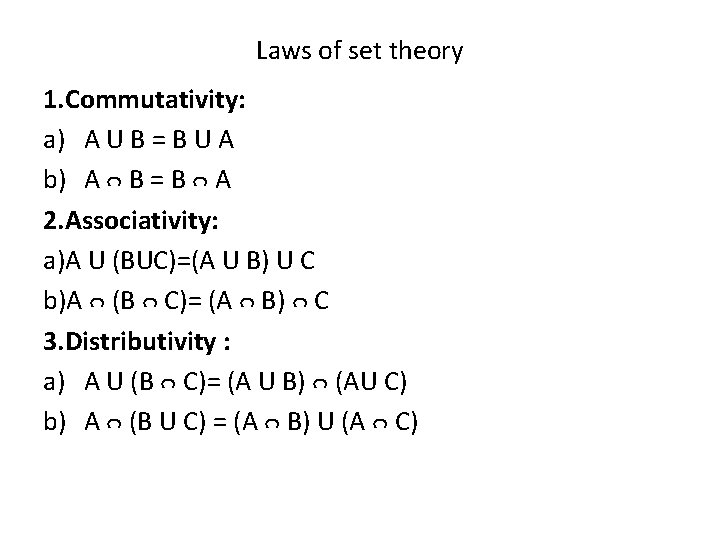
Laws of set theory 1. Commutativity: a) A U B = B U A b) A ᴒ B = B ᴒ A 2. Associativity: a)A U (BUC)=(A U B) U C b)A ᴒ (B ᴒ C)= (A ᴒ B) ᴒ C 3. Distributivity : a) A U (B ᴒ C)= (A U B) ᴒ (AU C) b) A ᴒ (B U C) = (A ᴒ B) U (A ᴒ C)
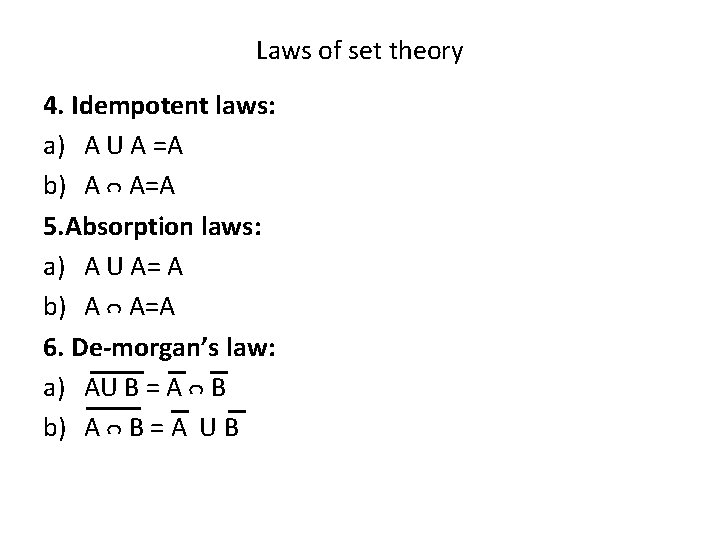
Laws of set theory 4. Idempotent laws: a) A U A =A b) A ᴒ A=A 5. Absorption laws: a) A U A= A b) A ᴒ A=A 6. De-morgan’s law: a) AU B = A ᴒ B b) A ᴒ B = A U B