
Unit 1 Invertebrates Introduction Topic Taxonomic Significance of

Unit 1: Invertebrates Introduction Topic : Taxonomic Significance of Invertebrates B. Ed (Hons) Secondary Semester IV Subject: Biology IV(Minor) Course Title: Invertebrates Diversity Represented By: Ms Sidra. Younis Department of Education (Planning and Development) Lahore College for Women University , Lahore
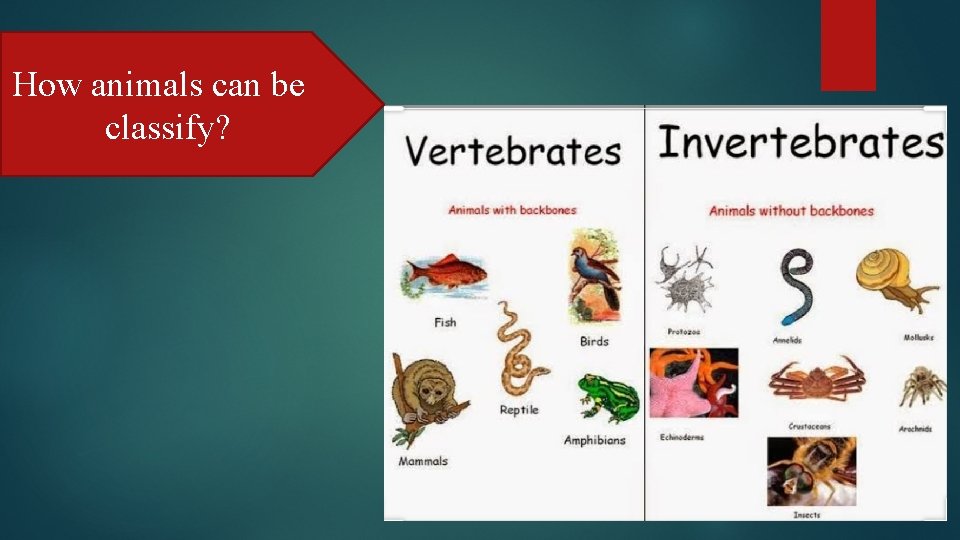
How animals can be classify?
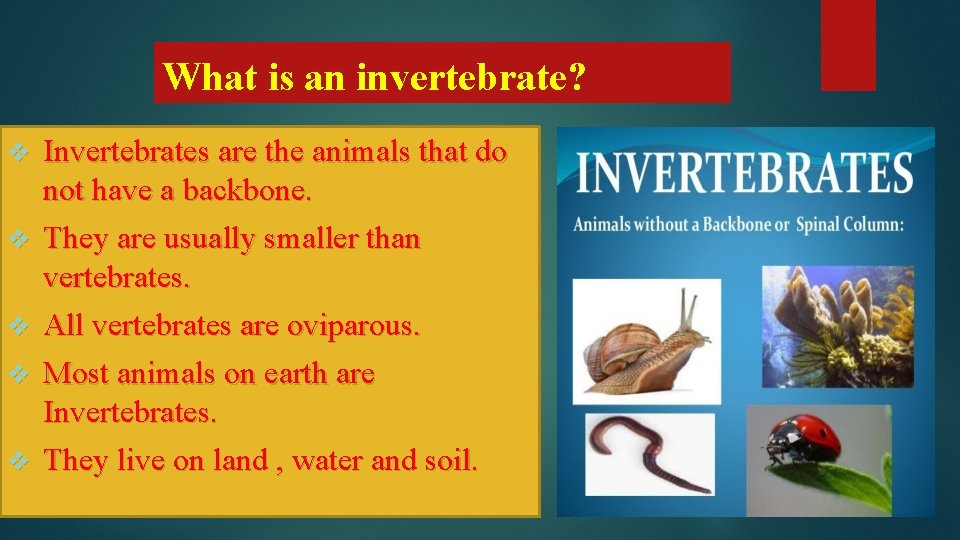
What is an invertebrate? Invertebrates are the animals that do not have a backbone. v They are usually smaller than vertebrates. v All vertebrates are oviparous. v Most animals on earth are Invertebrates. v They live on land , water and soil. v
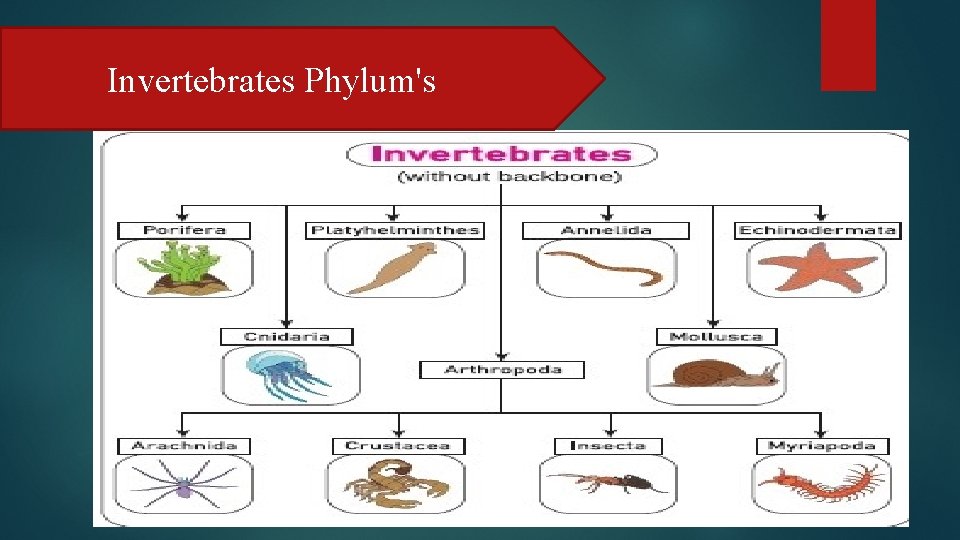
Invertebrates Phylum's
What do Invertebrates eat? Not all Invertebrates eat same food Herbivores eat only plants. Carnivores eat other animals. Omnivores eat both plants and animals.
Which Animals are Invertebrates? The groups of invertebrates include: Jellyfish Sea anemones , Flatworms , Roundworms , Segmented worms , Mollusks , Starfish, Sea Urchins and Arthropods
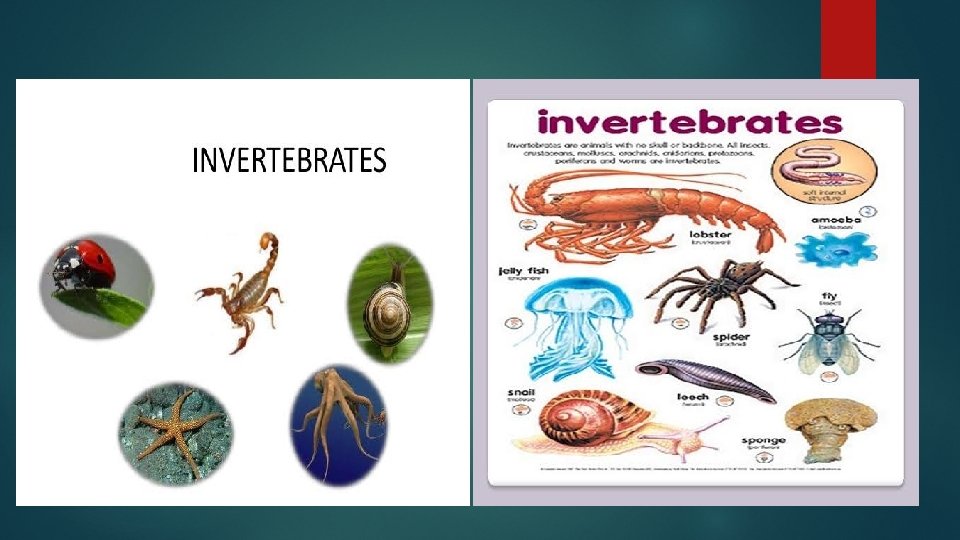
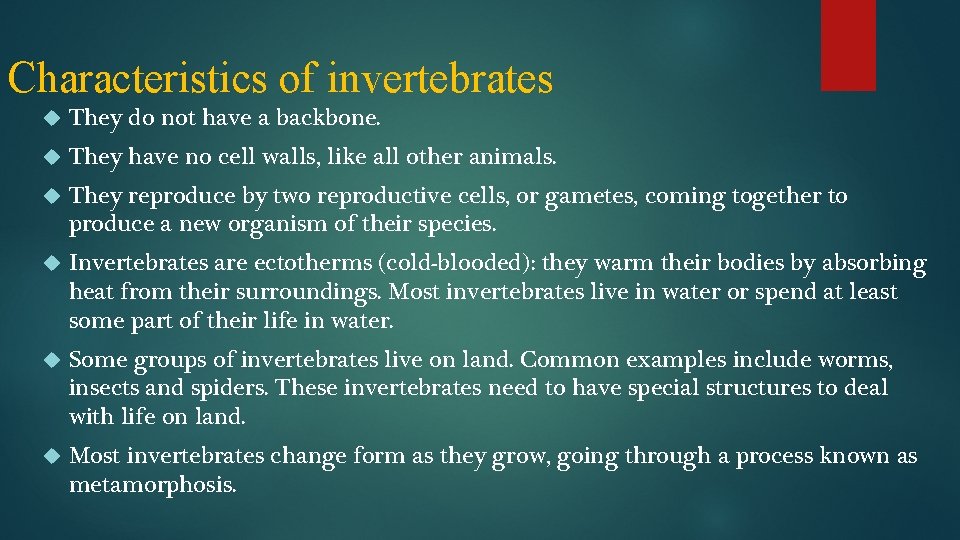
Characteristics of invertebrates They do not have a backbone. They have no cell walls, like all other animals. They reproduce by two reproductive cells, or gametes, coming together to produce a new organism of their species. Invertebrates are ectotherms (cold-blooded): they warm their bodies by absorbing heat from their surroundings. Most invertebrates live in water or spend at least some part of their life in water. Some groups of invertebrates live on land. Common examples include worms, insects and spiders. These invertebrates need to have special structures to deal with life on land. Most invertebrates change form as they grow, going through a process known as metamorphosis.
What is taxonomy? Taxonomy is the classification of something especially organisms. It is the process of naming and classifying animals and plants into groups within a larger system according to their similarities and differences.
Why taxonomy is important? Taxonomy helps us to categorize organisms so we can more easily communicate biological information. Taxonomy uses hierarchical classification as a way to help scientists understand an organize the diversity of life on our planet.
TAXONOMIC SIGNIFICANCE According to this understanding, invertebrates do not possess a skeleton or bone, either internal or external. They include hugely varied body plans. Many have fluid filled, hydrostatic skeletons, like jellyfish or worms. Others have hard exoskeletons, outer shells like those of insects and crustaceans. The most familiar invertebrates include the Protozoa, Porifera, Coelenterate, Platyhelminthes, Nematoda, Annelida, Mollusca, Arthropod and Echinodermata.
CONT … The term invertebrates is not always precise among non-biologists since it does not accurately describe a taxon in the same way that Arthropoda, Vertebrata or Manidae do. Each of these terms describes a valid, Taxon, Phylum, Subphylum or Family. "Invertebrata" is a term of convenience, not a Taxon; it has very little circumscriptional significance except within the Chordata.
CONT …. . Despite this, the concept of invertebrates as a Taxon of animals has persisted for over a century among within the zoological community and in its literature it remains in use as a term of convenience for animals that are not members of the Vertebrata.
v Lamark theory : Lamarck is best known for his Theory of “Inheritance of Acquired Characteristics” first presented in 1801 (Darwin's first book dealing with “Natural Selection” was published in 1859): If an organism changes during life in order to adapt to its environment, those changes are passed on to its offspring. He said that change is made by what the organisms want or need.
For Example , Lamarck believed that elephants all used to have short trunks. When there was no food or water that they could reach with their short trunks, they stretched their trunks to reach the water and branches, and their offspring inherited long trunks. Lamarck also said that body parts that are not being used, such as the human appendix and little toes are gradually disappearing. Eventually, people will be born without these parts.
v Darwin theory : Darwin believed that the desires of animals have nothing to do with how they evolve, and that changes in an organism during its life do not affect the evolution of the species. He said that organisms, even of the same species, are all different and that those which happen to have variations that help them to survive in their environments survive and have more offspring.
The offspring are born with their parents' helpful traits, and as they reproduce, individuals with that trait make up more of the population. Other individuals, that are not so well adapted, die off. Most elephants used to have short trunks, but some had longer trunks. When there was no food or water that they could reach with their short trunks, the ones with short trunks died off, and the ones with long trunks survived. Eventually, all of the elephants had long trunks. Darwin also believed that evolution does not happen according to any sort of plan
Significance of the group Invertebrates are animals that neither possess nor develop a vertebral column (commonly known as a backbone or spine), derived from the notochord. Over 90% of all species on Earth are invertebrates, and invertebrate species have been found in the fossil record as far back as 600 million years ago. Molecular Biology studies suggest that all invertebrates evolved from a single invertebrate group. Some invertebrates help to clear and clean up the environment by eating away fungi and bacteria, or decaying and dead matter, including things which we would find unpleasant or unhygienic.
Cont …. . Invertebrates feed on other invertebrates, but they are also a vital source of food for birds, fish and animals. Some of these are in turn eaten by many humans. Some species of invertebrates are brilliant aerators of soil as well as creating it. In other words, invertebrates not only help us to grow food crops through pollination, they help create and maintain soil quality. This is important for growing in agriculture, as well as in gardens and allotments. It is consider that the vast majority of invertebrate species are important to biodiversity.
- Slides: 19