
Unit 1 Invertebrates Introduction Topic Invertebrates Definition and
Unit 1: Invertebrates Introduction Topic: Invertebrates Definition and Characteristics B. Ed (Hons) Secondary Semester IV Subject: Biology IV(minor) Course Title: Invertebrates Diversity Represented By: Ms Sidra Younis Department of Education(Planning and Development) Lahore College for Women University, Lahore
LEARNING OUTCOMES After this chapter students become enable to, • Explain the characteristics and classification of invertebrates. • Understand the taxonomic significance of the group. • Describe the variety of invertebrates organisms. • Explain their evolutionary origin and diversification.
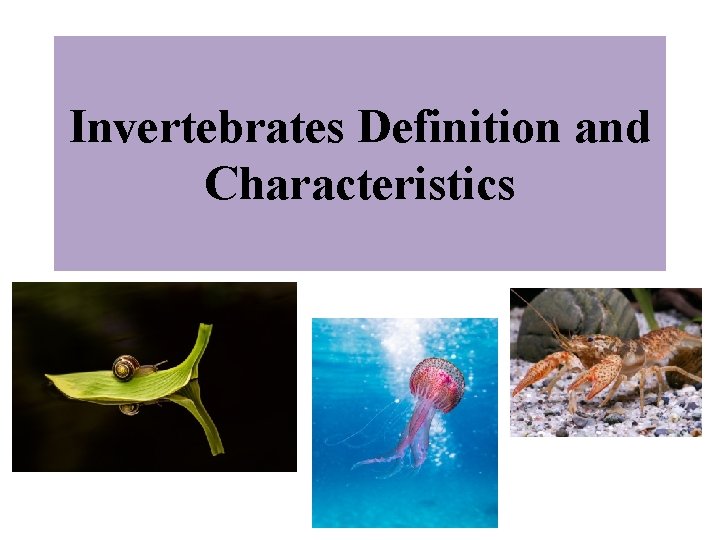
Invertebrates Definition and Characteristics
INVERTEBRATES INTRODUCTION • Invertebrates are animals that don’t have a backbone. The vertebral column is another name for the backbone. Over 90% of all species on Earth are invertebrates, and invertebrate species have been found in the fossil record as far back as 600 million years ago. Molecular biology studies suggest that all in vertebra.
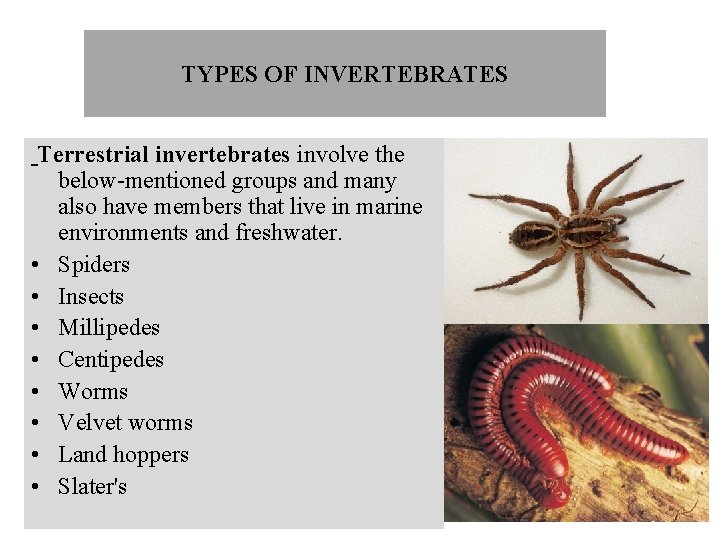
TYPES OF INVERTEBRATES Terrestrial invertebrates involve the below-mentioned groups and many also have members that live in marine environments and freshwater. • Spiders • Insects • Millipedes • Centipedes • Worms • Velvet worms • Land hoppers • Slater's
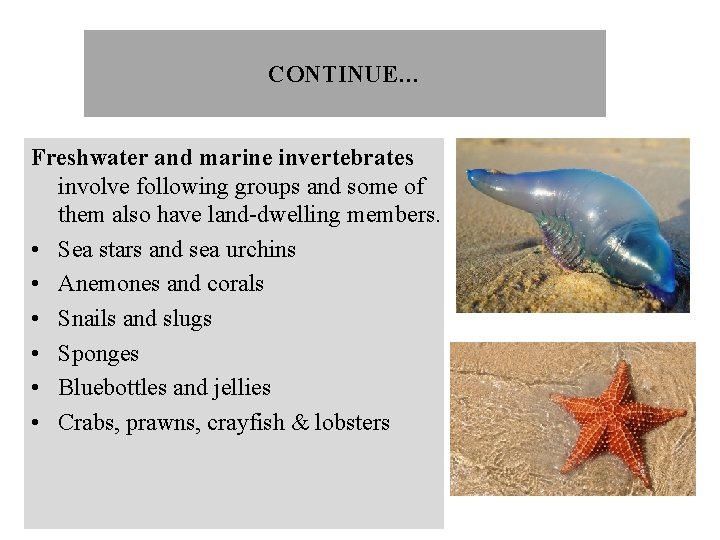
CONTINUE… Freshwater and marine invertebrates involve following groups and some of them also have land-dwelling members. • Sea stars and sea urchins • Anemones and corals • Snails and slugs • Sponges • Bluebottles and jellies • Crabs, prawns, crayfish & lobsters
CHARACTERISTICS OF INVERTEBRATES HABITAT: • Terrestrial (land-dwelling) Invertebrates are animals that lack a vertebral column (backbone). Insects are the most common invasive terrestrial invertebrate, but it also includes other arthropods, mollusks (such as snails and slugs), and nematodes (roundworms). • Marine invertebrates are the invertebrates that live in marine habitats. Marine habitats are habitats that support marine life. Marine life depends in some way on the saltwater that is in the sea. A habitat is an ecological or environmental area inhabited by one or more living species. The marine environment supports many kinds of these habitats.
NUMERICAL STRENGTH § At present nearly one million living species of animals are known out of which about 95 per cent constitute the invertebrates. § It has been estimated that the number of extinct species is around seven times the number of living species and, therefore, there may have been some seven million species. Among 1. 25 million animal species, 95% (1. 2 million) are invertebrates. § Among 1. 2 million invertebrates, 1 million are Arthropods.
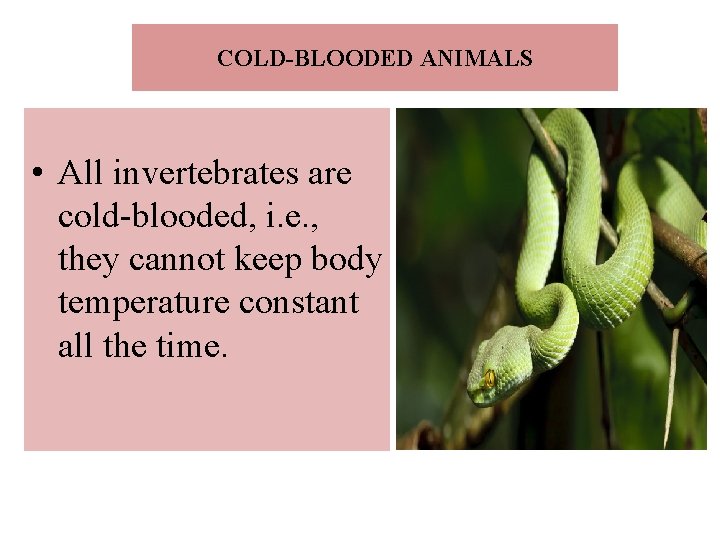
COLD-BLOODED ANIMALS • All invertebrates are cold-blooded, i. e. , they cannot keep body temperature constant all the time.
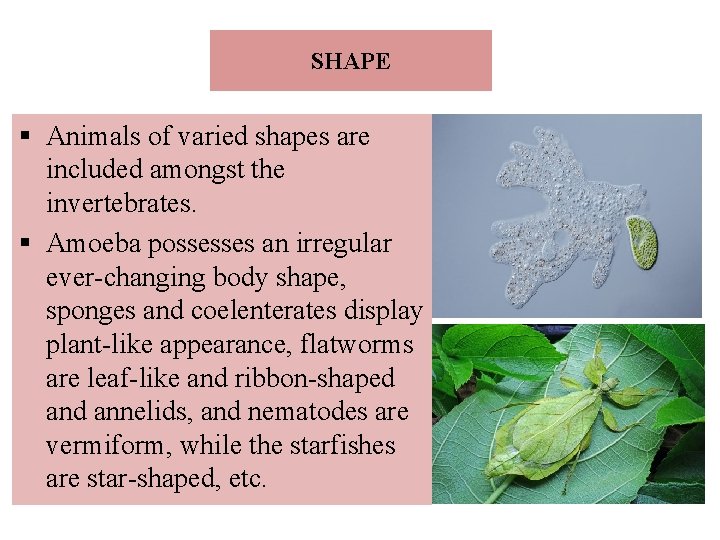
SHAPE § Animals of varied shapes are included amongst the invertebrates. § Amoeba possesses an irregular ever-changing body shape, sponges and coelenterates display plant-like appearance, flatworms are leaf-like and ribbon-shaped annelids, and nematodes are vermiform, while the starfishes are star-shaped, etc.
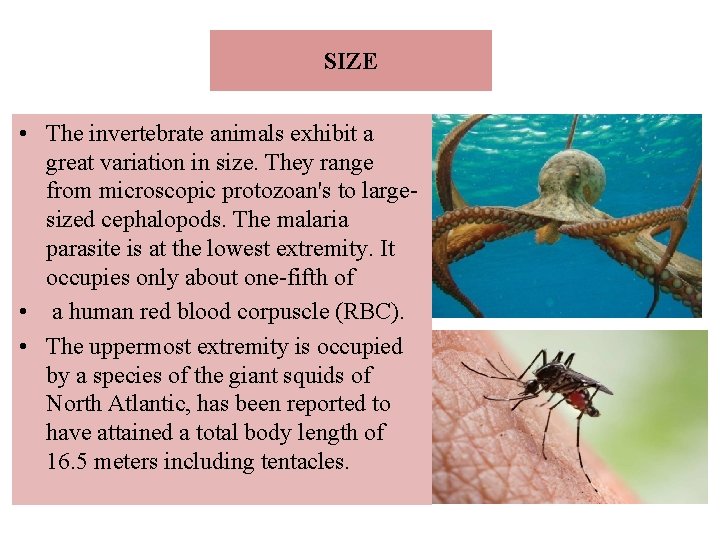
SIZE • The invertebrate animals exhibit a great variation in size. They range from microscopic protozoan's to largesized cephalopods. The malaria parasite is at the lowest extremity. It occupies only about one-fifth of • a human red blood corpuscle (RBC). • The uppermost extremity is occupied by a species of the giant squids of North Atlantic, has been reported to have attained a total body length of 16. 5 meters including tentacles.
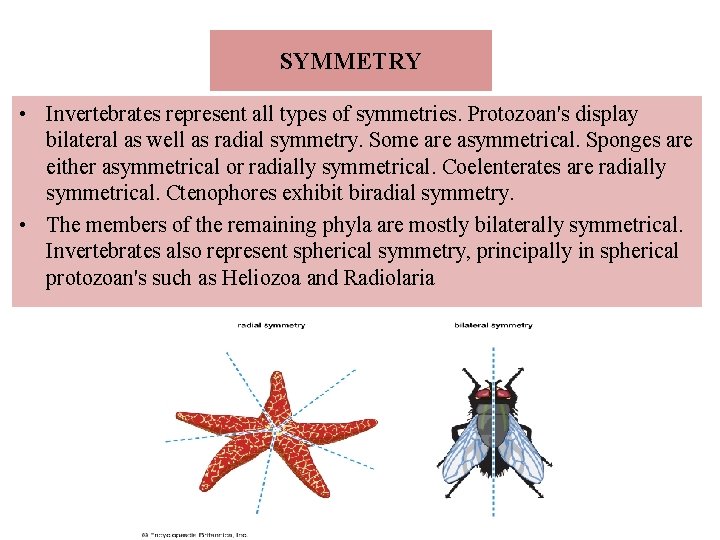
SYMMETRY • Invertebrates represent all types of symmetries. Protozoan's display bilateral as well as radial symmetry. Some are asymmetrical. Sponges are either asymmetrical or radially symmetrical. Coelenterates are radially symmetrical. Ctenophores exhibit biradial symmetry. • The members of the remaining phyla are mostly bilaterally symmetrical. Invertebrates also represent spherical symmetry, principally in spherical protozoan's such as Heliozoa and Radiolaria
GRADES OF ORGANIZATION • Invertebrates display all grades of organization. The protoplasmic grade is seen in Protozoa, as all activities at this level are carried on within the limits of plasma membrane (plasma lemma). • The cellular grade is characteristic of sponges. In sponges only, the cells exhibit division of labour for performing various specialized functions. The cell-tissue grade is observed in coelenterates as their cells are not only specialized for different functions but also certain similar cells gather together to form tissues as well
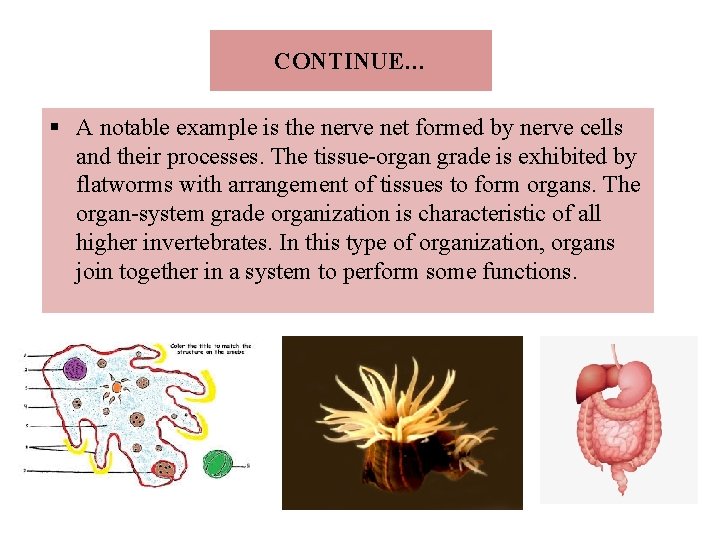
CONTINUE… § A notable example is the nerve net formed by nerve cells and their processes. The tissue-organ grade is exhibited by flatworms with arrangement of tissues to form organs. The organ-system grade organization is characteristic of all higher invertebrates. In this type of organization, organs join together in a system to perform some functions.
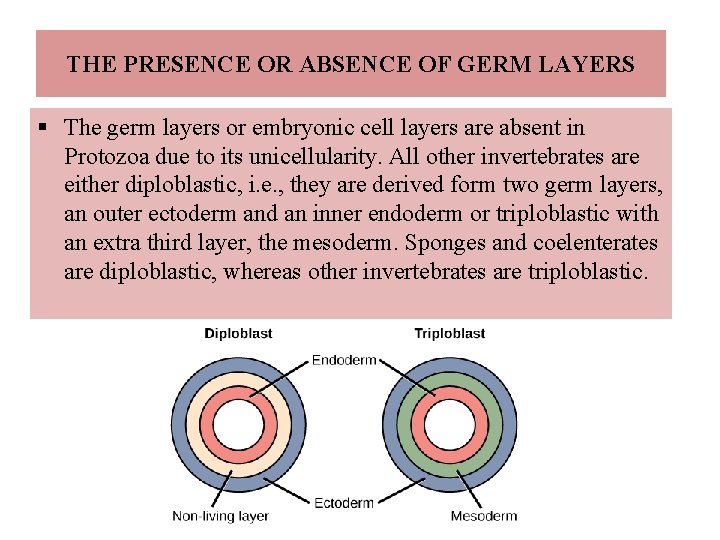
THE PRESENCE OR ABSENCE OF GERM LAYERS § The germ layers or embryonic cell layers are absent in Protozoa due to its unicellularity. All other invertebrates are either diploblastic, i. e. , they are derived form two germ layers, an outer ectoderm and an inner endoderm or triploblastic with an extra third layer, the mesoderm. Sponges and coelenterates are diploblastic, whereas other invertebrates are triploblastic.
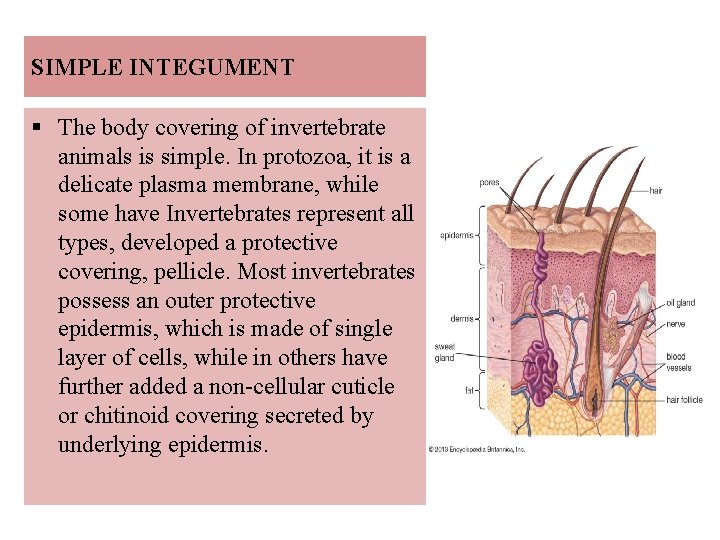
SIMPLE INTEGUMENT § The body covering of invertebrate animals is simple. In protozoa, it is a delicate plasma membrane, while some have Invertebrates represent all types, developed a protective covering, pellicle. Most invertebrates possess an outer protective epidermis, which is made of single layer of cells, while in others have further added a non-cellular cuticle or chitinoid covering secreted by underlying epidermis.
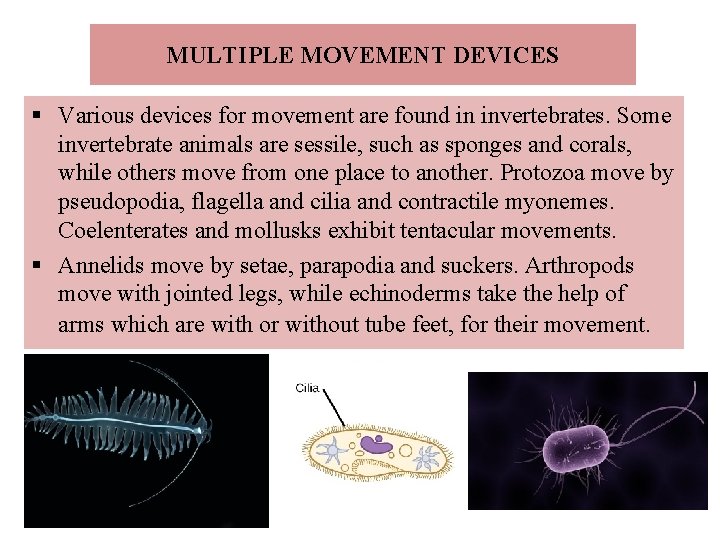
MULTIPLE MOVEMENT DEVICES § Various devices for movement are found in invertebrates. Some invertebrate animals are sessile, such as sponges and corals, while others move from one place to another. Protozoa move by pseudopodia, flagella and cilia and contractile myonemes. Coelenterates and mollusks exhibit tentacular movements. § Annelids move by setae, parapodia and suckers. Arthropods move with jointed legs, while echinoderms take the help of arms which are with or without tube feet, for their movement.
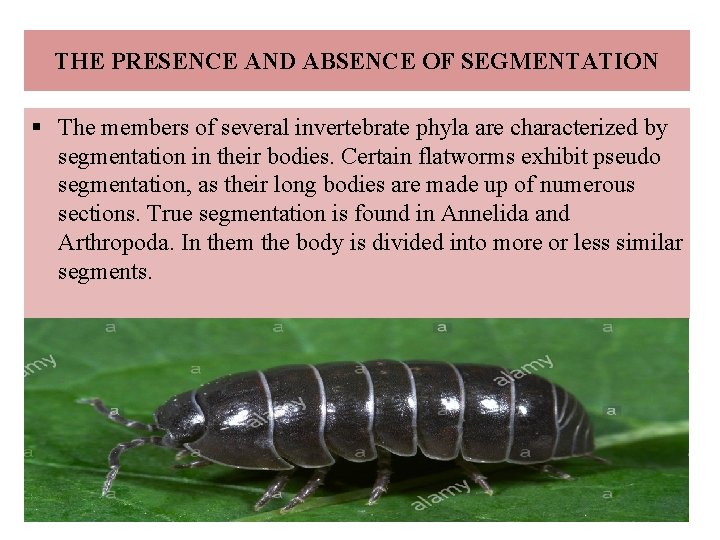
THE PRESENCE AND ABSENCE OF SEGMENTATION § The members of several invertebrate phyla are characterized by segmentation in their bodies. Certain flatworms exhibit pseudo segmentation, as their long bodies are made up of numerous sections. True segmentation is found in Annelida and Arthropoda. In them the body is divided into more or less similar segments.
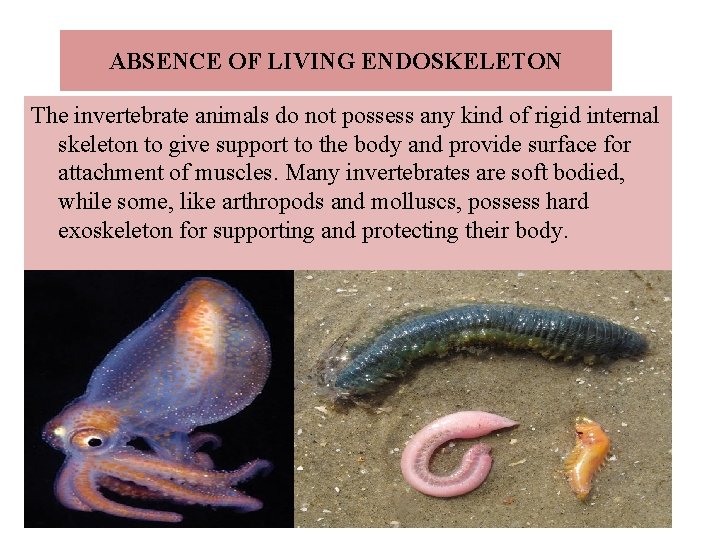
ABSENCE OF LIVING ENDOSKELETON The invertebrate animals do not possess any kind of rigid internal skeleton to give support to the body and provide surface for attachment of muscles. Many invertebrates are soft bodied, while some, like arthropods and molluscs, possess hard exoskeleton for supporting and protecting their body.
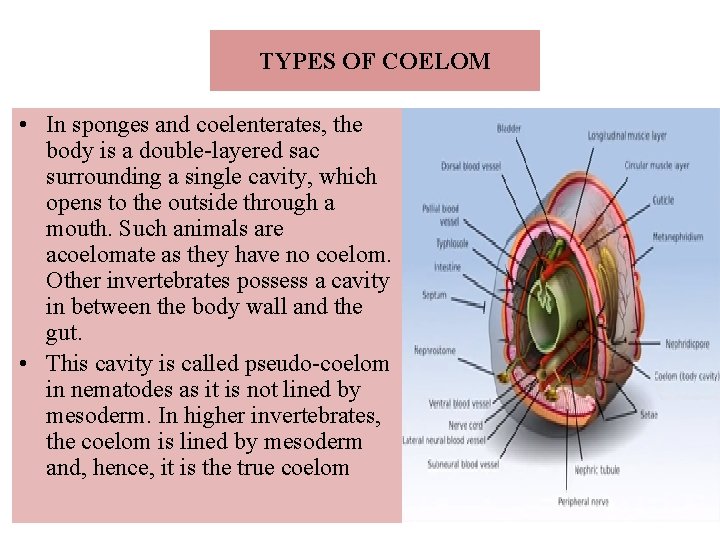
TYPES OF COELOM • In sponges and coelenterates, the body is a double-layered sac surrounding a single cavity, which opens to the outside through a mouth. Such animals are acoelomate as they have no coelom. Other invertebrates possess a cavity in between the body wall and the gut. • This cavity is called pseudo-coelom in nematodes as it is not lined by mesoderm. In higher invertebrates, the coelom is lined by mesoderm and, hence, it is the true coelom
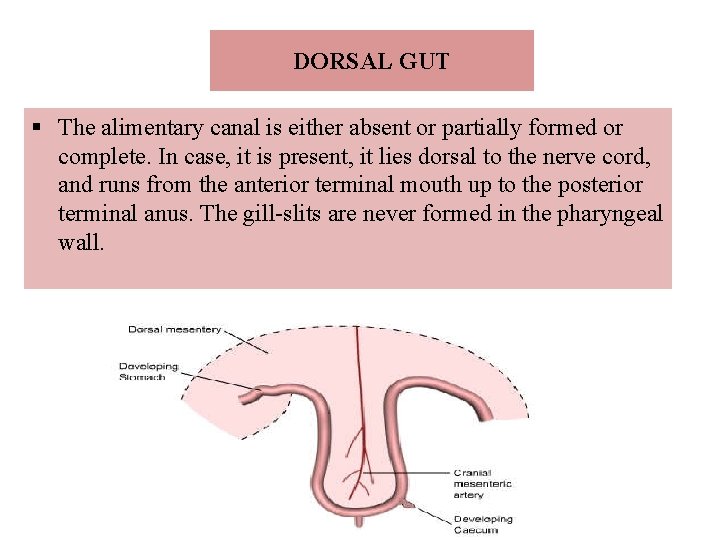
DORSAL GUT § The alimentary canal is either absent or partially formed or complete. In case, it is present, it lies dorsal to the nerve cord, and runs from the anterior terminal mouth up to the posterior terminal anus. The gill-slits are never formed in the pharyngeal wall.
INTRA-AS WELL AS EXTRACELLULAR DIGESTION § In invertebrates, the digestion of food takes place within the cell (intracellular digestion) as well as outside the cell (extracellular digestion). In protozoan's and sponges, the digestion of food takes place intracellularly. § In coelenterates, the digestion of food lakes place both intracellularly as well as extracellularly. All other invertebrates exhibit extracellular digestion, which in higher invertebrates occurs within a well defined gut.
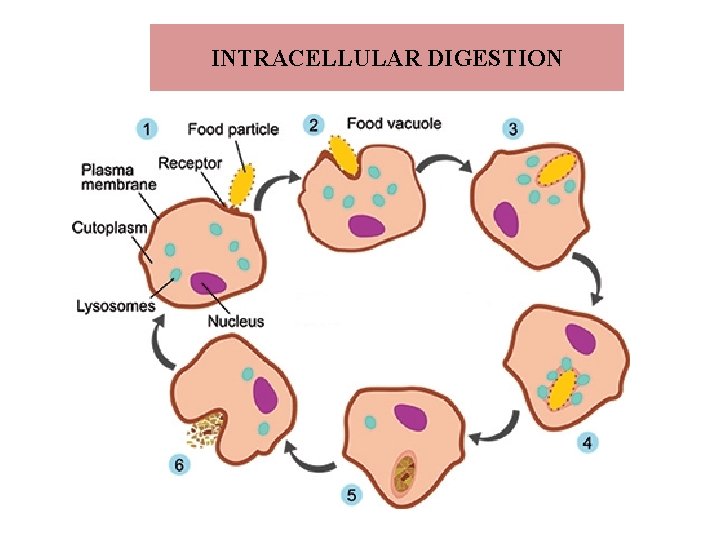
INTRACELLULAR DIGESTION
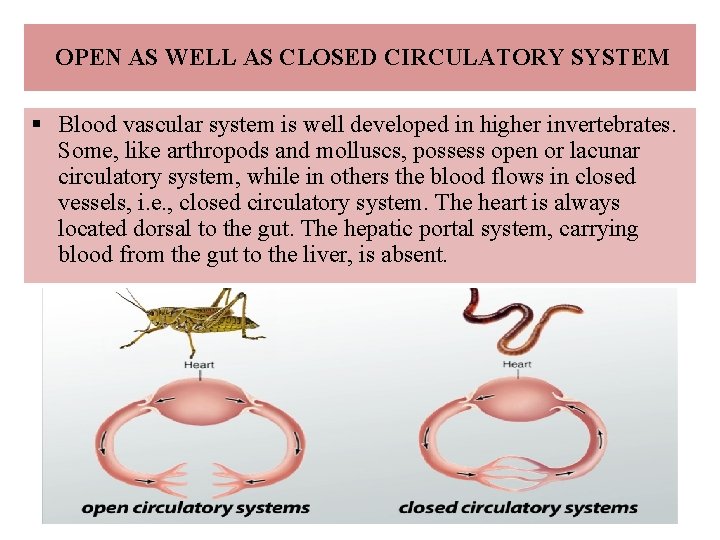
OPEN AS WELL AS CLOSED CIRCULATORY SYSTEM § Blood vascular system is well developed in higher invertebrates. Some, like arthropods and molluscs, possess open or lacunar circulatory system, while in others the blood flows in closed vessels, i. e. , closed circulatory system. The heart is always located dorsal to the gut. The hepatic portal system, carrying blood from the gut to the liver, is absent.
DIVERSIFIED EXCRETORY MECHANISM • In protozoan's, sponges and coelenterates, excretion is performed by direct diffusion through cell membranes. Flatworms possess characteristic flame cells, while annelids and molluscs possess true nephridia for the purpose. In insects, the excretory organs are Malpighian tubules. Echinoderms and some other invertebrates have amoeboid cells or phagocytes for storage and disposal of excretory products to outside
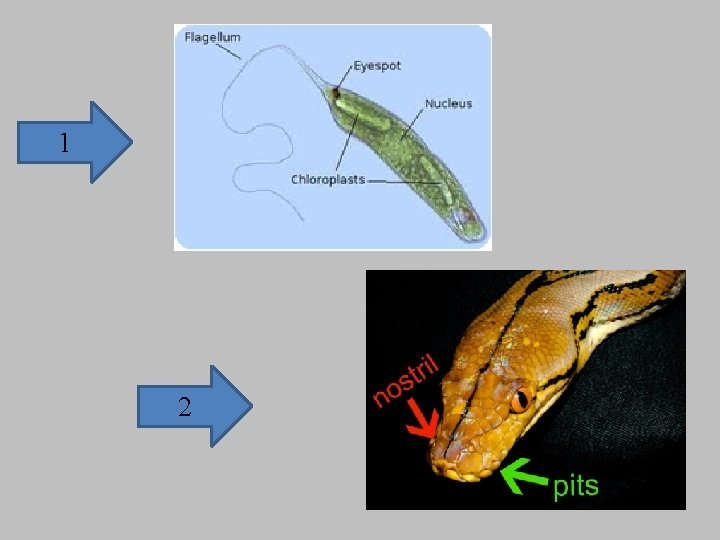
SIMPLE SENSE ORGAN • In protozoan's, the whole of the protoplasm acts as receptor, while in flagellates, the stigma or eyespot acts as a photoreceptor. Coelenterates possess long sensory cells, scattered throughout the body wall, while some also possess eyespots for the reception of light, statocysts for equilibrium and sensory pits for chemoreception. • Eyespots and chemoreceptors are also found in flatworms. Annelids possess various sensory receptors including simple eyes, present in the epidermis. In arthropods, compound eyes are found in addition to simple eyes. Statocysts for equilibrium; tactile receptors and chemoreceptors are common in arthropods and molluscs
1 2
VARIED MODES OF REPRODUCTION • In invertebrates, the Arthropods have compound eyes, modes of reproduction vary from simple asexual binary fission to most complicated sexual reproduction. In certain cases, parthenogenesis has also been observed in which an unfertilized egg develops into a complete individual. It occurs in rotifers, bees, some other insects and certain crustaceans. • In sexually reproducing invertebrates, hermaphrodites or bisexual forms are found, particularly in coelenterates, platyhelminthes, annelids and crustaceans. Fertilization is either external or internal. Development is direct or indirect. In the indirect development, the development includes both larval stages and metamorphosis
SUMMARY • Invertebrates are the animals that lack backbone. • They are of different types according to the habitat where they live. • They may be Aquatic (fresh water and marine) or terrestrial. • They vary in shape and size also they lack endoskeleton so they are called soft boded animals. • They move wit the help of different functional organs i. e Flagella, pseudopodia and cilia etc. • They are cold blooded animals which means that they cannot maintain their body temperature constantly. • Their modes of reproduction also vary.
- Slides: 29