
Unit 1 Introduction to the Railroad Industry Objective
Unit 1 Introduction to the Railroad Industry

Objective Describe how a typical railroad company is organized and the function of each of its major departments.
Objective Describe how to communicate with a railroad company and its employees.

Typical railroad administrative organization President Administrative Legal Marketing Operations Information Claims Engineering Public Relations Legal Mechanical Purchasing Transportation
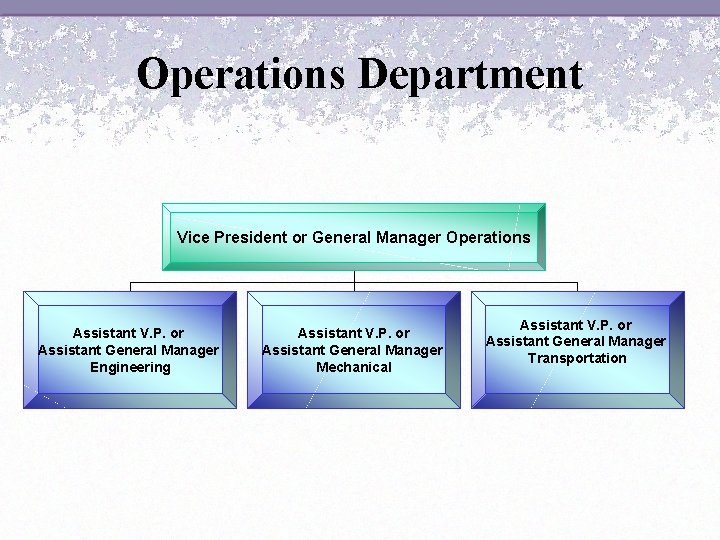
Operations Department Vice President or General Manager Operations Assistant V. P. or Assistant General Manager Engineering Assistant V. P. or Assistant General Manager Mechanical Assistant V. P. or Assistant General Manager Transportation
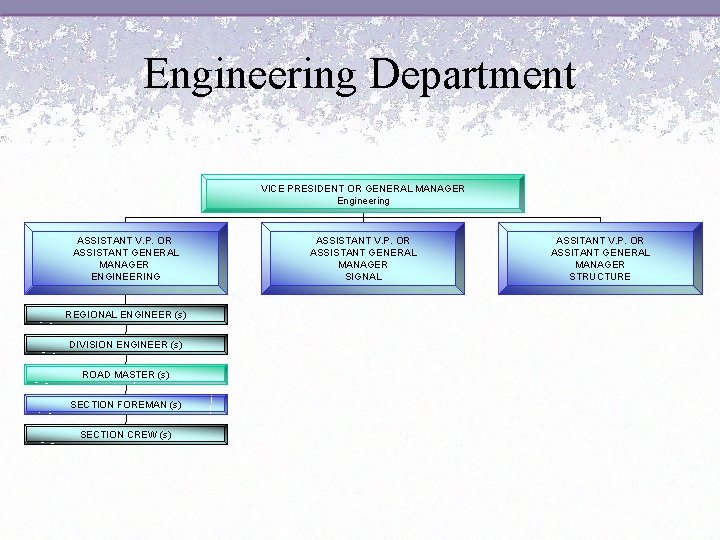
Engineering Department VICE PRESIDENT OR GENERAL MANAGER Engineering ASSISTANT V. P. OR ASSISTANT GENERAL MANAGER ENGINEERING REGIONAL ENGINEER (s) DIVISION ENGINEER (s) ROAD MASTER (s) SECTION FOREMAN (s) SECTION CREW (s) ASSISTANT V. P. OR ASSISTANT GENERAL MANAGER SIGNAL ASSITANT V. P. OR ASSITANT GENERAL MANAGER STRUCTURE
Mechanical • Headed by an Assistant V. P. or Assistant General Manager Mechanical • Responsible for maintenance and repair of all railroad rolling stock. . • Person in charge may be the Superintendent of Motive Power or Assistant General Manager of Locomotive Maintenance. • Shop Superintendent or General Foremen schedule and supervise maintenance of the railroad rolling stock.
Transportation • Headed by an Assistant V. P. or Assistant General Manager Transportation. • Schedules and monitors rolling stock and train movement. • Dispatchers, Train Masters and Traveling Engineers all work in this department.
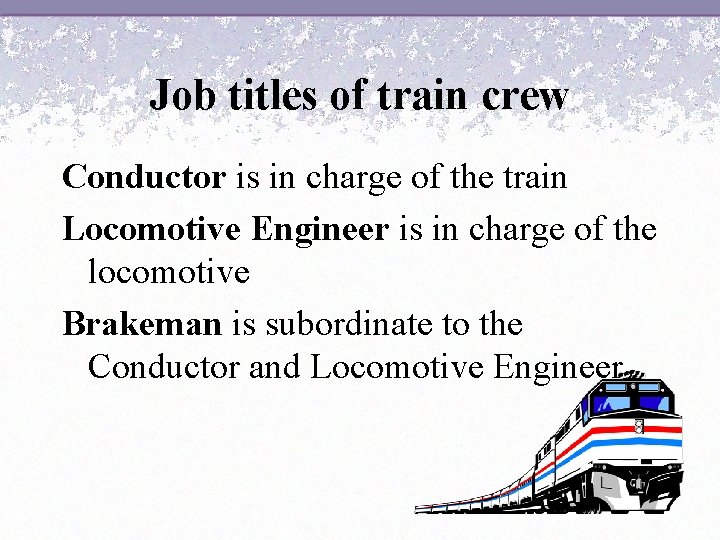
Job titles of train crew Conductor is in charge of the train Locomotive Engineer is in charge of the locomotive Brakeman is subordinate to the Conductor and Locomotive Engineer
Railroad Police Department
Communicating with a railroad company and its’ employees

Who to contact • • Section Crew Road Master Train Master Dispatchers Mechanical Foreman Signal Crew Train Crews • Regional or District Engineer • Regional or District Transportation Supervisor • Regional or District Mechanical Supervisor • Claims
Railroad Contacts • Personal visits with railroad employees • Telephone calls addressing railroad issues • Letters • Local / Division / Regional meetings between cooperative agencies and railroads Follow up in writing where necessary Keep communications ongoing and open
Review What are three major functions of the operations portion of a railroad?
Review Which function is responsible for the control of train movement from point A to point B? a. Dispatch b. Train master c. Section crew
Review If you needed help moving firefighters and equipment to a remote location on the track, who would you contact? a. Railroad Dispatch b. Road master c. Division Engineer
Review If you investigated a fire on the railroad right of way, and found that it was not the result of any train movement or maintenance activity, who should you have railroad dispatch notify? a. Mechanical b. Railroad police c. Section crew
Summary • Railroad organization varies from the simple to the very complex. • Successful interaction with a railroad requires you understand the railroad organization. • Successful communication and cooperation with a railroad begins before the fire starts.
Click to go back to master course unit list
- Slides: 20