
Unit 1 Introduction to the Health Social Care
- Slides: 21
Unit 1: Introduction to the Health & Social Care Sector 1
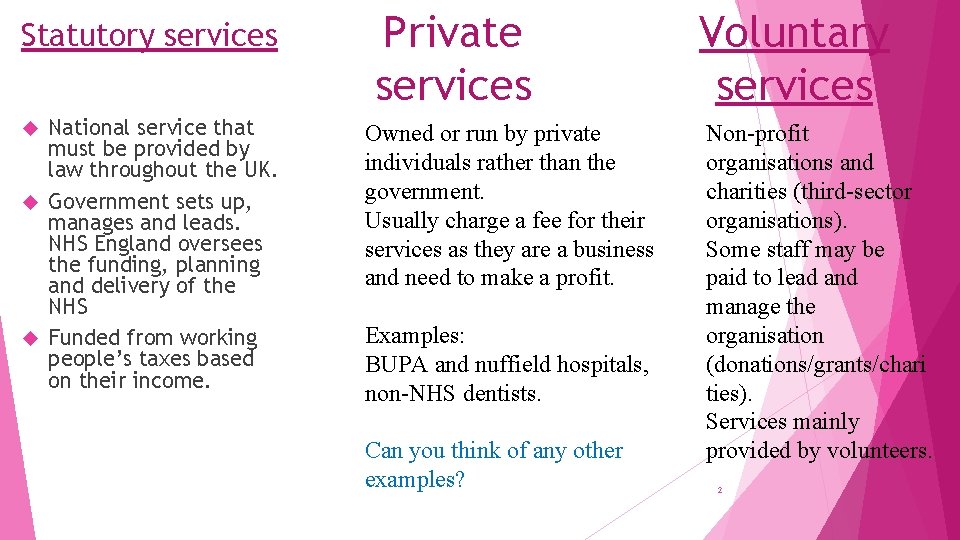
Statutory services National service that must be provided by law throughout the UK. Government sets up, manages and leads. NHS England oversees the funding, planning and delivery of the NHS Funded from working people’s taxes based on their income. Private services Owned or run by private individuals rather than the government. Usually charge a fee for their services as they are a business and need to make a profit. Examples: BUPA and nuffield hospitals, non-NHS dentists. Can you think of any other examples? Voluntary services Non-profit organisations and charities (third-sector organisations). Some staff may be paid to lead and manage the organisation (donations/grants/chari ties). Services mainly provided by volunteers. 2
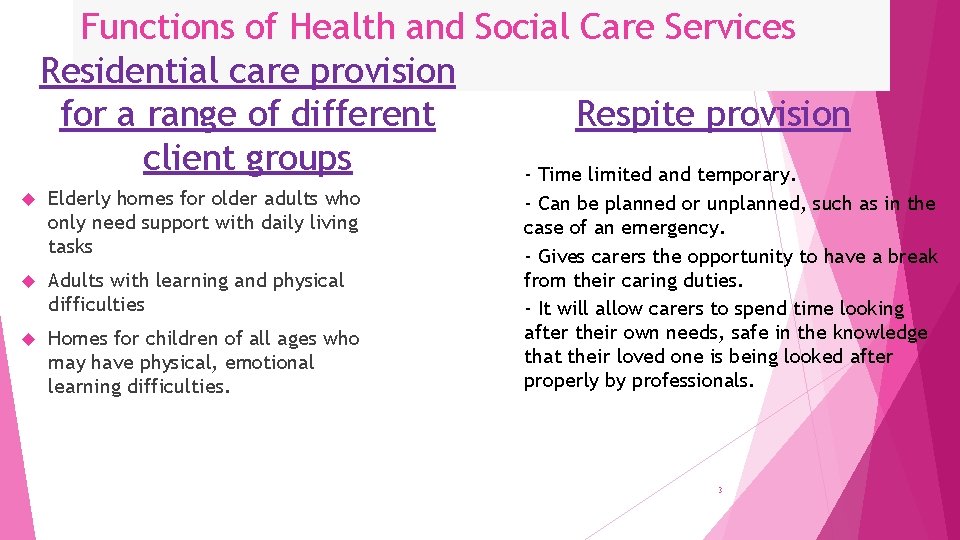
Functions of Health and Social Care Services Residential care provision for a range of different Respite provision client groups - Time limited and temporary. Elderly homes for older adults who only need support with daily living tasks Adults with learning and physical difficulties Homes for children of all ages who may have physical, emotional learning difficulties. - Can be planned or unplanned, such as in the case of an emergency. - Gives carers the opportunity to have a break from their caring duties. - It will allow carers to spend time looking after their own needs, safe in the knowledge that their loved one is being looked after properly by professionals. 3
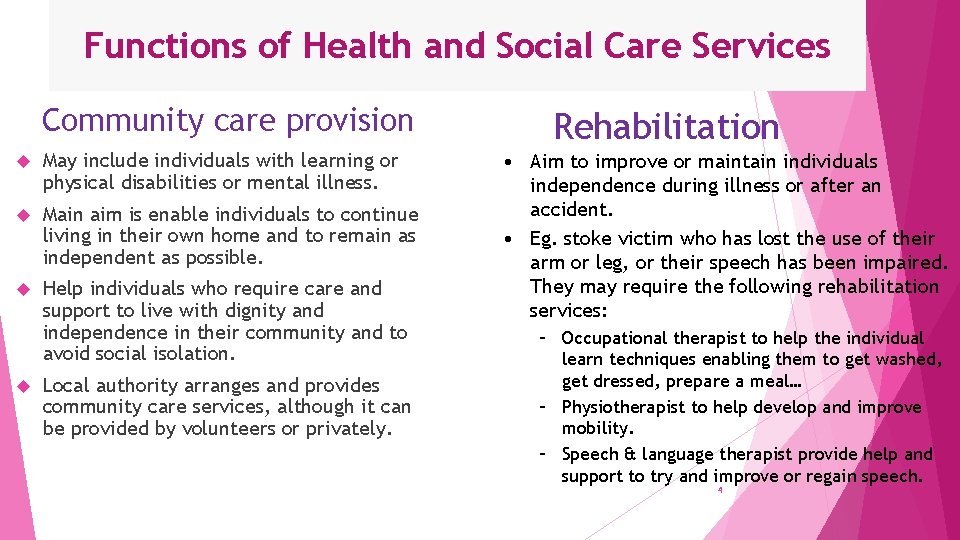
Functions of Health and Social Care Services Community care provision May include individuals with learning or physical disabilities or mental illness. Main aim is enable individuals to continue living in their own home and to remain as independent as possible. Help individuals who require care and support to live with dignity and independence in their community and to avoid social isolation. Local authority arranges and provides community care services, although it can be provided by volunteers or privately. Rehabilitation • Aim to improve or maintain individuals independence during illness or after an accident. • Eg. stoke victim who has lost the use of their arm or leg, or their speech has been impaired. They may require the following rehabilitation services: – Occupational therapist to help the individual learn techniques enabling them to get washed, get dressed, prepare a meal… – Physiotherapist to help develop and improve mobility. – Speech & language therapist provide help and support to try and improve or regain speech. 4
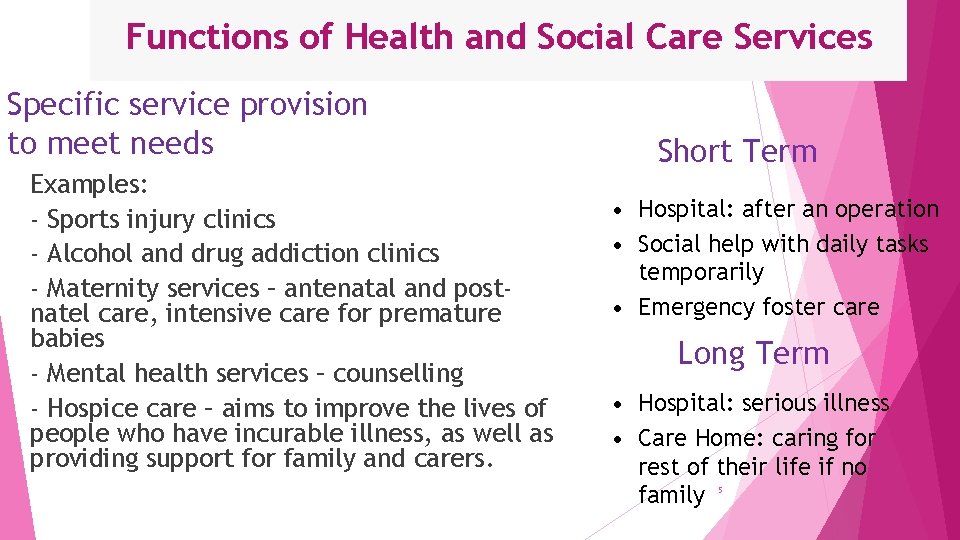
Functions of Health and Social Care Services Specific service provision to meet needs Examples: - Sports injury clinics - Alcohol and drug addiction clinics - Maternity services – antenatal and postnatel care, intensive care for premature babies - Mental health services – counselling - Hospice care – aims to improve the lives of people who have incurable illness, as well as providing support for family and carers. Short Term • Hospital: after an operation • Social help with daily tasks temporarily • Emergency foster care Long Term • Hospital: serious illness • Care Home: caring for rest of their life if no family 5
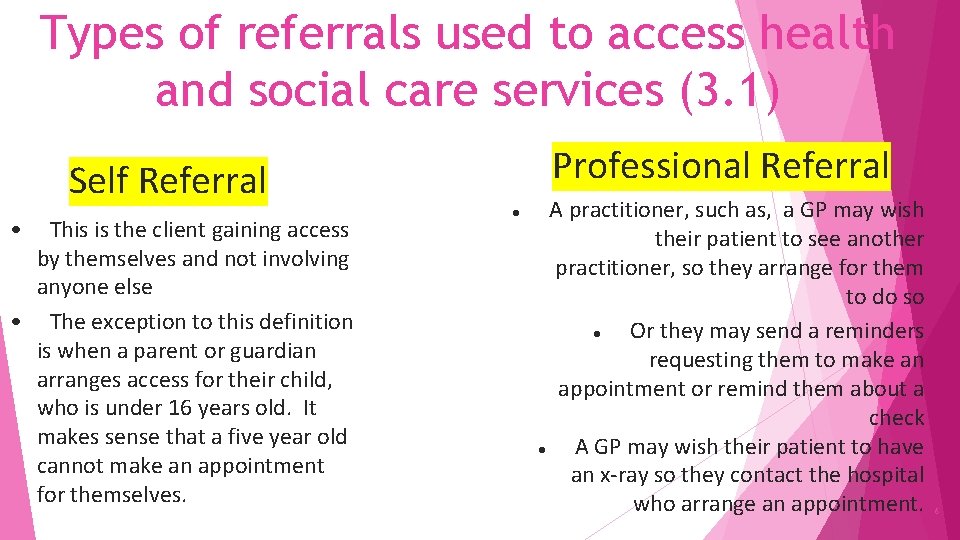
Types of referrals used to access health and social care services (3. 1) Self Referral • This is the client gaining access by themselves and not involving anyone else • The exception to this definition is when a parent or guardian arranges access for their child, who is under 16 years old. It makes sense that a five year old cannot make an appointment for themselves. Professional Referral ● A practitioner, such as, a GP may wish their patient to see another practitioner, so they arrange for them to do so ● Or they may send a reminders requesting them to make an appointment or remind them about a check ● A GP may wish their patient to have an x-ray so they contact the hospital who arrange an appointment. 6
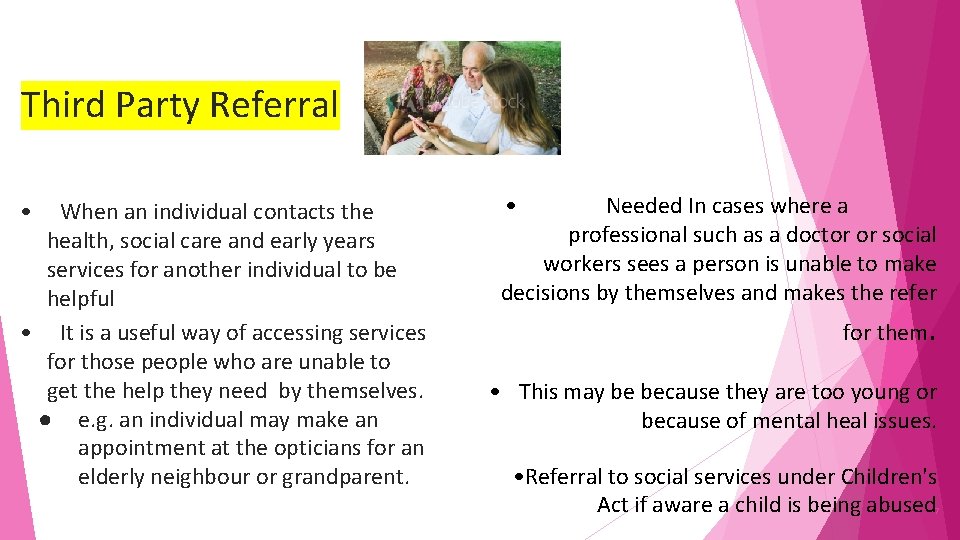
Third Party Referral • When an individual contacts the health, social care and early years services for another individual to be helpful • It is a useful way of accessing services for those people who are unable to get the help they need by themselves. ● e. g. an individual may make an appointment at the opticians for an elderly neighbour or grandparent. • Needed In cases where a professional such as a doctor or social workers sees a person is unable to make decisions by themselves and makes the refer for them. • This may be because they are too young or because of mental heal issues. • Referral to social services under Children's Act if aware a child is being abused 7
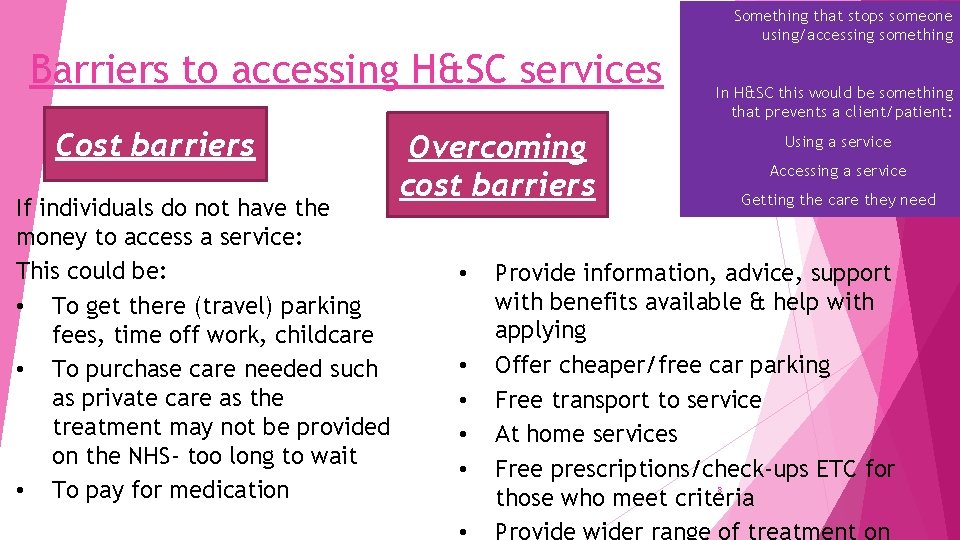
Something that stops someone using/accessing something Barriers to accessing H&SC services Cost barriers If individuals do not have the money to access a service: This could be: • To get there (travel) parking fees, time off work, childcare • To purchase care needed such as private care as the treatment may not be provided on the NHS- too long to wait • To pay for medication In H&SC this would be something that prevents a client/patient: Overcoming cost barriers • • • Using a service Accessing a service Getting the care they need Provide information, advice, support with benefits available & help with applying Offer cheaper/free car parking Free transport to service At home services Free prescriptions/check-ups ETC for those who meet criteria 8
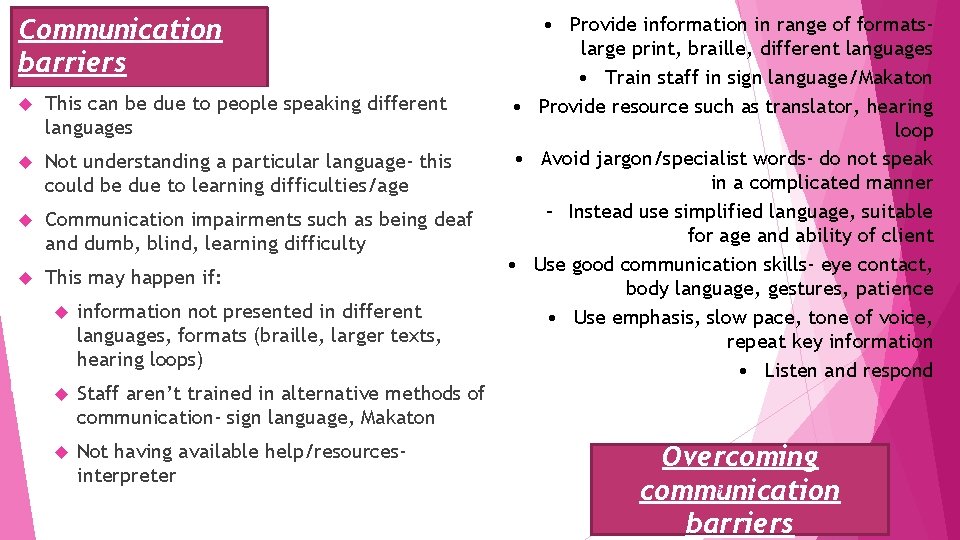
Communication barriers This can be due to people speaking different languages Not understanding a particular language- this could be due to learning difficulties/age Communication impairments such as being deaf and dumb, blind, learning difficulty This may happen if: information not presented in different languages, formats (braille, larger texts, hearing loops) Staff aren’t trained in alternative methods of communication- sign language, Makaton Not having available help/resourcesinterpreter • Provide information in range of formatslarge print, braille, different languages • Train staff in sign language/Makaton • Provide resource such as translator, hearing loop • Avoid jargon/specialist words- do not speak in a complicated manner – Instead use simplified language, suitable for age and ability of client • Use good communication skills- eye contact, body language, gestures, patience • Use emphasis, slow pace, tone of voice, repeat key information • Listen and respond Overcoming communication barriers 9
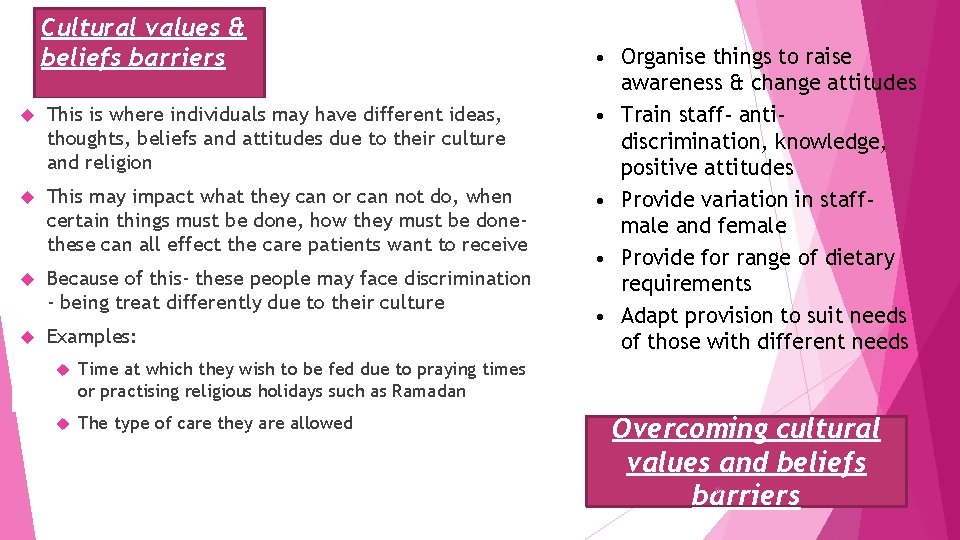
Cultural values & beliefs barriers This is where individuals may have different ideas, thoughts, beliefs and attitudes due to their culture and religion This may impact what they can or can not do, when certain things must be done, how they must be donethese can all effect the care patients want to receive Because of this- these people may face discrimination - being treat differently due to their culture Examples: Time at which they wish to be fed due to praying times or practising religious holidays such as Ramadan The type of care they are allowed • Organise things to raise awareness & change attitudes • Train staff- antidiscrimination, knowledge, positive attitudes • Provide variation in staffmale and female • Provide for range of dietary requirements • Adapt provision to suit needs of those with different needs Overcoming cultural values and beliefs barriers 10
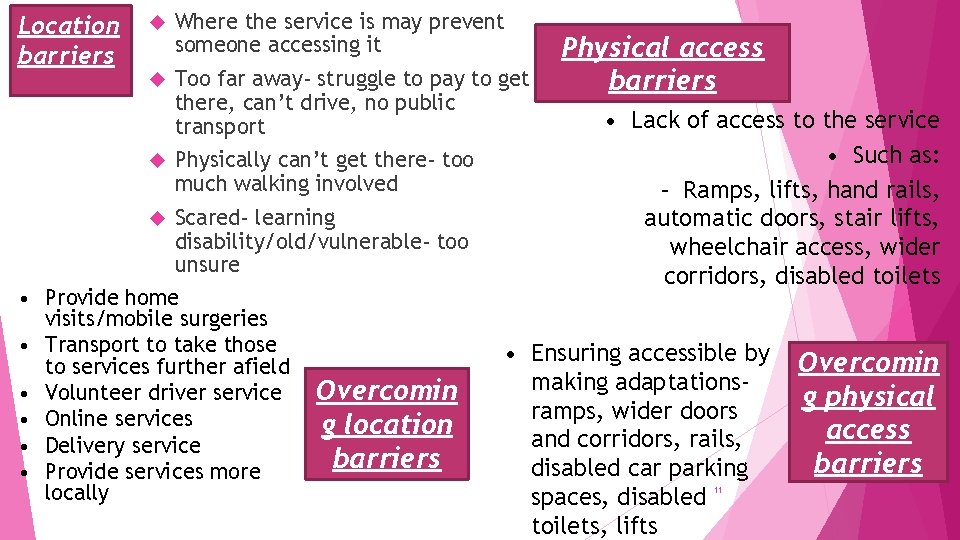
Location barriers Where the service is may prevent someone accessing it Too far away- struggle to pay to get there, can’t drive, no public transport Scared- learning disability/old/vulnerable- too unsure Provide home visits/mobile surgeries Transport to take those to services further afield Volunteer driver service Overcomin Online services g location Delivery service barriers Provide services more locally • • • Physically can’t get there- too much walking involved Physical access barriers • Lack of access to the service • Such as: – Ramps, lifts, hand rails, automatic doors, stair lifts, wheelchair access, wider corridors, disabled toilets • Ensuring accessible by making adaptationsramps, wider doors and corridors, rails, disabled car parking spaces, disabled toilets, lifts 11 Overcomin g physical access barriers
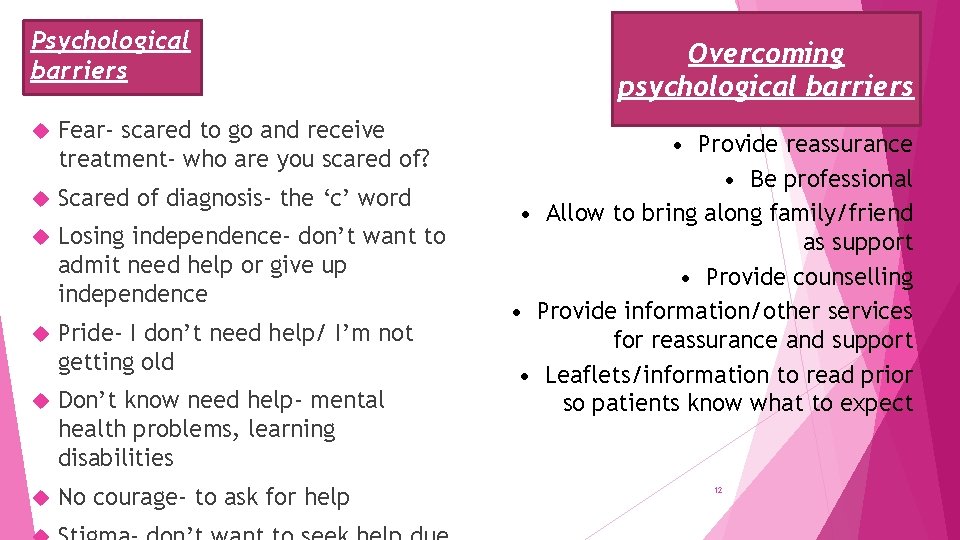
Psychological barriers Fear- scared to go and receive treatment- who are you scared of? Scared of diagnosis- the ‘c’ word Losing independence- don’t want to admit need help or give up independence Pride- I don’t need help/ I’m not getting old Don’t know need help- mental health problems, learning disabilities No courage- to ask for help Overcoming psychological barriers • Provide reassurance • Be professional • Allow to bring along family/friend as support • Provide counselling • Provide information/other services for reassurance and support • Leaflets/information to read prior so patients know what to expect 12
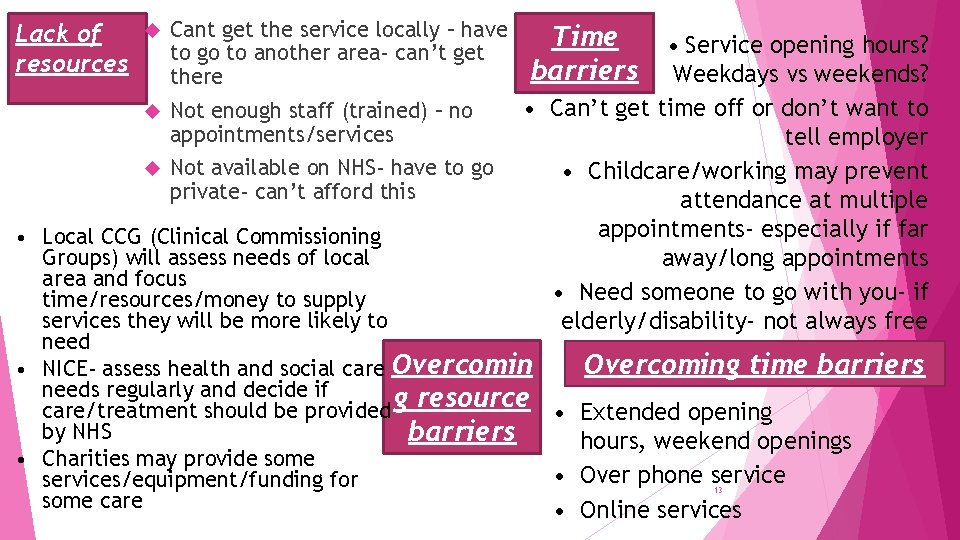
Lack of resources Cant get the service locally – have to go to another area- can’t get there Not enough staff (trained) – no appointments/services Not available on NHS- have to go private- can’t afford this Time barriers • Service opening hours? Weekdays vs weekends? • Can’t get time off or don’t want to tell employer • Childcare/working may prevent attendance at multiple appointments- especially if far away/long appointments • Need someone to go with you- if elderly/disability- not always free • Local CCG (Clinical Commissioning Groups) will assess needs of local area and focus time/resources/money to supply services they will be more likely to need Overcoming time barriers • NICE- assess health and social care Overcomin needs regularly and decide if care/treatment should be provided g resource • Extended opening by NHS barriers hours, weekend openings • Charities may provide some • Over phone services/equipment/funding for some care • Online services 13
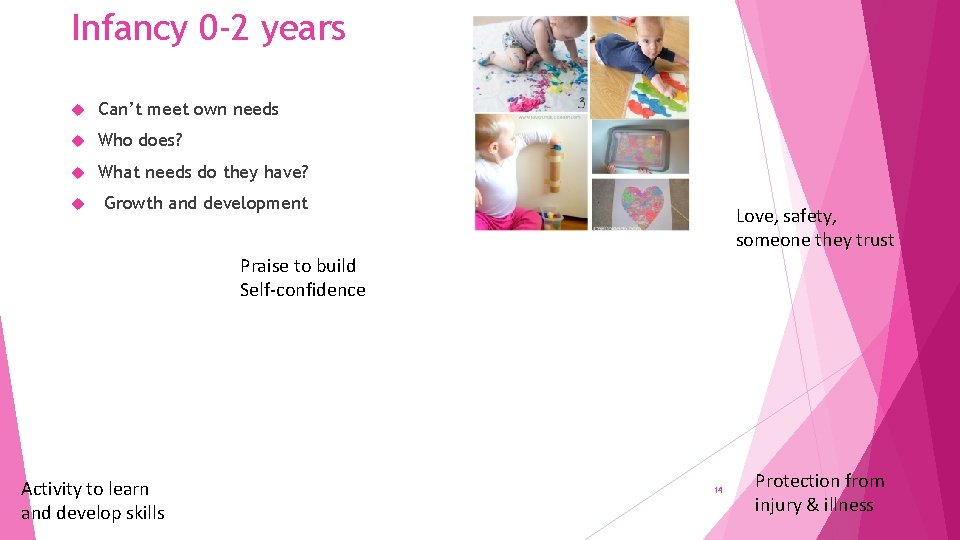
Infancy 0 -2 years Can’t meet own needs Who does? What needs do they have? Growth and development Love, safety, someone they trust Praise to build Self-confidence Activity to learn and develop skills 14 Protection from injury & illness
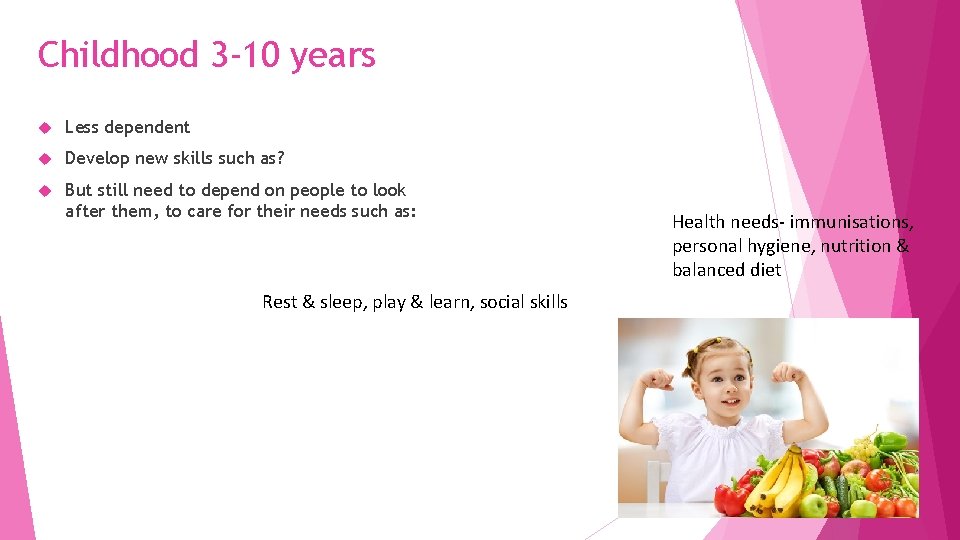
Childhood 3 -10 years Less dependent Develop new skills such as? But still need to depend on people to look after them, to care for their needs such as: Health needs- immunisations, personal hygiene, nutrition & balanced diet Rest & sleep, play & learn, social skills 15
Adolescence 1117 years Become even more independent = Arguments with parents Go through major body changes such as the effects of puberty Create friendships/first relationship- sexual encounters Emotions- stressed with rising expectationsschool, home life, work, love life, friendships What health/social needs does this link to? 16
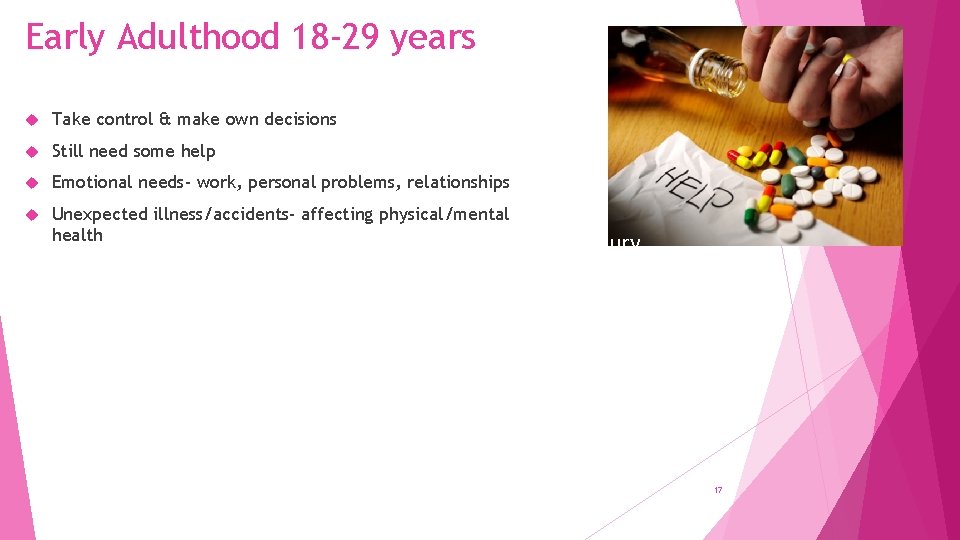
Early Adulthood 18 -29 years Take control & make own decisions Still need some help Emotional needs- work, personal problems, relationships Unexpected illness/accidents- affecting physical/mental health injury 17
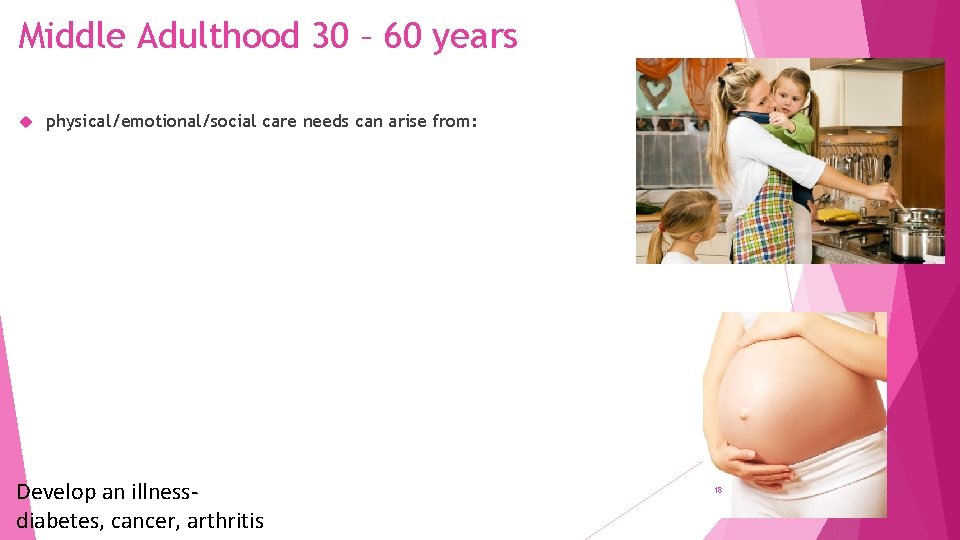
Middle Adulthood 30 – 60 years physical/emotional/social care needs can arise from: Develop an illnessdiabetes, cancer, arthritis 18
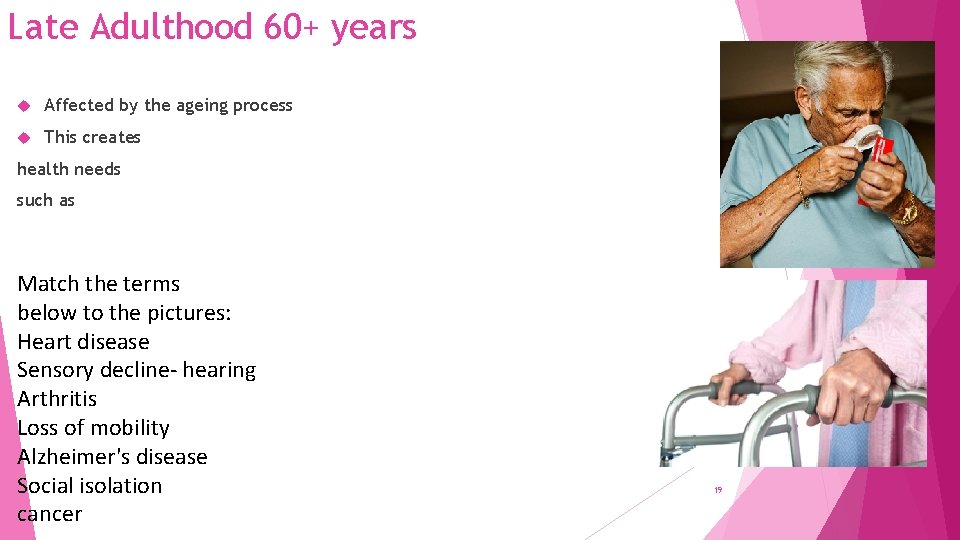
Late Adulthood 60+ years Affected by the ageing process This creates health needs such as Match the terms below to the pictures: Heart disease Sensory decline- hearing Arthritis Loss of mobility Alzheimer's disease Social isolation cancer 19
Health care services Social care services • Early education services Children’s care • Fostering & adoption services General health care • Domiciliary care Medical care for all ages • Social worker Nursing care for babies, children & adults • Outreach worker Mental health care services • Alcohol support services Dental, eyesight and hearing services • Family support worker • Community services & day centres • Bereavement counselling • Support groups For each service- identify which life stage they are most relevant for and what they do Maternity services YOU COULD add these to your timeline 20
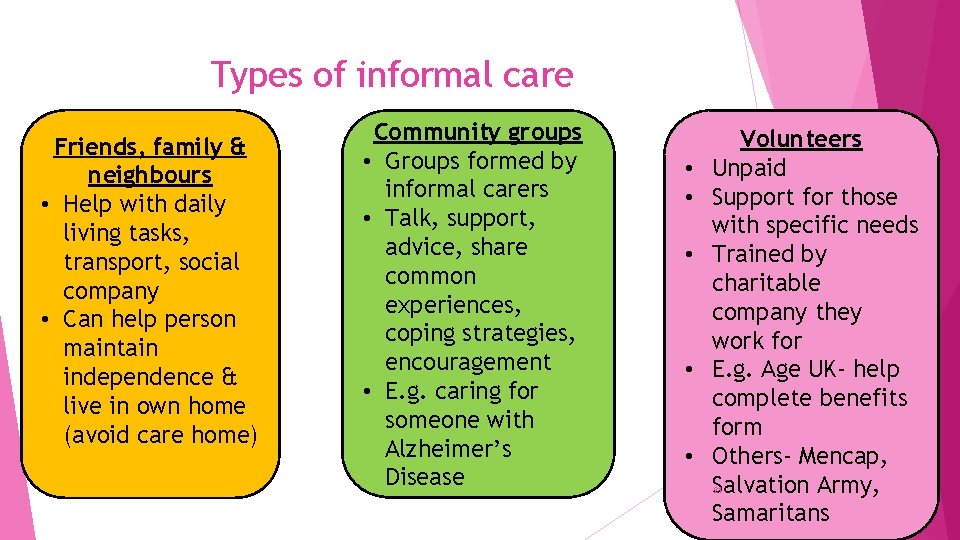
Types of informal care Friends, family & neighbours • Help with daily living tasks, transport, social company • Can help person maintain independence & live in own home (avoid care home) Community groups • Groups formed by informal carers • Talk, support, advice, share common experiences, coping strategies, encouragement • E. g. caring for someone with Alzheimer’s Disease • • • Volunteers Unpaid Support for those with specific needs Trained by charitable company they work for E. g. Age UK- help complete benefits form Others- Mencap, Salvation Army, Samaritans 21