
UNIT 1 INTRODUCTION TO LAW AND THE LEGAL

- Slides: 27
UNIT 1 INTRODUCTION TO LAW AND THE LEGAL SYSTEM
Chapter 1: What is Law? Why do societies create laws, and what do they hope their laws will accomplish? How might these goals conflict with one another? What are some societal problems that laws cannot solve? Do laws reflect a society’s values? How might laws in a society that values order and safety compare to a society that values individual freedom and creativity?
Chapter 1: What is Law? Law and Values We expect our legal system to: Protect basic human rights Promote fairness Help to resolve conflicts Promote order and stability Promote desirable social and economic behavior Represent the will of the majority Protect the rights of minorities Our problems involve conflicts among these goals Ex. Laws that give preferences to minorities
Chapter 1: What is Law? Laws are based on moral, economic, political, or social values. Moral values deal with questions or right or wrong Economic values deal with the accumulation, preservation, use, and distribution of wealth Political values reflect the relationship between the government and individuals Social values concern issues that are important to society
Chapter 1: What is Law? For each of the following values, indicate whether moral, economic, political, or social values are involved: All drivers must stop at stop signs It is a crime to cheat on your tax returns Economic and social Government officials may not accept gifts from people who want them to pass certain laws Social and Political Special government programs lend money to minority owned businesses at low interest rates Economic and social All citizens may vote at age 18 Social Moral, political, economic Possession of marijuana is a crime Moral and Social
Chapter 1: What is Law? Balancing Rights with Responsibilities Critics say Americans are too concerned with rights and neglect responsibilities Rights must be matched by social responsibilities Ex. If you want to be tried by a jury of your peers, you must be willing to serve on a jury Just because you have a legal right, doesn’t mean you should exercise it
Chapter 1: What is Law? Our Constitutional Framework Limited Government Separation of Powers Executive branch issues order and rules to enforce the law Legislative branch passes laws or statutes Judicial branch clarifies the law Checks and Balances Veto Judicial Review Federalism Amendments
Chapter 1: What is Law? Examine each of the following situations and determine for each whether it involves the principle of separation of powers, checks and balances, judicial review, federalism, or a combination. A state law requires that a prayer be said each day in public schools. The Courts rule that the law violates a 1 st Amendment clause that prohibits the government from establishing religion. The US Congress passes a law that restricts the import of handguns from other countries. The legislature in one state allows the sale of handguns to anyone over age 18. Because a prison is old and overcrowded, a state
Chapter 2: Lawmaking How Agencies Create Laws Most of the laws that affect you are made by gov’t agencies Ex. Congress passed the Clean Air Act The Environmental Protection Agency (EPA) decides how to enforce the law Regulations issued by agencies become law without being voted upon Hold hearings Federal Register
Chapter 2: Lawmaking How Courts Create Law Rulings Plessy v. Ferguson International Lawmaking Treaties EU UN
Chapter 3: Advocacy Lobbying A method used by interest groups to influence lawmakers Lobbyists use ads, favors, campaign contributions, letter writing campaigns, rallies, and protests to influence legislation Lobbyists must register with Congress and file quarterly reports Reports must indicate who has been lobbied and on what issue, how much they are paid, and how much they have spent
Chapter 3: Advocacy Campaign Finance Reform Proponents argue: That only rich people can run for office That interest groups receive favors in exchange for large campaign contributions Elected official spend too much time raising money Critics argue that contributions are protected under the 1 st amendment Soft Money Bipartisan Campaign Reform Act (eliminated soft money) Super PAC’s 527’s and issue advocacy
Chapter 5: The Court System Trial Courts Listen to testimony, consider evidence, and decide the facts In a trial, there are two parties: Plaintiff (or prosecutor) Defendant Only defendant can appeal a decision Based on the adversarial system Contest between opposing sides Europe uses the inquisitional system 6 th amendment guarantees right to a jury trial in criminal cases; 7 th amendment for civil cases Defendant decides if he/she wants a jury trial
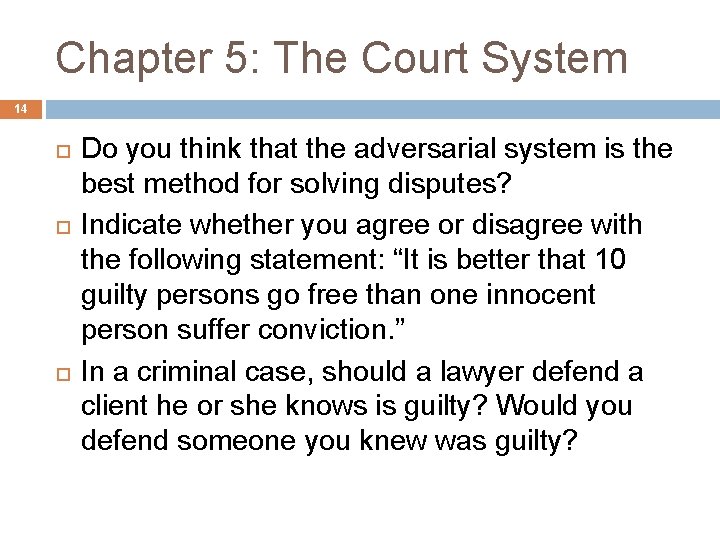
Chapter 5: The Court System 14 Do you think that the adversarial system is the best method for solving disputes? Indicate whether you agree or disagree with the following statement: “It is better that 10 guilty persons go free than one innocent person suffer conviction. ” In a criminal case, should a lawyer defend a client he or she knows is guilty? Would you defend someone you knew was guilty?
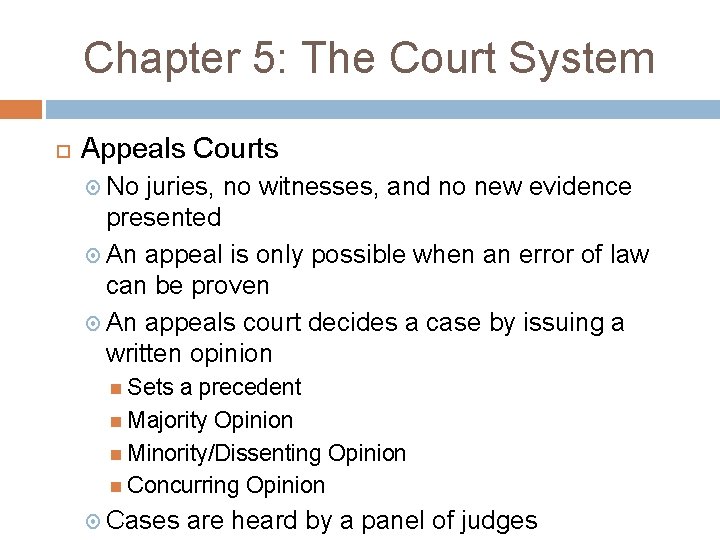
Chapter 5: The Court System Appeals Courts No juries, no witnesses, and no new evidence presented An appeal is only possible when an error of law can be proven An appeals court decides a case by issuing a written opinion Sets a precedent Majority Opinion Minority/Dissenting Opinion Concurring Opinion Cases are heard by a panel of judges
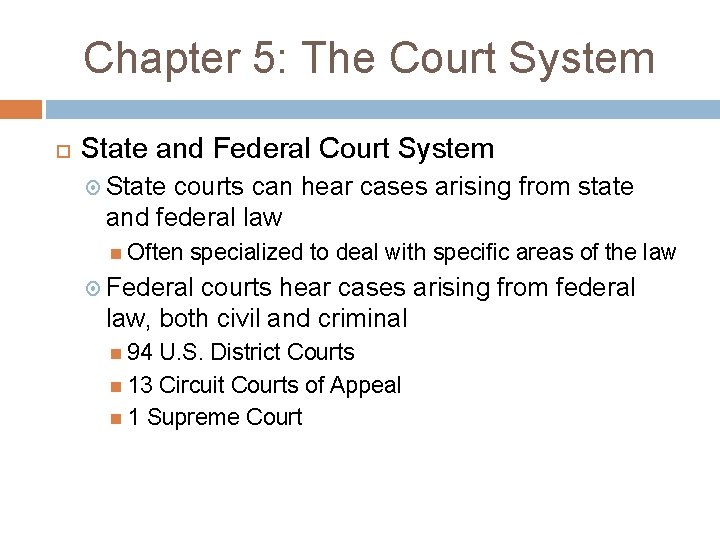
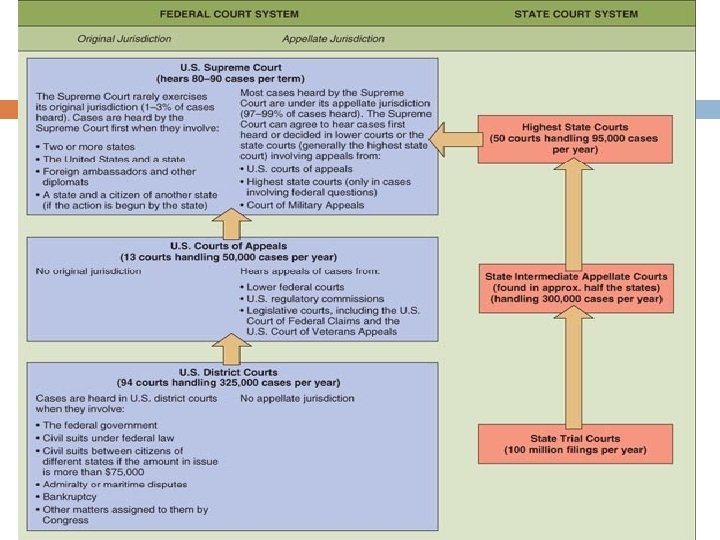
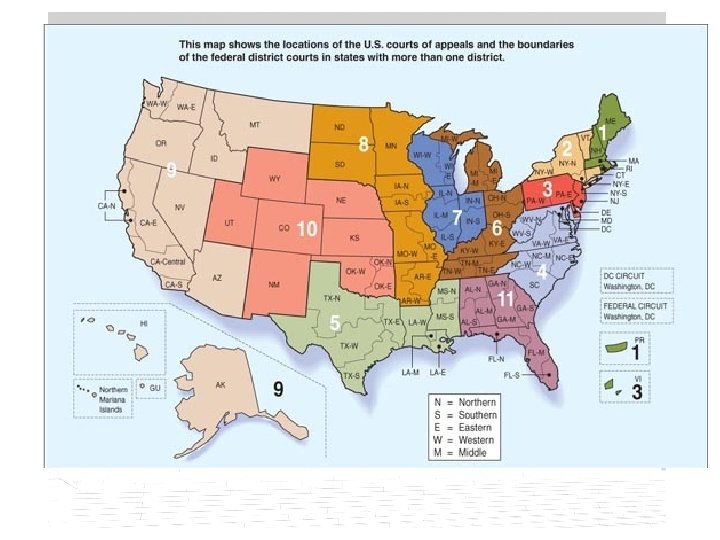
Chapter 5: The Court System State and Federal Court System State courts can hear cases arising from state and federal law Often specialized to deal with specific areas of the law Federal courts hear cases arising from federal law, both civil and criminal 94 U. S. District Courts 13 Circuit Courts of Appeal 1 Supreme Court
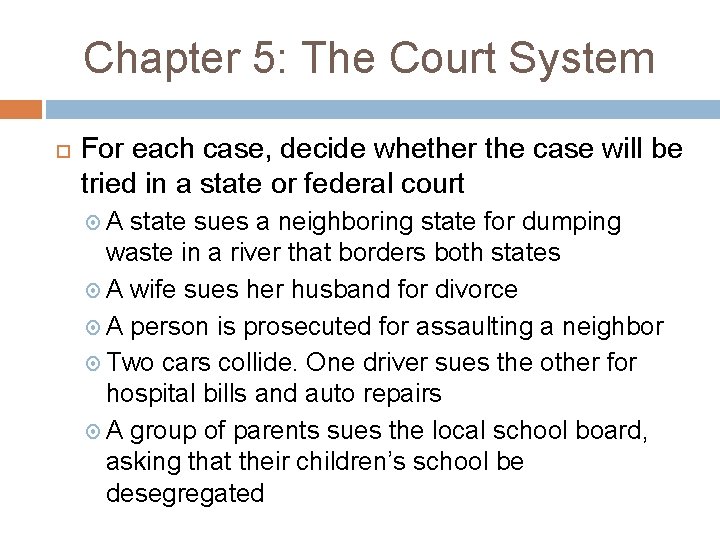
Chapter 5: The Court System For each case, decide whether the case will be tried in a state or federal court A state sues a neighboring state for dumping waste in a river that borders both states A wife sues her husband for divorce A person is prosecuted for assaulting a neighbor Two cars collide. One driver sues the other for hospital bills and auto repairs A group of parents sues the local school board, asking that their children’s school be desegregated
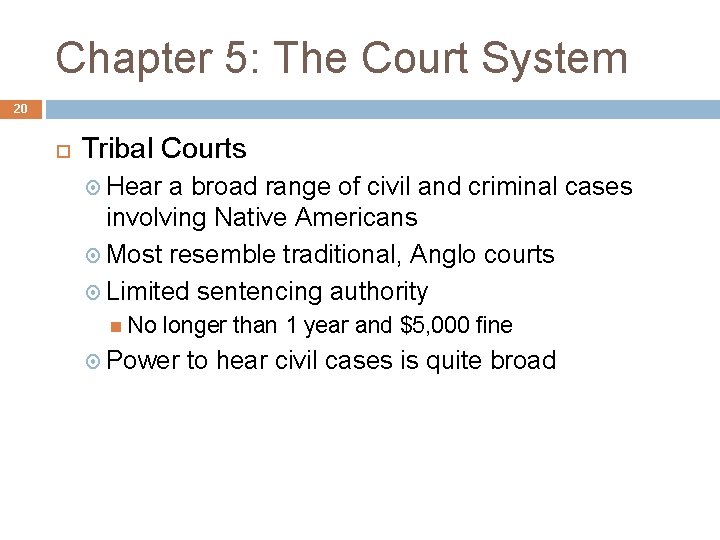
Chapter 5: The Court System 20 Tribal Courts Hear a broad range of civil and criminal cases involving Native Americans Most resemble traditional, Anglo courts Limited sentencing authority No longer than 1 year and $5, 000 fine Power to hear civil cases is quite broad
21
Chapter 5: The Court System 22 International Courts Set up by the UN to enforce international law International Court of Justice The Hague in the Netherlands International Began Criminal Court operating in 2003 Hears cases dealing with genocide, crimes against humanity, and war crimes
Chapter 6: Lawyers 23 How Do You Find a Lawyer? Recommendation from a friend Yellow Pages Martindale Hubbell Law Directory Billboards (lol)! Critics Local of advertising Bar Association
Chapter 6: Lawyers 24 A television ad shows a lawyer in a bathing suit coming out of a lake. He says, “If you’re in over your head because of bad debts, let us bail you out. We’re the best firm in the state. ” Should there be any restrictions on ads like this? If so, what? A lawyer hears that many people have been injured as a result of accidents in a car crash. He runs a newspaper ad showing a car crash. The ad reads, “If this happens to you, I may be able to help you recover your losses. ” should the lawyer be able to do this? Many people in an area have lost their jobs and are about to lose their homes because they cannot pay their mortgages. Jane, a lawyer, writes to all of these people saying she is willing to represent them to prevent the loss of their homes. Should she be allowed to do this?
Chapter 6: Lawyers 25 What to Ask Your Lawyer What is the lawyer’s fee? By the hour? Retainer? Contingency? Will there be a written fee agreement? Has the lawyer handled cases like this before? Will the lawyer provide you with copies of all correspondence and documents prepared in your case? Will the lawyer keep you informed of any new developments and talk to you in plain English?
Chapter 6: Lawyers 26 Working with your Lawyer Pick a lawyer you are comfortable with Attorney-client privilege Judges very rarely allow you to fire a lawyer once the trial has begun Lawyers must follow a Code of Professional Responsibility Violations can result in disbarrment Can be sued for legal malpractice Must pass state bar exam
Chapter 6: Lawyers 27 Problem 6. 4, p. 70