
UNIT 1 INFORMATION TECHNOLOGY THEORY CAPE INFORMATION TECHNOLOGY
- Slides: 13
UNIT 1 INFORMATION TECHNOLOGY THEORY CAPE INFORMATION TECHNOLOGY MODULE 1 FUNDAMENTALS OF INFORMATION TECHNOLOGY Objective 6: Discuss the importance of data and information.
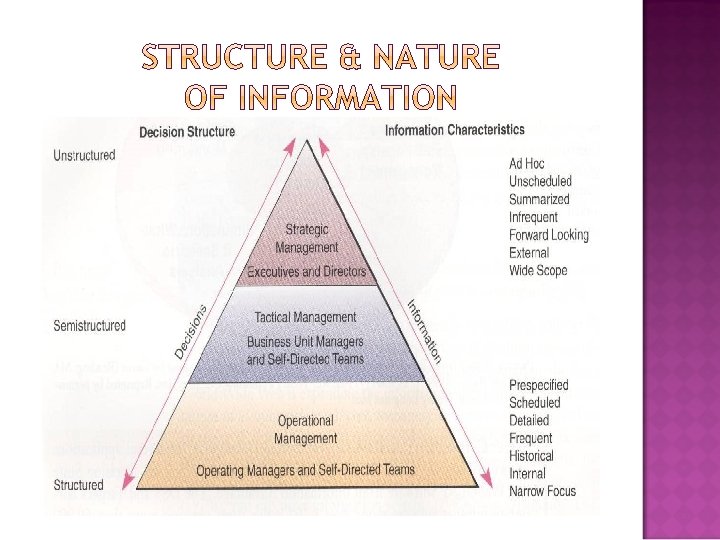
The type of information required by decisionmakers in a company is directly related to the level of management and the amount of structure in the decision situations decisionmakers face.
STRATEGIC MANAGEMENT Typically consists of a board of directors and an executive committee of the CEO and top executives. Developing overall organizational goals, strategies, policies, and objectives as part of a strategic planning process. Monitoring the strategic performance of the organization and its overall direction in the political, economic, and competitive business environment.
TACTICAL MANAGEMENT Includes business professional in self-directed teams and business unit managers. Developing short- and medium-range plans, schedules and budgets. Specifying the policies, procedures and business objectives for subunits of the company. Allocating resources. Monitoring the performance of organizational subunits, including departments, divisions, process teams, project teams and other workgroups.
OPERATIONAL MANAGEMENT Includes self-directed team members or operating managers. Developing short-range plans such as weekly production schedules. Directing the use of resources and the performance of tasks according to procedures and within budgets and schedules that were established for teams and other workgroups of the organization.
Decisions mostly made at the operational management level. Structured decisions involve situations where the procedures to follow when a decision is needed can be specified in advance. Example: The inventory reorder decisions faced by most businesses.
Decisions usually made at the tactical management level. Semi-structured decision procedures can be prespecified but not enough to lead to a definite recommended decision. Many decision situations are semi-structured. Example: Making major changes to employee benefits.
Decisions generally made at the strategic management level. Decision situations where it is not possible to specific in advance most of the decision procedures to follow. Example: Developing a new product/service.
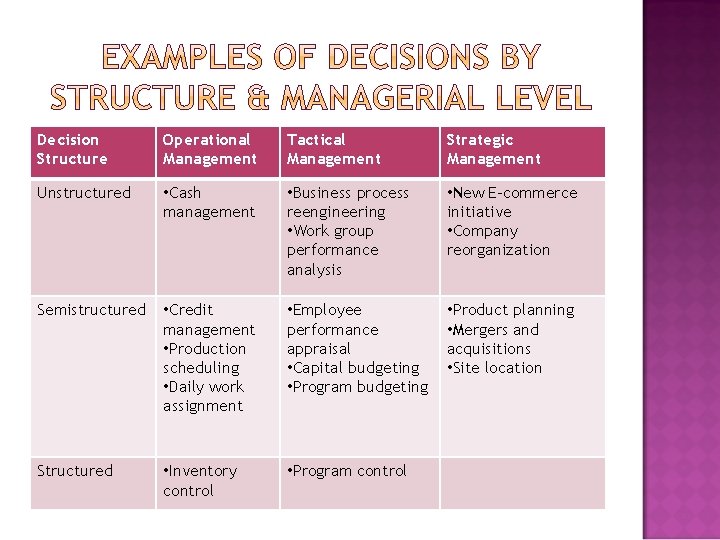
Decision Structure Operational Management Tactical Management Strategic Management Unstructured • Cash management • Business process reengineering • Work group performance analysis • New E-commerce initiative • Company reorganization Semistructured • Credit management • Production scheduling • Daily work assignment • Employee performance appraisal • Capital budgeting • Program budgeting • Product planning • Mergers and acquisitions • Site location Structured • Inventory control • Program control
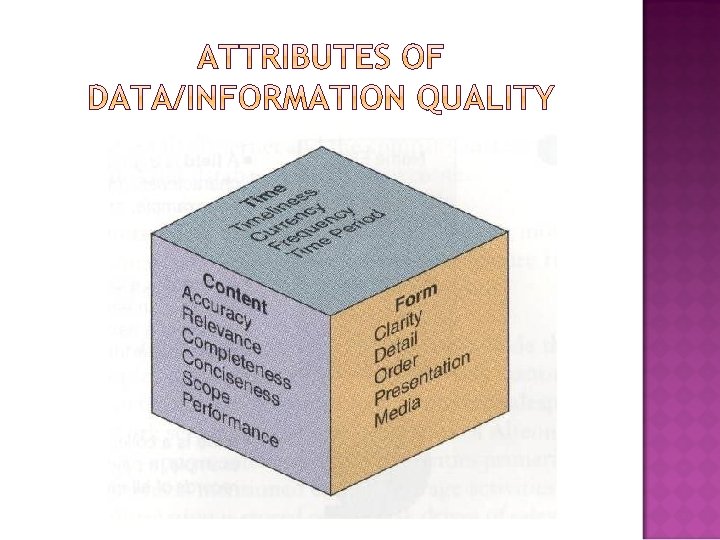
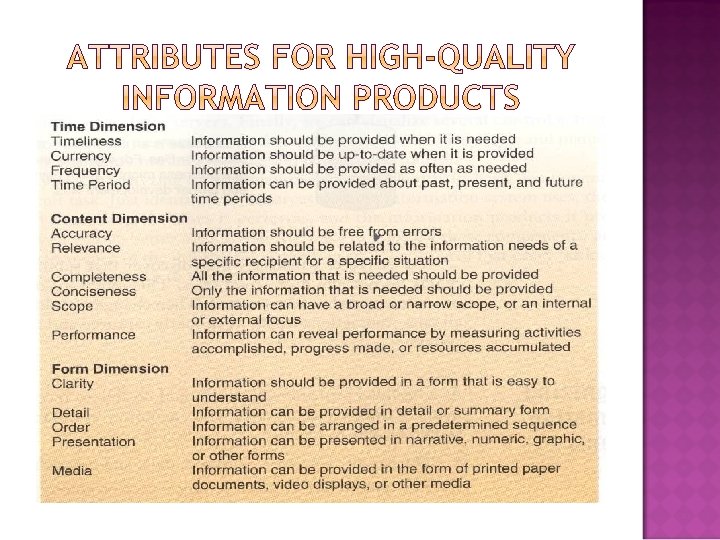
The characteristics or attributes determine the quality, value and usefulness of data/ information. Data/Information must be accurate and up-todate. Data/Information that are outdated, inaccurate or difficult to understand would not be meaningful, useful or valuable to end users. The quality of data stored in an IS must be maintained by a continual process of correcting and updating activities. The attributes of data/information quality can be grouped in the three (3) dimensions of time, content and form.