
Unit 1 In China we open a gift
![[拓展] accept的反义词是refuse, refuse作动词, 意 为“拒绝, 回绝”, 常用于refuse sth. / to do sth. 结构。 I](https://slidetodoc.com/presentation_image_h2/2490de2634b6ac416689e9ae52f6a9a2/image-22.jpg "[拓展] accept的反义词是refuse, refuse作动词, 意 为“拒绝, 回绝”, 常用于refuse sth. / to do sth. 结构。 I")
- Slides: 43
Unit 1 In China, we open a gift later.
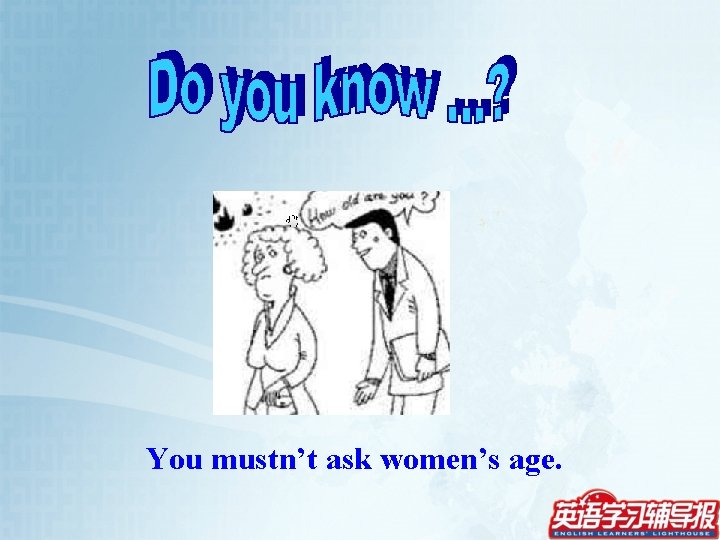
You mustn’t ask women’s age.
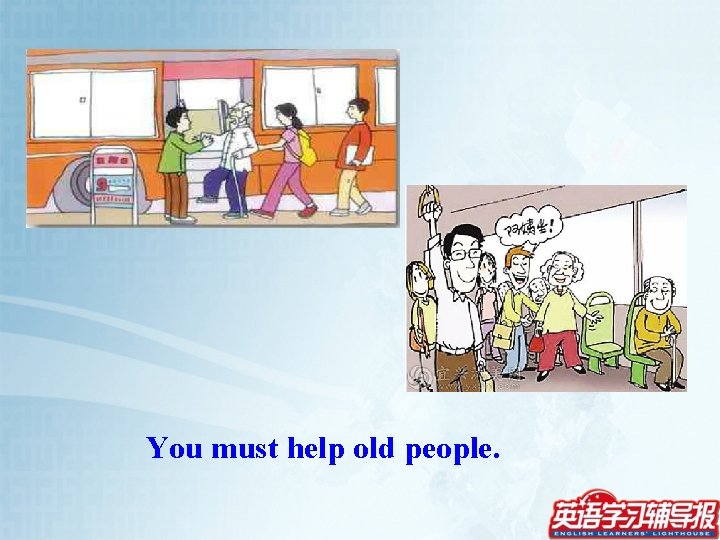
You must help old people.
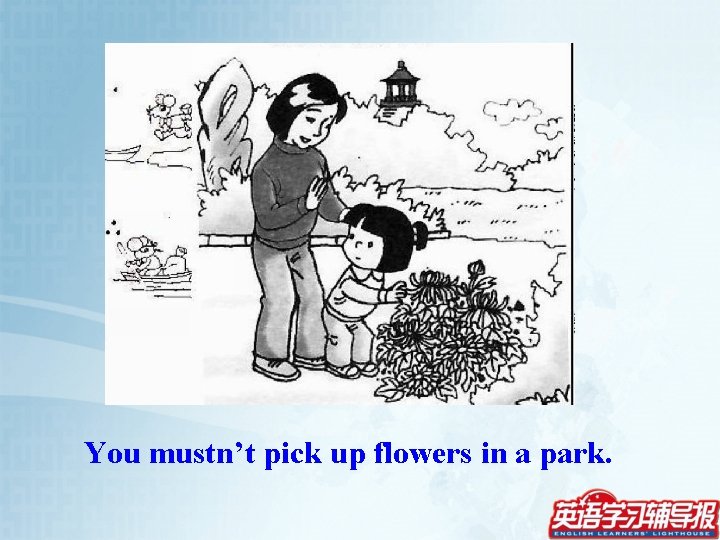
You mustn’t pick up flowers in a park.
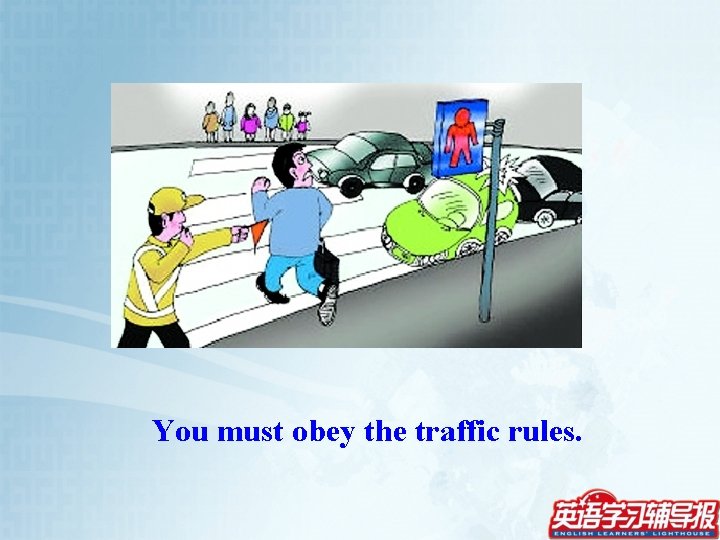
You must obey the traffic rules.
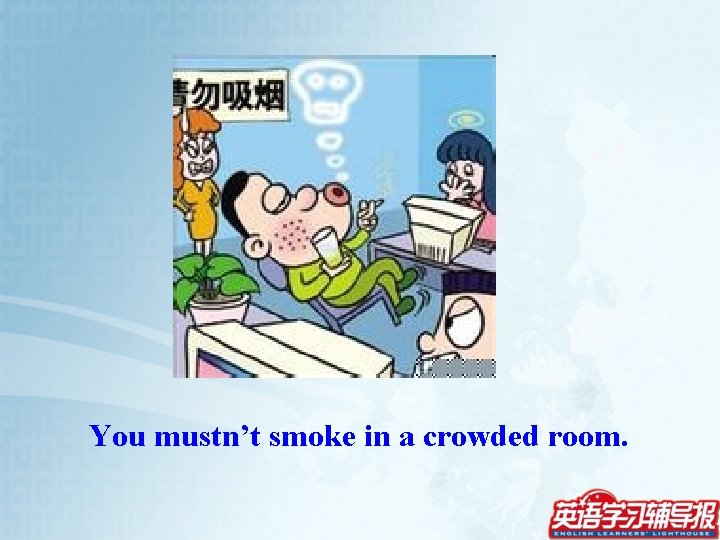
You mustn’t smoke in a crowded room.
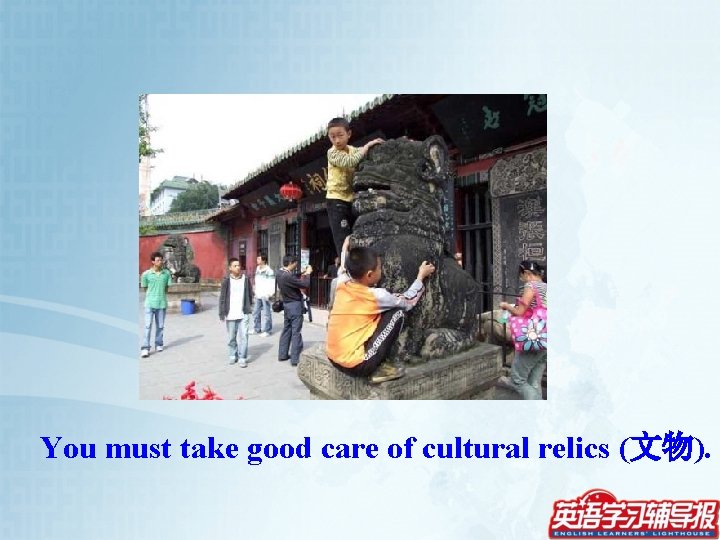
You must take good care of cultural relics (文物).
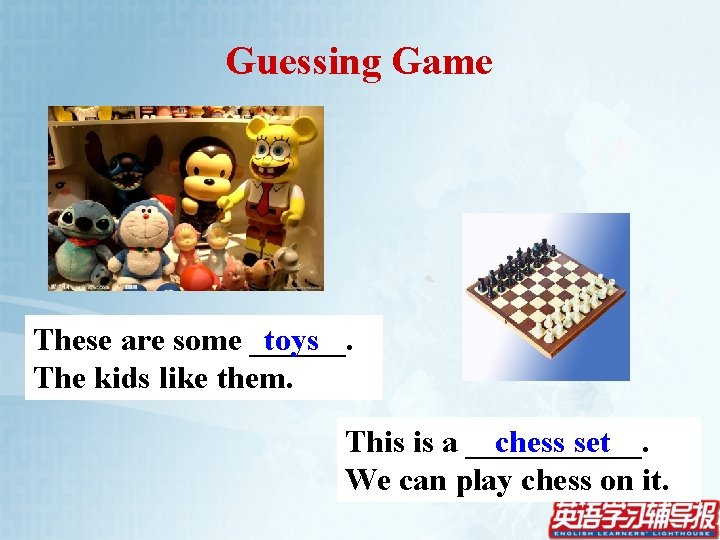
Guessing Game These are some ______. toys The kids like them. This is a ______. chess set We can play chess on it.
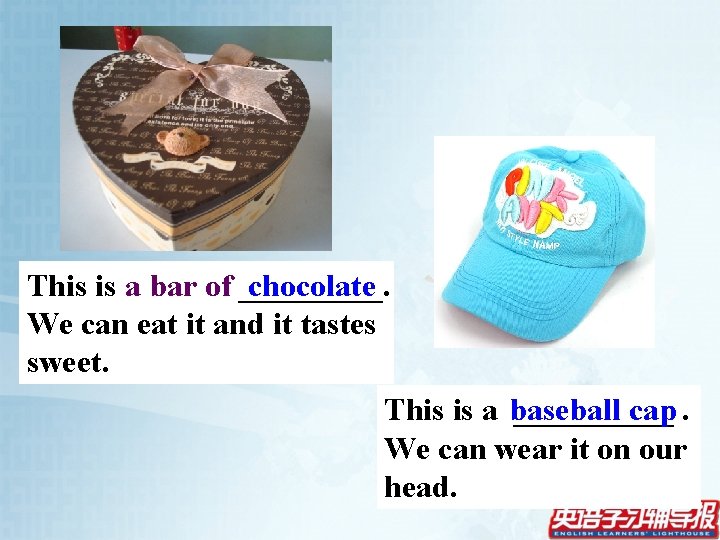
This is a bar of _____. chocolate We can eat it and it tastes sweet. This is a baseball _____ cap. We can wear it on our head.
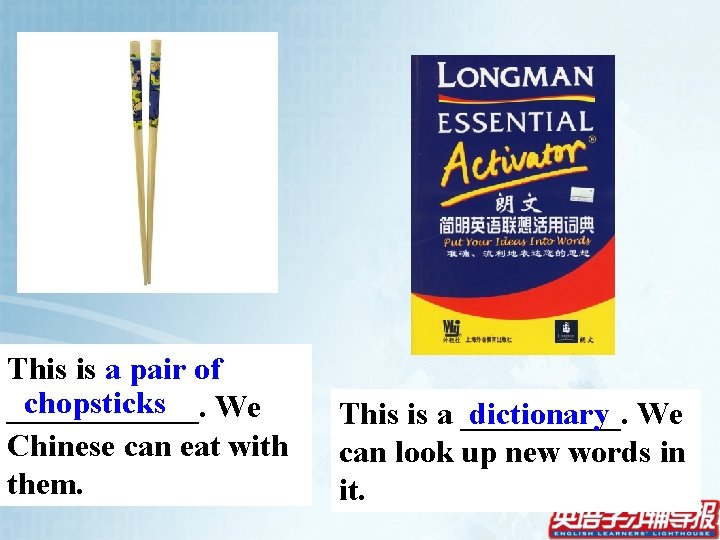
This is a pair of chopsticks ______. We Chinese can eat with them. This is a _____. dictionary We can look up new words in it.
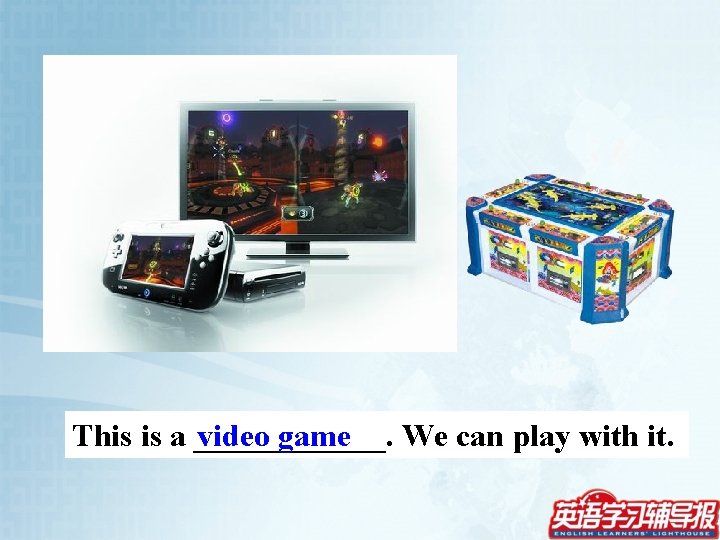
This is a ______. video game We can play with it.
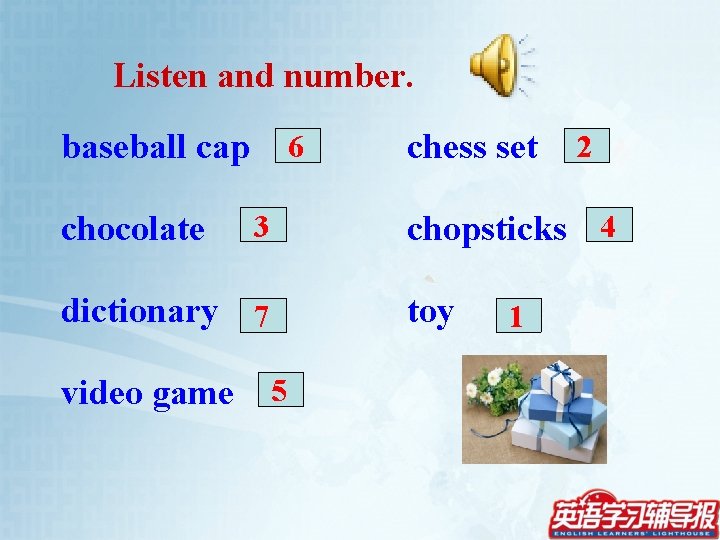
Listen and number. baseball cap chocolate 6 2 chopsticks 4 3 toy dictionary 7 video game chess set 5 1
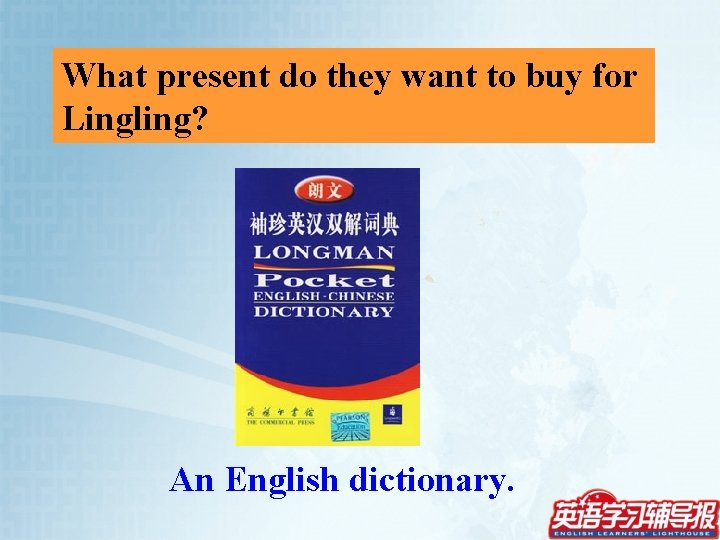
What present do they want to buy for Lingling? An English dictionary.
Listen again and answer the question. Why mustn’t Lingling open her present immediately? Because in China when someone gives you a present, it’s bad manners to open it immediately.
What are the different customs between China and western countries? In China you open a gift immediately but in the US, you open a gift immediately. In China you accept a gift with both hands but in the west you usually don’t pay much attention to that.
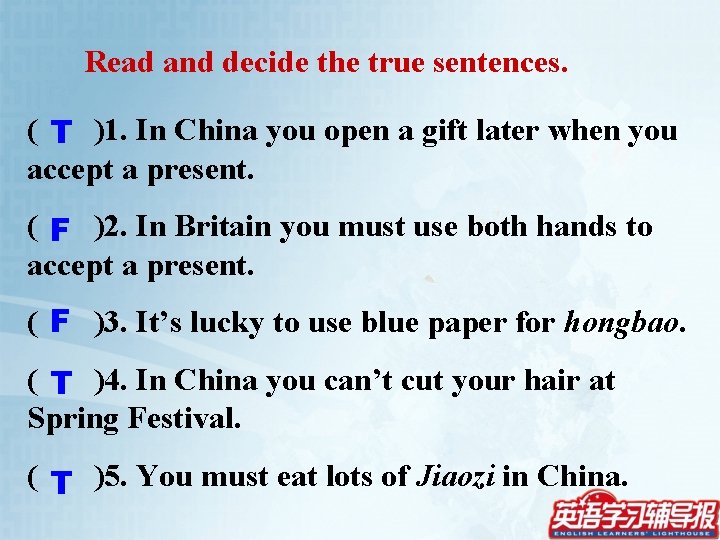
Read and decide the true sentences. ( T )1. In China you open a gift later when you accept a present. ( F )2. In Britain you must use both hands to accept a present. ( F )3. It’s lucky to use blue paper for hongbao. ( T )4. In China you can’t cut your hair at Spring Festival. ( T )5. You must eat lots of Jiaozi in China.
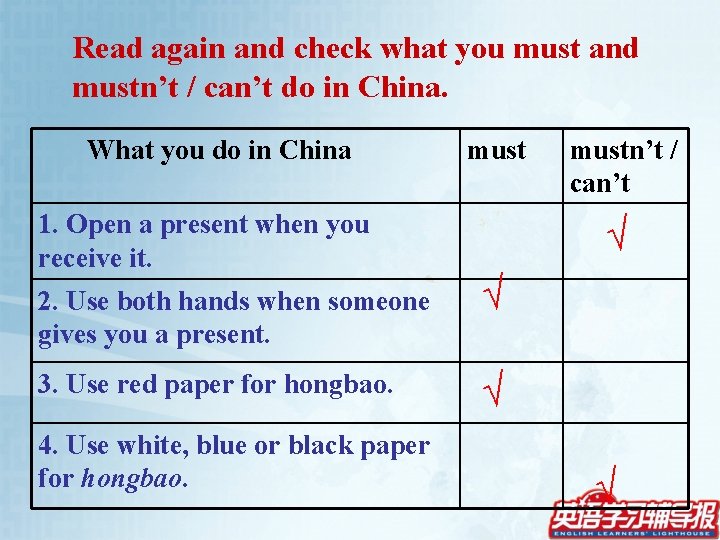
Read again and check what you must and mustn’t / can’t do in China. What you do in China must 1. Open a present when you receive it. √ 2. Use both hands when someone gives you a present. √ 3. Use red paper for hongbao. √ 4. Use white, blue or black paper for hongbao. mustn’t / can’t √
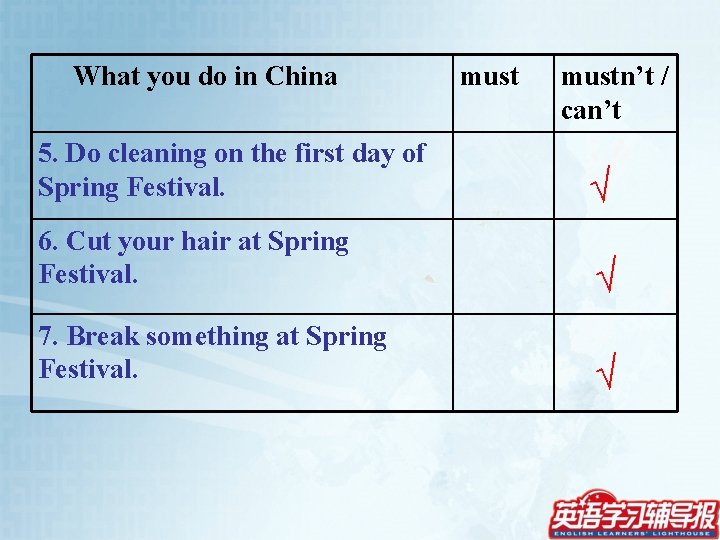
What you do in China mustn’t / can’t 5. Do cleaning on the first day of Spring Festival. √ 6. Cut your hair at Spring Festival. √ 7. Break something at Spring Festival. √
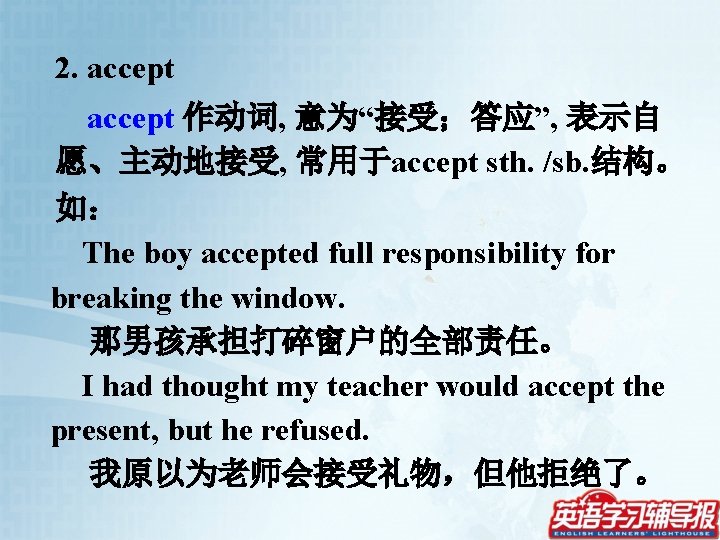
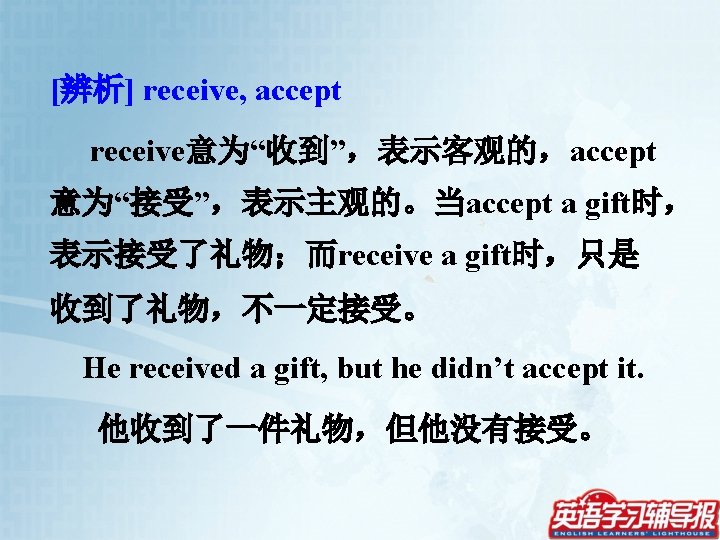
2. accept 作动词, 意为“接受;答应”, 表示自 愿、主动地接受, 常用于accept sth. /sb. 结构。 如: The boy accepted full responsibility for breaking the window. 那男孩承担打碎窗户的全部责任。 I had thought my teacher would accept the present, but he refused. 我原以为老师会接受礼物,但他拒绝了。
[拓展] accept的反义词是refuse, refuse作动词, 意 为“拒绝, 回绝”, 常用于refuse sth. / to do sth. 结构。 I refuse to answer that question. 我不愿回答那个问题。
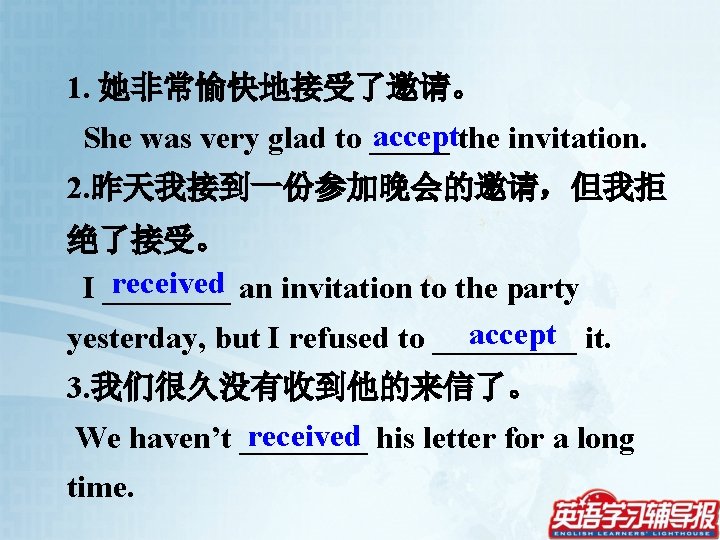
1. 她非常愉快地接受了邀请。 acceptthe invitation. She was very glad to _____ 2. 昨天我接到一份参加晚会的邀请,但我拒 绝了接受。 received an invitation to the party I ____ accept it. yesterday, but I refused to _____ 3. 我们很久没有收到他的来信了。 received his letter for a long We haven’t ____ time.
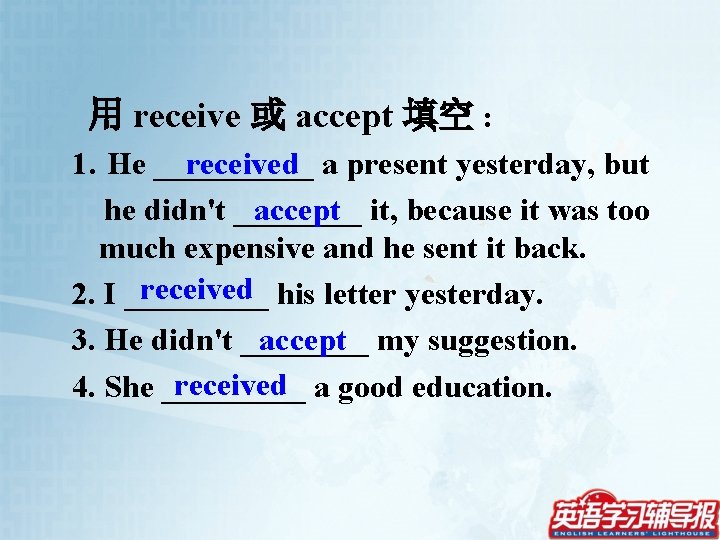
用 receive 或 accept 填空 : 1. He _____ received a present yesterday, but accept it, because it was too he didn't ____ much expensive and he sent it back. received his letter yesterday. 2. I _____ accept my suggestion. 3. He didn't ____ received a good education. 4. She _____
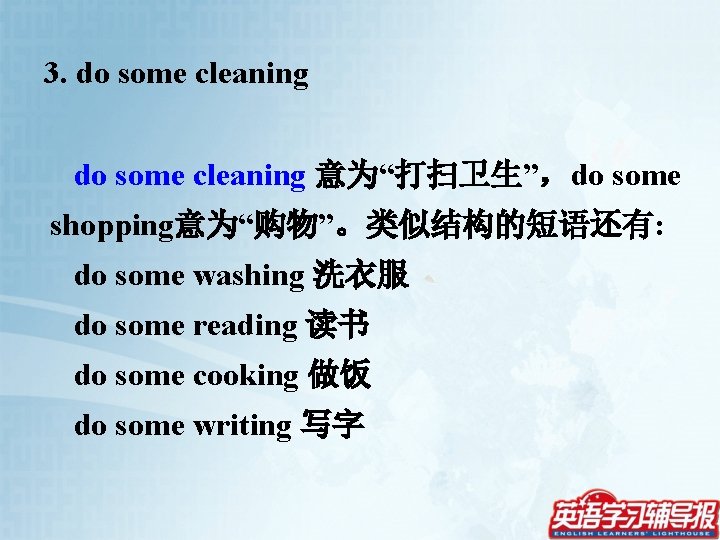
3. do some cleaning 意为“打扫卫生”,do some shopping意为“购物”。类似结构的短语还有: do some washing 洗衣服 do some reading 读书 do some cooking 做饭 do some writing 写字
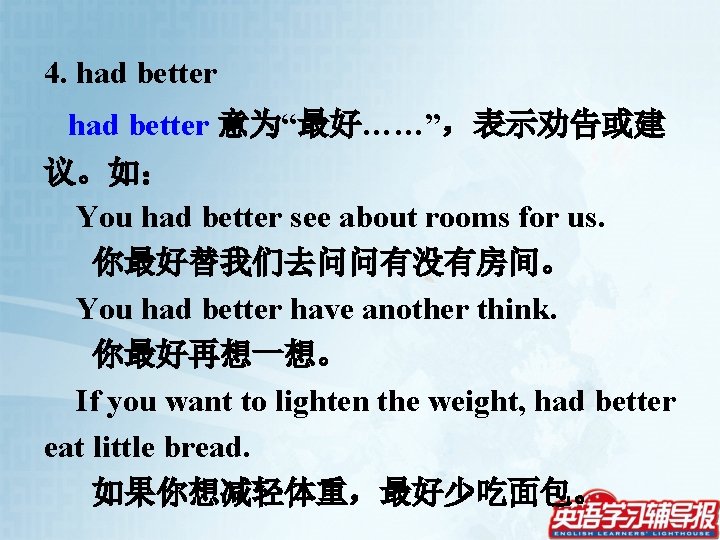
4. had better 意为“最好……”,表示劝告或建 议。如: You had better see about rooms for us. 你最好替我们去问问有没有房间。 You had better have another think. 你最好再想一想。 If you want to lighten the weight, had better eat little bread. 如果你想减轻体重,最好少吃面包。
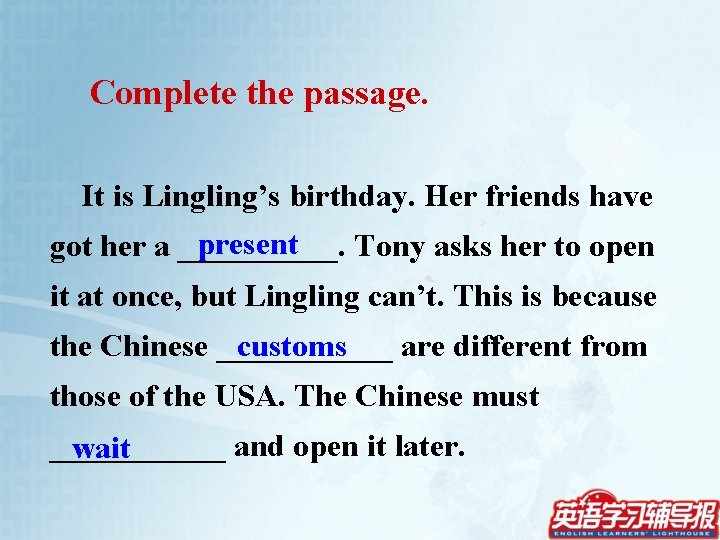
Complete the passage. It is Lingling’s birthday. Her friends have present got her a _____. Tony asks her to open it at once, but Lingling can’t. This is because customs the Chinese ______ are different from those of the USA. The Chinese must ______ and open it later. wait
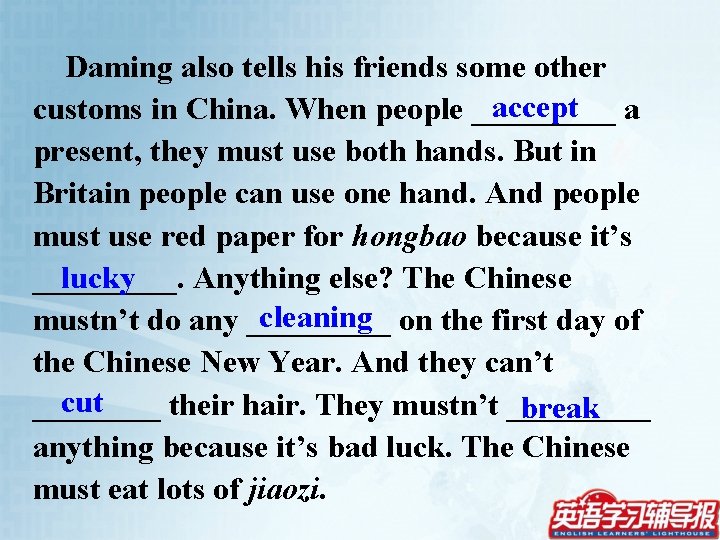
Daming also tells his friends some other accept a customs in China. When people _____ present, they must use both hands. But in Britain people can use one hand. And people must use red paper for hongbao because it’s lucky _____. Anything else? The Chinese cleaning on the first day of mustn’t do any _____ the Chinese New Year. And they can’t cut ____ their hair. They mustn’t _____ break anything because it’s bad luck. The Chinese must eat lots of jiaozi.
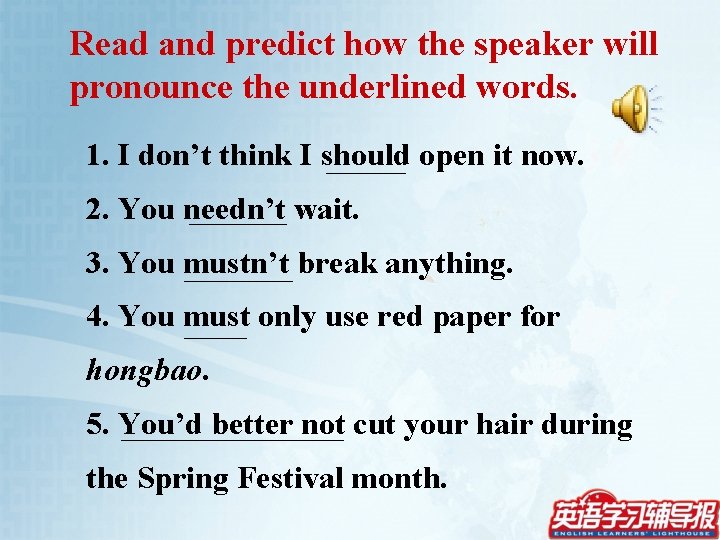
Read and predict how the speaker will pronounce the underlined words. 1. I don’t think I should open it now. 2. You needn’t wait. 3. You mustn’t break anything. 4. You must only use red paper for hongbao. 5. You’d better not cut your hair during the Spring Festival month.
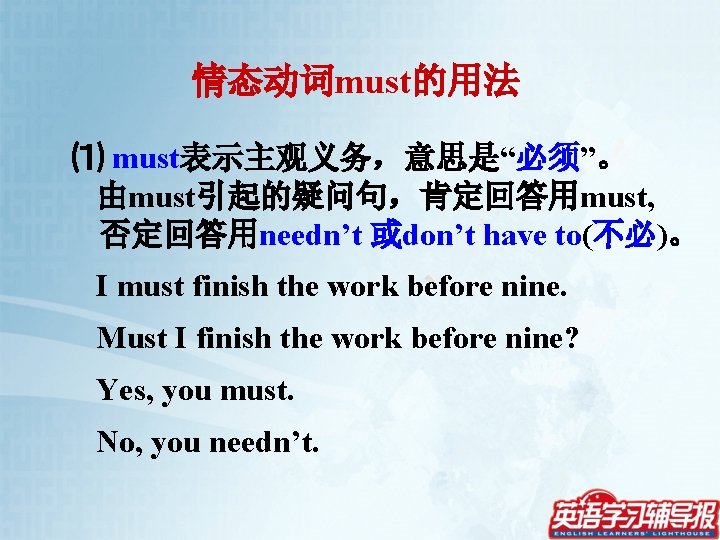
情态动词must的用法 ⑴ must表示主观义务,意思是“必须”。 由must引起的疑问句,肯定回答用must, 否定回答用needn’t 或don’t have to(不必)。 I must finish the work before nine. Must I finish the work before nine? Yes, you must. No, you needn’t.
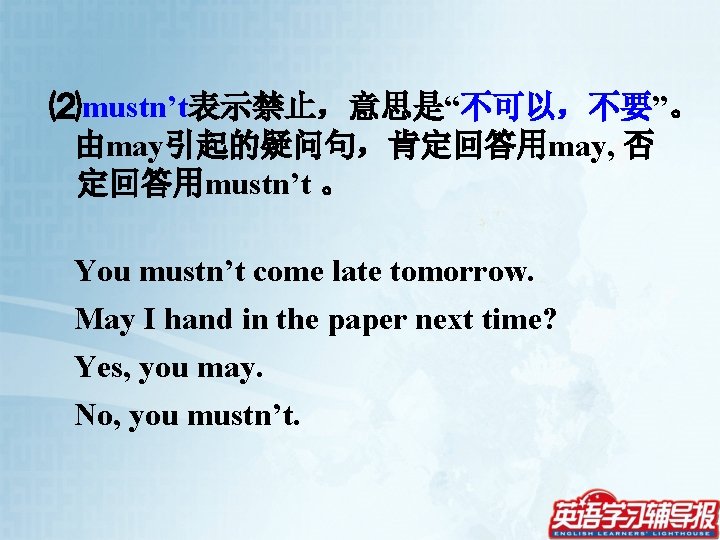
⑵mustn’t表示禁止,意思是“不可以,不要”。 由may引起的疑问句,肯定回答用may, 否 定回答用mustn’t 。 You mustn’t come late tomorrow. May I hand in the paper next time? Yes, you may. No, you mustn’t.
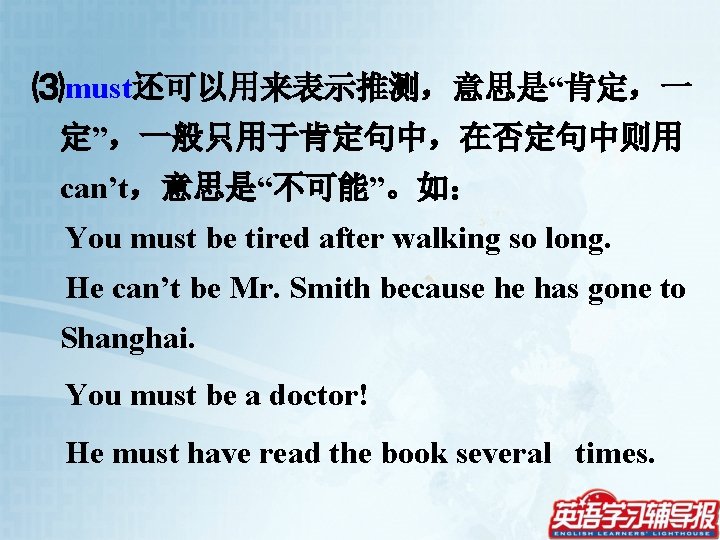
⑶must还可以用来表示推测,意思是“肯定,一 定”,一般只用于肯定句中,在否定句中则用 can’t,意思是“不可能”。如: You must be tired after walking so long. He can’t be Mr. Smith because he has gone to Shanghai. You must be a doctor! He must have read the book several times.
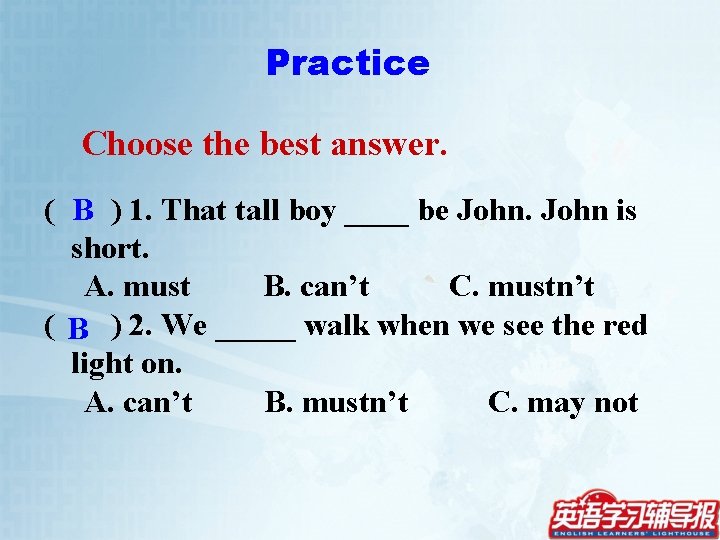
Practice Choose the best answer. ( B ) 1. That tall boy ____ be John is short. A. must B. can’t C. mustn’t ( B ) 2. We _____ walk when we see the red light on. A. can’t B. mustn’t C. may not
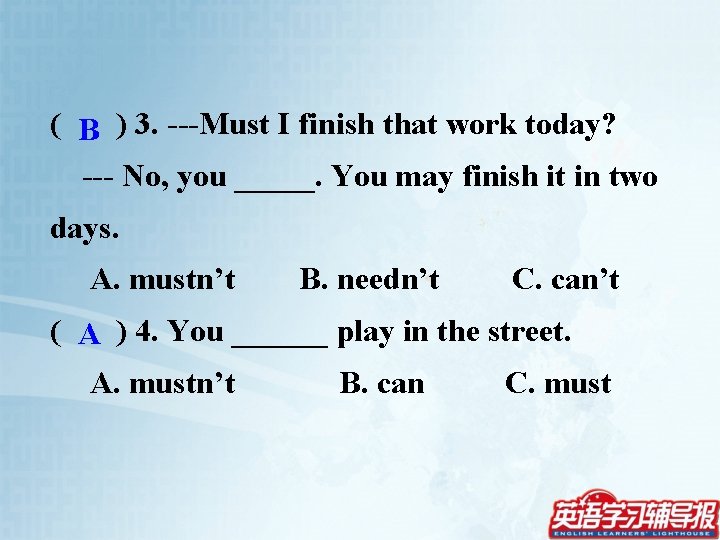
( B ) 3. ---Must I finish that work today? --- No, you _____. You may finish it in two days. A. mustn’t B. needn’t C. can’t ( A ) 4. You ______ play in the street. A. mustn’t B. can C. must
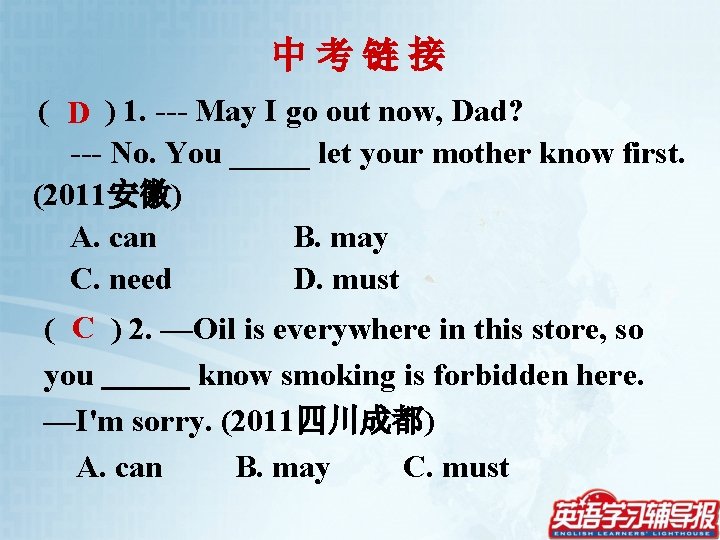
中考链接 ( D ) 1. --- May I go out now, Dad? --- No. You _____ let your mother know first. (2011安徽) A. can B. may C. need D. must ( C ) 2. —Oil is everywhere in this store, so you know smoking is forbidden here. —I'm sorry. (2011四川成都) A. can B. may C. must
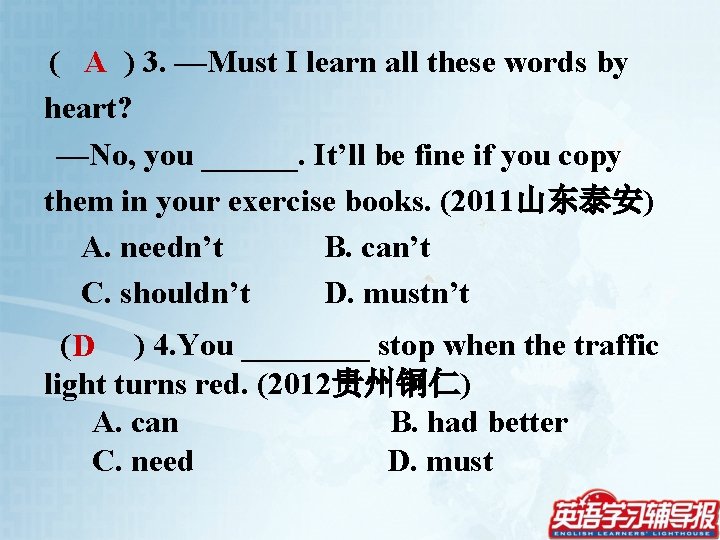
( A ) 3. —Must I learn all these words by heart? —No, you ______. It’ll be fine if you copy them in your exercise books. (2011山东泰安) A. needn’t B. can’t C. shouldn’t D. mustn’t ( D ) 4. You ____ stop when the traffic light turns red. (2012贵州铜仁) A. can B. had better C. need D. must
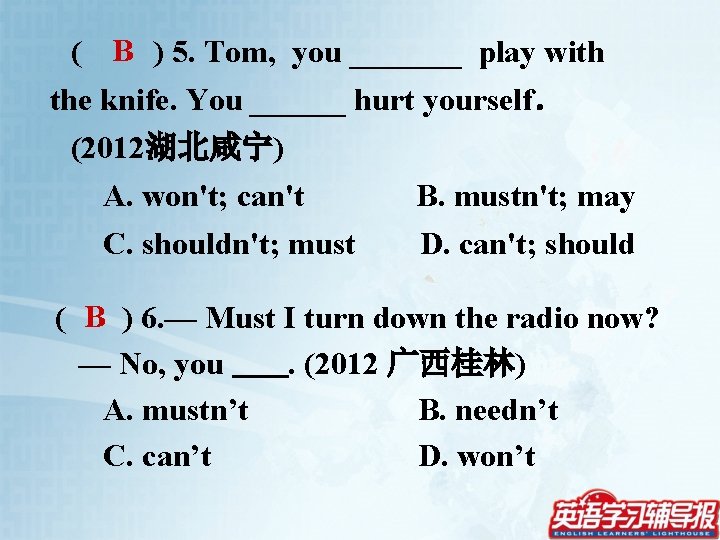
( B ) 5. Tom, you _______ play with the knife. You ______ hurt yourself. (2012湖北咸宁) A. won't; can't B. mustn't; may C. shouldn't; must D. can't; should ( B ) 6. — Must I turn down the radio now? — No, you. (2012 广西桂林) A. mustn’t B. needn’t C. can’t D. won’t
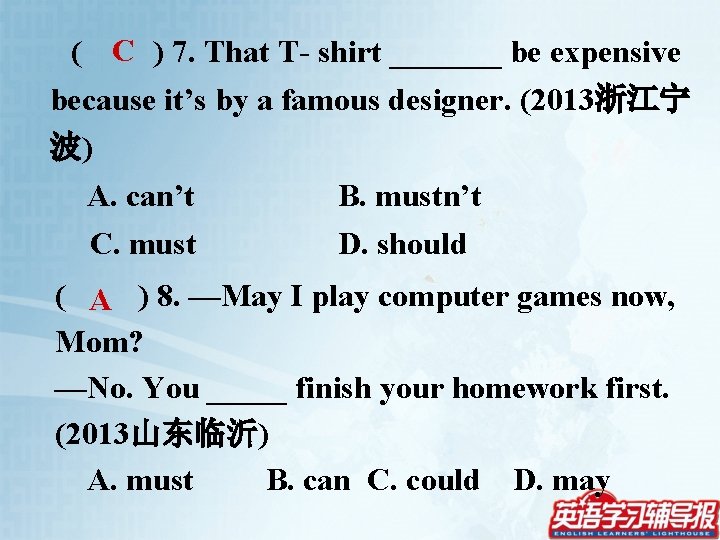
( C ) 7. That T- shirt _______ be expensive because it’s by a famous designer. (2013浙江宁 波) A. can’t B. mustn’t C. must D. should ( A ) 8. —May I play computer games now, Mom? —No. You _____ finish your homework first. (2013山东临沂) A. must B. can C. could D. may
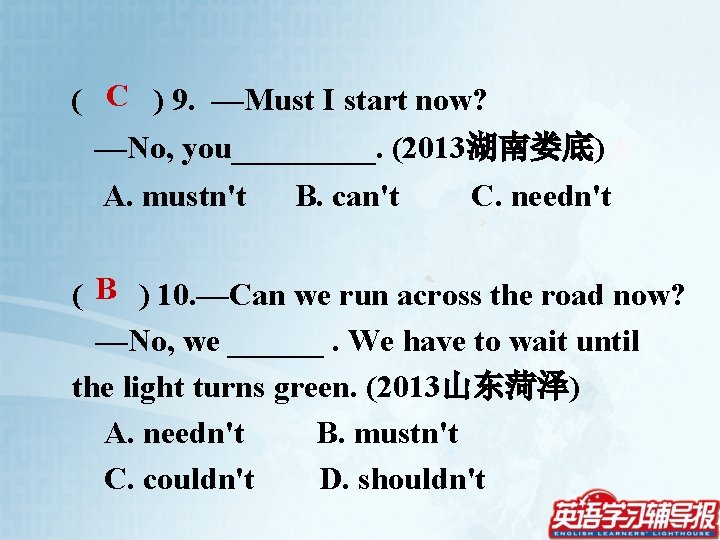
( C ) 9. —Must I start now? —No, you_____. (2013湖南娄底) A. mustn't B. can't C. needn't ( B ) 10. —Can we run across the road now? —No, we ______. We have to wait until the light turns green. (2013山东菏泽) A. needn't B. mustn't C. couldn't D. shouldn't
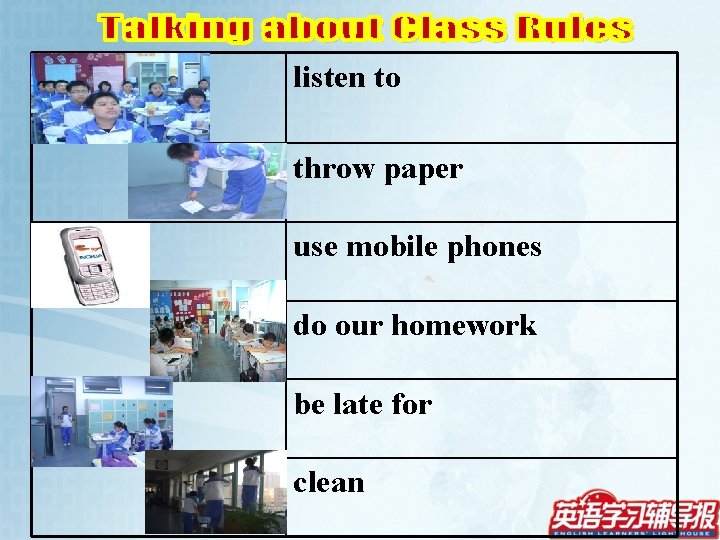
listen to throw paper use mobile phones do our homework be late for clean
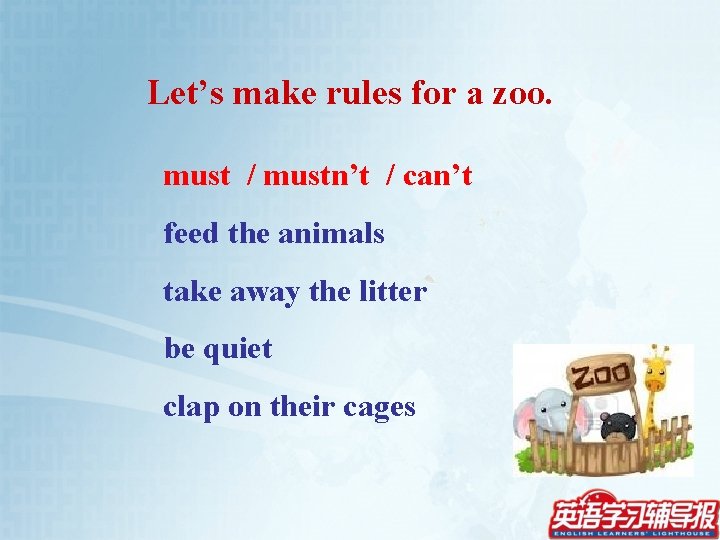
Let’s make rules for a zoo. must / mustn’t / can’t feed the animals take away the litter be quiet clap on their cages
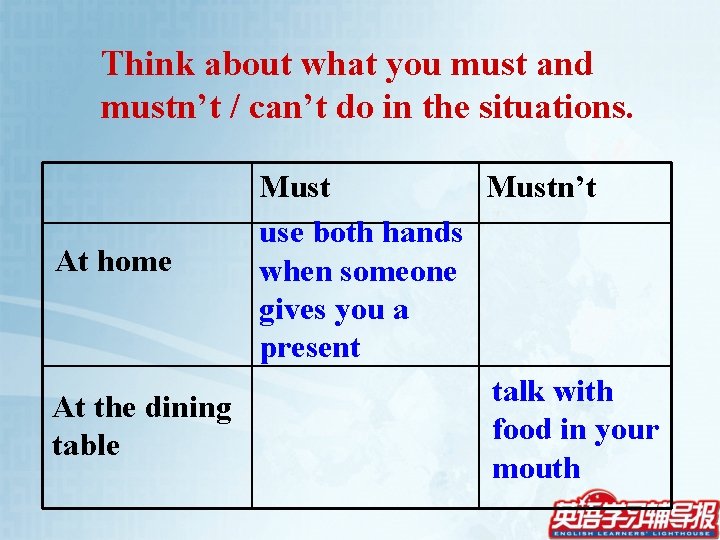
Think about what you must and mustn’t / can’t do in the situations. Mustn’t use both hands At home when someone gives you a present talk with At the dining food in your table mouth