
Unit 1 Fundamentals of Economics Unit 1 Standards





- Slides: 60
Unit 1: Fundamentals of Economics
Unit 1 Standards: SSEF 1, SSEF 2, SSEF 4, SSEF 5, SSEF 6, SSMI 1
Unit 1: EQs What is scarcity? What are the factors of production? How are limited resources allocated? What trade-offs appear on a production possibilities frontier? How are rational decisions made? What are the similarities and differences of a command, market, and mixed economic system? 7. How does each economic system answer the three basic economic questions of what to produce, how to produce, and for whom to produce? 8. How does each economic system meet a society’s broad economic and social goals? 9. What is the role of government in a market economy? 10. How do goods and services flow in a market economy? 11. What is the role of money in a market economy? 1. 2. 3. 4. 5. 6.
Unit 1: Key Terms Scarcity Choice Opportunity cost Trade-offs Factors of production Marginal thinking Production Possibilities curve (frontier) 9. Economic systems 10. 3 basic economic questions 1. 2. 3. 4. 5. 6. 7. 8. 11. 12. 13. 14. 15. 16. 17. 18. 19. 20. 21. Market economy Public goods and services Property rights Market failures Government regulations Deregulation Circular flow diagram Product market Factor market Households Firms
SSEF 1 Explain why limited productive resources and unlimited wants result in scarcity, opportunity costs, and tradeoffs for individuals, businesses, and governments. a. Define scarcity as a basic condition that exists when unlimited wants exceed limited productive resources. b. Define and give examples of productive resources (factors of production) (e. g. , land (natural), labor (human), capital (capital goods), entrepreneurship). c. List a variety of strategies for allocating scarce resources. d. Define opportunity cost as the next best alternative given up when individuals, businesses, and governments confront scarcity by making choices.
Scarcity is the fundamental economic problem of having seemingly unlimited human needs and wants, in a world of limited resources. not all of society's goals can be pursued at the same time trade-offs are made of one good against others.
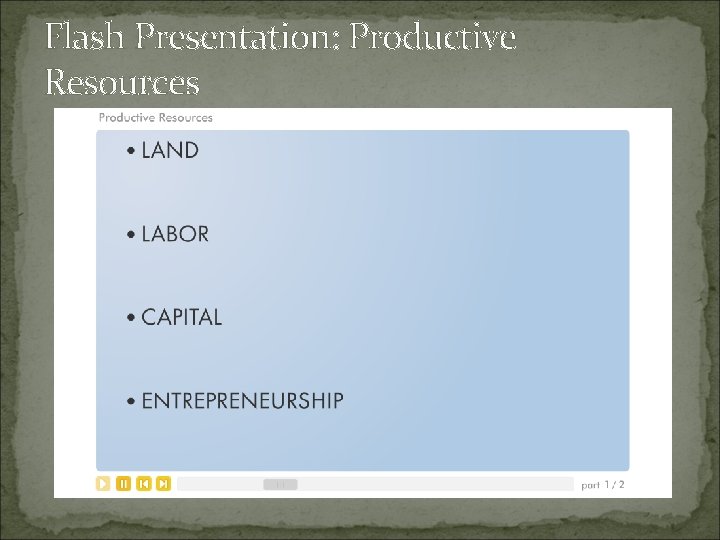
Factors of Production A. K. A. productive resources Anything used in the production of a good or service They are classified into one of the following areas: Land Labor Capital Physical capital Human capital Entrepreneurship
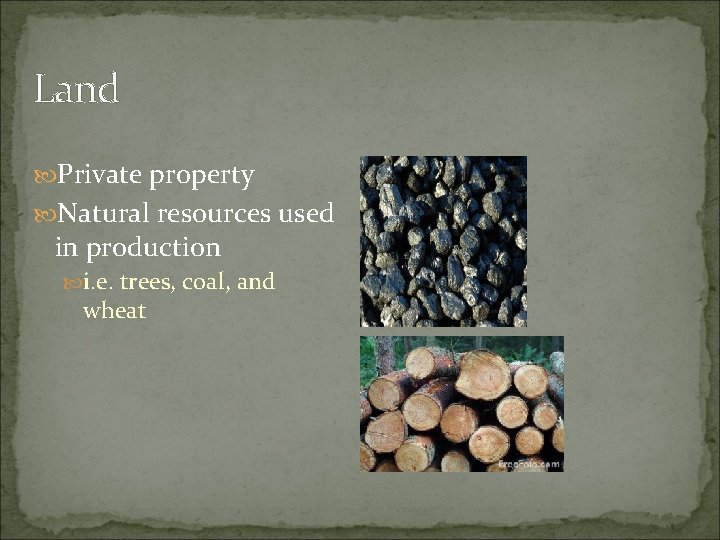
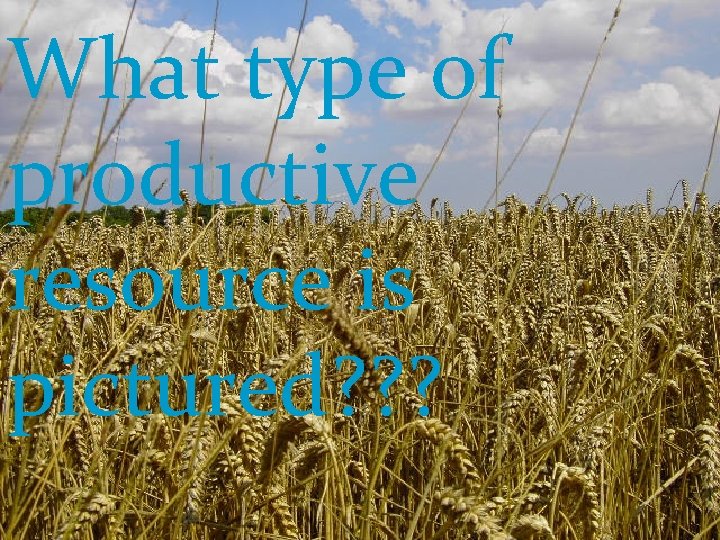
Land Private property Natural resources used in production i. e. trees, coal, and wheat
Labor People who provide skills that assist in the production of a good or service
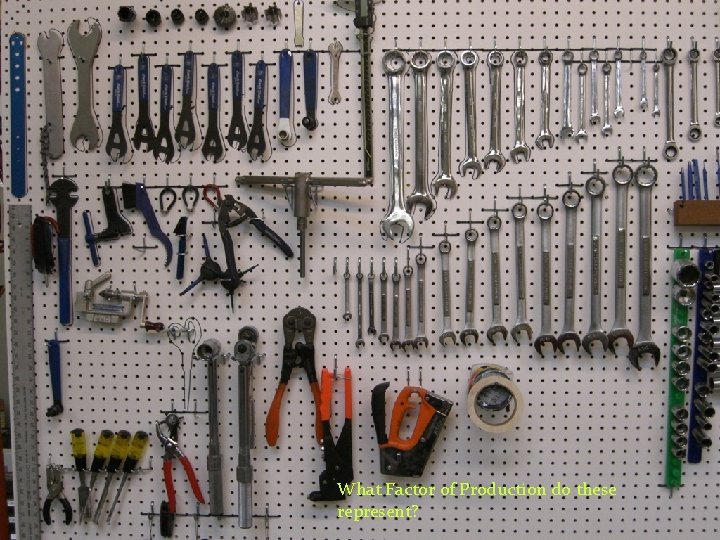
Capital Physical – technology, equipment, buildings, and tools that assist in the production of a good or service Human – the knowledge and skills that assist in the production of a good or service Example: taxi cab driver’s knowledge of city streets
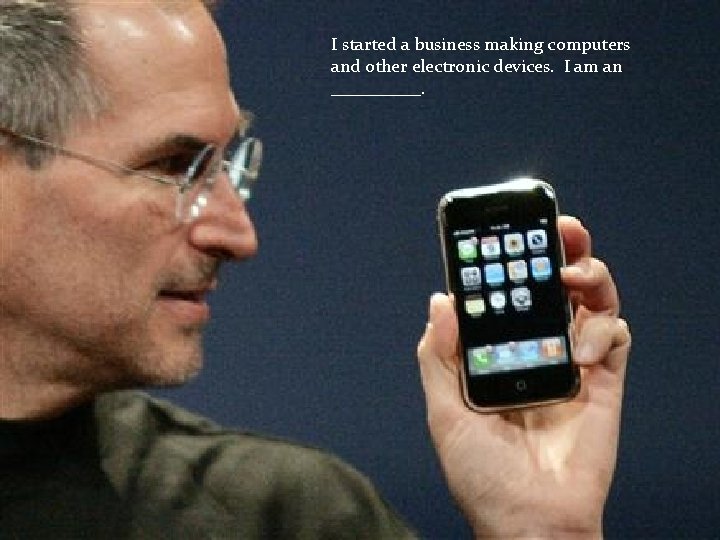
Entrepreneurship The risk-taking and managerial skills needed to start any business
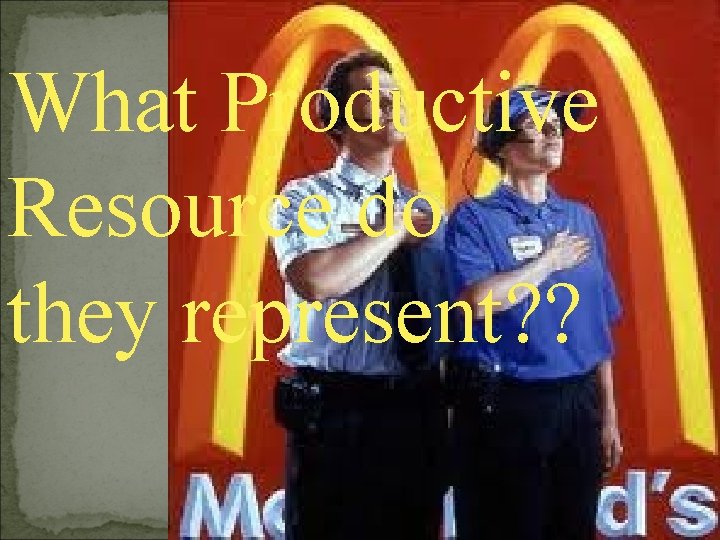
What Productive Resource do they represent? ?
What type of productive resource is pictured? ? ?
What Factor of Production is in this lady’s brain? ?
I started a business making computers and other electronic devices. I am an _____.
What Factor of Production do these represent?
Flash Presentation: Productive Resources
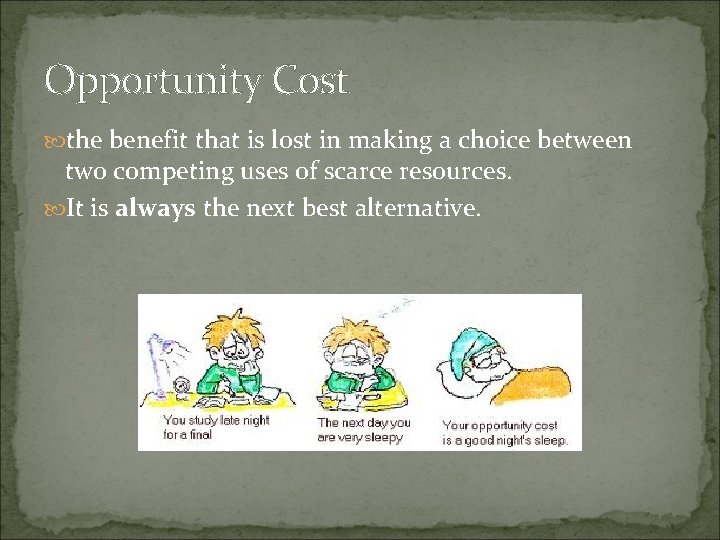
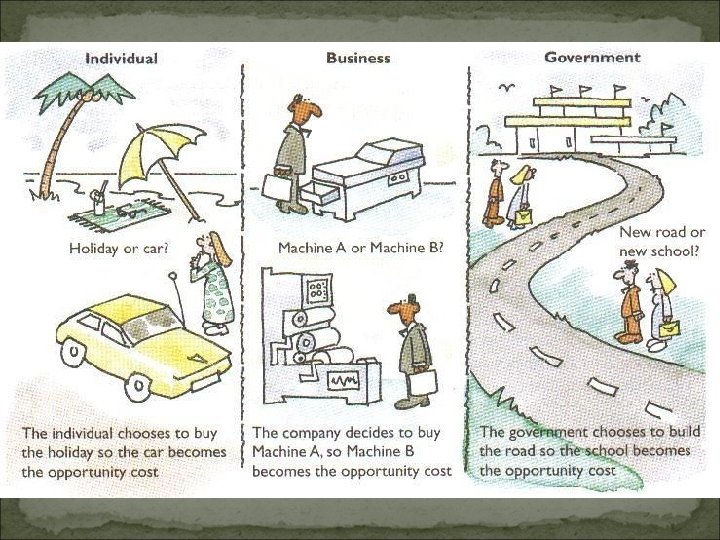
Opportunity Cost the benefit that is lost in making a choice between two competing uses of scarce resources. It is always the next best alternative.
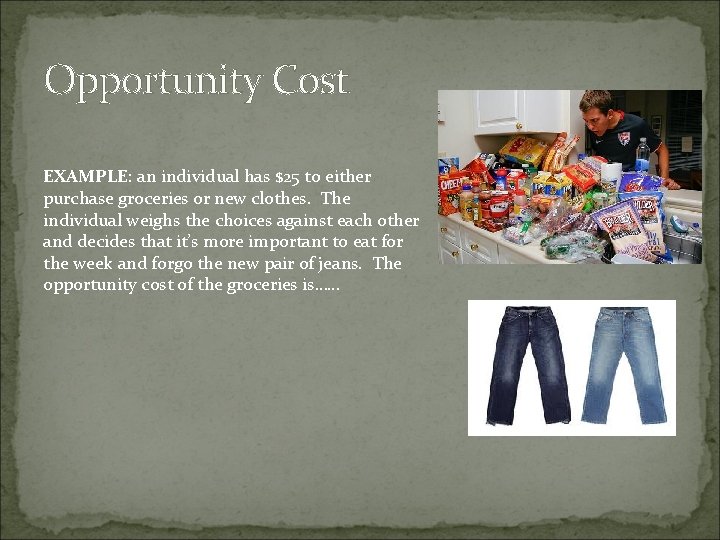
Opportunity Cost EXAMPLE: an individual has $25 to either purchase groceries or new clothes. The individual weighs the choices against each other and decides that it’s more important to eat for the week and forgo the new pair of jeans. The opportunity cost of the groceries is……
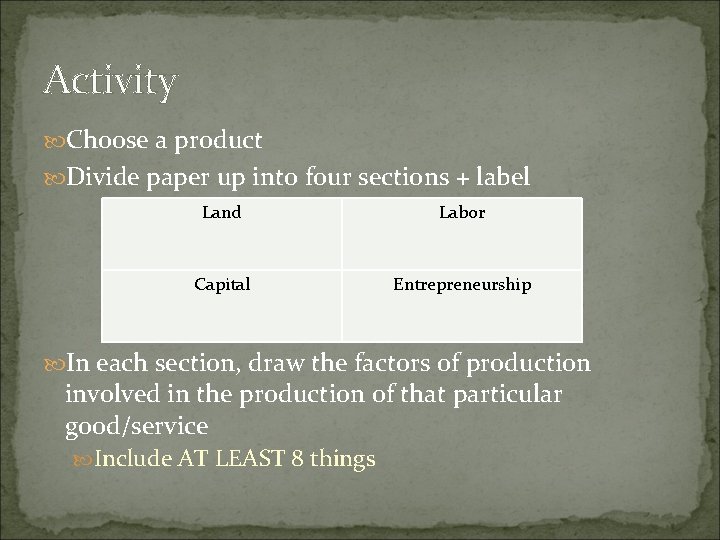
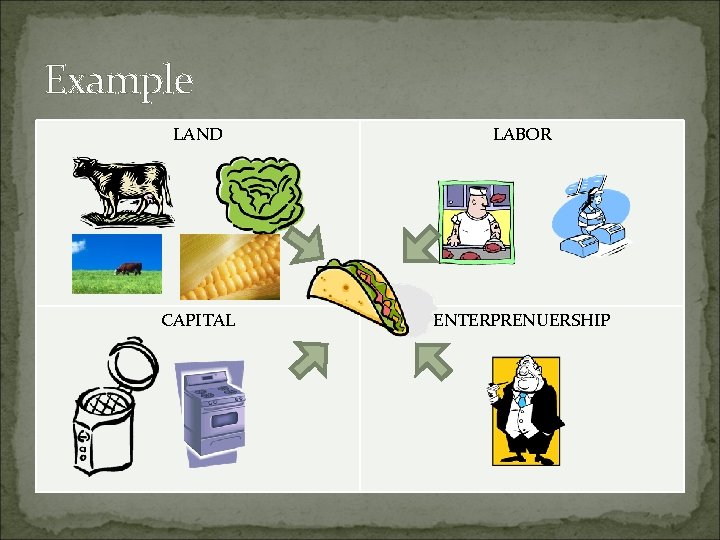
Activity Choose a product Divide paper up into four sections + label Land Labor Capital Entrepreneurship In each section, draw the factors of production involved in the production of that particular good/service Include AT LEAST 8 things
Example LAND LABOR CAPITAL ENTERPRENUERSHIP
GPS SSEF 2 Give examples of how rational decision making entails comparing the marginal benefits and the marginal costs of an action. a. Illustrate by means of a production possibilities curve the trade offs between two options. b. Explain that rational decisions occur when the marginal benefits of an action equal or exceed the marginal costs.
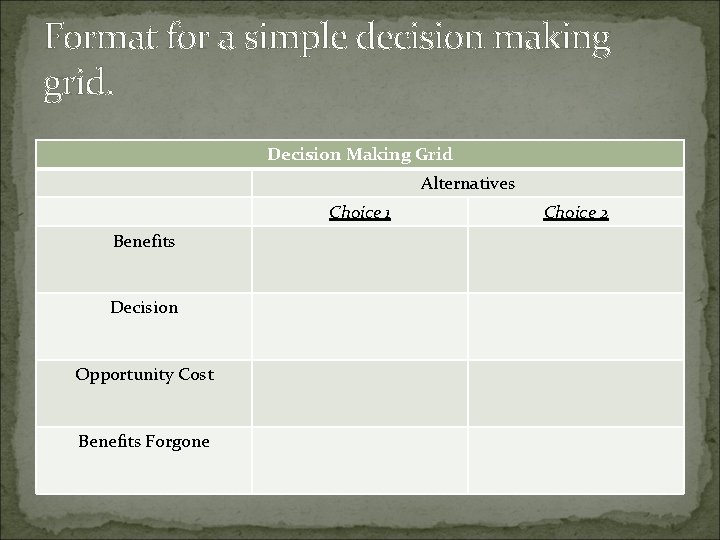
What is a decision making grid? Sometimes, making a decision can be complex or unclear Putting this kind of information “on paper” can make the opportunity cost clear, and make the decision easier
Format for a simple decision making grid. Decision Making Grid Alternatives Choice 1 Benefits Decision Opportunity Cost Benefits Forgone Choice 2
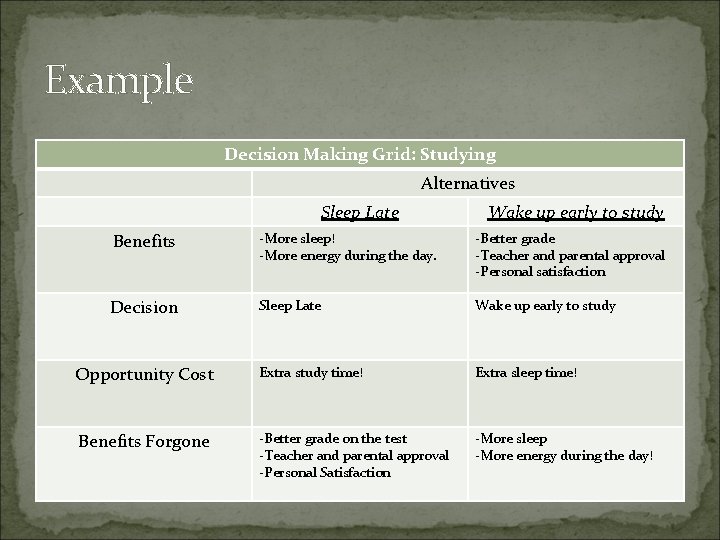
Example Decision Making Grid: Studying Alternatives Sleep Late Wake up early to study Benefits -More sleep! -More energy during the day. -Better grade -Teacher and parental approval -Personal satisfaction Decision Sleep Late Wake up early to study Opportunity Cost Extra study time! Extra sleep time! Benefits Forgone -Better grade on the test -Teacher and parental approval -Personal Satisfaction -More sleep -More energy during the day!
Thinking at the margin Not all choices are all or nothing Sometimes you can decide “how much” of one choice you can do and “how much” of the other This is called “Thinking at the Margin”
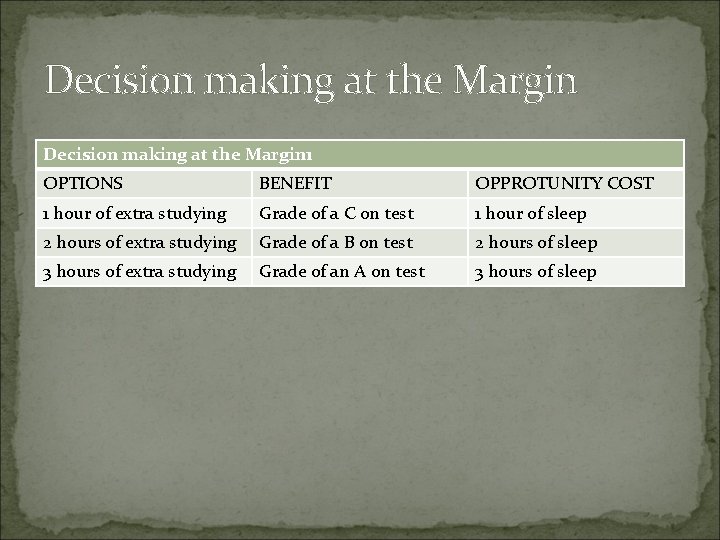
Decision making at the Margin 1 OPTIONS BENEFIT OPPROTUNITY COST 1 hour of extra studying Grade of a C on test 1 hour of sleep 2 hours of extra studying Grade of a B on test 2 hours of sleep 3 hours of extra studying Grade of an A on test 3 hours of sleep
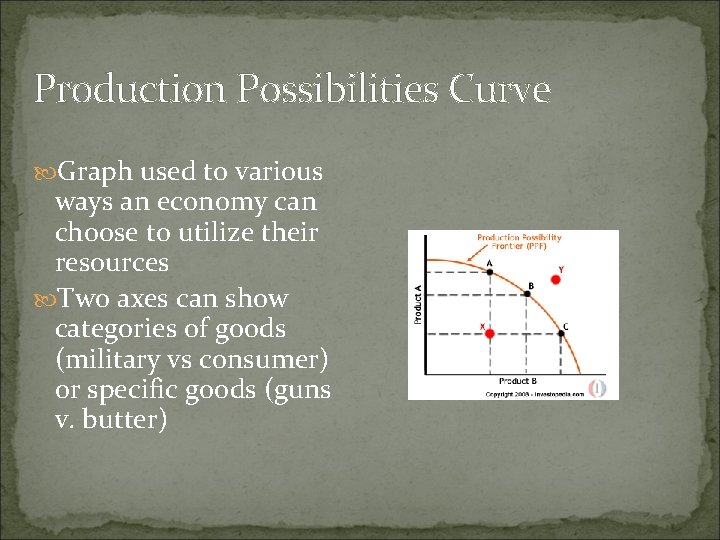
Production Possibilities Curve Graph used to various ways an economy can choose to utilize their resources Two axes can show categories of goods (military vs consumer) or specific goods (guns v. butter)
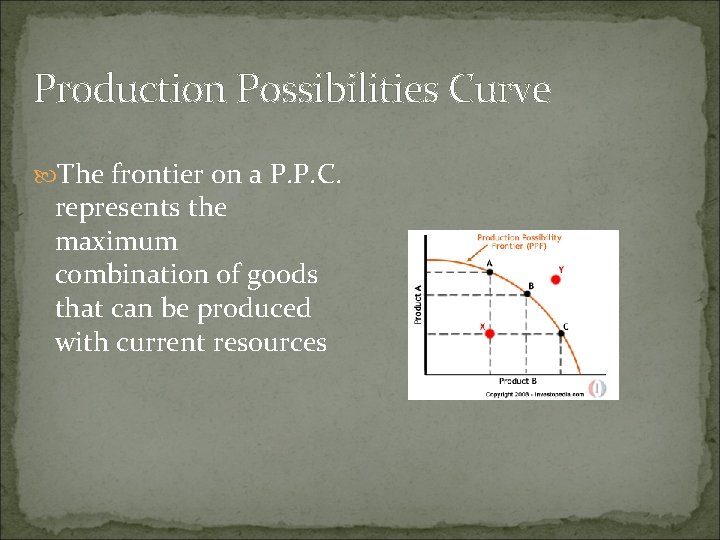
Production Possibilities Curve The frontier on a P. P. C. represents the maximum combination of goods that can be produced with current resources
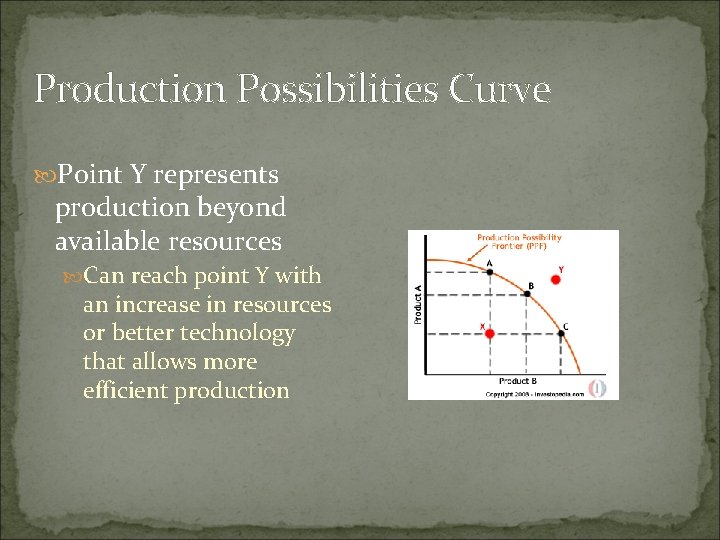
Production Possibilities Curve Point Y represents production beyond available resources Can reach point Y with an increase in resources or better technology that allows more efficient production
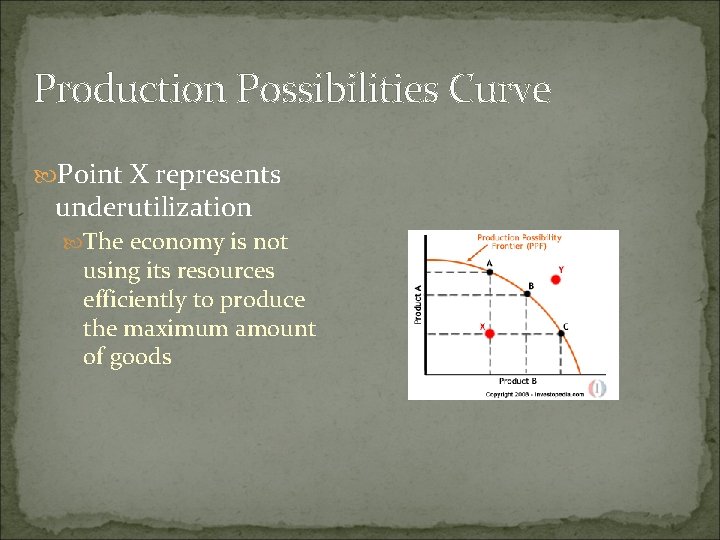
Production Possibilities Curve Point X represents underutilization The economy is not using its resources efficiently to produce the maximum amount of goods
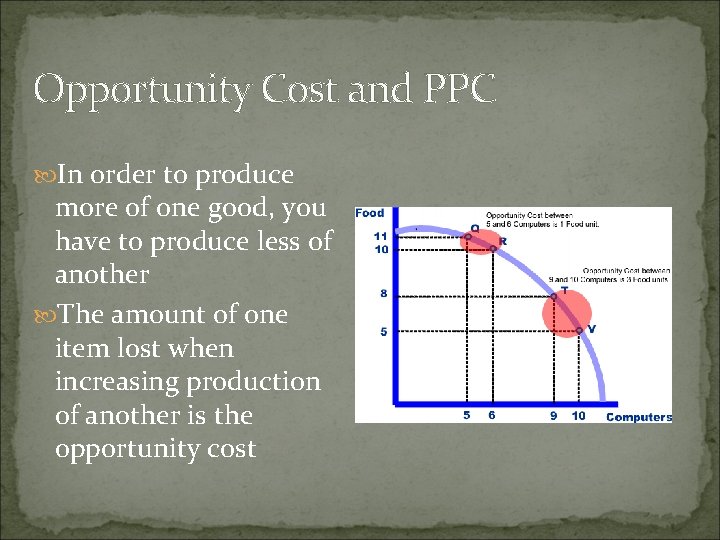
Opportunity Cost and PPC In order to produce more of one good, you have to produce less of another The amount of one item lost when increasing production of another is the opportunity cost
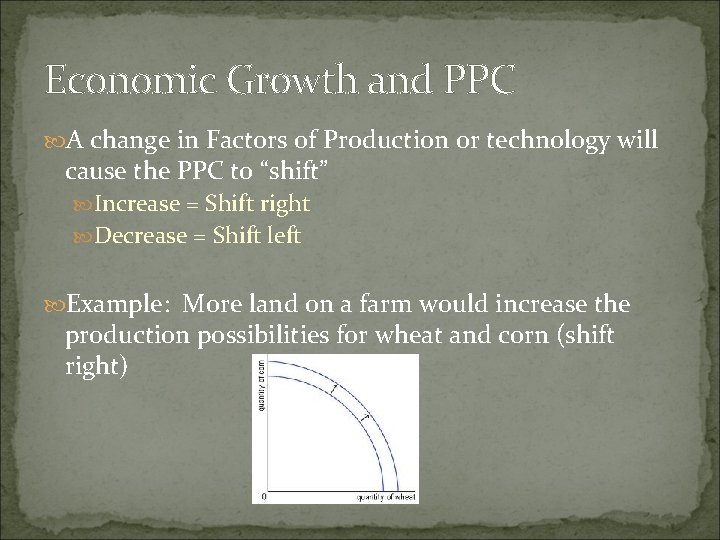
Economic Growth and PPC A change in Factors of Production or technology will cause the PPC to “shift” Increase = Shift right Decrease = Shift left Example: More land on a farm would increase the production possibilities for wheat and corn (shift right)
Activity Create a table showing the production possibilities between two alternatives Graph the points & create a Production Possibilities curve Include 2 things that could cause Production Possibilities to increase Sketch an additional curve showing growth Include 2 things that could cause Production Possibilities to decrease Sketch an additional curve showing reduction
3 Economic Systems Unit 1 Notes 3
GPS SSEF 4 Compare and contrast different economic systems and explain how they answer the three basic economic questions of what to produce, how to produce, and for whom to produce. a. Compare command, market, and mixed economic systems with regard to private ownership, profit motive, consumer sovereignty, competition, and government regulation. b. Evaluate how well each type of system answers the three economic questions and meets the broad social and economic goals of freedom, security, equity, growth, efficiency, and stability.
3 Key Economic Questions Because resources are limited, all societies must answer the following: What goods and services to produce? How to produce? For whom to produce?
Different Economic Systems
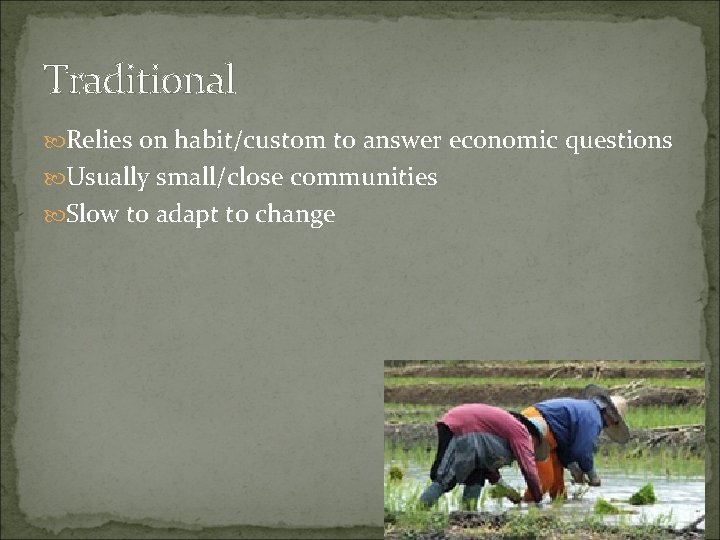
Traditional Relies on habit/custom to answer economic questions Usually small/close communities Slow to adapt to change
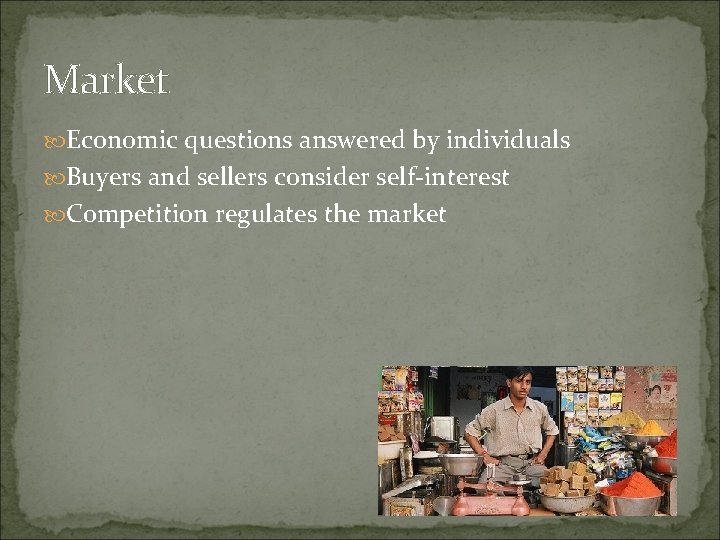
Market Economic questions answered by individuals Buyers and sellers consider self-interest Competition regulates the market
Market Advantages Disadvantages Freedom Less stability Efficiency Inequality Encourages growth Consumers have a great deal of control
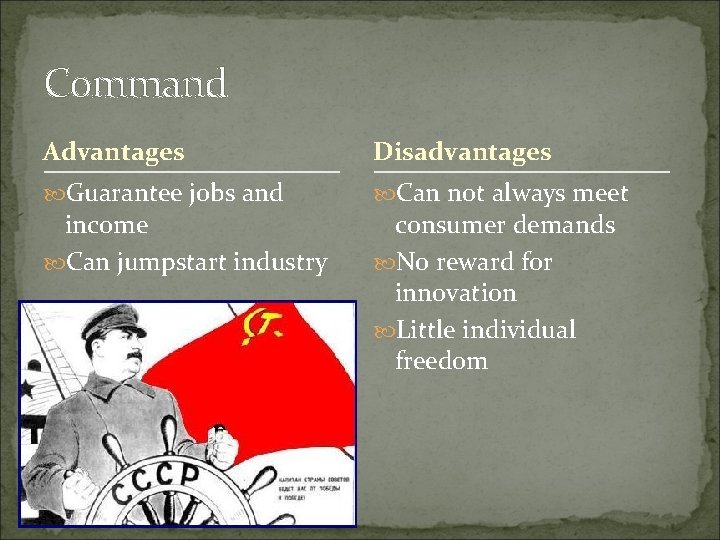
Command Governments answer economic questions Terms associated: Socialism Democratic means should be used to distribute wealth evenly though society democracy Communism All economic and political power lies with the government authoritarian
Command Advantages Disadvantages Guarantee jobs and Can not always meet income Can jumpstart industry consumer demands No reward for innovation Little individual freedom
Mixed In reality, no one economic system can answer all economic questions Most economies use aspects of both free market and centrally planned economics to accomplish their goals
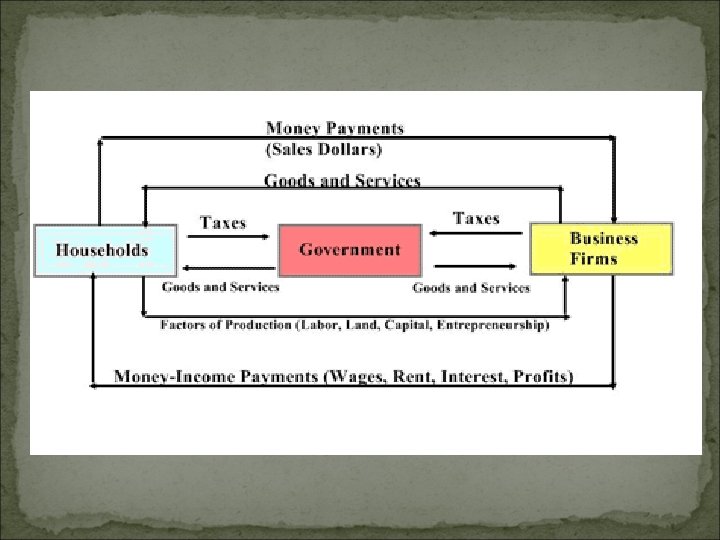
GPS SSEMI 1 Describe how households, businesses, and governments are interdependent and interact through flows of goods, services, and money. a. Illustrate by means of a circular flow diagram, the Product market; the Resource (factor) market; the real flow of goods and services between and among businesses, households, and government; and the flow of money. b. Explain the role of money as a medium of exchange and how it facilitates exchange.
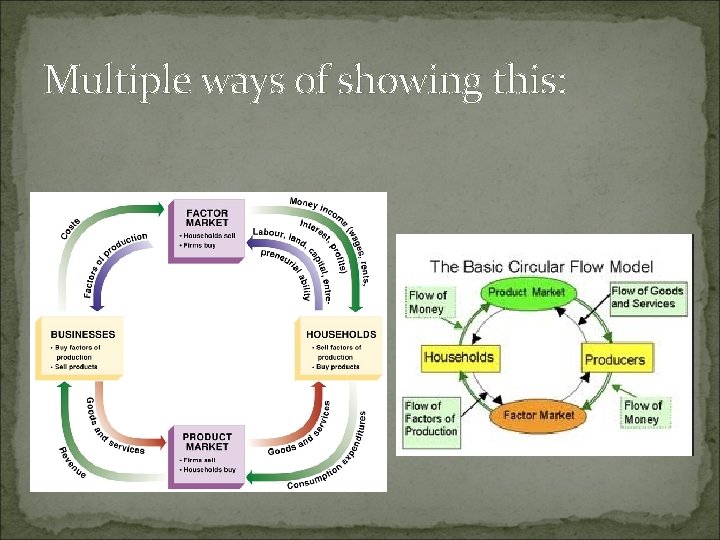
Money in the Free Market Players Households Own the factors of production and consume goods + services Firms Uses factors of production to produce a product
Money in the Free Market Factors of production and products are exchanged in 2 markets FACTOR MARKET (A. k. a. Resource Market) Households supply Factors of Production to firms in exchange for money PRODUCT MARKET Firms supply households with goods and services in exchange for money
Multiple ways of showing this:
Money in a Mixed Economy 3 rd player is added to market Government Factor market – purchases Factors of Production from households Product Market – buys goods and services from firms Government collects money from firms and households through taxes + provides goods and services
Activity: Create a MARKET ECONOMY circular flow model using a specific business Draw & label the firm and the household 20% Show which way money is moving around the economy 20% Show which way goods/resources are moving around the economy 20% Explain what is happening in the factor market 20% Explain what is happening in the product market 20%
GPS SSEF 5 Describe the roles of government in a market economy. a. Explain why government provides public goods and services, redistributes income, protects property rights, and resolves market failures. b. Give examples of government regulation and deregulation and their effects on consumers and producers.
Promoting Strength Because of the business cycle, the American government aims to stabilize the economy by Keeping employment high Unemployment between 3% and 6% Keeping growth steady Economy must grow with population for there to be jobs and goods for everyone Keeping prices stable Prevent inflation through regulating banks and businesses
Increasing Productivity The Federal Government promotes technological innovation through federal agencies (like NASA) and by offering patents
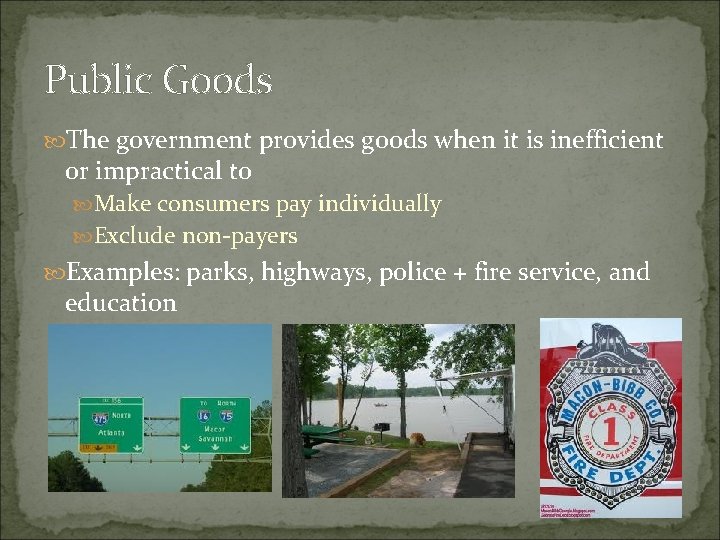
Public Goods The government provides goods when it is inefficient or impractical to Make consumers pay individually Exclude non-payers Examples: parks, highways, police + fire service, and education
Free rider With any public good, people who would chose not to pay can still benefit These individuals are called “free riders”
Externalities An economic side effect of a good or service that generates benefits or costs to someone other then the person deciding how much to produce or consume Two Types: Positive Generates benefits for someone other then the individuals paying Negative Generates costs for someone other then the person paying for the good or service
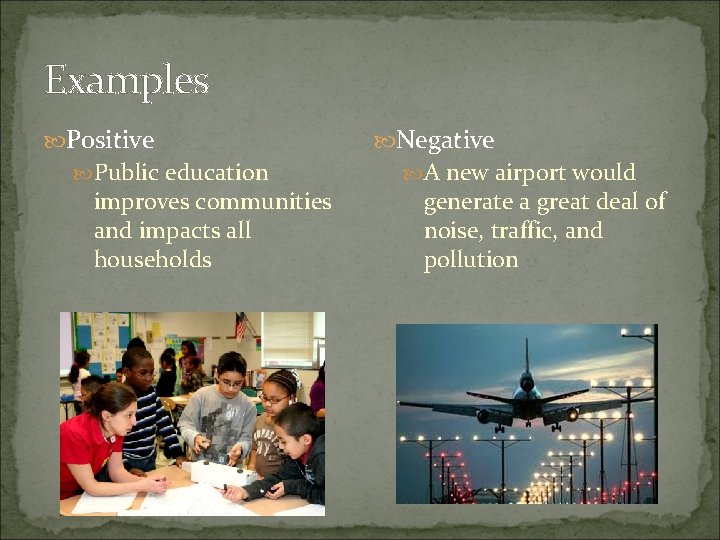
Examples Positive Public education improves communities and impacts all households Negative A new airport would generate a great deal of noise, traffic, and pollution