
Unit 1 Epistemology Knowledge Belief and Truth The
Unit 1: Epistemology Knowledge, Belief, and Truth
“The Mouse Who Ate The Cheese” A story
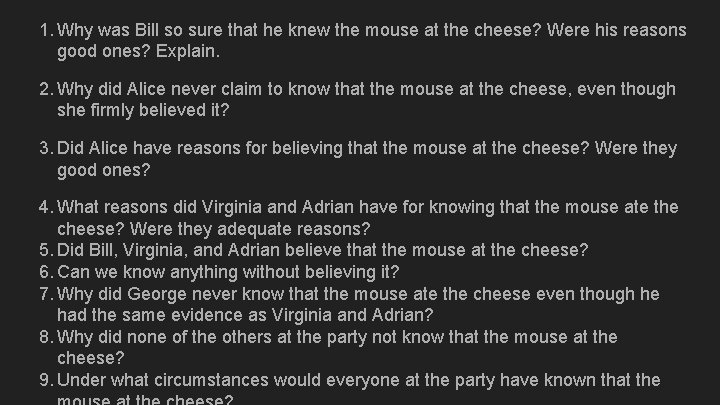
1. Why was Bill so sure that he knew the mouse at the cheese? Were his reasons good ones? Explain. 2. Why did Alice never claim to know that the mouse at the cheese, even though she firmly believed it? 3. Did Alice have reasons for believing that the mouse at the cheese? Were they good ones? 4. What reasons did Virginia and Adrian have for knowing that the mouse ate the cheese? Were they adequate reasons? 5. Did Bill, Virginia, and Adrian believe that the mouse at the cheese? 6. Can we know anything without believing it? 7. Why did George never know that the mouse ate the cheese even though he had the same evidence as Virginia and Adrian? 8. Why did none of the others at the party not know that the mouse at the cheese? 9. Under what circumstances would everyone at the party have known that the
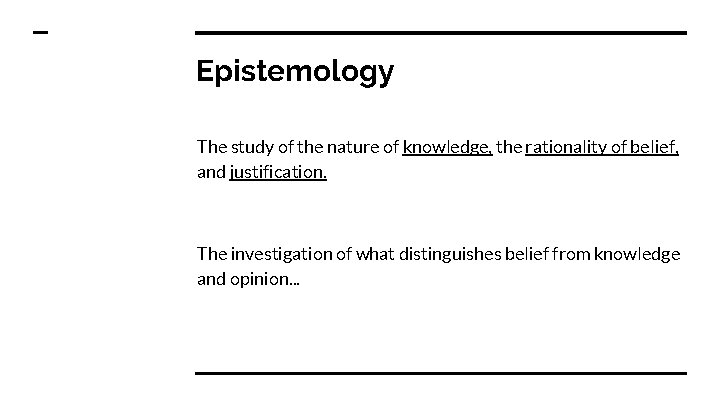
Epistemology The study of the nature of knowledge, the rationality of belief, and justification. The investigation of what distinguishes belief from knowledge and opinion. . .
KNOWLEDGE 1. What can we know? 2. How can we be sure we know it? 3. Are there different types of knowledge?
Socrates (Greece, 470 -399 B. C. ) First of the Academic philosophers. �Taught through public discussion. Questioned how we ought to live and what the good life for man might be. Continuous critical reflection/critical thought. “The only thing I know is that I know nothing. ”
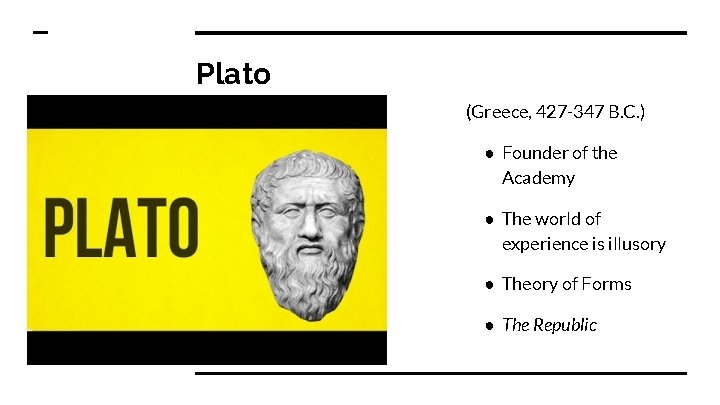
Plato (Greece, 427 -347 B. C. ) ● Founder of the Academy ● The world of experience is illusory ● Theory of Forms ● The Republic
Plato’s Theory of Forms ● We can’t see anything that is “abstract, ” aka The Forms. ● Anything we experience through our senses are particular things, not the abstract. ● What “really” exists; unchanging and eternal. ● Example: Beauty. ○ Many things could be “beautiful, ” but they can’t be Beauty. ○ Beauty exists because even if beautiful things are destroyed, Beauty still exists. ● We can only know the Forms if we reorient ourselves away from the
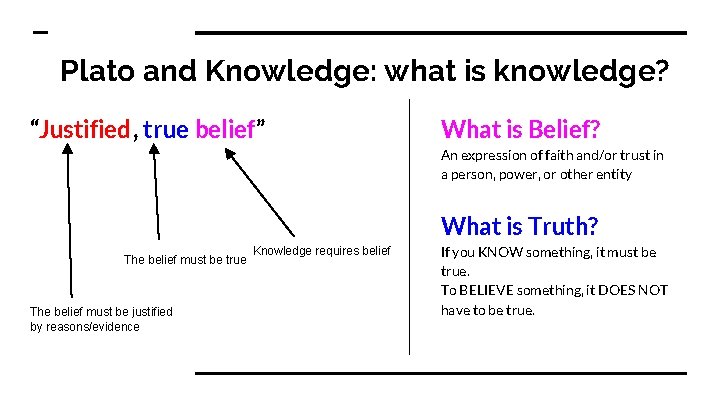
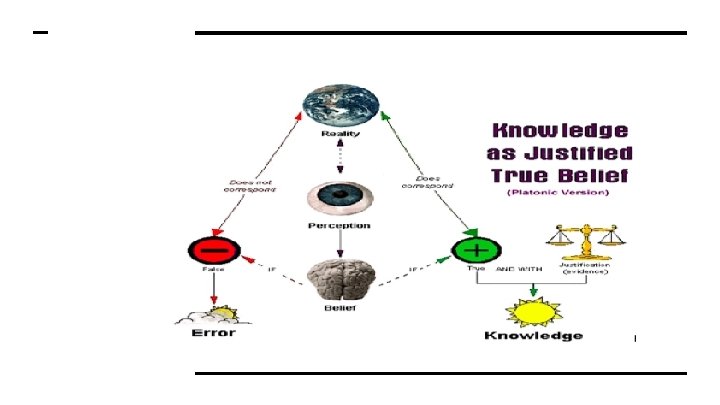
Plato and Knowledge: what is knowledge? “Justified, true belief” What is Belief? An expression of faith and/or trust in a person, power, or other entity What is Truth? The belief must be true The belief must be justified by reasons/evidence Knowledge requires belief If you KNOW something, it must be true. To BELIEVE something, it DOES NOT have to be true.
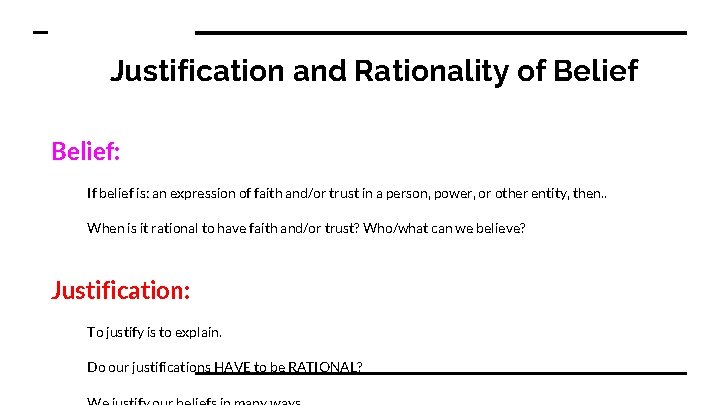
Justification and Rationality of Belief: If belief is: an expression of faith and/or trust in a person, power, or other entity, then. . When is it rational to have faith and/or trust? Who/what can we believe? Justification: To justify is to explain. Do our justifications HAVE to be RATIONAL?
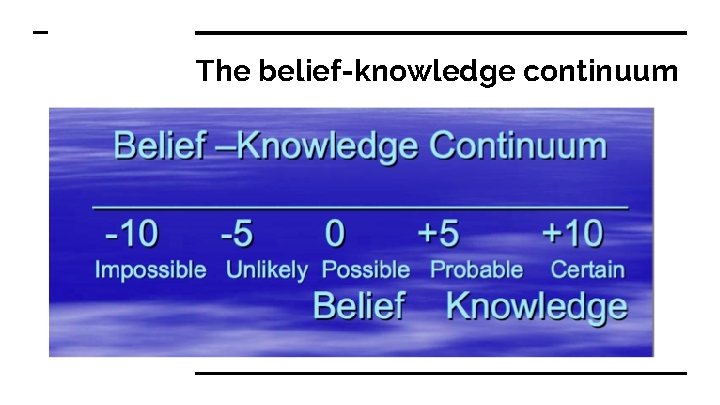
The belief-knowledge continuum
Rank these, according to the continuum 1. Columbus discovered America in 1492. 2. If A is bigger than B and B is bigger than C, then A is bigger than C. 3. Human beings descended from Apes. 4. Killing is wrong. 5. Aliens have visited Earth at some time in its history. 6. All metals expand when heated. 7. Human beings have an immortal soul. 8. It is possible to construct a square with the same given area as a circle.
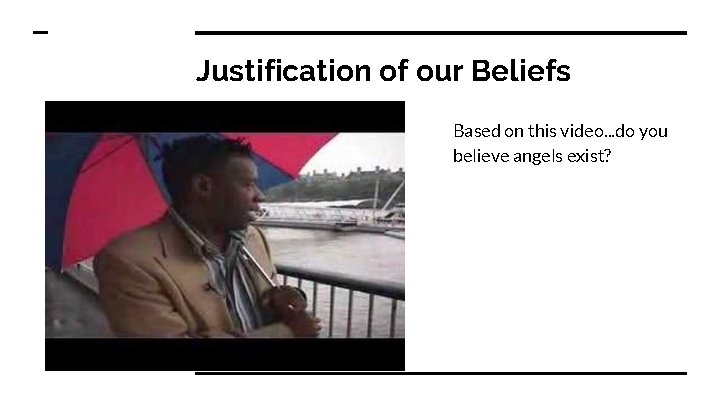
Justification of our Beliefs Based on this video. . . do you believe angels exist?
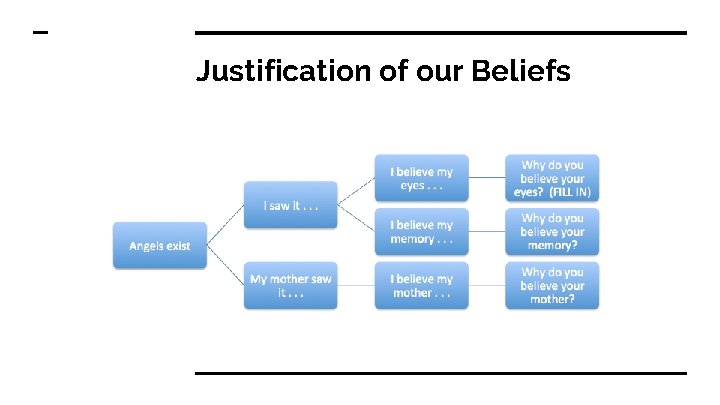
Justification of our Beliefs
A Priori - When you can’t offer any more support for your argument… - That’s where you stop.
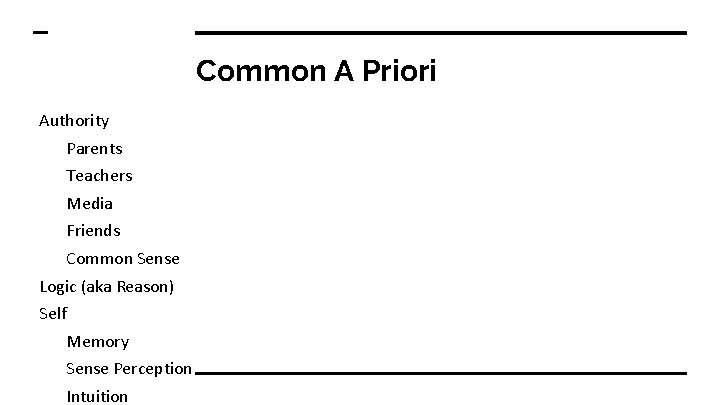
Common A Priori Authority Parents Teachers Media Friends Common Sense Logic (aka Reason) Self Memory Sense Perception Intuition
- Slides: 17