
Unit 1 Cont Free Fall Projectile Motion Free
- Slides: 12
Unit 1 Con’t Free Fall & Projectile Motion
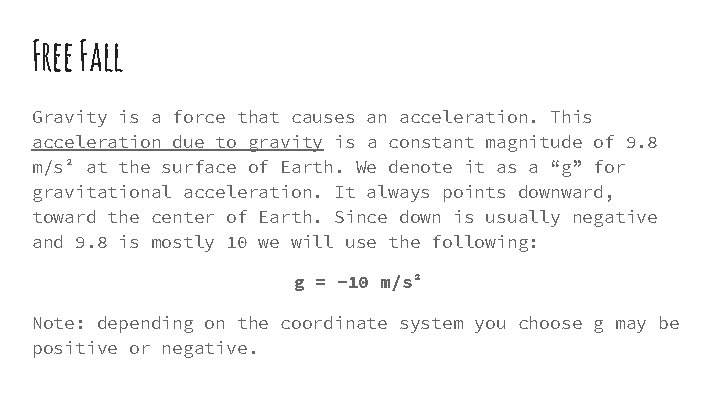
Free Fall Gravity is a force that causes an acceleration. This acceleration due to gravity is a constant magnitude of 9. 8 m/s² at the surface of Earth. We denote it as a “g” for gravitational acceleration. It always points downward, toward the center of Earth. Since down is usually negative and 9. 8 is mostly 10 we will use the following: g = -10 m/s² Note: depending on the coordinate system you choose g may be positive or negative.
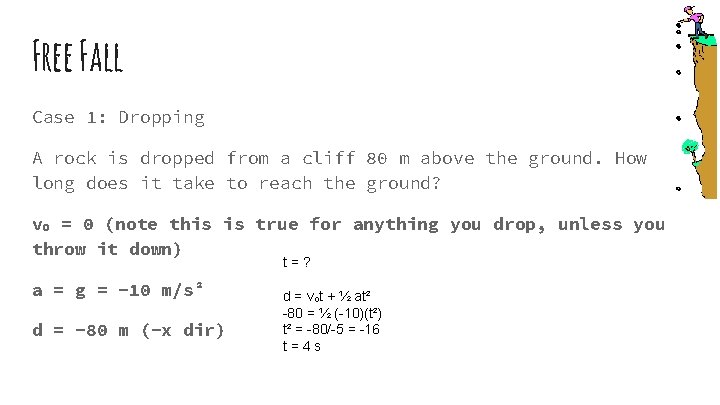
Free Fall Case 1: Dropping A rock is dropped from a cliff 80 m above the ground. How long does it take to reach the ground? vₒ = 0 (note this is true for anything you drop, unless you throw it down) t=? a = g = -10 m/s² d = -80 m (-x dir) d = vₒt + ½ at² -80 = ½ (-10)(t²) t² = -80/-5 = -16 t=4 s
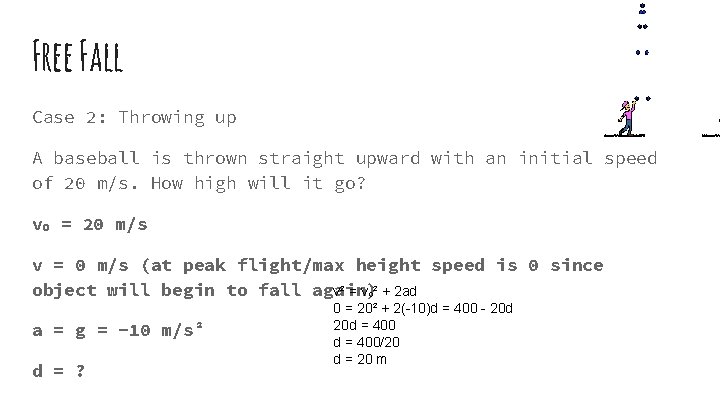
Free Fall Case 2: Throwing up A baseball is thrown straight upward with an initial speed of 20 m/s. How high will it go? vₒ = 20 m/s v = 0 m/s (at peak flight/max height speed is 0 since object will begin to fall again) v² = vₒ² + 2 ad a = g = -10 m/s² d = ? 0 = 20² + 2(-10)d = 400 - 20 d = 400/20 d = 20 m
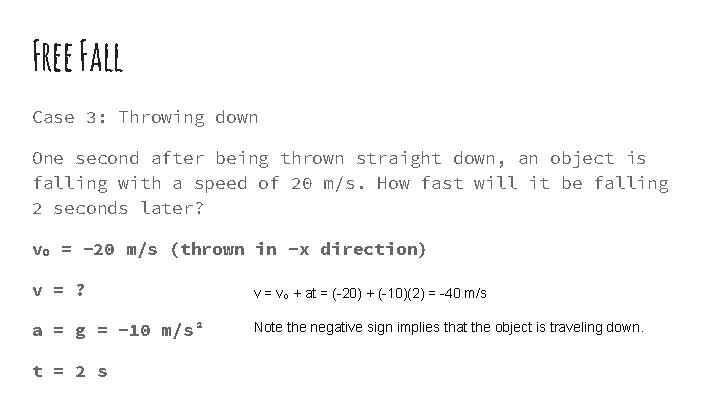
Free Fall Case 3: Throwing down One second after being thrown straight down, an object is falling with a speed of 20 m/s. How fast will it be falling 2 seconds later? vₒ = -20 m/s (thrown in -x direction) v = ? v = vₒ + at = (-20) + (-10)(2) = -40 m/s a = g = -10 m/s² Note the negative sign implies that the object is traveling down. t = 2 s
Free Fall Example: If an object is thrown straight upward with an initial speed of 8 m/s and takes 3 seconds to strike the ground, from what height was the object thrown? (NOTE: the time it takes for an object to be thrown straight up is the same as the time it takes for an object to fall down from the peak back to your hand)
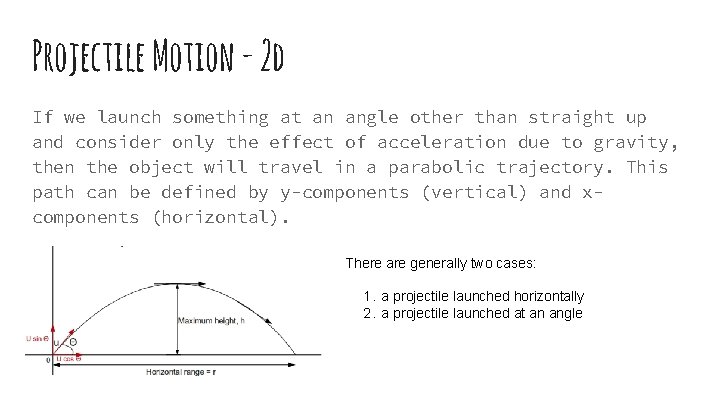
Projectile Motion - 2 d If we launch something at an angle other than straight up and consider only the effect of acceleration due to gravity, then the object will travel in a parabolic trajectory. This path can be defined by y-components (vertical) and xcomponents (horizontal). There are generally two cases: 1. a projectile launched horizontally 2. a projectile launched at an angle
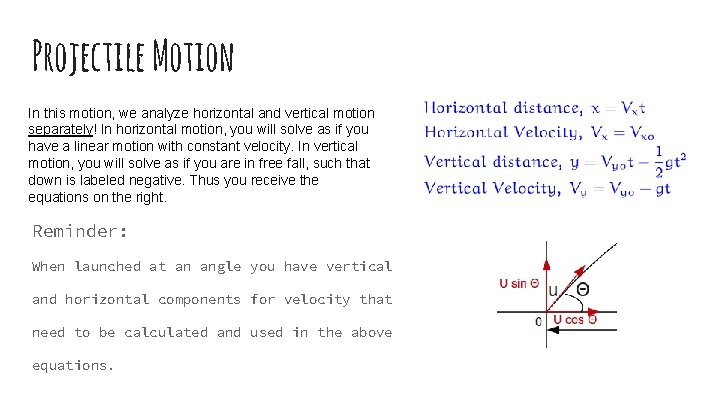
Projectile Motion In this motion, we analyze horizontal and vertical motion separately! In horizontal motion, you will solve as if you have a linear motion with constant velocity. In vertical motion, you will solve as if you are in free fall, such that down is labeled negative. Thus you receive the equations on the right. Reminder: When launched at an angle you have vertical and horizontal components for velocity that need to be calculated and used in the above equations.
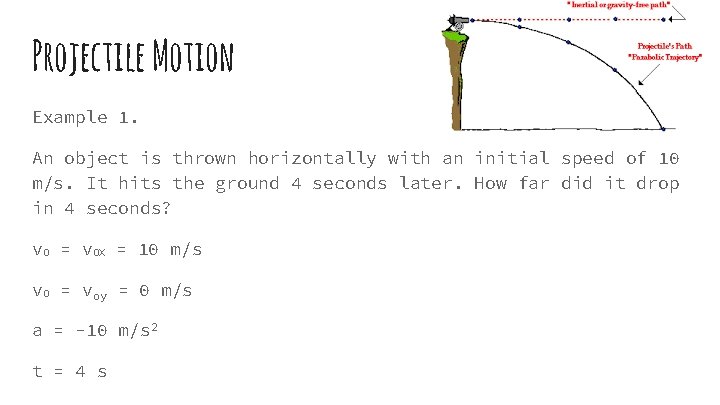
Projectile Motion Example 1. An object is thrown horizontally with an initial speed of 10 m/s. It hits the ground 4 seconds later. How far did it drop in 4 seconds? vₒ = vₒₓ = 10 m/s vₒ = voy = 0 m/s a = -10 m/s 2 t = 4 s
Projectile motion Example 2. From a height of 100 m, a ball is thrown horizontally with an initial speed of 15 m/s. How far does it travel horizontally in the first 2 seconds?
Projectile Motion Example 3. An object is projected upward with a 30⁰ launch angle and an initial speed of 40 m/s. How long will it take for the object to reach the top of its trajectory? How high is this? Hint: for the vertical component you can treat it as if you throw straight up. . . just remember the object traveling to the peak is only part of the total time. . . it still needs to fall.
Projectile motion Example 4. An object is projected upward with the ground an initial speed of seconds will it be in the air? How horizontally? Assume it returns to a 30⁰ launch angle from 60 m/s. For how many far will it travel its original height. Hint: If you use v = -vo in your equation you will not need to multiply by 2 at the end to get the full time.