
UNIT 1 BOILER FEED WATER The water into
UNIT - 1
BOILER FEED WATER Ø The water into boiler fed the production the for of steam is called boiler feed water. Ø oil, dissolved gases, alkali and hardness causing substances. Ø fed directly into the boilers, the following troubles may arise.
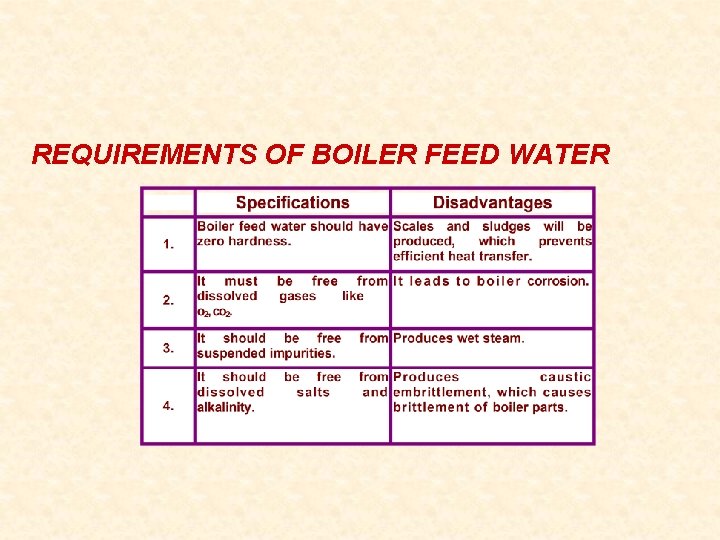
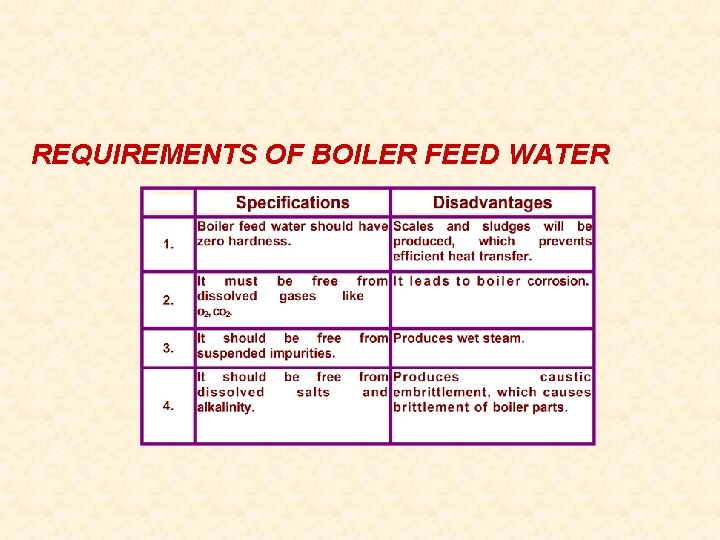
REQUIREMENTS OF BOILER FEED WATER
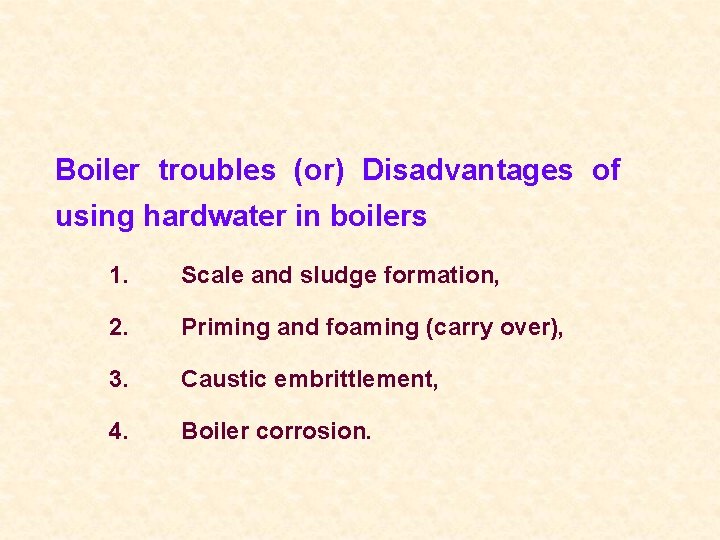
Boiler troubles (or) Disadvantages of using hardwater in boilers 1. Scale and sludge formation, 2. Priming and foaming (carry over), 3. Caustic embrittlement, 4. Boiler corrosion.
Scale and Sludge Formation in boilers continuously ØWhen water is converted steam into in boilers, the concentration of dissolved salts in water increases progressively. Ø saturation point, they are thrown out in the form of precipitates on the inner walls of the boilers. The least soluble one gets precipitated first.
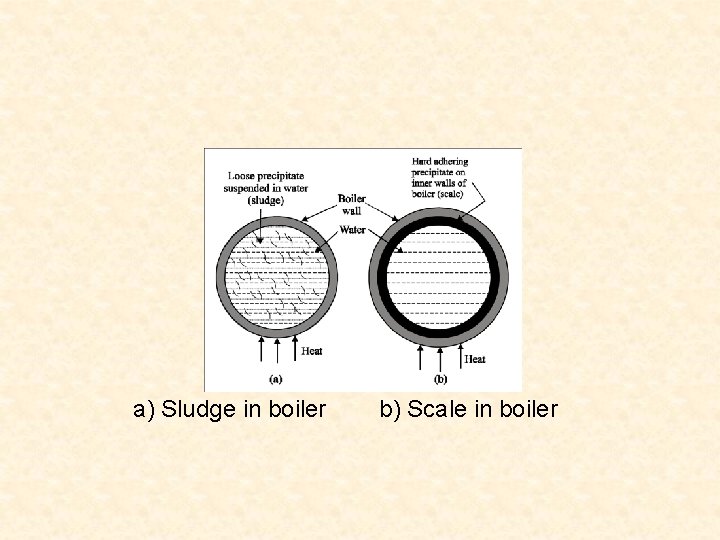
a) Sludge in boiler b) Scale in boiler
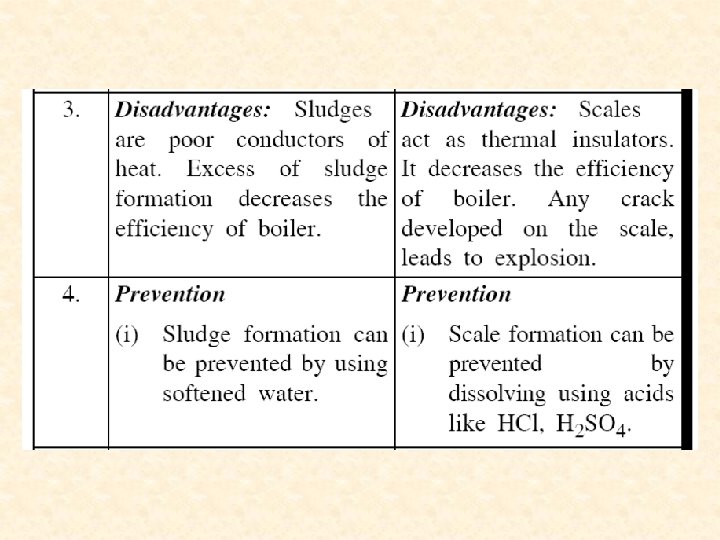
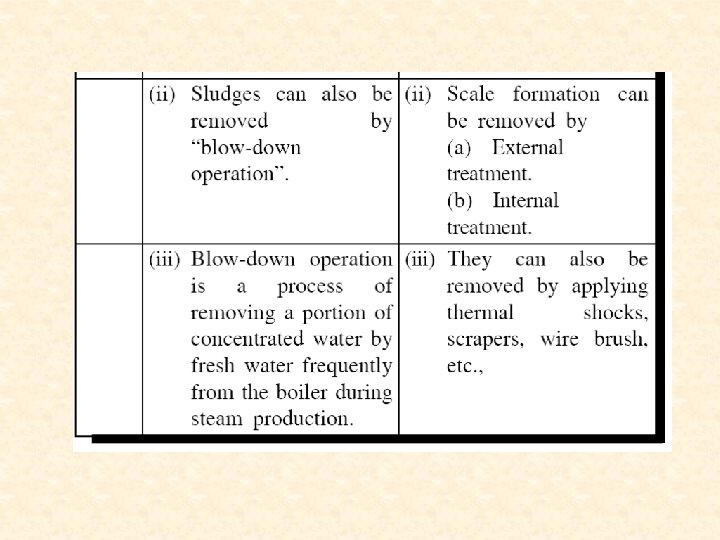
Sludge If the precipitate is loose and slimy it is called sludge. Sludges are formed by substances like Mg. Cl 2, Mg. CO 3, Mg. SO 4 and Ca. Cl 2. They have greater solubilities in hot water than cold water. Scale On the other hand, if the precipitate forms hard and adherent coating on the inner walls of the boiler, it is called scale. Scales are formed by substances like Ca(HCO 3)2, Ca. SO 4 and Mg(OH)2.
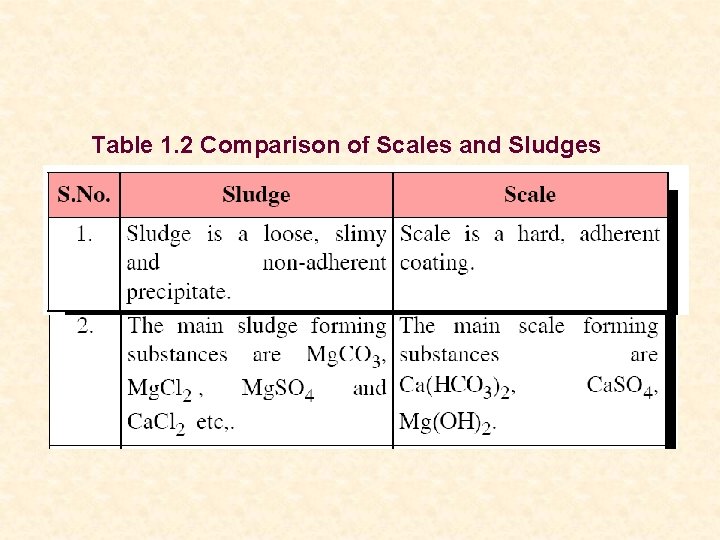
Table 1. 2 Comparison of Scales and Sludges
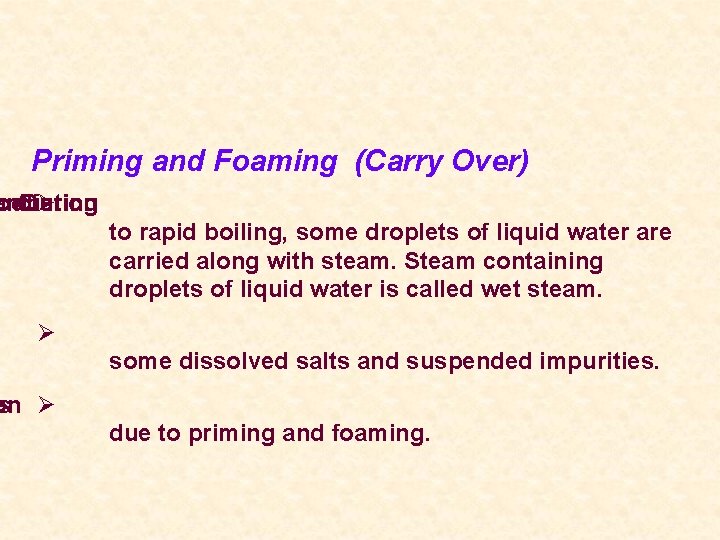
Priming and Foaming (Carry Over) am oduction of the During Ø to rapid boiling, some droplets of liquid water are carried along with steam. Steam containing droplets of liquid water is called wet steam. Ø some dissolved salts and suspended impurities. on s Ø due to priming and foaming.
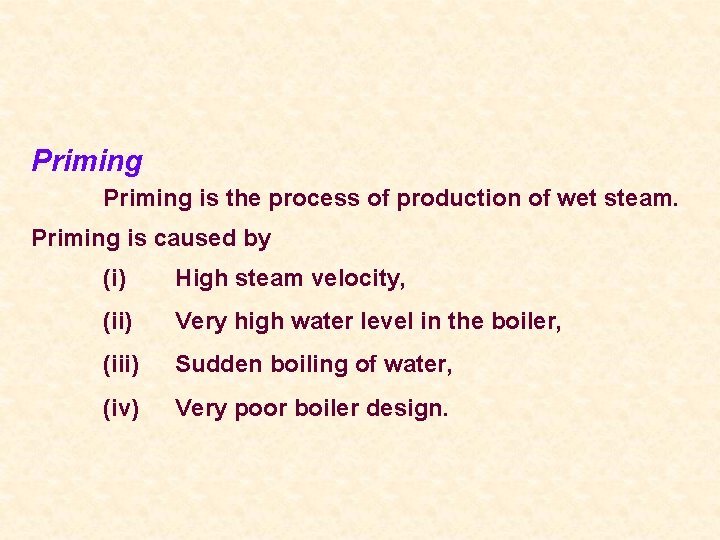
Priming is the process of production of wet steam. Priming is caused by (i) High steam velocity, (ii) Very high water level in the boiler, (iii) Sudden boiling of water, (iv) Very poor boiler design.
Prevention Priming can be controlled by (i) Controlling the velocity of steam, (ii) Keeping the water level lower, (iii) Good boiler design, (iv) Using treated water.
Foaming Ø surface of water is called foaming. Ø leading to excessive priming. Foaming is caused by the (i) presence of oil, and grease, (ii) presence of finely divided particles.
Prevention Foaming can be prevented by (i) aluminium hydroxide, (ii) adding poly amides.
Caustic Embrittlement (lntercrystalline Cracking) tlement austic ine s Ø cracking of boiler metal. Ø Ø proportion of Na 2 CO 3. In high pressure boilers this Na 2 CO 3 undergoes decomposition to give Na. OH. Na 2 CO 3 + H 2 O 2 Na. OH +CO 2
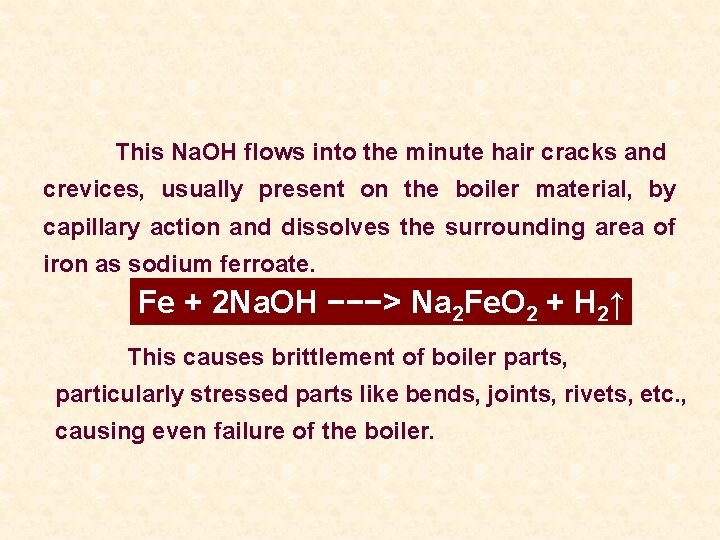
This Na. OH flows into the minute hair cracks and crevices, usually present on the boiler material, by capillary action and dissolves the surrounding area of iron as sodium ferroate. Fe + 2 Na. OH −−−> Na 2 Fe. O 2 + H 2↑ This causes brittlement of boiler parts, particularly stressed parts like bends, joints, rivets, etc. , causing even failure of the boiler.
Prevention Caustic embrittlement can be prevented by (i) using sodium phosphate as softening agent instead of sodium carbonate. (ii) by adding tannin, lignin to the boiler water, which blocks the hair cracks.
Boiler Corrosion in boilers is due to the presence of 1. Dissolved Oxygen. 2. Dissolved Carbon Dioxide. 3. Dissolved Salts.
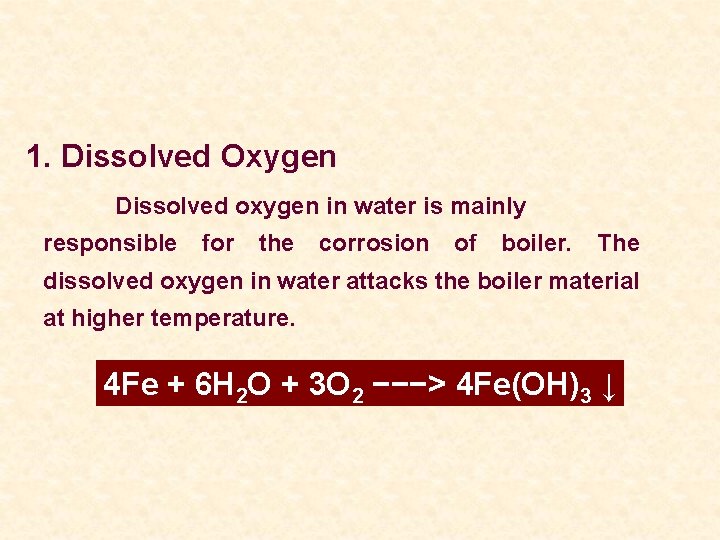
1. Dissolved Oxygen Dissolved oxygen in water is mainly responsible for the corrosion of boiler. The dissolved oxygen in water attacks the boiler material at higher temperature. 4 Fe + 6 H 2 O + 3 O 2 −−−> 4 Fe(OH)3 ↓
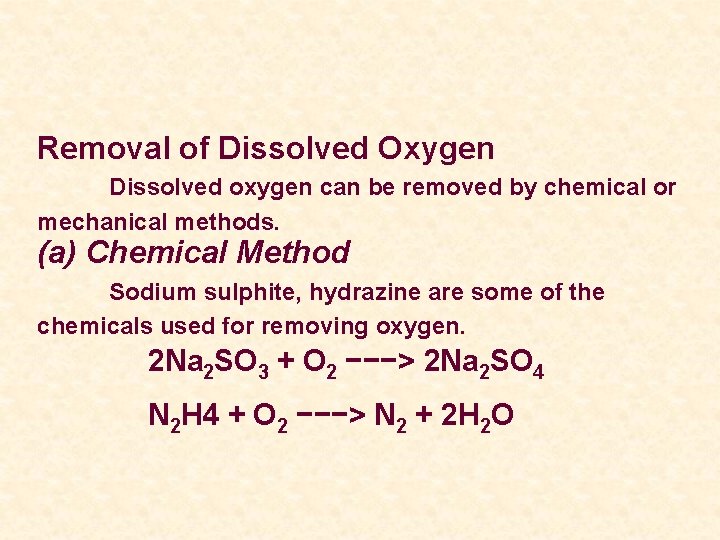
Removal of Dissolved Oxygen Dissolved oxygen can be removed by chemical or mechanical methods. (a) Chemical Method Sodium sulphite, hydrazine are some of the chemicals used for removing oxygen. 2 Na 2 SO 3 + O 2 −−−> 2 Na 2 SO 4 N 2 H 4 + O 2 −−−> N 2 + 2 H 2 O
Hydrazine is found to be an ideal compound for removing dissolved oxygen in the water, since the products are water and inert N 2 gas. (b) Mechanical De – aeration Dissolved oxygen can also be removed from water by mechanical deaeration (Fig. ) In this process, water is allowed to fall slowly on the perforated plates fitted inside the tower.
The sides of the tower are heated, and a vacuum pump is also attached to it. produced inside the tower reduce the dissolved oxygen content of the water.
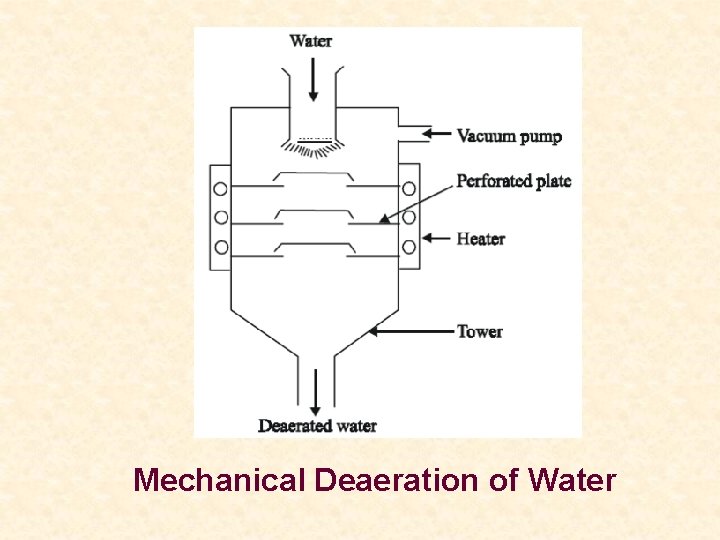
Mechanical Deaeration of Water
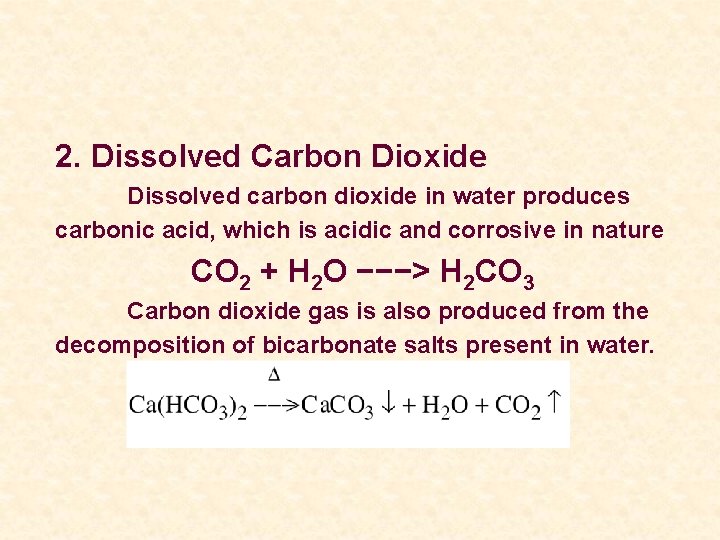
2. Dissolved Carbon Dioxide Dissolved carbon dioxide in water produces carbonic acid, which is acidic and corrosive in nature CO 2 + H 2 O −−−> H 2 CO 3 Carbon dioxide gas is also produced from the decomposition of bicarbonate salts present in water.
Removal of Dissolved Carbon Dioxide (a) Carbon dioxide can be removed from water by adding a calculated amount of NH 4 OH into water. 2 NH 4 OH + CO 2 −−−> (NH 4)2 CO 3 + H 2 O (b) Carbon dioxide along with oxygen can also be removed mechanically by de-aeration method.
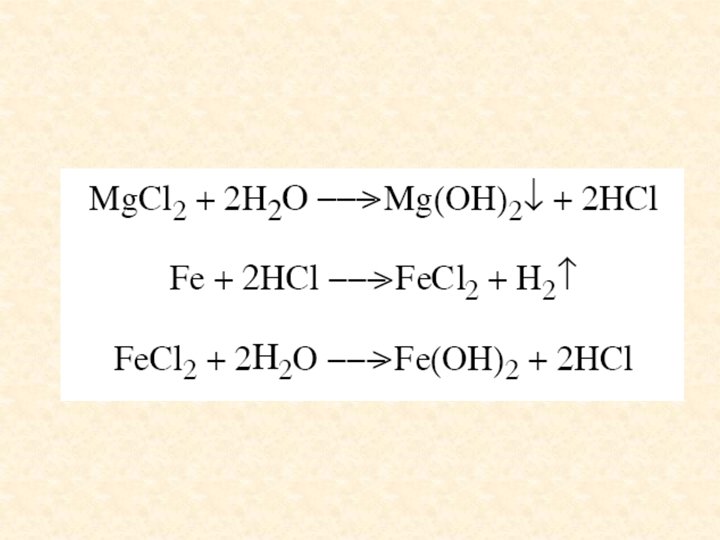
3. Dissolved Mg. Cl 2 Acids, produced from salts dissolved in water, are also mainly responsible for the corrosion of boilers. Mg. Cl Salts like Ca. Cl undergo etc, 2, hydrolysis 2, at higher temperature to give HCl, which corrodes the boiler.
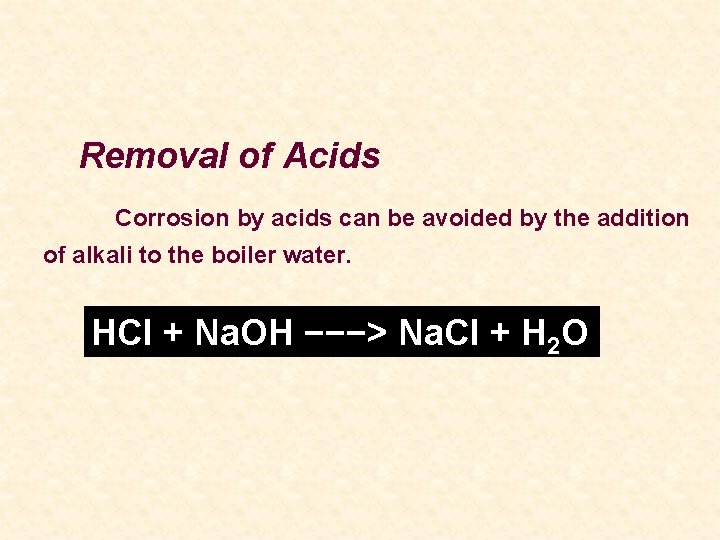
Removal of Acids Corrosion by acids can be avoided by the addition of alkali to the boiler water. HCl + Na. OH −−−> Na. Cl + H 2 O
REQUIREMENTS OF BOILER FEED WATER
SOFTENING or CONDITIONING METHODS Water used for industrial purposes should be free from hardness producing substances, suspended impurities and dissolved gases etc. The process of removing hardness producing salts from water is known as softening (or) conditioning of water.
Softening of water can be done in two methods 1. External conditioning. 2. Internal conditioning.
EXTERNAL CONDITIONING Ø from the water before feeding into the boiler. Ø Demineralisation or Ion-exchange process.
Ion Exchange (or) Demineralisation process moves rocess st This Ø anions and cations) present in the hard water. Ø processes, does not contain hardness producing Ca 2+ and Mg 2+ ions, but it will contain other ions like Na+, K+, SO 42 -, Cl- etc. , On the other hand D. M. Ø anions and cations.
v whereas a demineralised water is soft water. ess Thisv resins, which are long chain, cross linked, insoluble organic polymers
1. Cation Exchanger ng esins (−COOH, −SO 3 H) are capable of exchanging their H+ ions with other cations of hard water. Cation exchange resin is represented as RH 2. (i) (ii) Sulphonated coals. Sulphonated polystyrene. R − SO 3 H ; R − COOH ≡ RH 2
2. Anion Exchanger Resins containing functional basic groups (−NH 2, −OH) are capable of exchanging their anions with other anions of hard water. Anion exchange resin is represented as R (OH)2. (i) Cross-linked quaternary ammonium salts. (ii) Urea-formaldehyde resin. R − NR 3 OH ; R−NH 2 ≡ R(OH)2
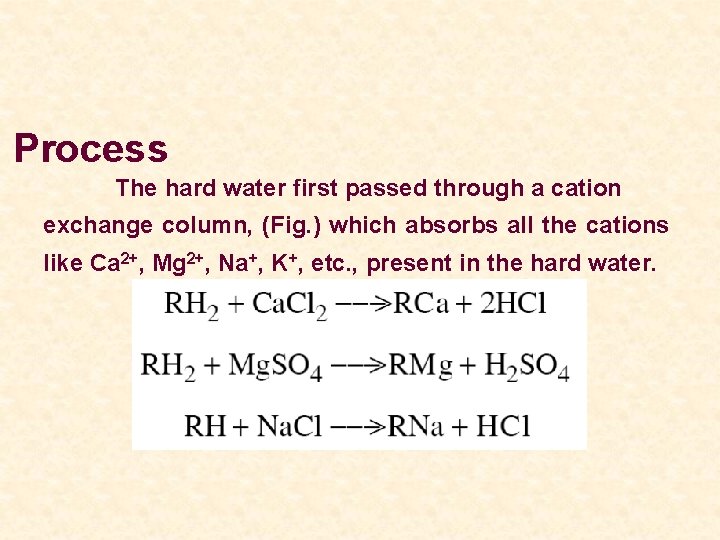
Process The hard water first passed through a cation exchange column, (Fig. ) which absorbs all the cations like Ca 2+, Mg 2+, Na+, K+, etc. , present in the hard water.
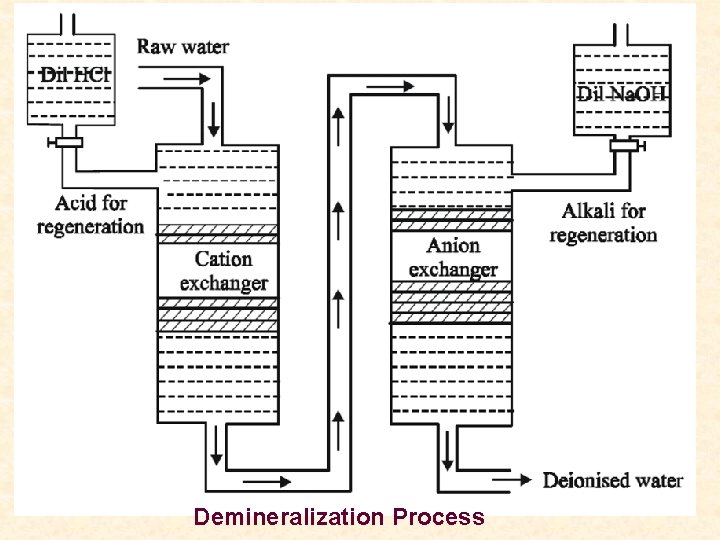
Demineralization Process
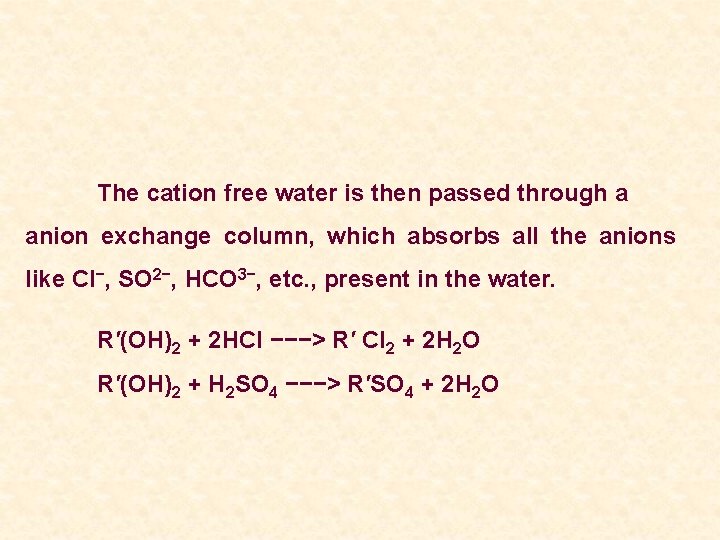
The cation free water is then passed through a anion exchange column, which absorbs all the anions like Cl−, SO 2−, HCO 3−, etc. , present in the water. R′(OH)2 + 2 HCl −−−> R′ Cl 2 + 2 H 2 O R′(OH)2 + H 2 SO 4 −−−> R′SO 4 + 2 H 2 O
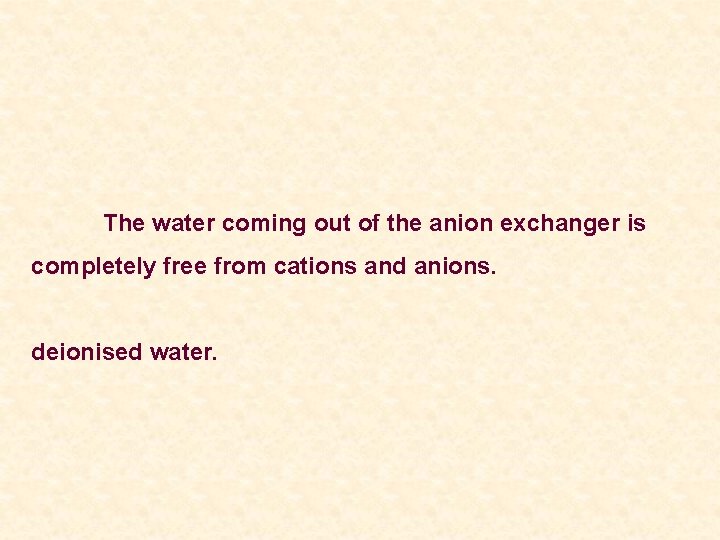
The water coming out of the anion exchanger is completely free from cations and anions. deionised water.
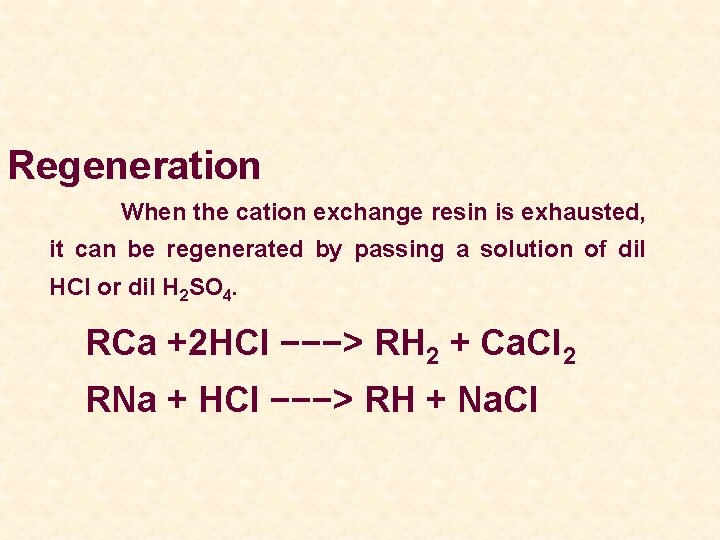
Regeneration When the cation exchange resin is exhausted, it can be regenerated by passing a solution of dil HCl or dil H 2 SO 4. RCa +2 HCl −−−> RH 2 + Ca. Cl 2 RNa + HCl −−−> RH + Na. Cl
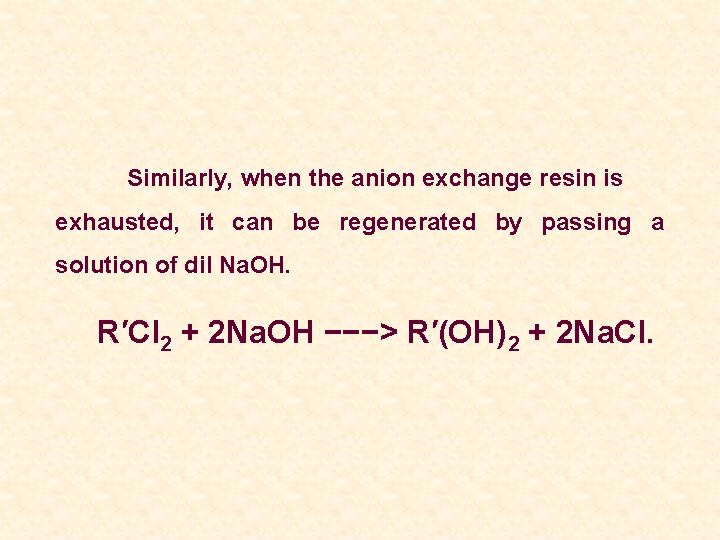
Similarly, when the anion exchange resin is exhausted, it can be regenerated by passing a solution of dil Na. OH. R′Cl 2 + 2 Na. OH −−−> R′(OH)2 + 2 Na. Cl.
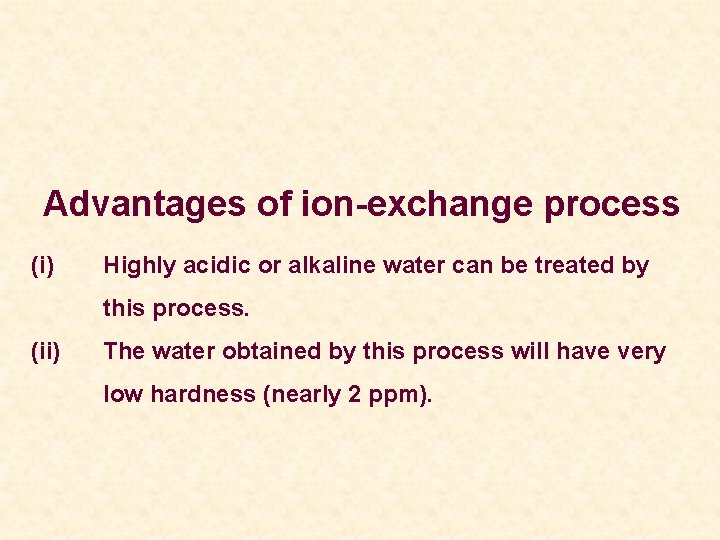
Advantages of ion-exchange process (i) Highly acidic or alkaline water can be treated by this process. (ii) The water obtained by this process will have very low hardness (nearly 2 ppm).
Disadvantages of ion – exchange process (i) (ii) Water containing turbidity, Fe and Mn cannot be treated, because turbidity reduces the output and Fe, Mn form stable compound with the resin. The equipment is costly and more expensive chemicals are needed.
INTERNAL CONDITIONING OR INTERNAL TREATMENT OR BOILER COMPOUNDS It involves the removal of scale forming substance, which were not completely removed in the external treatment, by adding chemicals directly into the boiler. This chemicals are also called boiler compounds.
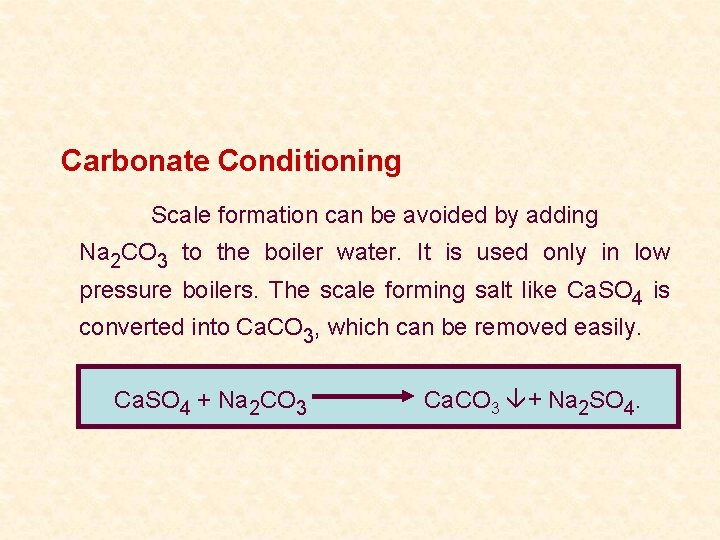
Carbonate Conditioning Scale formation can be avoided by adding Na 2 CO 3 to the boiler water. It is used only in low pressure boilers. The scale forming salt like Ca. SO 4 is converted into Ca. CO 3, which can be removed easily. Ca. SO 4 + Na 2 CO 3 Ca. CO 3 + Na 2 SO 4.
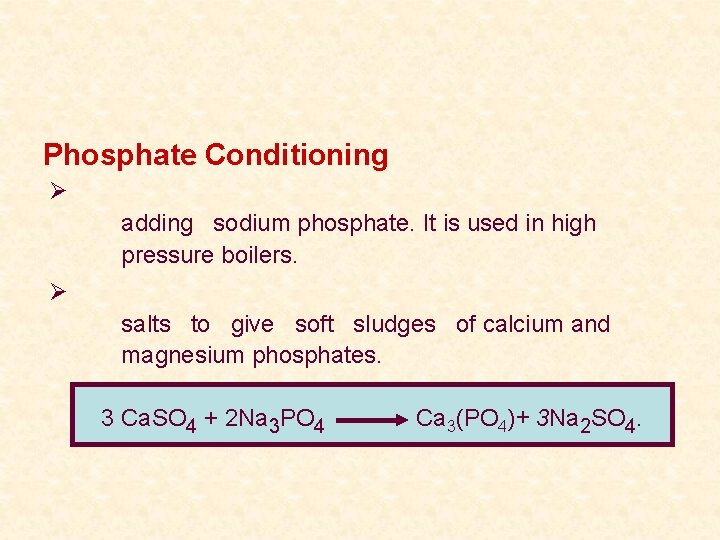
Phosphate Conditioning Ø adding sodium phosphate. It is used in high pressure boilers. Ø salts to give soft sludges of calcium and magnesium phosphates. 3 Ca. SO 4 + 2 Na 3 PO 4 Ca 3(PO 4)+ 3 Na 2 SO 4.
![Calgon Conditioning Ø phosphate Na 2 [Na 4(PO 3)6]. Ø This substance interacts with](http://slidetodoc.com/presentation_image_h2/002f89268a38ad5308466182b25e6581/image-49.jpg "Calgon Conditioning Ø phosphate Na 2 [Na 4(PO 3)6]. Ø This substance interacts with")
Calgon Conditioning Ø phosphate Na 2 [Na 4(PO 3)6]. Ø This substance interacts with calcium ions. Ø prevents the precipitation of scale forming salt. 2 Ca. SO 4 + Na 2[Na 4(PO 3)6] Na 2[Ca 2(PO 3)6] + 2 Na 2 SO 4.
DESALINATION OF BRACKISH WATER Ø chloride) from the water is known as desalination. Ø
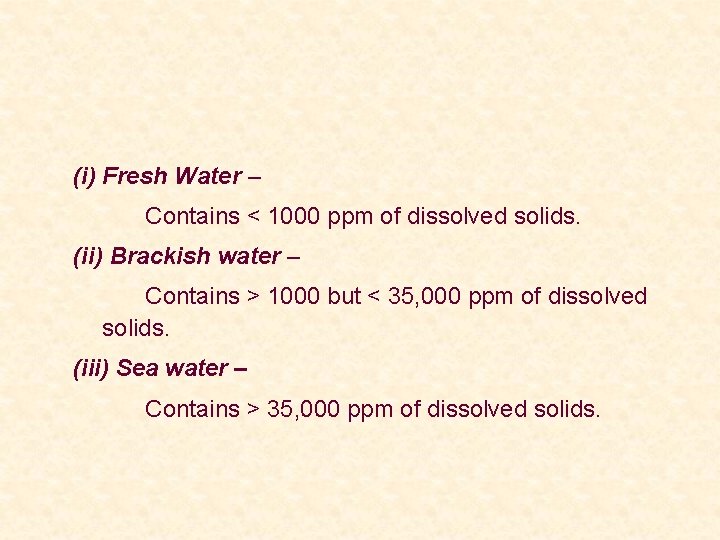
(i) Fresh Water – Contains < 1000 ppm of dissolved solids. (ii) Brackish water – Contains > 1000 but < 35, 000 ppm of dissolved solids. (iii) Sea water – Contains > 35, 000 ppm of dissolved solids.
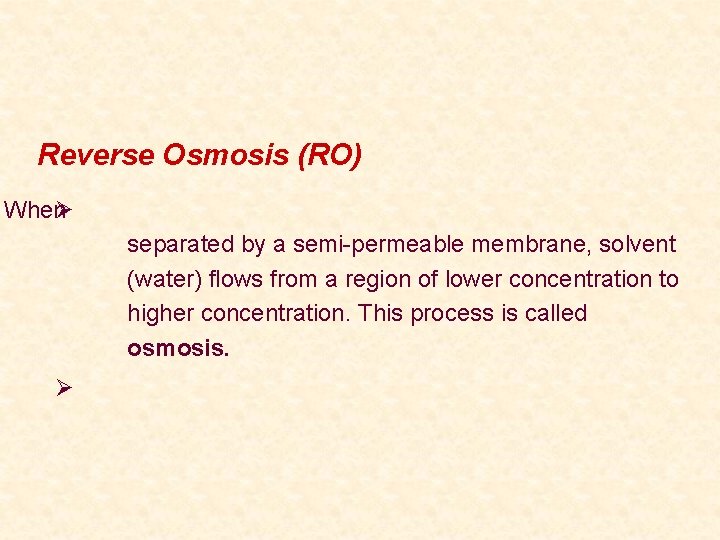
Reverse Osmosis (RO) WhenØ separated by a semi-permeable membrane, solvent (water) flows from a region of lower concentration to higher concentration. This process is called osmosis. Ø
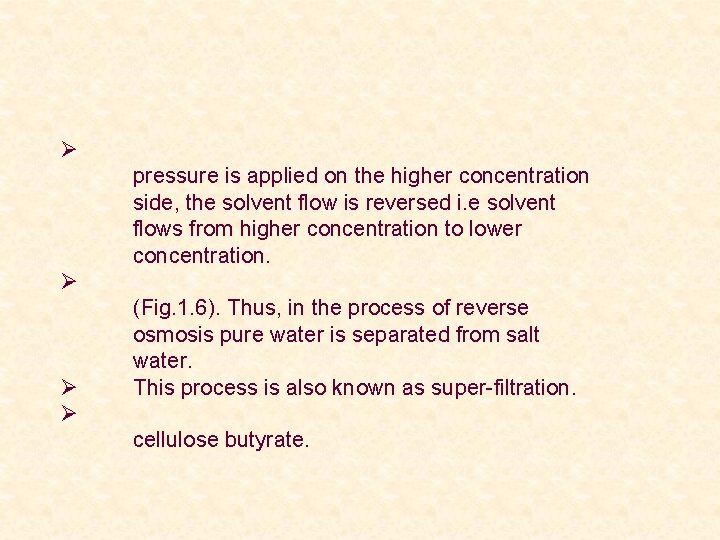
Ø pressure is applied on the higher concentration side, the solvent flow is reversed i. e solvent flows from higher concentration to lower concentration. Ø Ø Ø (Fig. 1. 6). Thus, in the process of reverse osmosis pure water is separated from salt water. This process is also known as super-filtration. cellulose butyrate.
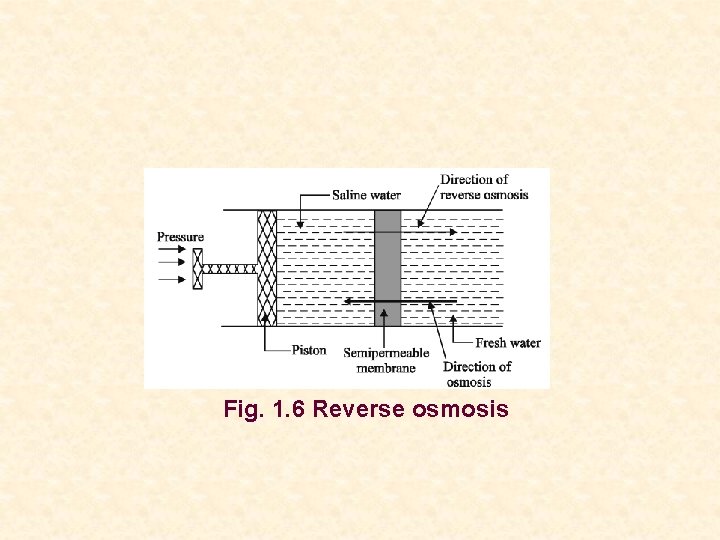
Fig. 1. 6 Reverse osmosis
Advantages membrane Ø the time of The life be can high, and itis replaced within few minutes. Ø impurities. Ø this process is used for converting sea water into drinking water.
- Slides: 56