
Unit 1 Biology Notes Characteristics of Life Objective
Unit 1 Biology Notes Characteristics of Life Objective 1: List the six characteristics of life. Objective 2: Use the six characteristics of life to determine if an object is living, non-living, or dead.

Characteristics of Life

Characteristics of Life All living things possess these characteristics at SOME time during their lifespan… 1. Growth and Development: • Living organisms grow and develop to a mature adult form. – Growth is increase in size. – Development is change in shape/ability.

Characteristics of Life 2. Reproduction: • Living organisms have the ability to make more of their own kind and transmit genes and DNA from generation to generation.
Characteristics of Life 3. Adaptation to the Environment: • A POPULATION of organisms is able to genetically adapt to changing environmental conditions (evolve over time).

Characteristics of Life 4. Cellular Organization: • All living organisms are composed of one or more cells.
Characteristics of Life 5. Interaction with the Environment: • Living organisms respond to stimuli in order to interact with the environment. • This allows organisms to maintain HOMEOSTASIS (a stable internal environment).

Characteristics of Life 6. Energy Requirement: • All living organisms use energy for their life processes.

Characteristics of Life • • • G R A C I E Growth and Development Reproduction Adaptation to the Environment Cellular Organization Interaction with the Environment Energy Requirement
Unit 1 Biology Notes The Nature of Science Objective 3: Describe unique characteristics of scientific study. Objective 4: Describe the difference between a theory and a hypothesis.

What is Science? • Science: – An organized way of using evidence to learn about the natural world.

Unique Characteristics of Science

Unique Characteristics of Science • Deals with natural observable events, not supernatural • Makes observations and collects measurable data.

Unique Characteristics of Science • Data and observations are repeatable and capable of change. • Leads to understanding and explanations that can be tested by examining experimental evidence.
Theory vs. Hypothesis • Hypothesis: A possible explanation for a set of observations which guides further experimentation. • Theory: An explanation for many related observations based on extensive scientific and experimental evidence in many conditions.
Unit 1 Biology Notes Observations and Inferences Objective 5: Write detailed observations in order to collect data. Objective 6: Be able to distinguish between an inference and an observation. Objective 7: Use observations to make appropriate inferences.

Observations and Inferences Observation: Def. : a statement about the characteristics of an object. • The characteristics are detected by the 5 senses. • The statement must be in a complete sentence. Quantitative Observation: an observation that includes measurement or counting. Qualitative Observation: an observation that does not include measurement or counting and therefore requires judgments. (description) Inference: an assumption based on observations.
Unit 1 Biology Notes Experimental Design Objective 8: Write a testable hypothesis that predicts the relationship between the independent and dependent variables. Objective 9: Identify and describe the components of good experimental design from a sample investigation. Objective 10: Using the components of good experimental design, design and carry out an experiment. Objective 11: Construct a data table and an appropriate graph to present data.
Experimental Design Independent variable (IV): What: the variable which is purposely changed or manipulated in an experiment Why: it’s what you are testing Dependent variable (DV): What: the variable which is measured and responds to the independent variable Why: Measures what changes
Experimental Design Variable Examples: 1) Susie wants to know what temperature causes bacteria to reproduce the fastest. What is the IV? Temperature (of what? ? ) Be specific! What is the DV? Rate of bacteria reproduction or how fast bacteria reproduce How to measure this? Be sure you can explain this. 2) Kevin wants to know if changing the amount of water will delay the leaves of a tree from dropping.

Experimental Design Hypothesis: A possible explanation for a set of observations which guides further experimentation. A hypothesis: • Must be testable • Predicts the relationship between one independent variable (IV) and a measurable dependent variable (DV) • The direction of the IV/DV relationship must be included in the hypothesis.
Experimental Design • Example hypotheses 1) If the amount of fertilizer increases, the plants will grow. 2) If the amount of fertilizer changes, the plant will change. 3) Increasing the amount of fertilizer will cause an increase in plant height. 4) If the amount of fertilizer increases, the plants will taste worst.
Experimental Design Constants: What: variables which do not change during the course of the experiment Why: so we know the results are due to changing the IV and not other factors Control: What: the test group which does not receive the IV treatment, or a group that is chosen as the basis for comparison (the “normal” or “standard”) Why: to know what effect your IV has had on your experiment (sometimes you don’t need a control if you are only interested in comparing data sets)
Experimental Design Repeated trials: What: an entire procedure is repeated to detect sources of procedural errors Why: account for procedural error Multiple subjects: What: the use of many organisms in an experiment to account for range of variability in test organisms Why: account for variation in test subjects

Conclusion A. B. C. D. Restate hypothesis and tell if data supports Summarize data Analyze data-trends/patterns/oddities Summarize the relationship between the independent and dependent variables

Data Tables Remember to include the following: 1. Specific Title Why: Describes the content of the table, Describes the relationship between the IV and DV 2. Labels for IV and DV Why: Clearly identifies all the data and results, Organizes your columns and rows

Data Tables Remember to include the following: 3. Units Why: Shows the degree of measurement 4. Averages Why: Calculate and include these when appropriate (for example, when multiple subjects or repeated trials are used)
Data Tables Remember to include the following: 5. Organization and Neatness Why: Allows the reader to quickly understand the data and gain information needed

Example Data Table • Hypothesis: Students who eat breakfast regularly will score higher on the ACT test. (The ACT test scores have no units)

Graphs Remember to include the following: 1. Specific Title Why: Describes the relationship between the IV and DV 2. Label each axis Why: Clearly identifies all the data and results
Graphs Remember to include the following: 3. Units Why: Shows the degree of measurement 4. Appropriate type of graph: pie, bar, histogram, line Why: Depends on type of data and what you want to communicate
Graphs Remember to include the following: 5. Appropriate scale (do not use scale breaks!) Why: Correctly depicts the data 6. Data Points stay within graph boundaries Why: Correctly depicts the data
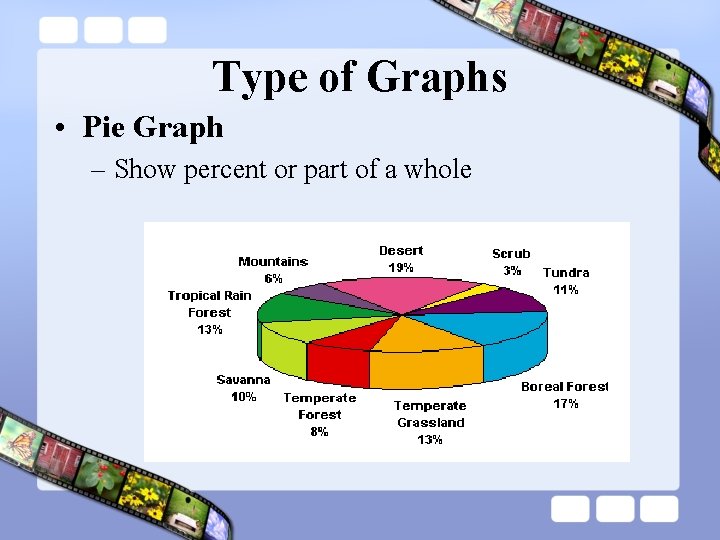
Type of Graphs • Pie Graph – Show percent or part of a whole
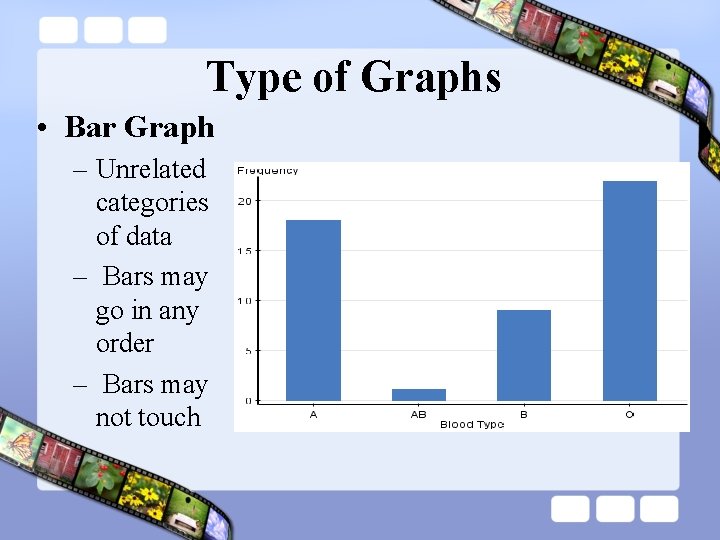
Type of Graphs • Bar Graph – Unrelated categories of data – Bars may go in any order – Bars may not touch
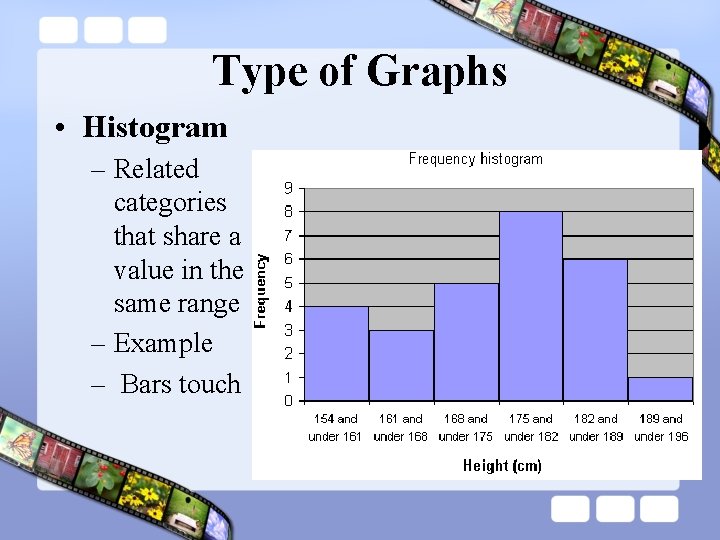
Type of Graphs • Histogram – Related categories that share a value in the same range – Example – Bars touch

Type of Graphs • Line Graph – Graphs continuous sets of data – Connect the points or do a line of best fit – Label lines or use a key
- Slides: 36