
Unit 1 Biology Introduction Topic Levels of Organization
Unit 1: Biology Introduction Topic: Levels of Organization B. Ed (Hons) Secondary Semester: I Subject: Biology I (Minor) Course Title: General Biology Represented By: Ms Sidra Younis Department of Education (Planning and Development) Lahore College for Women University, Lahore
�Life Levels of Organization is found almost everywhere on Earth. In fact, the vast diversity of organisms present is indeed fascinating. Different species of plants, various types of animals, and all sorts of organisms comprise our planet. �The Earth is assumed to be about 4. 5 billion years old for that much time, various species of organisms have already emerged and disappeared. However, it is quite ironic how in order to maintain equilibrium (balance), living organisms are classified in a hierarchical and orderly manner according to their level of complexity.
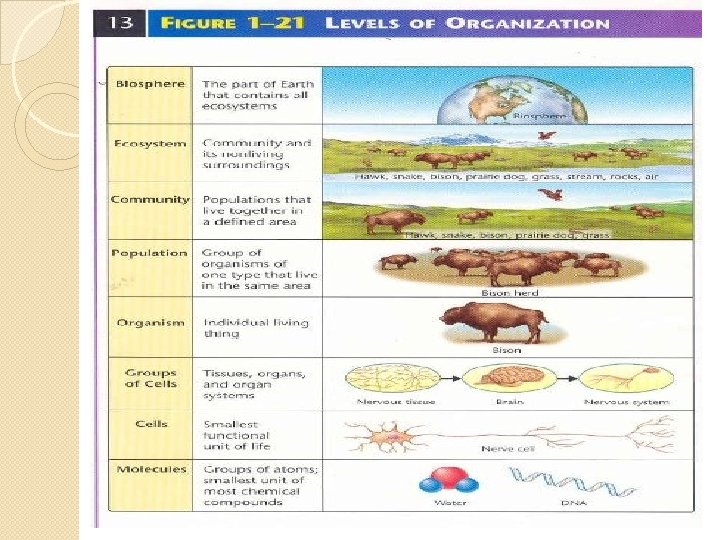
Cont… �In each successive level of organization, the complexity of life increases and a distinguishable property can be observed. To further understand the complexity of life, listed below are the ten levels of biological organization in living organisms listed based on the hierarchy starting with the basic element, cell.
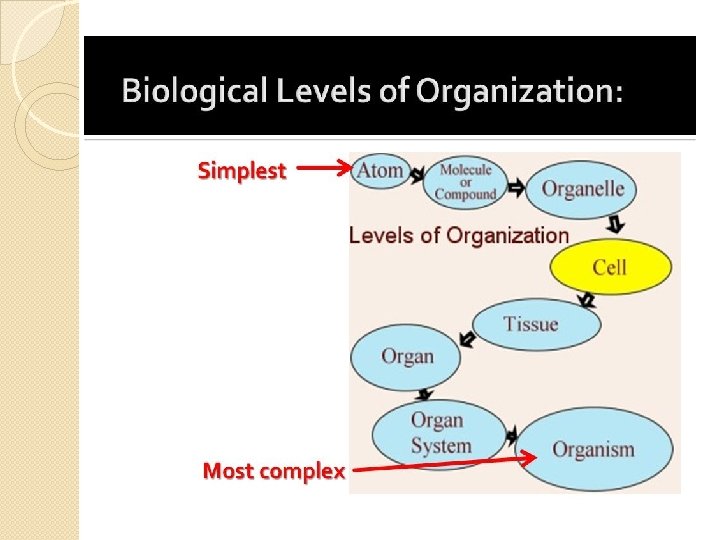
� Molecule: Molecules are made of atoms, the smallest unit of chemical elements. They can be found in all matter, living and non-living. Molecules make up the most basic structures of living beings. Two biological disciplines that focus on this level are biochemistry and molecular biology. � Cell: The cell is known to be the basic building block of life. It performs various metabolic functions like providing structure and rigidity to the body, converting food into nutrients and energy, and others. While it is apparently not the smallest particle (organelles, molecules, and atoms are even smaller in size), the cell is called as such because it is the smallest living entity that can function on its own. At cellular level, organisms can be classified into two: single-celled organisms (unicellular) and multiple-celled organisms (multi-cellular).
�Tissues: When similar cells aggregate, they form a tissue. Basically, a tissue is a group of interconnected cells that perform the same function. Like cells, tissues perform metabolic processes that keep the organism alive. In multi cellular organisms, the study of tissue is called histology (from Greek words histos meaning “tissue” and logos meaning “study of”. • Organ: Coming from the Latin word organum which means “tool” or “instrument”, an organ is a collection of tissues and similar structures that all function as one. Organs of multi-cellular organisms are in fact very diverse. In plants, their organs include the flowers (if there is) roots, stems, and the leaves. On the other hand, organs of animals include the brain, heart, stomach, eyes, and many more.
Organ System: Next to the hierarchy is the organ system. By definition, an organ system is an association of different organs and other anatomical structures that perform a certain physiological process. While each organ system in an organism work as a distinct entity, they all function in cooperation with each other in order to help keep the organism alive. In plants, organ systems include the root and shoot system, while animal organ systems include the digestive, nervous, circulatory system, and others. � Organism: An organism is a recognizable, self-contained individual. Organisms can be unicellular organisms such as bacteria or amoebae, or multicellular organisms comprised of organs and organ systems. A human being is an example of a multicellular organism. §
�Population: When similar organisms group together, they form the next level in the organization, a population. By definition, a population is formed when such individuals reside a common environment at a given time. For instance, a population can change over time due to several events like births, mortality, and migration of organisms. Oftentimes, the number of individuals in a population is highly dependent on the abundance of resources and the presence of favorable climate. In addition, predation and competition are also biological factors that control populations.
�Community: Next to the hierarchy is the community. A community is defined as the interactions of different populations with each other. Apparently, various interactions can exist such as mutualism, commensalism, predation, parasitism, and competition. Oftentimes, a certain population of organisms tend to dominate the community and hence are relatively more abundant than others. Such is considered as a distinguishable
�Ecosystem: A short term for “ecological system”, an ecosystem is the interaction of (organisms, population, and community) to their abiotic or non-living environment. The biotic (living) members of an ecosystem are highly dependent on such abiotic factors which include the weather, sunlight, water depth, salinity, and the availability of nutrients. Hence, the presence or absence of even one factor can greatly affect the ecosystem. In addition to that, one distinct characteristic of an ecosystem is that each organism has a “niche” or role to perform.
�Biome: Ever heard of tundra, savanna, desert, tropical rain-forest, and grassland? Some of these are quite familiar but if you haven’t heard of them yet, all mentioned are types of the next level in the biological organization, the biome. As described by the different environments, a biome is a very huge geographic area where various ecosystems exist and different organisms adapt to it. In general, a biome is more of the continental grouping of various ecosystems in a particular climate.
�Biosphere: Coming from the Greek word “bios” meaning “life”, and “sphaira” meaning sphere, biosphere is basically the topmost level in the hierarchy of living organisms. A biosphere is a global system that generally comprises everything where life exist and the abiotic environments they reside in, all blending with each other. It is basically the sum of all ecosystems on Earth, hence, it is also called as the ecosphere.
Conclusion �Our planet is indeed composed of a variety of living things ranging from a simple cell to a massive sphere of life forms. While each organism tend to vary on size and function, still, no one lives alone and can live alone. �Each organism somehow depends or affect the life of other living organisms and non-living factors in the environment. Any change in a part of one system can drastically increase or decrease the chances of survival of an organism.
- Slides: 14