
Unit 1 Basic Political Theory and Historical Roots
Unit 1 Basic Political Theory and Historical Roots
The Basic Unit ►The foundational political unit in the world is the state § Body of people in a territory with a government that has no higher authority § Examples: Mexico, Russia, Canada, the United States are all states
The 4 Characteristics of a State ►Population ►Territory ►Sovereignty ►Government Vice-President Joe Biden
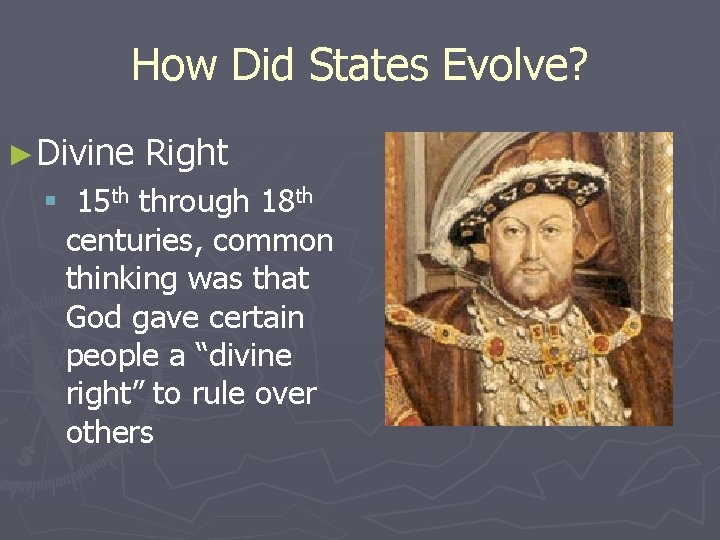
How Did States Evolve? ►Divine Right § 15 th through 18 th centuries, common thinking was that God gave certain people a “divine right” to rule over others
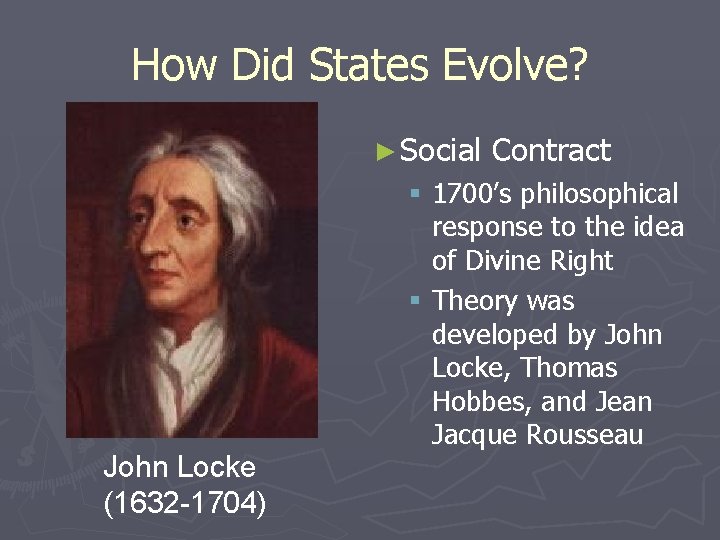
How Did States Evolve? ► Social John Locke (1632 -1704) Contract § 1700’s philosophical response to the idea of Divine Right § Theory was developed by John Locke, Thomas Hobbes, and Jean Jacque Rousseau
How Did States Evolve? ►Social Contract § Free people decided to form states to keep themselves safe John Locke (1632 -1704)
The Big Deal is: ►If people formed states to serve their own interests, then government exists to serve the people
Purpose of Government ► Based on the social contract theory, the purpose of American government is to: § Form a More Perfect Union § Establish Justice § Insure Domestic Tranquility § Provide for the Common Defense § Promote the General Welfare § Secure the Blessings of Liberty ►*In case you’re curious, this is the Preamble to the U. S. Constitution*
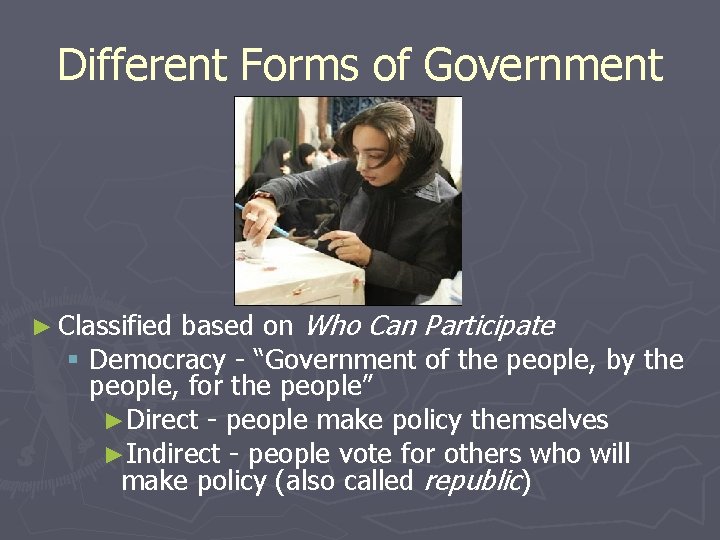
Different Forms of Government based on Who Can Participate § Democracy - “Government of the people, by the people, for the people” ►Direct - people make policy themselves ►Indirect - people vote for others who will make policy (also called republic) ► Classified
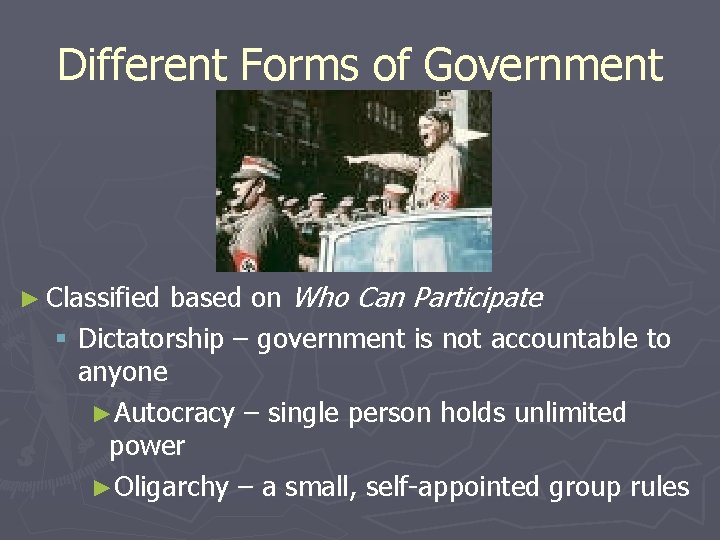
Different Forms of Government based on Who Can Participate § Dictatorship – government is not accountable to anyone ►Autocracy – single person holds unlimited power ►Oligarchy – a small, self-appointed group rules ► Classified
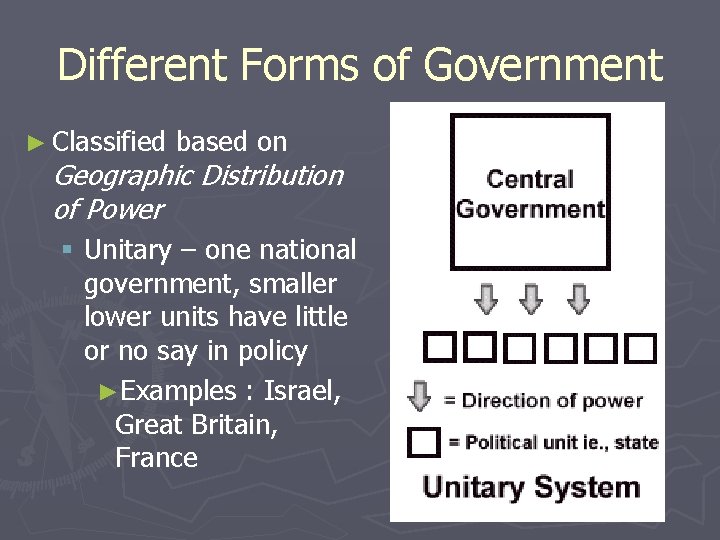
Different Forms of Government ► Classified based on Geographic Distribution of Power § Unitary – one national government, smaller lower units have little or no say in policy ►Examples : Israel, Great Britain, France
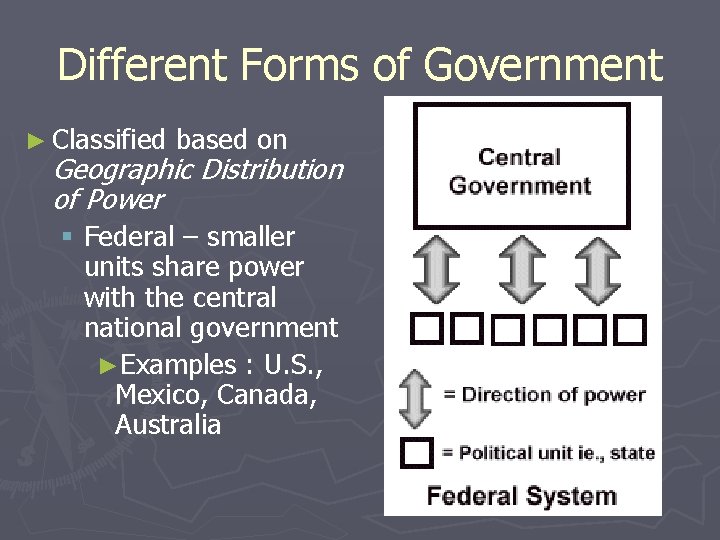
Different Forms of Government ► Classified based on Geographic Distribution of Power § Federal – smaller units share power with the central national government ►Examples : U. S. , Mexico, Canada, Australia
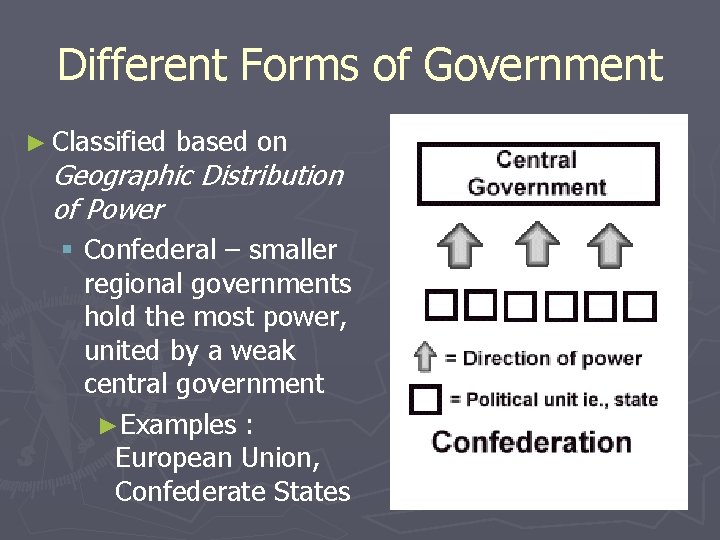
Different Forms of Government ► Classified based on Geographic Distribution of Power § Confederal – smaller regional governments hold the most power, united by a weak central government ►Examples : European Union, Confederate States
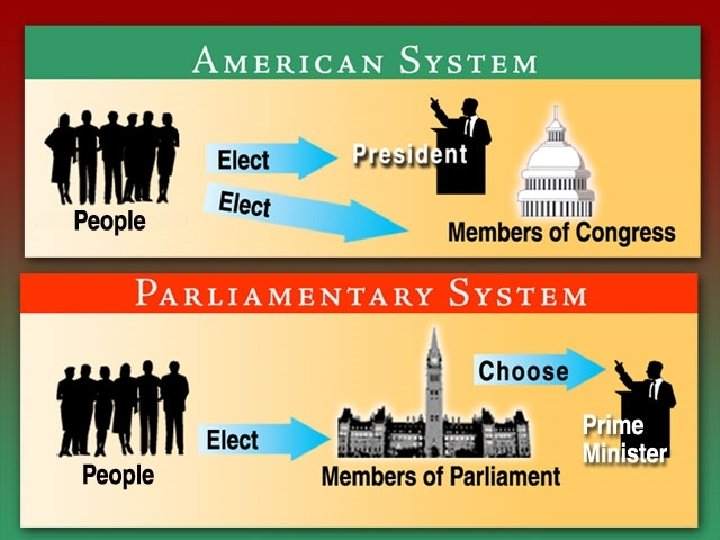
Different Forms of Government based on Relationship between Legislative (people writing the laws) and Executive (people enforcing the laws) § Presidential – voters separately elect Executive and Legislative branch members ► Classified
Different Forms of Government ► Classified based on Relationship between Legislative and Executive Branches § Parliamentary – Executive is chosen from the Legislative branch
Basic Concepts of Democracy ►Worth of the Individual ►Equality of All Persons § Not necessarily equal conditions, but strive for equal opportunity
Basic Concepts of Democracy ►Majority Rule, Minority Rights ►Necessity of Compromise ►Individual Freedom
Free Enterprise ►Free Enterprise is the economic system associated with most democracies
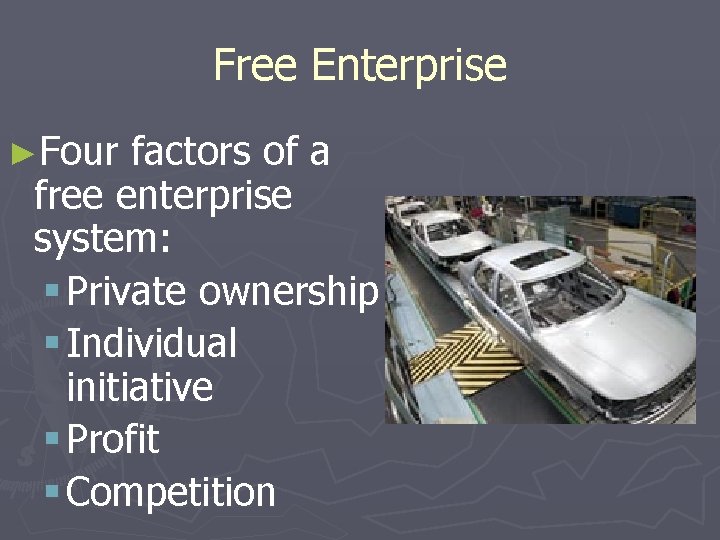
Free Enterprise ►Four factors of a free enterprise system: § Private ownership § Individual initiative § Profit § Competition
How it Works ►The Law of Supply and Demand § When supply is high or demand is low, prices are low § When supply is low or demand is high, prices are high
Where does Government Fit in? ►Government always plays a role in regulating an economy § Governments can fully control an economy, or let it be free § The U. S. uses a mixed economy, to protect the public and preserve private ownership
- Slides: 22