
Unit 1 Basic Concepts Circular Flow and Production
Unit 1: Basic Concepts Circular Flow and Production Possibilities Models
Factors of Production DEFINITION: Resources used to make all goods and services are called factors of production. The factors of production are: 1. Land 2. Labor 3. Capital 4. Entrepreneurial ability
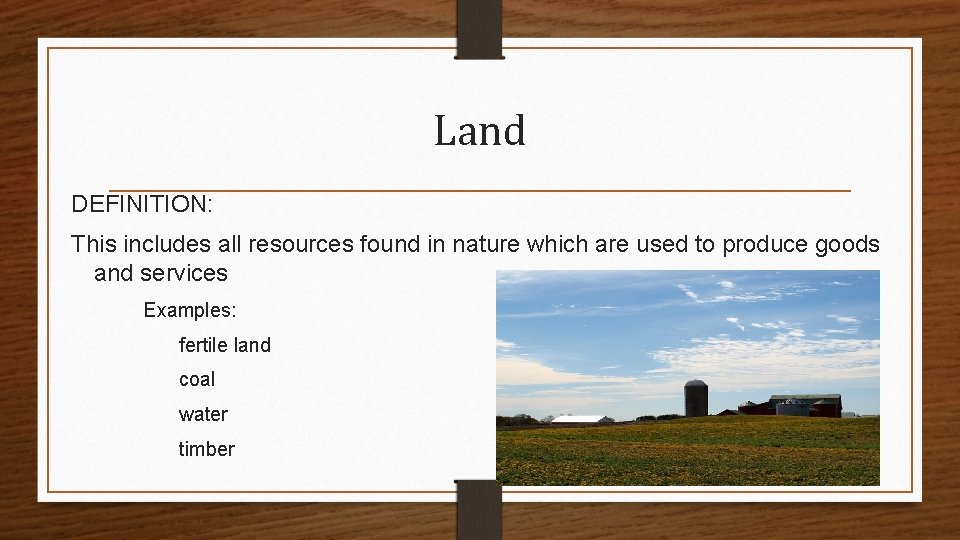
Land DEFINITION: This includes all resources found in nature which are used to produce goods and services Examples: fertile land coal water timber

Labor DEFINITION: This describes the actual effort an individual puts into an activity which produces a good or service Examples: • Your mechanic fixing your car • Your doctor performing surgery on you
Capital DEFINITION: This means any human-made resources used to produce goods or services. Capital can be divided into two types – Physical and Human.
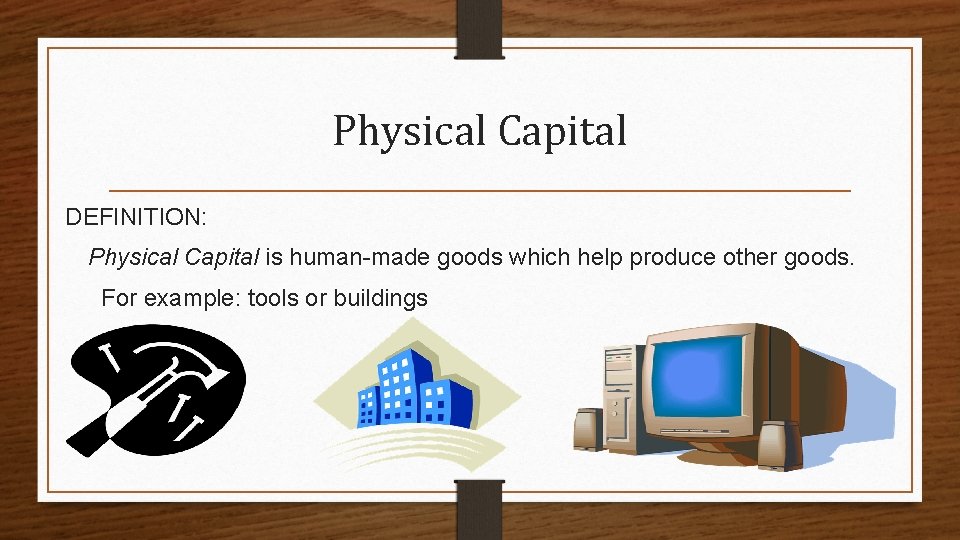
Physical Capital DEFINITION: Physical Capital is human-made goods which help produce other goods. For example: tools or buildings
Human Capital DEFINITION: Human Capital is the skills and knowledge gained by a worker through education and experience. For example: the training and knowledge a doctor gains through medical school
Entrepreneurial Ability DEFINITION: Entrepreneurs are ambitious leaders who combine the other three factors of production (land, labor and capital) to create and market new goods and services. Their risk-taking fuels economic growth by developing new ideas, businesses and industries.
What characteristics make people become entrepreneurs? Can you think of any entrepreneurs either locally, nationally or globally?
Who participates in a market? • Households own the factors of production. They also consume goods and services. • Firms are organizations that use factors of production to produce goods and services.
The Circular Flow of an Economy
Where do households and firms interact? • Households and firms trade (buy and sell) with each other in markets. Specifically the factor and product market. • The factor and product market are not physical places. They exist where ever trade between business/households occurs.
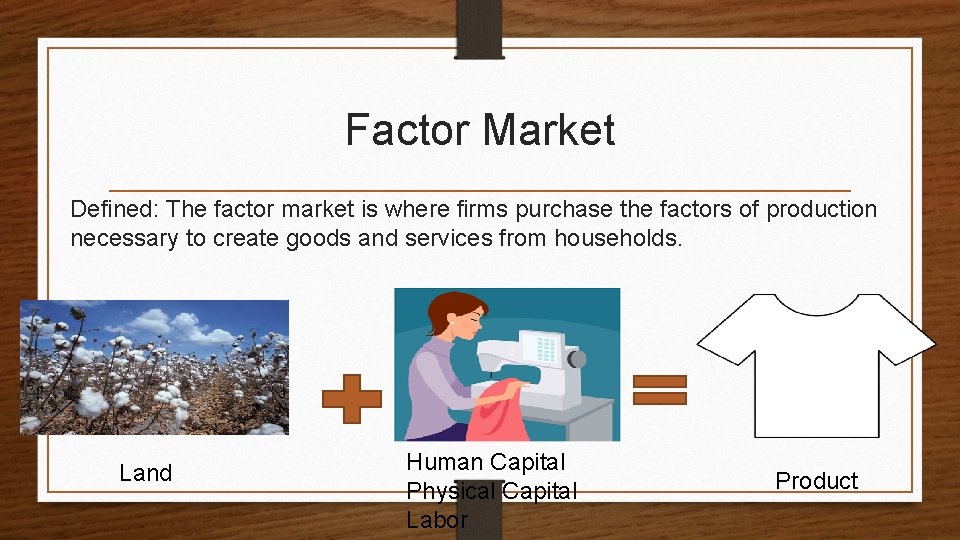
Factor Market Defined: The factor market is where firms purchase the factors of production necessary to create goods and services from households. Land Human Capital Physical Capital Labor Product
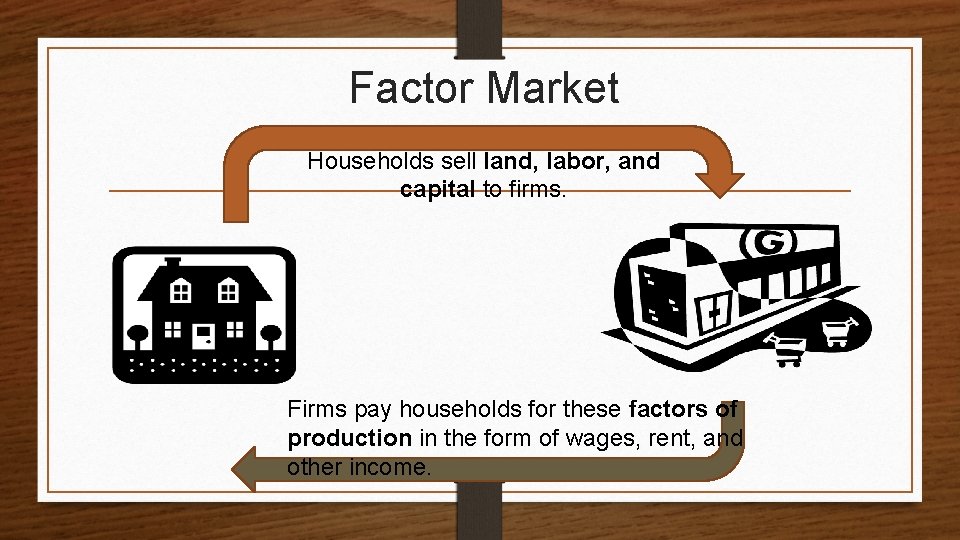
Factor Market Households sell land, labor, and capital to firms. Firms pay households for these factors of production in the form of wages, rent, and other income.
Product Market Defined: The product market is where firms offer products for sale to households. The raw material inputs (land, labor, capital) purchased on the factor market are turned into goods and services by firms. These finished products are then sold back to households on the product market.
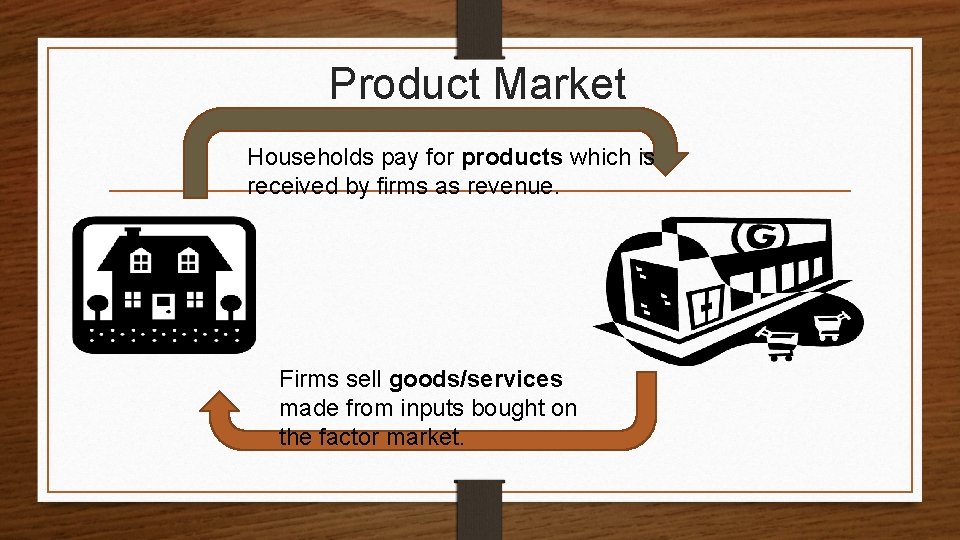
Product Market Households pay for products which is received by firms as revenue. Firms sell goods/services made from inputs bought on the factor market.

Need to see this in action? Watch the Circular Flow Video On our Youtube Channel
Connecting the Markets • There are two flows in a mixed economy, physical and monetary, which run counter to each other. • Physical is the flow of goods/services between households and firms. • Monetary is the compensation received by households and firms in exchange for goods/services.
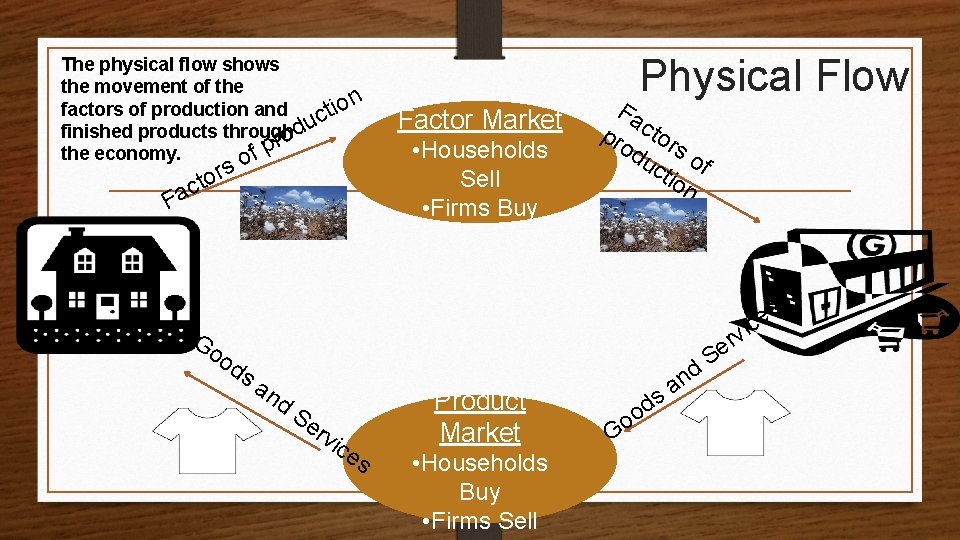
The physical flow shows the movement of the n o i factors of production and t c finished products throughodu r p the economy. of rs o t c Fa Physical Flow Factor Market • Households Sell • Firms Buy Fa pr ctor od s uc of tio n Go od s an d Se rv ice s Product Market • Households Buy • Firms Sell nd o o G a s d S s e ic v er
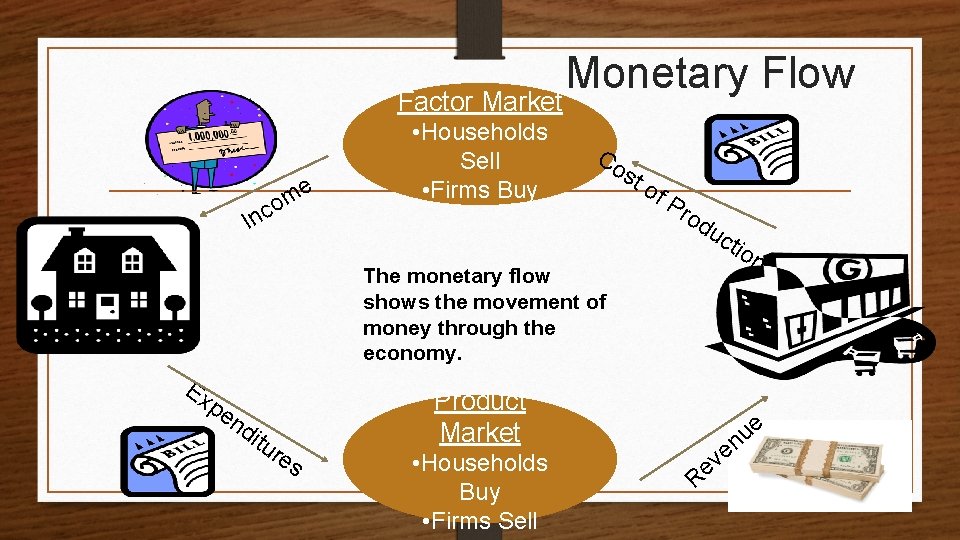
Factor Market me o c n I • Households Sell • Firms Buy Monetary Flow Co st of Pr od uc tio The monetary flow shows the movement of money through the economy. n Ex pe nd itu re Product Market s • Households Buy • Firms Sell e v Re e u n
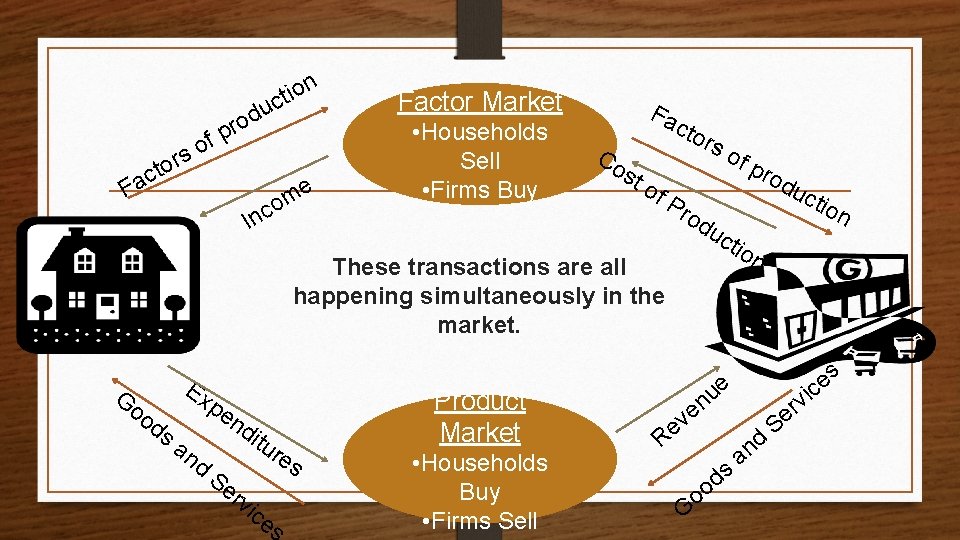
F f o s tor n o i ct Factor Market me • Households Sell • Firms Buy u d o pr ac o c n I Co Fa cto rs st of Pr od uc G oo ds an d pe nd itu Se re Product Market rv ice s s • Households Buy • Firms Sell pro du ctio n tio These transactions are all happening simultaneously in the market. Ex of n s e vic e u n e v Re o G s d o d n a r e S
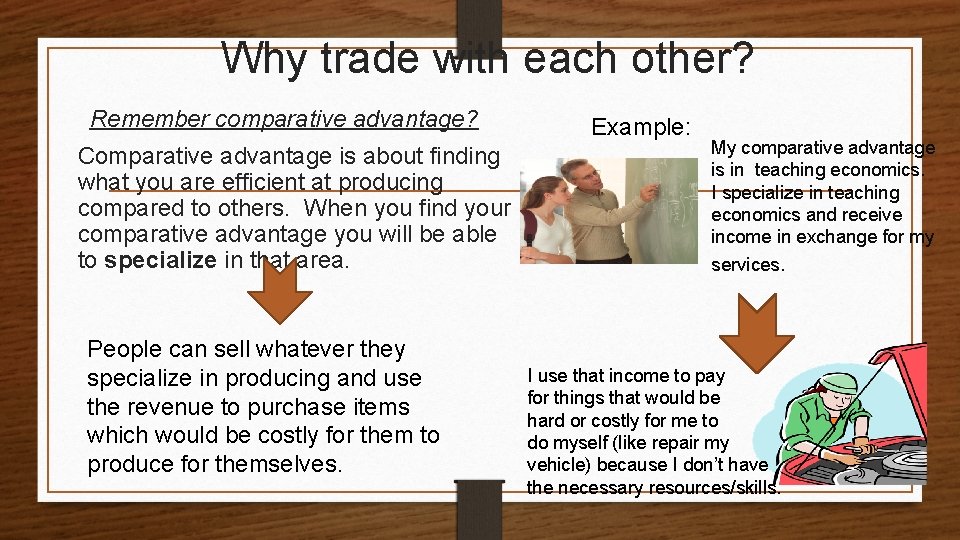
Why trade with each other? Remember comparative advantage? Comparative advantage is about finding what you are efficient at producing compared to others. When you find your comparative advantage you will be able to specialize in that area. People can sell whatever they specialize in producing and use the revenue to purchase items which would be costly for them to produce for themselves. Example: My comparative advantage is in teaching economics. I specialize in teaching economics and receive income in exchange for my services. I use that income to pay for things that would be hard or costly for me to do myself (like repair my vehicle) because I don’t have the necessary resources/skills.
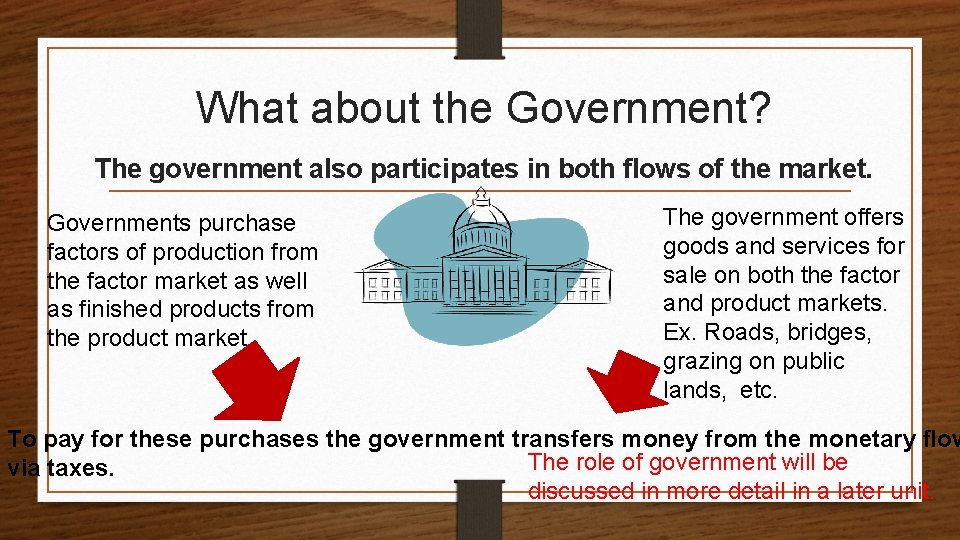
What about the Government? The government also participates in both flows of the market. Governments purchase factors of production from the factor market as well as finished products from the product market. The government offers goods and services for sale on both the factor and product markets. Ex. Roads, bridges, grazing on public lands, etc. To pay for these purchases the government transfers money from the monetary flow The role of government will be via taxes. discussed in more detail in a later unit.
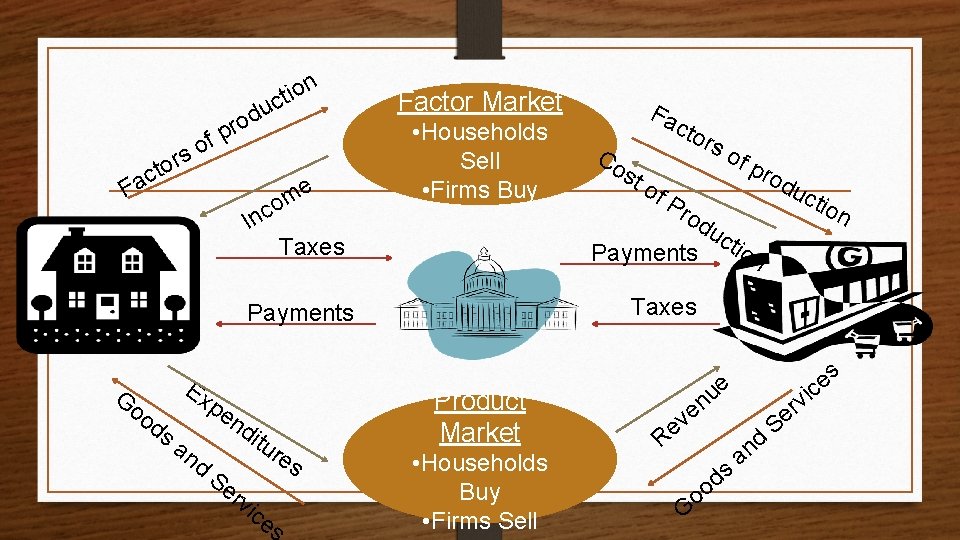
F f o s tor n o i ct Factor Market me • Households Sell • Firms Buy u d o pr ac o c n I Taxes G oo ds an d pe nd itu Se Product Market re rv ice s s st of of Pr pro od uc Payments tion du ctio n Taxes Payments Ex Co Fa cto rs • Households Buy • Firms Sell s e vic e u n e v Re o G s d o d n a r e S
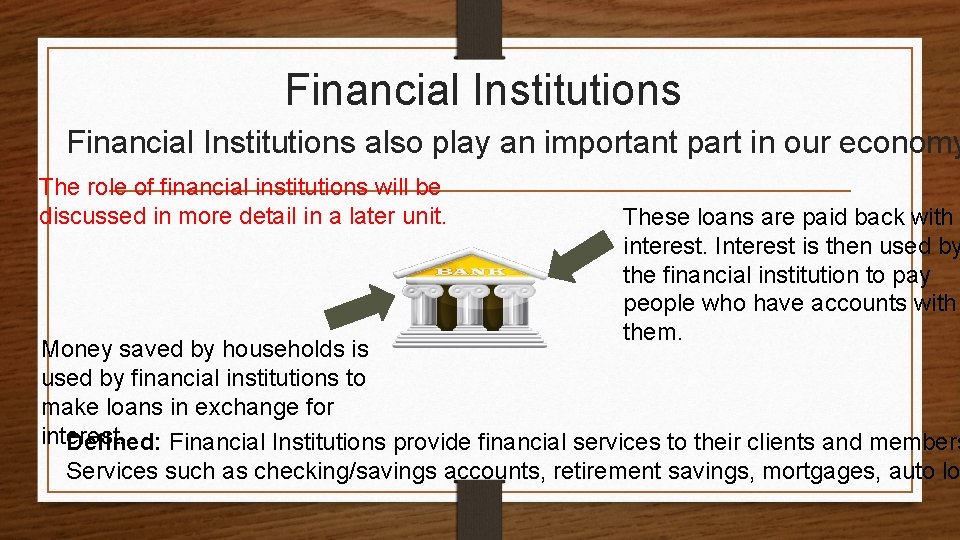
Financial Institutions also play an important part in our economy The role of financial institutions will be discussed in more detail in a later unit. These loans are paid back with interest. Interest is then used by the financial institution to pay people who have accounts with them. Money saved by households is used by financial institutions to make loans in exchange for interest. Defined: Financial Institutions provide financial services to their clients and members Services such as checking/savings accounts, retirement savings, mortgages, auto lo
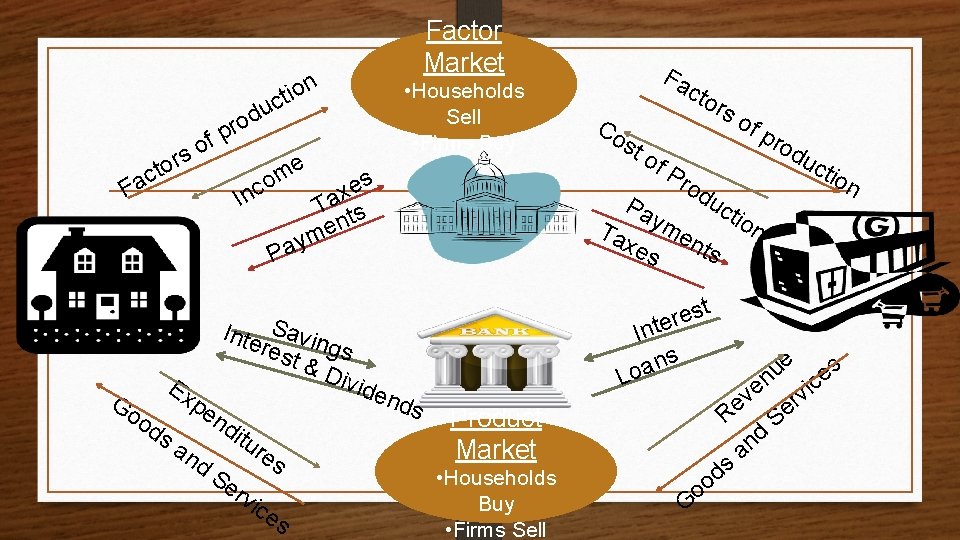
t uc ion Factor Market d o r fp o rs e o t m c o es c Fa x n I Ta ts n e ym a P • Households Sell • Firms Buy Ex Go o pe n Co st of tor so fp rod Pr uc od uc Pa tio y m n Ta e nts xe s tio st e r nte Inte Savin g res t& s Div ide dit ds ur an es d. S er vic es Fa c I nds s n a Lo e u n Product Market • Households Buy • Firms Sell o G e v v r e R Se d n a s d o s e ic n

Concluding thoughts on Circular Flow • Together the monetary and physical flows illustrate the interactions between firms and households. The interactions occur as both households and firms find their comparative advantage and specialize in production.
Production Possibilities Curves
Production Possibilities Curves • Production Possibilities Curves (PPC) are simplified models to illustrate the economic principal of trade-offs. This model simplifies production into only two product choices. This simplification means allows us to measure the opportunity cost of producing one good in terms of its cost in the alternative good. • Production possibilities curves allow economists to make the determine the most productive uses of scarce resources.
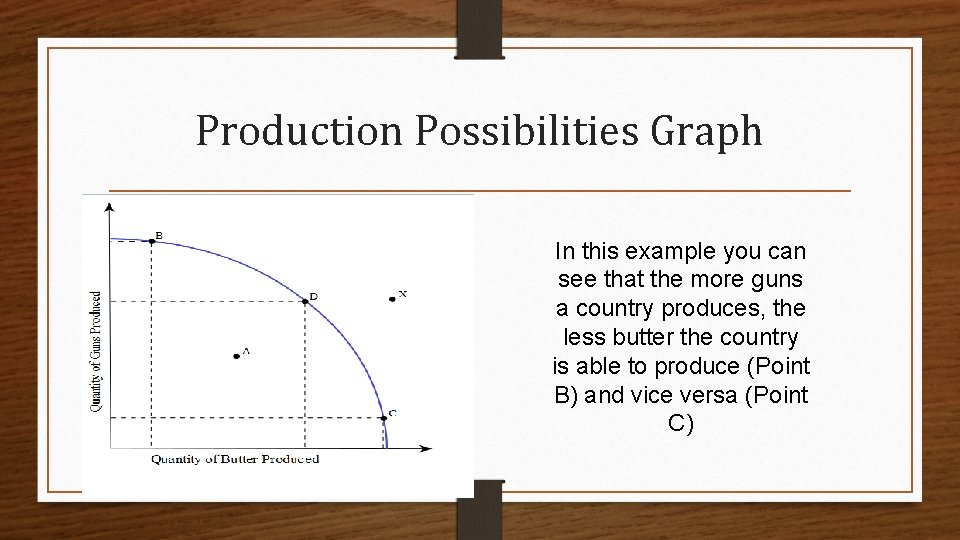
Production Possibilities Graph In this example you can see that the more guns a country produces, the less butter the country is able to produce (Point B) and vice versa (Point C)
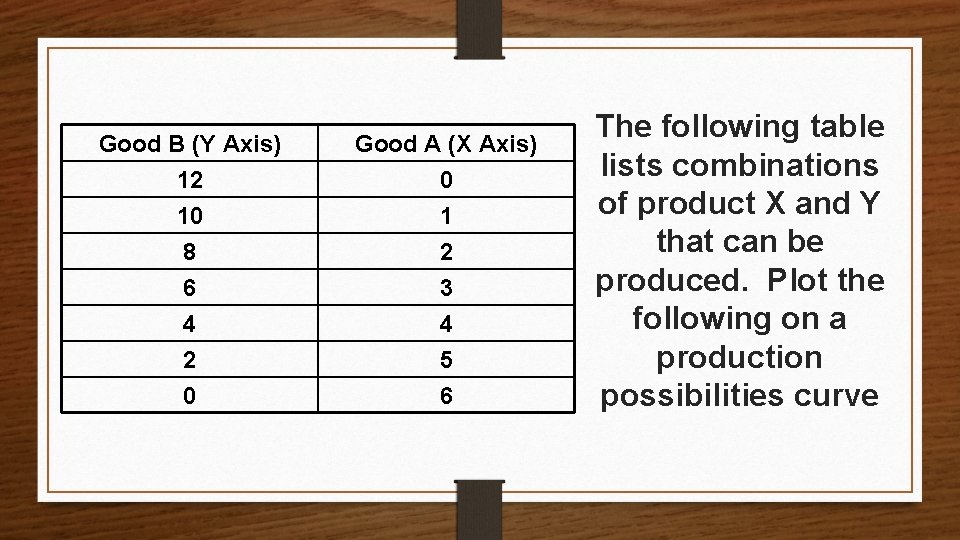
Good B (Y Axis) 12 10 8 Good A (X Axis) 0 1 2 6 4 2 0 3 4 5 6 The following table lists combinations of product X and Y that can be produced. Plot the following on a production possibilities curve
If the economy is producing 12 units of Good B, how many units of Good A are they producing? What is the opportunity cost of increasing production of Good A from zero units to one unit?
What is the opportunity cost of increasing production of Good A from one unit to two units? What is the opportunity cost of increasing production of Good A from two units to three units? Is the opp. cost increasing, decreasing, or constant?
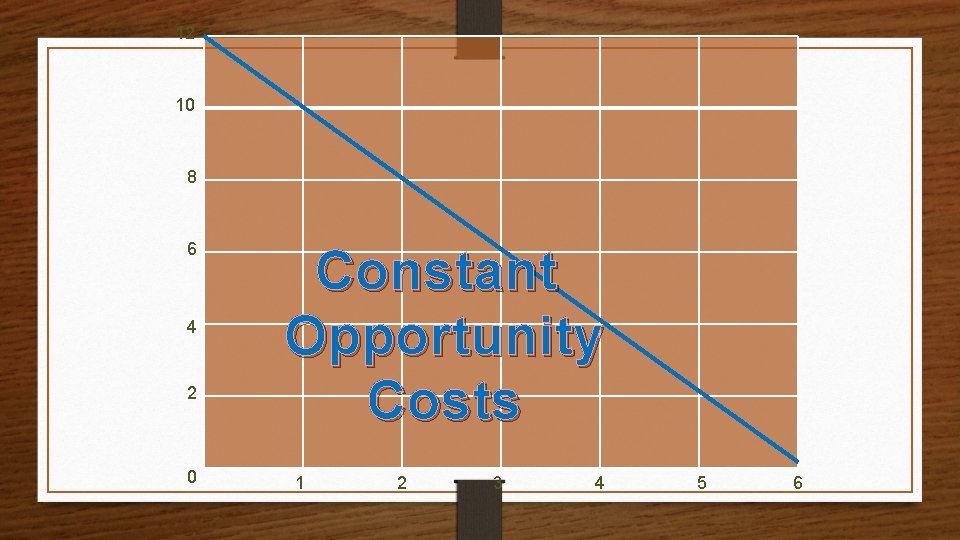
12 10 8 6 4 2 0 Constant Opportunity Costs 1 2 3 4 5 6
A production possibilities curve like this would be appropriately labeled if the resources were? Similar in resource requirementsland, labor, capital
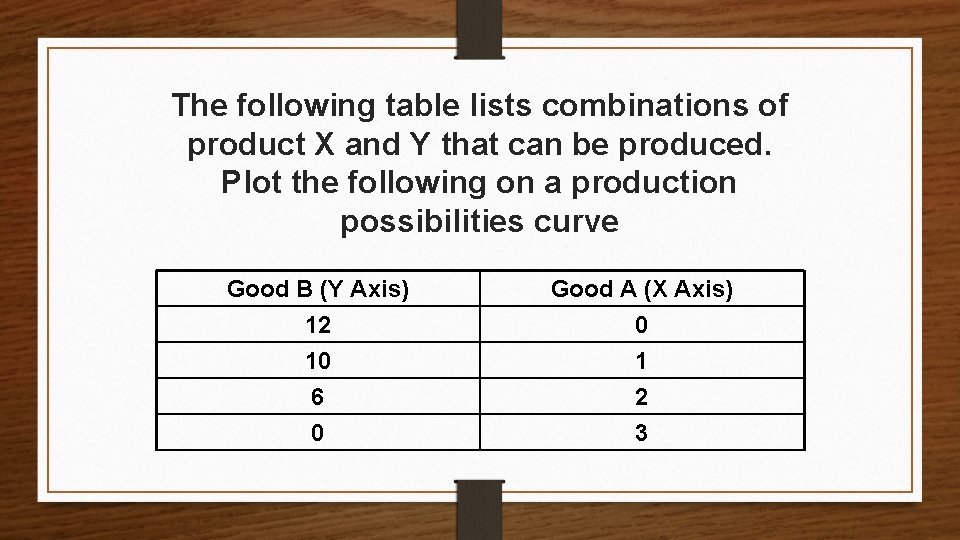
The following table lists combinations of product X and Y that can be produced. Plot the following on a production possibilities curve Good B (Y Axis) 12 10 6 Good A (X Axis) 0 1 2 0 3
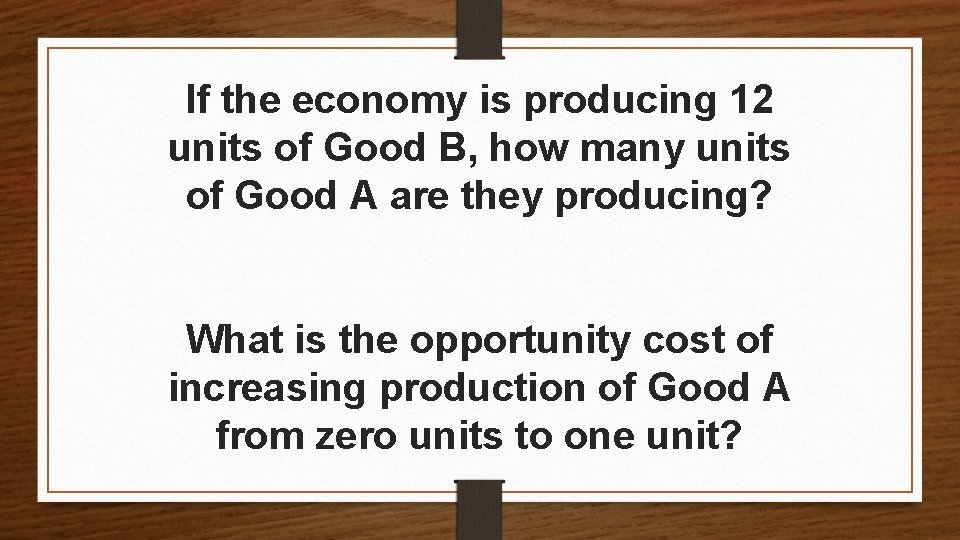
If the economy is producing 12 units of Good B, how many units of Good A are they producing? What is the opportunity cost of increasing production of Good A from zero units to one unit?
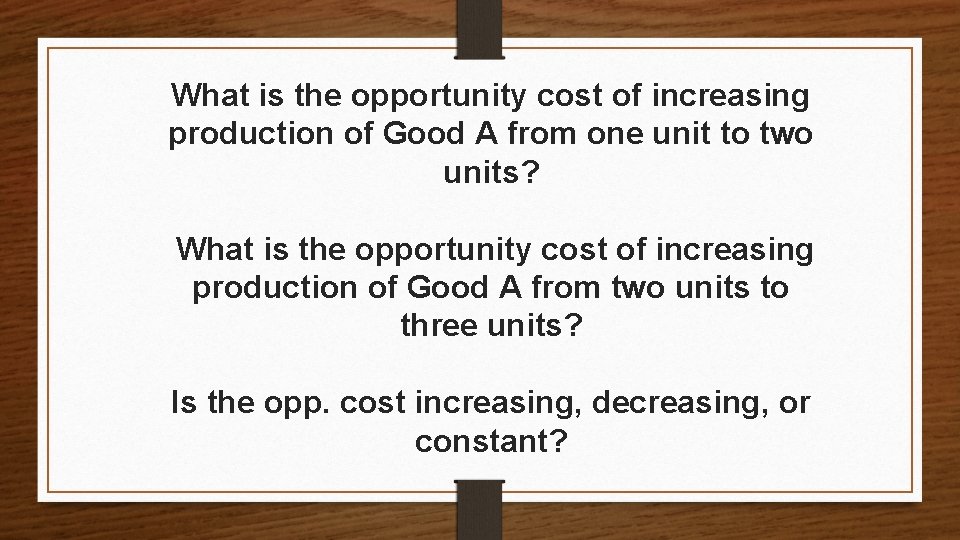
What is the opportunity cost of increasing production of Good A from one unit to two units? What is the opportunity cost of increasing production of Good A from two units to three units? Is the opp. cost increasing, decreasing, or constant?
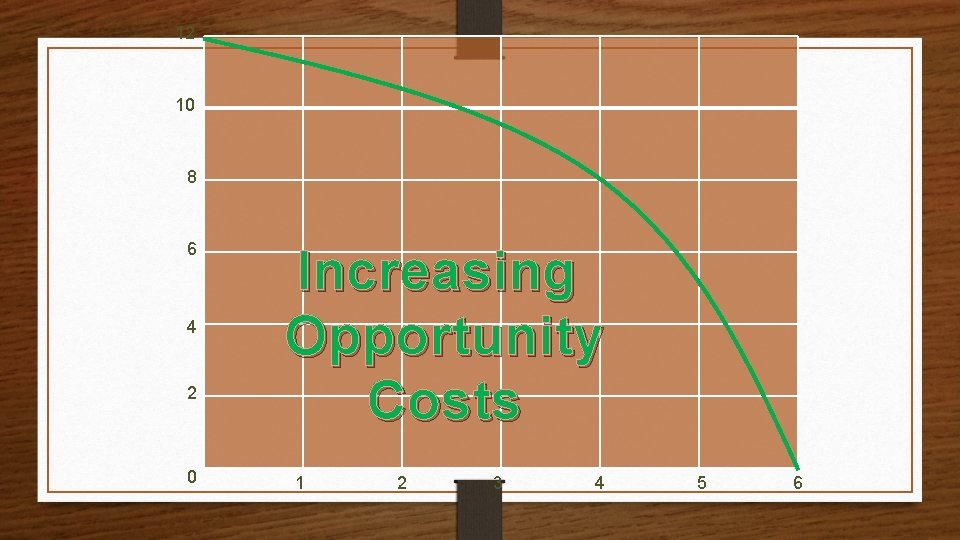
12 10 8 6 4 2 0 Increasing Opportunity Costs 1 2 3 4 5 6

A production possibilities curve like this would be appropriately labeled if the resources of goods were? Dissimilar in resource requirements - land, labor, capital
Points and Their Meaning • The line on a PPC represents the possible combination of goods that can be produced. We use a point (or dot) to represent the actual production levels being realized by an economy or business. • In other words the line represents what could be done while the point represents what is actually being done.
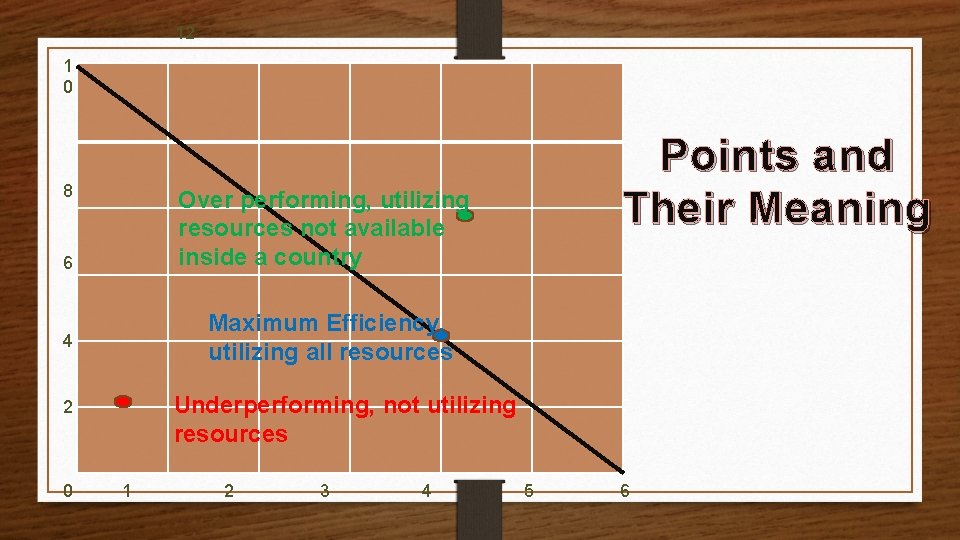
12 1 0 8 Over performing, utilizing resources not available inside a country 6 Maximum Efficiency, utilizing all resources 4 Underperforming, not utilizing resources 2 0 Points and Their Meaning 1 2 3 4 5 6
Why would a PPC shift? • Changes to resources change your production possibilities curves which is represented by a movement of the curve to the left or right. • Leftward shifts represent a decrease in production. • Rightward shifts represent an increase in production.
- Slides: 43