
Unit 1 Banking LESSON OBJECTIVES Objectives 1 To
Unit 1 Banking LESSON OBJECTIVES: Objectives: 1. To explain the different types of banking services for short term and long term needs 2. To explain the different types of electronic banking services and the regulations and fees that are associated with them. 3. To explain the different types of fees to look out for when selecting a bank
Financial Institutions Bank Credit Union Electronic Bank
Financial Service Needs You should consider Time frame when evaluating needs Short Intermediate Long Term
Types of Financial Services Asset management account or cash management account Offered to customers by providing a complete line of financial services program, which include: Checking account and ATM card Credit card Online banking Line of credit for loans Access to a variety of investments IRAs or Roths CDs
Online and Mobile Banking Discuss these questions with your classmates or with a partner: What are the 3 most important tasks you do on your phone currently? Do you do any online banking mobily? If so, what do you do? If not, why not?
Online and Mobile Banking Watch the following three commercials regarding online and mobile banking at three different banks. https: //www. youtube. com/watch? v=Yp. ULjd 3 Fev. I&list=PLx. EG 2 Lw 0 VKp. MZSLq. TJIVOWa. Vjl 7 tvp. IOd&index=7 https: //www. youtube. com/watch? v=7 Q 02 y. JFSYEc https: //www. youtube. com/watch? v=x. Qdo. Cy. Co. Pj 8&list=PLWPzno. Z 4 ap 9 je 7 -gzz. Sr. Wz. SZRwxgt. MIV 3 Consider the following questions: What is the difference between online banking and mobile banking? What common themes do you see between the three commercials? What benefits do you see in doing online and/or mobile banking?
ONLINE BANKING ADVANTAGES DISADVANTAGES
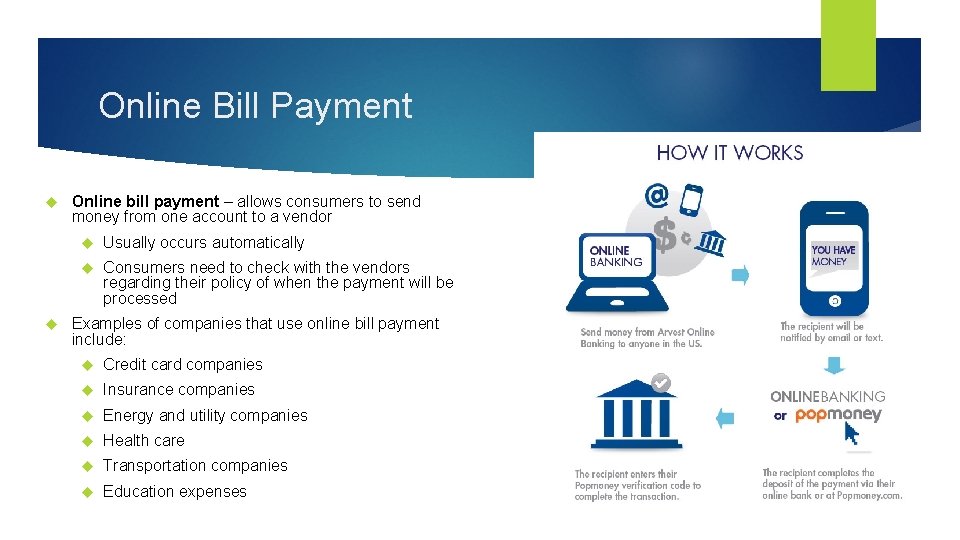
Online Bill Payment Online bill payment – allows consumers to send money from one account to a vendor Usually occurs automatically Consumers need to check with the vendors regarding their policy of when the payment will be processed Examples of companies that use online bill payment include: Credit card companies Insurance companies Energy and utility companies Health care Transportation companies Education expenses
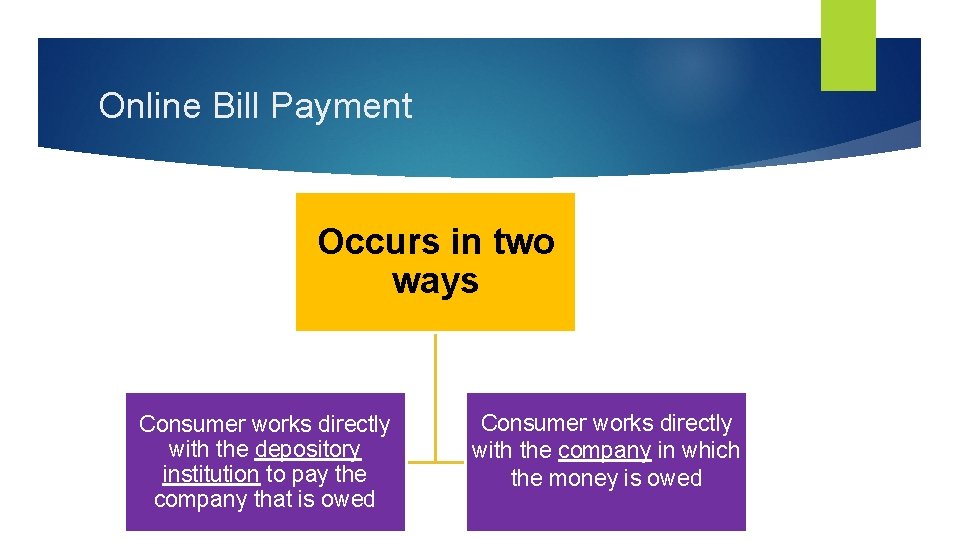
Online Bill Payment Occurs in two ways Consumer works directly with the depository institution to pay the company that is owed Consumer works directly with the company in which the money is owed
Online Bill Payment Important financial aspects include: Checking with the vendor or company to understand their policy of when transactions are complete Confirming there are enough funds in the account to cover the expense of the bill Confirming bill will be paid, money will be taken out of the account, and the transaction will be completed Their financial information is secure and it is safe to make online transactions
Additional Info for Online Banking All or some of your accounts can be linked and viewed Direct deposit Paychecks and other regular income Automatic payments transfer funds Recurring payments such as for utilities Remember to deduct them from your register Ability to view Available vs Current Funds
Online Banking: Rules and Regulations Regulation D: Limits withdrawal and transfer transactions to and from Savings Accounts from ATMS and Online Banking up to six times a month How much can I transfer using online banking? $5, 000 a day $10, 000 per month How much of my past history can I view? Standard is 12 -18 months
Automatic Teller Machines (ATMs) Requires a PIN Research locations to avoid fees Research out of network atm fees because they can range from $1. 50 - $3. 00 and you can also get charged by the ATM operator If depositing money through an ATM, only the first $100 is cleared to use until the next business day
Avoiding ATM Fees 1. See if plastic or digital wallets are accepted 2. Find an ATM in your bank’s network 3. Get cash back at a store checkout counter 4. Choose a bank or credit union that reimburses ATM fees or has a larger network
Pros and Cons - Debit Cards PRO Convenient Small Can be used like a credit card Allows a person to carry less cash Does not allow overspending CON Can lose track of balance if transactions are not written down Opens checking account up to credit fraud Others can gain access to the account if the card is lost and PIN is known
Debit Cards Signature vs Pin Signature takes longer for a transaction to clear Clerks rarely check identification when signing so increase theft is a possibility
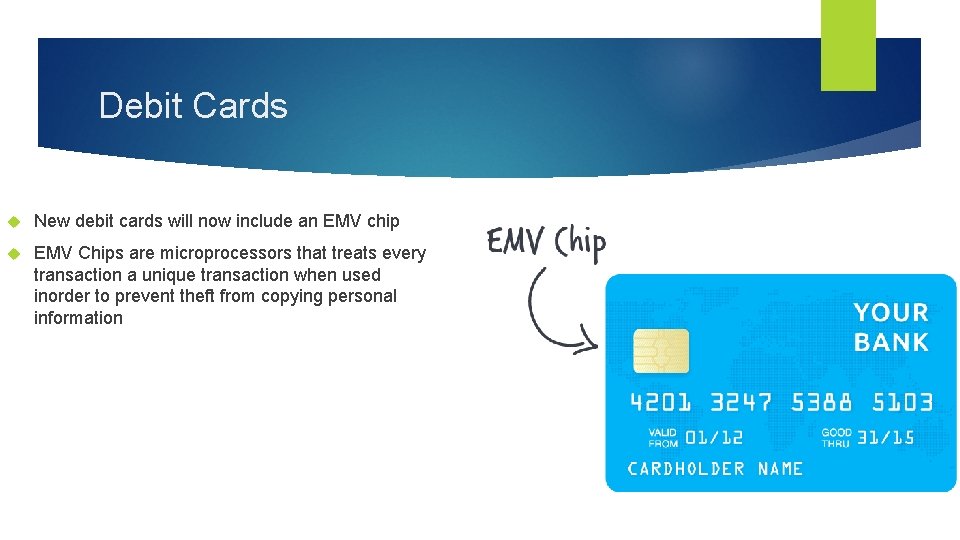
Debit Cards New debit cards will now include an EMV chip EMV Chips are microprocessors that treats every transaction a unique transaction when used inorder to prevent theft from copying personal information
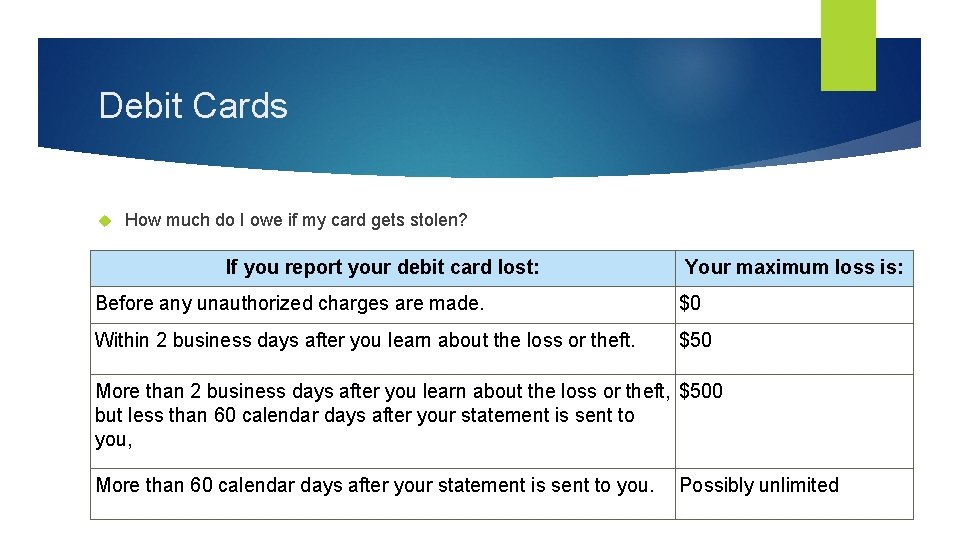
Debit Cards How much do I owe if my card gets stolen? If you report your debit card lost: Your maximum loss is: Before any unauthorized charges are made. $0 Within 2 business days after you learn about the loss or theft. $50 More than 2 business days after you learn about the loss or theft, $500 but less than 60 calendar days after your statement is sent to you, More than 60 calendar days after your statement is sent to you. Possibly unlimited
Why E Banks? Making an informed decision. http: //time. com/money/4529940/best-online-bank/
What are your Pros and Cons to belonging to an Electronic Banking? Benefits Concerns
Annoying Bank Fees Monthly or annual maintenance fee Minimum balance fee. Lost debit card fee Human teller fee Over Draft fees Foreign Transaction Fees Inactivity Fees Excess Fees such as Regulation D
- Slides: 21