
Unit 1 Atomic Structure and Properties General Overview
- Slides: 15
+ Unit #1 Atomic Structure and Properties
+ General Overview of Unit 1 1. 1 Molar Mass 1. 2 Mass Spectroscopy 1. 3 Elemental Composition of Pure Substances 1. 4 Composition of Mixtures 1. 5 Atomic Structure and Electron Configurations 1. 6 Photoelectron Spectroscopy 1. 7 Periodic Trends 1. 8 Valence Electrons
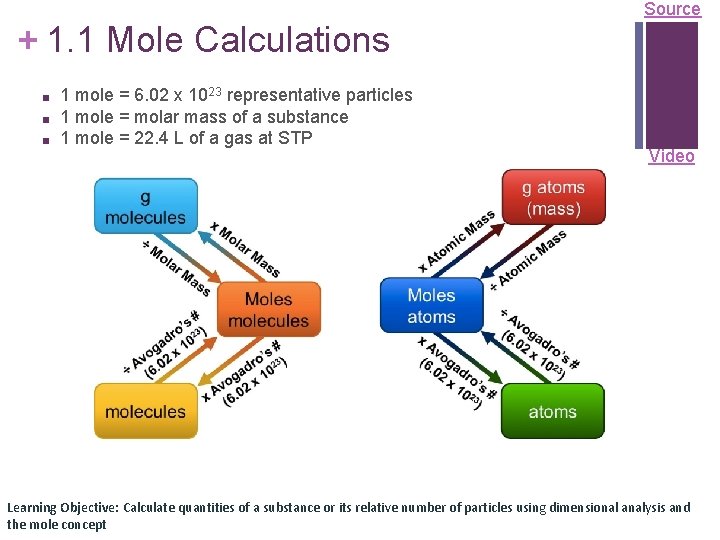
Source + 1. 1 Mole Calculations ■ ■ ■ 1 mole = 6. 02 x 1023 representative particles 1 mole = molar mass of a substance 1 mole = 22. 4 L of a gas at STP Video Learning Objective: Calculate quantities of a substance or its relative number of particles using dimensional analysis and the mole concept
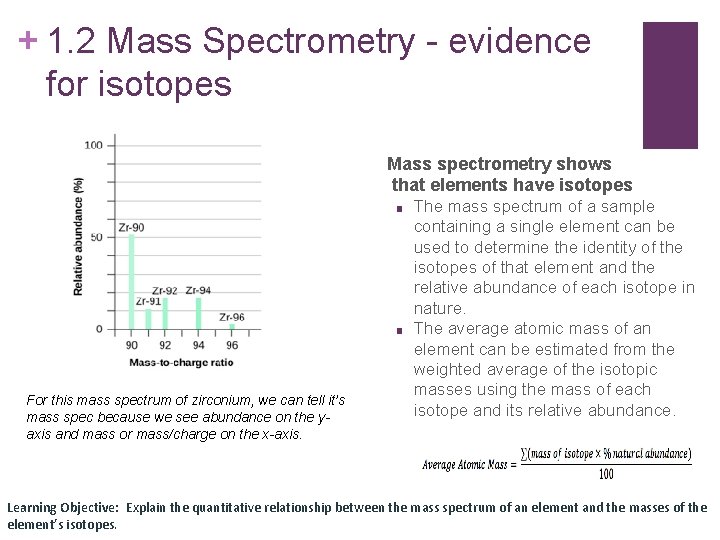
+ 1. 2 Mass Spectrometry - evidence for isotopes Mass spectrometry shows that elements have isotopes ■ ■ For this mass spectrum of zirconium, we can tell it’s mass spec because we see abundance on the yaxis and mass or mass/charge on the x-axis. The mass spectrum of a sample containing a single element can be used to determine the identity of the isotopes of that element and the relative abundance of each isotope in nature. The average atomic mass of an element can be estimated from the weighted average of the isotopic masses using the mass of each isotope and its relative abundance. Learning Objective: Explain the quantitative relationship between the mass spectrum of an element and the masses of the element’s isotopes.
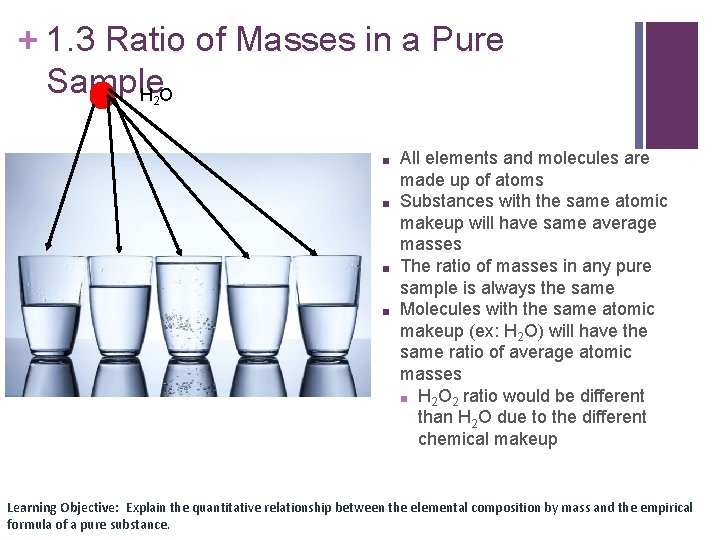
+ 1. 3 Ratio of Masses in a Pure Sample HO 2 ■ ■ All elements and molecules are made up of atoms Substances with the same atomic makeup will have same average masses The ratio of masses in any pure sample is always the same Molecules with the same atomic makeup (ex: H 2 O) will have the same ratio of average atomic masses ■ H 2 O 2 ratio would be different than H 2 O due to the different chemical makeup Learning Objective: Explain the quantitative relationship between the elemental composition by mass and the empirical formula of a pure substance.
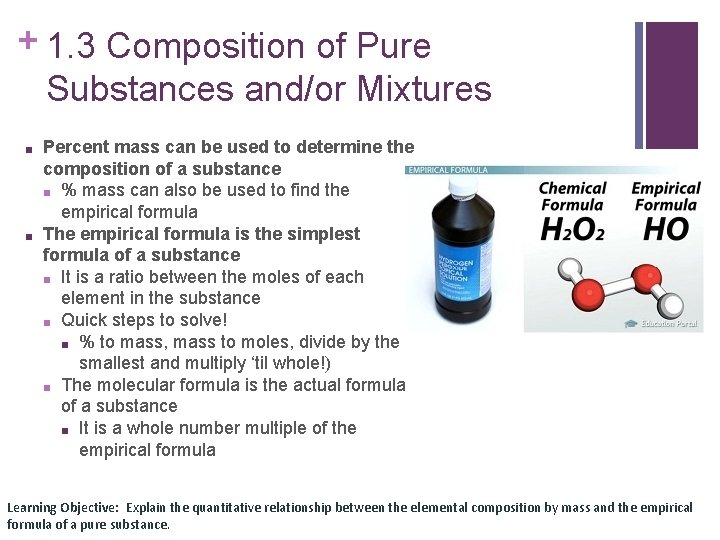
+ 1. 3 Composition of Pure Substances and/or Mixtures ■ ■ Percent mass can be used to determine the composition of a substance ■ % mass can also be used to find the empirical formula The empirical formula is the simplest formula of a substance ■ It is a ratio between the moles of each element in the substance ■ Quick steps to solve! ■ % to mass, mass to moles, divide by the smallest and multiply ‘til whole!) ■ The molecular formula is the actual formula of a substance ■ It is a whole number multiple of the empirical formula Learning Objective: Explain the quantitative relationship between the elemental composition by mass and the empirical formula of a pure substance.
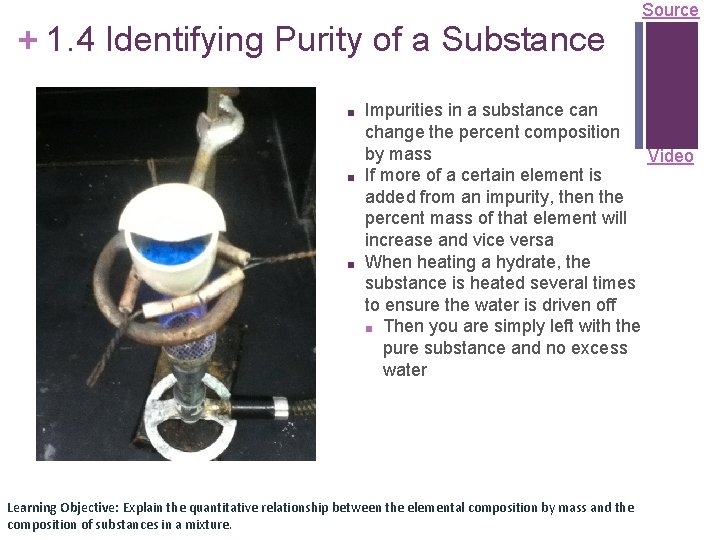
+ 1. 4 Identifying Purity of a Substance ■ ■ ■ Source Impurities in a substance can change the percent composition by mass Video If more of a certain element is added from an impurity, then the percent mass of that element will increase and vice versa When heating a hydrate, the substance is heated several times to ensure the water is driven off ■ Then you are simply left with the pure substance and no excess water Learning Objective: Explain the quantitative relationship between the elemental composition by mass and the composition of substances in a mixture.
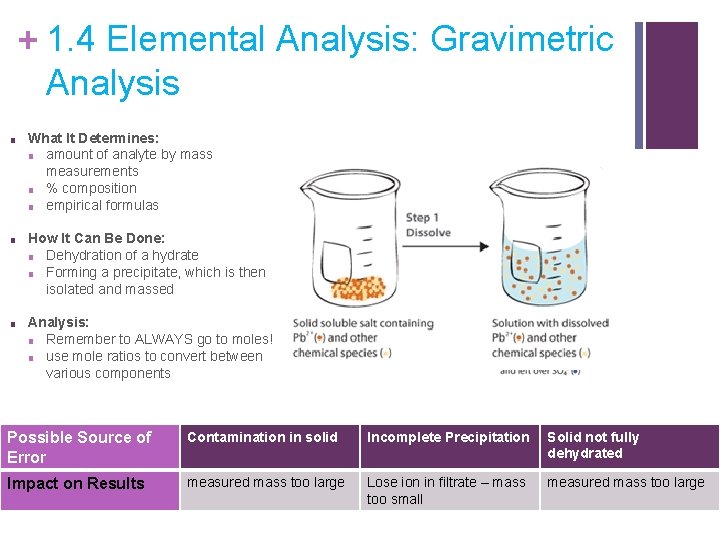
+ 1. 4 Elemental Analysis: Gravimetric Analysis ■ What It Determines: ■ amount of analyte by mass measurements ■ % composition ■ empirical formulas ■ How It Can Be Done: ■ Dehydration of a hydrate ■ Forming a precipitate, which is then isolated and massed ■ Analysis: ■ Remember to ALWAYS go to moles! ■ use mole ratios to convert between various components Possible Source of Error Contamination in solid Incomplete Precipitation Solid not fully dehydrated Impact on Results measured mass too large Lose ion in filtrate – mass too small measured mass too large
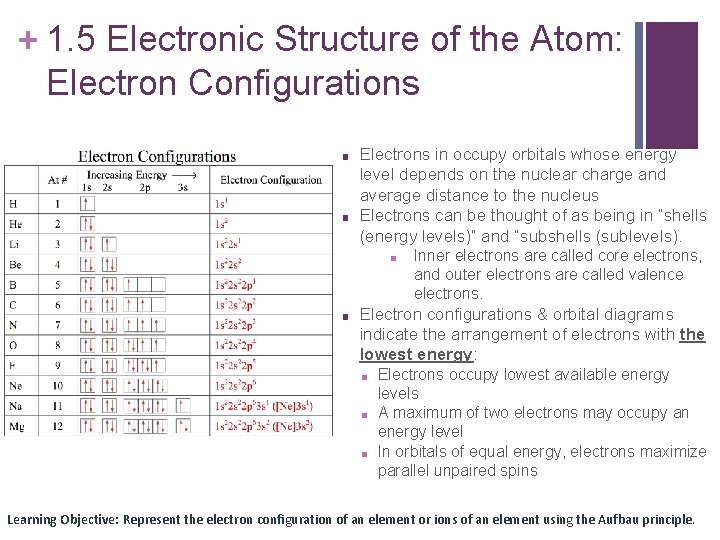
+ 1. 5 Electronic Structure of the Atom: Electron Configurations ■ ■ Electrons in occupy orbitals whose energy level depends on the nuclear charge and average distance to the nucleus Electrons can be thought of as being in “shells (energy levels)” and “subshells (sublevels). ■ ■ Inner electrons are called core electrons, and outer electrons are called valence electrons. Electron configurations & orbital diagrams indicate the arrangement of electrons with the lowest energy: ■ ■ ■ Electrons occupy lowest available energy levels A maximum of two electrons may occupy an energy level In orbitals of equal energy, electrons maximize parallel unpaired spins Learning Objective: Represent the electron configuration of an element or ions of an element using the Aufbau principle.
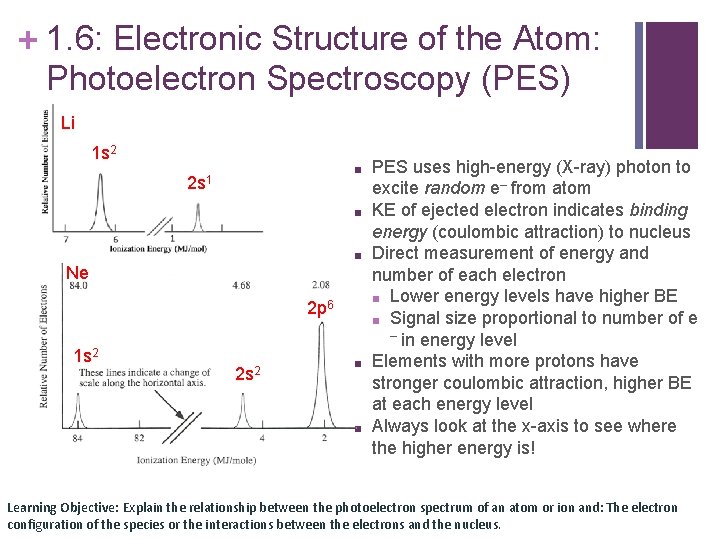
+ 1. 6: Electronic Structure of the Atom: Photoelectron Spectroscopy (PES) Li 1 s 2 ■ 2 s 1 ■ ■ Ne 2 p 6 1 s 2 2 s 2 ■ ■ PES uses high-energy (X-ray) photon to excite random e– from atom KE of ejected electron indicates binding energy (coulombic attraction) to nucleus Direct measurement of energy and number of each electron ■ Lower energy levels have higher BE ■ Signal size proportional to number of e – in energy level Elements with more protons have stronger coulombic attraction, higher BE at each energy level Always look at the x-axis to see where the higher energy is! Learning Objective: Explain the relationship between the photoelectron spectrum of an atom or ion and: The electron configuration of the species or the interactions between the electrons and the nucleus.
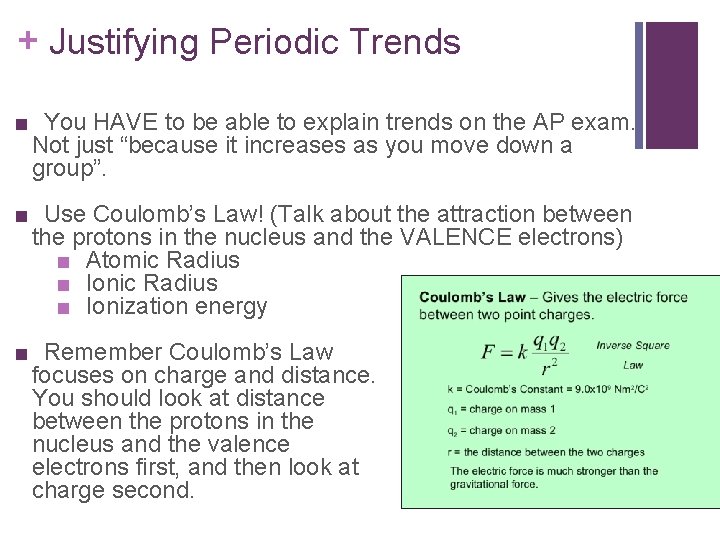
+ Justifying Periodic Trends ■ You HAVE to be able to explain trends on the AP exam. Not just “because it increases as you move down a group”. ■ Use Coulomb’s Law! (Talk about the attraction between the protons in the nucleus and the VALENCE electrons) ■ Atomic Radius ■ Ionization energy ■ Remember Coulomb’s Law focuses on charge and distance. You should look at distance between the protons in the nucleus and the valence electrons first, and then look at charge second.
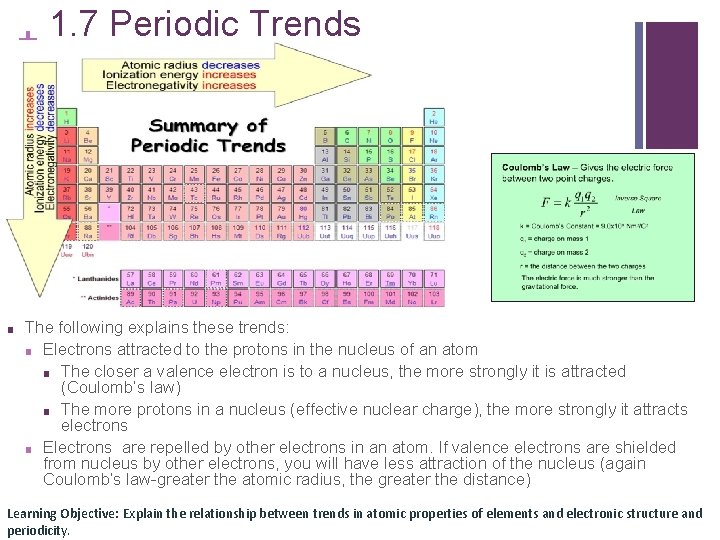
1. 7 Periodic Trends + ■ The following explains these trends: ■ Electrons attracted to the protons in the nucleus of an atom ■ The closer a valence electron is to a nucleus, the more strongly it is attracted (Coulomb’s law) ■ The more protons in a nucleus (effective nuclear charge), the more strongly it attracts electrons ■ Electrons are repelled by other electrons in an atom. If valence electrons are shielded from nucleus by other electrons, you will have less attraction of the nucleus (again Coulomb’s law-greater the atomic radius, the greater the distance) Learning Objective: Explain the relationship between trends in atomic properties of elements and electronic structure and periodicity.
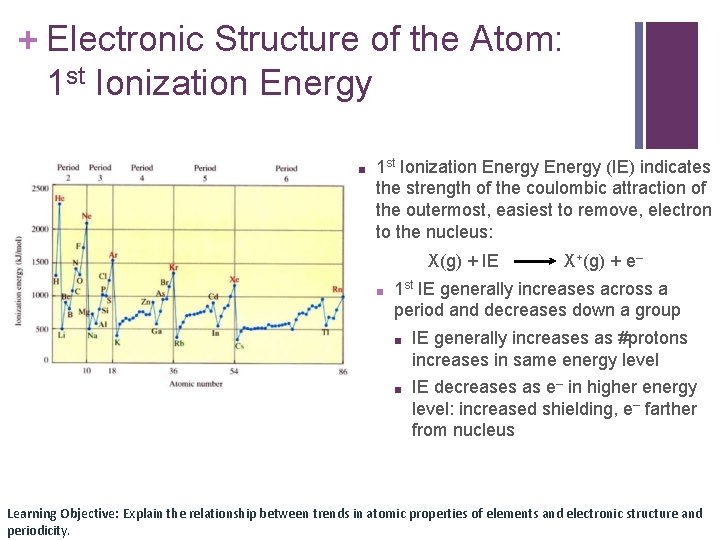
+ Electronic Structure of the Atom: 1 st Ionization Energy ■ 1 st Ionization Energy (IE) indicates the strength of the coulombic attraction of the outermost, easiest to remove, electron to the nucleus: X(g) + IE ■ X+(g) + e– 1 st IE generally increases across a period and decreases down a group ■ IE generally increases as #protons increases in same energy level ■ IE decreases as e– in higher energy level: increased shielding, e– farther from nucleus Learning Objective: Explain the relationship between trends in atomic properties of elements and electronic structure and periodicity.
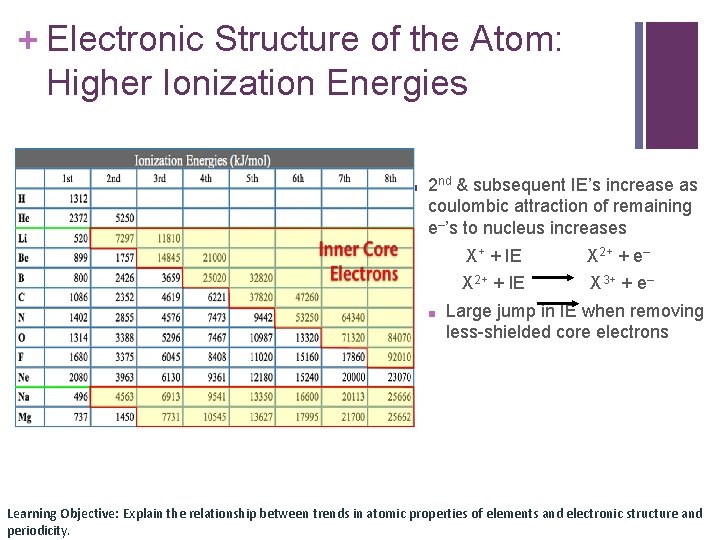
+ Electronic Structure of the Atom: Higher Ionization Energies ■ 2 nd & subsequent IE’s increase as coulombic attraction of remaining e–’s to nucleus increases ■ X+ + IE X 2+ + e– X 2+ + IE X 3+ + e– Large jump in IE when removing less-shielded core electrons Learning Objective: Explain the relationship between trends in atomic properties of elements and electronic structure and periodicity.
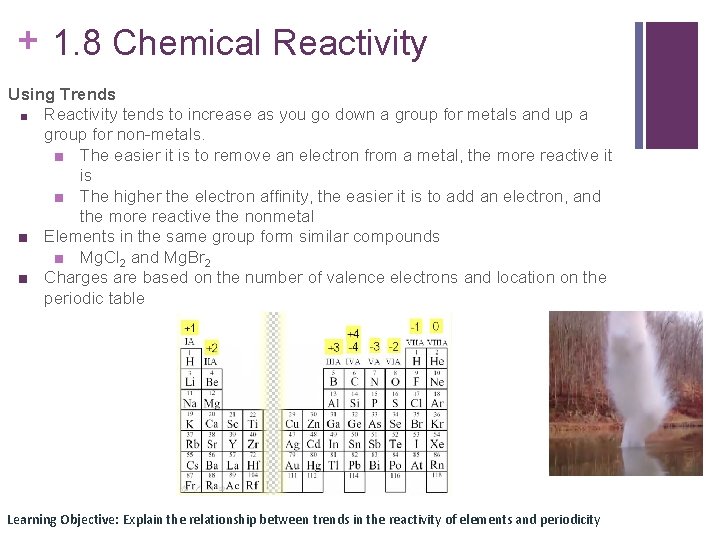
+ 1. 8 Chemical Reactivity Using Trends ■ Reactivity tends to increase as you go down a group for metals and up a group for non-metals. ■ The easier it is to remove an electron from a metal, the more reactive it is ■ The higher the electron affinity, the easier it is to add an electron, and the more reactive the nonmetal ■ Elements in the same group form similar compounds ■ Mg. Cl 2 and Mg. Br 2 ■ Charges are based on the number of valence electrons and location on the periodic table Learning Objective: Explain the relationship between trends in the reactivity of elements and periodicity