
Unit 1 and 2 th 20 Century History

- Slides: 25
Unit 1 and 2 th 20 Century History Introduction to the Study Design and Assessment 2021
Why do I need to know what the study design covers § Become familiar with the language used in the specific study § Use the subject specific language used in the study design in the completion of class/homework tasks, school based assessment tasks and the end of year examination. § Demonstrates a higher level of confidence and understanding of the key knowledge and key skills. § The study design is your guide to the specific subject undertaken in VCE § Reference to ensure all AOS of covered and Outcomes are assessed § Reference is made to the study design during each lesson to identify the key knowledge and the key skills covered
Area of Study 1: Ideology and conflict § What impact did the treaties which concluded World War One have on nations and people? § What were the dominant ideologies of the period? § What impact did the post-war treaties, the development of ideologies and the economic crisis have on the events leading to World War Two? Unit 1: Twentieth century history 19181939
In this area of study students explore the events, ideologies and movements of the period after World War One; the emergence of conflict; and the causes of World War Two. They investigate the impact of the treaties which ended the Great War and which redrew the map of Europe and broke up the former empires of the defeated nations. They consider the aims, achievements and limitations of the League of Nations. While democratic governments initially replaced the monarchies and authoritarian forms of government in European countries at the end of the war, new ideologies of socialism, communism and fascism gained popular support. Communism emerged in Russia after the 1917 Bolshevik Revolution. Fascism first emerged in Italy where the Italian Fascist Party gained power in 1922 and before the end of the decade fascist parties existed in several European countries. In 1933, Adolf Hitler’s National Socialist (Nazi) Party gained power in Germany. In Japan, the government was increasingly influenced by the military and by anti-Western attitudes, shaping much of its political and social action. In the wake of World War One, the USA pursued an isolationist policy and while the ‘Roaring Twenties’ was a decade of economic growth, the thirties saw considerable suffering as a result of the Depression. Economic instability, territorial aggression and totalitarianism combined to draw the world into a second major conflict in 1939.
Outcome 1 § On completion of this unit the student should be able to explain the consequences of the peace treaties which ended World War One, the impact of ideologies on nations and the events that led to World War Two. § To achieve this outcome the student will draw on key knowledge and key skills outlined in Area of Study 1
§ the principal features of the post-World War One peace treaties, such as the re-drawing of borders, reparations, loss of territory and population by the defeated countries, and economic and political sanctions § ideologies, movements and events of the interwar period such as socialism and communism in the USSR, fascism in Italy, fascism and militarism in Japan, Nazism in Germany, isolationism in the USA and liberal democracy in Britain and the USA Key knowledge § the establishment, goals, achievements and limitations of the League of Nations, Woodrow Wilson’s 14 Points and the responses of Britain, France, the USA, Japan and Italy to these measures § the significant influences and events which led the world into a second war in 1939, such as the peace treaties, actions of the League of Nations, the rise of fascist and militarist regimes, the Great Depression, and territorial aggression § key concepts: imperialism, fascism, nazism, socialism, communism, democracy, capitalism, nationalism and national self-determination, and militarism.
§ use questions to shape historical inquiry into the events of the interwar years § explain the historical significance of the treaties which ended World War One § explain continuity and change in the period between the world wars Key skills § explain the causes of World War Two § compare attitudes, beliefs and values of ideologies of the period § analyse perspectives of people from the period on political and economic change as reflected in primary sources § compare historical interpretations of the causes of World War Two § construct arguments about the causes of World War Two using primary sources and historical interpretations as evidence.
Area of Study 2: Social and Cultural Change § What continuity and what change is evident between the 1920 s and 1930 s in social and cultural life? § How did ideologies affect the daily lives of people? § How did cultural life both reflect and challenge the prevailing political, economic and social circumstances? Unit 1: Twentieth century history 19181939
In this area of study students focus on the social life and cultural expression in the 1920 s and 1930 s and their relation to the technological, political and economic changes of the period. Students explore particular forms of cultural expression from the period in one or more of the following contexts: Italy, Germany, Japan, USSR and/or USA. The period between the wars was characterised by significant social and cultural change. While the 1920 s was largely marked by optimism and material prosperity in the West, by contrast the 1930 s was a period of severe economic hardship for many dominated by the impact of the Great Depression. The emergence of new governments in Italy, Germany and Japan at the end of World War One led to the emergence of societies driven by new ideologies and in some countries the consequent oppression and persecution of certain groups, the most extreme case being the Holocaust of Nazi Germany. In the USSR, the establishment of a communist regime in 1917 was initially greeted with support by a large proportion of the people, but under Stalin millions of people were forced to work in state-owned factories and farms and dissenters were sent to labour camps. In the USA controls such as prohibition and race segregation affected the lives of many people during the decades between the wars. While the 1920 s was characterised by material progress, increased personal freedoms and unprecedented economic growth, the Great Depression brought hardship. The creative arts both reflected and challenged social life and change in this period where mass entertainment and information by means of radio and film became widespread.
Outcome 2 § Outcome 2 On completion of this unit the student should be able to explain patterns of social life and cultural change in one or more contexts, and analyse the factors which influenced changes to social life and culture, in the inter-war years. § To achieve this outcome the student will draw on key knowledge and key skills outlined in Area of Study 2, focusing on one or more of the following contexts: Italy, Germany, Japan, USSR and/or USA.
§ the influence of political, economic and technological change on the ways in which society was organised and people lived their lives including: working conditions and workers’ rights and the positions and roles of men, women and children; and law and order, social control and personal freedoms § the role of race, class, ethnicity, political affiliation and gender in social experience § the extent to which certain groups were included or excluded from participation in Key knowledge the society and the manifestations of that inclusion or exclusion § the ways in which particular forms of cultural expression such as art, literature, architecture, film and music both influenced and reflected social, economic and political change § attempts by governments, groups and individuals to control cultural expression and use it to challenge or shape political and social agendas § the influence of and responses to an individual artist, film maker, photographer, writer or group (such as the Bauhaus movement, Art Deco, Futurism, Modernism, African American music).
§ use questions to inform historical inquiry into the impact of political, economic and technological change on the ways that people lived their lives § explain the historical significance of particular social and cultural movements § explain continuity and change in social and cultural life during the 1920 s and 1930 s Key skills § explain the social and political consequences of key social and cultural movements § explain beliefs and values reflected in individual cultural movements § analyse perspectives of people from the period on social and cultural change § compare historical interpretations about cultural movements and cultural expression § construct arguments about the nature of particular social and cultural movements using primary sources and historical interpretations as evidence
Area of Study 1: Competing ideologies § What were the causes of the Cold War? § What were the key characteristics of the ideologies of communism in the USSR and democracy and capitalism in the USA? § What was the impact of the Cold War on nations and people? § What led to the end of the Cold War? Unit 2: Twentieth century history 19452000
In this area of study students focus on causes and consequences of the Cold War; the competing ideologies that underpinned events, the effects on people, groups and nations, and the reasons for the end of this sustained period of ideological conflict. Students explore the causes of the Cold War in the aftermath of World War Two. They investigate significant events and developments and the consequences for nations and people in the period 1945 – 1991. While the USA and the USSR never engaged in direct armed conflict, they opposed each other in a range of international conflicts such as those in Berlin, Korea, Cuba and Vietnam. They both tried to exert their influence through aid and propaganda in Africa, Asia and the Americas and engaged in an arms race and a space race with competition also extending to sport and the arts. Students consider the reasons for the end of this long-running period of ideological conflict and the collapse of the Soviet Union in 1991.
Outcome 1 § On completion of this unit the student should be able to explain the ideological divisions in the post-war period analyse the nature, development and impact of the Cold War on nations and people, in relation to one or more particular conflicts in the period. § To achieve this outcome the student will draw on key knowledge and key skills outlined in Area of Study 1.
Key knowledge § the economic, political and social characteristics of the competing ideologies of Communism in the USSR and democracy and capitalism in the USA § the significant features of the peace conferences at Yalta and Potsdam such as the re-drawing of borders, loss of territory and population by the defeated countries and the tensions between Truman and Stalin over the treatment of Germany § the significance to the Cold War and Soviet–American relationship of Churchill’s Iron Curtain speech, the Truman Doctrine, the Marshall Plan and the Berlin Blockade § the establishment and goals of the United Nations including initiatives to address areas of international concern about human rights, and economic and social issues § the significant features of the Cold War such as the development of alliances, the arms race, the space race, propaganda, sport, popular culture and espionage § wars and conflicts that reflected the tensions and divisions of the Cold War focusing on one or more of: § the Korean War including the background to the conflict and the outcome for people, countries and the Cold War superpowers § the division of Germany and Berlin, the building of the Berlin Wall, the Stasi and the consequences for those who lived with the division for 28 years § dissent among Soviet Satellites, including the uprisings in Poland Hungary in 1956 and the Prague Spring in 1968, and Soviet responses to dissent § the Vietnam War, including the background to the conflict, the domino theory, reasons for international involvement, the anti-war movement, outcomes and consequences § events in Cuba such as the Cuban Revolution, the Bay of Pigs invasion, the Cuban missile crisis, and outcomes and consequences for Cuba and for superpower relationships § influences that contributed to the end of the Cold War such as detente between the USSR and the USA, the war in Afghanistan, Reagan and Star Wars, Gorbachev’s policies, developments in the satellite states such as Solidarity in Poland, dismantling of the Berlin Wall and reunification of Germany, and the breakup of the Soviet Union § the key concepts which underpinned events and crises during the period: nationalism and national self-determination, decolonisation, glasnost, perestroika, solidarity and internationalism.
§ use questions to shape historical inquiry into the causes of the Cold War § explain the historical significance of particular Cold War conflicts § explain continuity and change in the nature of the Cold War over the period § explain the causes of end of the Cold War Key skills § explain the beliefs and values reflected in ideologies of the period § analyse the perspectives of people from this period § compare historical interpretations of Cold War events § construct arguments about the nature of particular social and cultural movements using primary sources and historical interpretations as evidence.
Area of Study 2: Challenge and change § What were the significant causes of challenge to and change in existing political and social orders in the second half of the twentieth century? § How did the actions and ideas of popular movements and individuals contribute to change? § What impacts did challenge and change have on nations and people? Unit 2: Twentieth century history 19452000
In this area of study students focus on the ways in which traditional ideas, values and political systems were challenged and changed by individuals and groups in a range of contexts during the period 1945 to 2000. Students explore the causes of significant political and social events and movements, and their consequences for nations and people. While the Cold War dominated the second half of the twentieth century, political and social challenge and change occurred within and between nations based on religion, nationalism, race, gender and human rights. Developments in mass communication including the internet and satellite television meant that many of the political and social movements transcended national boundaries and were exposed to a global audience. Independence movements led to the emergence of new nations. Some, like Algeria, achieved sovereignty through armed struggle; others, including Papua New Guinea, through diplomatic means. While terrorism was not a new historical phenomenon, it took on new dimensions and became increasingly globalised. Other conflicts continued in the second half of the century. These included the Arab–Israeli conflict, the struggle against Apartheid in South Africa and conflict in Northern Ireland. In the Western world groups emerged to challenge the ways that power structures were organised, distributed and used. Traditional attitudes to race, war, gender, sexuality, religion, the environment and human rights were questioned. Students study challenge and change in relation to two of the following: § decolonisation movements in Africa or the Asia Pacific such as Algeria, Congo, Indonesia, Cambodia, Malaya, East Timor, Papua New Guinea § campaigns by terrorist groups such as EOKA (Cyprus), ETTA (Spain), FLN (Algeria), Baader Meinhoff (West Germany), Japanese Red Army, Black September, Symbionese Liberation Army (USA), Irish Republican Army, Al Jihad, Hezbollah, and Al Qaeda § other conflicts such as the Arab–Israeli dispute, the anti-Apartheid movement in South Africa, the Irish ‘troubles’ § social and political movements such as civil rights campaigns in the USA, feminism, environmentalism and the peace movement.
Outcome 2 § On completion of this unit the student should be able to explain the causes and nature of challenge and change in relation to two selected contexts in the second half of the twentieth century and analyse the consequences for nations and people. § To achieve this outcome the student will draw on key knowledge and key skills outlined in Area of Study 2.
Key knowledge § conditions and events that gave rise to the challenge and change to power § the ideas that influenced the challenge and brought about change § key individuals and/or groups involved in the movement for change § the methods employed by groups and individuals to implement change and express views, such as diplomacy, meetings and marches, civil disobedience, armed conflict, hijackings, bombings § the responses of established political and social orders, both positive and negative § the extent to which goals were achieved and change occurred § the short- and long-term consequences of particular events and movements § the key concepts that underpinned challenge and change in the period: decolonisation, nationalism, theocracy, self-determination, racism, sexism, feminism and egalitarianism.
§ use questions to shape historical inquiry into arguments for change § explain the historical significance of particular movements, people and events § analyse continuity and change in particular contexts involving power relationships § explain the causes and consequences of movements and events Key skills § explain the beliefs, values and attitudes of people as reflected in primary sources § compare the perspectives of people from the period on political, economic and social change § compare historical interpretations about events of the period § construct arguments about the nature of particular social and cultural movements using primary sources and historical interpretations as evidence
The award of satisfactory completion for a unit is based on whether the student has demonstrated the set of outcomes specified for the unit. Teachers should use a variety of learning activities and assessment tasks that provide a range of opportunities for students to demonstrate the key knowledge and key skills in the outcomes. The areas of study, including the key knowledge and key skills listed for the outcomes should be used for course design and the development of learning activities and assessment tasks. Assessment must be a part of the regular teaching and learning program and should be completed mainly in class and within a limited timeframe. All assessments at Units 1 and 2 are school-based. Procedures for assessment of levels of achievement in Units 1 and 2 are a matter for school decision. For this unit students are required to demonstrate two outcomes. As a set these outcomes encompass the areas of study in the unit. Assessment tasks over Units 1 and 2 should include the following: § a historical inquiry § an analysis of primary sources § an analysis of historical interpretations § an essay. Assessment
Achievement of outcomes Classroom participation Homework completion Formative task completion Maintaining revision notes (concept map, cue cards, glossary) Attendance Achievement of 50% for Outcomes (We want to aim for 80%+)
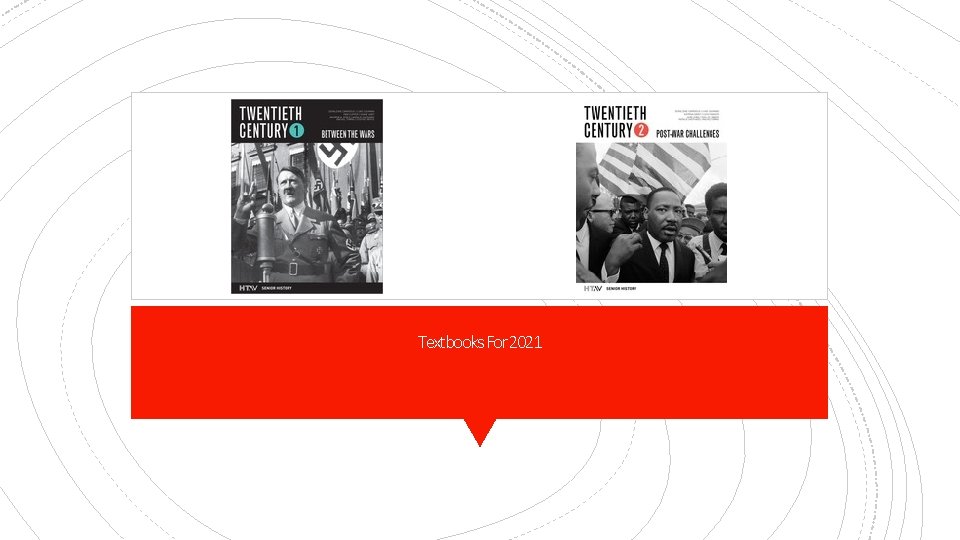
Textbooks For 2021