
Unit 1 3 Review Principles of Biomedical Sciences
Unit 1 -3 Review Principles of Biomedical Sciences
What can be done at a scene of a mysterious death to help reconstruct what happened? • Interview witnesses, possible suspects, and known associates • Examine the crime scene for all evidence in an orderly fashion • Sketch the crime scene using a key and scale • Photograph the scene with rulers for size estimation • Collect all evidence 2
How do the clues found at a scene of a mysterious death help investigators determine what might have occurred and help identify or exonerate potential suspects? 3
Blood Type • There are four basic blood types – Type A – has A antigens – Type B – has B antigens – Type AB – has A and B antigens – Type O – has no antigens • Blood types can be found by adding antibodies to the blood and seeing if the blood clumps. • Blood will clumps due to the antibody binding to the antigen. Antibodies are specific to each antigen so only B antibodies will bind with B antigens. • Lets look at this animation http: //waynesword. palomar. edu/aniblood. htm 4
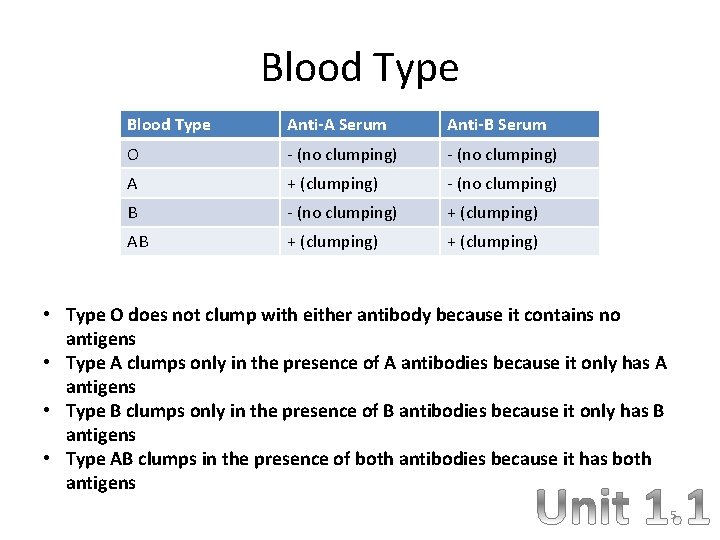
Blood Type Anti-A Serum Anti-B Serum O - (no clumping) A + (clumping) - (no clumping) B - (no clumping) + (clumping) AB + (clumping) • Type O does not clump with either antibody because it contains no antigens • Type A clumps only in the presence of A antibodies because it only has A antigens • Type B clumps only in the presence of B antibodies because it only has B antigens • Type AB clumps in the presence of both antibodies because it has both antigens 5

Fingerprints • There are three main patterns you need to understand – Loop – Whorl – Arch 6
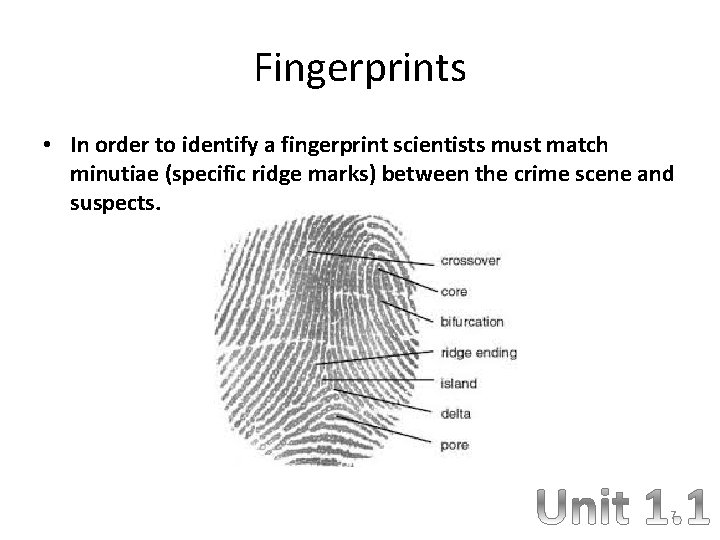
Fingerprints • In order to identify a fingerprint scientists must match minutiae (specific ridge marks) between the crime scene and suspects. 7
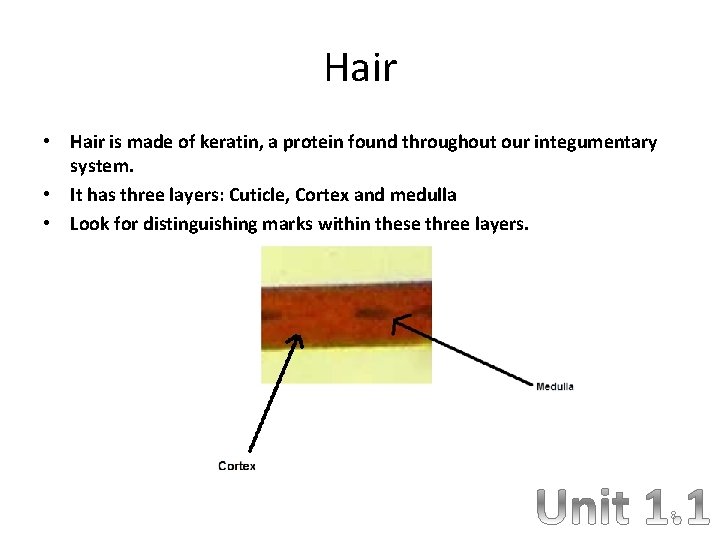
Hair • Hair is made of keratin, a protein found throughout our integumentary system. • It has three layers: Cuticle, Cortex and medulla • Look for distinguishing marks within these three layers. 8
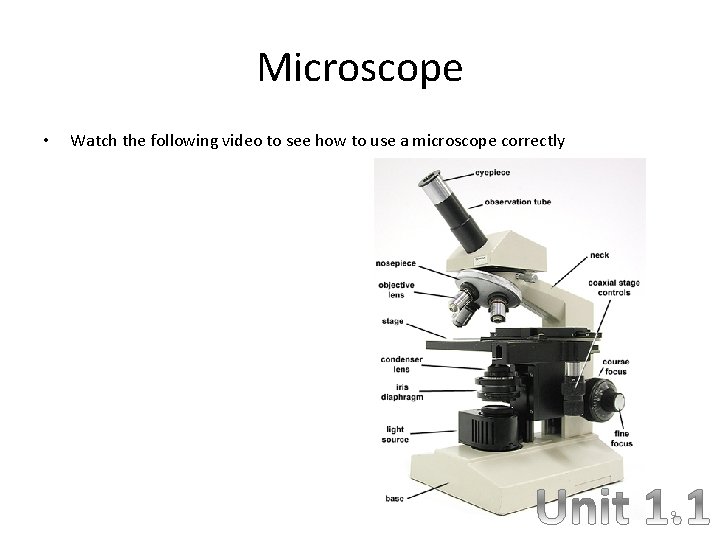
Microscope • Watch the following video to see how to use a microscope correctly 9
Time of Death • Signs to estimate time of death – Rigor mortis – Tightening of the muscles after death (more on this in HBS) – Algor mortis – Internal temperature cooling – Lividity – Blood pooling – Amount of decomposition – Entomology – study of bugs and when they arrive after death • Factors affecting Algor Mortis – – – Clothing Original internal temp Ambient temperature Environment (such as humidity, etc. ) Body size 10
How do scientists design experiments to find the most accurate answer to the question they are asking? Example Experiment: A scientist is studying the affect caffeine on blood sugar in diabetics. The scientist gathers 300 diabetics and half of them drink caffeine every day. The other half do not drink caffeine. They continue this for a month. Blood sugar is measured every day. 11
• Independent variable – What you change or manipulate (Caffeine) • Dependent variable – Outcome or data that is collected (Blood sugar) • Null Hypothesis – A hypothesis that assumes everything will stay the same/no change (Caffeine will have no effect on blood sugar) • Alternative Hypothesis – A hypothesis that describes the outcome that is predicted (Caffeine will affect blood sugar) • Random – Patients should be selected at random/at chance. (The experimenter chose people with diabetes at random) 12
• Replication – How many times the experiment is repeated (there were 150 participants in each sample) • Standardization – Each group should have the same conditions as each other except for the independent variable. All extraneous variables should be controlled and kept constant between groups. (Each group should have the same type of diabetes, same diet, and same physical activity) • Control – Group that receives NO TREATMENT. (The control was people without caffeine. ) 13
How are bloodstain patterns left at a crime scene used to help investigators establish the events that took place during a crime? 14
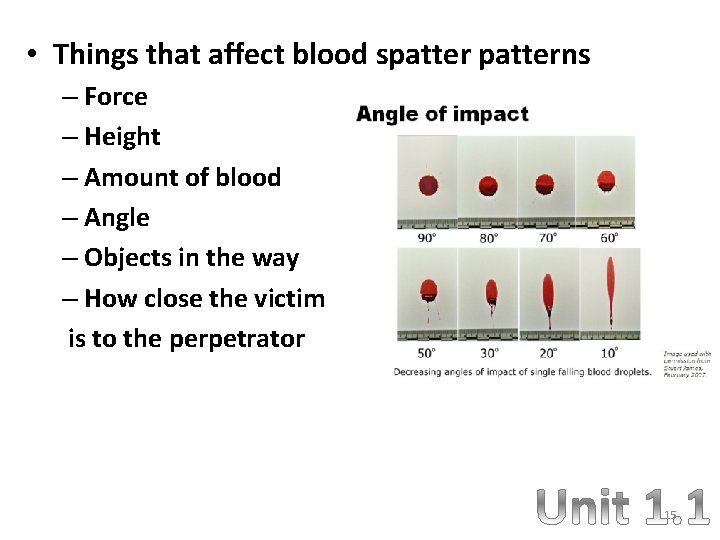
• Things that affect blood spatterns – Force – Height – Amount of blood – Angle – Objects in the way – How close the victim is to the perpetrator 15
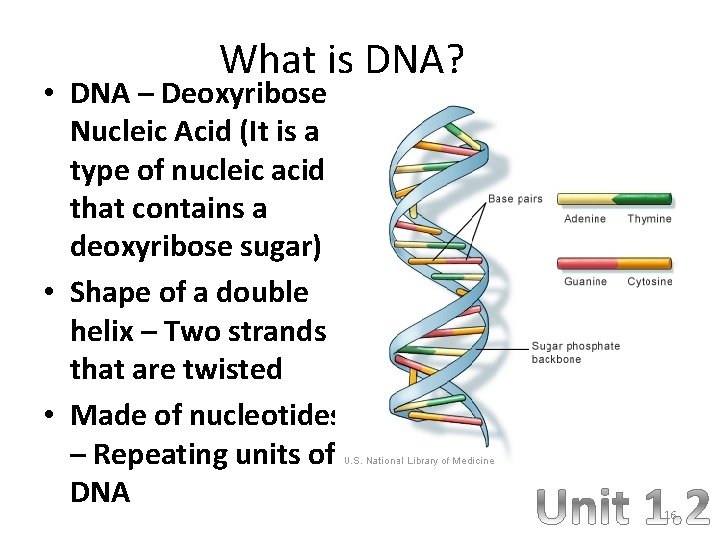
What is DNA? • DNA – Deoxyribose Nucleic Acid (It is a type of nucleic acid that contains a deoxyribose sugar) • Shape of a double helix – Two strands that are twisted • Made of nucleotides – Repeating units of DNA 16
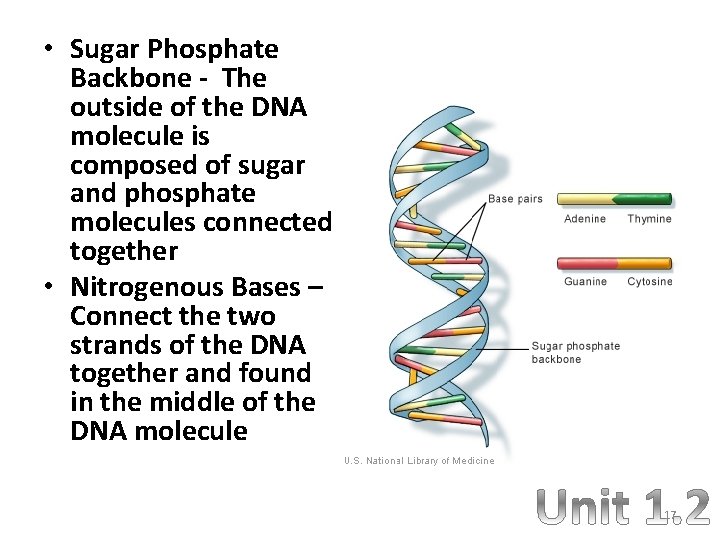
• Sugar Phosphate Backbone - The outside of the DNA molecule is composed of sugar and phosphate molecules connected together • Nitrogenous Bases – Connect the two strands of the DNA together and found in the middle of the DNA molecule 17
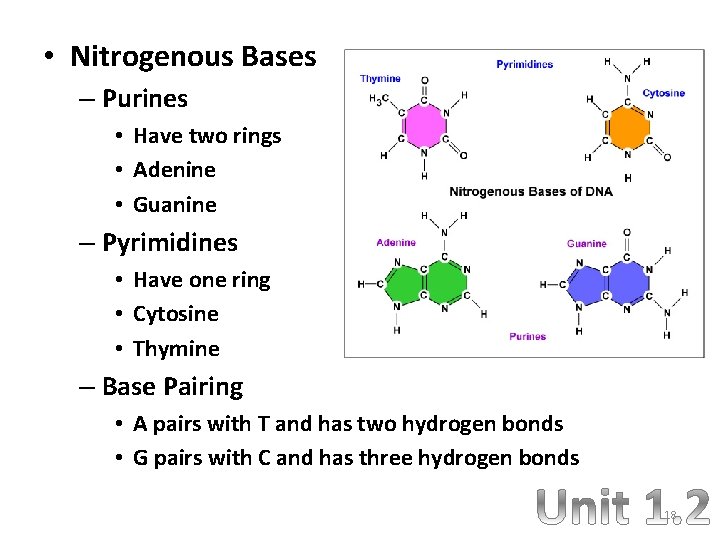
• Nitrogenous Bases – Purines • Have two rings • Adenine • Guanine – Pyrimidines • Have one ring • Cytosine • Thymine – Base Pairing • A pairs with T and has two hydrogen bonds • G pairs with C and has three hydrogen bonds 18
How do scientists isolate DNA in order to study it? 1. If using plants the food needs to be mashed up first. 2. Soap solution is added to breakup the cell membrane. 3. Alcohol will separate the DNA from the rest of the liquid. See http: //learn. genetics. utah. edu/content/labs/ext raction/howto/
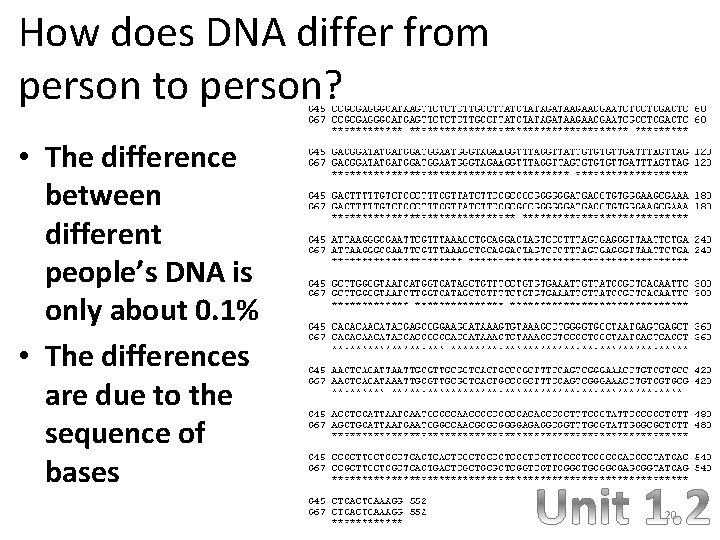
How does DNA differ from person to person? • The difference between different people’s DNA is only about 0. 1% • The differences are due to the sequence of bases 20
How can tools of molecular biology be used to compare the DNA of two individuals? What are restriction enzymes? What are restriction fragment length polymorphisms?
• Restriction enzymes are used to cut the DNA into different sized fragments (RFLP’s) that are determined by the sequence • The DNA is run on a gel to separate the fragments and determine the length • The fragment lengths can be compared by viewing the bands on the gel See: http: //highered. mcgrawhill. com/olcweb/cgi/pluginpop. cgi? it=swf: : 535 : : /sites/dl/free/0072437316/120078/bio 20. swf: : Re striction%20 Fragment%20 Length%20 Polymorphism s 22
What is gel electrophoresis and how can the results of this technique be interpreted?
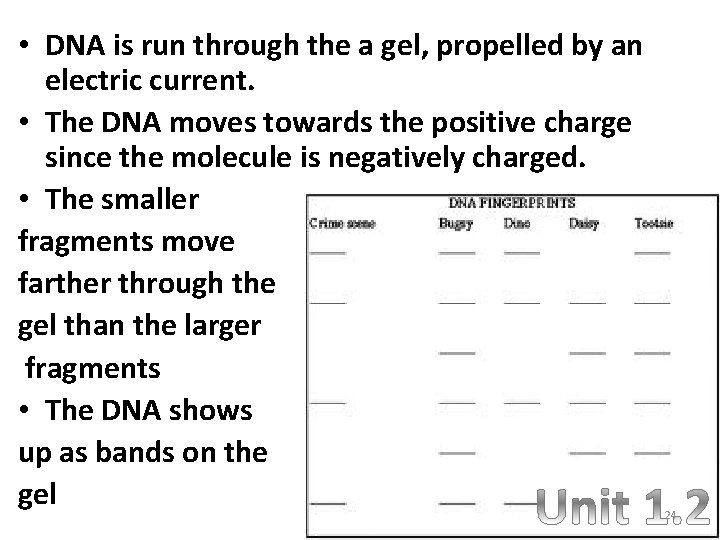
• DNA is run through the a gel, propelled by an electric current. • The DNA moves towards the positive charge since the molecule is negatively charged. • The smaller fragments move farther through the gel than the larger fragments • The DNA shows up as bands on the gel 24
What is an autopsy and how can it be used to determine the cause of death? How can the manner of death be determined?
• An autopsy is an internal and external examination of the body to determine the cause of death. • Forensic autopsies are done to solve crimes • Clinical autopsies are done to understand diseases • 5 Legal Manners of Death – Homicide – Suicide – Accident – Undetermined – Natural 26
- Slides: 26