
Unit 1 2 Have you declared your i


- Slides: 48
Unit
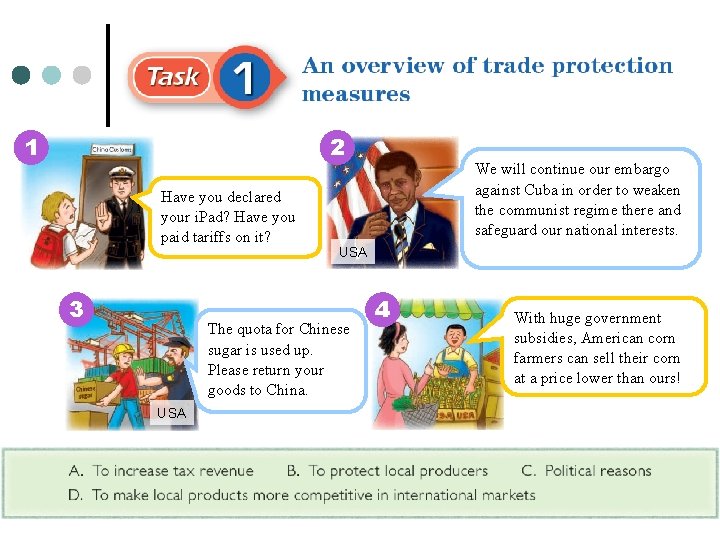
1 2 Have you declared your i. Pad? Have you paid tariffs on it? 3 We will continue our embargo against Cuba in order to weaken the communist regime there and safeguard our national interests. USA The quota for Chinese sugar is used up. Please return your goods to China. 4 With huge government subsidies, American corn farmers can sell their corn at a price lower than ours! USA 2
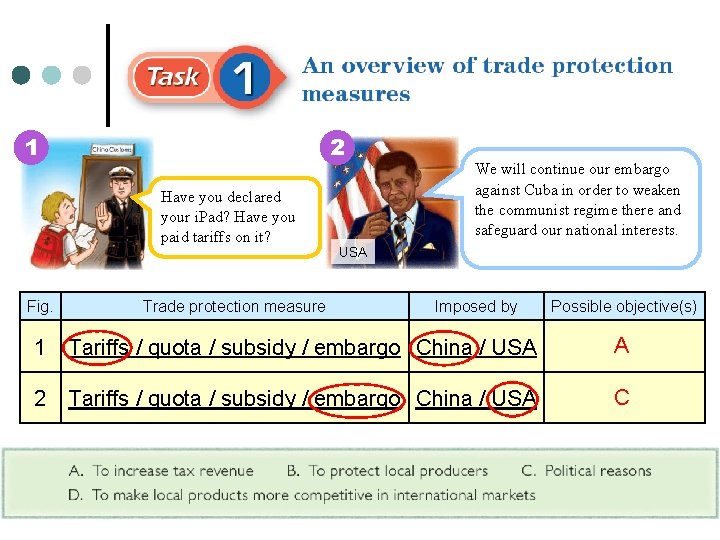
1 2 Have you declared your i. Pad? Have you paid tariffs on it? Fig. Trade protection measure We will continue our embargo against Cuba in order to weaken the communist regime there and safeguard our national interests. USA Imposed by Possible objective(s) 1 Tariffs / quota / subsidy / embargo China / USA A 2 Tariffs / quota / subsidy / embargo China / USA C 3
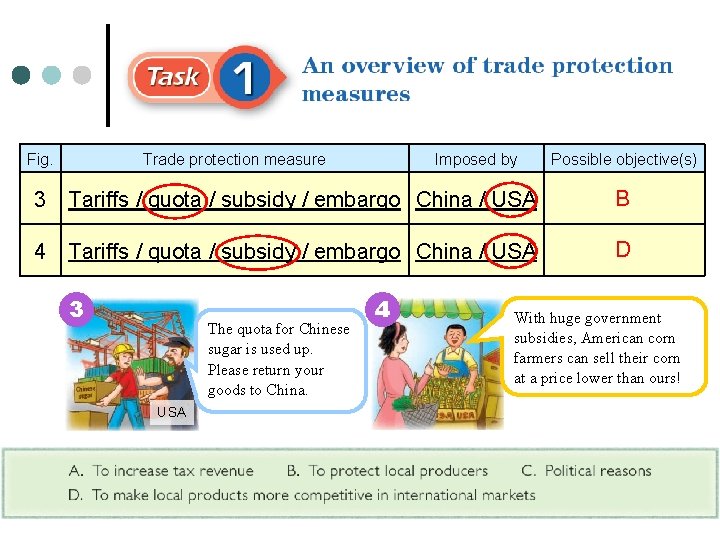
Fig. Trade protection measure Imposed by Possible objective(s) 3 Tariffs / quota / subsidy / embargo China / USA B 4 Tariffs / quota / subsidy / embargo China / USA D 3 The quota for Chinese sugar is used up. Please return your goods to China. 4 With huge government subsidies, American corn farmers can sell their corn at a price lower than ours! USA 4
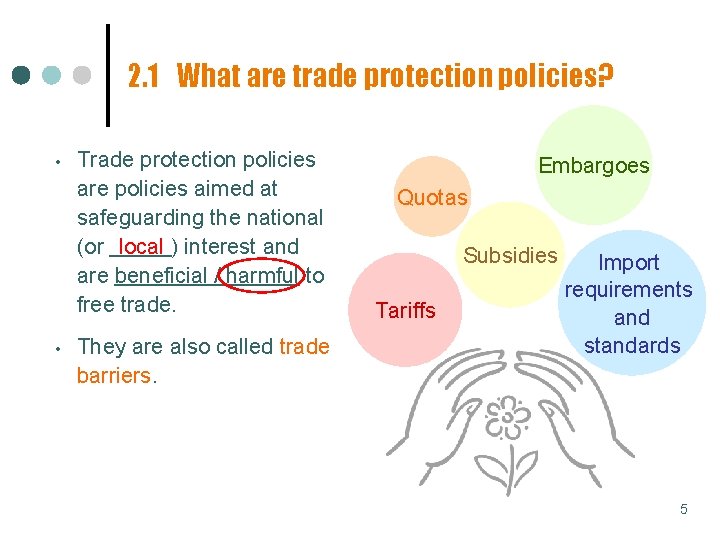
2. 1 What are trade protection policies? • • Trade protection policies are policies aimed at safeguarding the national (or local ) interest and are beneficial / harmful to free trade. They are also called trade barriers. Embargoes Quotas Subsidies Tariffs Import requirements and standards 5
2. 1 What are trade protection policies? • Today, most countries/regions employ trade protection policies to various degrees. • As Hong Kong is a free port , it basically does not implement any trade protection policies. Excise duties are levied only on four types of dutiable commodities, namely liquors, tobacco, hydrocarbon oil and methyl alcohol. 6
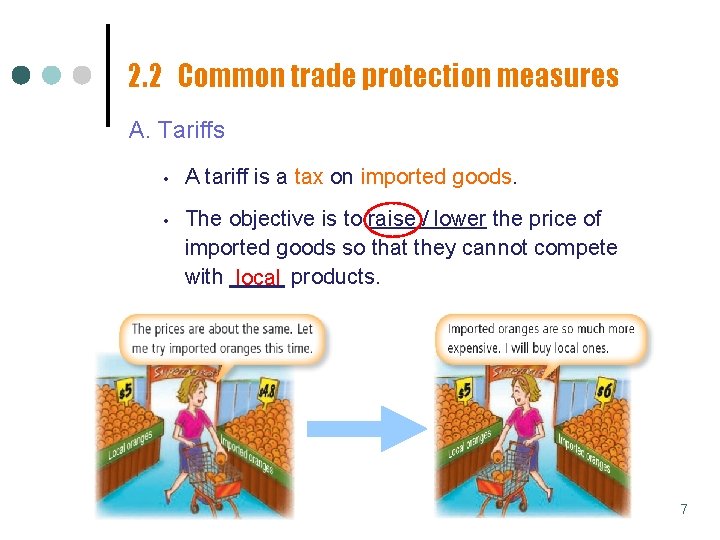
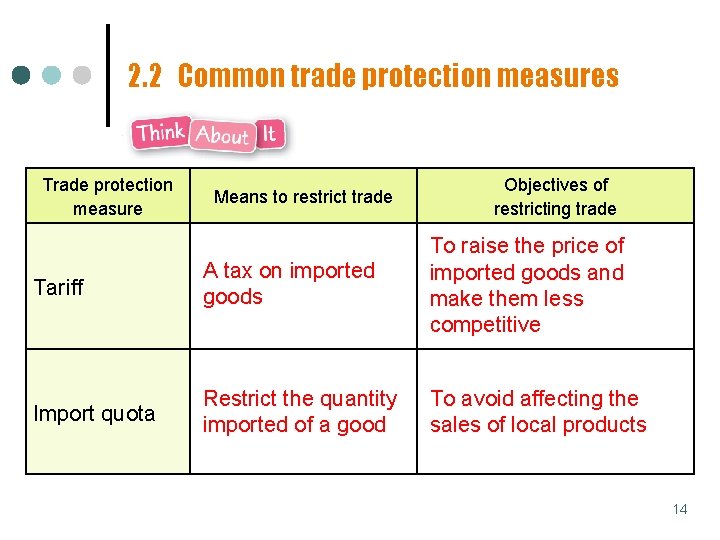
2. 2 Common trade protection measures A. Tariffs • A tariff is a tax on imported goods. • The objective is to raise / lower the price of imported goods so that they cannot compete with local products. 7
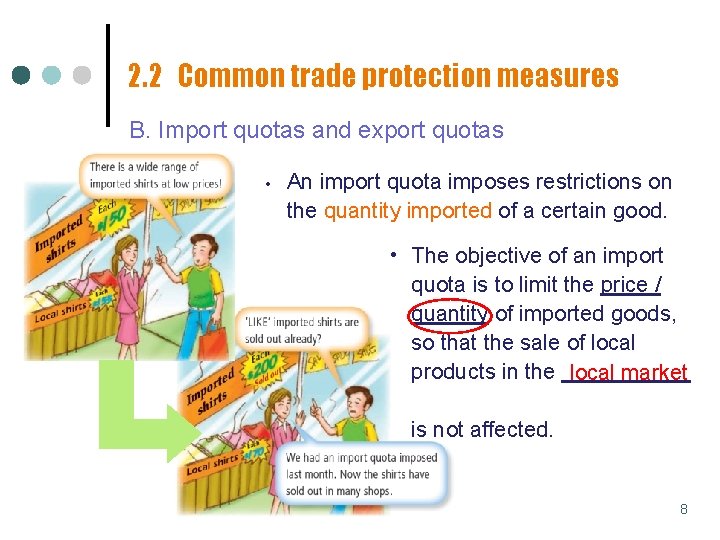
2. 2 Common trade protection measures B. Import quotas and export quotas • An import quota imposes restrictions on the quantity imported of a certain good. • The objective of an import quota is to limit the price / quantity of imported goods, so that the sale of local products in the local market. is not affected. 8
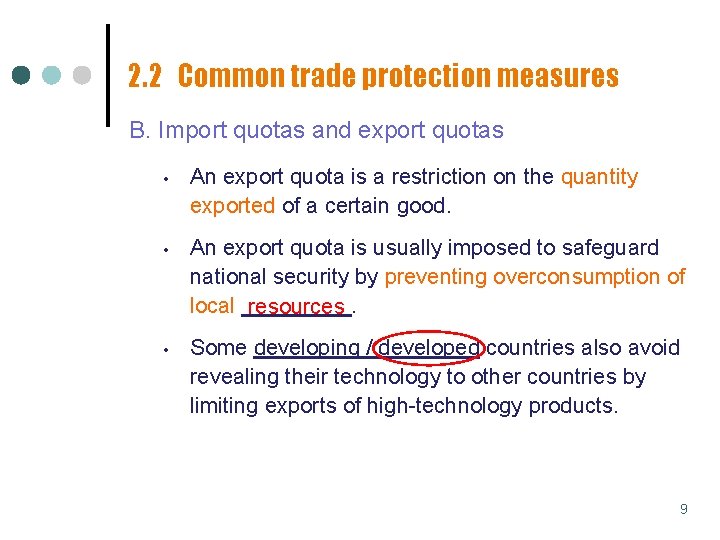
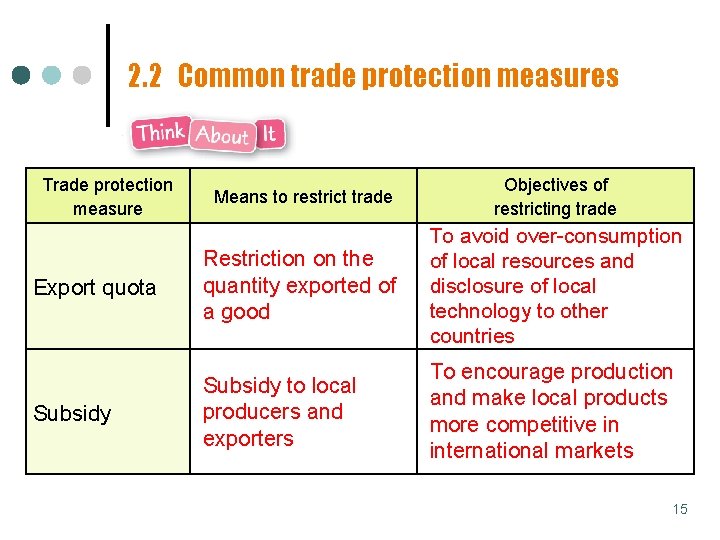
2. 2 Common trade protection measures B. Import quotas and export quotas • An export quota is a restriction on the quantity exported of a certain good. • An export quota is usually imposed to safeguard national security by preventing overconsumption of local resources. • Some developing / developed countries also avoid revealing their technology to other countries by limiting exports of high-technology products. 9
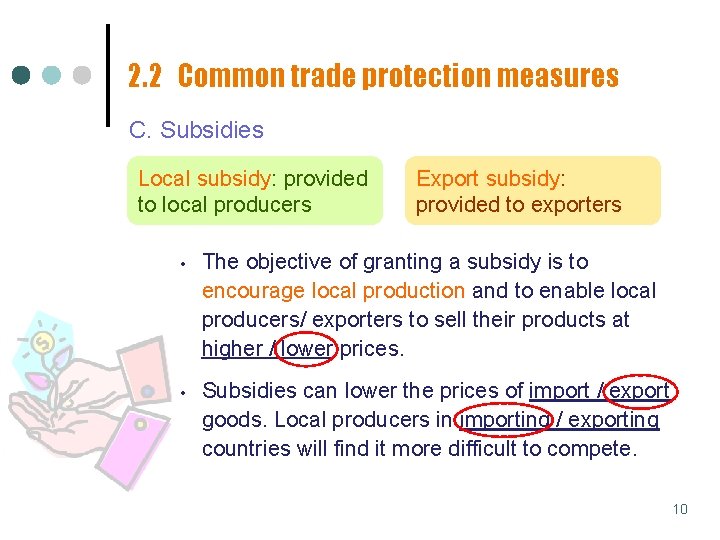
2. 2 Common trade protection measures C. Subsidies Local subsidy: provided to local producers Export subsidy: provided to exporters • The objective of granting a subsidy is to encourage local production and to enable local producers/ exporters to sell their products at higher / lower prices. • Subsidies can lower the prices of import / export goods. Local producers in importing / exporting countries will find it more difficult to compete. 10
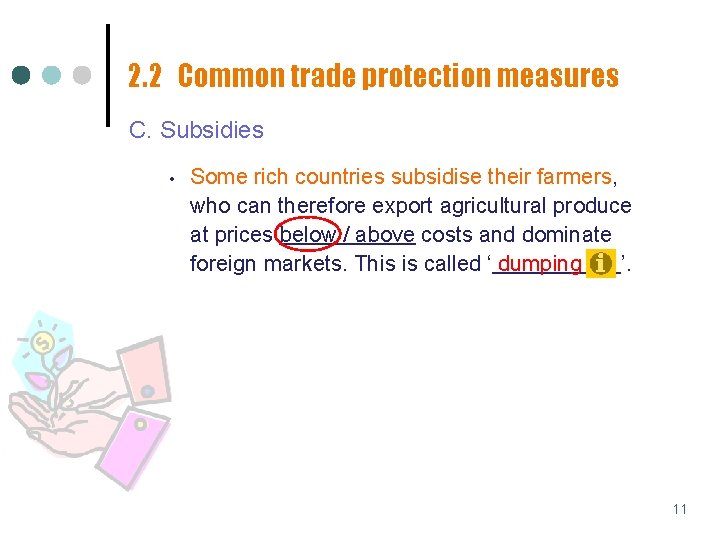
2. 2 Common trade protection measures C. Subsidies • Some rich countries subsidise their farmers, who can therefore export agricultural produce at prices below / above costs and dominate foreign markets. This is called ‘ dumping ’. 11
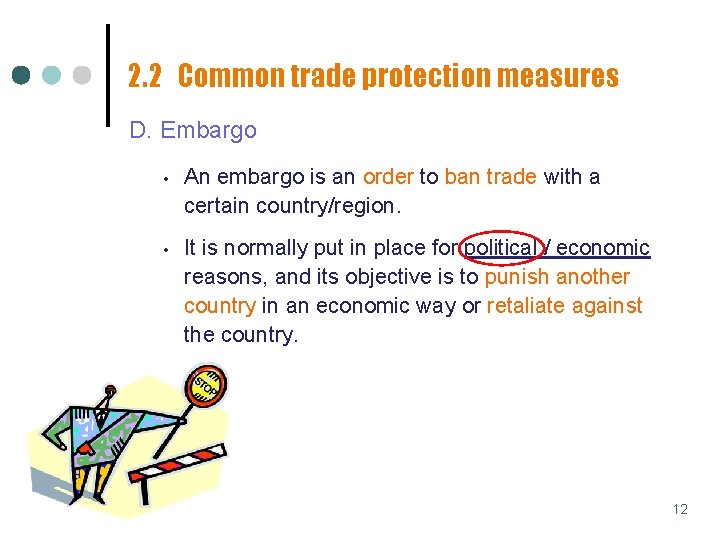
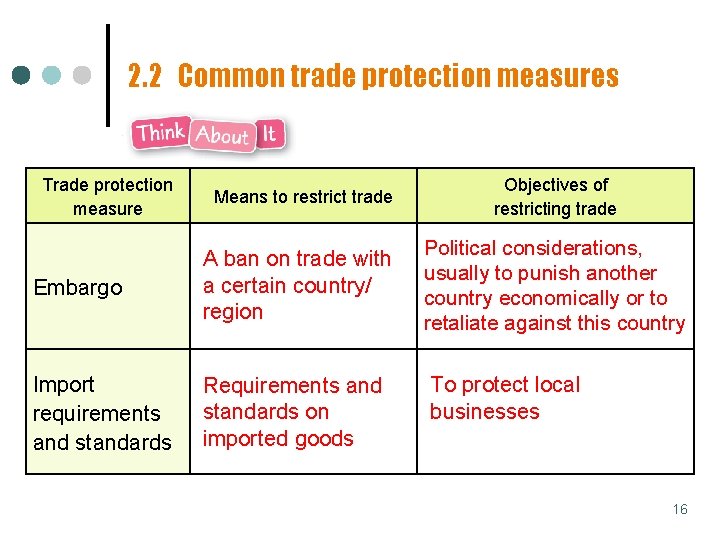
2. 2 Common trade protection measures D. Embargo • An embargo is an order to ban trade with a certain country/region. • It is normally put in place for political / economic reasons, and its objective is to punish another country in an economic way or retaliate against the country. 12
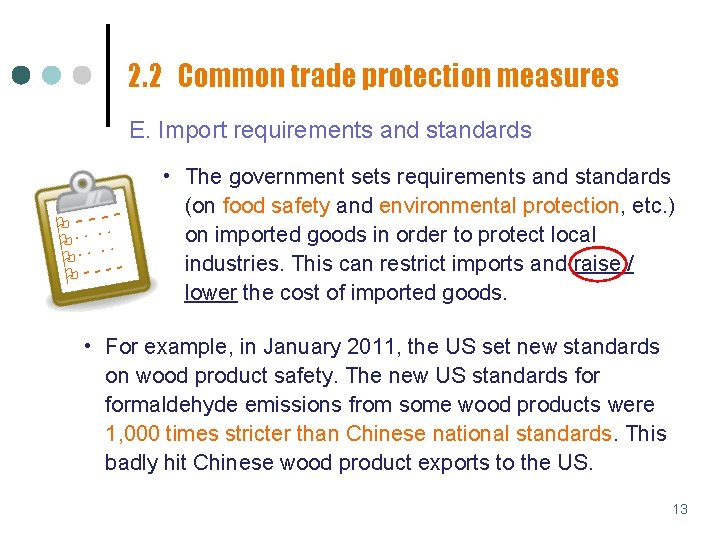
2. 2 Common trade protection measures E. Import requirements and standards -- ‥ ‥ --- • The government sets requirements and standards (on food safety and environmental protection, etc. ) on imported goods in order to protect local industries. This can restrict imports and raise / lower the cost of imported goods. • For example, in January 2011, the US set new standards on wood product safety. The new US standards formaldehyde emissions from some wood products were 1, 000 times stricter than Chinese national standards. This badly hit Chinese wood product exports to the US. 13
2. 2 Common trade protection measures Trade protection measure Means to restrict trade Objectives of restricting trade Tariff A tax on imported goods To raise the price of imported goods and make them less competitive Import quota Restrict the quantity imported of a good To avoid affecting the sales of local products 14
2. 2 Common trade protection measures Trade protection measure Export quota Subsidy Means to restrict trade Objectives of restricting trade Restriction on the quantity exported of a good To avoid over-consumption of local resources and disclosure of local technology to other countries Subsidy to local producers and exporters To encourage production and make local products more competitive in international markets 15
2. 2 Common trade protection measures Trade protection measure Means to restrict trade Embargo A ban on trade with a certain country/ region Import requirements and standards Requirements and standards on imported goods Objectives of restricting trade Political considerations, usually to punish another country economically or to retaliate against this country To protect local businesses 16
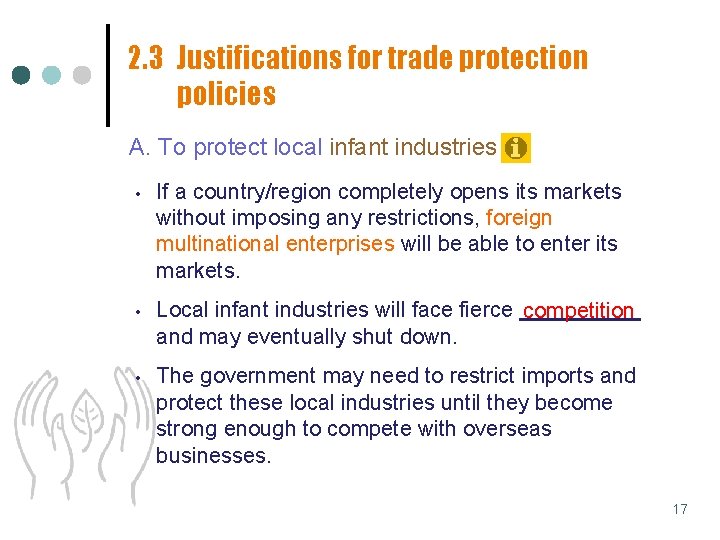
2. 3 Justifications for trade protection policies A. To protect local infant industries • If a country/region completely opens its markets without imposing any restrictions, foreign multinational enterprises will be able to enter its markets. • Local infant industries will face fierce competition. and may eventually shut down. • The government may need to restrict imports and protect these local industries until they become strong enough to compete with overseas businesses. 17
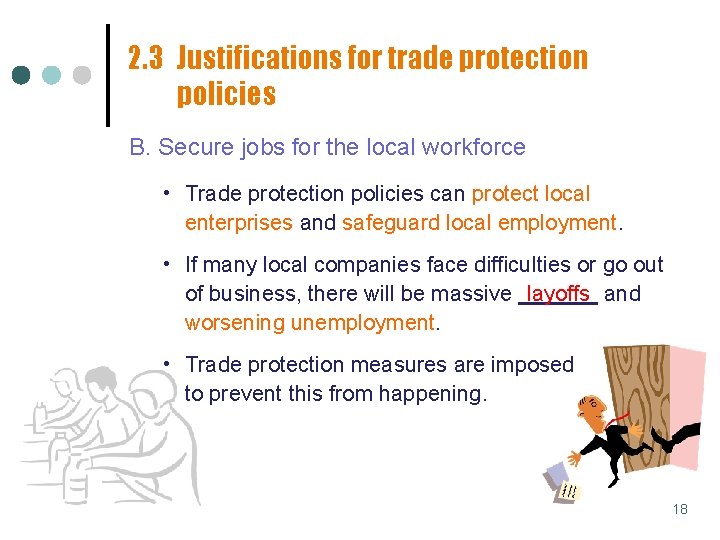
2. 3 Justifications for trade protection policies B. Secure jobs for the local workforce • Trade protection policies can protect local enterprises and safeguard local employment. • If many local companies face difficulties or go out of business, there will be massive layoffs and worsening unemployment. • Trade protection measures are imposed to prevent this from happening. 18
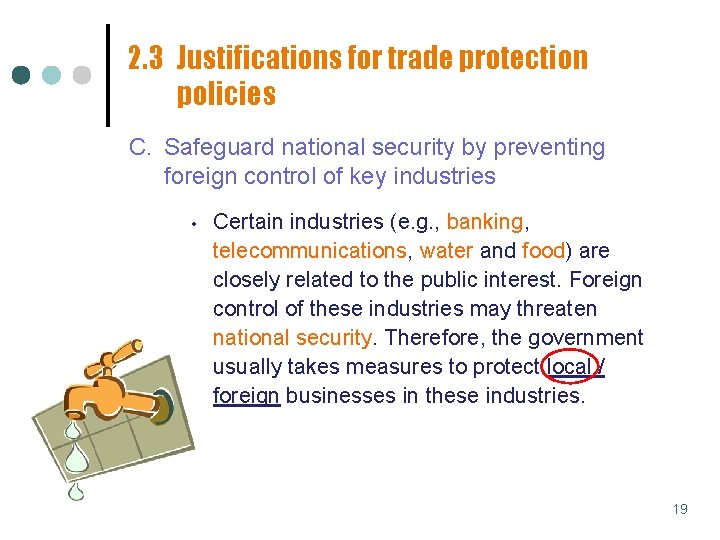
2. 3 Justifications for trade protection policies C. Safeguard national security by preventing foreign control of key industries • Certain industries (e. g. , banking, telecommunications, water and food) are closely related to the public interest. Foreign control of these industries may threaten national security. Therefore, the government usually takes measures to protect local / foreign businesses in these industries. 19
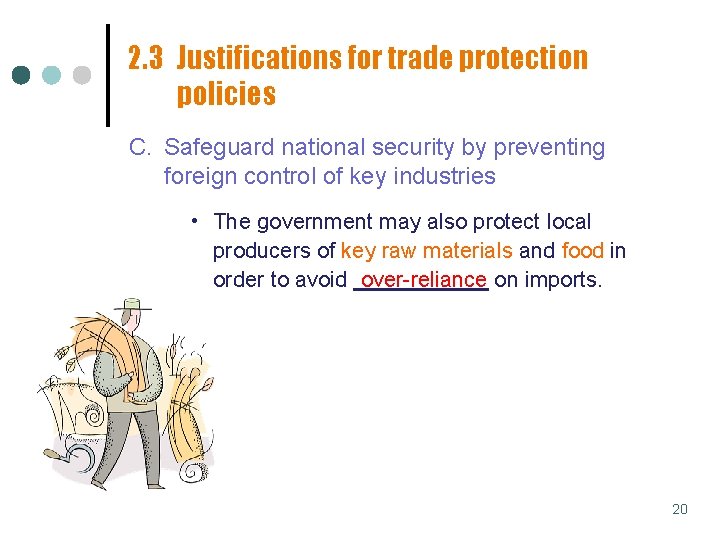
2. 3 Justifications for trade protection policies C. Safeguard national security by preventing foreign control of key industries • The government may also protect local producers of key raw materials and food in order to avoid over-reliance on imports. 20
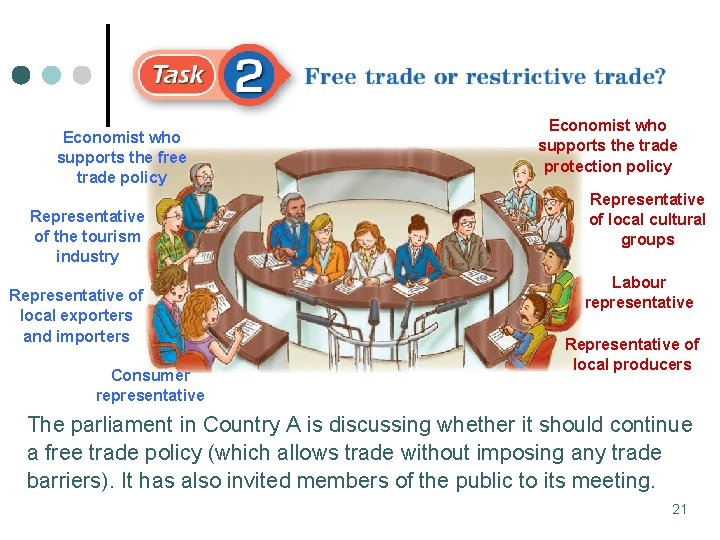
Economist who supports the free trade policy Representative of the tourism industry Representative of local exporters and importers Consumer representative Economist who supports the trade protection policy Representative of local cultural groups Labour representative Representative of local producers The parliament in Country A is discussing whether it should continue a free trade policy (which allows trade without imposing any trade barriers). It has also invited members of the public to its meeting. 21
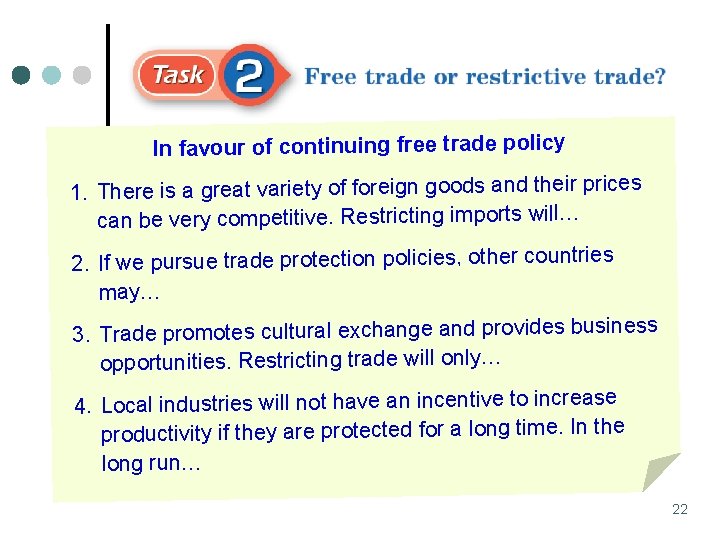
In favour of continuing free trade policy 1. There is a great variety of foreign goods and their prices can be very competitive. Restricting imports will… 2. If we pursue trade protection policies, other countries may… 3. Trade promotes cultural exchange and provides business opportunities. Restricting trade will only… 4. Local industries will not have an incentive to increase productivity if they are protected for a long time. In the long run… 22
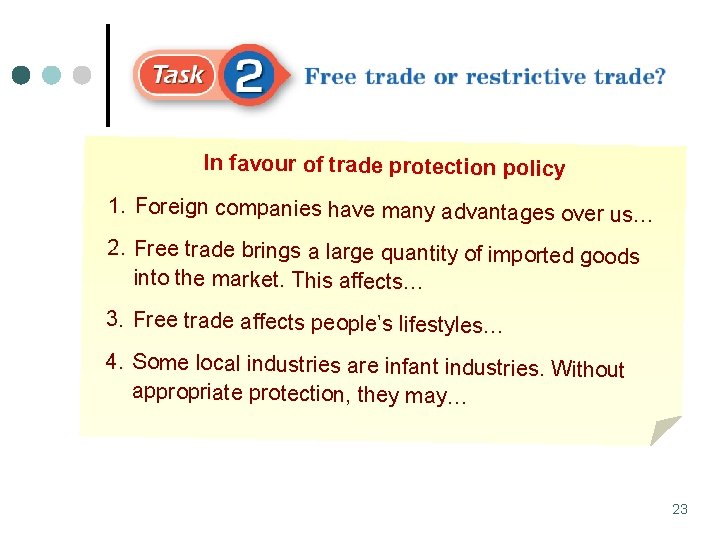
In favour of trade protection policy 1. Foreign companies have many advantages over us… 2. Free trade brings a large quantity of imported goods into the market. This affects… 3. Free trade affects people’s lifestyles… 4. Some local industries are infant industries. Without appropriate protection, they may… 23
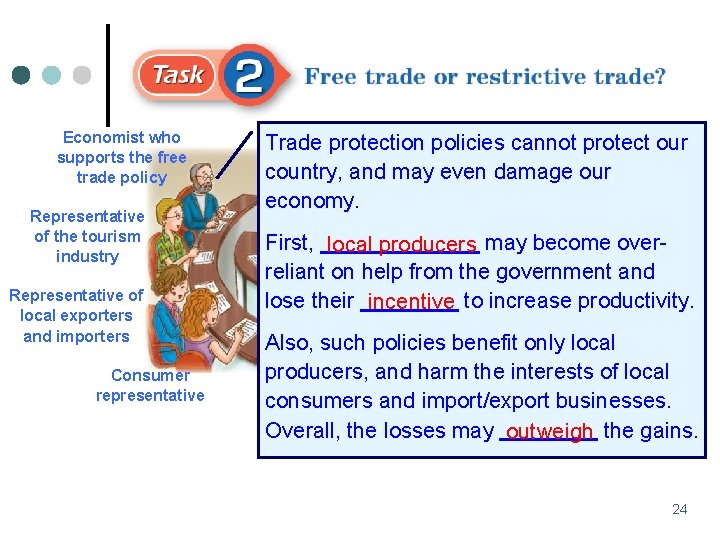
Economist who supports the free trade policy Representative of the tourism industry Representative of local exporters and importers Consumer representative Trade protection policies cannot protect our country, and may even damage our economy. First, local producers may become overreliant on help from the government and lose their incentive to increase productivity. Also, such policies benefit only local producers, and harm the interests of local consumers and import/export businesses. Overall, the losses may outweigh the gains. 24
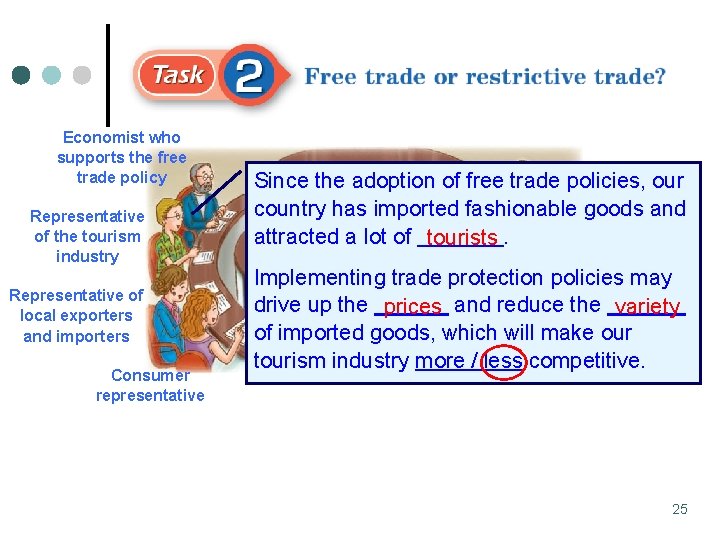
Economist who supports the free trade policy Representative of the tourism industry Representative of local exporters and importers Consumer representative Since the adoption of free trade policies, our country has imported fashionable goods and attracted a lot of tourists. Implementing trade protection policies may drive up the prices and reduce the variety. of imported goods, which will make our tourism industry more / less competitive. 25
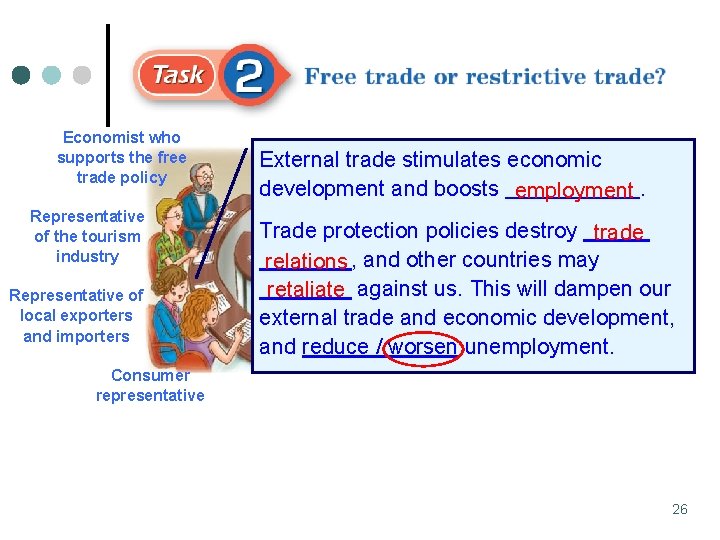
Economist who supports the free trade policy Representative of the tourism industry Representative of local exporters and importers External trade stimulates economic development and boosts employment. Trade protection policies destroy trade. relations , and other countries may retaliate against us. This will dampen our external trade and economic development, and reduce / worsen unemployment. Consumer representative 26
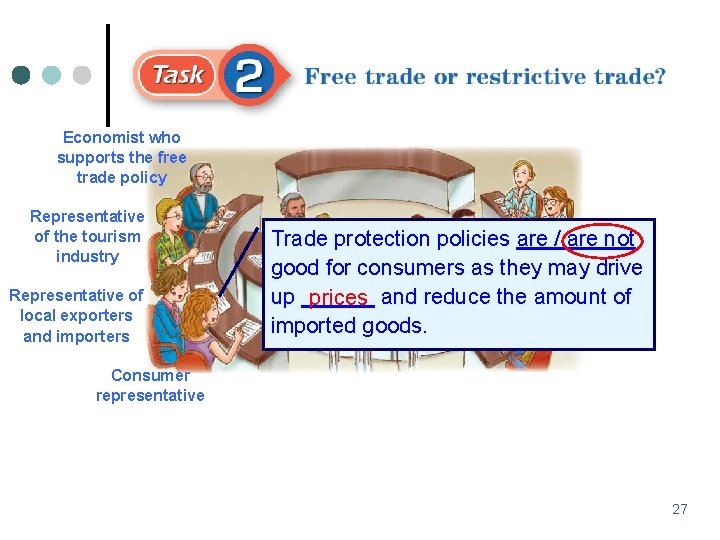
Economist who supports the free trade policy Representative of the tourism industry Representative of local exporters and importers Trade protection policies are / are not good for consumers as they may drive up prices and reduce the amount of imported goods. Consumer representative 27
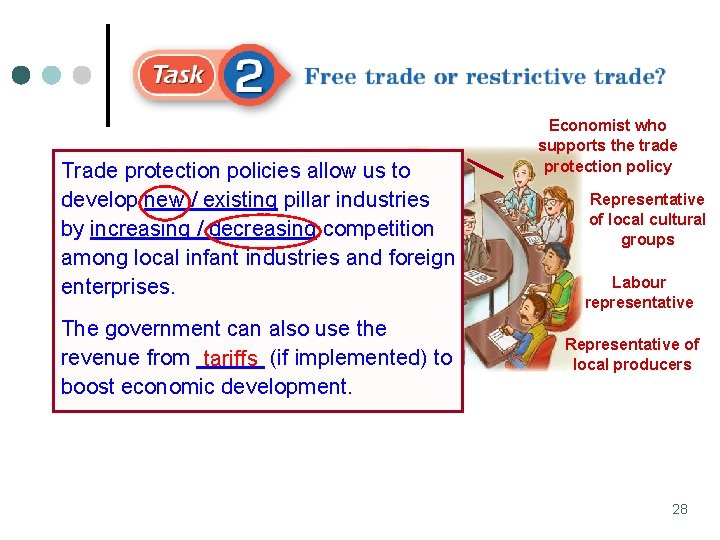
Trade protection policies allow us to develop new / existing pillar industries by increasing / decreasing competition among local infant industries and foreign enterprises. The government can also use the revenue from tariffs (if implemented) to boost economic development. Economist who supports the trade protection policy Representative of local cultural groups Labour representative Representative of local producers 28
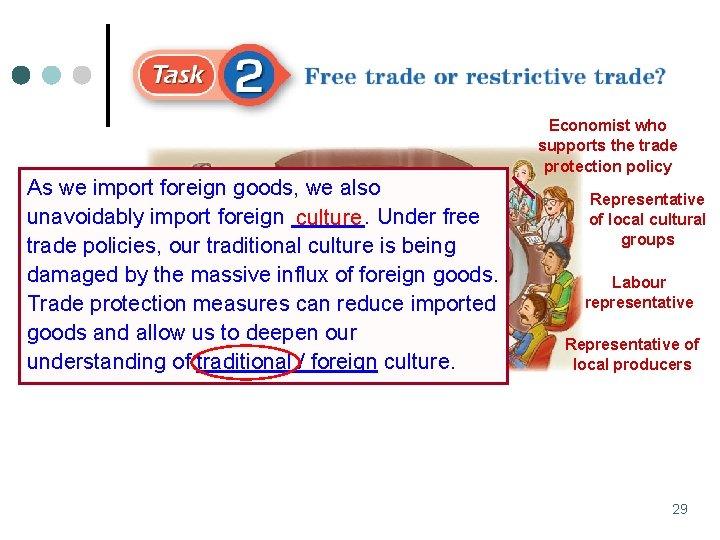
Economist who supports the trade protection policy As we import foreign goods, we also unavoidably import foreign culture. Under free trade policies, our traditional culture is being damaged by the massive influx of foreign goods. Trade protection measures can reduce imported goods and allow us to deepen our understanding of traditional / foreign culture. Representative of local cultural groups Labour representative Representative of local producers 29
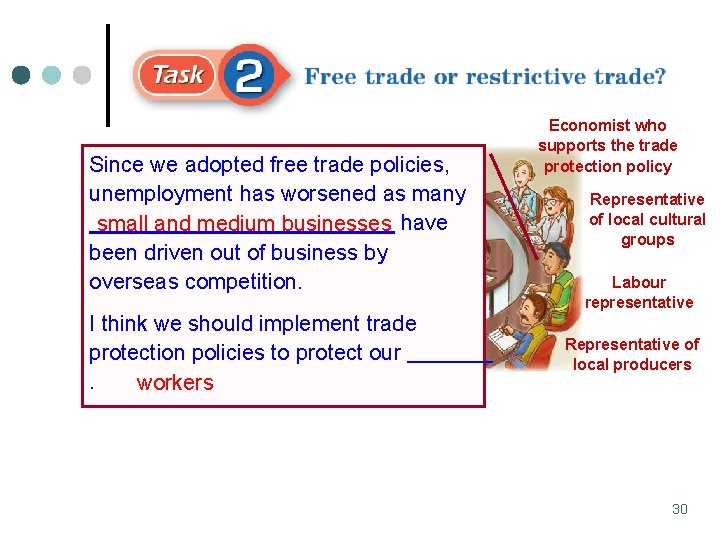
Since we adopted free trade policies, unemployment has worsened as many small and medium businesses have been driven out of business by overseas competition. I think we should implement trade protection policies to protect our. workers Economist who supports the trade protection policy Representative of local cultural groups Labour representative Representative of local producers 30
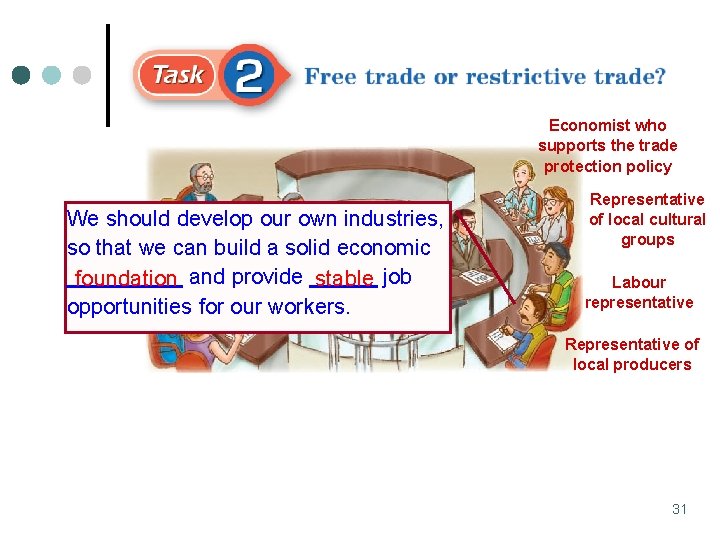
Economist who supports the trade protection policy We should develop our own industries, so that we can build a solid economic foundation and provide stable job opportunities for our workers. Representative of local cultural groups Labour representative Representative of local producers 31
Economist who supports the free trade policy Representative of the tourism industry Representative of local exporters and importers Consumer representative Economist who supports the trade protection policy Representative of local cultural groups Labour representative Representative of local producers How would you vote if you were a member of the Parliament? Why? 32
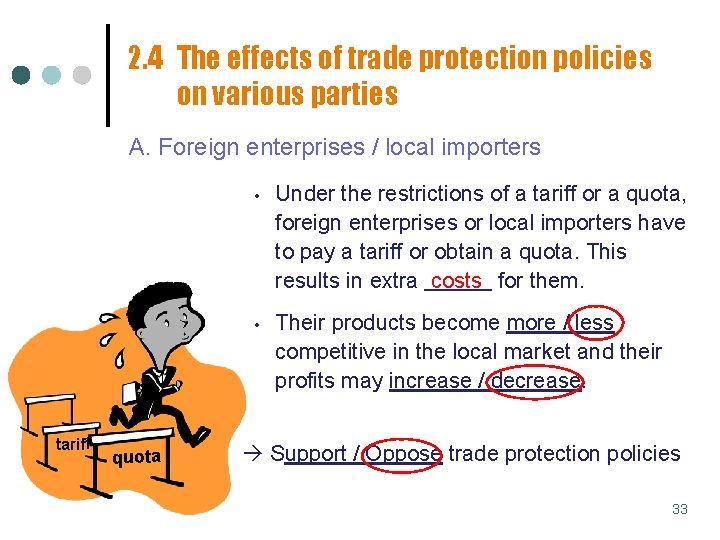
2. 4 The effects of trade protection policies on various parties A. Foreign enterprises / local importers tariff quota • Under the restrictions of a tariff or a quota, foreign enterprises or local importers have to pay a tariff or obtain a quota. This results in extra costs for them. • Their products become more / less competitive in the local market and their profits may increase / decrease. Support / Oppose trade protection policies 33
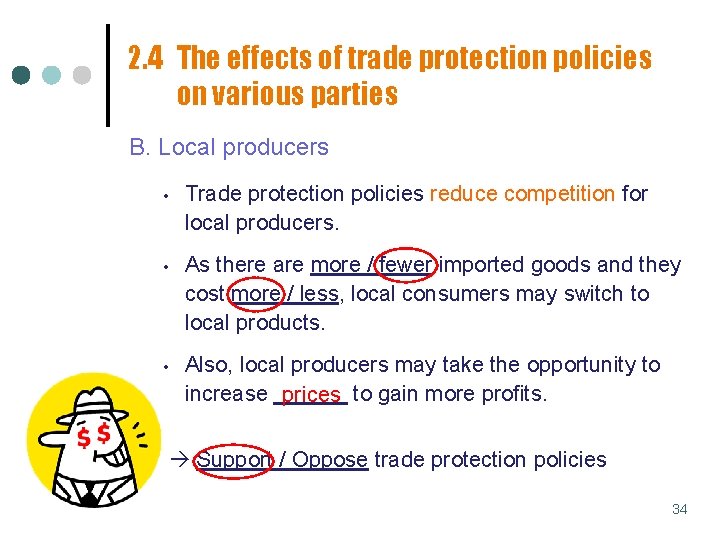
2. 4 The effects of trade protection policies on various parties B. Local producers • Trade protection policies reduce competition for local producers. • As there are more / fewer imported goods and they cost more / less, local consumers may switch to local products. • Also, local producers may take the opportunity to increase prices to gain more profits. Support / Oppose trade protection policies 34
2. 4 The effects of trade protection policies on various parties B. Local producers • However, local industries may rely on government support and lose their incentive to increase productivity. 35
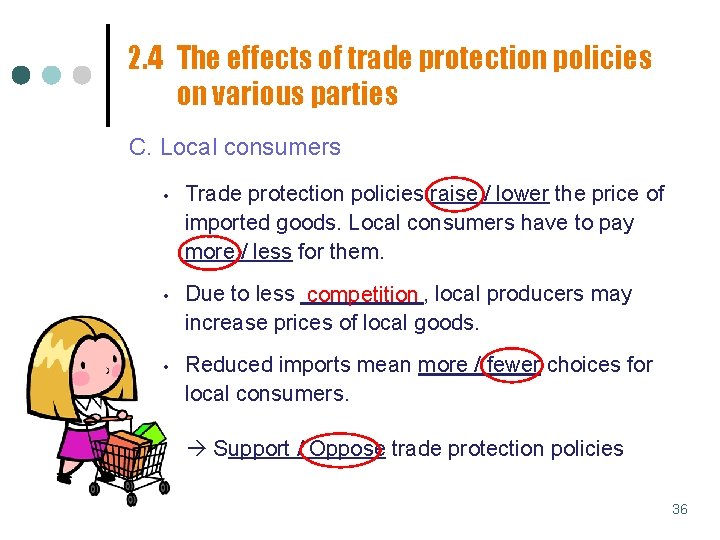
2. 4 The effects of trade protection policies on various parties C. Local consumers • Trade protection policies raise / lower the price of imported goods. Local consumers have to pay more / less for them. • Due to less competition , local producers may increase prices of local goods. • Reduced imports mean more / fewer choices for local consumers. Support / Oppose trade protection policies 36
2. 4 The effects of trade protection policies on various parties D. The government • On one hand, the government obtains revenue from tariffs or selling quotas. On the other hand, the government will spend more if it subsidises. local enterprises. • In international trade, developing / developed countries are more able to heavily subsidise their producers. 37
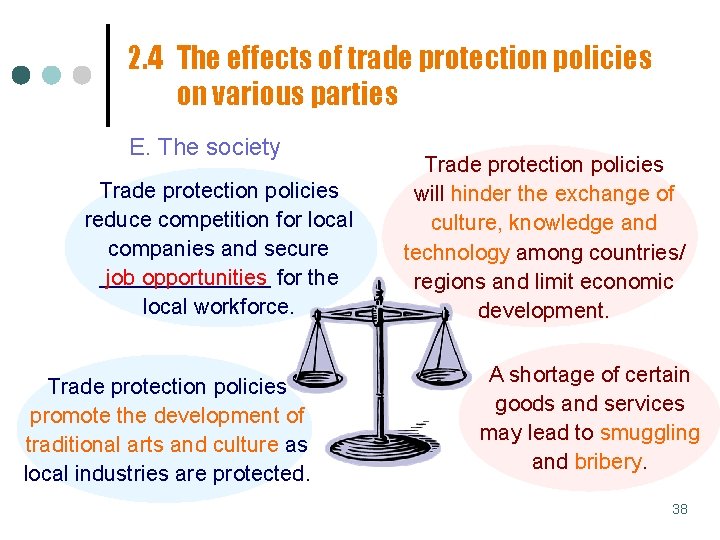
2. 4 The effects of trade protection policies on various parties E. The society Trade protection policies reduce competition for local companies and secure job opportunities for the local workforce. Trade protection policies promote the development of traditional arts and culture as local industries are protected. Trade protection policies will hinder the exchange of culture, knowledge and technology among countries/ regions and limit economic development. A shortage of certain goods and services may lead to smuggling and bribery. 38
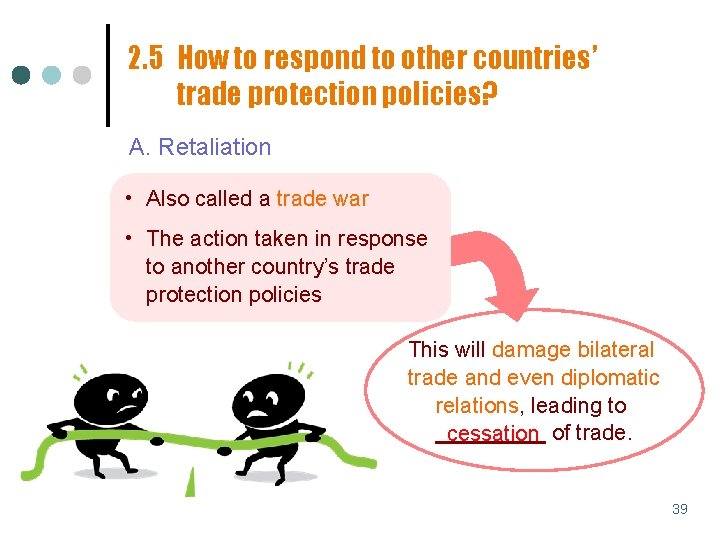
2. 5 How to respond to other countries’ trade protection policies? A. Retaliation • Also called a trade war • The action taken in response to another country’s trade protection policies This will damage bilateral trade and even diplomatic relations, leading to cessation of trade. 39
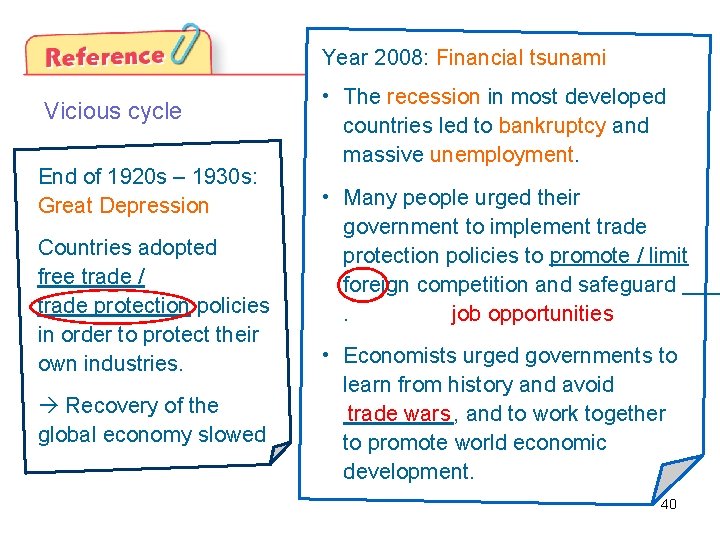
Year 2008: Financial tsunami Vicious cycle End of 1920 s – 1930 s: Great Depression Countries adopted free trade / trade protection policies in order to protect their own industries. Recovery of the global economy slowed • The recession in most developed countries led to bankruptcy and massive unemployment. • Many people urged their government to implement trade protection policies to promote / limit foreign competition and safeguard. job opportunities • Economists urged governments to learn from history and avoid trade wars , and to work together to promote world economic development. 40
2. 5 How to respond to other countries’ trade protection policies? B. Bilateral negotiations • Negotiations between two regions, countries or trade blocs over a reduction in trade barriers • As there are more / fewer participating countries, it is easier / more difficult to come to an agreement. • For example, the ASEAN — China Free Trade Area and Economic Cooperation Framework Agreement (ECFA) were formed as a result of bilateral negotiations. 41
2. 5 How to respond to other countries’ trade protection policies? C. Multilateral negotiations • Negotiations among three or more countries on trade matters by setting up international ( ) trade organisations multinational • At present, major multinational trade organisations include the World Trade Organization (WTO) and the Association of Southeast Asian Nations (ASEAN). 42
End of Unit 2 43
2. 2 Common trade protection measures Dumping • Dumping is widely forbidden in international trade. • Exporters sell their goods in large quantities at prices below costs, with the aim of dominating the market by driving out producers in importing countries. • This practice harms not only the exporters themselves but also the production capacity of the importing countries. 44
2. 3 Justifications for trade protection policies Infant industries • Infant industries refer to local business start-ups with growth potential. • At the initial stage, these are usually smaller businesses with less capital and more primitive technology. • However, in the long term, these industries may become pillar industries of the local economy. 45
2. 5 How to respond to other countries’ trade protection policies? ASEAN — China Free Trade Area • Came into effect on 1 January 2010 • This is the most populous free trade area with a membership of 10 ASEAN countries and China. • Member countries are required to lower tariffs among themselves. 46
2. 5 How to respond to other countries’ trade protection policies? Economic Cooperation Framework Agreement (ECFA) • Signed by the mainland of China and Taiwan on 29 June 2010 • It is aimed at lowering tariffs and reducing trade barriers. 47
2. 5 How to respond to other countries’ trade protection policies? Association of Southeast Asian Nations (ASEAN) • Formed in 1961 • Currently, its ten member countries include Malaysia, Thailand, the Philippines, Singapore, Indonesia, Brunei, Burma, Laos, Vietnam and Cambodia. 48