
Unit 08 Moles and Stoichiometry I Molar Conversions
- Slides: 30
Unit 08 – Moles and Stoichiometry I. Molar Conversions
A. What is the Mole? b. A counting number (like a dozen) b. Avogadro’s number (6. 02 1023 particles) (SI unit) b 1 mol = molar mass A large amount!!!!
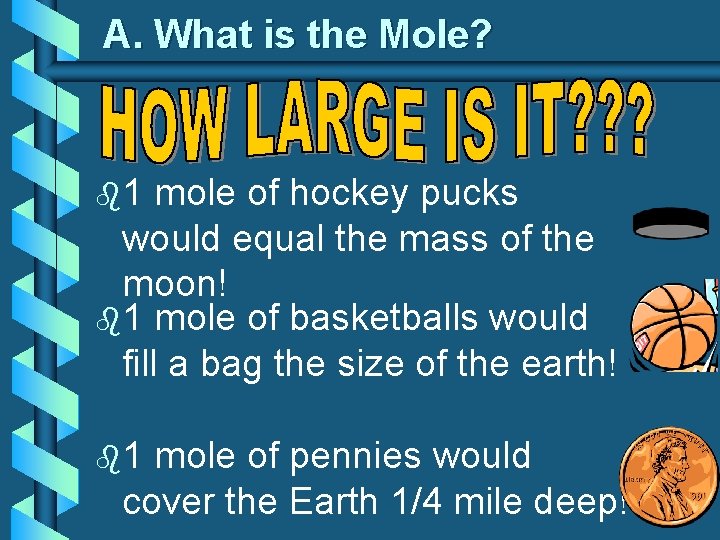
A. What is the Mole? b 1 mole of hockey pucks would equal the mass of the moon! b 1 mole of basketballs would fill a bag the size of the earth! b 1 mole of pennies would cover the Earth 1/4 mile deep!
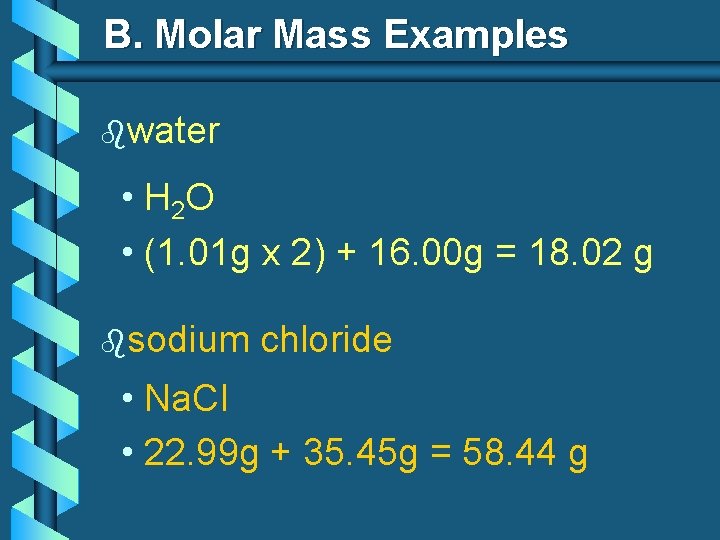
B. Molar Mass o Molar Mass- the mass of a mole of any element or compound (in grams) o. Round to 2 decimal places o Also called: o. Gram Formula mass – sum of the atomic masses of all the atoms in a formula of a compound o. Formula weight
B. Molar Mass Examples bwater • H 2 O • (1. 01 g x 2) + 16. 00 g = 18. 02 g bsodium chloride • Na. Cl • 22. 99 g + 35. 45 g = 58. 44 g
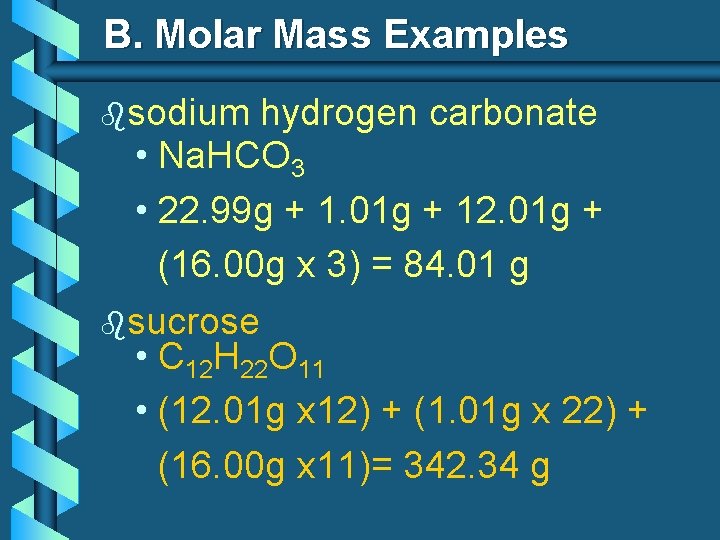
B. Molar Mass Examples bsodium hydrogen carbonate • Na. HCO 3 • 22. 99 g + 1. 01 g + 12. 01 g + (16. 00 g x 3) = 84. 01 g bsucrose • C 12 H 22 O 11 • (12. 01 g x 12) + (1. 01 g x 22) + (16. 00 g x 11)= 342. 34 g
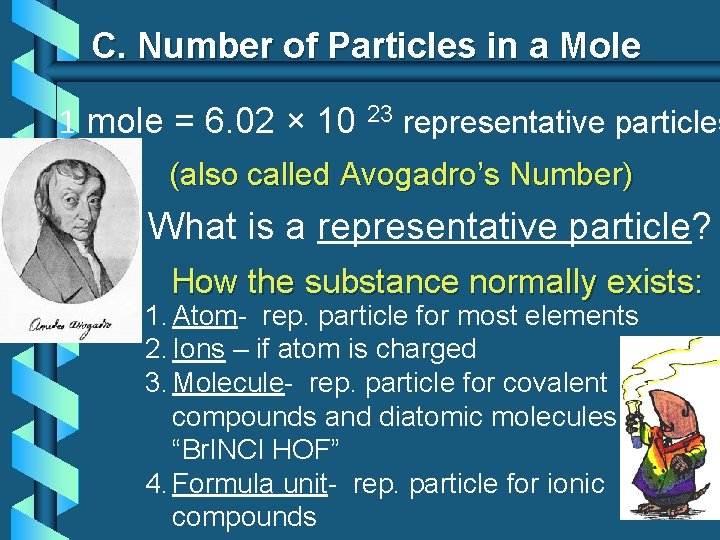
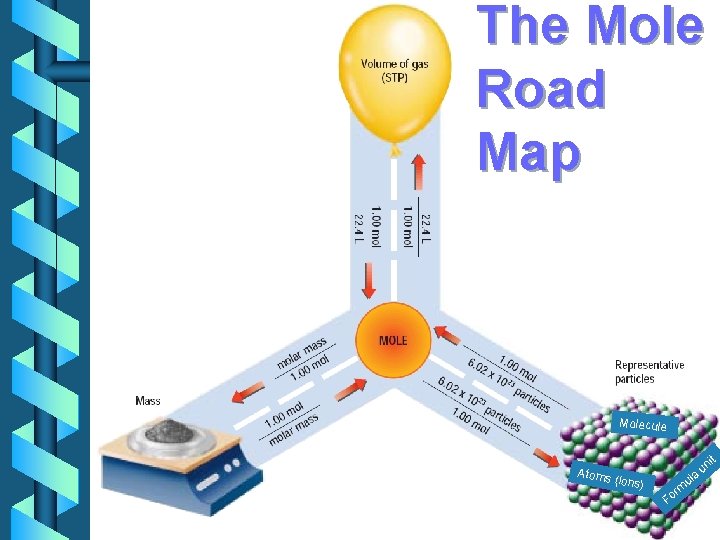
C. Number of Particles in a Mole 1 mole = 6. 02 × 10 23 representative particles (also called Avogadro’s Number) What is a representative particle? How the substance normally exists: 1. Atom- rep. particle for most elements 2. Ions – if atom is charged 3. Molecule- rep. particle for covalent compounds and diatomic molecules “Br. INCl HOF” 4. Formula unit- rep. particle for ionic compounds
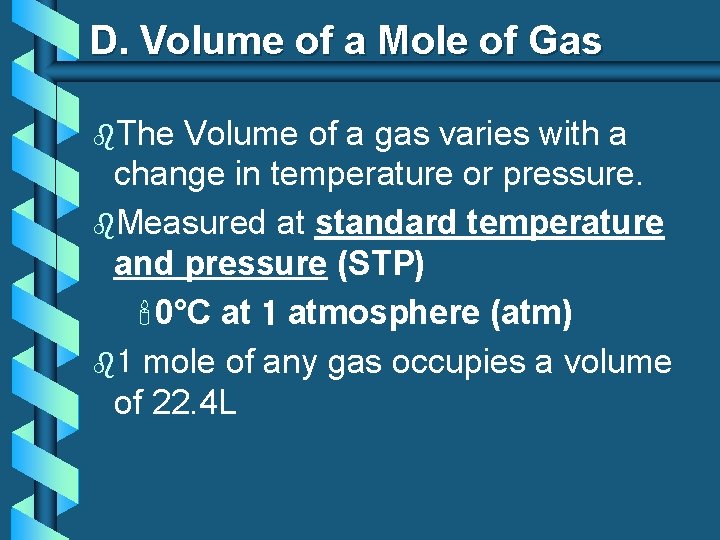
D. Volume of a Mole of Gas b. The Volume of a gas varies with a change in temperature or pressure. b. Measured at standard temperature and pressure (STP) ' 0°C at 1 atmosphere (atm) b 1 mole of any gas occupies a volume of 22. 4 L
The Mole Road Map Molecule Atoms it a ul (ions) F m or un
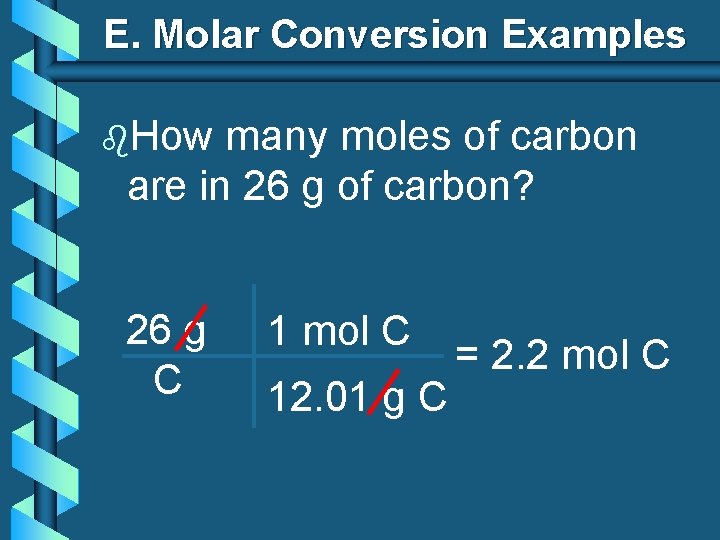
E. Molar Conversion Examples b. How many moles of carbon are in 26 g of carbon? 26 g C 1 mol C 12. 01 g C = 2. 2 mol C
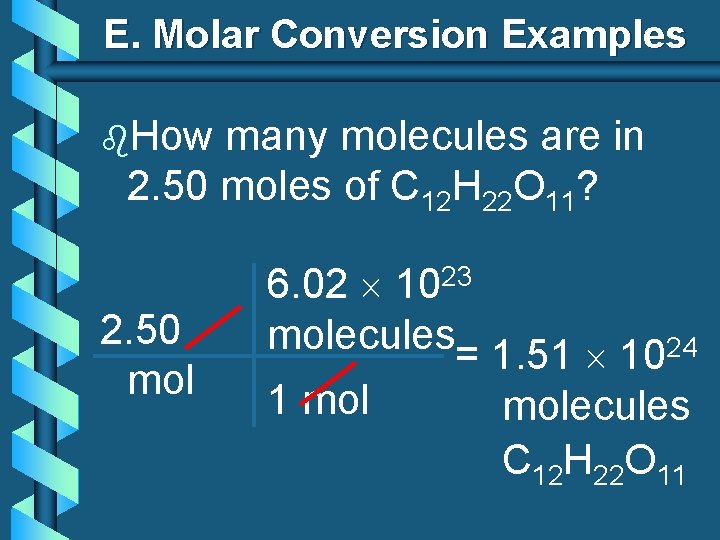
E. Molar Conversion Examples b. How many molecules are in 2. 50 moles of C 12 H 22 O 11? 2. 50 mol 6. 02 1023 molecules= 1. 51 1024 1 molecules C 12 H 22 O 11
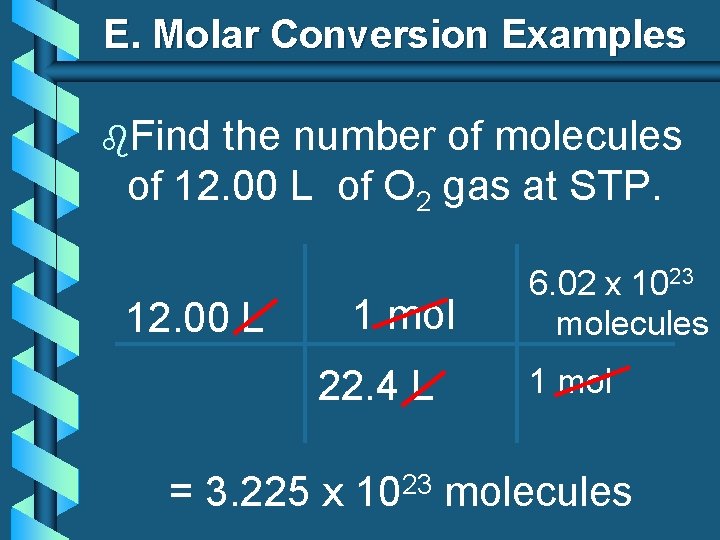
E. Molar Conversion Examples b. Find the number of molecules of 12. 00 L of O 2 gas at STP. 12. 00 L 1 mol 22. 4 L 6. 02 x 1023 molecules 1 mol = 3. 225 x 1023 molecules
II. Stoichiometric Calculations
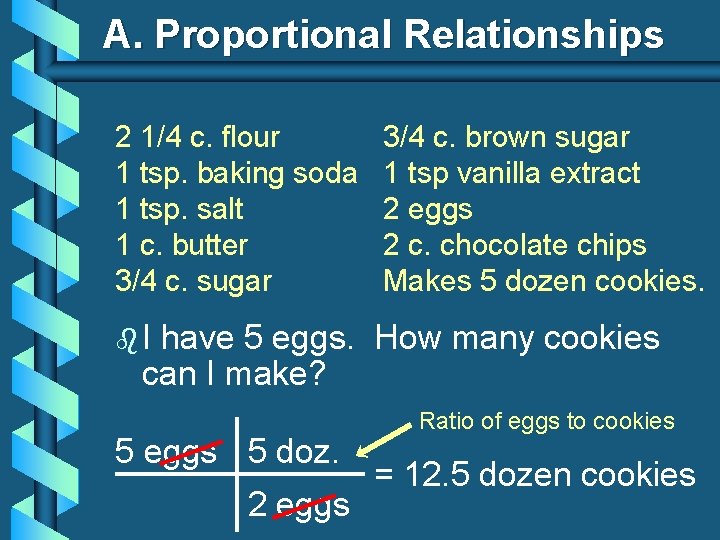
A. Proportional Relationships 2 1/4 c. flour 1 tsp. baking soda 1 tsp. salt 1 c. butter 3/4 c. sugar 3/4 c. brown sugar 1 tsp vanilla extract 2 eggs 2 c. chocolate chips Makes 5 dozen cookies. b. I have 5 eggs. How many cookies can I make? 5 eggs 5 doz. 2 eggs Ratio of eggs to cookies = 12. 5 dozen cookies
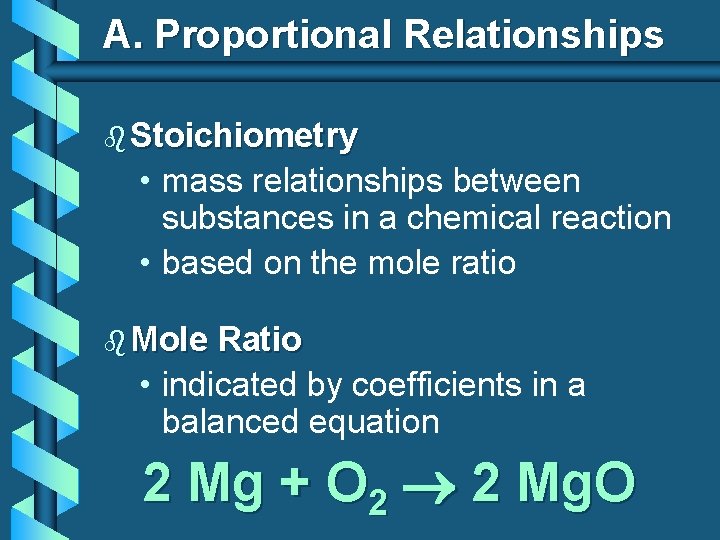
A. Proportional Relationships b Stoichiometry • mass relationships between substances in a chemical reaction • based on the mole ratio b Mole Ratio • indicated by coefficients in a balanced equation 2 Mg + O 2 2 Mg. O
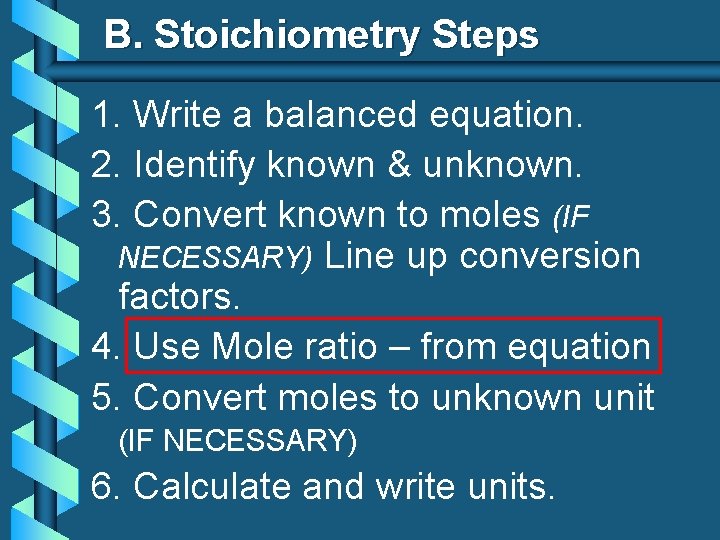
B. Stoichiometry Steps 1. Write a balanced equation. 2. Identify known & unknown. 3. Convert known to moles (IF NECESSARY) Line up conversion factors. 4. Use Mole ratio – from equation 5. Convert moles to unknown unit (IF NECESSARY) 6. Calculate and write units.
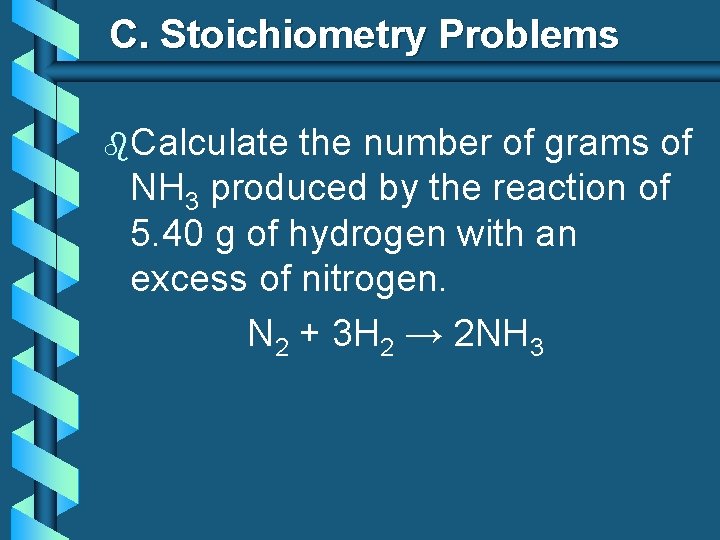
C. Stoichiometry Problems b. Calculate the number of grams of NH 3 produced by the reaction of 5. 40 g of hydrogen with an excess of nitrogen. N 2 + 3 H 2 → 2 NH 3
III. Stoichiometry in the Real World
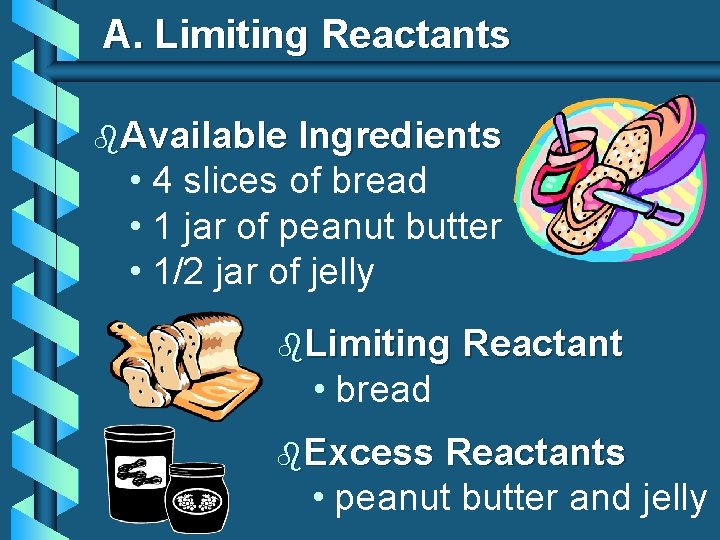
A. Limiting Reactants b. Available Ingredients • 4 slices of bread • 1 jar of peanut butter • 1/2 jar of jelly b. Limiting Reactant • bread b. Excess Reactants • peanut butter and jelly
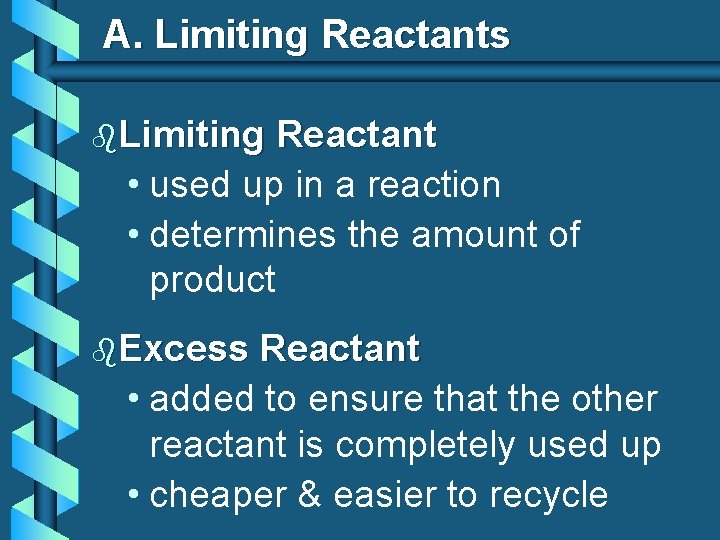
A. Limiting Reactants b. Limiting Reactant • used up in a reaction • determines the amount of product b. Excess Reactant • added to ensure that the other reactant is completely used up • cheaper & easier to recycle
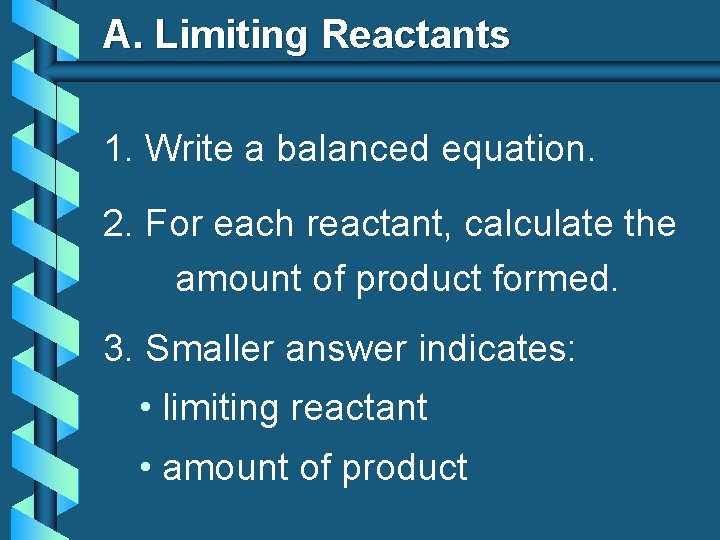
A. Limiting Reactants 1. Write a balanced equation. 2. For each reactant, calculate the amount of product formed. 3. Smaller answer indicates: • limiting reactant • amount of product
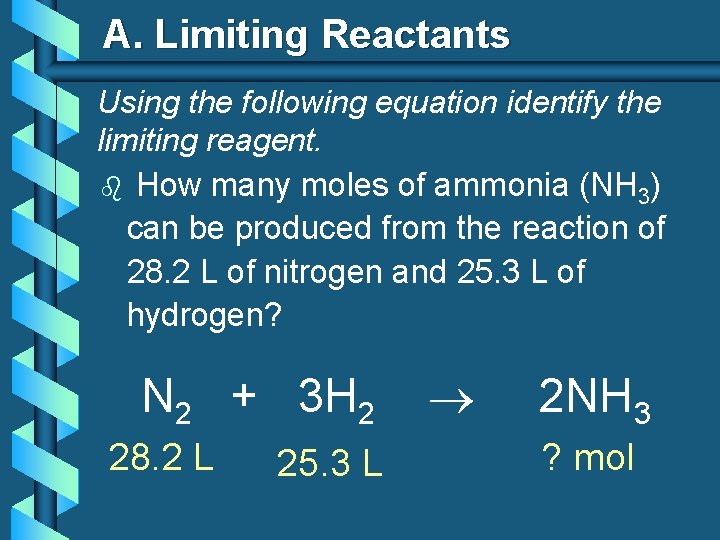
A. Limiting Reactants Using the following equation identify the limiting reagent. b How many moles of ammonia (NH 3) can be produced from the reaction of 28. 2 L of nitrogen and 25. 3 L of hydrogen? N 2 + 3 H 2 28. 2 L 25. 3 L 2 NH 3 ? mol
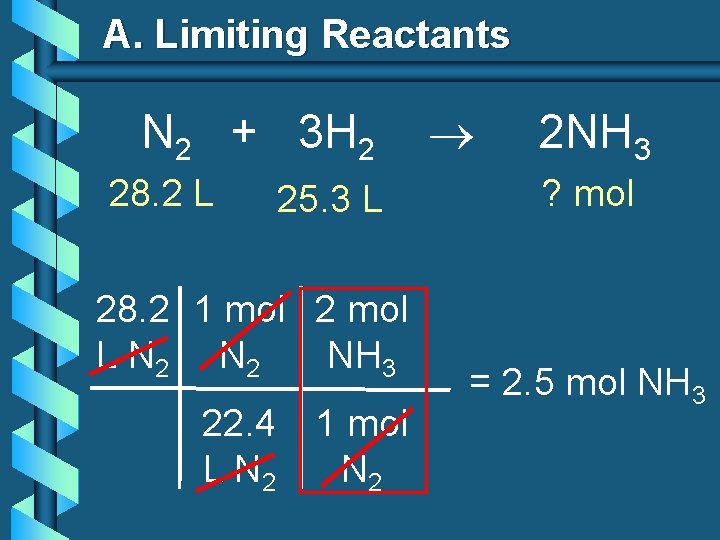
A. Limiting Reactants N 2 + 3 H 2 28. 2 L 25. 3 L 28. 2 1 mol 2 mol L N 2 NH 3 22. 4 L N 2 1 mol N 2 2 NH 3 ? mol = 2. 5 mol NH 3
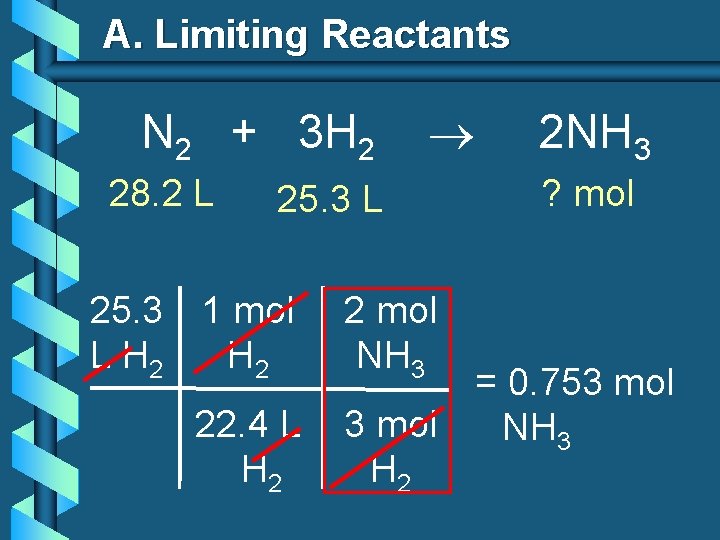
A. Limiting Reactants N 2 + 3 H 2 28. 2 L 25. 3 1 mol L H 2 2 mol NH 3 22. 4 L H 2 3 mol H 2 2 NH 3 ? mol = 0. 753 mol NH 3
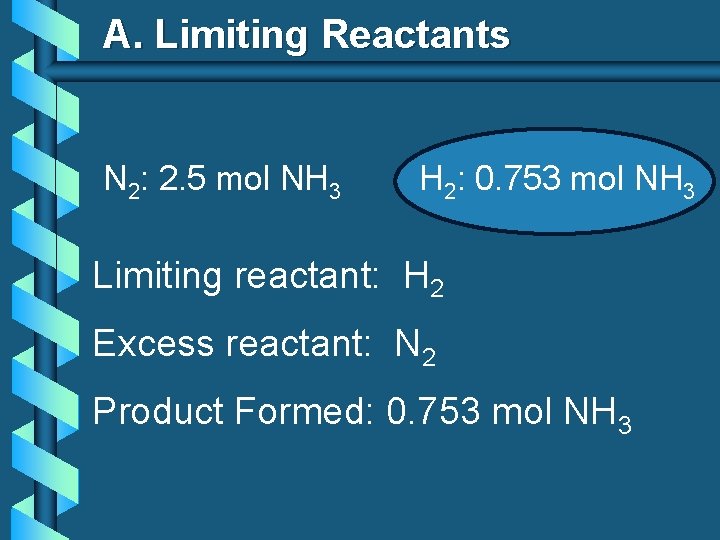
A. Limiting Reactants N 2: 2. 5 mol NH 3 H 2: 0. 753 mol NH 3 Limiting reactant: H 2 Excess reactant: N 2 Product Formed: 0. 753 mol NH 3
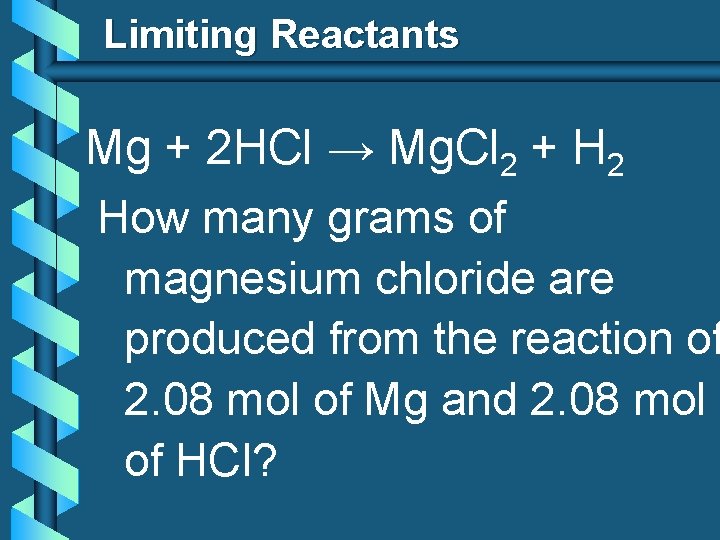
Limiting Reactants Mg + 2 HCl → Mg. Cl 2 + H 2 How many grams of magnesium chloride are produced from the reaction of 2. 08 mol of Mg and 2. 08 mol of HCl?
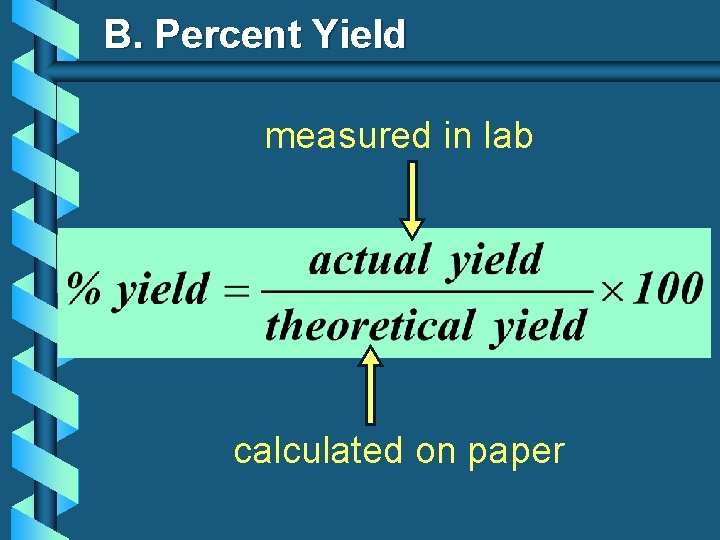
B. Percent Yield measured in lab calculated on paper
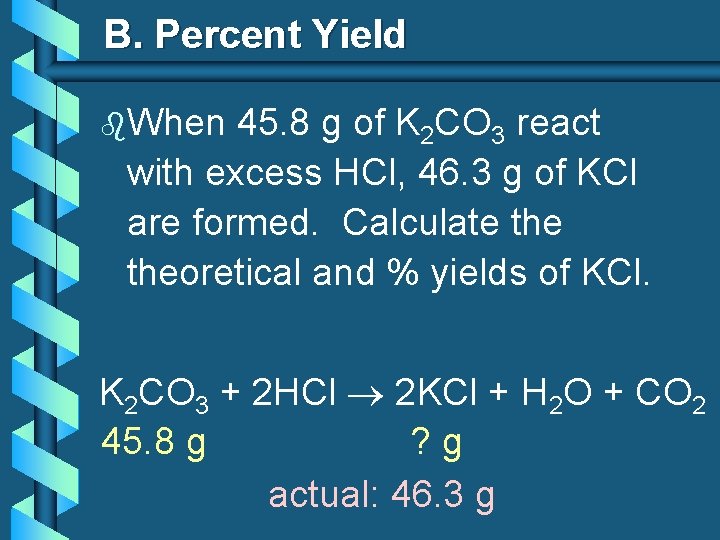
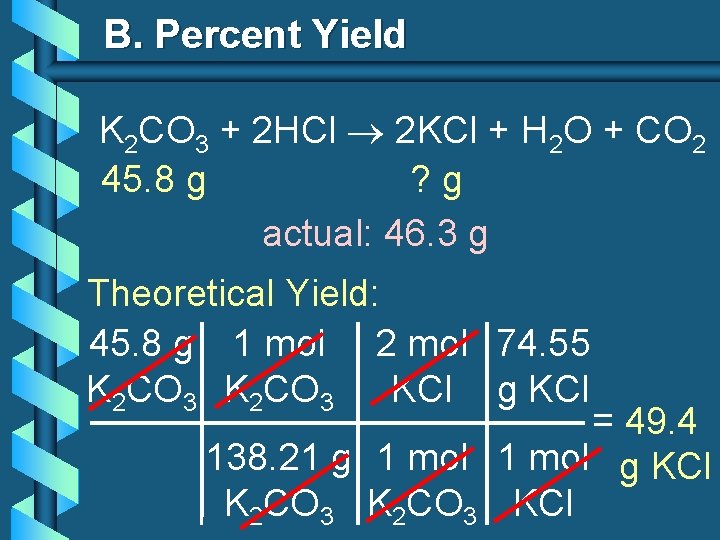
B. Percent Yield b. When 45. 8 g of K 2 CO 3 react with excess HCl, 46. 3 g of KCl are formed. Calculate theoretical and % yields of KCl. K 2 CO 3 + 2 HCl 2 KCl + H 2 O + CO 2 45. 8 g ? g actual: 46. 3 g
B. Percent Yield K 2 CO 3 + 2 HCl 2 KCl + H 2 O + CO 2 45. 8 g ? g actual: 46. 3 g Theoretical Yield: 45. 8 g 1 mol 2 mol 74. 55 K 2 CO 3 KCl g KCl = 49. 4 138. 21 g 1 mol g KCl K 2 CO 3 KCl
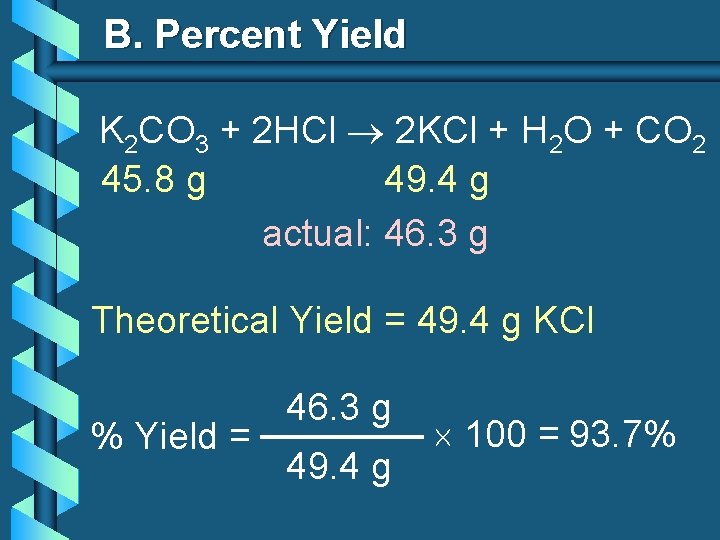
B. Percent Yield K 2 CO 3 + 2 HCl 2 KCl + H 2 O + CO 2 45. 8 g 49. 4 g actual: 46. 3 g Theoretical Yield = 49. 4 g KCl % Yield = 46. 3 g 49. 4 g 100 = 93. 7%