
Unit 06 Pure Substances Mixtures Background Info Review
Unit 06 – Pure Substances & Mixtures

Background Info (Review)
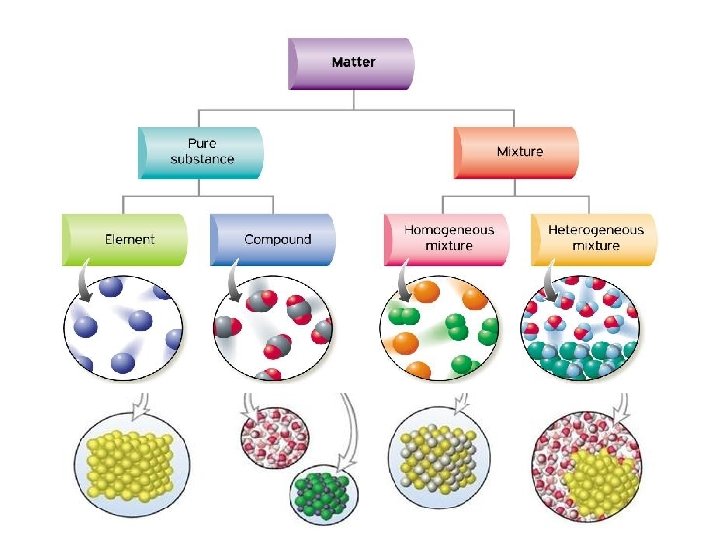
Classifying Matter
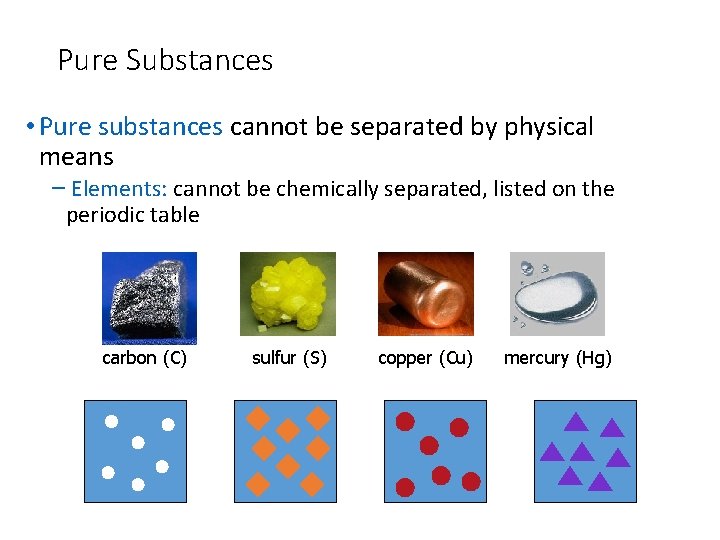
Pure Substances • Pure substances cannot be separated by physical means – Elements: cannot be chemically separated, listed on the periodic table carbon (C) sulfur (S) copper (Cu) mercury (Hg)
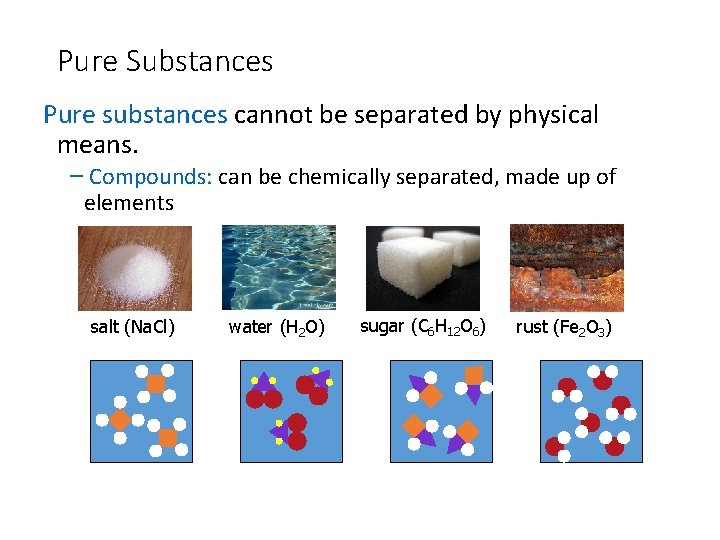
Pure Substances Pure substances cannot be separated by physical means. – Compounds: can be chemically separated, made up of elements salt (Na. Cl) water (H 2 O) sugar (C 6 H 12 O 6) rust (Fe 2 O 3)
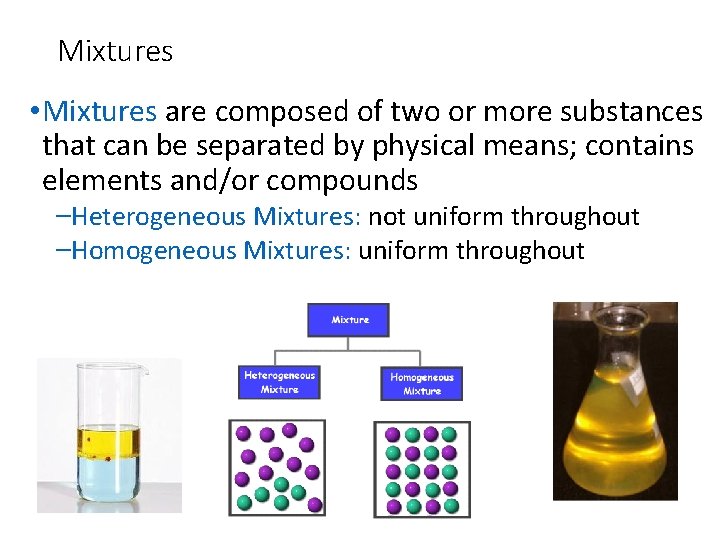
Mixtures • Mixtures are composed of two or more substances that can be separated by physical means; contains elements and/or compounds –Heterogeneous Mixtures: not uniform throughout –Homogeneous Mixtures: uniform throughout
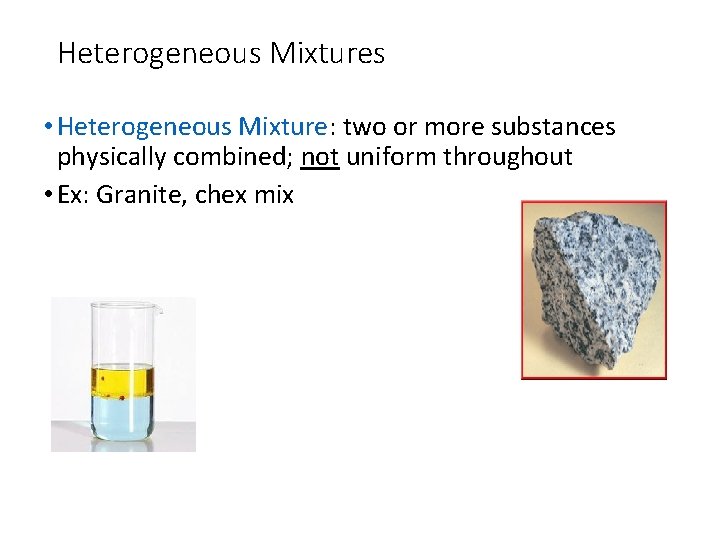
Heterogeneous Mixtures • Heterogeneous Mixture: two or more substances physically combined; not uniform throughout • Ex: Granite, chex mix
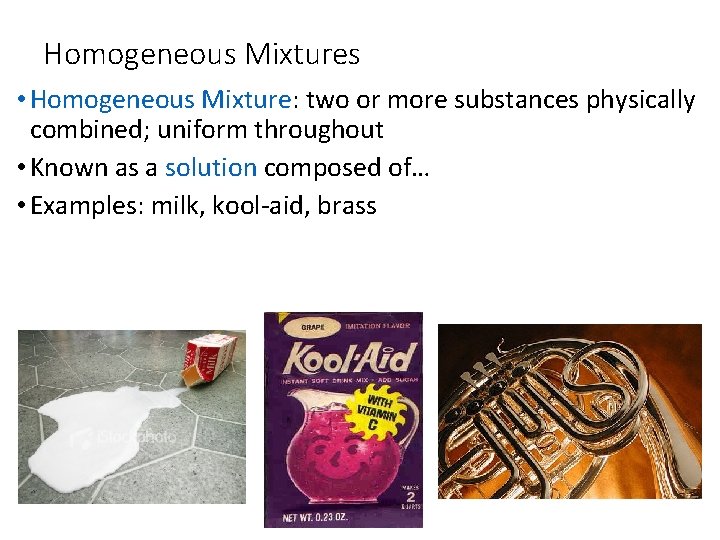
Homogeneous Mixtures • Homogeneous Mixture: two or more substances physically combined; uniform throughout • Known as a solution composed of… • Examples: milk, kool-aid, brass

New Info
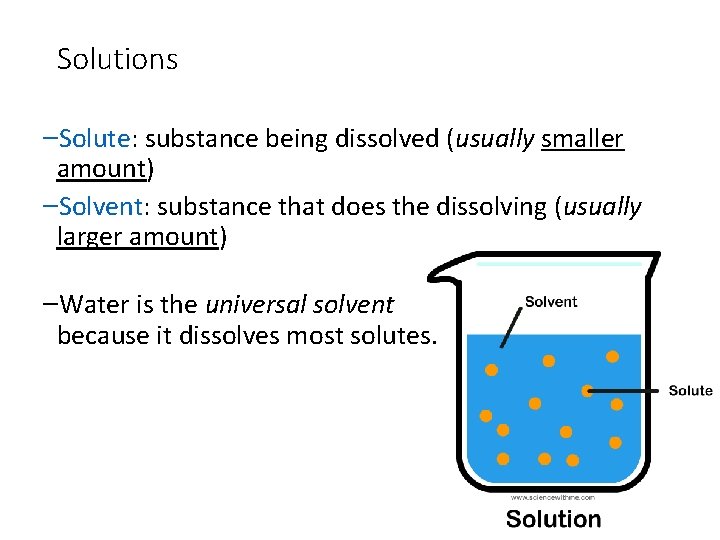
Solutions –Solute: substance being dissolved (usually smaller amount) –Solvent: substance that does the dissolving (usually larger amount) –Water is the universal solvent because it dissolves most solutes.
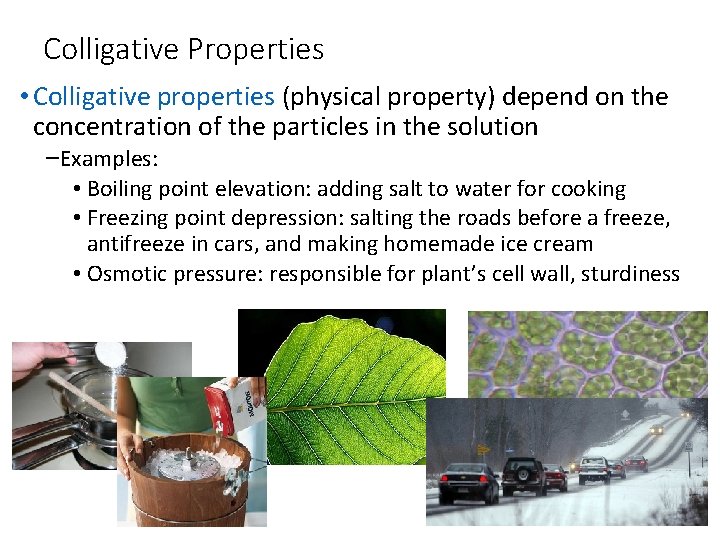
Colligative Properties • Colligative properties (physical property) depend on the concentration of the particles in the solution –Examples: • Boiling point elevation: adding salt to water for cooking • Freezing point depression: salting the roads before a freeze, antifreeze in cars, and making homemade ice cream • Osmotic pressure: responsible for plant’s cell wall, sturdiness
Colligative Properties • How does adding a solute change physical properties? –Solute particles get in the way of the solvent molecules –Makes it harder for the solvent molecules to boil (more energy needed – higher temperature) –Makes it harder for the solvent molecules to freeze (need to release more energy – lower temperature)
Scenario 1 • You are making iced tea for a party. You only have 10 minutes to make it. Name 3 ways you can make the sugar dissolve faster so you can put it out for the party in time.
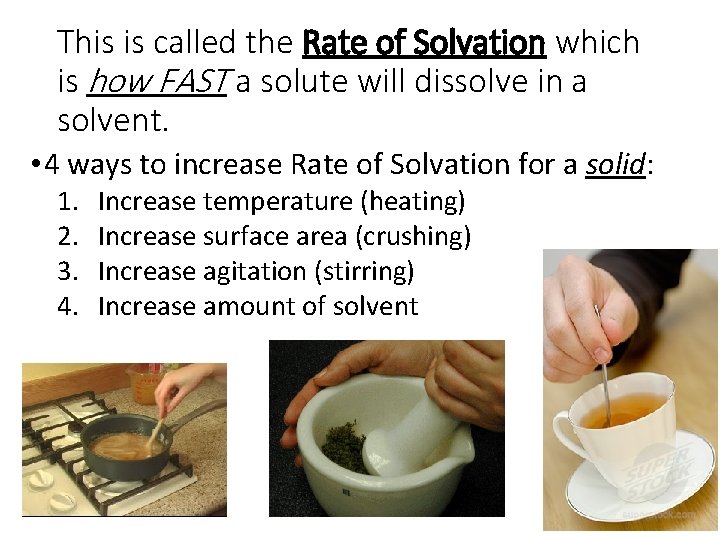
This is called the Rate of Solvation which is how FAST a solute will dissolve in a solvent. • 4 ways to increase Rate of Solvation for a solid: 1. 2. 3. 4. Increase temperature (heating) Increase surface area (crushing) Increase agitation (stirring) Increase amount of solvent
Scenario 2 • You are making iced tea for a party. Your aunt wants really sweet tea. You add 2 x the normal amount of sugar but the extra amount won’t dissolve. How can you force more to dissolve?
This is called the Solubility which is how MUCH a solute will dissolve in a solvent. • 1 way to increase Solubility for a solid: 1. Increase temperature (heating) • Allows molecules to move around and solute to fit in the nook and crannies of the solvent • 2 ways to increase Solubility or a gas: 1. Decrease temperature (cooling) • Reduces the KE of the gas so they don’t leave the solvent 2. Increase pressure • Forces the gas back into the solvent if it tries to leave

Solubility
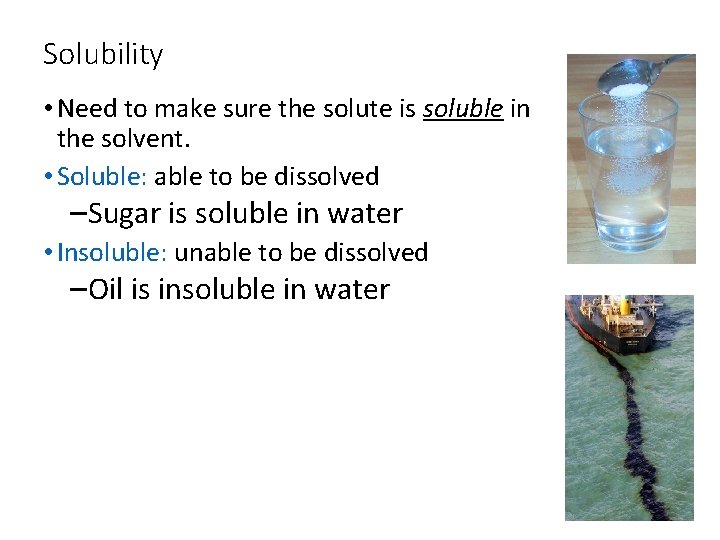
Solubility • Need to make sure the solute is soluble in the solvent. • Soluble: able to be dissolved –Sugar is soluble in water • Insoluble: unable to be dissolved –Oil is insoluble in water

3 Types of Solutions • Unsaturated – solvent contains less solute than it can hold • Saturated – solvent contains the maximum amount of solute –If more solute is added, it does not dissolve Ex: Coffee and sugar How could you tell if your coffee was unsaturated or saturated?
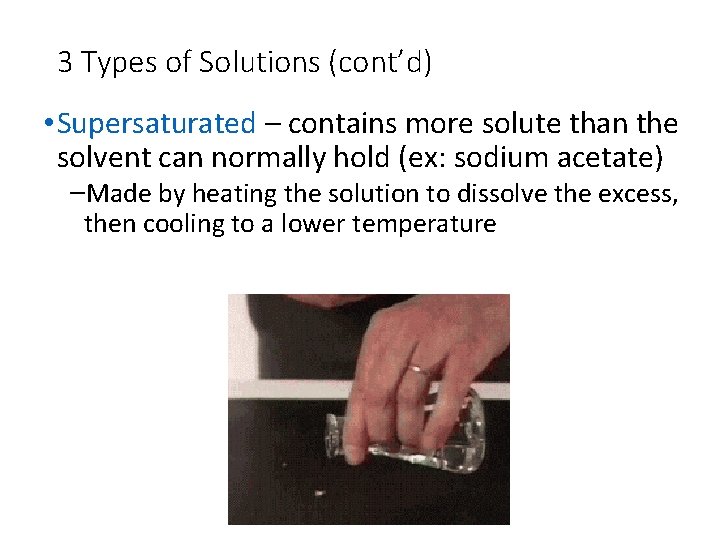
3 Types of Solutions (cont’d) • Supersaturated – contains more solute than the solvent can normally hold (ex: sodium acetate) –Made by heating the solution to dissolve the excess, then cooling to a lower temperature
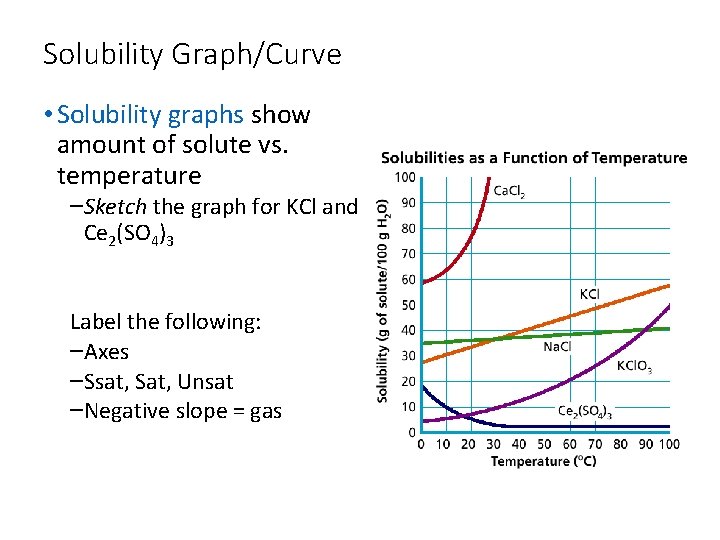
Solubility Graph/Curve • Solubility graphs show amount of solute vs. temperature –Sketch the graph for KCl and Ce 2(SO 4)3 Label the following: –Axes –Ssat, Sat, Unsat –Negative slope = gas
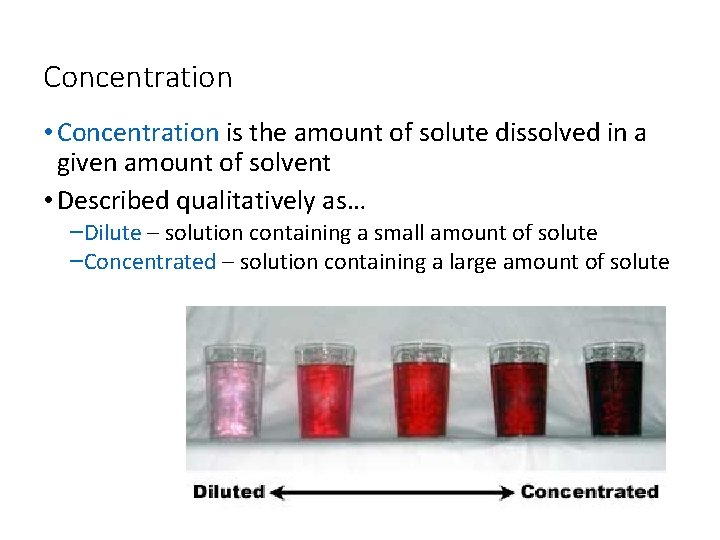
Concentration • Concentration is the amount of solute dissolved in a given amount of solvent • Described qualitatively as… –Dilute – solution containing a small amount of solute –Concentrated – solution containing a large amount of solute

Using Quantitative Concentration to describe solutions Friendly reminder next Friday is your test day! Last unit MG and 2 nd to last overall MG.
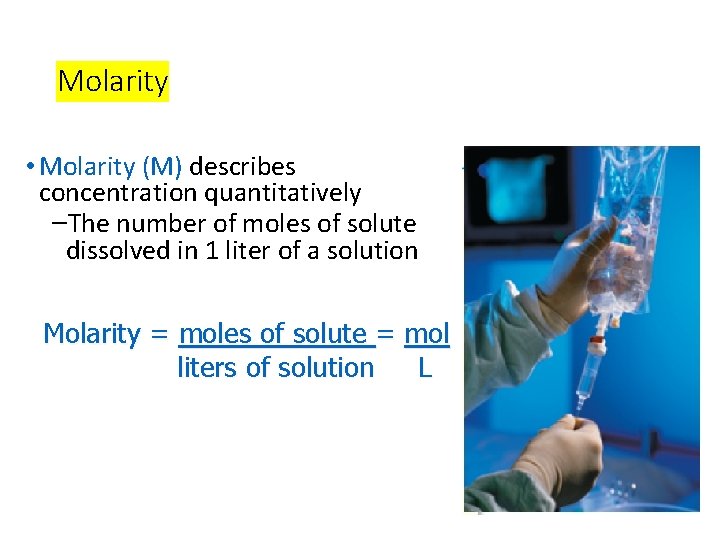
Molarity • Molarity (M) describes concentration quantitatively –The number of moles of solute dissolved in 1 liter of a solution Molarity = moles of solute = mol liters of solution L

Solutions - Molarity 1. What is the molarity of 2 mol sodium chloride in 5 L of solution? 0. 4 M 2. How many moles of potassium bromide would be present in 1 L of a 3 M solution? 3 moles 3. What is the volume of a 1. 5 M solution of hydrochloric acid that contains 10. 0 moles? 6. 7 L
Molality • The number of moles of solute per kilogram of solvent. • Molality = moles of solute = mol Kilograms of solvent kg
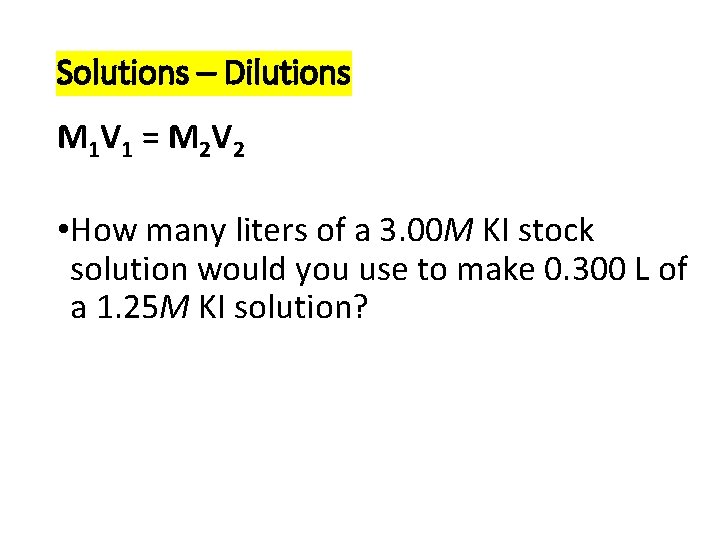
Solutions – Dilutions M 1 V 1 = M 2 V 2 • How many liters of a 3. 00 M KI stock solution would you use to make 0. 300 L of a 1. 25 M KI solution?
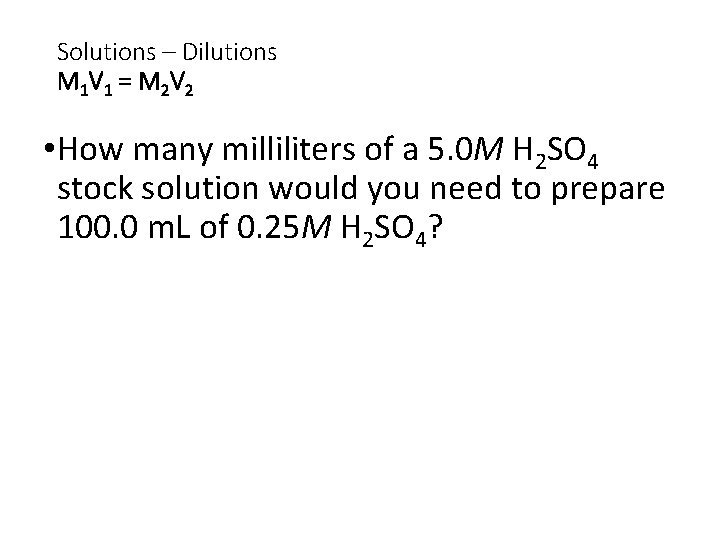
Solutions – Dilutions M 1 V 1 = M 2 V 2 • How many milliliters of a 5. 0 M H 2 SO 4 stock solution would you need to prepare 100. 0 m. L of 0. 25 M H 2 SO 4?
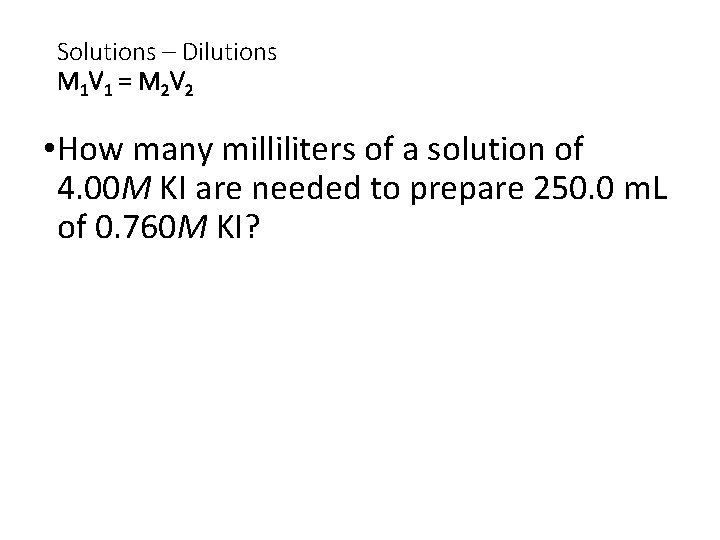
Solutions – Dilutions M 1 V 1 = M 2 V 2 • How many milliliters of a solution of 4. 00 M KI are needed to prepare 250. 0 m. L of 0. 760 M KI?
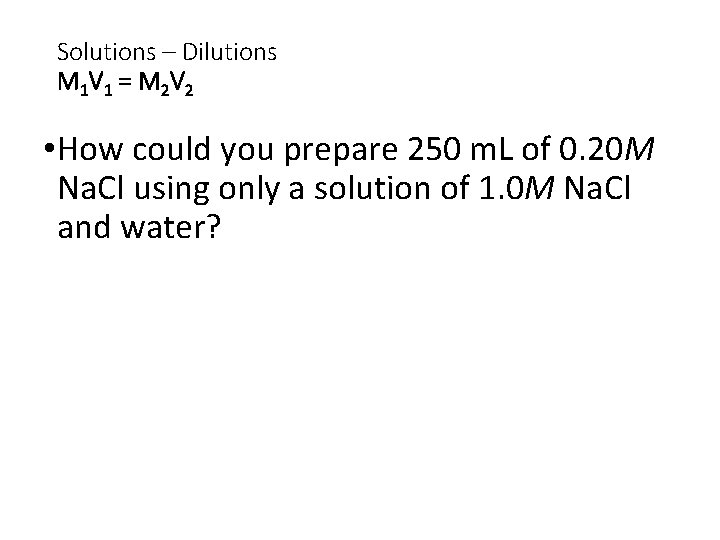
Solutions – Dilutions M 1 V 1 = M 2 V 2 • How could you prepare 250 m. L of 0. 20 M Na. Cl using only a solution of 1. 0 M Na. Cl and water?

Solutions of Gas • The total pressure of a gas mixture is the sum of the partial pressures of each individual gas • Air is a mixture! I’m John Dalton
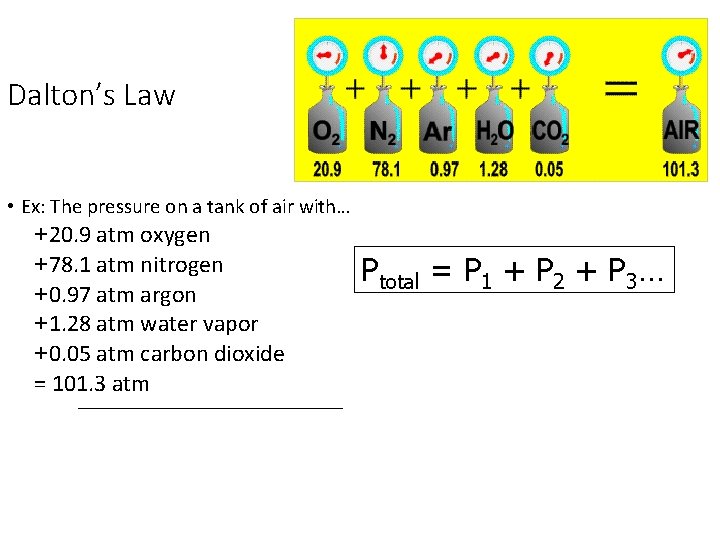
Dalton’s Law • Ex: The pressure on a tank of air with… +20. 9 atm oxygen +78. 1 atm nitrogen +0. 97 atm argon +1. 28 atm water vapor +0. 05 atm carbon dioxide = 101. 3 atm Ptotal = P 1 + P 2 + P 3…
Dalton’s Law • Determine the total pressure of a gas mixture that contains oxygen, nitrogen, and helium. The partial pressures are: PO 2 = 20. 0 k. Pa, PN 2 = 46. 7 k. Pa, and PHe = 26. 7 k. Pa.
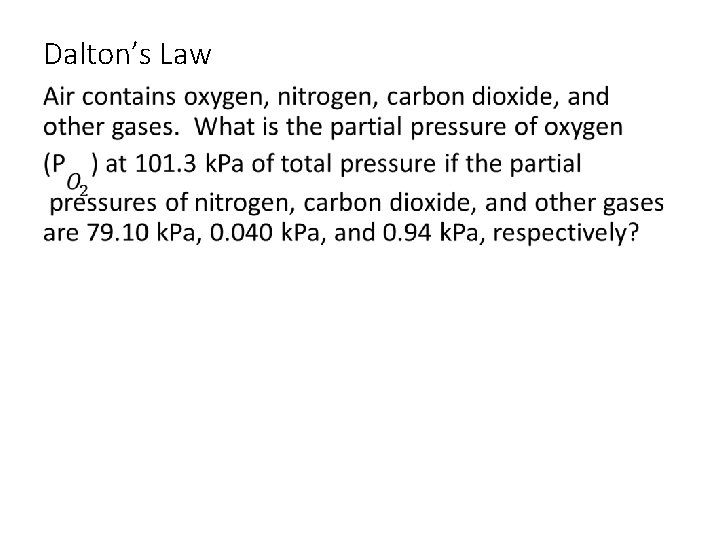
Dalton’s Law •
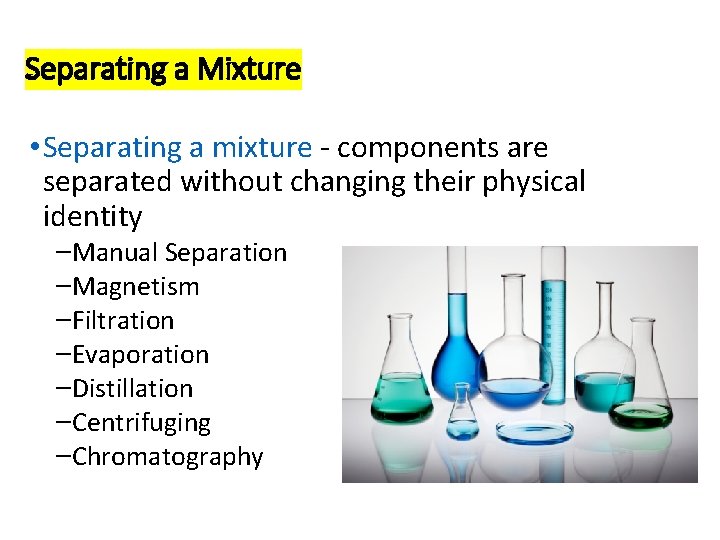
Separating a Mixture • Separating a mixture - components are separated without changing their physical identity –Manual Separation –Magnetism –Filtration –Evaporation –Distillation –Centrifuging –Chromatography
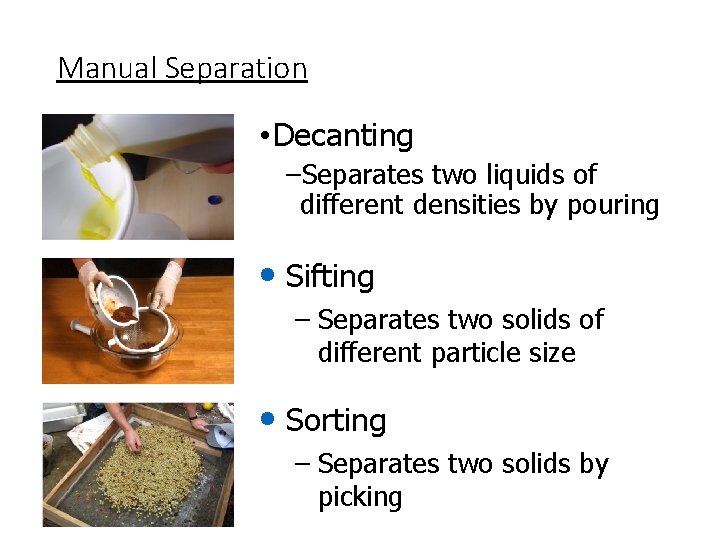
Manual Separation • Decanting –Separates two liquids of different densities by pouring • Sifting – Separates two solids of different particle size • Sorting – Separates two solids by picking
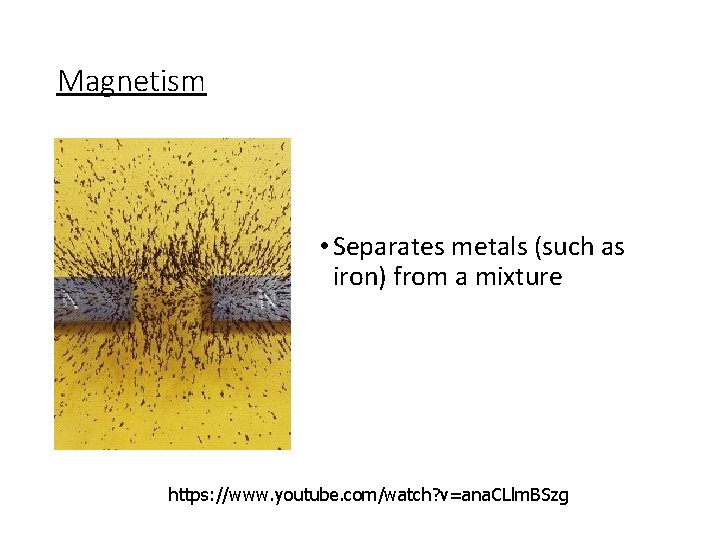
Magnetism • Separates metals (such as iron) from a mixture https: //www. youtube. com/watch? v=ana. CLlm. BSzg
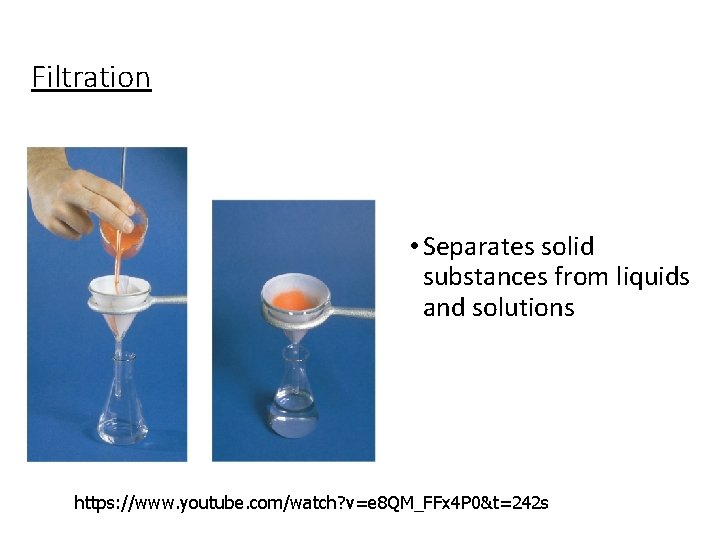
Filtration • Separates solid substances from liquids and solutions https: //www. youtube. com/watch? v=e 8 QM_FFx 4 P 0&t=242 s
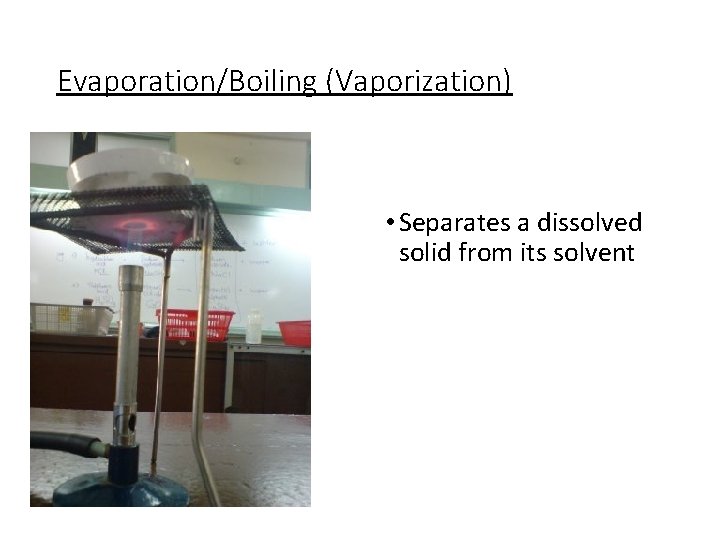
Evaporation/Boiling (Vaporization) • Separates a dissolved solid from its solvent
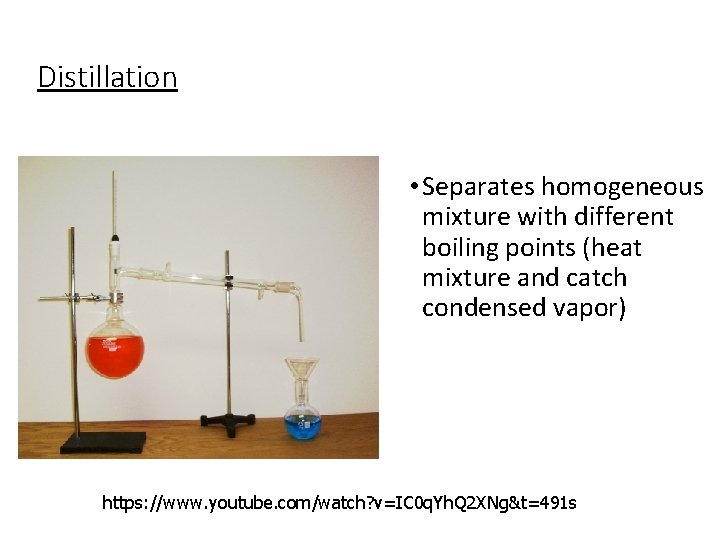
Distillation • Separates homogeneous mixture with different boiling points (heat mixture and catch condensed vapor) https: //www. youtube. com/watch? v=IC 0 q. Yh. Q 2 XNg&t=491 s
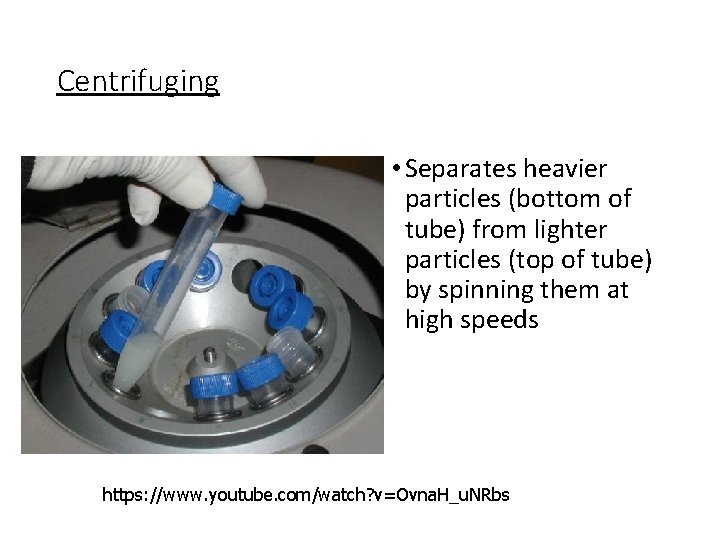
Centrifuging • Separates heavier particles (bottom of tube) from lighter particles (top of tube) by spinning them at high speeds https: //www. youtube. com/watch? v=Ovna. H_u. NRbs

Chromatography • Separates substances on the basis of their differences in solubility in a solvent - different substances are attracted to paper or gel and move at different speeds
- Slides: 42