
Unit 001 Level 2 RISK ASSESSME NT AIMS


- Slides: 29
Unit 001 Level 2 RISK ASSESSME NT
AIMS AND OBJECTIVES Understand the application of health & safety in the engineering environment By the end of this presentation you should know: • What risk assessment is • Why we carry out risk assessments. Aim: • To research risk assessment on the HSE website. • To carry out risk assessment activity's in the T 5 workshop.
RISK ASSESSMENT - WHAT IS IT? • Hazards exist in all workplaces. • Think about how accidents and ill health could happen. • It is important to spot these hazards and reduce the risk of harm. • As part of managing the health and safety of a business, owners must control the risks in the workplace. • To do this you need to think about what might cause harm to people and decide whether you are taking reasonable steps to prevent that harm.
RISK ASSESSMENT. When do I need to do a risk assessment? • You should carry out an assessment before you do work which presents a risk of injury or ill health. • You only need to do a risk assessment if you are an employer or a selfemployed person.
RISK ASSESSMENT - WHAT IS IT? • A risk assessment is nothing more than a careful examination of what, in your work or activities, could cause harm to people, so that you can weigh up whether you have taken enough precautions or should do more to prevent harm. • The aim is to make sure that no one gets hurt or becomes ill. • It is a legal requirement.
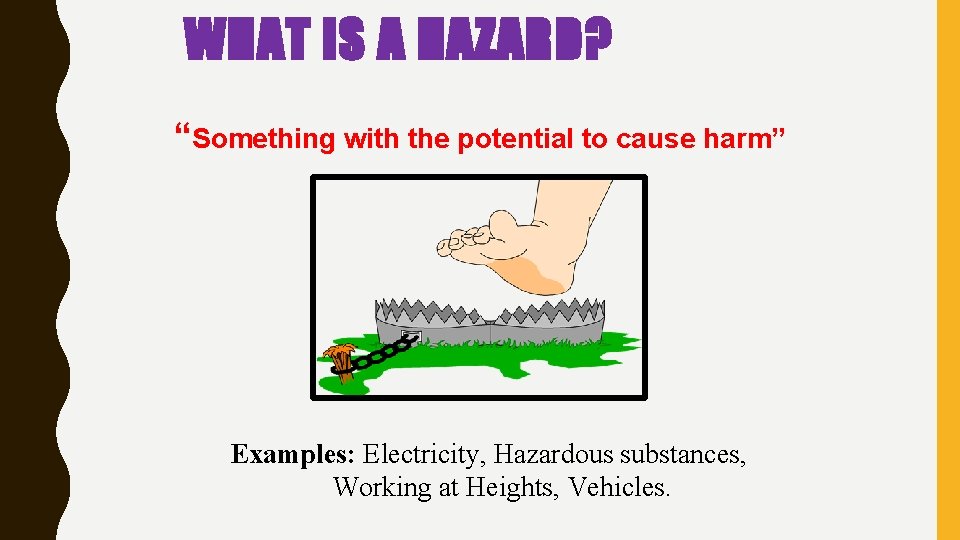
WHAT IS A HAZARD? “Something with the potential to cause harm” Examples: Electricity, Hazardous substances, Working at Heights, Vehicles.
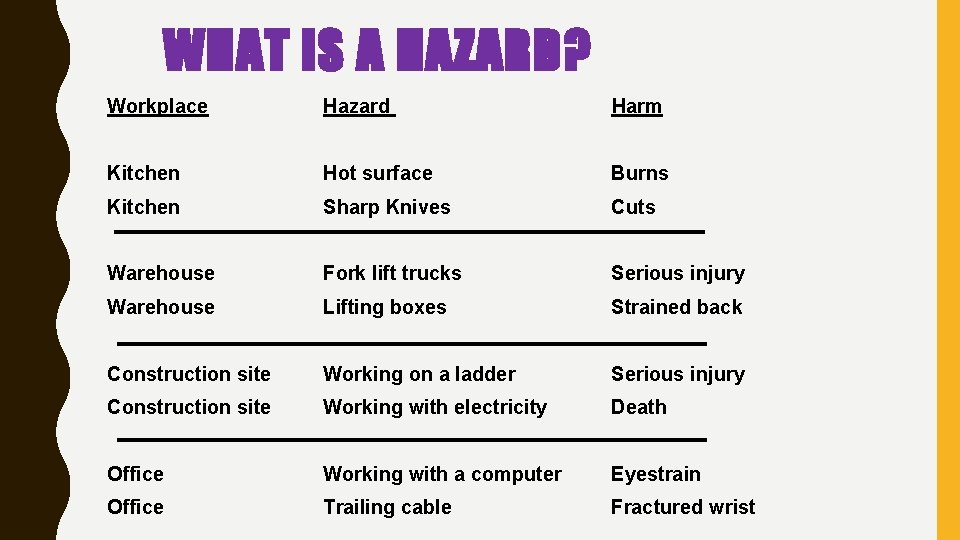
WHAT IS A HAZARD? Workplace Hazard Harm Kitchen Hot surface Burns Kitchen Sharp Knives Cuts Warehouse Fork lift trucks Serious injury Warehouse Lifting boxes Strained back Construction site Working on a ladder Serious injury Construction site Working with electricity Death Office Working with a computer Eyestrain Office Trailing cable Fractured wrist
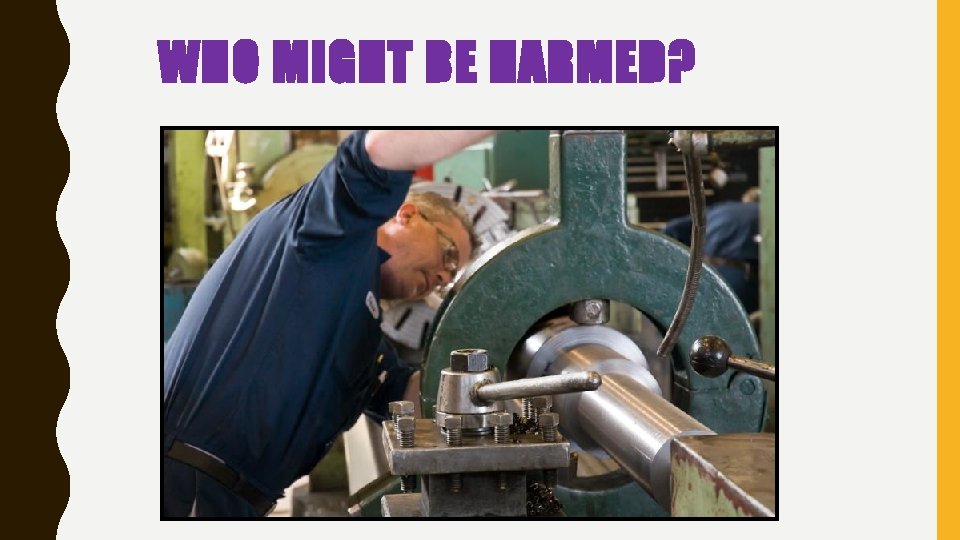
WHO MIGHT BE HARMED?
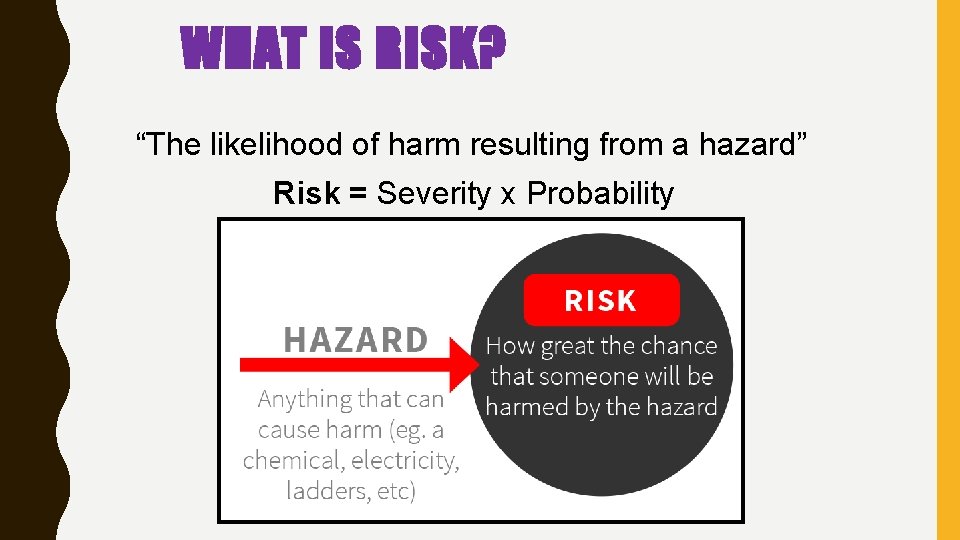
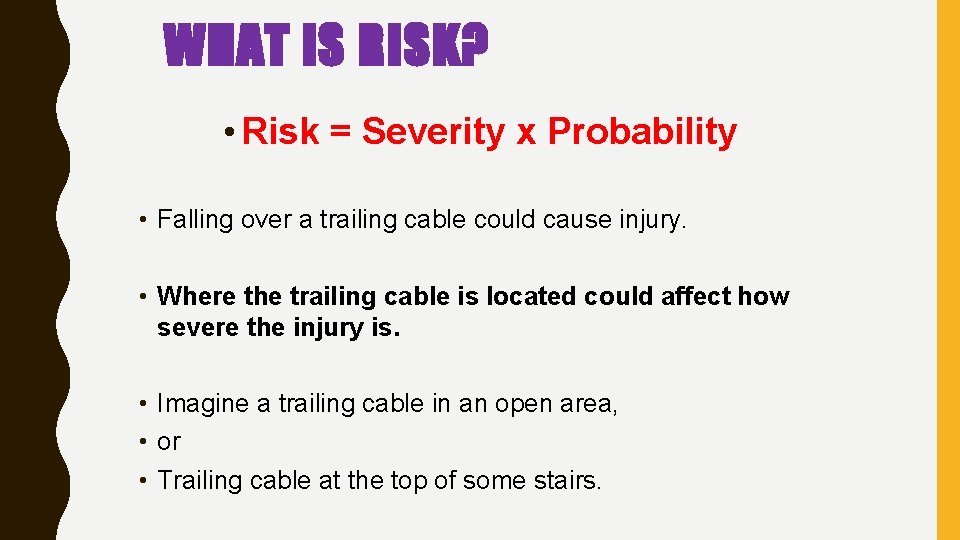
WHAT IS RISK? “The likelihood of harm resulting from a hazard” Risk = Severity x Probability
WHAT IS RISK? • Risk = Severity x Probability • Falling over a trailing cable could cause injury. • Where the trailing cable is located could affect how severe the injury is. • Imagine a trailing cable in an open area, • or • Trailing cable at the top of some stairs.
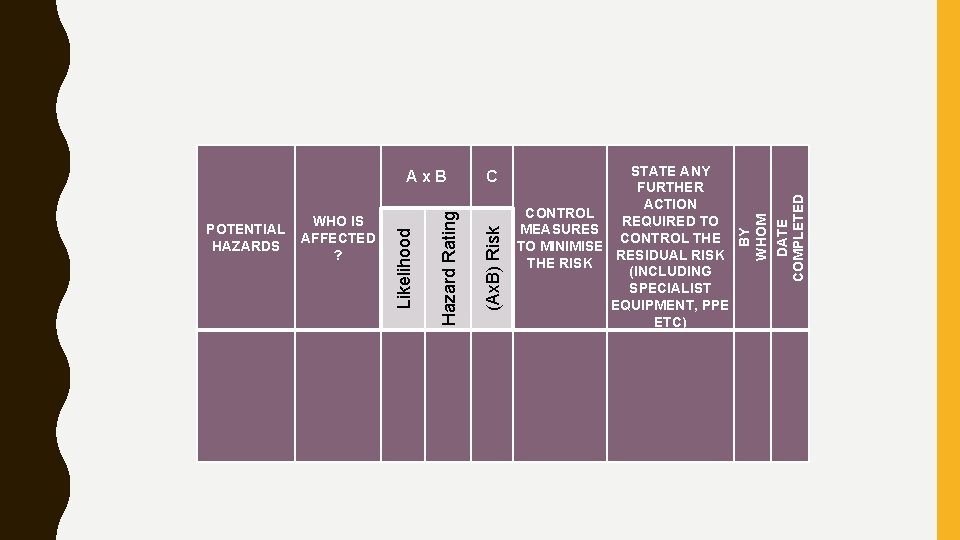
RISK ASSESSMENT BY WHOM DATE COMPLETED (Ax. B) Risk Likelihood WHO IS POTENTIAL AFFECTED HAZARDS ? C Hazard Rating A x B STATE ANY FURTHER ACTION CONTROL REQUIRED TO MEASURES CONTROL THE TO MINIMISE RESIDUAL RISK THE RISK (INCLUDING SPECIALIST EQUIPMENT, PPE ETC)
RISK RANKING - LIKELIHOOD Measurement of frequency / likelihood 6 Categories: Likelihood (A) Number Most unlikely Unlikely 1 Possible 3 Likely 4 Most Likely 5 Certain 6 2
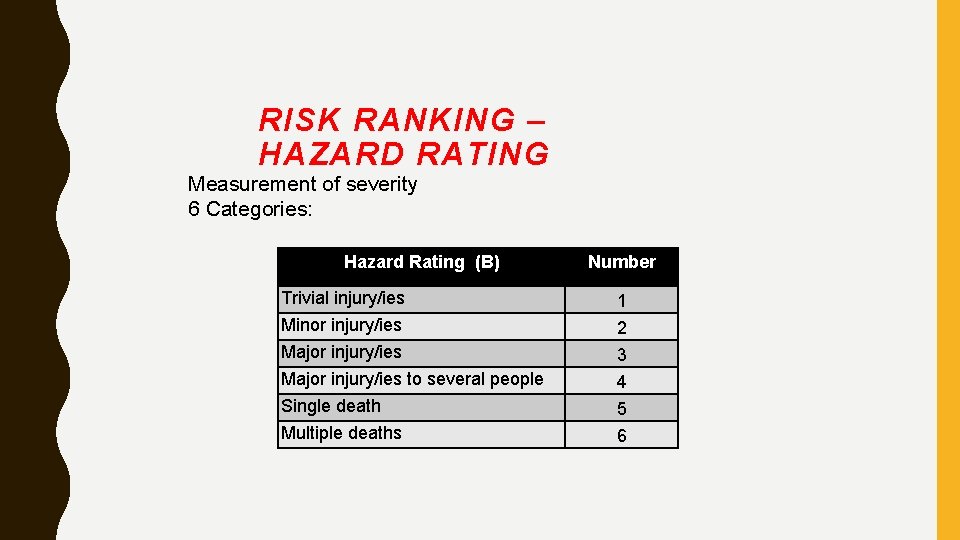
RISK RANKING – HAZARD RATING Measurement of severity 6 Categories: Hazard Rating (B) Number Trivial injury/ies 1 Minor injury/ies 2 Major injury/ies 3 Major injury/ies to several people 4 Single death 5 Multiple deaths 6
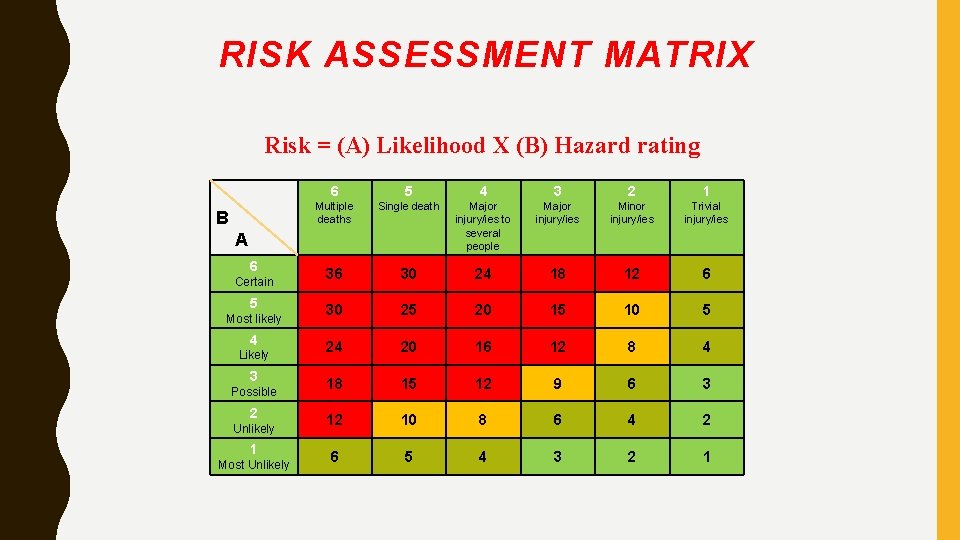
RISK ASSESSMENT MATRIX Risk = (A) Likelihood X (B) Hazard rating B 6 5 4 3 2 1 Multiple deaths Single death Major injury/ies to several people Major injury/ies Minor injury/ies Trivial injury/ies 36 30 24 18 12 6 30 25 20 15 10 5 24 20 16 12 8 4 18 15 12 9 6 3 12 10 8 6 4 2 6 5 4 3 2 1 A 6 Certain 5 Most likely 4 Likely 3 Possible 2 Unlikely 1 Most Unlikely
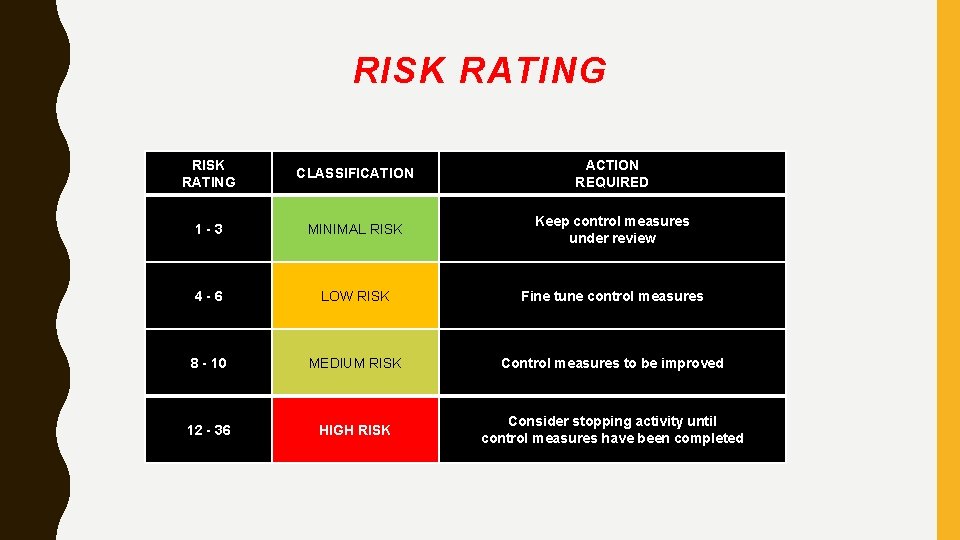
RISK RATING CLASSIFICATION ACTION REQUIRED 1 - 3 MINIMAL RISK Keep control measures under review 4 - 6 LOW RISK Fine tune control measures 8 - 10 MEDIUM RISK Control measures to be improved 12 - 36 HIGH RISK Consider stopping activity until control measures have been completed
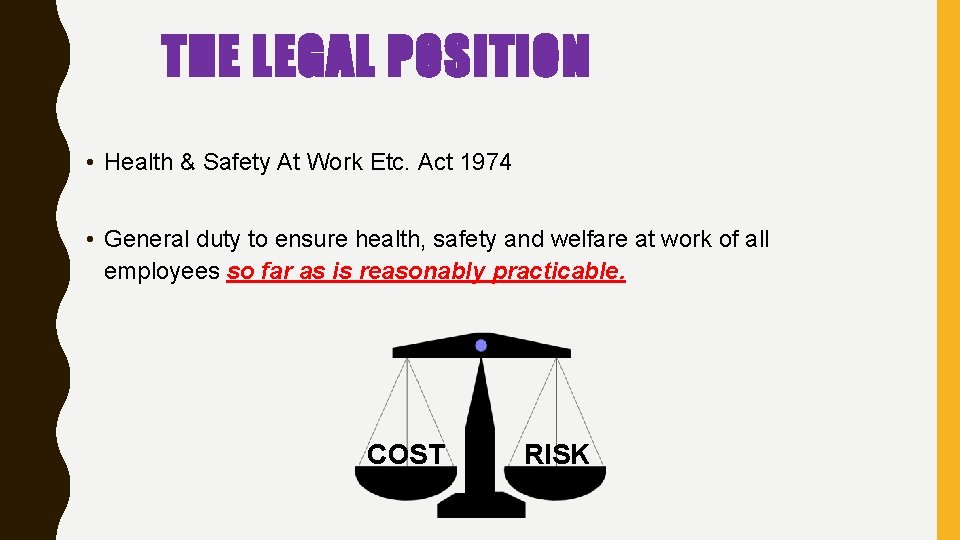
THE LEGAL POSITION • Health & Safety At Work Etc. Act 1974 • General duty to ensure health, safety and welfare at work of all employees so far as is reasonably practicable. COST RISK
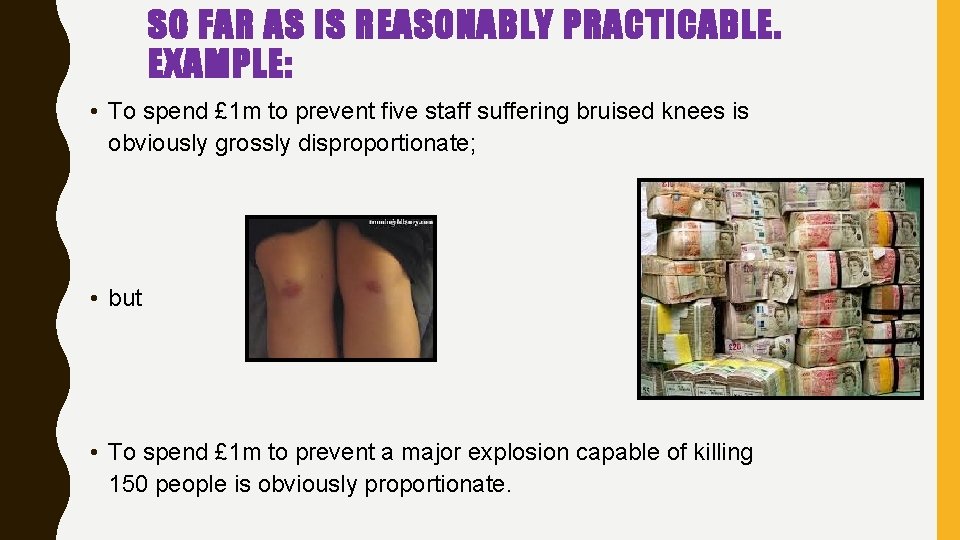
SO FAR AS IS REASONABLY PRACTICABLE. EXAMPLE: • To spend £ 1 m to prevent five staff suffering bruised knees is obviously grossly disproportionate; • but • To spend £ 1 m to prevent a major explosion capable of killing 150 people is obviously proportionate.
MANAGEMENT OF HEALTH & SAFETY AT WORK REGULATIONS 1999 • Legal duty on employers to carry out risk assessments as first step in ensuring safe and healthy workplace • Written record (5 or more employees) • Identify preventive and protective measures • Review assessments if no longer valid • Risk assessments must be “Suitable and Sufficient”
WHAT IS “SUITABLE & SUFFICIENT”? • a proper check was made • Identify all hazards. • Identify who is at risk. • you asked who might be affected • Identify specific regulations. • you dealt with all the obvious significant hazards, taking into account the number of people who could be involved; • the precautions are reasonable, and the remaining risk is low; • Include non-routine operations.
5 STEPS TO RISK ASSESSMENT 1. Look for and list the hazards 2. Decide who might be harmed and how 3. Evaluate the risks and decide on precautions 4. Record the findings 5. Review assessment when necessary
STEP 1. IDENTIFY HAZARDS • First you need to work out how people could be harmed. How? • Walk around your workplace • Ask employees • Check manufacturers’ instructions (data sheets etc. ) • Have a look back at your accident book
STEP 2. WHO COULD BE HARMED • For each hazard you need to be clear about who might be harmed. • That doesn’t mean listing everyone by name, but rather identifying groups of people. • People working in the storeroom’ or ‘passers-by • Some workers have particular requirements? • new and young workers • Expectant mothers • people with disabilities
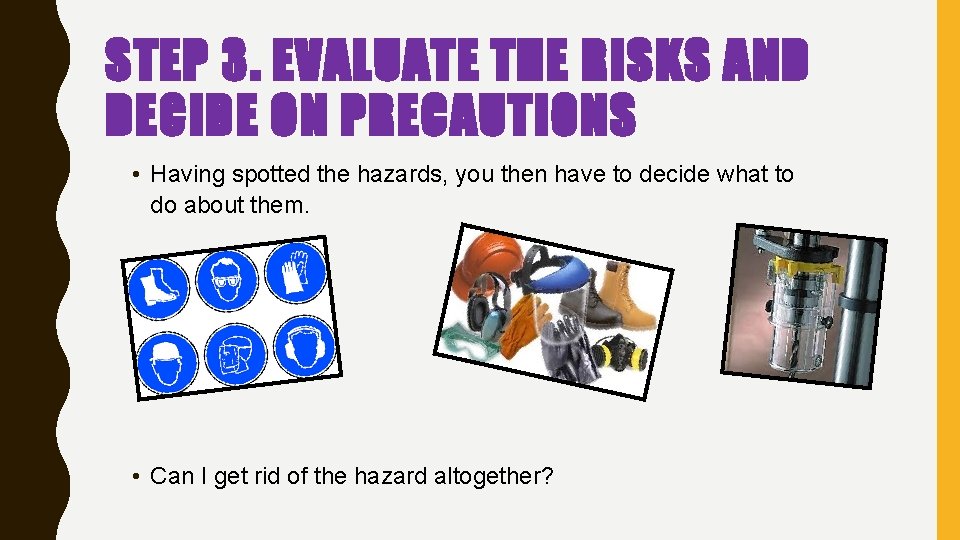
STEP 3. EVALUATE THE RISKS AND DECIDE ON PRECAUTIONS • Having spotted the hazards, you then have to decide what to do about them. • Can I get rid of the hazard altogether?
STEP 4. RECORD THE FINDINGS • Create the risk assessments. Share them with employees. • When writing down your results, keep it simple. • E. g. • Tripping over rubbish: • bins provided, staff instructed, weekly housekeeping checks. • Fumes from welding: • local exhaust ventilation used and regularly checked.
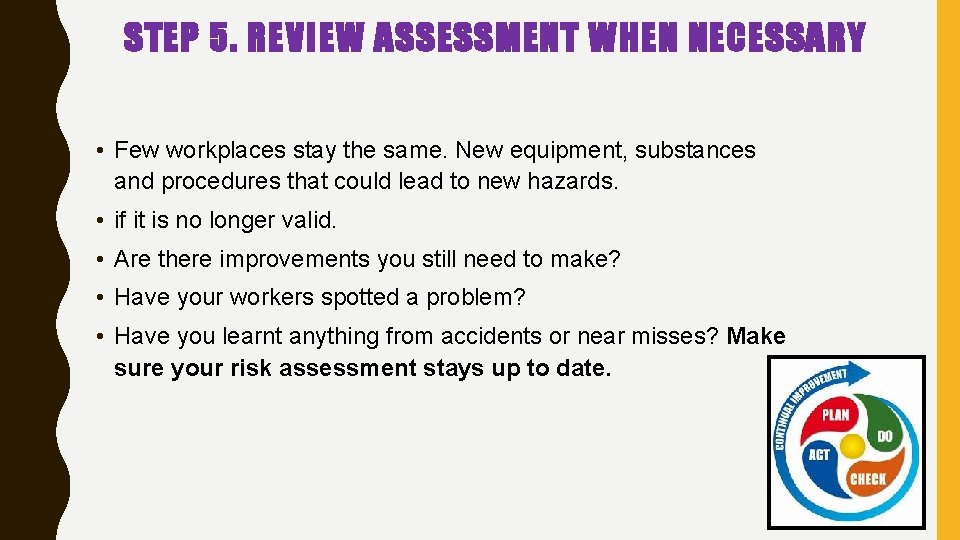
STEP 5. REVIEW ASSESSMENT WHEN NECESSARY • Few workplaces stay the same. New equipment, substances and procedures that could lead to new hazards. • if it is no longer valid. • Are there improvements you still need to make? • Have your workers spotted a problem? • Have you learnt anything from accidents or near misses? Make sure your risk assessment stays up to date.
SUMMARY • Risk assessment is a legal requirement • Follow the “ 5 steps to Risk Assessment”; – Identify the hazards – Decide who can be harmed – Evaluate the risk – Record significant findings – Review and revise • Risk assessment is a means to an end, not an end in itself the aim is to keep people safe, not have good paperwork
QUESTIONS?
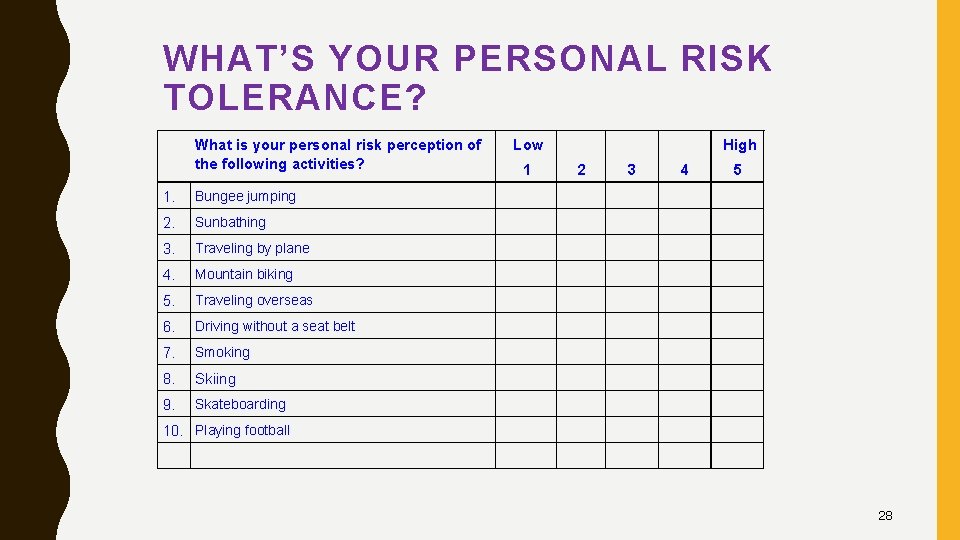
WHAT’S YOUR PERSONAL RISK TOLERANCE? What is your personal risk perception of the following activities? 1. Bungee jumping 2. Sunbathing 3. Traveling by plane 4. Mountain biking 5. Traveling overseas 6. Driving without a seat belt 7. Smoking 8. Skiing 9. Skateboarding Low 1 High 2 3 4 5 10. Playing football 28
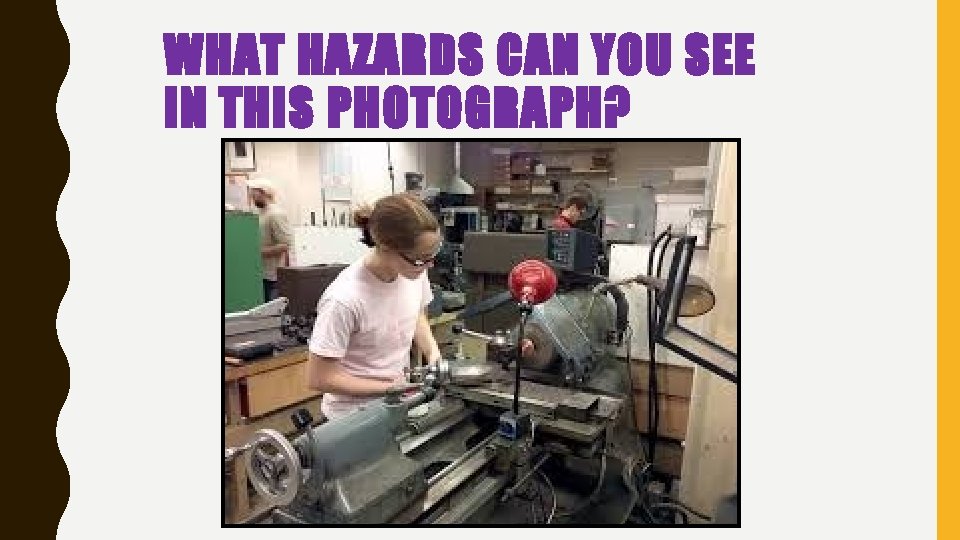
WHAT HAZARDS CAN YOU SEE IN THIS PHOTOGRAPH?