
Unit 001 Health and safety roles and responsibilities
Unit 001 - Health and safety roles and responsibilities.
AIMS: Have an awareness of health and safety roles and responsibilities. OBJECTIVES: State the job role of a trading standard officer. To Include: § Their purpose, § Job role § Power & penalties § A case that has gone to court.

Trading standards professionals work in local authorities across the UK to enforce approximately 250 separate pieces of legislation. They cover a wide range of subject areas from agriculture and animal health to weights and measures.

By maintaining standards and enforcing the law in these areas, trading standards services contribute to four key priorities for local and central government Trading standards professionals act on behalf of consumers and business. They advise on and enforce laws that govern the way we buy, sell, rent and hire goods and services.

STANDARDS § Trading standards officers (TSOs) work for local councils advising on consumer law, investigating complaints and, if all else fails, prosecuting traders who break the law. § These laws cover a wide area, which includes: § Consumer safety § Counterfeit goods § Product labelling § Weights and measures § Under-age sales § Animal welfare
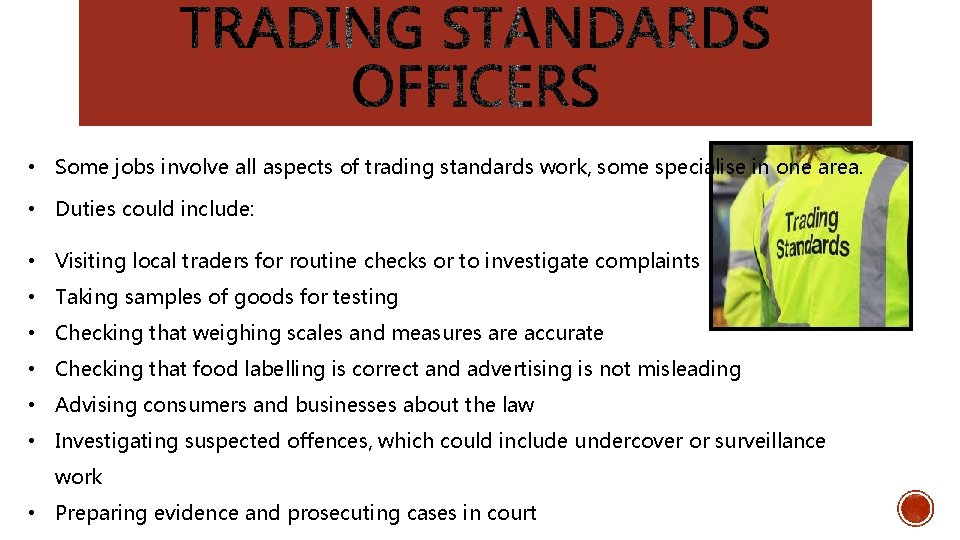
• Some jobs involve all aspects of trading standards work, some specialise in one area. • Duties could include: • Visiting local traders for routine checks or to investigate complaints • Taking samples of goods for testing • Checking that weighing scales and measures are accurate • Checking that food labelling is correct and advertising is not misleading • Advising consumers and businesses about the law • Investigating suspected offences, which could include undercover or surveillance work • Preparing evidence and prosecuting cases in court
§ Every year Wrexham Trading Standards take people to court for selling and making counterfeit goods. § A case is often heard at the Crown Court which hears more serious offences, and as such attracts a higher penalty should the defendant be found guilty. § Our successful cases have resulted in fines, community punishment, suspended sentences and imprisonment.
§ When people have been found guilty Trading Standards also apply to remove all of the infringing items which can include laptops, computers and printers which have been used to make e. g. DVDs, as well as the counterfeit items. § Further to this, confiscation orders can be made under the Proceeds of Crime Act following conviction of a crime. § This targets the criminal lifestyle of the defendant by seeking confiscation of their assets. § This can even lead to the loss of your house. If payments to the Court are not met within a deadline they can then impose a prison sentence for non-payment.
§ October 2009 at Mold Crown Court 2 Wolverhampton men received 100 hours community punishment each, and 12 weeks imprisonment suspended for 2 years for selling counterfeit clothing at Chirk Car Boot Sale. Case referred for Proceeds of Crime Investigation resulting in confiscation order in excess of £ 50, 000. § November 2008 at Mold Crown Court. Stockport man jailed for 6 months for sale and possession of counterfeit clothing at Chirk Car Boot Sale. Case referred for Proceeds of Crime Investigation resulting in confiscation order in excess of £ 50, 000.
- Slides: 9