
Unique Career Development Needs of Women with Learning
- Slides: 20
Unique Career Development Needs of Women with Learning Disabilities Presenters: Kathryn Metzgar Kimberly Lawrence November 15, 2008
"What do you think are some of the unique career -related issues facing women with learning disabilities? "
The Role of Self Advocacy • • • Inability to self advocate, lack of use of career development services, impact their disability and has it affects their career choices. Students with disabilities view employment as a source of income and not exploring career choices. Little or no knowledge of skills required for various careers Not aware of how disability will affect careers. Unrealistic career ambitions or no career ambitions at all (Hitchings, 1998)
Barriers to Career Choice • Gender Roles and Societal Stereotypes • Self Confidence/ Self Esteem • Disability Limitations • Family and Childhood Experiences • Lack of Opportunities • Early Work Experiences • Career Exploration and Counseling (Lindstrom, 2004)
Boundaries of Research • No relevant career development theory • Existing career development strategies effectiveness is unclear. • No single theory can address the different types of disabilities. • Career services staff frequently refers students to the campus Disability Services office which is ineffective. (Aune, 1997)
Career Decision Making Processing Influences: • Gender • SES • Family Structure • Self-Efficacy • Level of Education • Age • Disability Status (Hitchings, 2001)
Four Factors Related that Impact CDM 1. Type and Severity of Disability 2. Time Spent in Academic Remediation and Physical Intervention 3. Overprotected advocate parents/ low expectations/ lack of seriousness 4. Impeded CDM and maladaptive career beliefs (Hitchings, 2001)
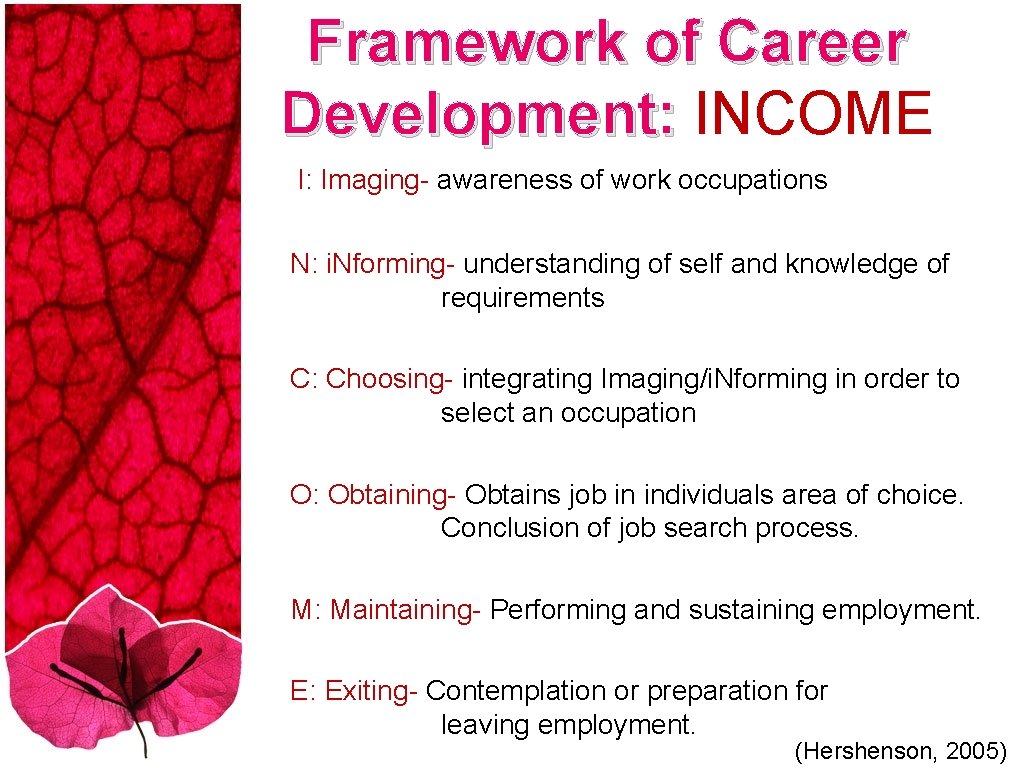
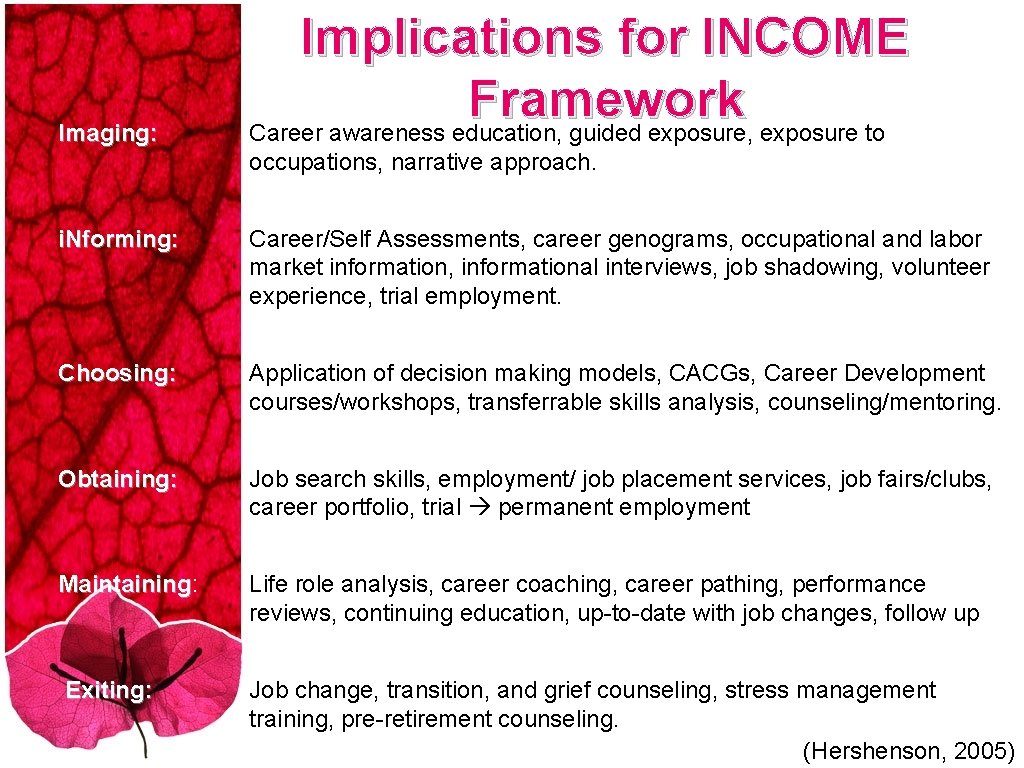
Framework of Career Development: INCOME I: Imaging- awareness of work occupations N: i. Nforming- understanding of self and knowledge of requirements C: Choosing- integrating Imaging/i. Nforming in order to select an occupation O: Obtaining- Obtains job in individuals area of choice. Conclusion of job search process. M: Maintaining- Performing and sustaining employment. E: Exiting- Contemplation or preparation for leaving employment. (Hershenson, 2005)
Imaging: Implications for INCOME Framework Career awareness education, guided exposure, exposure to occupations, narrative approach. i. Nforming: Career/Self Assessments, career genograms, occupational and labor market information, informational interviews, job shadowing, volunteer experience, trial employment. Choosing: Application of decision making models, CACGs, Career Development courses/workshops, transferrable skills analysis, counseling/mentoring. Obtaining: Job search skills, employment/ job placement services, job fairs/clubs, career portfolio, trial permanent employment Maintaining: Maintaining Life role analysis, career coaching, career pathing, performance reviews, continuing education, up-to-date with job changes, follow up Exiting: Job change, transition, and grief counseling, stress management training, pre-retirement counseling. (Hershenson, 2005)
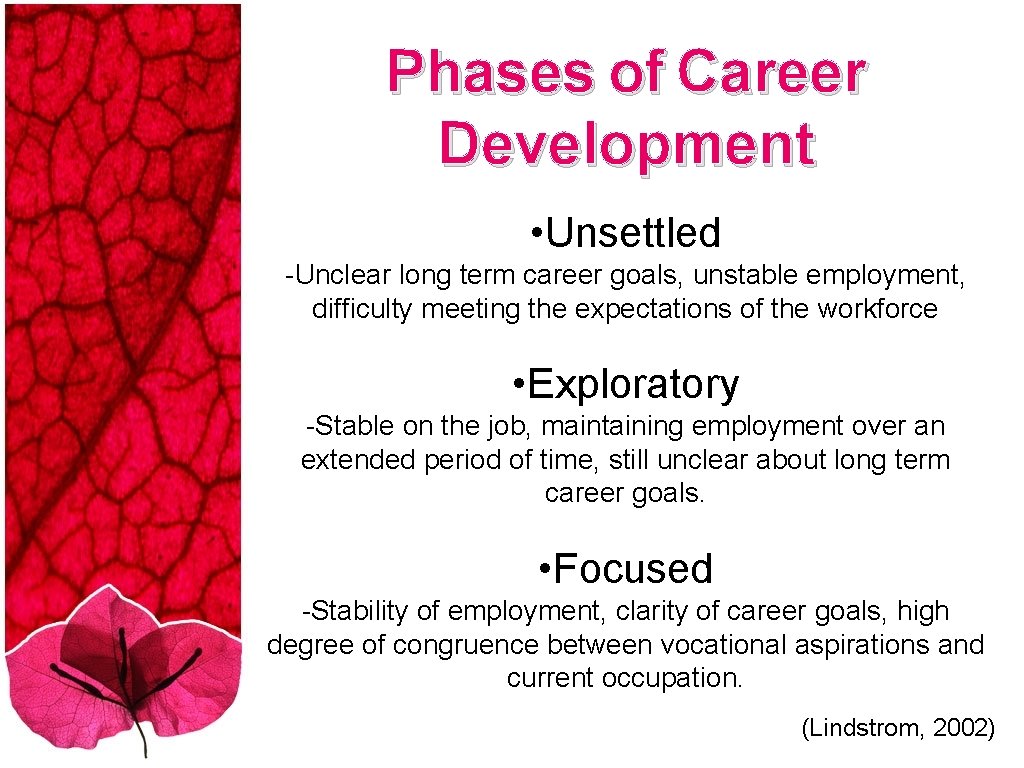
Phases of Career Development • Unsettled -Unclear long term career goals, unstable employment, difficulty meeting the expectations of the workforce • Exploratory -Stable on the job, maintaining employment over an extended period of time, still unclear about long term career goals. • Focused -Stability of employment, clarity of career goals, high degree of congruence between vocational aspirations and current occupation. (Lindstrom, 2002)
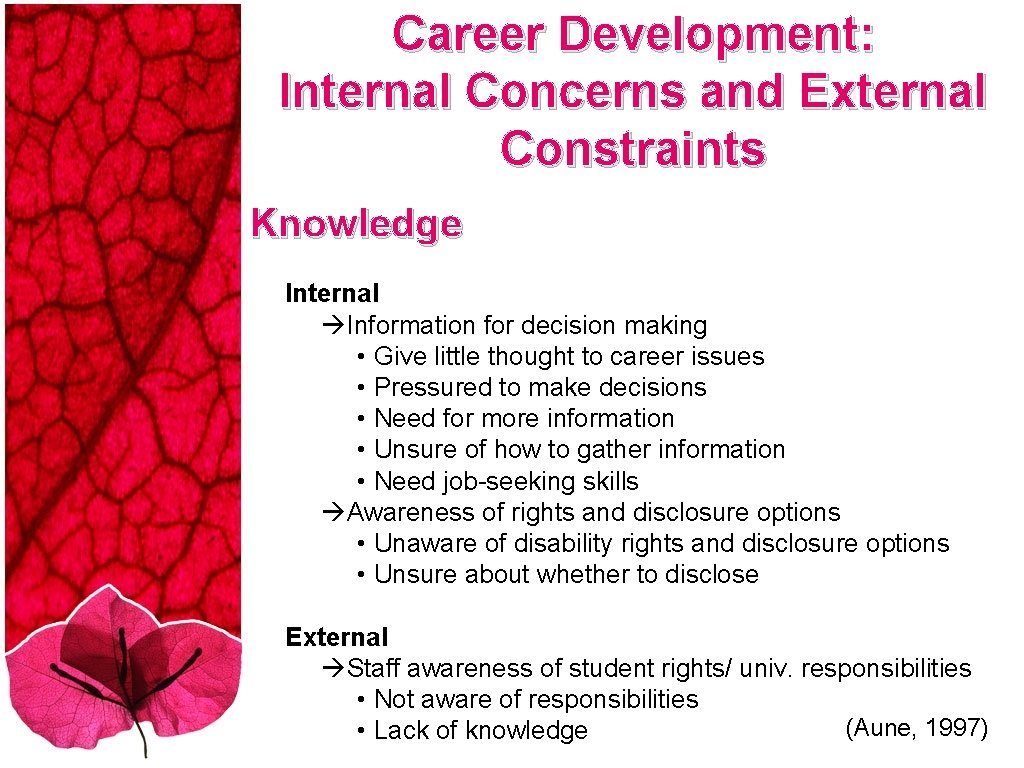
Career Development: Internal Concerns and External Constraints Knowledge Internal Information for decision making • Give little thought to career issues • Pressured to make decisions • Need for more information • Unsure of how to gather information • Need job-seeking skills Awareness of rights and disclosure options • Unaware of disability rights and disclosure options • Unsure about whether to disclose External Staff awareness of student rights/ univ. responsibilities • Not aware of responsibilities (Aune, 1997) • Lack of knowledge
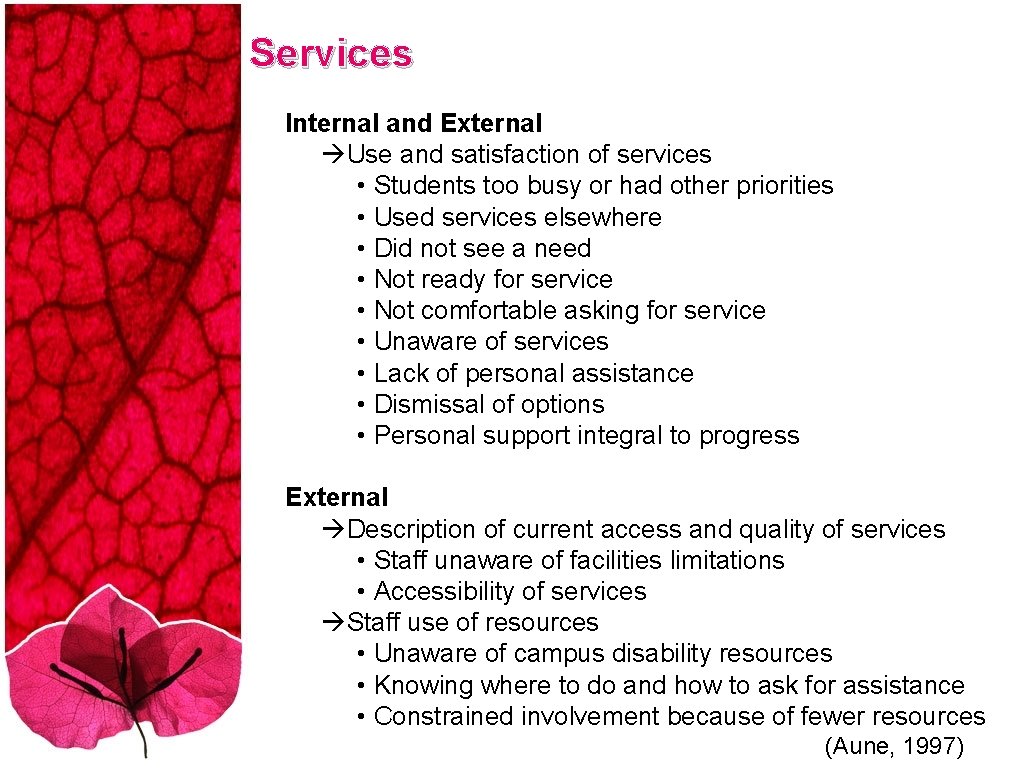
Services Internal and External Use and satisfaction of services • Students too busy or had other priorities • Used services elsewhere • Did not see a need • Not ready for service • Not comfortable asking for service • Unaware of services • Lack of personal assistance • Dismissal of options • Personal support integral to progress External Description of current access and quality of services • Staff unaware of facilities limitations • Accessibility of services Staff use of resources • Unaware of campus disability resources • Knowing where to do and how to ask for assistance • Constrained involvement because of fewer resources (Aune, 1997)
Attitudes Internal Attitude toward self • Anxiety • Lack of self-acceptance • Difficulty incorporating disability into identity • Empowerment issues • Being part of a disabled community • Difficulty asking for help External Attitudes of others • Negative reactions from others • Anxiety about other people’s reactions • Negative perceptions • Stereotypes • Fears • Ignorance (Aune, 1997)
Circumstances Internal Personal circumstance • Stress • Family situations • Health-related problems • Financial problems • Lack of skills and abilities External Circumstances in the environment • Transportation • Handicapped spaces • Elevator • Accessibility Barrier-free environments (Aune, 1997)
Keys to Successful Adult Employment: Internal Decisions: • Powerful desire to succeed • Clear sense of goal orientation • Reframing of LD experience External Manifestations: • Persistence • Goodness of fit • Learned creativity • Positive social networks (Kerka, 2002)
Implications for Career Counselors: • Create a “campus climate” that facilitates open dialog between students, Disability services staff, and Career services staff. • Avoid making assumptions of a students “can” and “cannot” based on disability. • Create welcoming and encouraging environments; staff may have unconscious negative views regarding disability. • Gaining the disability perspective. • Assist students by capitalizing on strengths as oppose to focusing on limitations. (Aune, 1997)
Further Implications: • Informed about barriers related to gender as well as strategies to expand career options. (Lindstrom, 2004) • Encourage LD women to engage in a wide variety of work experiences in traditional and non traditional occupations. (Lindstrom, 2004) • School staff most offer structured opportunities that enable students to explore a wide variety of occupations. (Lindstrom, 2004) • Postsecondary education programs could include a self advocacy component through SDS office. (Hitchings, 2001)
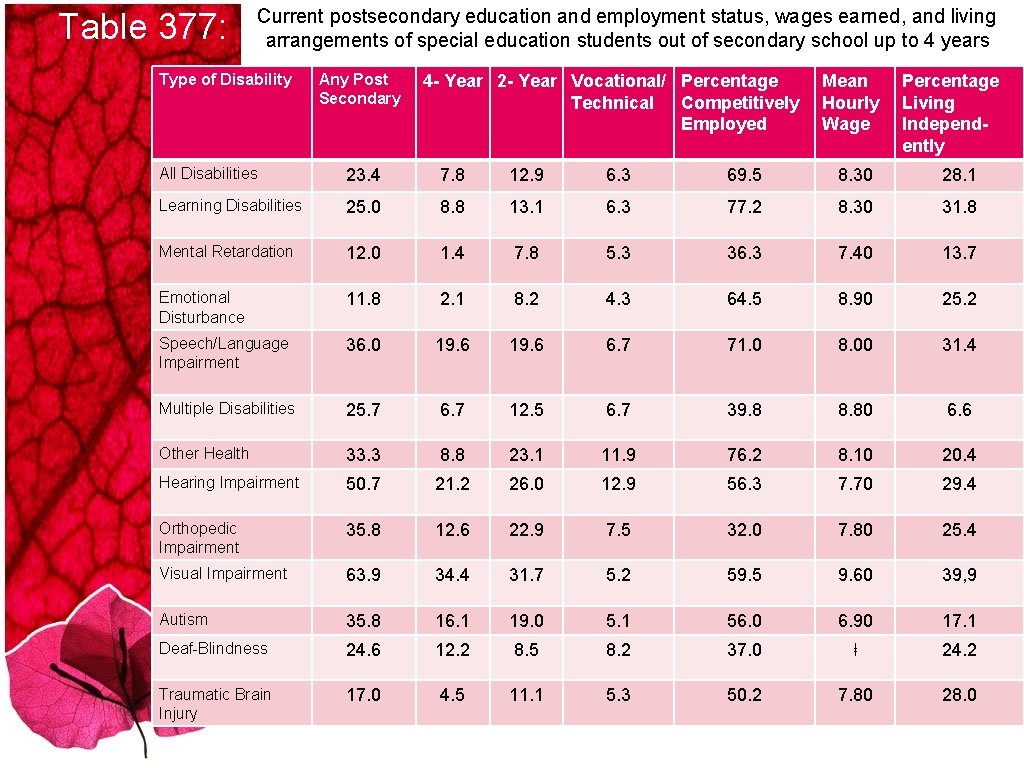
Table 377: Current postsecondary education and employment status, wages earned, and living arrangements of special education students out of secondary school up to 4 years Type of Disability Any Post Secondary 4 - Year 2 - Year Vocational/ Percentage Technical Competitively Employed Mean Hourly Wage Percentage Living Independently All Disabilities 23. 4 7. 8 12. 9 6. 3 69. 5 8. 30 28. 1 Learning Disabilities 25. 0 8. 8 13. 1 6. 3 77. 2 8. 30 31. 8 Mental Retardation 12. 0 1. 4 7. 8 5. 3 36. 3 7. 40 13. 7 Emotional Disturbance 11. 8 2. 1 8. 2 4. 3 64. 5 8. 90 25. 2 Speech/Language Impairment 36. 0 19. 6 6. 7 71. 0 8. 00 31. 4 Multiple Disabilities 25. 7 6. 7 12. 5 6. 7 39. 8 8. 80 6. 6 Other Health 33. 3 8. 8 23. 1 11. 9 76. 2 8. 10 20. 4 Hearing Impairment 50. 7 21. 2 26. 0 12. 9 56. 3 7. 70 29. 4 Orthopedic Impairment 35. 8 12. 6 22. 9 7. 5 32. 0 7. 80 25. 4 Visual Impairment 63. 9 34. 4 31. 7 5. 2 59. 5 9. 60 39, 9 Autism 35. 8 16. 1 19. 0 5. 1 56. 0 6. 90 17. 1 Deaf-Blindness 24. 6 12. 2 8. 5 8. 2 37. 0 ǂ 24. 2 Traumatic Brain Injury 17. 0 4. 5 11. 1 5. 3 50. 2 7. 80 28. 0
References Lindstrom, L. ; Benz, M. ; Doren, B. (2004) Expanding Career Options for Young Women with Learning Disabilities. Career Development for Exceptional Individuals, 27: 1, 43 -63. Lindstrom, L. ; Benz, M. (2002) Phase of Career Development: Case Studies of Young Women with Learning Disabilities. Council for Exceptional Children, 69: 1, 67 -83. Hitchings, W. ; Luzzo, D. ; Ristow, R. ; Horvath, M. ; Retish, P. ; Tanners, A. (2001) The Career Development Needs of College Students with Learning Disabilities: In Their Own Words. Learning Disabilities Research and Practice, 16: 1, 8 -17. Hopkins-Best, M. ; Wilnamaki, M. ; Yurcisin, A. (1985) Career Education for College Women with Disabilities. Journal of College Student Personnel, 26: 3, 220 -223. Hitchings, W. ; Luzzo, D, ; Ristow, R. ; Horvath, M. ; Retish, P. (1998) Identifying the Career Development Needs of College Students with Disabilities. Journal of College Student Development, 39: 1, 23 -32. Hershenson, D. (2005) INCOME: A culturally inclusive and disability sensitive framework for organizing career development concepts and interventions. Career Development Quarterly, 54: 2, 150 -161.
Aune, B and Kroeger, S. (1997) Career Development of College Students with Disabilities: An Interactional Approach to Defining the Issues. Journal of College Student Development, 38: 4, 344 -356. Kerka, Sandra. (2002) Learning Disabilities and Career Development. Practice Application Brief No. 20. ERIC Clearinghouse on Adult, Career, and Vocational Education. Nedbtac. (2008, April 06). Valeska’s Learning Disability [Video File]. Video posted to http: //www. youtube. com/watch? v=oi 0 Hlhtuo. W 8