
Unipolar Depression Major Depressive Disorder a large area
- Slides: 17
Unipolar Depression Major Depressive Disorder a large area; time for just a few highlights (or lowlights? ) • Sad or Major Depressive Disorder? • Clinical Presentation • Neuropharmalogy –Rx History –Animal Models –Of many SSRIs, TCAs, a brief look at Prozac • Alternative treatments –Notably, the recently approved TMS –Affordably, St Johns Wort/ Perika –Therapy, TMS, ECT, Meditation, Exercise….
Sad or Major Depressive Disorder? • Diagnostic and Statistical Manual of Mental Disorders (DSM-III, IVTR) – commonly used criteria for diagnosis… MDD comes from more than one MD episode in a two month period. • The End of Sadness by Horwitz and Wakefield – A critique of the DSM criteria, citing it is too easy to categorize normal, healthy responses to problems in life as a pathology. Diagnosis as a disease may interfere with an otherwise adaptive response, making the situation worse for the individual. – Arthur Miller’s Willie Lomax in “Death of a Salesman” – Sadness with (normal, adaptive response) or without (pathological depression) cause – …However, a 15% suicide rate among those diagnosed with MDD clearly requires intervention
Selected Alternative Treatments (time limits amount of discussion) • • St. Johns Wort Transcranial Magnetic Stimulation Electroconvulsive Therapy Psychotherapy and Counseling Meditation Acupuncture Exercise, Lifestyle
CLINICAL FEATURES (via NIH) • According to the DSM-IV-TR (American Psychiatric Association, 2000), major depressive disorder is characterized by one or more major depressive episodes without a history of manic, mixed, or hypomanic episodes. A major depressive episode is characterized by at least 2 weeks during which there is a new onset or clear worsening of either depressed mood or loss of interest or pleasure in nearly all activities. Four additional symptoms must also be present including changes in appetite, weight, sleep, and psychomotor activity; decreased energy; feelings of worthlessness or guilt; difficulty thinking, concentrating, or making decisions; or recurrent thoughts of death or suicidal ideation, plans, or attempts. The episode must be accompanied by distress or impairment in social, occupational, or other important areas of functioning. • Major depressive disorder is commonly recurrent and can be lethal. Up to 15% of individuals with severe major depressive disorder die by suicide. There is a 4 -fold increase in death rate of individuals with major depressive disorder over 55 years of age
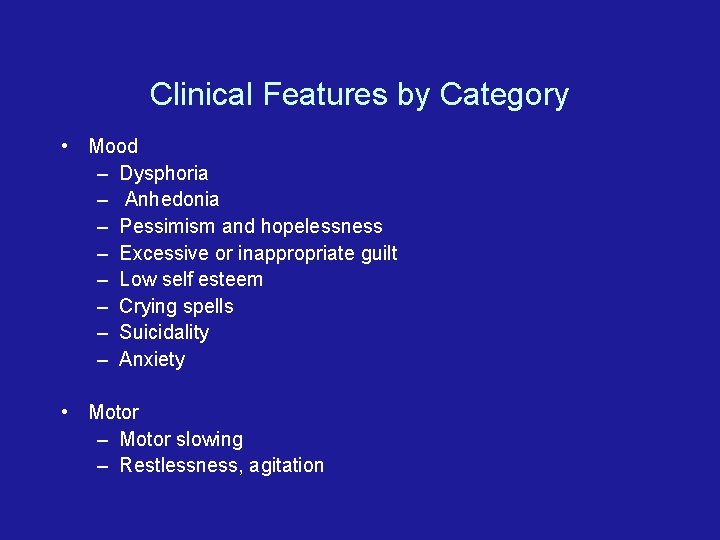
Clinical Features by Category • Mood – Dysphoria – Anhedonia – Pessimism and hopelessness – Excessive or inappropriate guilt – Low self esteem – Crying spells – Suicidality – Anxiety • Motor – Motor slowing – Restlessness, agitation
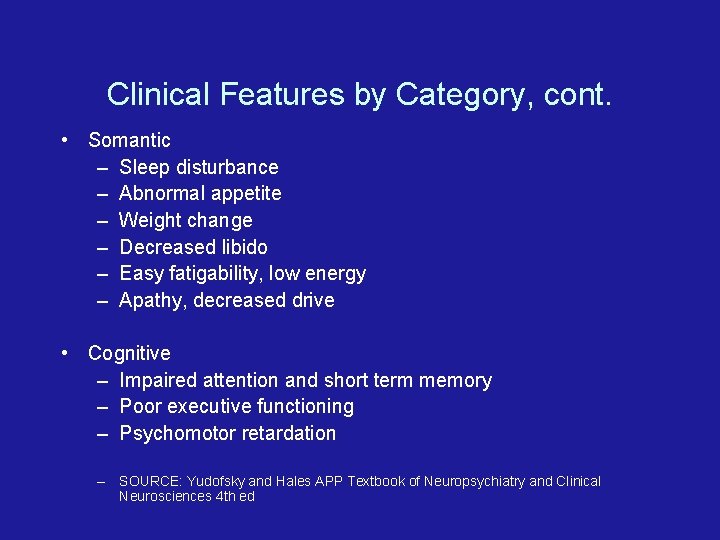
Clinical Features by Category, cont. • Somantic – Sleep disturbance – Abnormal appetite – Weight change – Decreased libido – Easy fatigability, low energy – Apathy, decreased drive • Cognitive – Impaired attention and short term memory – Poor executive functioning – Psychomotor retardation – SOURCE: Yudofsky and Hales APP Textbook of Neuropsychiatry and Clinical Neurosciences 4 th ed
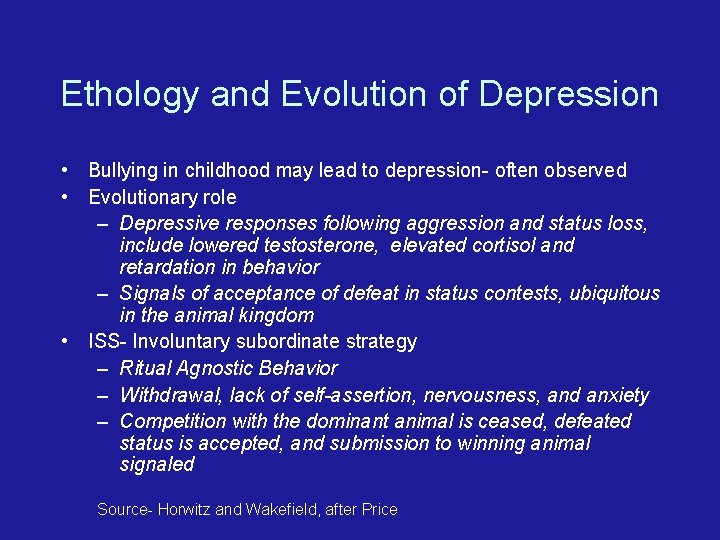
Ethology and Evolution of Depression • Bullying in childhood may lead to depression- often observed • Evolutionary role – Depressive responses following aggression and status loss, include lowered testosterone, elevated cortisol and retardation in behavior – Signals of acceptance of defeat in status contests, ubiquitous in the animal kingdom • ISS- Involuntary subordinate strategy – Ritual Agnostic Behavior – Withdrawal, lack of self-assertion, nervousness, and anxiety – Competition with the dominant animal is ceased, defeated status is accepted, and submission to winning animal signaled Source- Horwitz and Wakefield, after Price
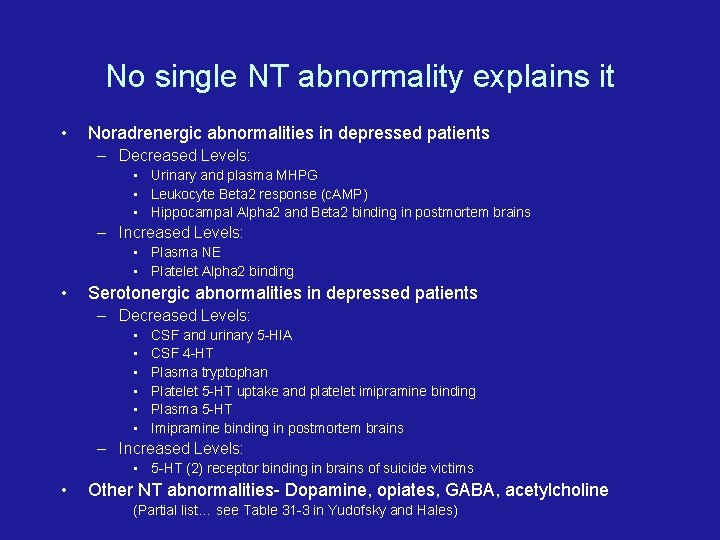
No single NT abnormality explains it • Noradrenergic abnormalities in depressed patients – Decreased Levels: • Urinary and plasma MHPG • Leukocyte Beta 2 response (c. AMP) • Hippocampal Alpha 2 and Beta 2 binding in postmortem brains – Increased Levels: • Plasma NE • Platelet Alpha 2 binding • Serotonergic abnormalities in depressed patients – Decreased Levels: • • • CSF and urinary 5 -HIA CSF 4 -HT Plasma tryptophan Platelet 5 -HT uptake and platelet imipramine binding Plasma 5 -HT Imipramine binding in postmortem brains – Increased Levels: • 5 -HT (2) receptor binding in brains of suicide victims • Other NT abnormalities- Dopamine, opiates, GABA, acetylcholine (Partial list… see Table 31 -3 in Yudofsky and Hales)
Genetics FROM NIH OMIM (Mendelian Inheritance) • • chromosome 12 q 22 -q 23. 2 chromosome 12 q 22 -q 23 Polymorphism in the FKBP 5 gene mutation in the tryptophan hydroxylase-2 gene (12 q 21 mapping enzyme of serotonin synthesis) • A polymorphism in the HTR 2 A gene (encodes serotonin 2 A receptor)
Animal Models • One perspective- The Olfactory Bulbectomized Rat as a Model of Major Depressive Disorder- Neuromethods vol 19 - J. Steven Richardson – problems reflect philosophical positions ranging from those based on the premise that primary depression does not fit the medical model and therefore is not a “disease” that can be modeled, to those holding that the emotional state of depression is so uniquely human that subhuman organisms cannot be used in its analysis. • More pragmatically, we have (e. g. ) forced swimming, climbing, and mouse tail suspension test. (full references may be supplied) – Potentiation of the Antidepressant-Like Effect of Fluoxetine by Aripiprazole in the Mouse Tail Suspension Test – Confirmation of antidepressant potential of the selective beta 3 adrenoceptor agonist amibegron in an animal model of depression. (forced swimming) – Depressive-like behavior and high alcohol drinking co-occur in the FH/WJD rat but appear to be under independent genetic control (Next slide…. )
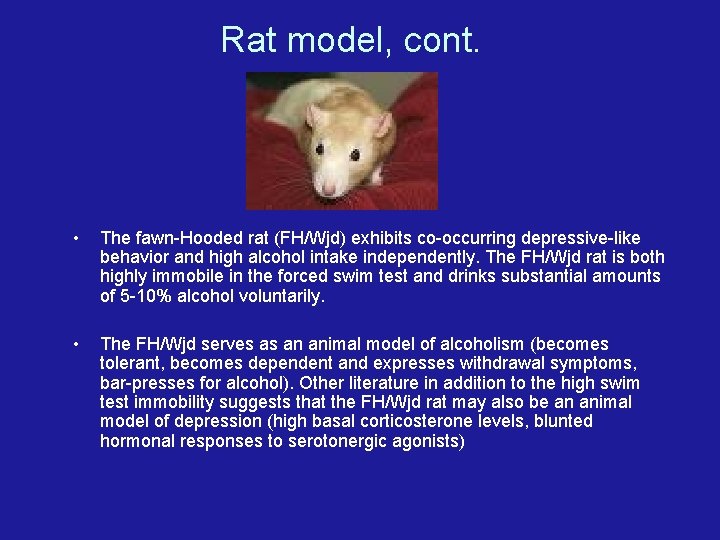
Rat model, cont. • The fawn-Hooded rat (FH/Wjd) exhibits co-occurring depressive-like behavior and high alcohol intake independently. The FH/Wjd rat is both highly immobile in the forced swim test and drinks substantial amounts of 5 -10% alcohol voluntarily. • The FH/Wjd serves as an animal model of alcoholism (becomes tolerant, becomes dependent and expresses withdrawal symptoms, bar-presses for alcohol). Other literature in addition to the high swim test immobility suggests that the FH/Wjd rat may also be an animal model of depression (high basal corticosterone levels, blunted hormonal responses to serotonergic agonists)
Modern Depression Rx History 19 th Century Opium, morphine Early 20 th Barbituate sedatives 1950 s Miltown- Meprobamate, a tranquilizer, MAOIs, TCA (imipramine and amitriptyline) by 1956, 1 in 20 Americans took tranquilizers 1960 s Valium, Librium Rolling Stones “Mother’s Little Helper” 1980 s SSRIs, with Prozac becoming very popular in the 90 s Managed health care Direct to Consumer Advertising started in 1997 (source- Horwitz and Wakefield)
Prozac: A common Rx • Two common medication types- TCA and SSRI; Prozac is a SSRI • SSRI- Selective Serotinin Re-Uptake Inhibitor • TCA- Tricyclic antidepressant- less commonly used as more serious side effects (weight gain, confusion, cardiovascular problems, easy to take overdose)
Prozac Rx Notes • Used to treat Depression, OCD, Panic Disorder, Bulimia • 1 st Warning by Lilly is Increased Risk of Suicide thought and behavior (compared to placebo), particularly in those less than 24 y. o. • Structure of Fluoxetine – (±)-N-methyl-3 -phenyl-3 -[(α, α, α trifluoro-p-tolyl)oxy]propylamine hydrochloride – C 17 H 18 F 3 NO • HCl – molecular weight is 345. 79 • • • Side effects: drowsiness, nervousness, insomnia, tremor, dizziness, headache, confusion, paresthesia, nausea, sexual dysfunction, weight loss May take 8 weeks to reach steady state Inhibition of 5 -HT re-uptake, increasing 5 -HT in synapse Inhibition of hepatic cytochrome P 450 2 D 6 enzyme (also 2 C, 3 A(4)) Zung Depression Self-Assessment Test on prozac. com website(is it too � easy to be diagnosed? )
NIH Medline gives an A grade to St. Johns Wort • • • Short-term studies (1 -3 months) suggest that SJW is more effective than placebo (sugar pill), and equally effective as tricyclic antidepressants (TCAs) in the treatment of mild-to-moderate major depression. Comparisons to the more commonly prescribed selective serotonin reuptake inhibitor (SSRI) antidepressants, such as fluoxetine (Prozac) or sertraline (Zoloft), are more limited. However, other data suggest that SJW may be just as effective as SSRIs with fewer side effects. • Hypericin may inhibit dopamine enzyme β-hydroxylase, leading to increased DA and drops in norepinephrine and epinephrine. • • Wide variety of supplement formulations and claims- wide ranging doses (10 x conc difference), sources (e. g. stem leaf flower), and purification method of Hyperforin (Hypericum and other spellings may be encountered. ) Perika better substantiated than most- made by Schwabe in Germany, demonstrated superior to other SJW products in clinical trials, distributed by Nature’s Way in US (Note- contradictory statements exist in NIH websites; however, testing supports the above)
Transcranial Magnetic Stimulation (TMS) • • • Recently approved by the FDA for treatment in patients who have not responded to at least one antidepressant medication Very minor side effects compared to other treatments On HAMD testing, > 50% patients show significant improvements, with 33% cases in remission Magnetic pulses stimulate left prefrontal cortex, using a non invasive device; 3000 200 u. S pulses induce electric current to flow in brain via neuron activation 20 -30 sessions over 4 -6 wks, 37 minute treatment $6 -10 K cost for treatment series (for investigational use only at this time) May be useful for schizophrenia, PTSD, migraine Possibly valuable treatment for teens who have higher risk of suicide on medications Web link to video http: //www. neuronetics. com/howtmsworks. html
Meditation • Controlling mind and body with the mind • Many choices, very affordable, coupled with spiritual and/or physical exercises (Insight meditation, Mahamudra, Tonglen, Zen/ Dzogchen (non meditation as meditation), Tai Chi, hatha yoga… • Well documented and easily demonstrated benefits in calming, lowering of BP, concentration, awareness • Some may consider it time consuming, others life saving. • And there was music, and there wonderful roses… they tell me, in sweet fragrant meadows of dawn, and dew… There was love, all around, but I never heard it singing… No, I never heard it at all, till there was you. -Meredith Wilson, from “The Music Man” • And what of love and music and acupuncture and exercise… but that’s all the time we have for now… Relax, be happy!