
Unimolecular reactions and chain reactions Presented by Amrutha
Unimolecular reactions and chain reactions Presented by Amrutha Raj
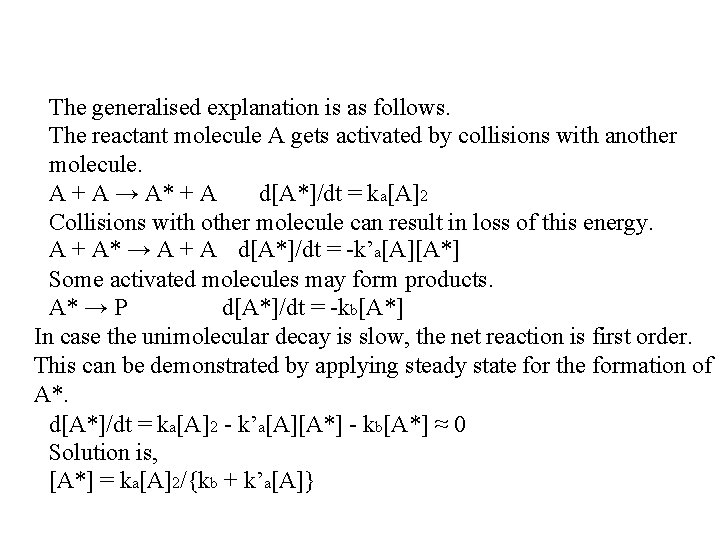
The generalised explanation is as follows. The reactant molecule A gets activated by collisions with another molecule. A + A → A* + A d[A*]/dt = ka[A]2 Collisions with other molecule can result in loss of this energy. A + A* → A + A d[A*]/dt = -k’a[A][A*] Some activated molecules may form products. A* → P d[A*]/dt = -kb[A*] In case the unimolecular decay is slow, the net reaction is first order. This can be demonstrated by applying steady state for the formation of A*. d[A*]/dt = ka[A]2 - k’a[A][A*] - kb[A*] ≈ 0 Solution is, [A*] = ka[A]2/{kb + k’a[A]}
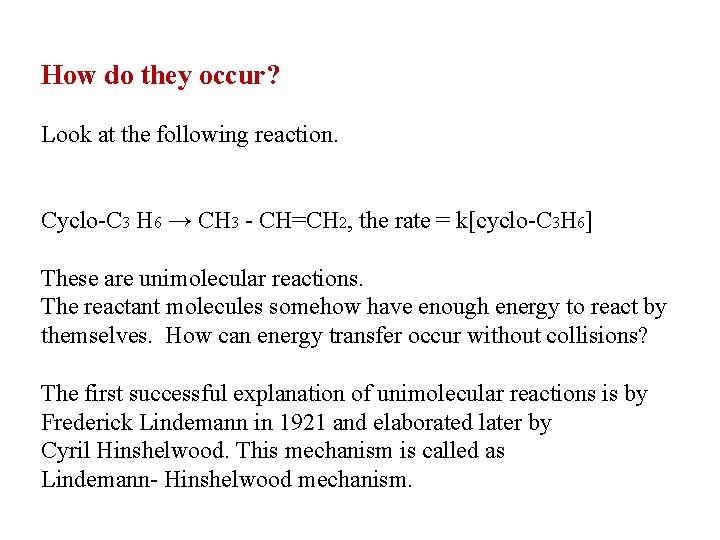
How do they occur? Look at the following reaction. Cyclo-C 3 H 6 → CH 3 - CH=CH 2, the rate = k[cyclo-C 3 H 6] These are unimolecular reactions. The reactant molecules somehow have enough energy to react by themselves. How can energy transfer occur without collisions? The first successful explanation of unimolecular reactions is by Frederick Lindemann in 1921 and elaborated later by Cyril Hinshelwood. This mechanism is called as Lindemann- Hinshelwood mechanism.
![The rate law for the formation of P is, d[P]/dt = kb[A*] = kakb[A]2/{kb](http://slidetodoc.com/presentation_image_h2/16cbbda2961fb47732bc180ba5e1b4c6/image-5.jpg "The rate law for the formation of P is, d[P]/dt = kb[A*] = kakb[A]2/{kb")
The rate law for the formation of P is, d[P]/dt = kb[A*] = kakb[A]2/{kb + k’a[A]} As can be seen, the rate law is not first order. The important aspect is that rate of deactivation of A* by collisions with A is much larger than the rate of unimolecular decay. k’a[A*][A] » kb [A*] or k’a[A] » kb Thus we can neglect kb in the denominator and write, d[P]/dt ≈ k[A] where k = kakb/k’a This is a first order rate law. The rate expression also shows that when the concentration (partial pressure) of A is small, then ka’[A] << kb, we get d[P]/dt ≈ ka[A]2
![If we write the rate expression as, d[P]/dt = k[A] where k = kakb[A]/{kb](http://slidetodoc.com/presentation_image_h2/16cbbda2961fb47732bc180ba5e1b4c6/image-6.jpg "If we write the rate expression as, d[P]/dt = k[A] where k = kakb[A]/{kb")
If we write the rate expression as, d[P]/dt = k[A] where k = kakb[A]/{kb + k’a[A]} The effective rate constant is, 1/k = k’a/(kakb) + 1/ka[A] The test for theory is to get a straight line for 1/k vs. 1/[A] plot. A typical plot is seen below.
![2 1/k 1 0 0 0. 5 1. 0 1. 5 2. 0 1/[A]](http://slidetodoc.com/presentation_image_h2/16cbbda2961fb47732bc180ba5e1b4c6/image-7.jpg "2 1/k 1 0 0 0. 5 1. 0 1. 5 2. 0 1/[A]")
2 1/k 1 0 0 0. 5 1. 0 1. 5 2. 0 1/[A] The behaviour is in gross agreement with theory. At high pr (lower 1/[A]) the value of k higher (lower 1/k) than expected from behaviour. The reaction studied is the unimolecular isomerizatio CHD=CHD. The Lindemann-Hinshelwood mechanism is the stra extrapolation from lower pressure (larger 1/[A]) to higher pressu 1/[A]).
Chain reactions
Chain reactions are examples of complex reactions, with complex rate expressions. In a chain reaction, the intermediate produced in one step generates an intermediate in another step. This process goes on. Intermediates are called chain carriers. Sometimes, the chain carriers are radicals, they can be ions as well. In nuclear fission they are neutrons.
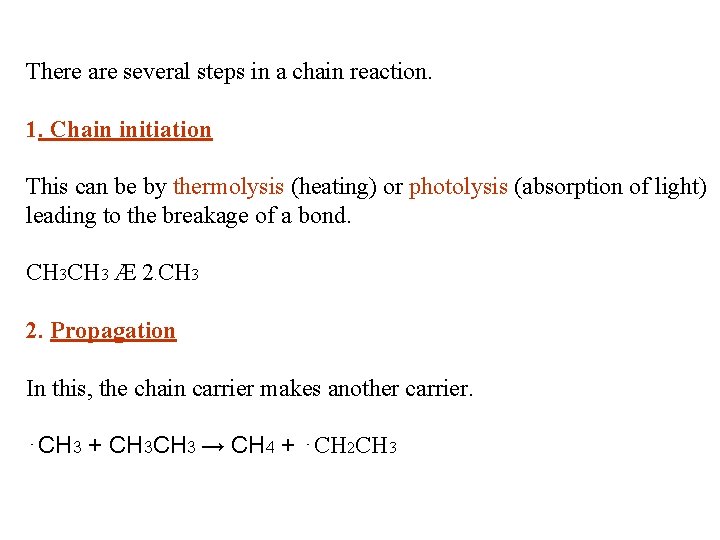
There are several steps in a chain reaction. 1. Chain initiation This can be by thermolysis (heating) or photolysis (absorption of light) leading to the breakage of a bond. CH 3 Æ 2. CH 3 2. Propagation In this, the chain carrier makes another carrier. ⋅CH 3 + CH 3 → CH 4 + ⋅CH 2 CH 3
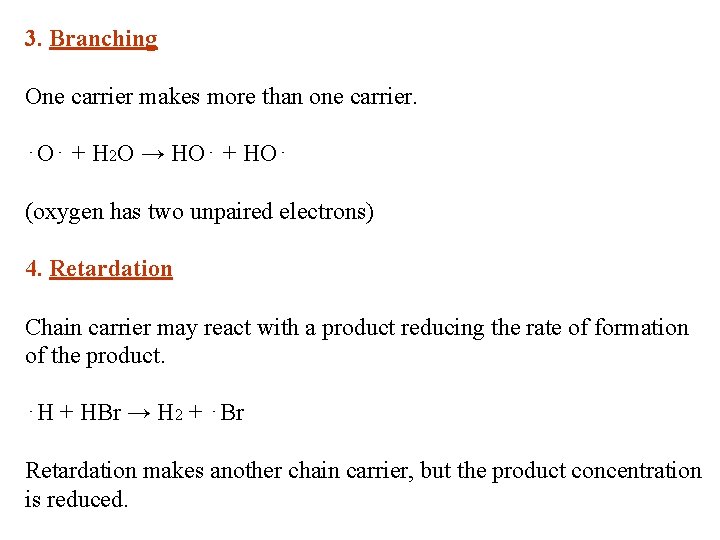
3. Branching One carrier makes more than one carrier. ⋅O⋅ + H 2 O → HO⋅ + HO⋅ (oxygen has two unpaired electrons) 4. Retardation Chain carrier may react with a product reducing the rate of formation of the product. ⋅H + HBr → H 2 + ⋅Br Retardation makes another chain carrier, but the product concentration is reduced.
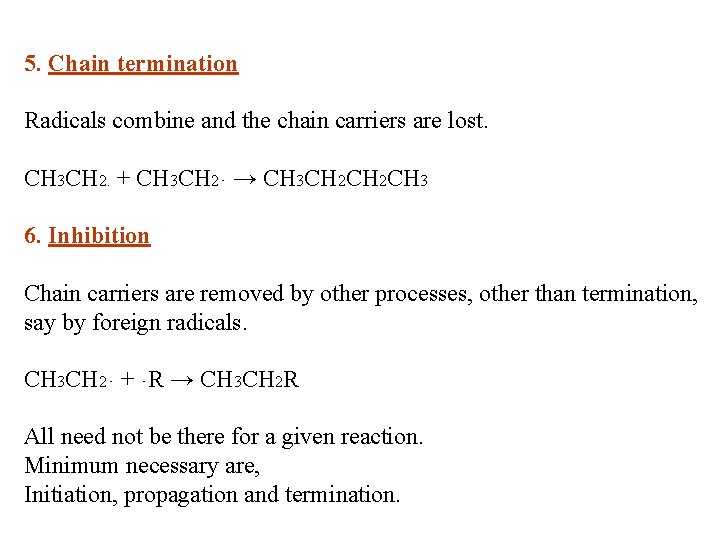
5. Chain termination Radicals combine and the chain carriers are lost. CH 3 CH 2. + CH 3 CH 2⋅ → CH 3 CH 2 CH 3 6. Inhibition Chain carriers are removed by other processes, other than termination, say by foreign radicals. CH 3 CH 2⋅ + ⋅R → CH 3 CH 2 R All need not be there for a given reaction. Minimum necessary are, Initiation, propagation and termination.
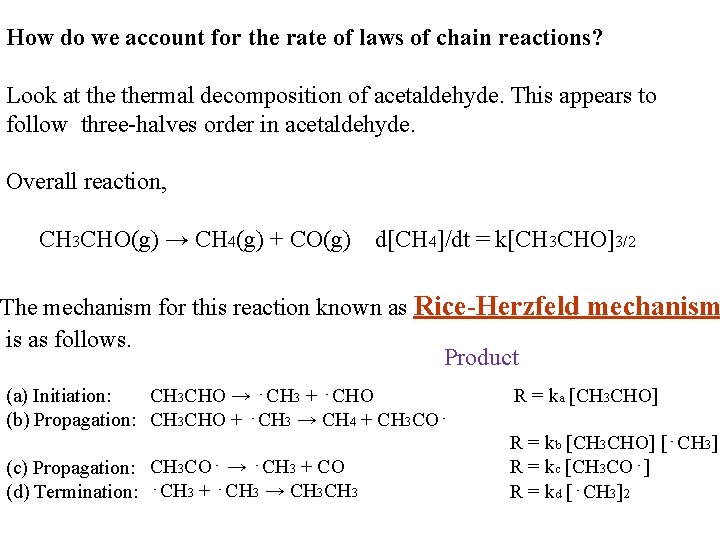
How do we account for the rate of laws of chain reactions? Look at thermal decomposition of acetaldehyde. This appears to follow three-halves order in acetaldehyde. Overall reaction, CH 3 CHO(g) → CH 4(g) + CO(g) d[CH 4]/dt = k[CH 3 CHO]3/2 The mechanism for this reaction known as Rice-Herzfeld mechanism is as follows. Product (a) Initiation: CH 3 CHO → ⋅CH 3 + ⋅CHO (b) Propagation: CH 3 CHO + ⋅CH 3 → CH 4 + CH 3 CO⋅ (c) Propagation: CH 3 CO⋅ → ⋅CH 3 + CO (d) Termination: ⋅CH 3 + ⋅CH 3 → CH 3 R = ka [CH 3 CHO] R = kb [CH 3 CHO] [⋅CH 3] R = kc [CH 3 CO⋅] R = kd [⋅CH 3]2
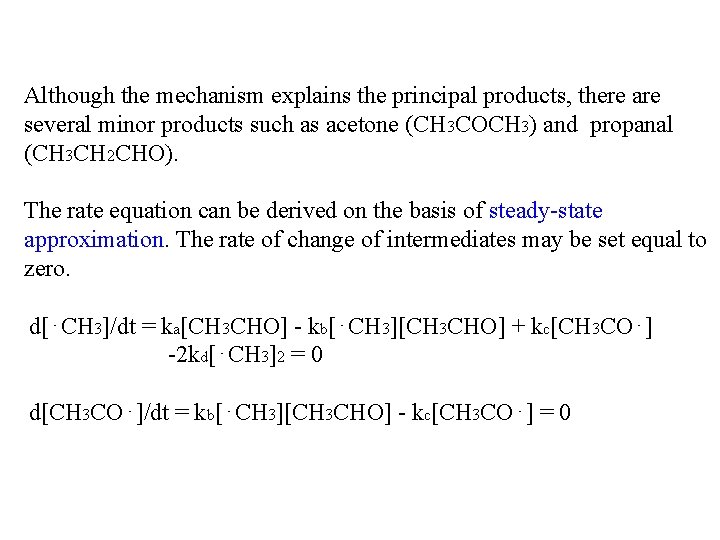
Although the mechanism explains the principal products, there are several minor products such as acetone (CH 3 COCH 3) and propanal (CH 3 CH 2 CHO). The rate equation can be derived on the basis of steady-state approximation. The rate of change of intermediates may be set equal to zero. d[⋅CH 3]/dt = ka[CH 3 CHO] - kb[⋅CH 3][CH 3 CHO] + kc[CH 3 CO⋅] -2 kd[⋅CH 3]2 = 0 d[CH 3 CO⋅]/dt = kb[⋅CH 3][CH 3 CHO] - kc[CH 3 CO⋅] = 0
![The sum of the two equation is, ka[CH 3 CHO] - 2 kd[⋅CH 3]2](http://slidetodoc.com/presentation_image_h2/16cbbda2961fb47732bc180ba5e1b4c6/image-15.jpg "The sum of the two equation is, ka[CH 3 CHO] - 2 kd[⋅CH 3]2")
The sum of the two equation is, ka[CH 3 CHO] - 2 kd[⋅CH 3]2 = 0 The steady-state concentration of ⋅CH 3 radicals is, [⋅CH 3] = (ka/2 kd)1/2 [CH 3 CHO]1/2 It follows that the rate of formation of CH 4 is d[CH 4]/dt = kb[⋅CH 3][CH 3 CHO] = kb (ka/2 kd)1/2 [CH 3 CHO]3/2 Thus the mechanism explains the observed rate expression. It is sure that the true rate law is more complicated than that observed experimentally. There are several cases where the reaction is complicated.
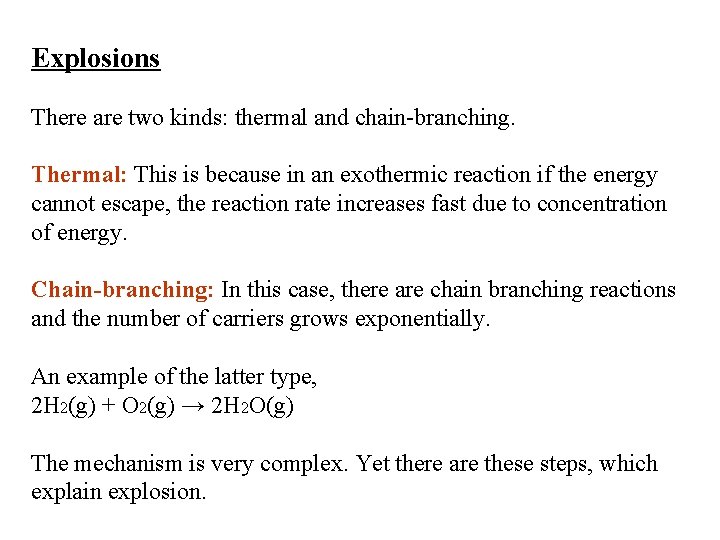
Explosions There are two kinds: thermal and chain-branching. Thermal: This is because in an exothermic reaction if the energy cannot escape, the reaction rate increases fast due to concentration of energy. Chain-branching: In this case, there are chain branching reactions and the number of carriers grows exponentially. An example of the latter type, 2 H 2(g) + O 2(g) → 2 H 2 O(g) The mechanism is very complex. Yet there are these steps, which explain explosion.
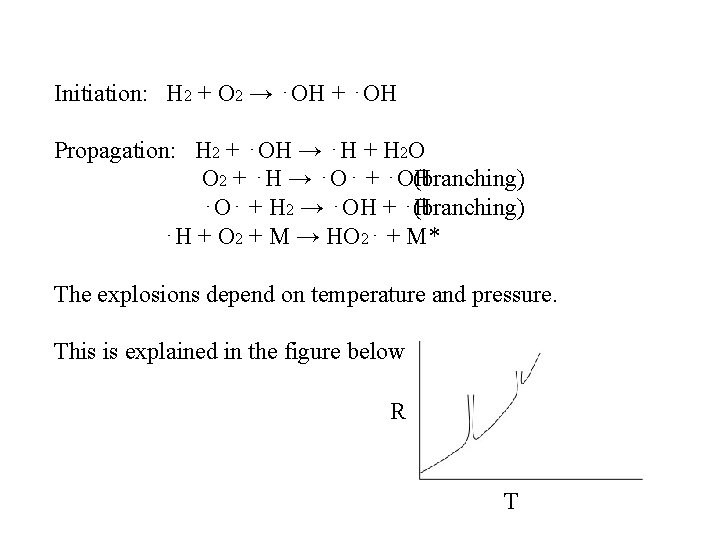
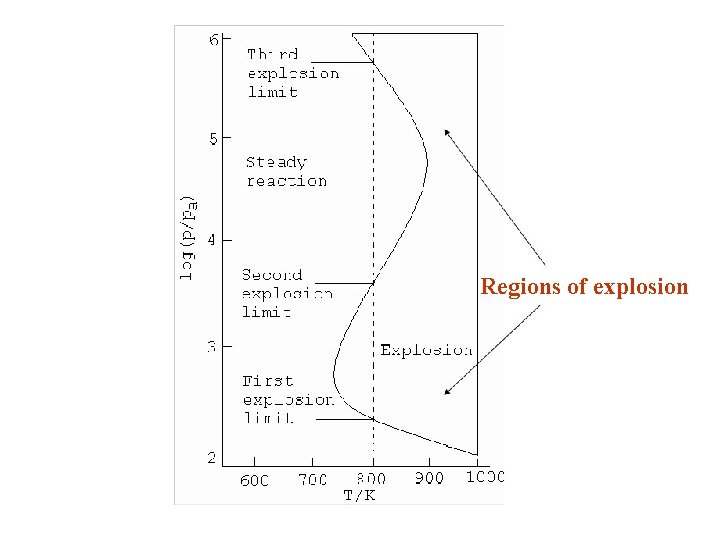
Initiation: H 2 + O 2 → ⋅OH + ⋅OH Propagation: H 2 + ⋅OH → ⋅H + H 2 O O 2 + ⋅H → ⋅O⋅ + ⋅OH (branching) ⋅O⋅ + H 2 → ⋅OH + ⋅H (branching) ⋅H + O 2 + M → HO 2⋅ + M* The explosions depend on temperature and pressure. This is explained in the figure below R T
Regions of explosion

At low pressures the chain carriers can reach the walls and get lost. No explosion happens. As the pressure is increased along the dotted line shown, the radicals react before reaching the walls and the reaction suddenly becomes explosive. This is the first explosion limit. In the second explosion limit, the pressure of the products is high so that reactions of the type, O 2 + H. →. O 2 H occur. These recombination reactions become efficient as the excess energy can be removed by three body collisions. Then the reaction goes smoothly. In the third explosion limit, thermal explosion occur. In this limit, reaction such as HO 2. + H 2 → H 2 O 2 + H. dominates the elimination of HO 2. by the walls.

THANK YOU
- Slides: 20