
Unilateral vocal cord paralysis A guide for voice

- Slides: 17
Unilateral vocal cord paralysis: A guide for voice therapy Voice EBP Extravaganza 2010
Background �Common caseload (inpts > outpatients) �Unknown: �When to provide therapy and for how long �What therapy to provide �Contraindications �Role of surgery in recovery �Prognosis and pattern of recovery
Question For patients with unilateral vocal cord paralysis, does voice therapy improve voice outcomes?
Search strategy �Search words: �Unilateral vocal fold/cord paralysis/paresis �RLN palsy �Voice therapy �Voice disorders �Hemiplegia �Databases: �Medline / Pub. Med �Web of science �Cochrane �Scopus
Results �Critically appraised 16 articles �Each article appraised by 2 people �Developed specific Q’s to assist our broad clinical Q �Mix of retrospective and experimental time series studies �No control groups �Level of evidence: III to IV �Range of participants per study: 3 - 91
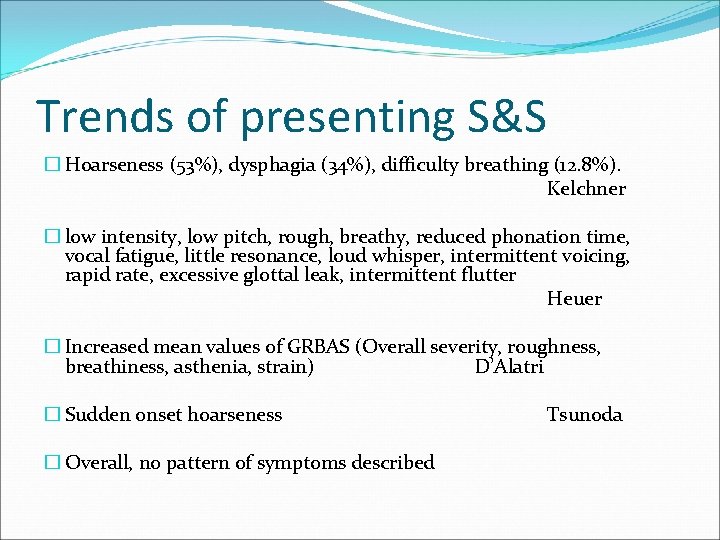
Trends of presenting S&S � Hoarseness (53%), dysphagia (34%), difficulty breathing (12. 8%). Kelchner � low intensity, low pitch, rough, breathy, reduced phonation time, vocal fatigue, little resonance, loud whisper, intermittent voicing, rapid rate, excessive glottal leak, intermittent flutter Heuer � Increased mean values of GRBAS (Overall severity, roughness, breathiness, asthenia, strain) D’Alatri � Sudden onset hoarseness � Overall, no pattern of symptoms described Tsunoda
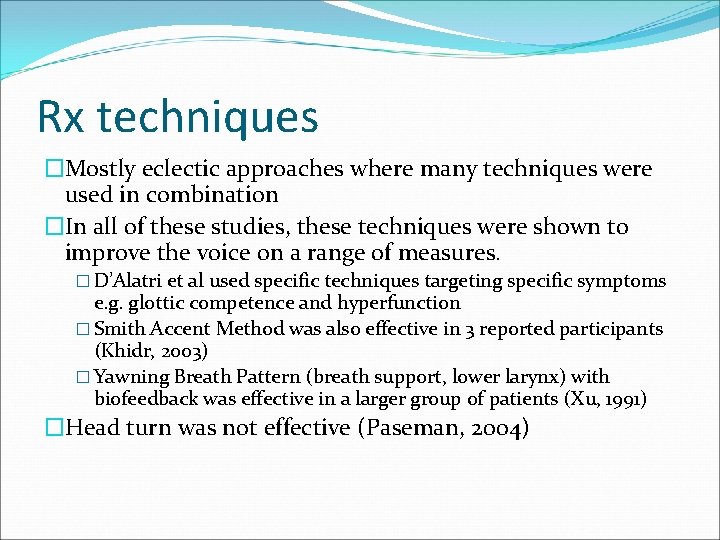
Rx techniques �Mostly eclectic approaches where many techniques were used in combination �In all of these studies, these techniques were shown to improve the voice on a range of measures. � D’Alatri et al used specific techniques targeting specific symptoms e. g. glottic competence and hyperfunction � Smith Accent Method was also effective in 3 reported participants (Khidr, 2003) � Yawning Breath Pattern (breath support, lower larynx) with biofeedback was effective in a larger group of patients (Xu, 1991) �Head turn was not effective (Paseman, 2004)
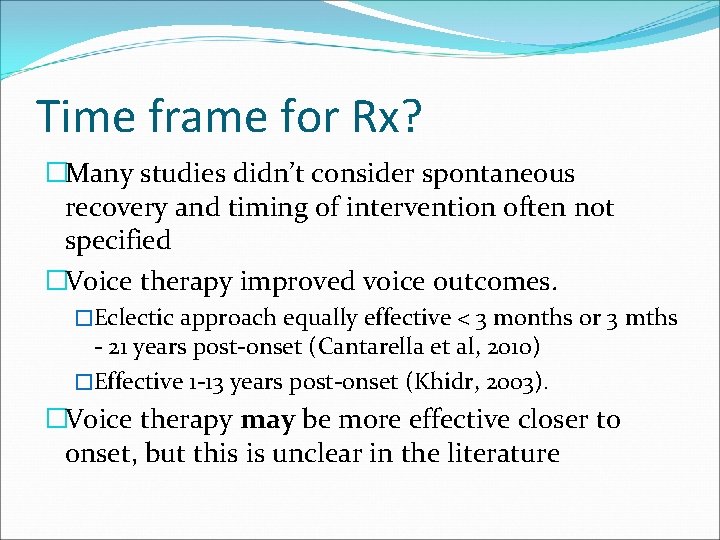
Time frame for Rx? �Many studies didn’t consider spontaneous recovery and timing of intervention often not specified �Voice therapy improved voice outcomes. �Eclectic approach equally effective < 3 months or 3 mths - 21 years post-onset (Cantarella et al, 2010) �Effective 1 -13 years post-onset (Khidr, 2003). �Voice therapy may be more effective closer to onset, but this is unclear in the literature
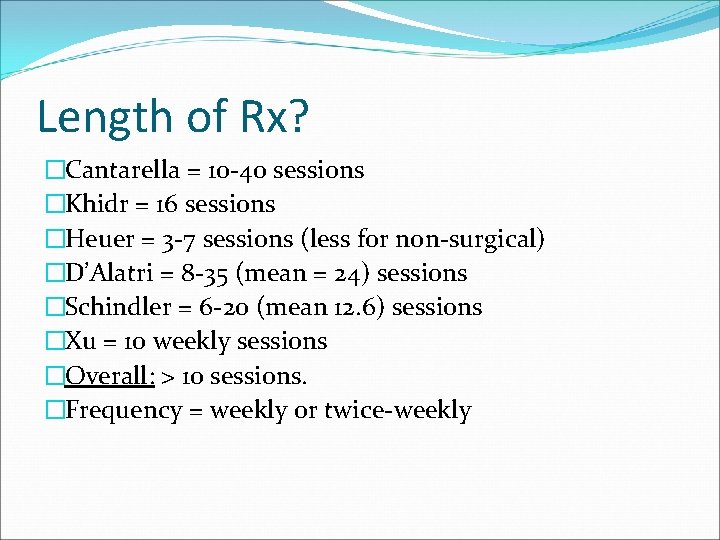
Length of Rx? �Cantarella = 10 -40 sessions �Khidr = 16 sessions �Heuer = 3 -7 sessions (less for non-surgical) �D’Alatri = 8 -35 (mean = 24) sessions �Schindler = 6 -20 (mean 12. 6) sessions �Xu = 10 weekly sessions �Overall: > 10 sessions. �Frequency = weekly or twice-weekly
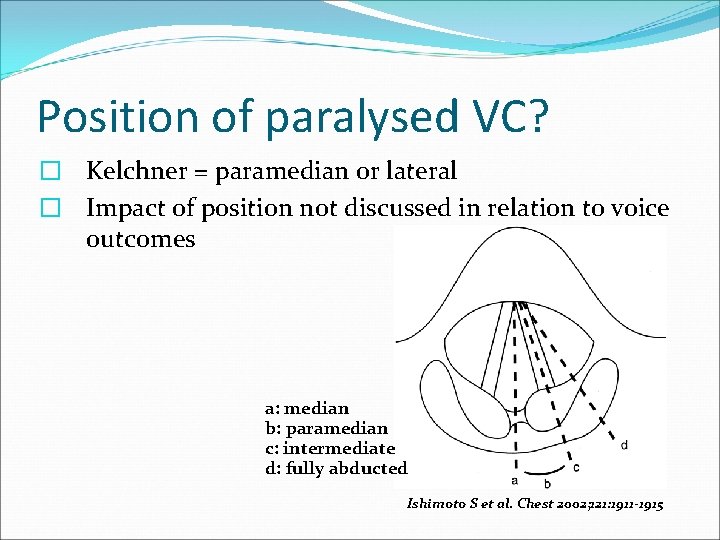
Position of paralysed VC? � Kelchner = paramedian or lateral � Impact of position not discussed in relation to voice outcomes a: median b: paramedian c: intermediate d: fully abducted Ishimoto S et al. Chest 2002; 121: 1911 -1915
Reliability and validity of outcome measures? �Most studies use multidimensional outcome measures �videostroboscopy, acoustic measures, perceptual evaluation, aerodynamic measures and patient-reported quality of life (i. e. VHI). �No reported blinding for rating �Intra or inter-rater reliability for perceptual evaluation often not reported �Acoustic measures used h/e type of acoustic signal not specified to ensure reliability
Role of Sx �Surgery > voice therapy for sig dysphonia �Surgery = voice therapy for less severe dysphonia (Kelchner et al , 1999) �Pre-op voice therapy may help patients achieve adequate voicing without surgery (Heuer, 1997) �Many studies reported voice outcomes from surgery alone → no CAP
Evidence from clinical practice �Timing of Rx – early is better than later to prevent hyperfunction �Rx techniques – gentle vocal adduction while preventing hyperfunction �Position of cord – therapy more beneficial for those with smaller glottic gaps �Length of therapy – re-evaluate if no improvement after approx. 4 sessions �Outcomes – use a range but all using perceptual ratings
Clients values �Patient choice was not documented in most studies �The only reference to patient choice was in Heuer and Khidr, where patients elected to have voice therapy vs surgery �As a group we all consider client choice and other factors e. g. compliance, fatigue, cognition
Clinical bottom line �Yes voice therapy is effective for UVFP to some degree �Therapy approaches appear to be eclectic in nature �We are still unsure how effective specific therapy approaches are �We are also unsure of when it’s best to intervene with therapy and the nature of spontaneous recovery
Clinical application �Increased confidence discussing literature evidence with clients and referrers �Voice therapy for those clients with mild dysphonia / small glottic gap �Clients with severe dysphonia / large glottic gap may benefit more from ENT for surgical intervention �Continue current voice therapy techniques and re-refer to ENT if no improvement �Continue collecting voice outcomes to evaluate success of therapy
NSW EBP members Judy Rough Katrina Blyth Sam Warhurst Danielle Stone Katherine Kelly Asta Fung Beth Atkins Sharon Moore Margaret Jacobs Therese Dodds Helen Brake Academic link: Cate Madill