
Unifying Structural Proximity and Equivalence for Network Embedding
Unifying Structural Proximity and Equivalence for Network Embedding 史本云 南京 业大学 Email:benyunshi@outlook. com
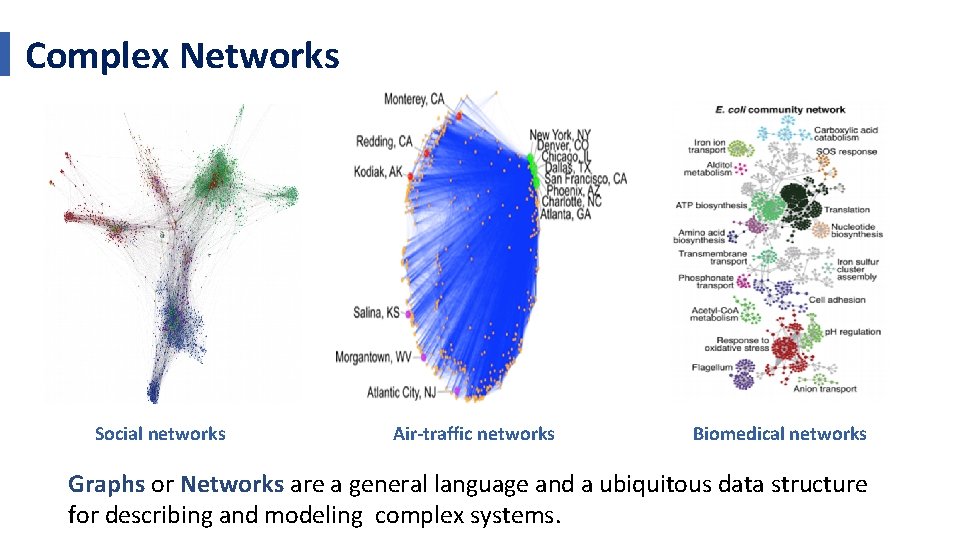
Complex Networks Social networks Air-traffic networks Biomedical networks Graphs or Networks are a general language and a ubiquitous data structure for describing and modeling complex systems.
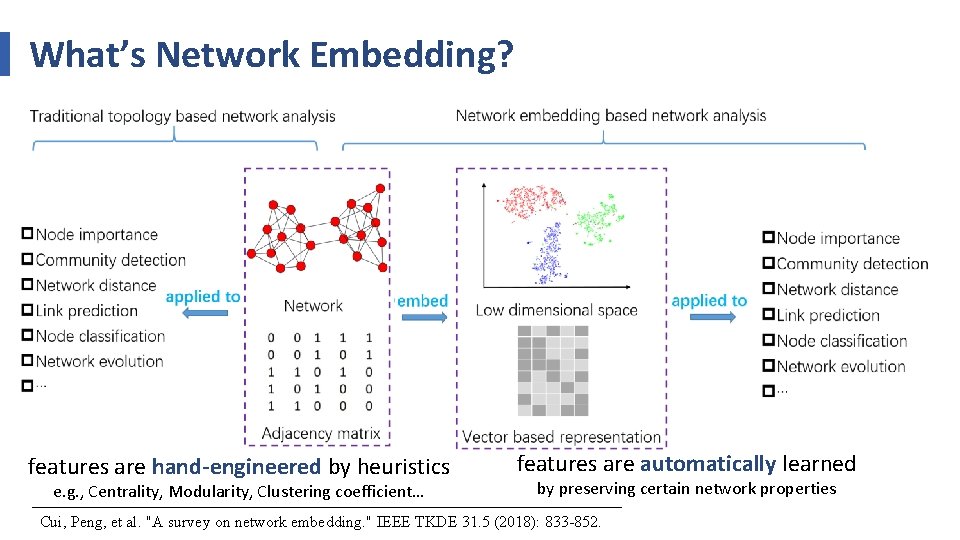
What’s Network Embedding? features are hand-engineered by heuristics e. g. , Centrality, Modularity, Clustering coefficient… features are automatically learned by preserving certain network properties Cui, Peng, et al. "A survey on network embedding. " IEEE TKDE 31. 5 (2018): 833 -852.
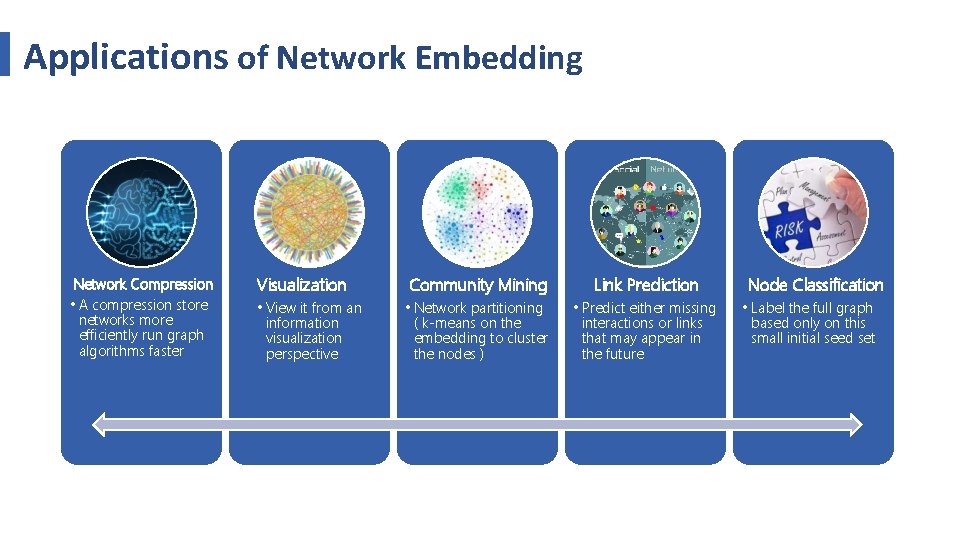
Applications of Network Embedding Network Compression Visualization • A compression store networks more efficiently run graph algorithms faster • View it from an information visualization perspective Community Mining Link Prediction • Network partitioning ( k-means on the embedding to cluster the nodes ) • Predict either missing interactions or links that may appear in the future Node Classification • Label the full graph based only on this small initial seed set
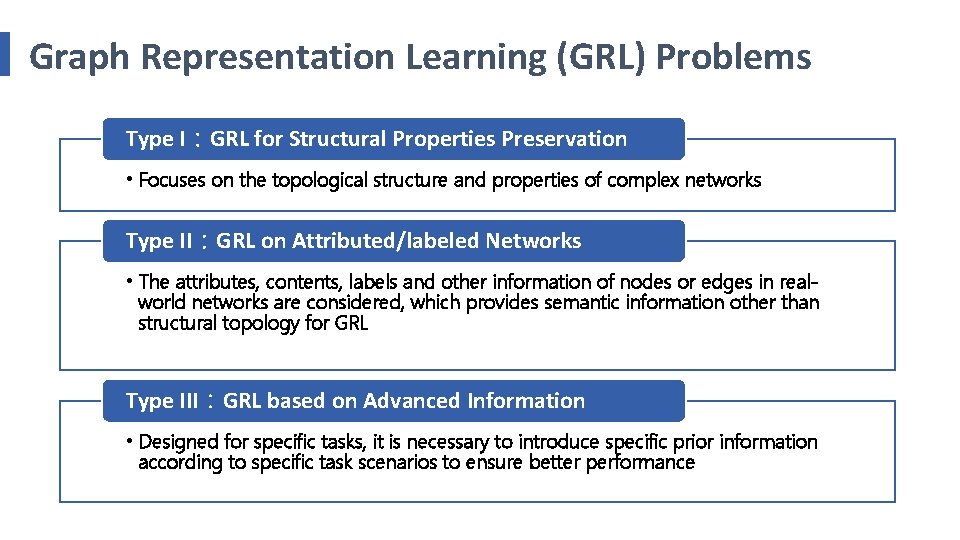
Graph Representation Learning (GRL) Problems Type I:GRL for Structural Properties Preservation • Focuses on the topological structure and properties of complex networks Type II:GRL on Attributed/labeled Networks • The attributes, contents, labels and other information of nodes or edges in realworld networks are considered, which provides semantic information other than structural topology for GRL Type III:GRL based on Advanced Information • Designed for specific tasks, it is necessary to introduce specific prior information according to specific task scenarios to ensure better performance
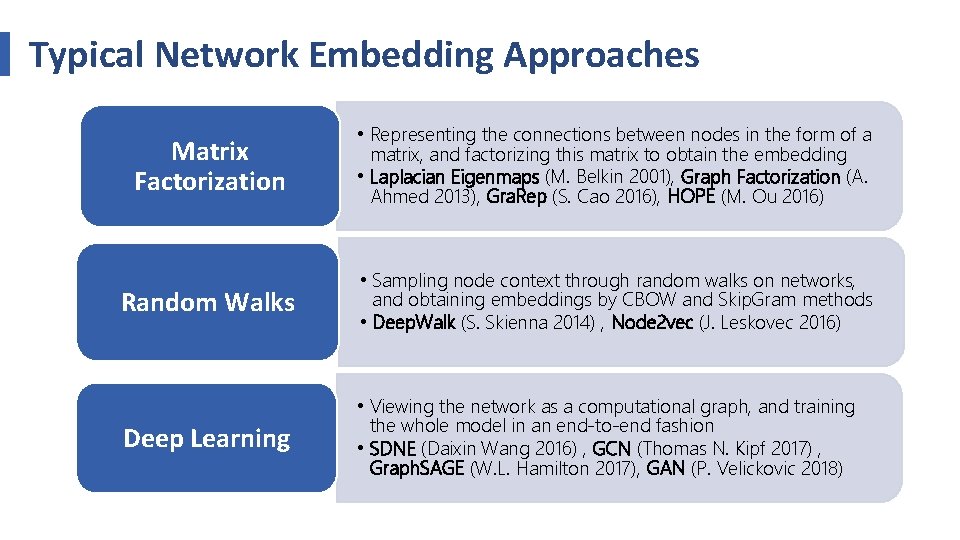
Typical Network Embedding Approaches Matrix Factorization • Representing the connections between nodes in the form of a matrix, and factorizing this matrix to obtain the embedding • Laplacian Eigenmaps (M. Belkin 2001), Graph Factorization (A. Ahmed 2013), Gra. Rep (S. Cao 2016), HOPE (M. Ou 2016) Random Walks • Sampling node context through random walks on networks, and obtaining embeddings by CBOW and Skip. Gram methods • Deep. Walk (S. Skienna 2014) , Node 2 vec (J. Leskovec 2016) Deep Learning • Viewing the network as a computational graph, and training the whole model in an end-to-end fashion • SDNE (Daixin Wang 2016) , GCN (Thomas N. Kipf 2017) , Graph. SAGE (W. L. Hamilton 2017), GAN (P. Velickovic 2018)
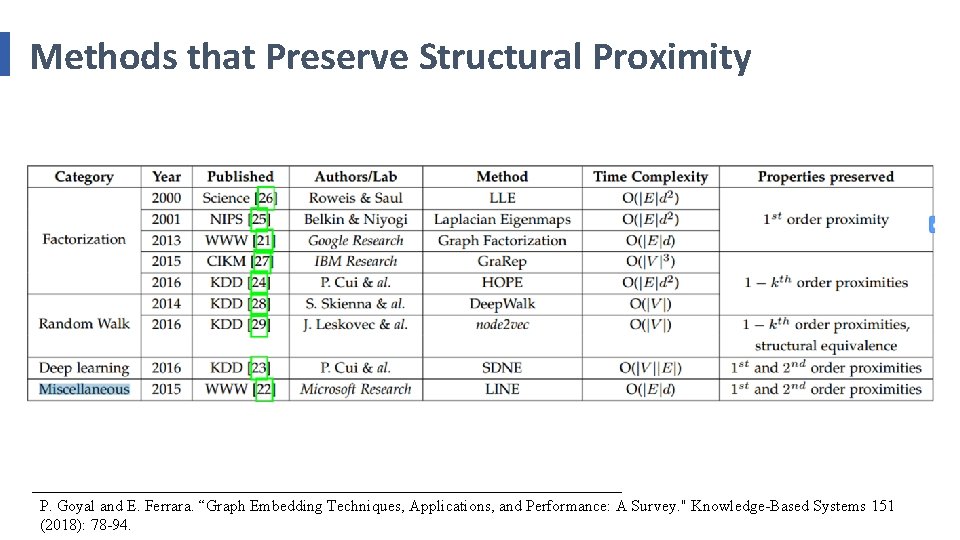
Methods that Preserve Structural Proximity P. Goyal and E. Ferrara. “Graph Embedding Techniques, Applications, and Performance: A Survey. " Knowledge-Based Systems 151 (2018): 78 -94.
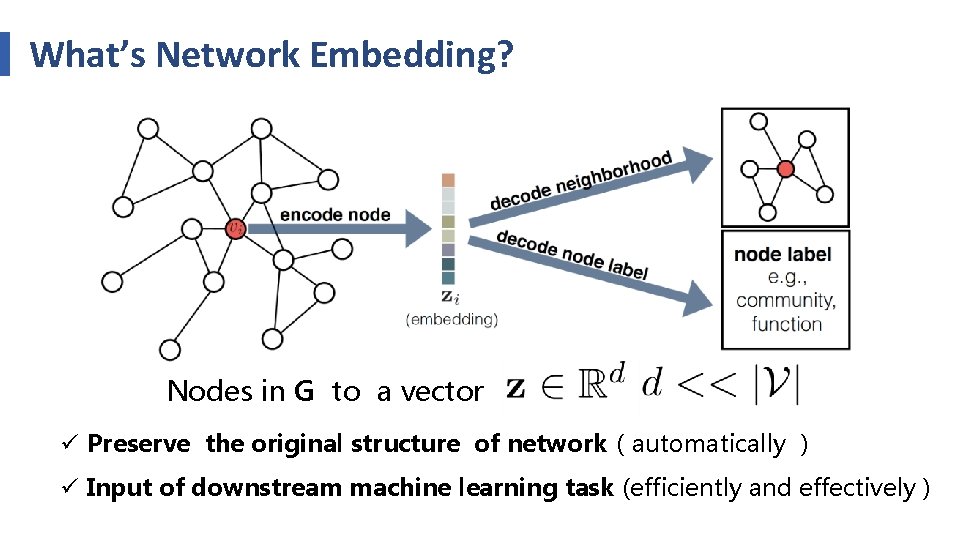
What’s Network Embedding? Nodes in G to a vector ü Preserve the original structure of network(automatically ) ü Input of downstream machine learning task (efficiently and effectively )
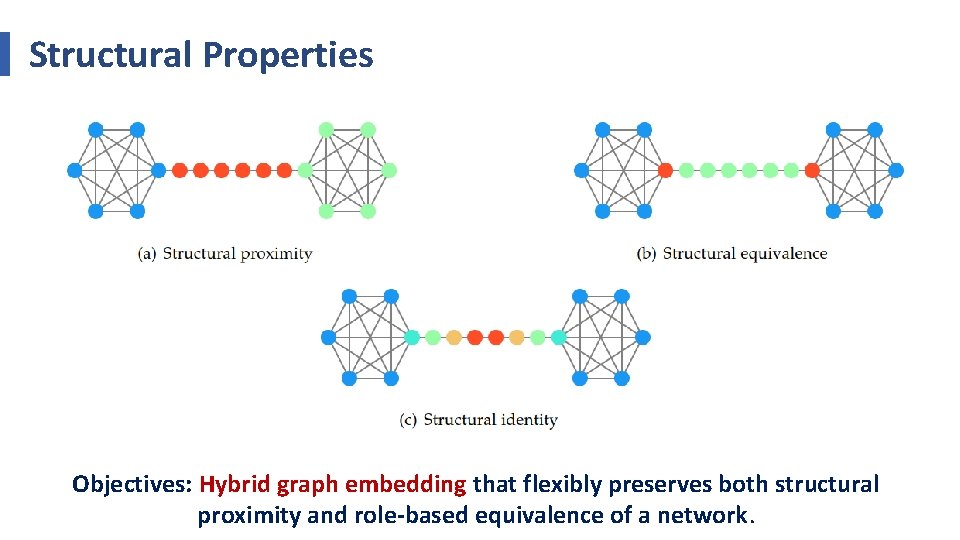
Structural Properties Objectives: Hybrid graph embedding that flexibly preserves both structural proximity and role-based equivalence of a network.
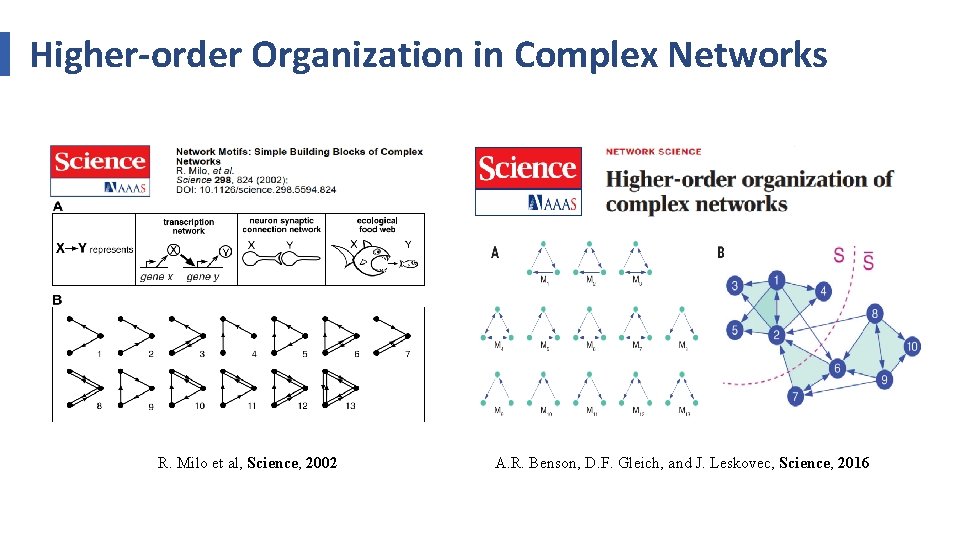
Higher-order Organization in Complex Networks R. Milo et al, Science, 2002 A. R. Benson, D. F. Gleich, and J. Leskovec, Science, 2016
Factorization-based Approach Unifying Structural Proximity and Equivalence for Network Embedding BENYUN SHI, CHUNPENG ZHOU, HONGJUN QIU, XIAOBIN XU, JIMING LIU INDEX TERMS Graphlet degree vector, Structural proximity, Structural equivalence, Network embedding, Node classification
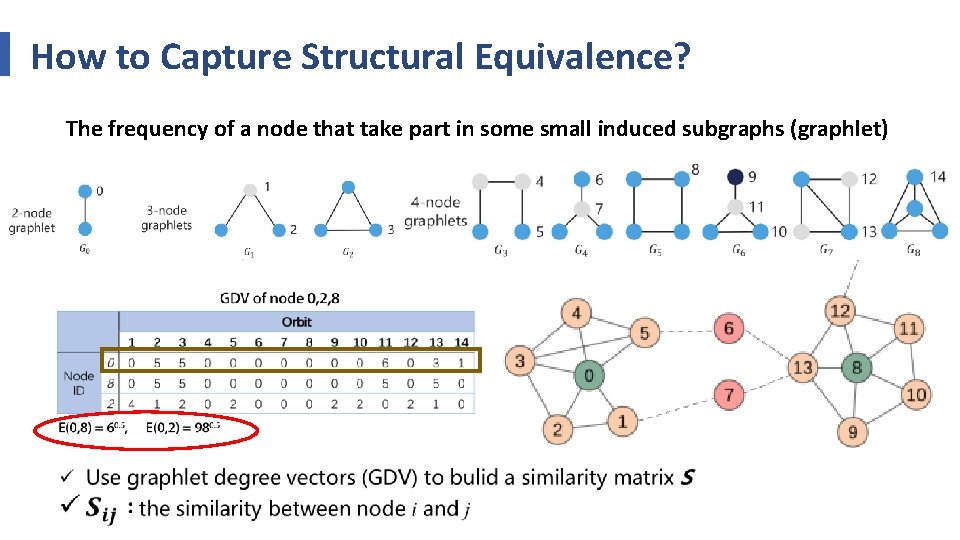
How to Capture Structural Equivalence? The frequency of a node that take part in some small induced subgraphs (graphlet)
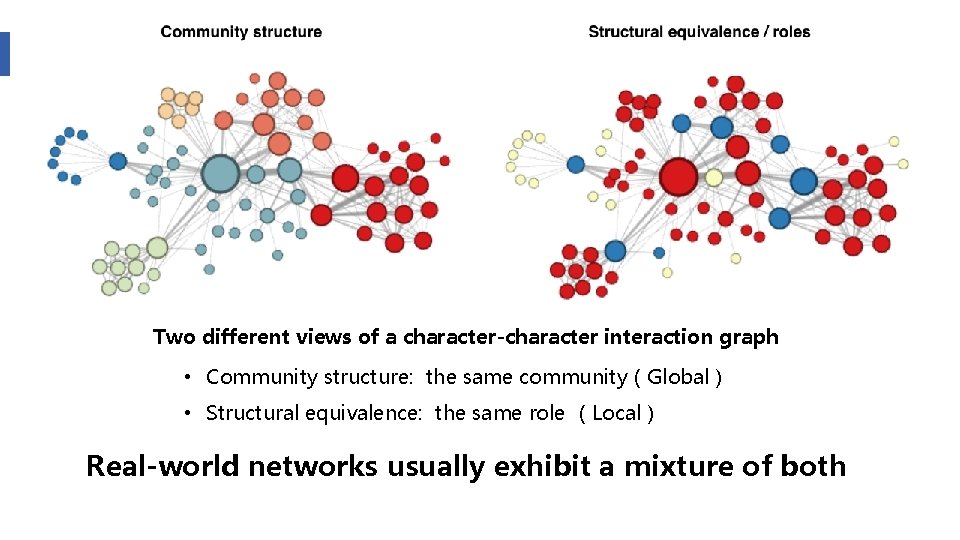
Two different views of a character-character interaction graph • Community structure: the same community(Global) • Structural equivalence: the same role (Local) Real-world networks usually exhibit a mixture of both
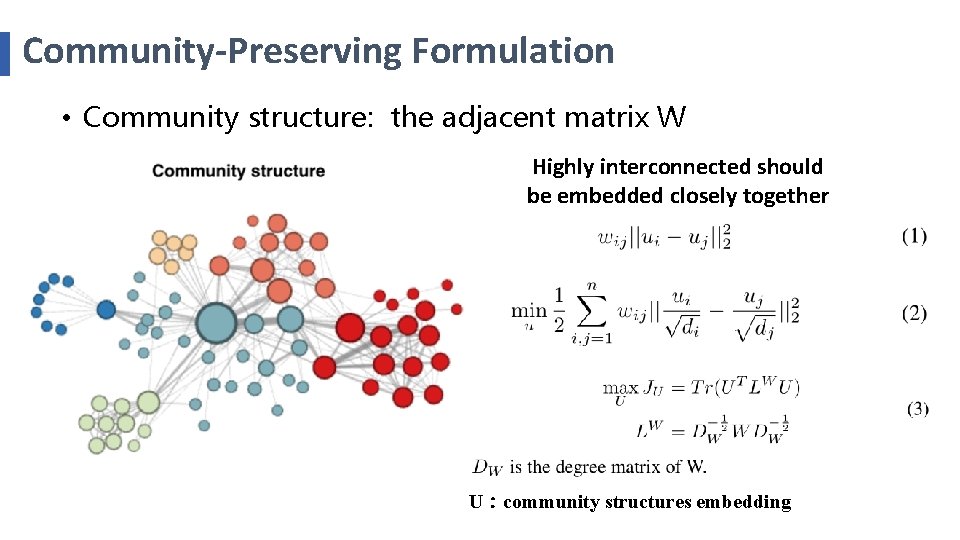
Community-Preserving Formulation • Community structure: the adjacent matrix W Highly interconnected should be embedded closely together U:community structures embedding
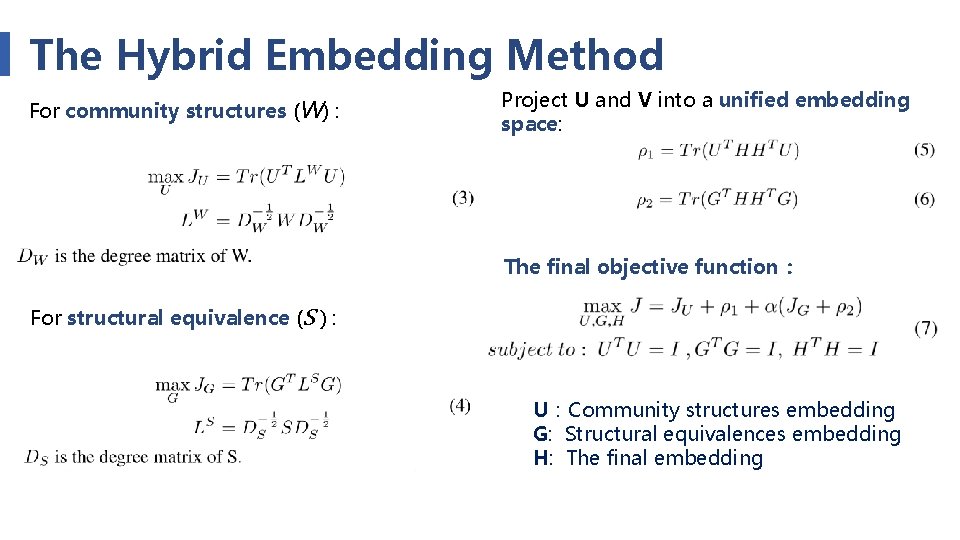
The Hybrid Embedding Method For community structures (W) : Project U and V into a unified embedding space: The final objective function: For structural equivalence (S ) : U:Community structures embedding G: Structural equivalences embedding H: The final embedding
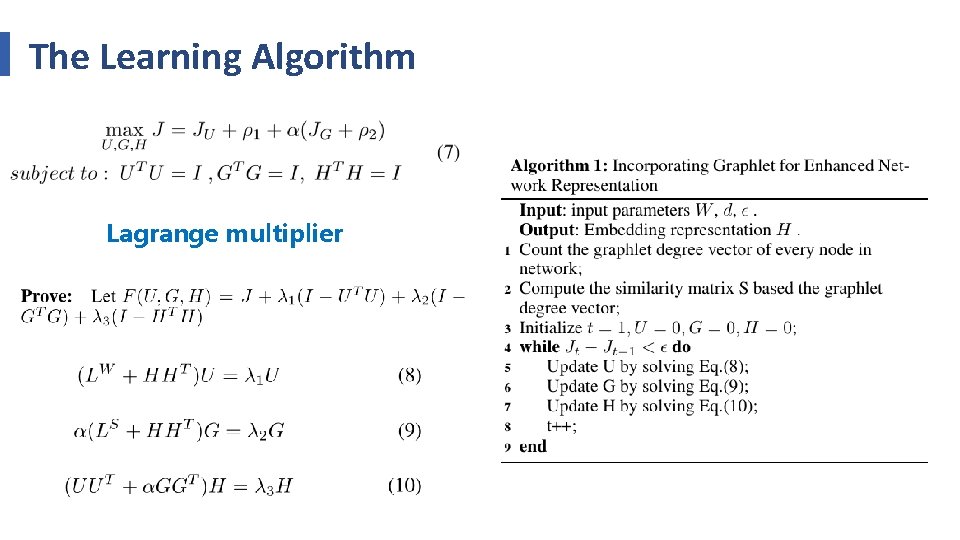
The Learning Algorithm Lagrange multiplier
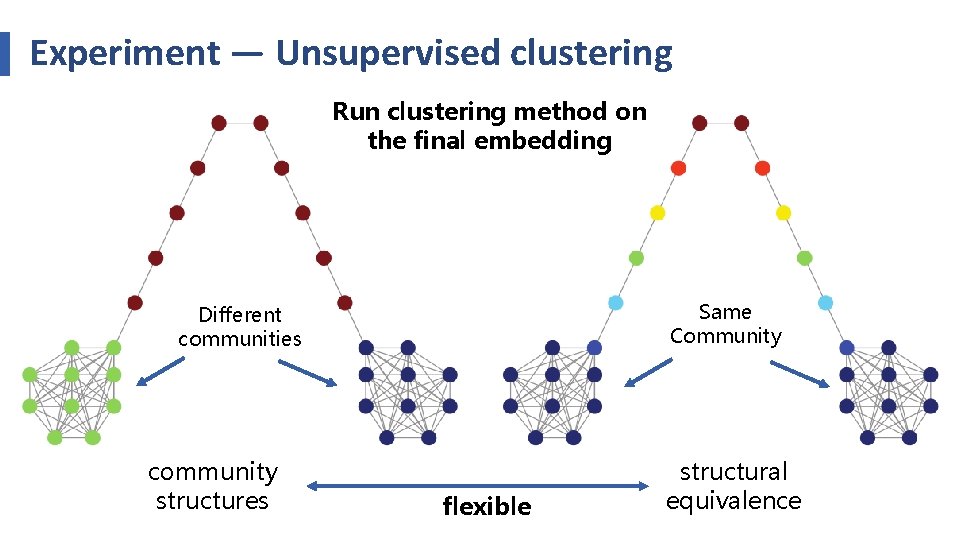
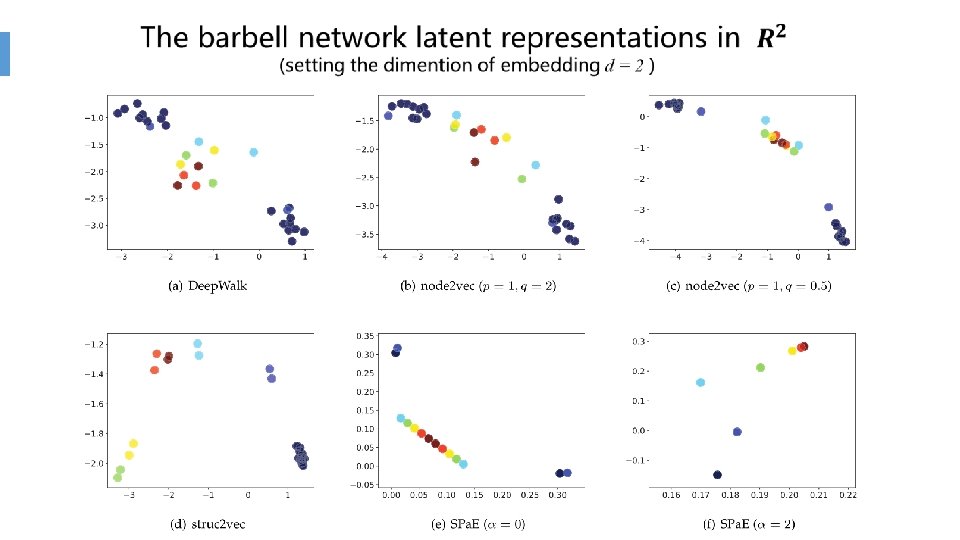
Experiment — Unsupervised clustering Run clustering method on the final embedding Same Community Different communities community structures flexible structural equivalence
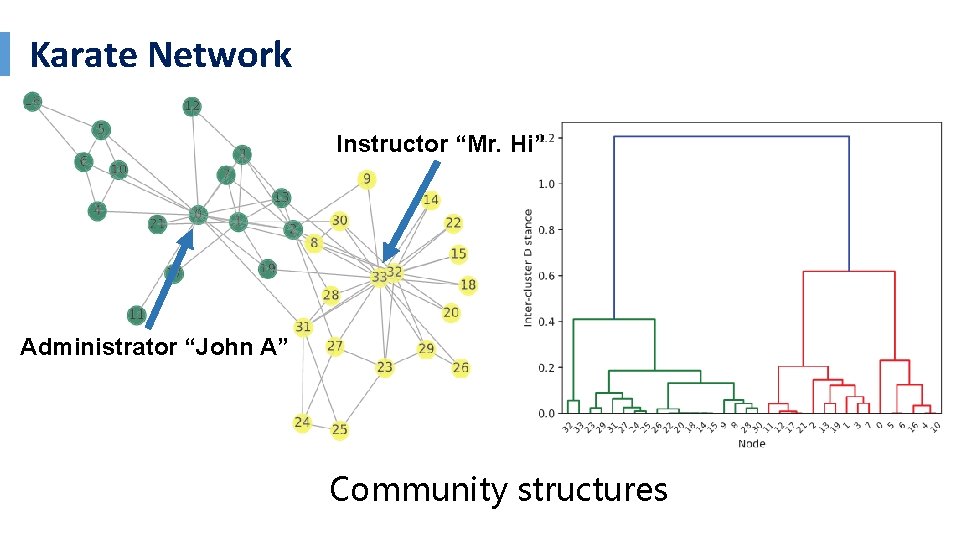
Karate Network Instructor “Mr. Hi” Administrator “John A” Community structures
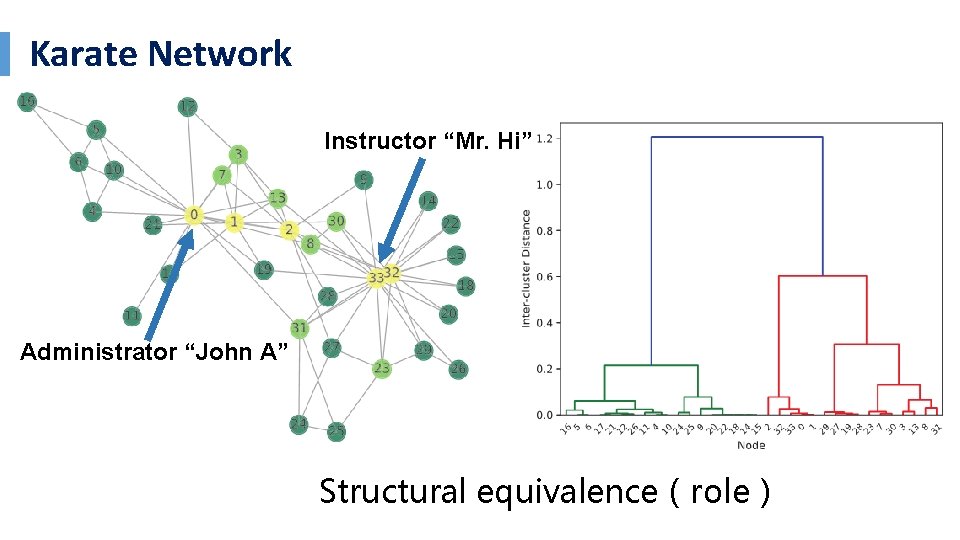
Karate Network Instructor “Mr. Hi” Administrator “John A” Structural equivalence(role)
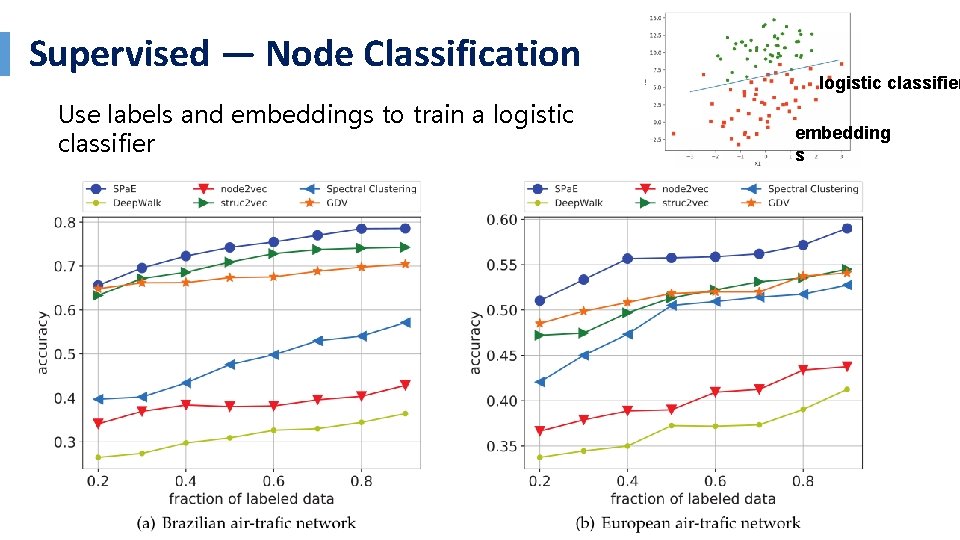
Supervised — Node Classification Use labels and embeddings to train a logistic classifier embedding s
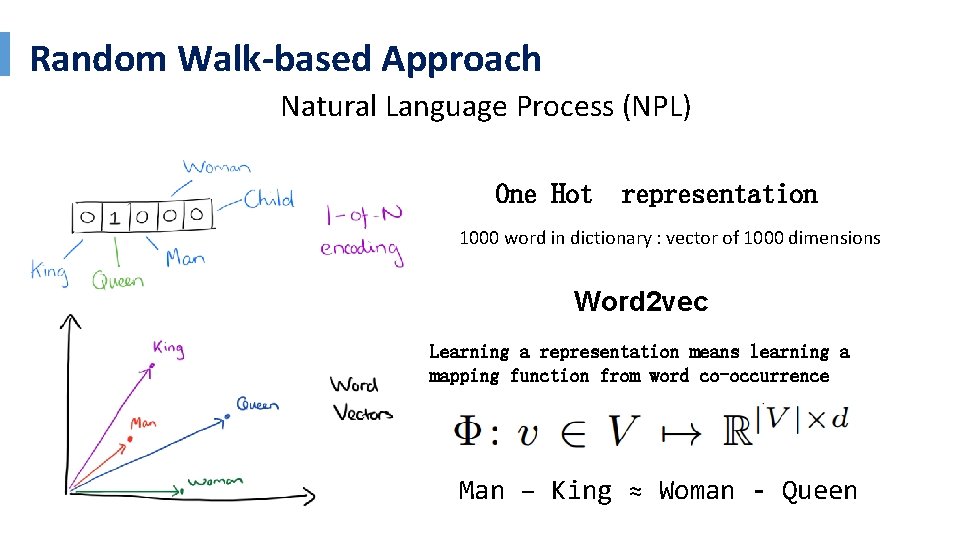
Random Walk-based Approach Natural Language Process (NPL) One Hot representation 1000 word in dictionary : vector of 1000 dimensions Word 2 vec Learning a representation means learning a mapping function from word co-occurrence Man – King ≈ Woman - Queen
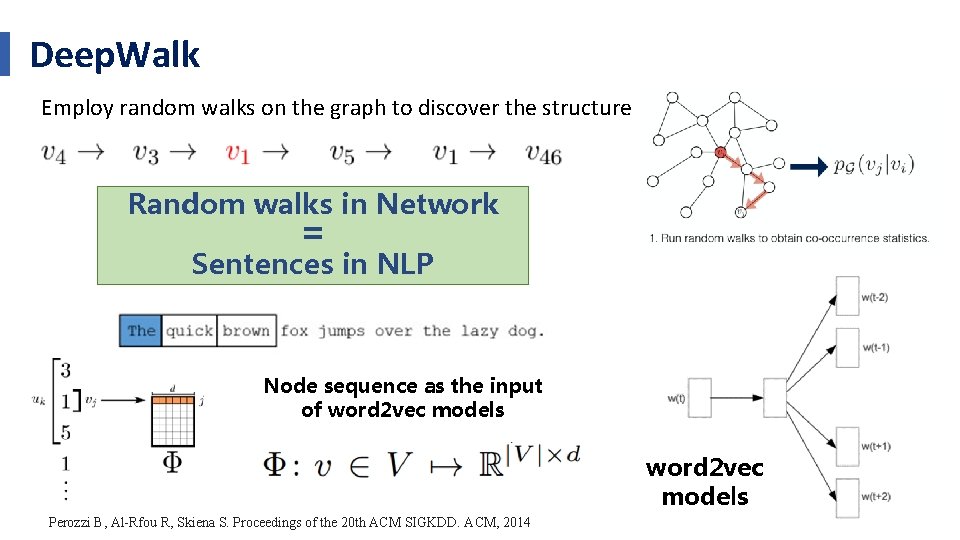
Deep. Walk Employ random walks on the graph to discover the structure Random walks in Network = Sentences in NLP Node sequence as the input of word 2 vec models Perozzi B, Al-Rfou R, Skiena S. Proceedings of the 20 th ACM SIGKDD. ACM, 2014
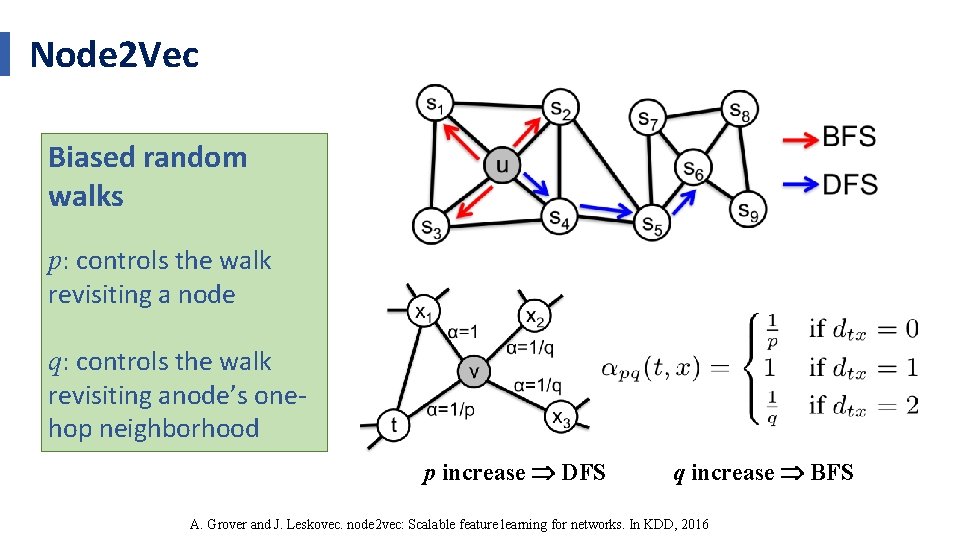
Node 2 Vec Biased random walks p: controls the walk revisiting a node q: controls the walk revisiting anode’s onehop neighborhood p increase DFS q increase BFS A. Grover and J. Leskovec. node 2 vec: Scalable feature learning for networks. In KDD, 2016
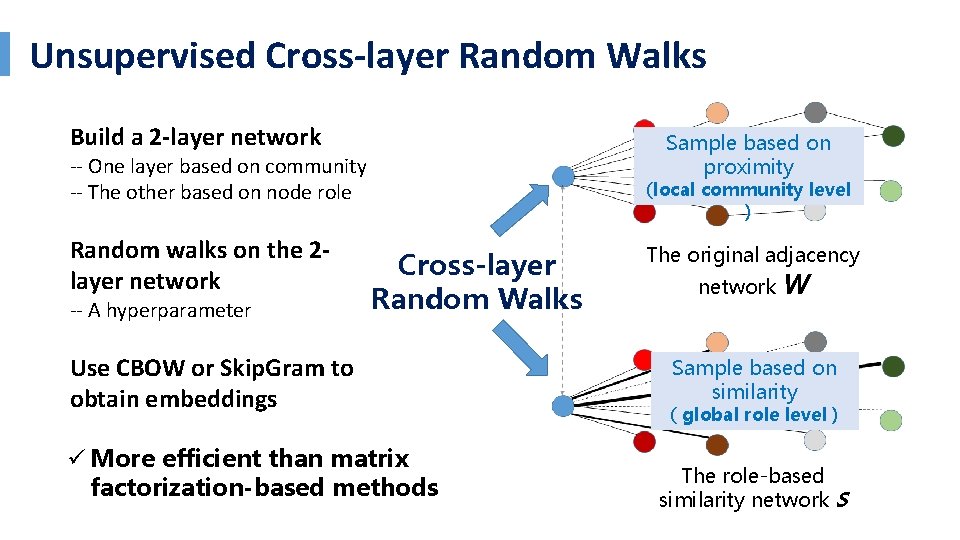
Unsupervised Cross-layer Random Walks Build a 2 -layer network Sample based on proximity -- One layer based on community -- The other based on node role Random walks on the 2 layer network -- A hyperparameter (local community level ) Cross-layer Random Walks Use CBOW or Skip. Gram to obtain embeddings ü More efficient than matrix factorization-based methods The original adjacency network W Sample based on similarity ( global role level ) The role-based similarity network S
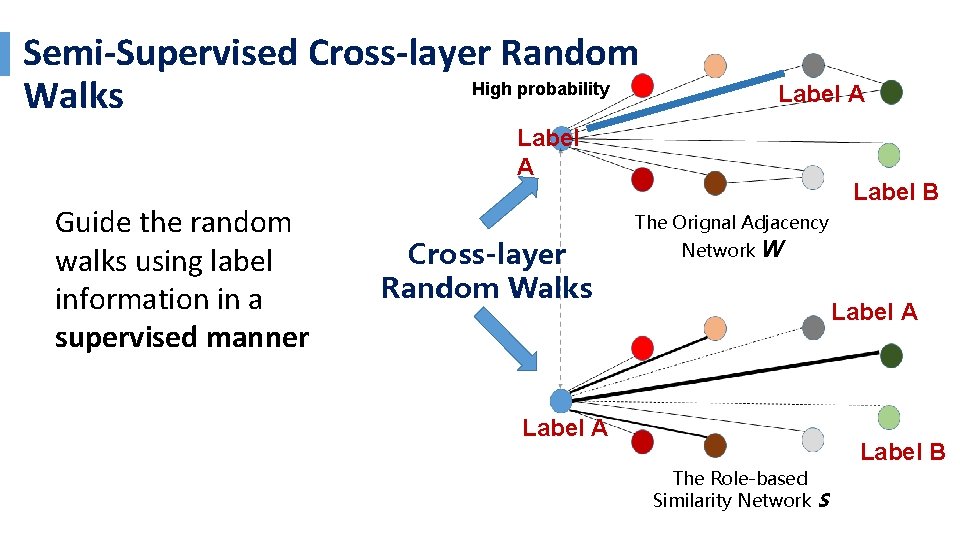
Semi-Supervised Cross-layer Random High probability Walks Label A Guide the random walks using label information in a supervised manner Label B The Orignal Adjacency Cross-layer Random Walks Network W Label A Label B The Role-based Similarity Network S
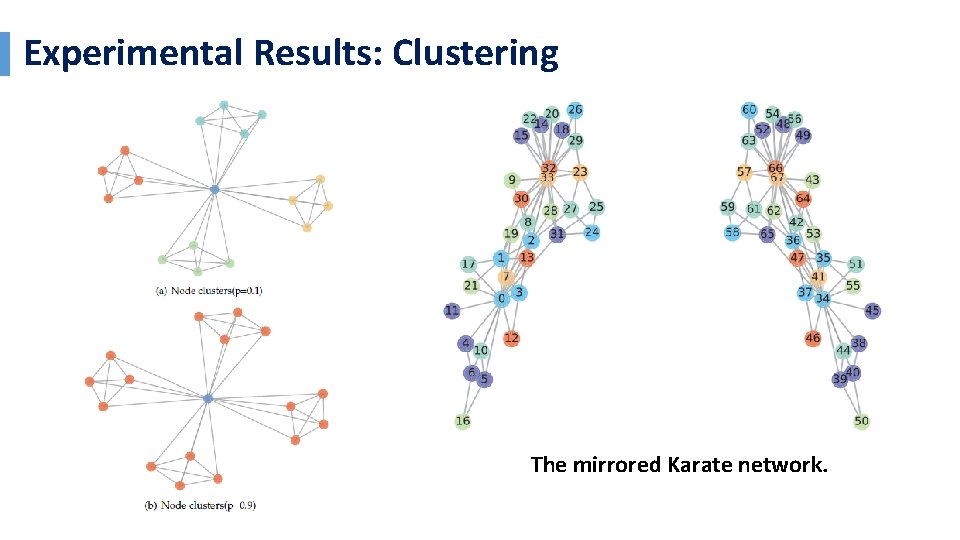
Experimental Results: Clustering The mirrored Karate network.
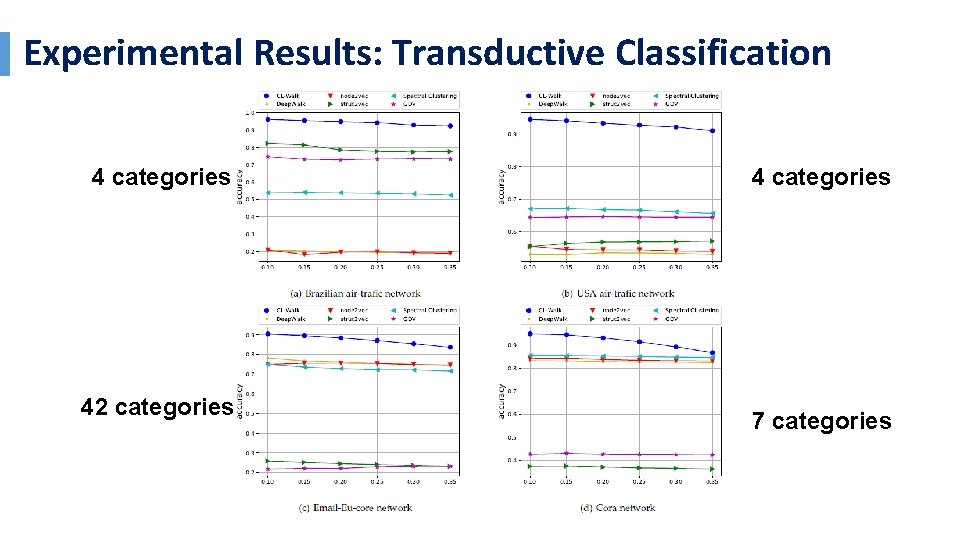
Experimental Results: Transductive Classification 4 categories 42 categories 4 categories 7 categories
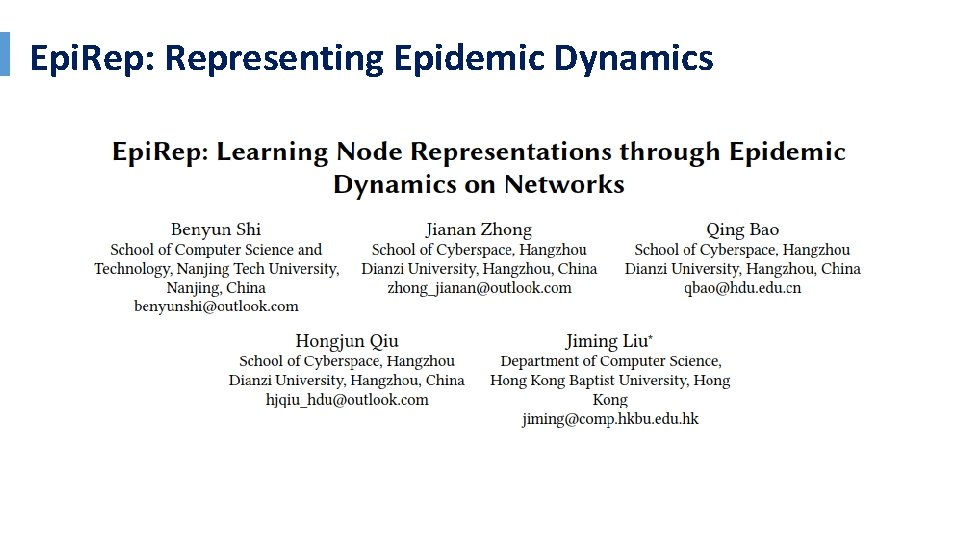
Epi. Rep: Representing Epidemic Dynamics
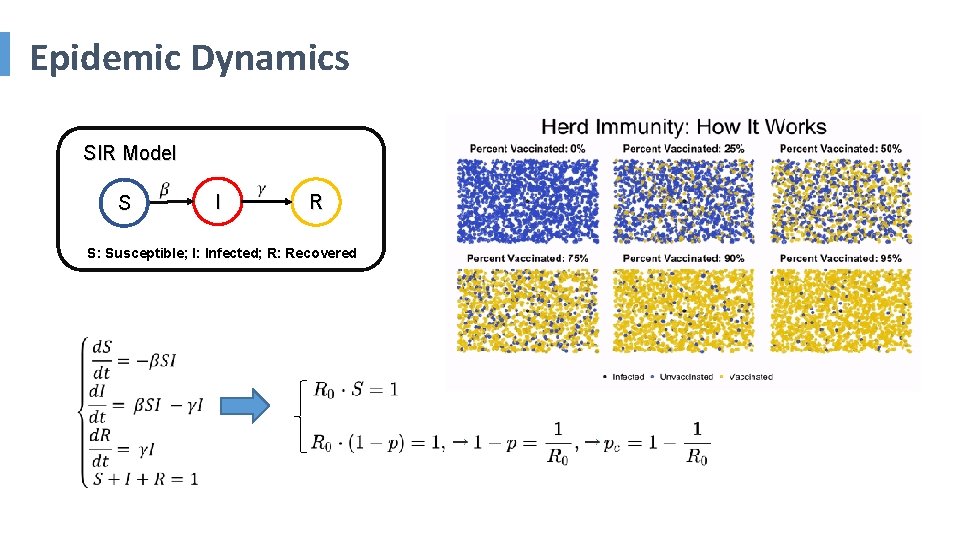
Epidemic Dynamics SIR Model S I R S: Susceptible; I: Infected; R: Recovered
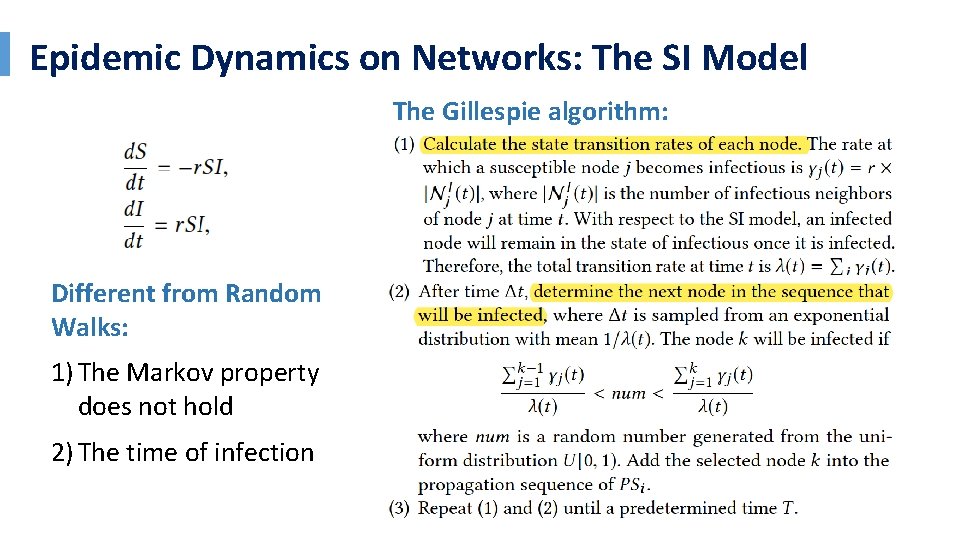
Epidemic Dynamics on Networks: The SI Model The Gillespie algorithm: Different from Random Walks: 1) The Markov property does not hold 2) The time of infection
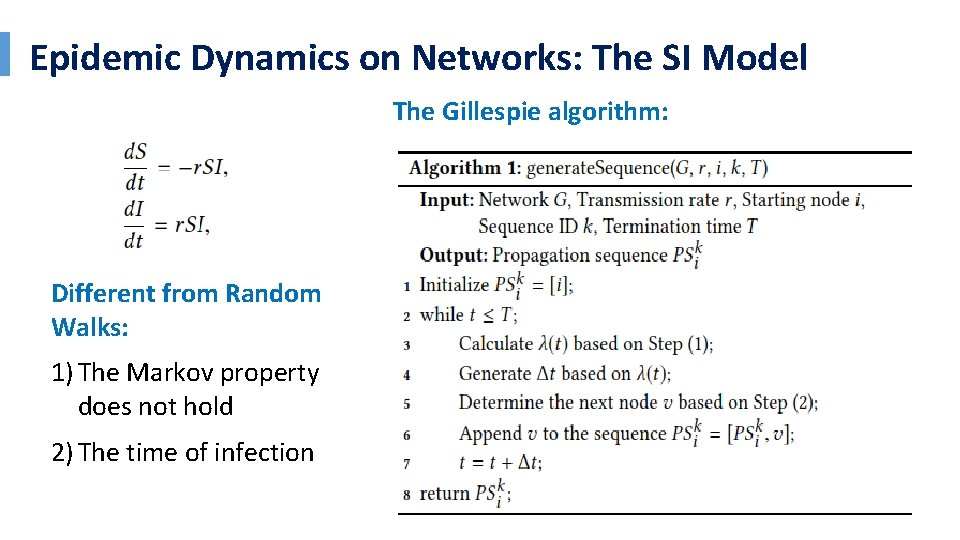
Epidemic Dynamics on Networks: The SI Model The Gillespie algorithm: Different from Random Walks: 1) The Markov property does not hold 2) The time of infection
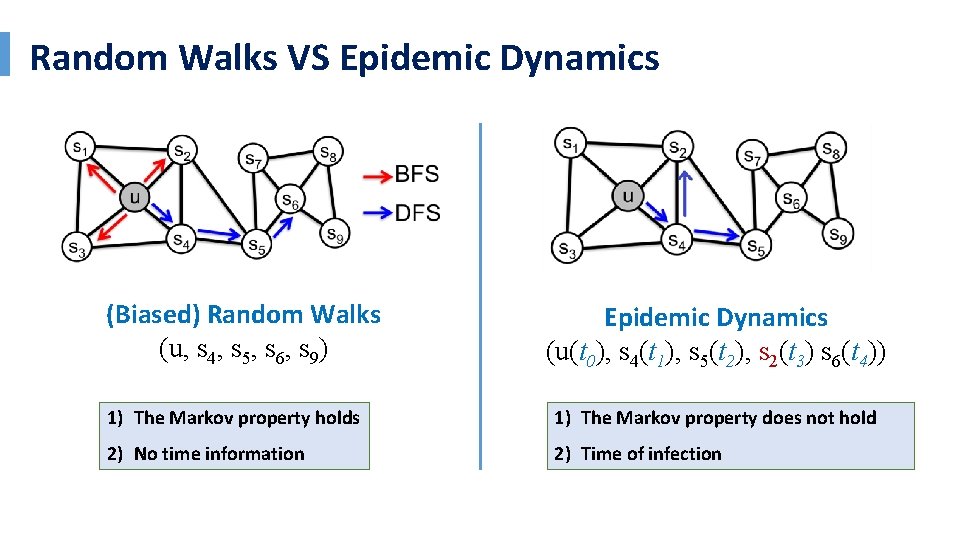
Random Walks VS Epidemic Dynamics (Biased) Random Walks (u, s 4, s 5, s 6, s 9) Epidemic Dynamics (u(t 0), s 4(t 1), s 5(t 2), s 2(t 3) s 6(t 4)) 1) The Markov property holds 1) The Markov property does not hold 2) No time information 2) Time of infection
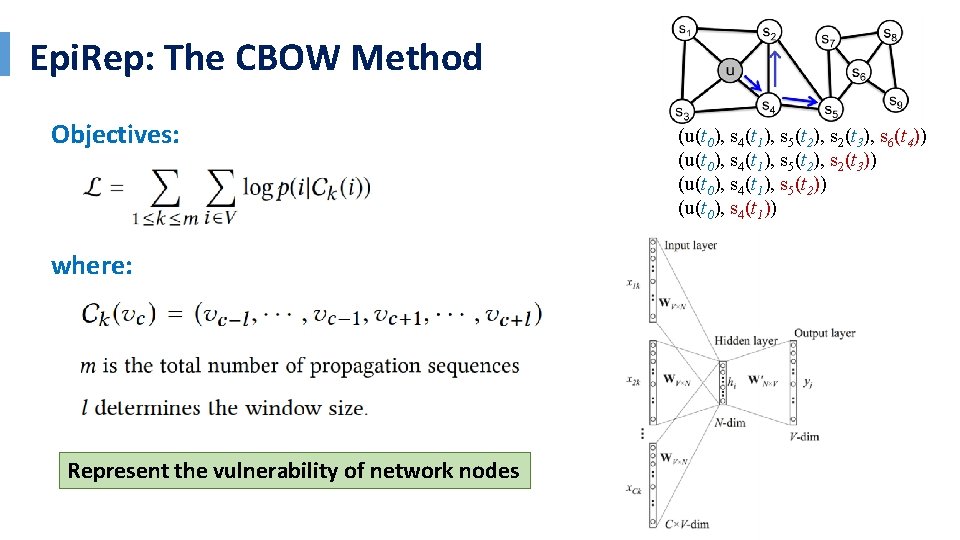
Epi. Rep: The CBOW Method Objectives: where: Represent the vulnerability of network nodes (u(t 0), s 4(t 1), s 5(t 2), s 2(t 3), s 6(t 4)) (u(t 0), s 4(t 1), s 5(t 2), s 2(t 3)) (u(t 0), s 4(t 1), s 5(t 2)) (u(t 0), s 4(t 1))
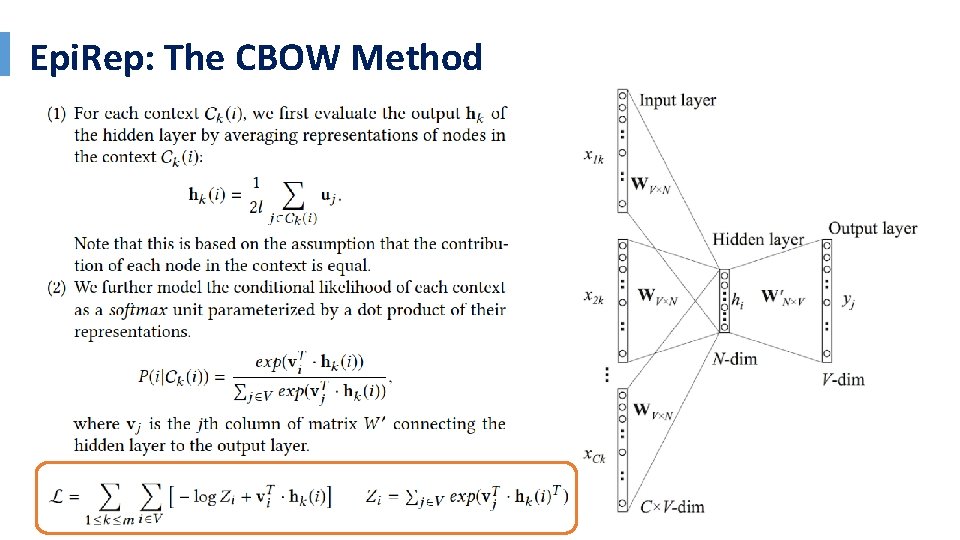
Epi. Rep: The CBOW Method
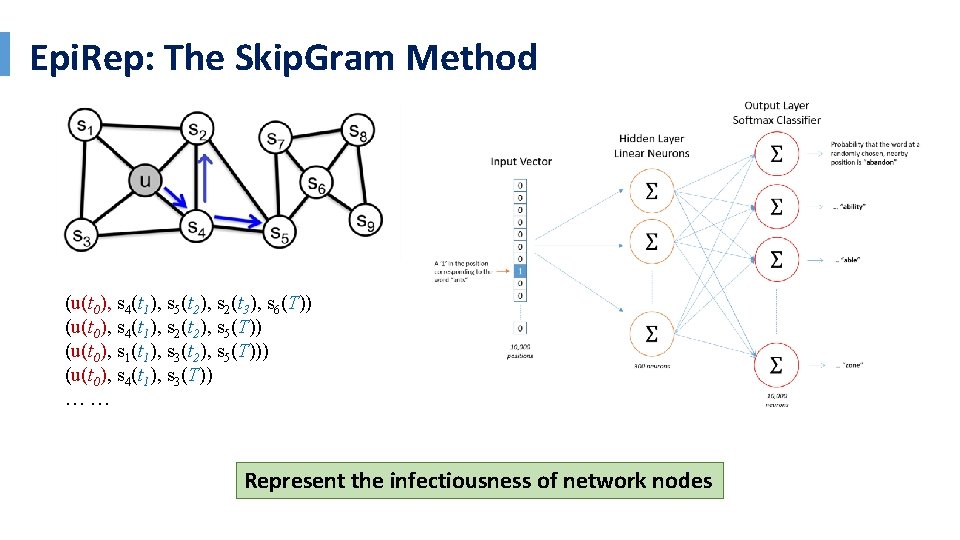
Epi. Rep: The Skip. Gram Method (u(t 0), s 4(t 1), s 5(t 2), s 2(t 3), s 6(T)) (u(t 0), s 4(t 1), s 2(t 2), s 5(T)) (u(t 0), s 1(t 1), s 3(t 2), s 5(T))) (u(t 0), s 4(t 1), s 3(T)) …… Represent the infectiousness of network nodes
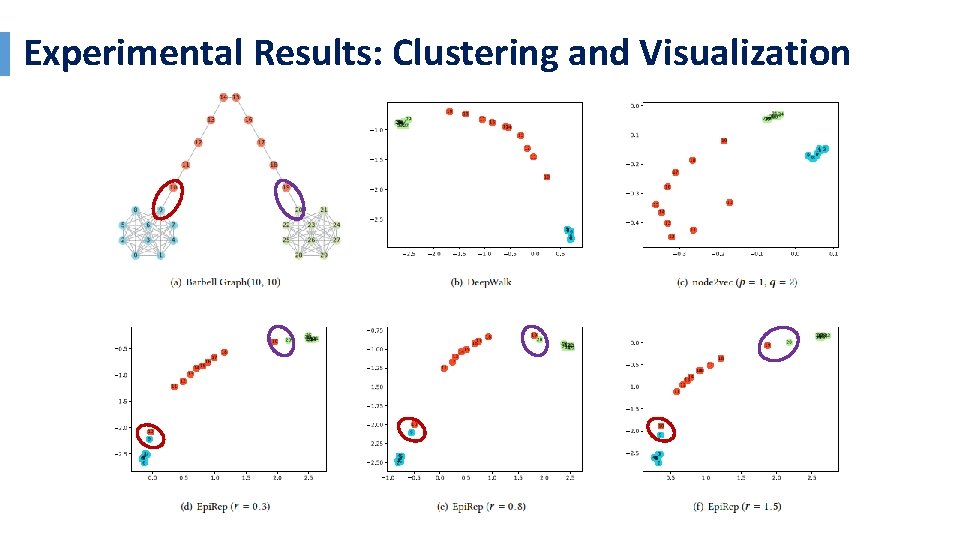
Experimental Results: Clustering and Visualization
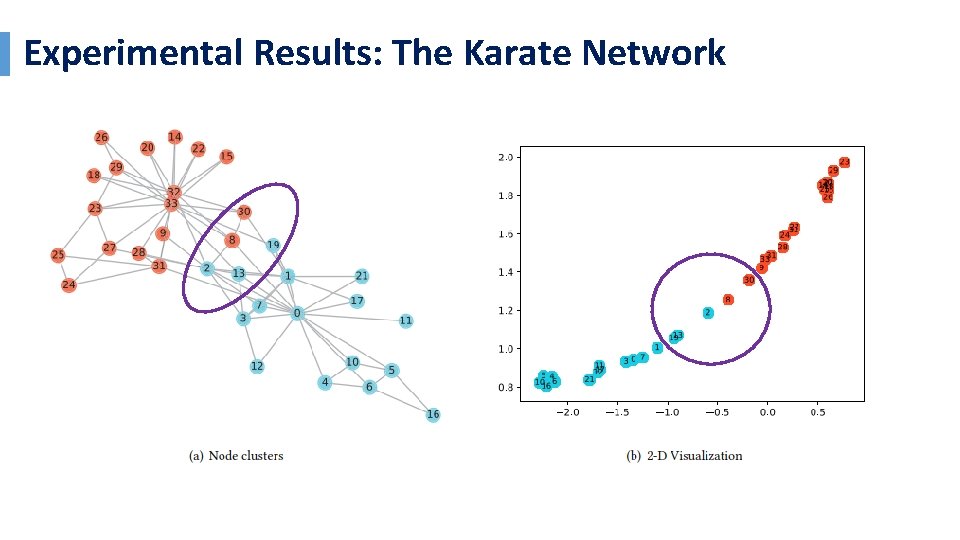
Experimental Results: The Karate Network
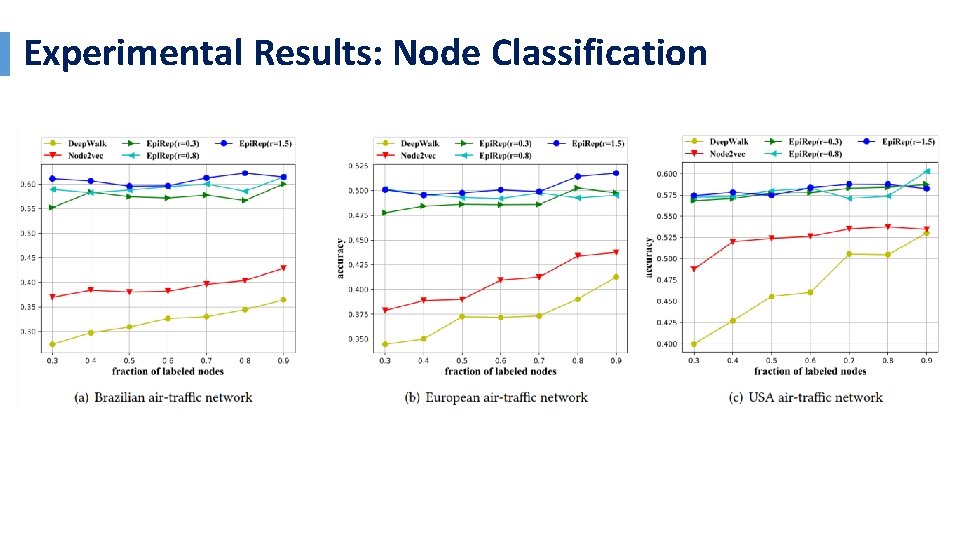
Experimental Results: Node Classification
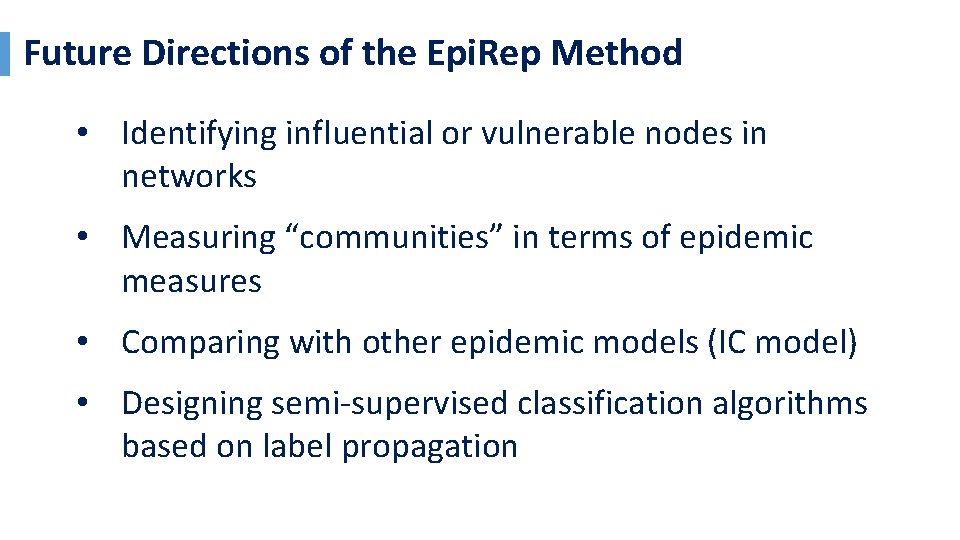
Future Directions of the Epi. Rep Method • Identifying influential or vulnerable nodes in networks • Measuring “communities” in terms of epidemic measures • Comparing with other epidemic models (IC model) • Designing semi-supervised classification algorithms based on label propagation
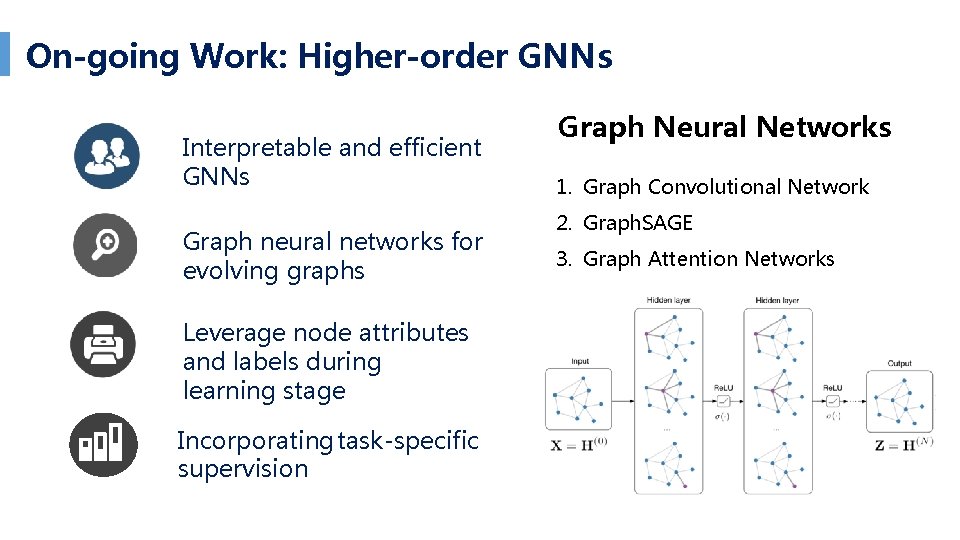
On-going Work: Higher-order GNNs Interpretable and efficient GNNs Graph neural networks for evolving graphs Leverage node attributes and labels during learning stage Incorporating task-specific supervision Graph Neural Networks 1. Graph Convolutional Network 2. Graph. SAGE 3. Graph Attention Networks

Thank you!
- Slides: 42