
Uniformity Requirements for a Color Printer Based on
Uniformity Requirements for a Color Printer Based on Perceptual Studies Nancy Goodman and R. Victor Klassen Xerox Research & Technology
BIO Name: Nancy Goodman; co-author R. Victor Klassen Organization: XR&T/Wilson Center Education (Degree/College): BA Bryn Mawr & Haverford Colleges; MS and Ph. D University of Chicago Area of Expertise: Image Quality and using Image Simulation to explore human sensitivity to degradations of image quality Years of Experience: 18 years at Xerox Area of Focus: image quality, human perception Written out brief bio: Nancy Goodman joined Xerox in 1982 after completing a BA in Astronomy at Bryn Mawr and Haverford Colleges, a MS and a Ph. D in physics at the University of Chicago and a post-doctoral fellowship at the Max Planck Institute in Stuttgart, Germany. She has worked on tri-level xerography and extended color palette by toner blending, both for the 4850 family of products. She is currently a Principal Scientist in the Marking Systems Laboratory of the Wilson Center for Research and Technology, where her focus is on the connection between the marking process and image quality and on human perceptibility of the resulting prints.
Abstract • Every printer is susceptible to various types of spatial non-uniformities, many of which are periodic and/or sinusoidal in nature. Developing a useful specification for these depends on understanding the threshold of human perception to each type. We report preliminary results of an experiment measuring threshold as a function of spatial frequency, location in color space and direction of variation. While early data is noisy, we have found population thresholds as a function of spatial frequency, on average, when any of L*, a*, b*, C* or Hab is varied. We have not yet found any meaningful dependency on any independent variable other than spatial frequency, such as C*, as would be expected from such color difference metrics as CIE DE 94 or DECMC. Although this is work in progress, results to date will be presented.
Outline • • • Motivation Background Our Experiment Results Discussion & Conclusions

Motivation • Guide development of product program specifications • Develop visual difference metric for evaluation of perceived quality of image representation
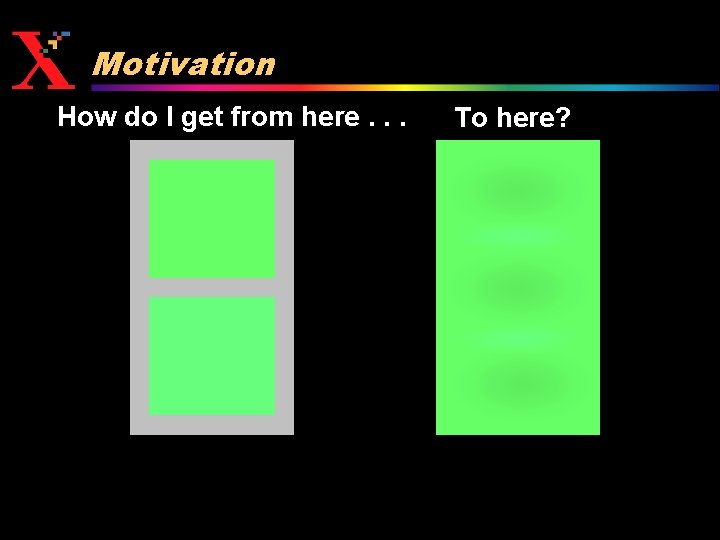
Motivation How do I get from here. . . To here?
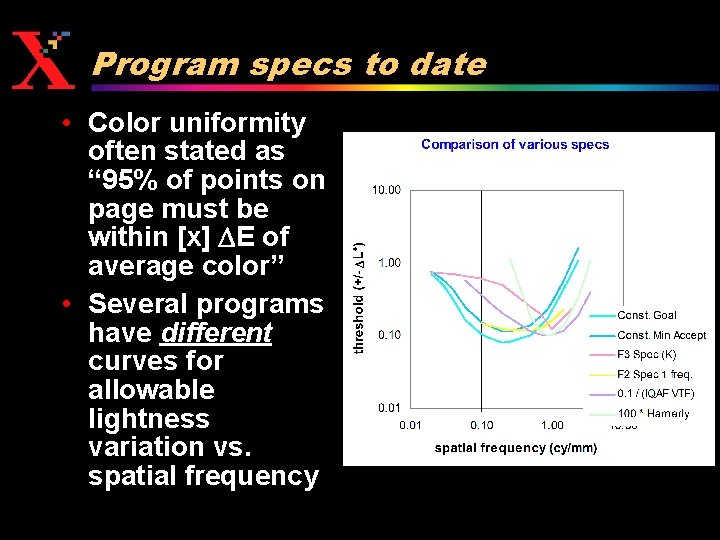
Program specs to date • Color uniformity often stated as “ 95% of points on page must be within [x] DE of average color” • Several programs have different curves for allowable lightness variation vs. spatial frequency
Related Work • Color Difference Metrics - DECIE 94 - DECMC(1: 1) • Contrast Sensitivity Functions – Luminance – Chrominance • Color Appearance Models
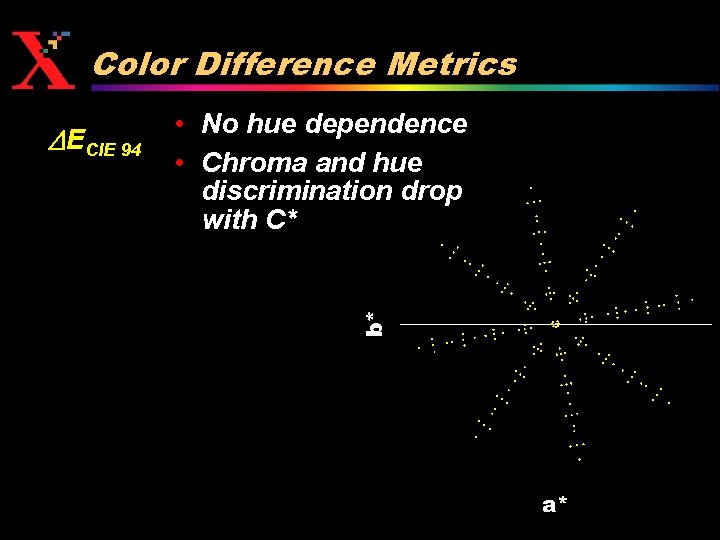
Color Difference Metrics DECIE 94 • No hue dependence • Chroma and hue discrimination drop with C*

Color Difference Metrics DECMC(1: 1) • Hue discrimination depends on hue • Chroma and hue discrimination drop with C* Most sensitive 3 d D 7 d d 5 D
Color Difference Metrics • Very simple geometry • Suggest dependence on C*, Hue • Folklore: – DE = 1 just noticeable – DE = 5 -6 acceptable for spot color
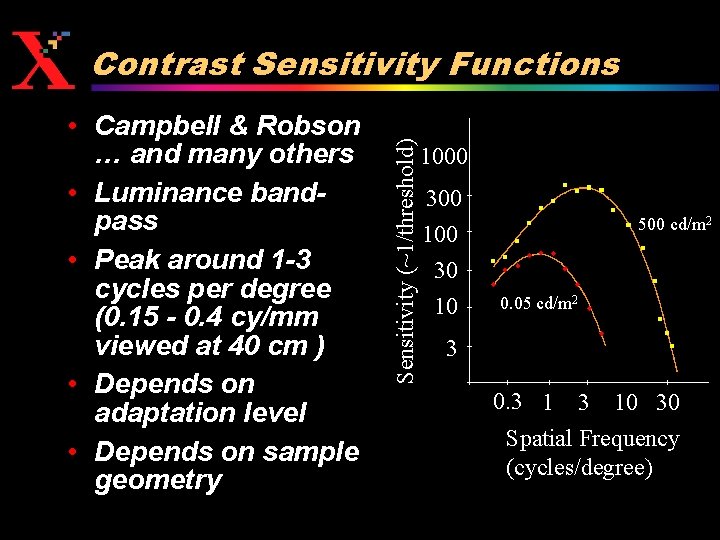
• Campbell & Robson … and many others • Luminance bandpass • Peak around 1 -3 cycles per degree (0. 15 - 0. 4 cy/mm viewed at 40 cm ) • Depends on adaptation level • Depends on sample geometry Sensitivity (~1/threshold) Contrast Sensitivity Functions 1000 300 100 30 10 500 cd/m 2 0. 05 cd/m 2 3 0. 3 10 30 Spatial Frequency (cycles/degree)
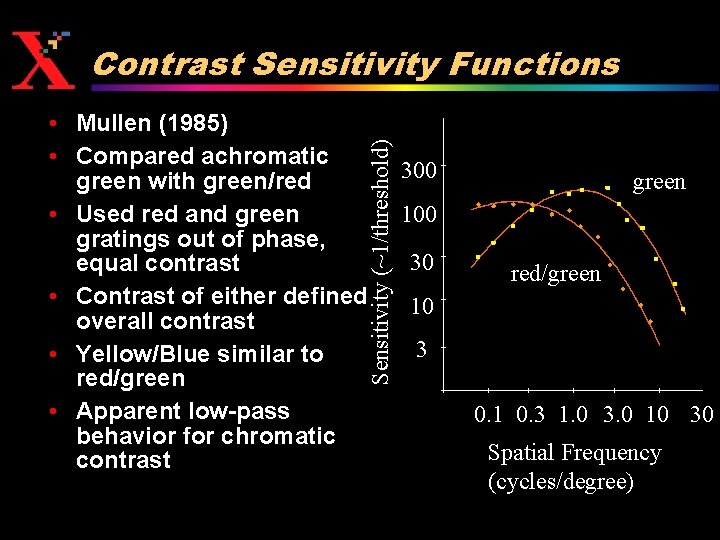
Contrast Sensitivity Functions Sensitivity (~1/threshold) • Mullen (1985) • Compared achromatic green with green/red • Used red and green gratings out of phase, equal contrast • Contrast of either defined overall contrast • Yellow/Blue similar to red/green • Apparent low-pass behavior for chromatic contrast 300 green 100 30 red/green 10 3 0. 1 0. 3 1. 0 3. 0 10 30 Spatial Frequency (cycles/degree)
Contrast Sensitivity Functions • Luminance – Many different viewing conditions • Few observers per experiment • Chromatic – Fewer experiments • Few observers per experiment • Typically nulled two dimensions while measuring third – E. g. red/green with no blue component • Limited range of base colors • Hard to convert to machine specifications
Outline • • • Motivation Related Work Our Experiment Results Discussion
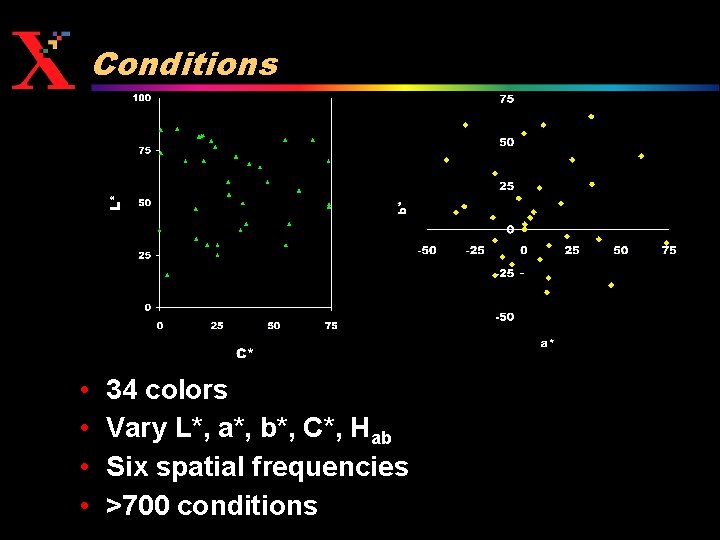
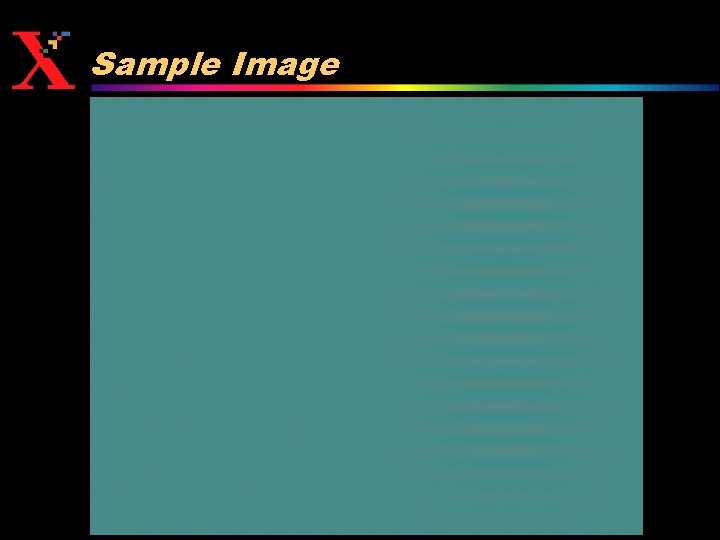
Conditions • • 34 colors Vary L*, a*, b*, C*, Hab Six spatial frequencies >700 conditions
Sample Image
Sample Image
Sample Image
Method • • Two alternative forced choice 50 contrast levels Untimed No feedback – Corrections permitted
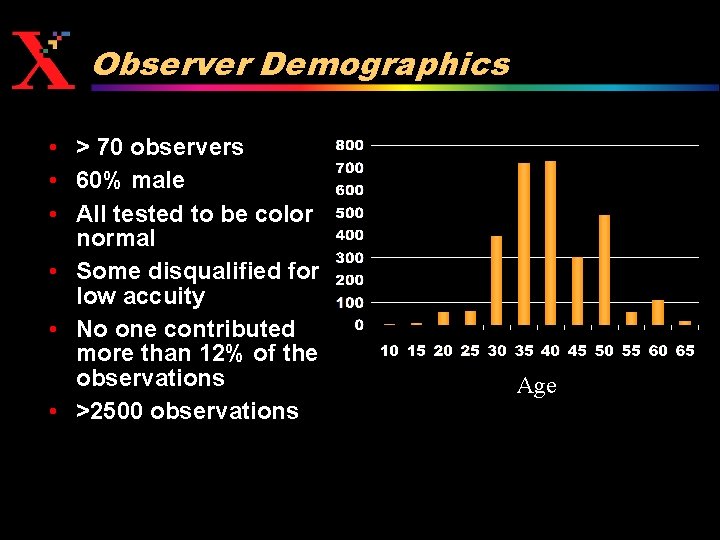
Observer Demographics • > 70 observers • 60% male • All tested to be color normal • Some disqualified for low accuity • No one contributed more than 12% of the observations • >2500 observations Age
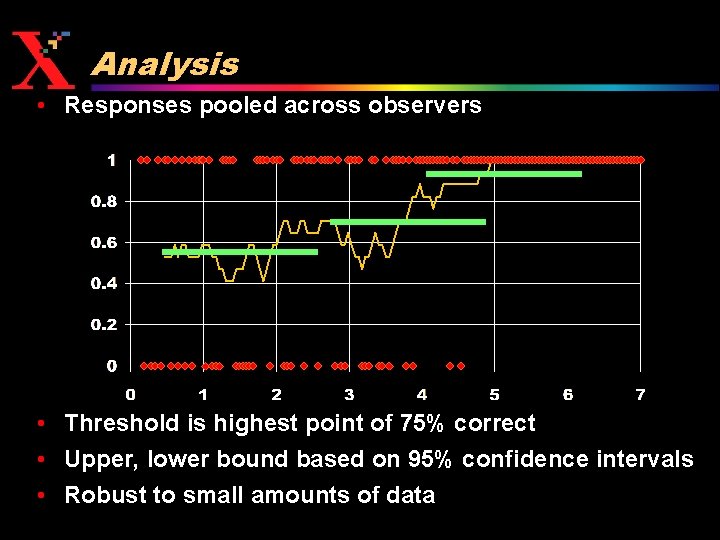
Analysis • Responses pooled across observers • Threshold is highest point of 75% correct • Upper, lower bound based on 95% confidence intervals • Robust to small amounts of data
Outline • • • Motivation Related Work Our Experiment Results Discussion
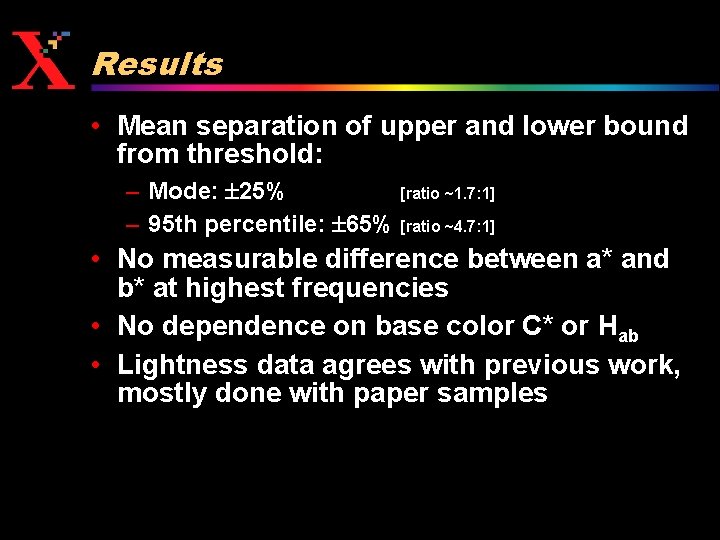
Results • Mean separation of upper and lower bound from threshold: – Mode: 25% [ratio ~1. 7: 1] – 95 th percentile: 65% [ratio ~4. 7: 1] • No measurable difference between a* and b* at highest frequencies • No dependence on base color C* or Hab • Lightness data agrees with previous work, mostly done with paper samples
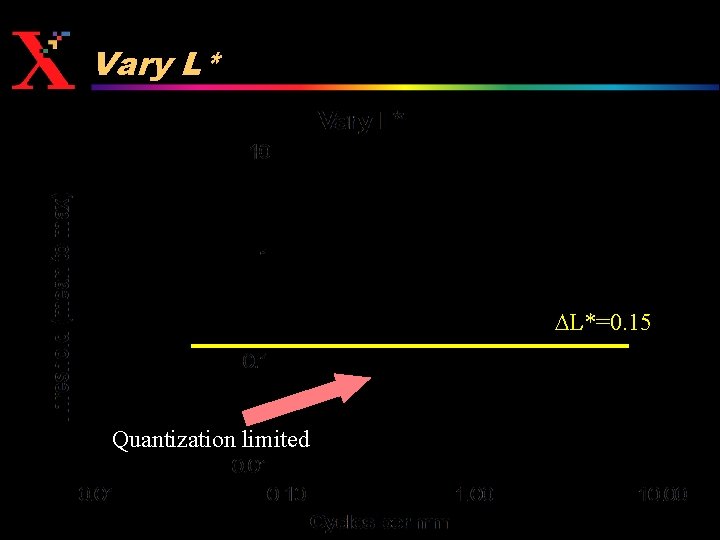
Vary L* DL*=0. 15 Quantization limited
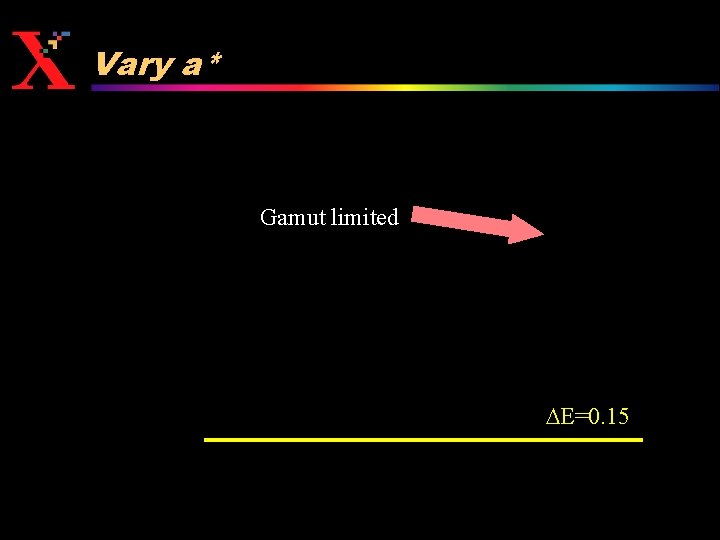
Vary a* Gamut limited DE=0. 15
Vary b* Gamut limited DE=0. 15
Vary C Gamut limited DE=0. 15
Vary Hab Gamut limited DE=0. 15
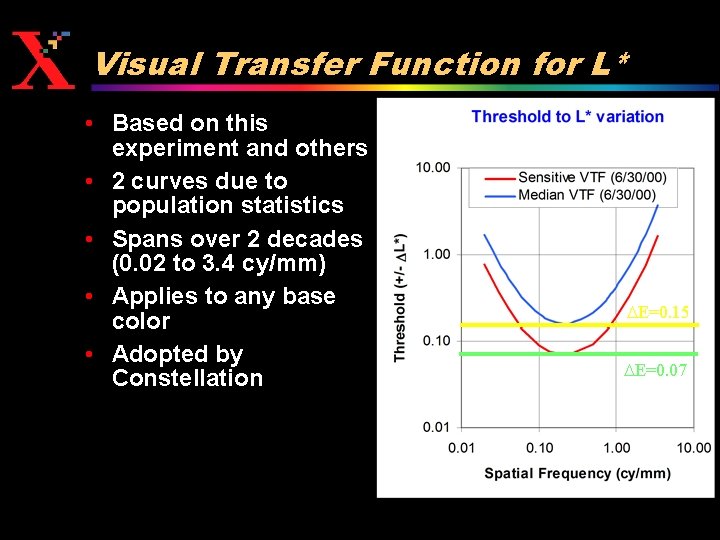
Visual Transfer Function for L* • Based on this experiment and others • 2 curves due to population statistics • Spans over 2 decades (0. 02 to 3. 4 cy/mm) • Applies to any base color • Adopted by Constellation DE=0. 15 DE=0. 07
Outline • • • Motivation Related Work Our Experiment Results Discussion
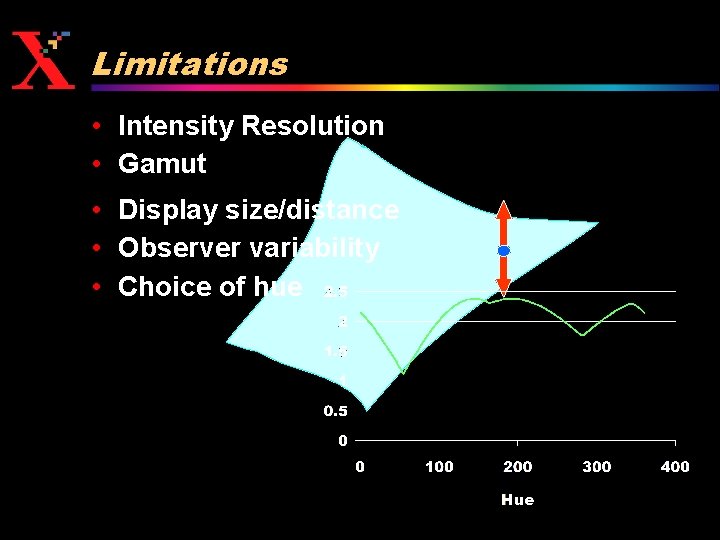
Limitations • Intensity Resolution • Gamut • Display size/distance • Observer variability • Choice of hue
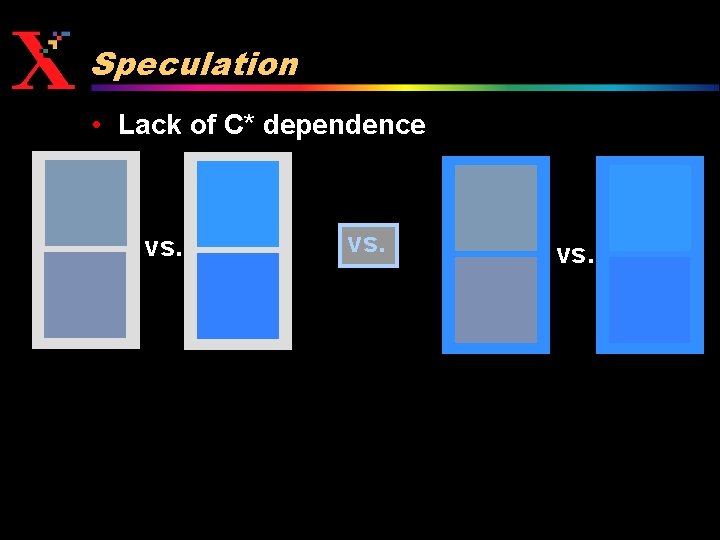
Speculation • Lack of C* dependence vs.
Conclusion • Preliminary results suggest: – Weak or no dependence on C* – Weak or no dependence on Hab – Chromatic variation harder to see than luminance down to at least 0. 06 cycles per mm – Harder to see b* variation than a* variation at 0. 15 cycle per mm or more • Except possibly at highest frequency
Future Work • Error diffusion for improved contrast resolution • Lower spatial frequencies • “Key” hues from DECMC(1: 1) • Will need more observers!
- Slides: 35