
Uniform Guidance Super Circular 2 CFR Part 200
- Slides: 27
Uniform Guidance Super Circular 2 CFR Part 200 MSU First Looks and Future Plans Faculty Focused Dan Evon, Contract & Grant Administration June/July 2014
The Rules Contracts – Federal Acquisition Regulations (FAR) Grants and Cooperative Agreements – Circulars and Agency Regulations Codified Federal Regulations (CFR) A-21 = 2 CFR 220
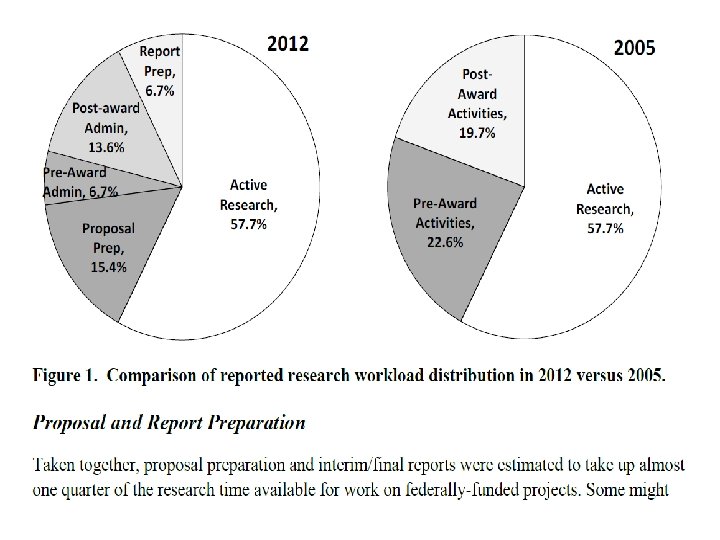
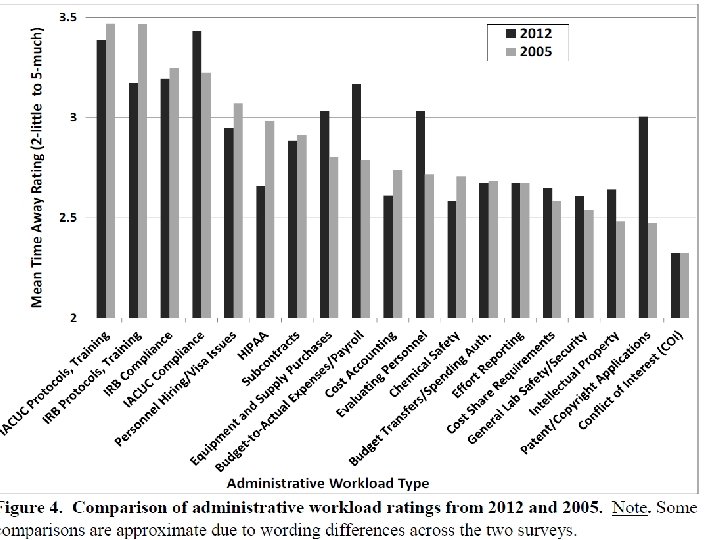
Grants Reform Federal Demonstration Partnership (FDP) Faculty Survey - 42% of a PI’s research time on administration http: //sites. nationalacademies. org/PGA/fdp/PGA_055749 Congressional Hearing on Administrative Workload in Federally Sponsored Research: www. ustream. tv/channel/hclive 10 Council on Financial Assistance Reform (COFAR) https: //cfo. gov/cofar/ Office of Management and Budget (OMB) on 12/26/2013 issued the Uniform Administrative Requirements, Cost Principles, and Audit Requirements for Federal Awards, i. e. 2 CFR Part 200
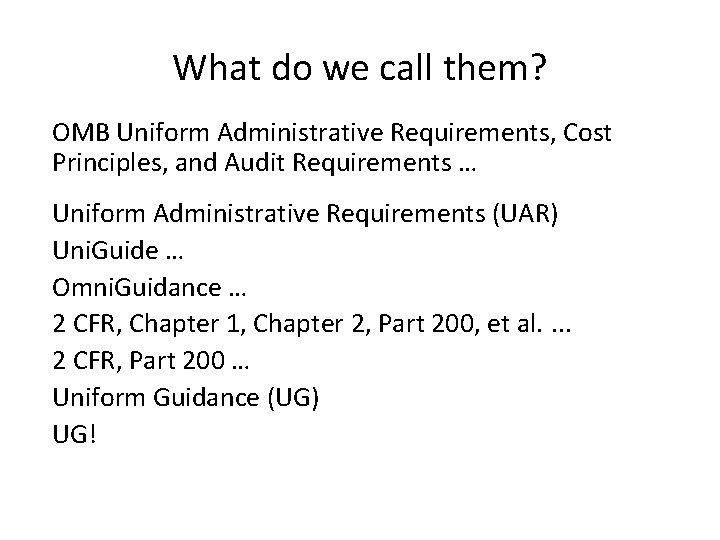
What do we call them? OMB Uniform Administrative Requirements, Cost Principles, and Audit Requirements … Uniform Administrative Requirements (UAR) Uni. Guide … Omni. Guidance … 2 CFR, Chapter 1, Chapter 2, Part 200, et al. . 2 CFR, Part 200 … Uniform Guidance (UG) UG!
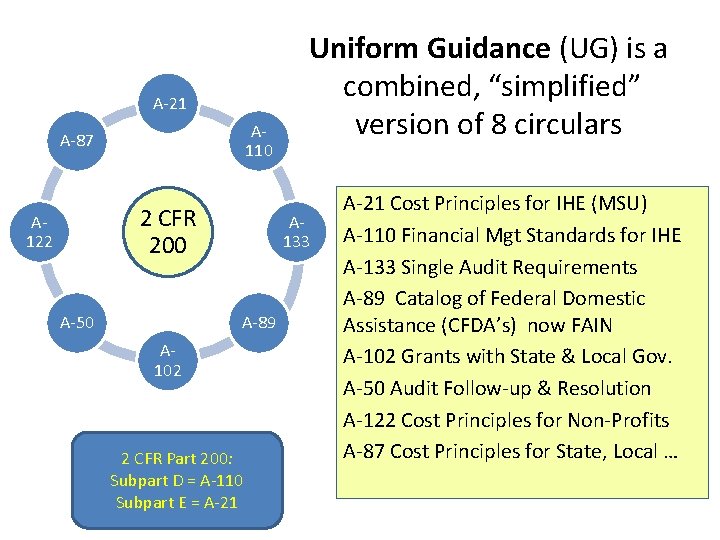
A-21 A 110 A-87 2 CFR 200 A 122 A-50 Uniform Guidance (UG) is a combined, “simplified” version of 8 circulars A 133 A-89 A 102 2 CFR Part 200: Subpart D = A-110 Subpart E = A-21 Cost Principles for IHE (MSU) A-110 Financial Mgt Standards for IHE A-133 Single Audit Requirements A-89 Catalog of Federal Domestic Assistance (CFDA’s) now FAIN A-102 Grants with State & Local Gov. A-50 Audit Follow-up & Resolution A-122 Cost Principles for Non-Profits A-87 Cost Principles for State, Local …
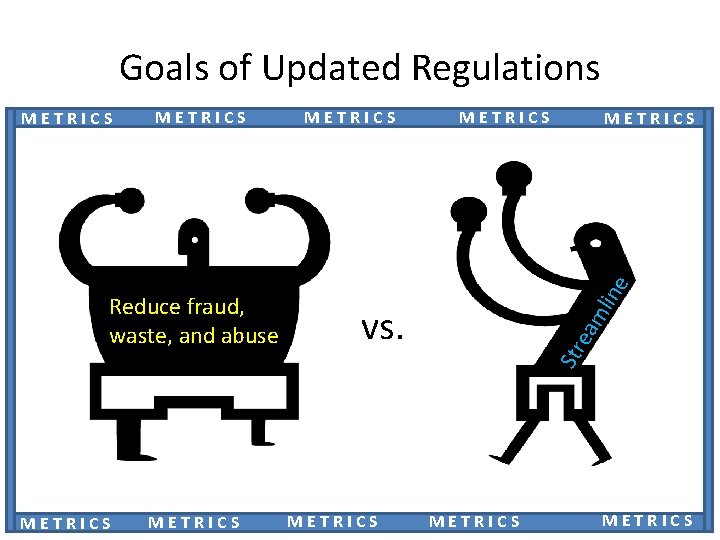
Goals of Updated Regulations METRICS ine vs. METRICS ml Reduce fraud, waste, and abuse METRICS ea METRICS Str METRICS
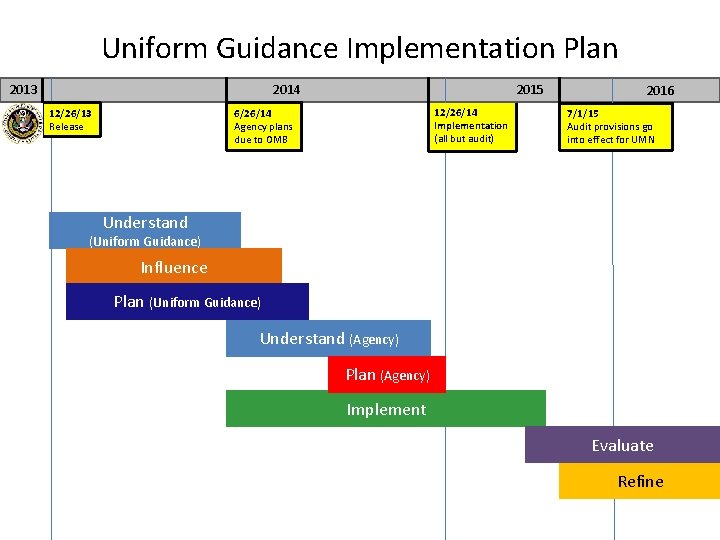
Uniform Guidance Implementation Plan 2013 2015 2014 12/26/13 Release 12/26/14 Implementation (all but audit) 6/26/14 Agency plans due to OMB 2016 7/1/15 Audit provisions go into effect for UMN Understand (Uniform Guidance) Influence Plan (Uniform Guidance) Understand (Agency) Plan (Agency) Implement Evaluate Refine
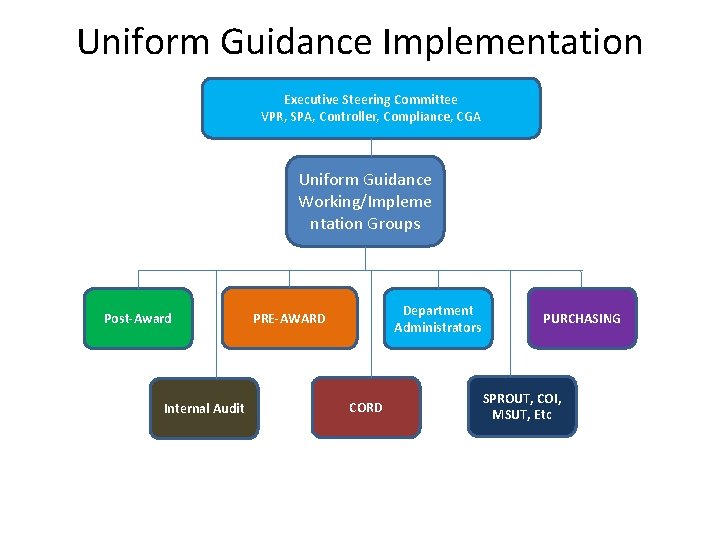
Uniform Guidance Implementation Executive Steering Committee VPR, SPA, Controller, Compliance, CGA Uniform Guidance Working/Impleme ntation Groups Post-Award Internal Audit Department Administrators PRE-AWARD CORD PURCHASING SPROUT, COI, MSUT, Etc
WHAT REGULATORY CHANGES MIGHT RESEARCHERS* CARE ABOUT? *and Research Administrators too!
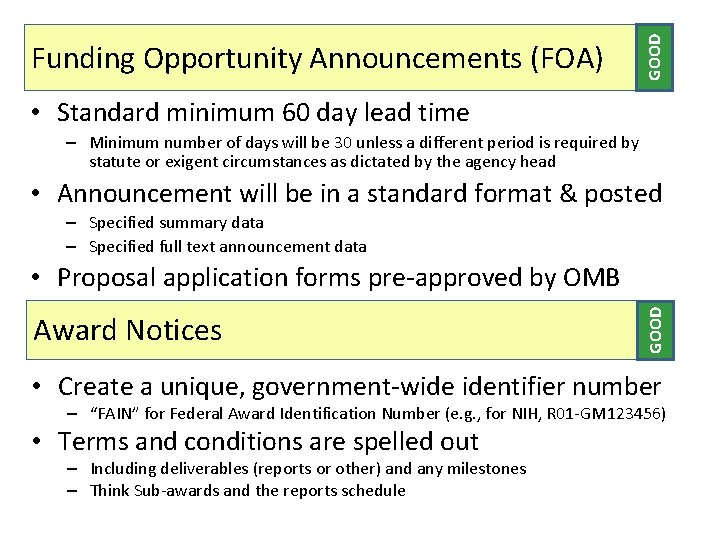
GOOD Funding Opportunity Announcements (FOA) • Standard minimum 60 day lead time – Minimum number of days will be 30 unless a different period is required by statute or exigent circumstances as dictated by the agency head • Announcement will be in a standard format & posted – Specified summary data – Specified full text announcement data Award Notices GOOD • Proposal application forms pre-approved by OMB • Create a unique, government-wide identifier number – “FAIN” for Federal Award Identification Number (e. g. , for NIH, R 01 -GM 123456) • Terms and conditions are spelled out – Including deliverables (reports or other) and any milestones – Think Sub-awards and the reports schedule
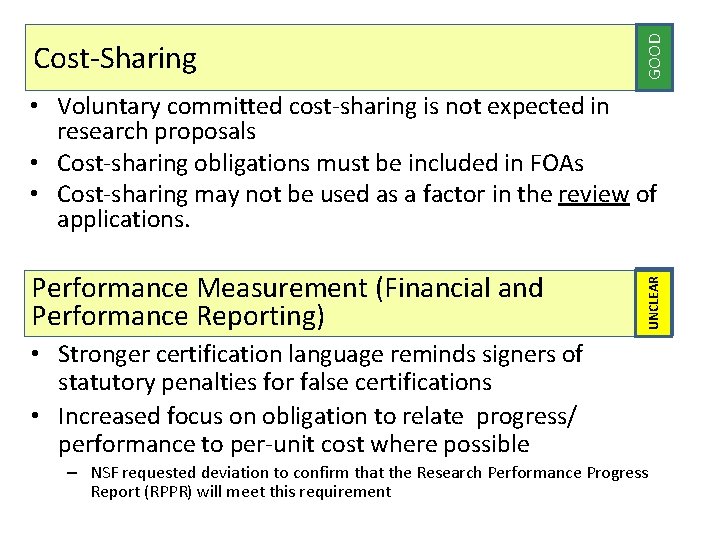
GOOD Cost-Sharing Performance Measurement (Financial and Performance Reporting) UNCLEAR BAD? • Voluntary committed cost-sharing is not expected in research proposals • Cost-sharing obligations must be included in FOAs • Cost-sharing may not be used as a factor in the review of applications. • Stronger certification language reminds signers of statutory penalties for false certifications • Increased focus on obligation to relate progress/ performance to per-unit cost where possible – NSF requested deviation to confirm that the Research Performance Progress Report (RPPR) will meet this requirement
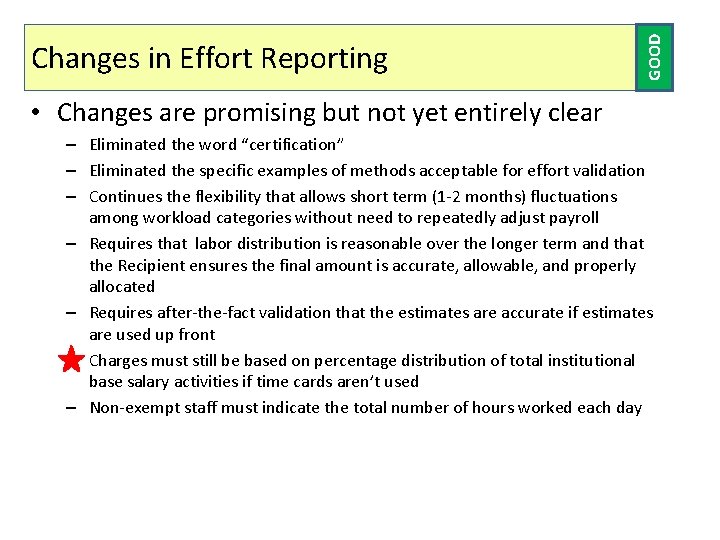
GOOD Changes in Effort Reporting • Changes are promising but not yet entirely clear – Eliminated the word “certification” – Eliminated the specific examples of methods acceptable for effort validation – Continues the flexibility that allows short term (1 -2 months) fluctuations among workload categories without need to repeatedly adjust payroll – Requires that labor distribution is reasonable over the longer term and that the Recipient ensures the final amount is accurate, allowable, and properly allocated – Requires after-the-fact validation that the estimates are accurate if estimates are used up front – Charges must still be based on percentage distribution of total institutional base salary activities if time cards aren’t used – Non-exempt staff must indicate the total number of hours worked each day
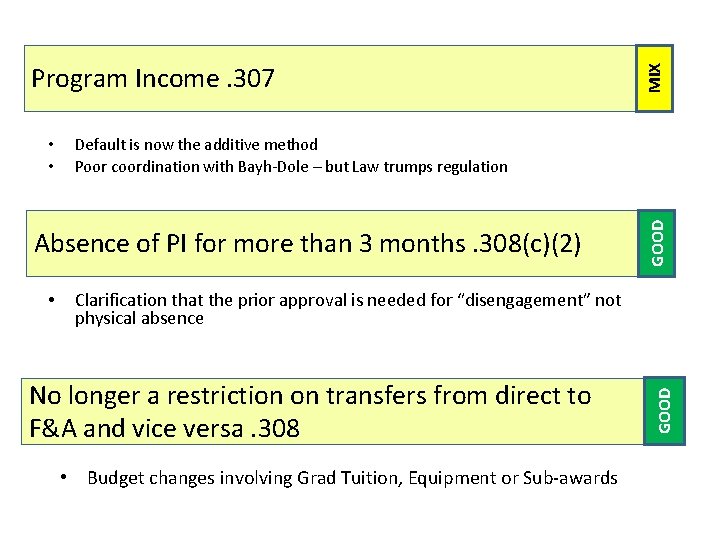
Absence of PI for more than 3 months. 308(c)(2) • GOOD Default is now the additive method Poor coordination with Bayh-Dole – but Law trumps regulation Clarification that the prior approval is needed for “disengagement” not physical absence No longer a restriction on transfers from direct to F&A and vice versa. 308 • Budget changes involving Grad Tuition, Equipment or Sub-awards GOOD • • MIX Program Income. 307
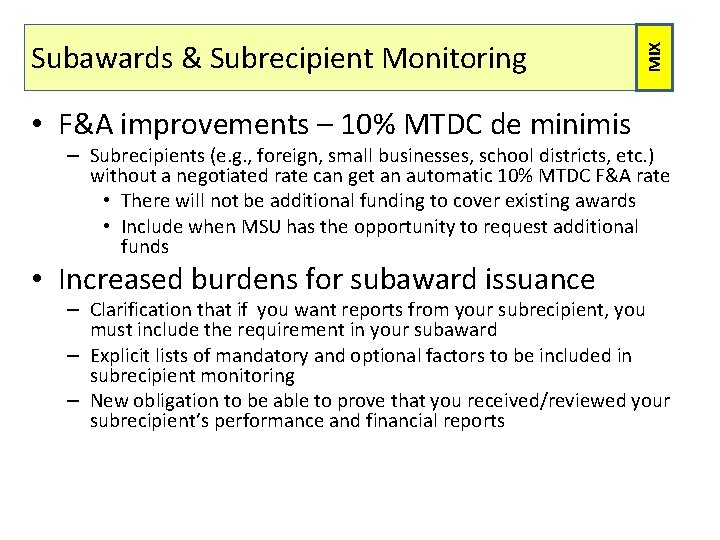
MIX Subawards & Subrecipient Monitoring • F&A improvements – 10% MTDC de minimis – Subrecipients (e. g. , foreign, small businesses, school districts, etc. ) without a negotiated rate can get an automatic 10% MTDC F&A rate • There will not be additional funding to cover existing awards • Include when MSU has the opportunity to request additional funds • Increased burdens for subaward issuance – Clarification that if you want reports from your subrecipient, you must include the requirement in your subaward – Explicit lists of mandatory and optional factors to be included in subrecipient monitoring – New obligation to be able to prove that you received/reviewed your subrecipient’s performance and financial reports
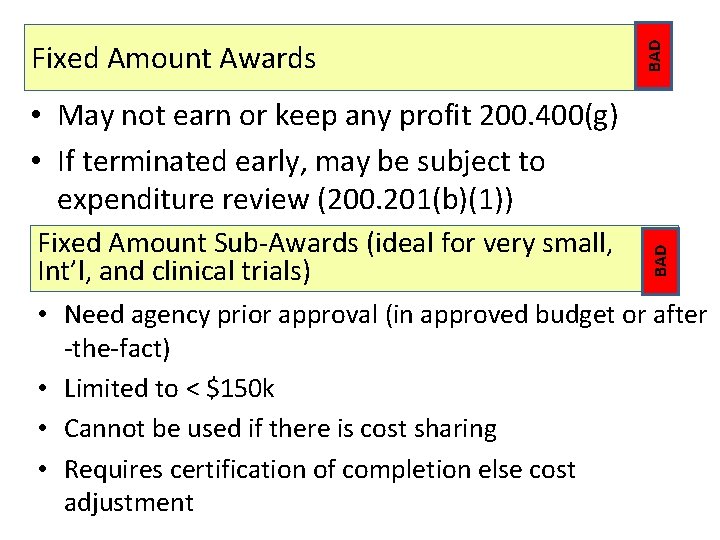
BAD Fixed Amount Awards Fixed Amount Sub-Awards (ideal for very small, Int’l, and clinical trials) BAD • May not earn or keep any profit 200. 400(g) • If terminated early, may be subject to expenditure review (200. 201(b)(1)) • Need agency prior approval (in approved budget or after -the-fact) • Limited to < $150 k • Cannot be used if there is cost sharing • Requires certification of completion else cost adjustment
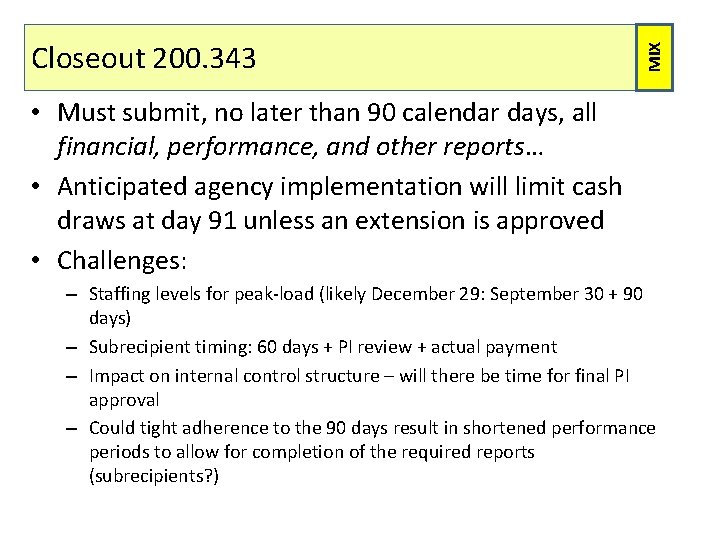
MIX Closeout 200. 343 • Must submit, no later than 90 calendar days, all financial, performance, and other reports… • Anticipated agency implementation will limit cash draws at day 91 unless an extension is approved • Challenges: – Staffing levels for peak-load (likely December 29: September 30 + 90 days) – Subrecipient timing: 60 days + PI review + actual payment – Impact on internal control structure – will there be time for final PI approval – Could tight adherence to the 90 days result in shortened performance periods to allow for completion of the required reports (subrecipients? )
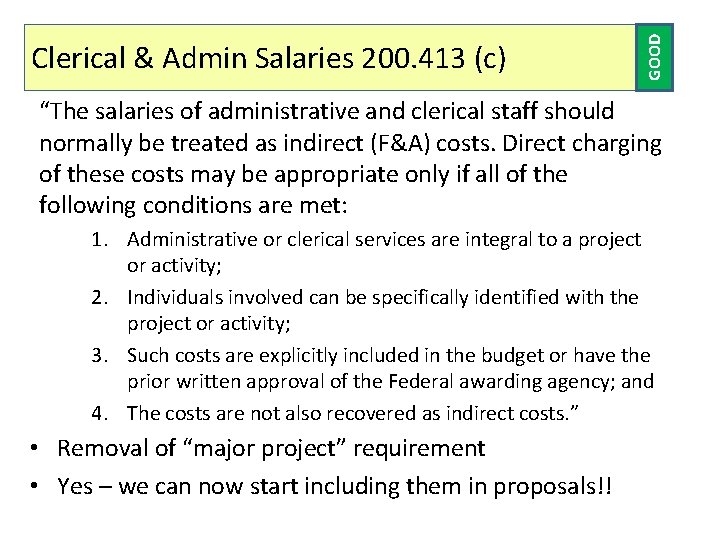
GOOD Clerical & Admin Salaries 200. 413 (c) “The salaries of administrative and clerical staff should normally be treated as indirect (F&A) costs. Direct charging of these costs may be appropriate only if all of the following conditions are met: 1. Administrative or clerical services are integral to a project or activity; 2. Individuals involved can be specifically identified with the project or activity; 3. Such costs are explicitly included in the budget or have the prior written approval of the Federal awarding agency; and 4. The costs are not also recovered as indirect costs. ” • Removal of “major project” requirement • Yes – we can now start including them in proposals!!
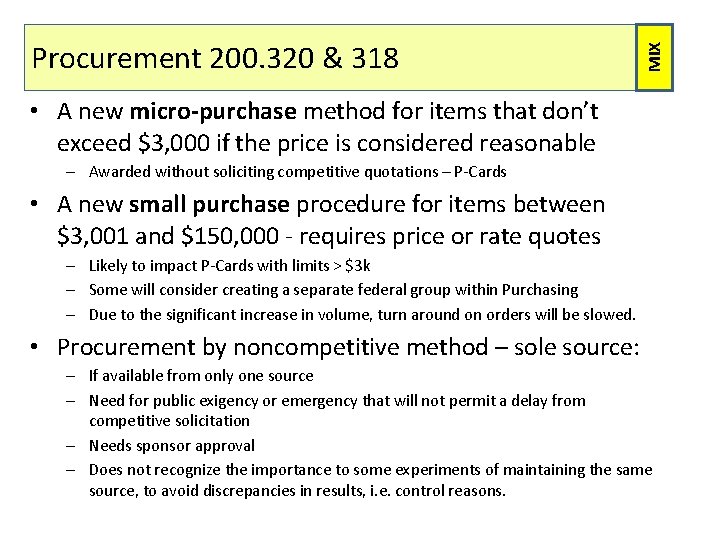
MIX Procurement 200. 320 & 318 • A new micro-purchase method for items that don’t exceed $3, 000 if the price is considered reasonable – Awarded without soliciting competitive quotations – P-Cards • A new small purchase procedure for items between $3, 001 and $150, 000 - requires price or rate quotes – Likely to impact P-Cards with limits > $3 k – Some will consider creating a separate federal group within Purchasing – Due to the significant increase in volume, turn around on orders will be slowed. • Procurement by noncompetitive method – sole source: – If available from only one source – Need for public exigency or emergency that will not permit a delay from competitive solicitation – Needs sponsor approval – Does not recognize the importance to some experiments of maintaining the same source, to avoid discrepancies in results, i. e. control reasons.
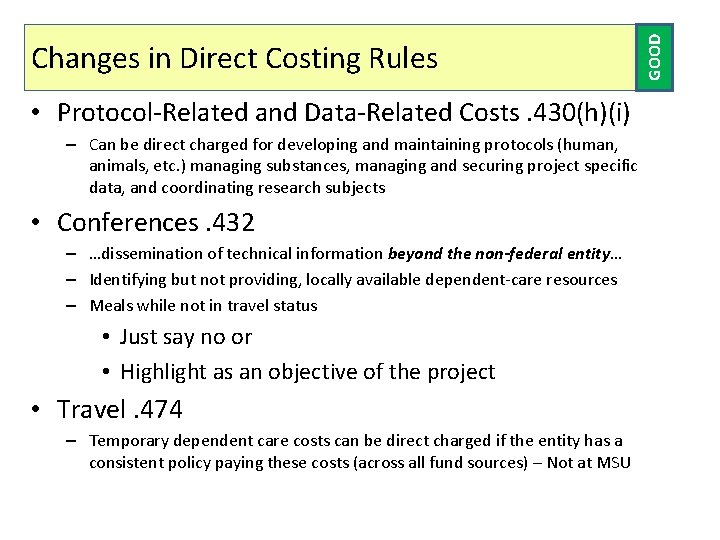
• Protocol-Related and Data-Related Costs. 430(h)(i) – Can be direct charged for developing and maintaining protocols (human, animals, etc. ) managing substances, managing and securing project specific data, and coordinating research subjects • Conferences. 432 – …dissemination of technical information beyond the non-federal entity… – Identifying but not providing, locally available dependent-care resources – Meals while not in travel status • Just say no or • Highlight as an objective of the project • Travel. 474 – Temporary dependent care costs can be direct charged if the entity has a consistent policy paying these costs (across all fund sources) – Not at MSU GOOD Changes in Direct Costing Rules
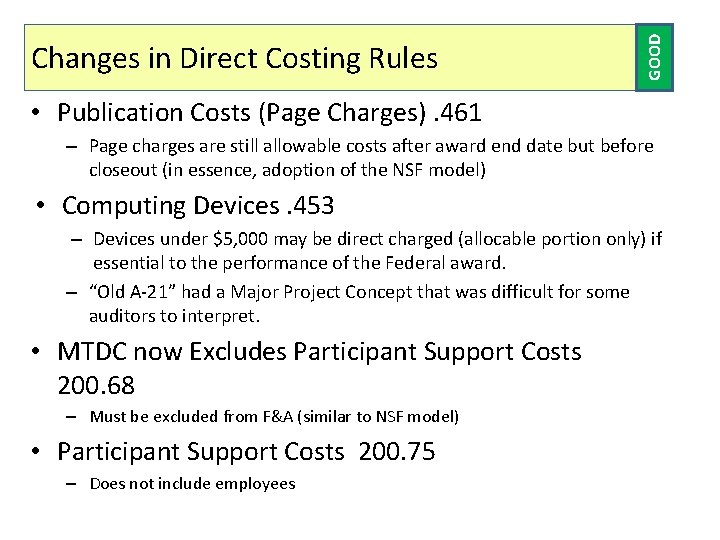
GOOD Changes in Direct Costing Rules • Publication Costs (Page Charges). 461 – Page charges are still allowable costs after award end date but before closeout (in essence, adoption of the NSF model) • Computing Devices. 453 – Devices under $5, 000 may be direct charged (allocable portion only) if essential to the performance of the Federal award. – “Old A-21” had a Major Project Concept that was difficult for some auditors to interpret. • MTDC now Excludes Participant Support Costs 200. 68 – Must be excluded from F&A (similar to NSF model) • Participant Support Costs 200. 75 – Does not include employees
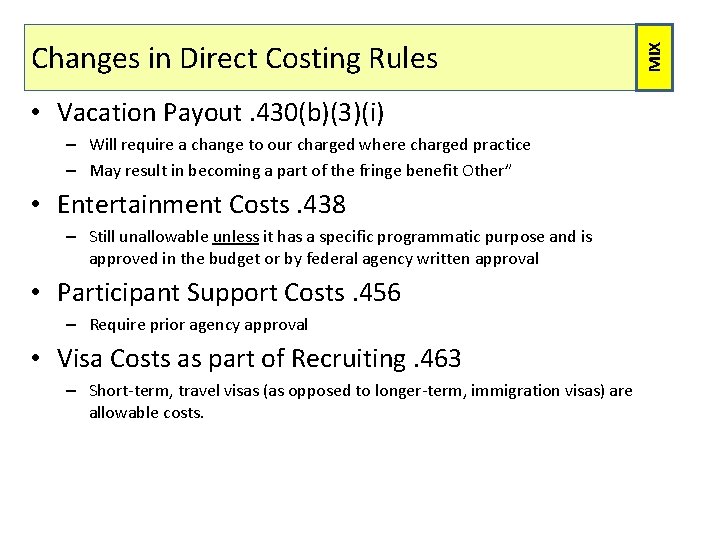
• Vacation Payout. 430(b)(3)(i) – Will require a change to our charged where charged practice – May result in becoming a part of the fringe benefit Other” • Entertainment Costs. 438 – Still unallowable unless it has a specific programmatic purpose and is approved in the budget or by federal agency written approval • Participant Support Costs. 456 – Require prior agency approval • Visa Costs as part of Recruiting. 463 – Short-term, travel visas (as opposed to longer-term, immigration visas) are allowable costs. MIX Changes in Direct Costing Rules
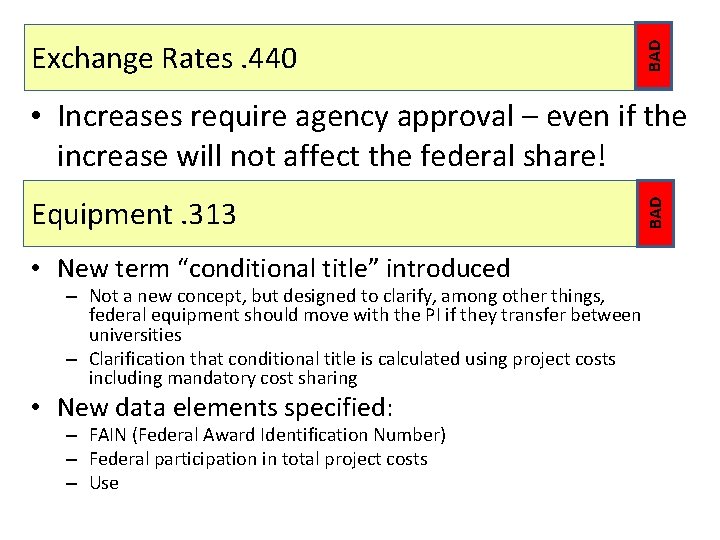
BAD Exchange Rates. 440 Equipment. 313 • New term “conditional title” introduced – Not a new concept, but designed to clarify, among other things, federal equipment should move with the PI if they transfer between universities – Clarification that conditional title is calculated using project costs including mandatory cost sharing • New data elements specified: – FAIN (Federal Award Identification Number) – Federal participation in total project costs – Use BAD • Increases require agency approval – even if the increase will not affect the federal share!
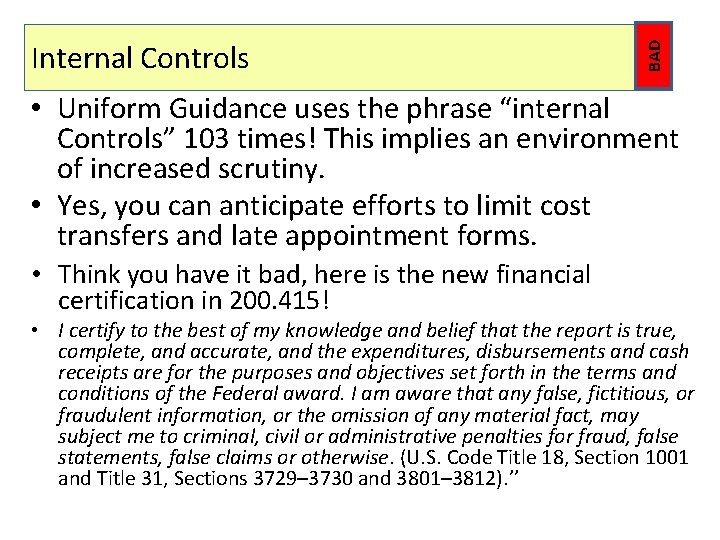
BAD Internal Controls • Uniform Guidance uses the phrase “internal Controls” 103 times! This implies an environment of increased scrutiny. • Yes, you can anticipate efforts to limit cost transfers and late appointment forms. • Think you have it bad, here is the new financial certification in 200. 415! • I certify to the best of my knowledge and belief that the report is true, complete, and accurate, and the expenditures, disbursements and cash receipts are for the purposes and objectives set forth in the terms and conditions of the Federal award. I am aware that any false, fictitious, or fraudulent information, or the omission of any material fact, may subject me to criminal, civil or administrative penalties for fraud, false statements, false claims or otherwise. (U. S. Code Title 18, Section 1001 and Title 31, Sections 3729– 3730 and 3801– 3812). ’’
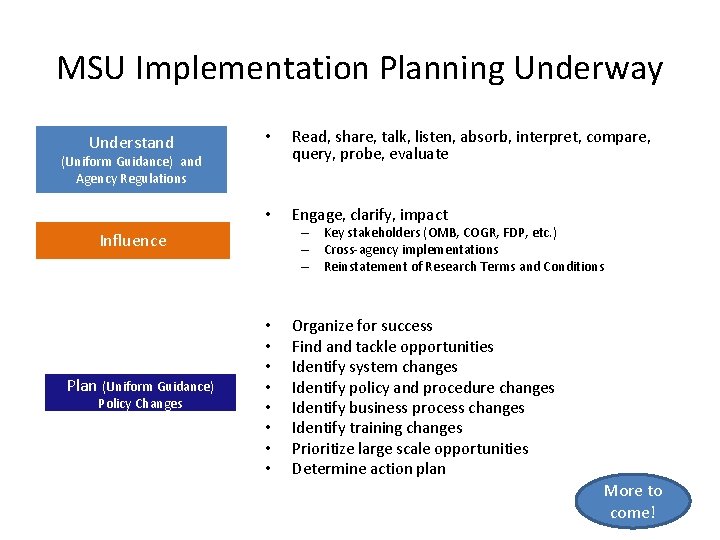
MSU Implementation Planning Underway Understand • Read, share, talk, listen, absorb, interpret, compare, query, probe, evaluate • Engage, clarify, impact (Uniform Guidance) and Agency Regulations – Key stakeholders (OMB, COGR, FDP, etc. ) – Cross-agency implementations – Reinstatement of Research Terms and Conditions Influence Plan (Uniform Guidance) Policy Changes • • Organize for success Find and tackle opportunities Identify system changes Identify policy and procedure changes Identify business process changes Identify training changes Prioritize large scale opportunities Determine action plan More to come!
Dan Evon Director, Contract & Grant Administration evon@cga. msu. edu (517) 884 -4234