
UNIFORM FIRE PREVENTION AND BUILDING CODE BRIEF HISTORY
UNIFORM FIRE PREVENTION AND BUILDING CODE: BRIEF HISTORY AND FLOOD REQUIREMENTS Daniel E. Nichols, P. E.
Overview � � � History of Uniform Code Applicability and enforcement Flood provisions: facts vs. myths Protection in the future Wrap-up/questions
Instructor Biography � Fire Protection Engineer; New York State Department of State � Member of several International Code Council Committees � Division of Code Enforcement and Administration Currently assigned to Kingston regional office Chairman, Fire Code Technical Subcommittee Active participant and manager; Disaster assistance response teams to southern tier, Catskills, and Long Island IBC- Fire Safety (past chairman) IBC- General CTC- Elevator Lobby Ad Hoc on Healthcare Member of several National Fire Protection Association Committees Historic Buildings and Cultural Resources Residential Board and Care Research Foundation on Smoke Alarm Functionality
Uniform Code History � In the early 1950’s, the Multiple Dwelling Law and Multiple Residence Law were created � First statewide requirements for construction � Still in effect todaay � At the same time, State Government starts to create a voluntary adoptable construction standard � “State Building Construction Code” � Very reminiscent to the first edition of the Basic Building Code, published by Building Officials and Code Administrators (BOCA) � All building types covered by 1959 (single family, residential, and commercial)
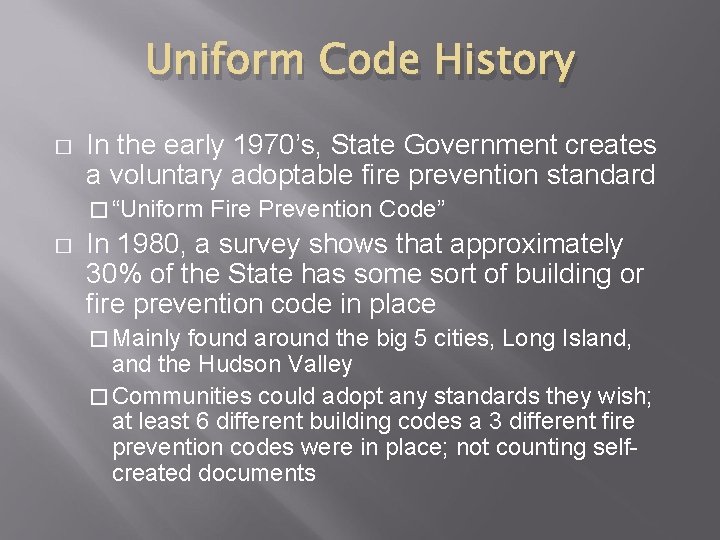
Uniform Code History � In the early 1970’s, State Government creates a voluntary adoptable fire prevention standard � “Uniform � Fire Prevention Code” In 1980, a survey shows that approximately 30% of the State has some sort of building or fire prevention code in place � Mainly found around the big 5 cities, Long Island, and the Hudson Valley � Communities could adopt any standards they wish; at least 6 different building codes a 3 different fire prevention codes were in place; not counting selfcreated documents
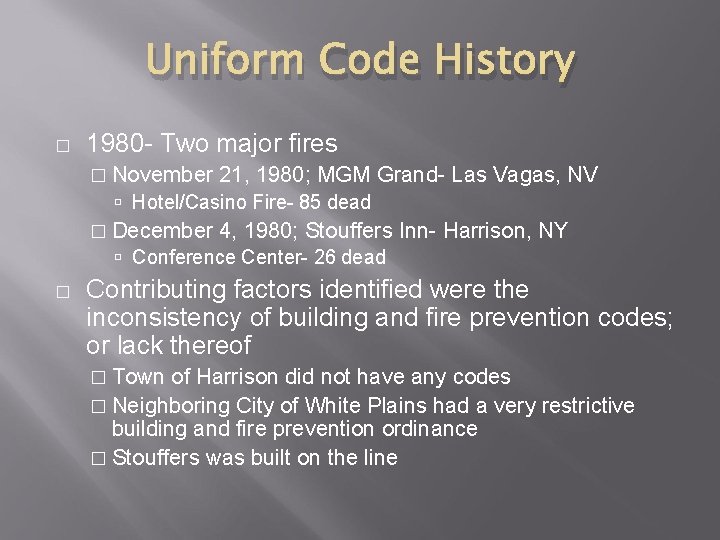
Uniform Code History � 1980 - Two major fires � November 21, 1980; MGM Grand- Las Vagas, NV Hotel/Casino Fire- 85 dead � December 4, 1980; Stouffers Inn- Harrison, NY Conference Center- 26 dead � Contributing factors identified were the inconsistency of building and fire prevention codes; or lack thereof � Town of Harrison did not have any codes � Neighboring City of White Plains had a very restrictive building and fire prevention ordinance � Stouffers was built on the line
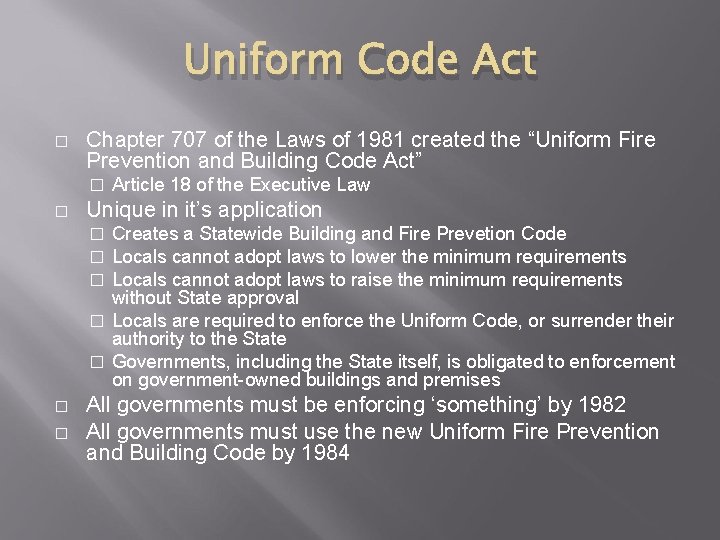
Uniform Code Act � Chapter 707 of the Laws of 1981 created the “Uniform Fire Prevention and Building Code Act” � � Article 18 of the Executive Law Unique in it’s application Creates a Statewide Building and Fire Prevetion Code Locals cannot adopt laws to lower the minimum requirements Locals cannot adopt laws to raise the minimum requirements without State approval � Locals are required to enforce the Uniform Code, or surrender their authority to the State � Governments, including the State itself, is obligated to enforcement on government-owned buildings and premises � � � All governments must be enforcing ‘something’ by 1982 All governments must use the new Uniform Fire Prevention and Building Code by 1984

How does code enforcement work? � Each City, Town, Village and County is responsible for code enforcement within their jurisdiction � � Counties enforce requirements on county-owned buildings Any county or local government can ‘opt-out’ of code enforcement Reverts to the next level of government of as delegated by the Secretary of State � Must meet the minimum requirements set by the Secretary of State 19 NYCRR Part 1203 � � City of New York permitted to continue with building and fire codes by Executive Law State Agencies must also follow the Uniform Code � � Done with an agency-designated code compliance manager Many agencies delegate their responsibility to other agencies OGS, DHESES, etc.
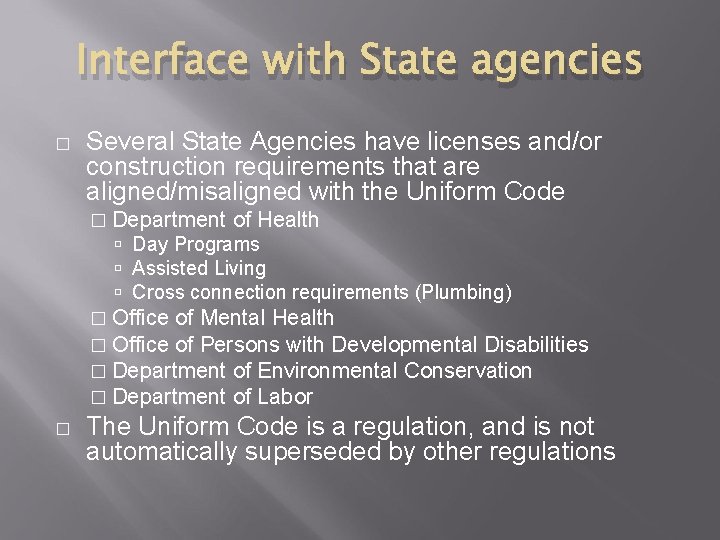
Interface with State agencies � Several State Agencies have licenses and/or construction requirements that are aligned/misaligned with the Uniform Code � Department of Health Day Programs Assisted Living Cross connection requirements (Plumbing) � Office of Mental Health � Office of Persons with Developmental Disabilities � Department of Environmental Conservation � Department of Labor � The Uniform Code is a regulation, and is not automatically superseded by other regulations
Understanding flood provisions � Flood-resistant construction is based upon whether a building is in a ‘flood hazard area’ � Within the 1% chance per year flood plain (100 year event) � Designated as a flood hazard area on a community’s flood hazard map or otherwise designated

2 Types of Flooding RUNOFF FLOODING WAVE ACTION FLOODING
Terms commonly used with flood preparation outside the Uniform Code � “Flood evacuation zones” � Developed by local jurisdictions to prioritize evacuation needs, based on flood potential, access, and population � Not a tool for determining flood-resistance of buildings � Useful as part of a fire safety and evacuation plan � “Freeboard” �A prescriptive elevation requirement within the Residential Code of New York State and ASCE 24 BOTH TERMS ARE NOT USED WITHIN THE BUILDING CODE OF NEW YORK STATE
Building Code Requirements � Determine Building Category � Medical buildings (Group I-2) with surgery or ED: Category 4 � Other medical buildings (Group I-2) over 50 patients: Category 3 � Other medical buildings, such as residential board and care, assisted living, and small nursing homes: Category 2

Building Code Requirements � Determine flood hazard area � Base flood Elevation � Design Flood Elevation � Zone categories
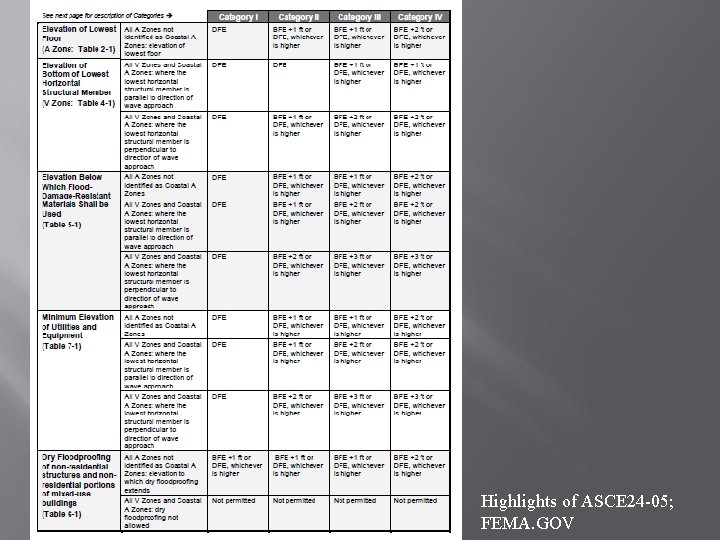
Highlights of ASCE 24 -05; FEMA. GOV
Building Code Effectiveness � Flood design becomes an issue in the 1970’s � Model Building Code began recognition long after the National Flood Insurance Program is developed � State of New York updates the code to national standards in 2003 (previously based on 1951) � City of New York updates the code to national standards in 2008 (previously based on 1968)
Building Code Effectiveness � � Building codes are not retroactive for construction features Flood-resistant construction is required for: � New buildings � Additions � Substantially damaged

Do flood resistant construction requirements work?

International Code Council � � � Adopted building code in almost every state and territory in the United States of America Based on the combination of 3 regional model code groups in 2000 Takes regional information and experience and makes it available to all � Flooding- Mississippi, Texas � Hurricanes: Carolinas, Florida, Louisiana � Snow- Colorado, Maine, Vermont, Alaska � Wildfires- Arizona, Utah, New York � Earthquakes- California, Hawaii
Other items for consideration � � Emergency Power supplies Building access � Stairs/ramps � Personnel � Evacuation � Medical needs � Oxygen � Waste � disposal Fuel sources
Questions? Daniel E. Nichols, P. E. New York State Department of State Division of Code Enforcement and Administration 1 Albany Ave. Suite G-5 Kingston , NY 12401 845. 334. 9768 Dan. nichols@dos. ny. gov
- Slides: 21