
Unified picture of electroweak symmetry breaking and family
Unified picture of electroweak symmetry breaking and family structure Junji Hisano (Nagoya Univ. ) On behalf of research group B 02 International Kickoff Meeting “Physics in LHC and early universe” Date: 9 th to 11 th, January, 2017 Place: The University of Tokyo 1
Contents of this talk • Introduction of B 02 • Precision studies of the Higgs coupling Electroweak Phase Transition, Elecroweak baryogensis • Higgs mass in SUSY SM • Tools of analysis for searches for NP @ LHC 2
NEW ERA COMES ! Higgs sector is a window to the BSM. • What derives μ 2 to be negative ? • What stablizes the radiative correction to μ 2 ? • Higgs doublet is only one or more? • Higgs fields are only SU(2) doublet? These questions are linked to the BSM@Te. Vs. 3
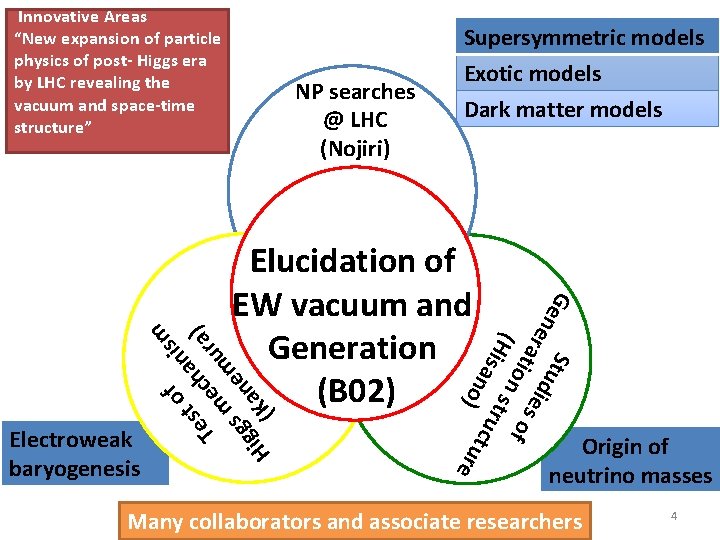
Innovative Areas “New expansion of particle physics of post- Higgs era by LHC revealing the vacuum and space-time structure” NP searches @ LHC (Nojiri) Supersymmetric models Exotic models Dark matter models m s f i o an t s ch a) e T e ur m m s e g n g Hi (Ka Electroweak baryogenesis Ge St n er udie a t io s o (H n s f i s an truc o ) ture Elucidation of EW vacuum and Generation (B 02) Origin of neutrino masses Many collaborators and associate researchers 4
Precision studies of the Higgs coupling 5
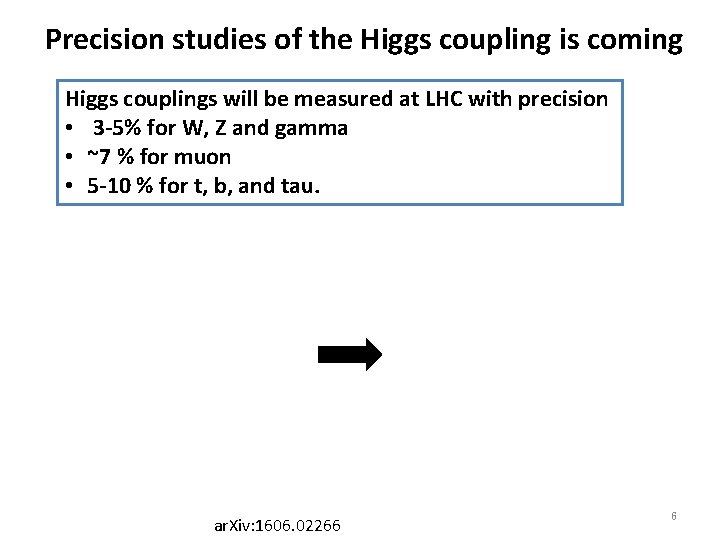
Precision studies of the Higgs coupling is coming Higgs couplings will be measured at LHC with precision • 3 -5% for W, Z and gamma • ~7 % for muon • 5 -10 % for t, b, and tau. ar. Xiv: 1606. 02266 6
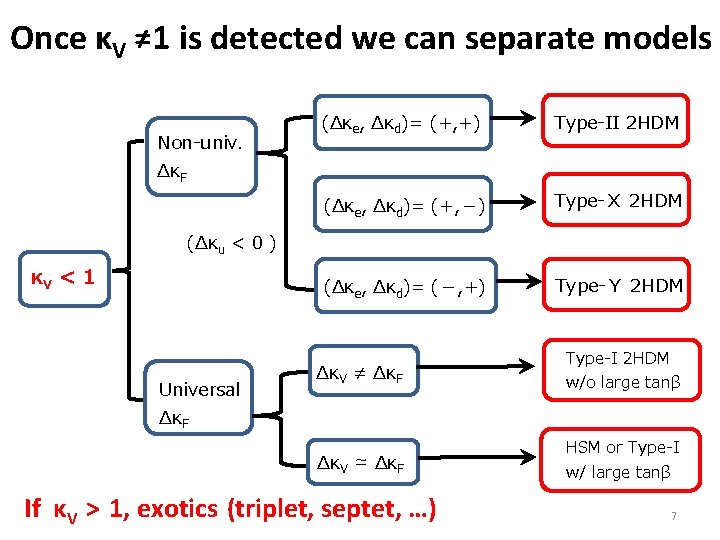
Once κV ≠ 1 is detected we can separate models Non-univ. (Δκe, Δκd)= (+, +) Type-II 2 HDM (Δκe, Δκd)= (+, -) Type-X 2 HDM (Δκe, Δκd)= (-, +) Type-Y 2 HDM ΔκF (Δκu < 0 ) κV < 1 Universal ΔκV ≠ ΔκF Type-I 2 HDM w/o large tanβ ΔκF ΔκV ≃ ΔκF If κV > 1, exotics (triplet, septet, …) HSM or Type-I w/ large tanβ 7
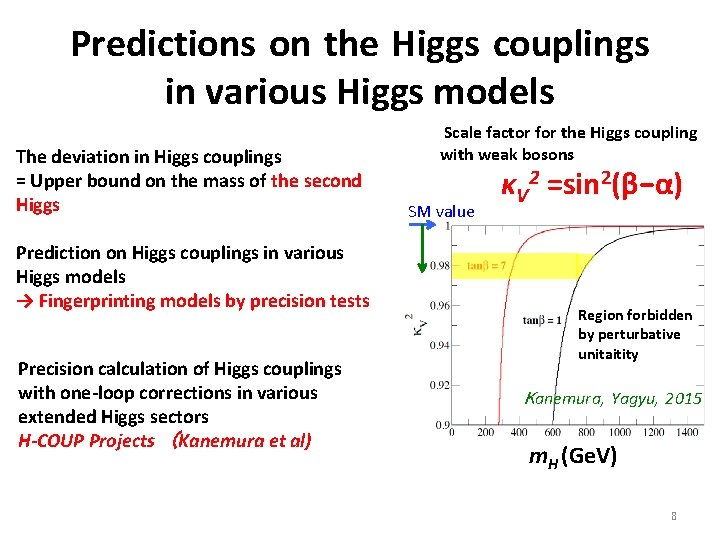
Predictions on the Higgs couplings in various Higgs models The deviation in Higgs couplings = Upper bound on the mass of the second Higgs Prediction on Higgs couplings in various Higgs models → Fingerprinting models by precision tests Precision calculation of Higgs couplings with one-loop corrections in various extended Higgs sectors H-COUP Projects (Kanemura et al) Scale factor for the Higgs coupling with weak bosons SM value κV 2 =sin 2(β−α) Region forbidden by perturbative unitaitity Kanemura, Yagyu, 2015 m. H (Ge. V) 8
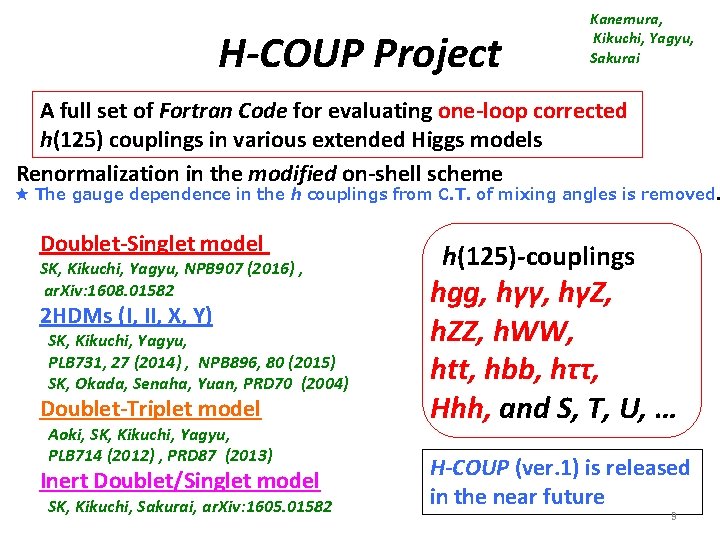
H-COUP Project Kanemura, Kikuchi, Yagyu, Sakurai A full set of Fortran Code for evaluating one-loop corrected h(125) couplings in various extended Higgs models Renormalization in the modified on-shell scheme ★ The gauge dependence in the h couplings from C. T. of mixing angles is removed. Doublet-Singlet model SK, Kikuchi, Yagyu, NPB 907 (2016) , ar. Xiv: 1608. 01582 2 HDMs (I, II, X, Y) SK, Kikuchi, Yagyu, PLB 731, 27 (2014) , NPB 896, 80 (2015) SK, Okada, Senaha, Yuan, PRD 70 (2004) Doublet-Triplet model Aoki, SK, Kikuchi, Yagyu, PLB 714 (2012) , PRD 87 (2013) Inert Doublet/Singlet model SK, Kikuchi, Sakurai, ar. Xiv: 1605. 01582 h(125)-couplings hgg, hγγ, hγZ, h. ZZ, h. WW, htt, hbb, hττ, Hhh, and S, T, U, … H-COUP (ver. 1) is released in the near future 9
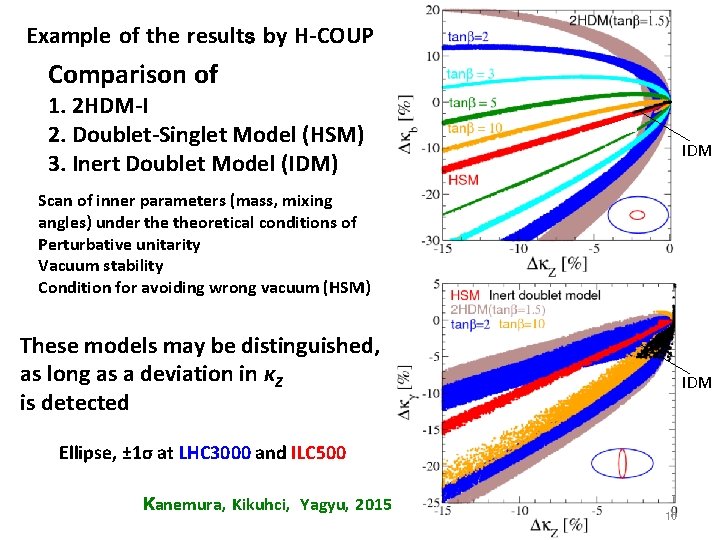
Example of the results by H-COUP Comparison of 1. 2 HDM-I 2. Doublet-Singlet Model (HSM) 3. Inert Doublet Model (IDM) IDM Scan of inner parameters (mass, mixing angles) under theoretical conditions of Perturbative unitarity Vacuum stability Condition for avoiding wrong vacuum (HSM) These models may be distinguished, as long as a deviation in κZ is detected IDM Ellipse, ± 1σ at LHC 3000 and ILC 500 Kanemura, Kikuhci, Yagyu, 2015 10
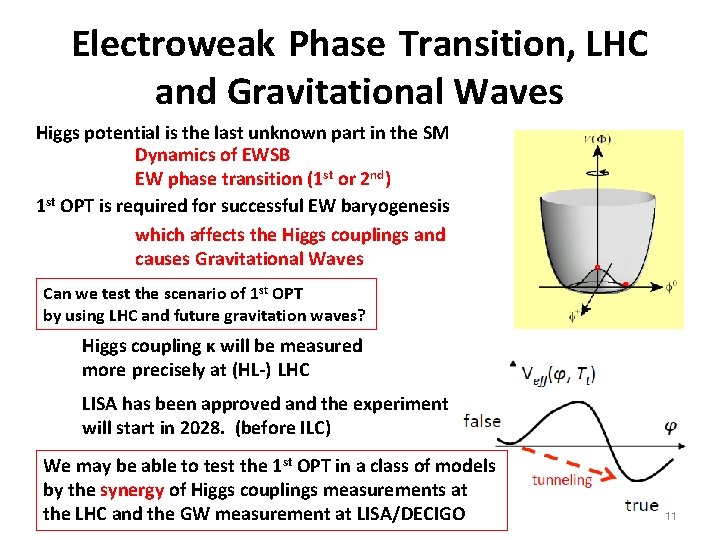
Electroweak Phase Transition, LHC and Gravitational Waves Higgs potential is the last unknown part in the SM Dynamics of EWSB EW phase transition (1 st or 2 nd) 1 st OPT is required for successful EW baryogenesis which affects the Higgs couplings and causes Gravitational Waves Can we test the scenario of 1 st OPT by using LHC and future gravitation waves? Higgs coupling κ will be measured more precisely at (HL-) LHC LISA has been approved and the experiment will start in 2028. (before ILC) We may be able to test the 1 st OPT in a class of models by the synergy of Higgs couplings measurements at the LHC and the GW measurement at LISA/DECIGO 11
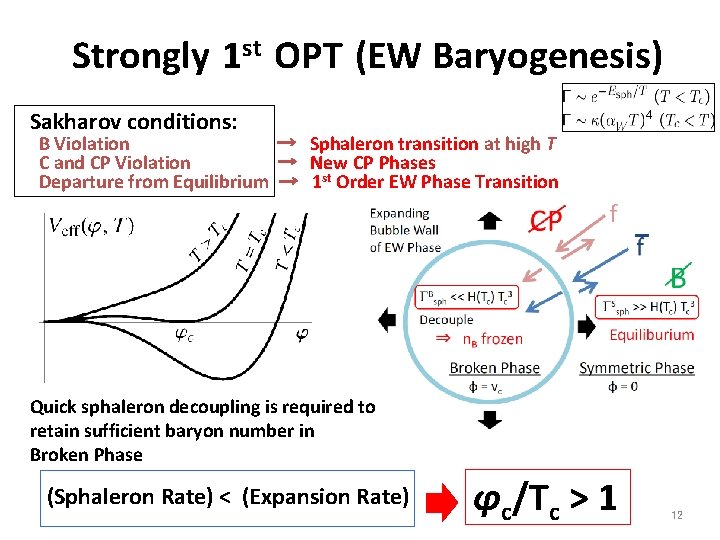
Strongly 1 st OPT (EW Baryogenesis) Sakharov conditions: B Violation → Sphaleron transition at high T C and CP Violation → New CP Phases Departure from Equilibrium → 1 st Order EW Phase Transition Quick sphaleron decoupling is required to retain sufficient baryon number in Broken Phase (Sphaleron Rate) < (Expansion Rate) φc/Tc > 1 12
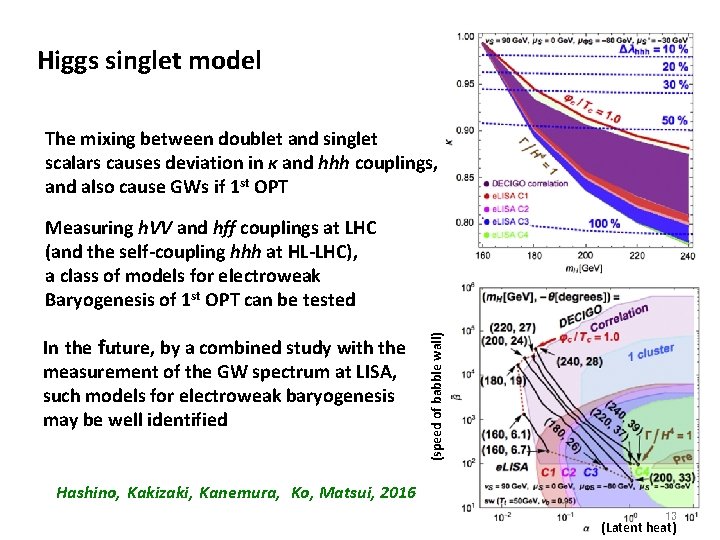
Higgs singlet model The mixing between doublet and singlet scalars causes deviation in κ and hhh couplings, and also cause GWs if 1 st OPT In the future, by a combined study with the measurement of the GW spectrum at LISA, such models for electroweak baryogenesis may be well identified (speed of babble wall) Measuring h. VV and hff couplings at LHC (and the self-coupling hhh at HL-LHC), a class of models for electroweak Baryogenesis of 1 st OPT can be tested Hashino, Kakizaki, Kanemura, Ko, Matsui, 2016 13 (Latent heat)
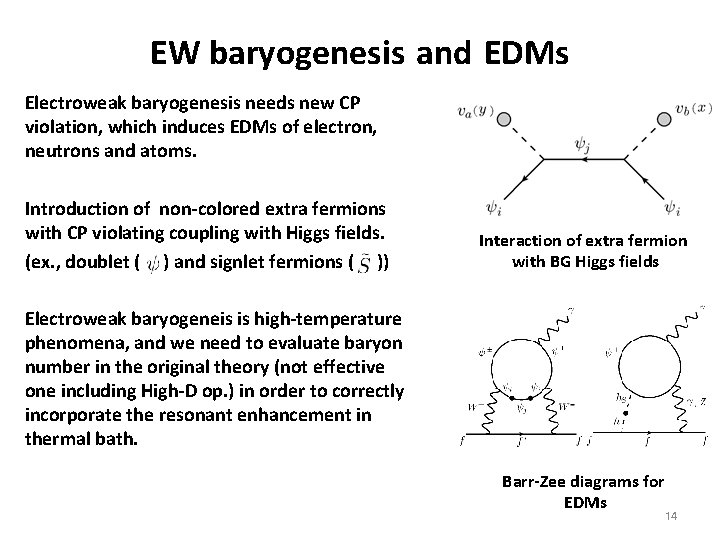
EW baryogenesis and EDMs Electroweak baryogenesis needs new CP violation, which induces EDMs of electron, neutrons and atoms. Introduction of non-colored extra fermions with CP violating coupling with Higgs fields. (ex. , doublet ( ) and signlet fermions ( )) Interaction of extra fermion with BG Higgs fields Electroweak baryogeneis is high-temperature phenomena, and we need to evaluate baryon number in the original theory (not effective one including High-D op. ) in order to correctly incorporate the resonant enhancement in thermal bath. Barr-Zee diagrams for EDMs 14
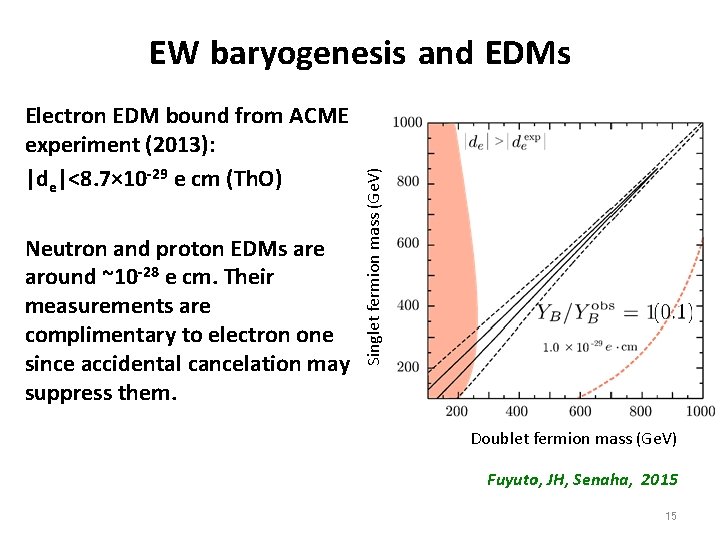
Electron EDM bound from ACME experiment (2013): |de|<8. 7× 10 -29 e cm (Th. O) Neutron and proton EDMs are around ~10 -28 e cm. Their measurements are complimentary to electron one since accidental cancelation may suppress them. Singlet fermion mass (Ge. V) EW baryogenesis and EDMs Doublet fermion mass (Ge. V) Fuyuto, JH, Senaha, 2015 15
Higgs mass in SUSY SM gives a chance to understand questions, • what derives μ 2 to be negative ? • what stablizes the radiative correction to μ 2 ? 16
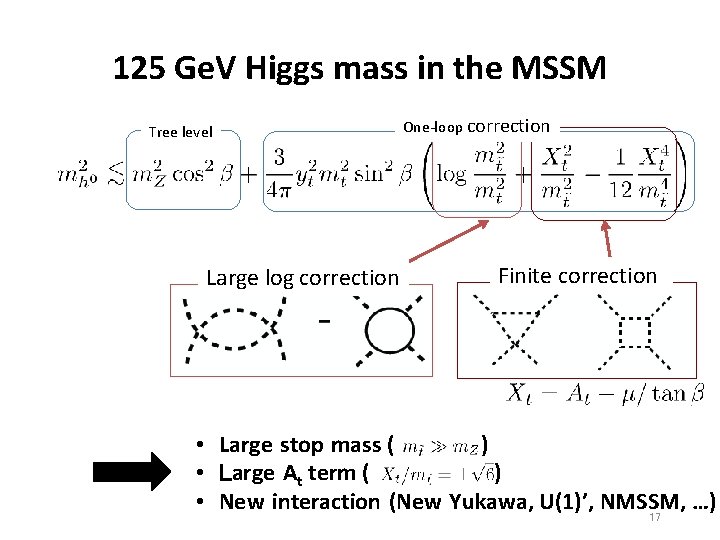
125 Ge. V Higgs mass in the MSSM Tree level Large log correction One-loop correction Finite correction • Large stop mass ( ) • Large At term ( ) • New interaction (New Yukawa, U(1)’, NMSSM, …) 17
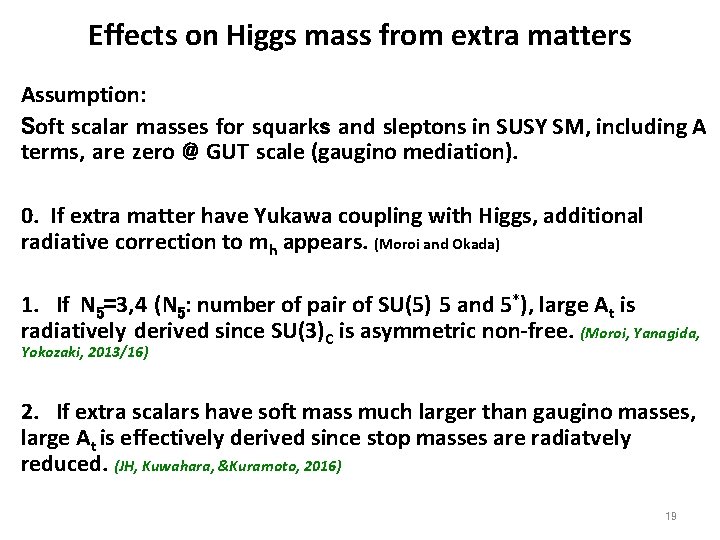
Effects on Higgs mass from extra matters Assumption: Soft scalar masses for squarks and sleptons in SUSY SM, including A terms, are zero @ GUT scale (gaugino mediation). 0. If extra matter have Yukawa coupling with Higgs, additional radiative correction to mh appears. (Moroi and Okada) 1. If N 5=3, 4 (N 5: number of pair of SU(5) 5 and 5*), large At is radiatively derived since SU(3)C is asymmetric non-free. (Moroi, Yanagida, Yokozaki, 2013/16) 2. If extra scalars have soft mass much larger than gaugino masses, large At is effectively derived since stop masses are radiatvely reduced. (JH, Kuwahara, &Kuramoto, 2016) 19
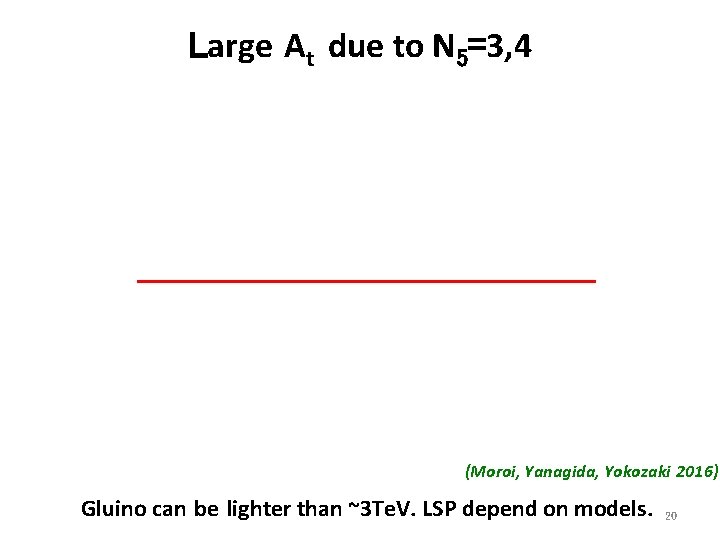
Large At due to N 5=3, 4 (Moroi, Yanagida, Yokozaki 2016) Gluino can be lighter than ~3 Te. V. LSP depend on models. 20
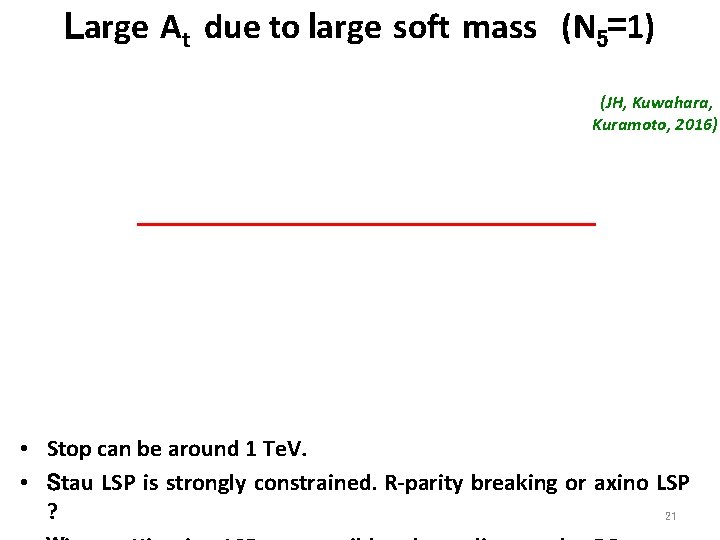
Large At due to large soft mass (N 5=1) (JH, Kuwahara, Kuramoto, 2016) • Stop can be around 1 Te. V. • Stau LSP is strongly constrained. R-parity breaking or axino LSP ? 21
Tools of analysis for searches for NP @ LHC • NLO calculation • gluon-quark separation • Photon jets • Anomalies are chances to develop methods for analysis. 22
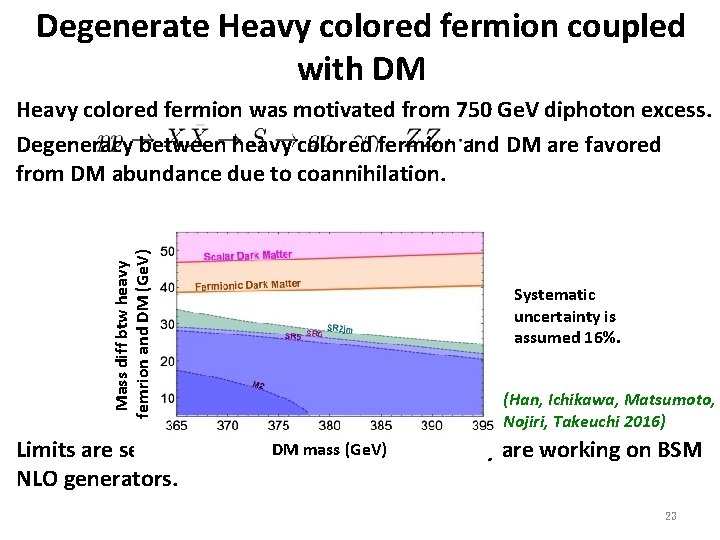
Degenerate Heavy colored fermion coupled with DM Mass diff btw heavy femrion and DM (Ge. V) Heavy colored fermion was motivated from 750 Ge. V diphoton excess. Degeneracy between heavy colored fermion and DM are favored from DM abundance due to coannihilation. Systematic uncertainty is assumed 16%. (Han, Ichikawa, Matsumoto, Nojiri, Takeuchi 2016) mass (Ge. V) Now they are working on BSM Limits are sensitive to NLODM correction. NLO generators. 23
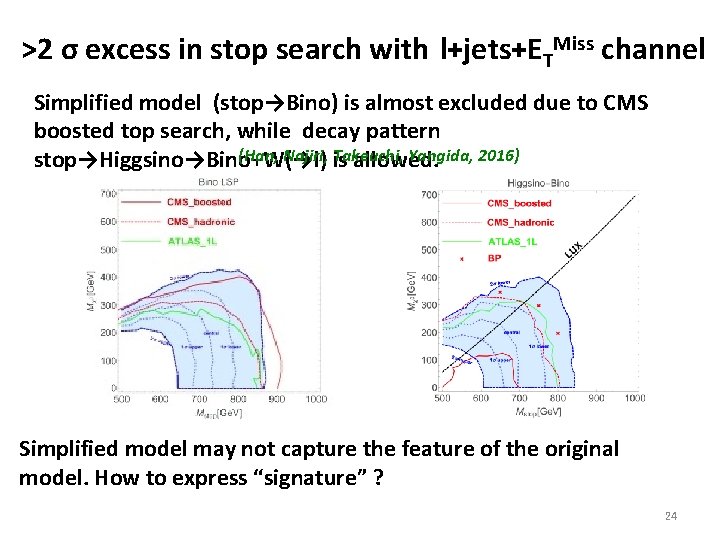
>2 σ excess in stop search with l+jets+ETMiss channel Simplified model (stop→Bino) is almost excluded due to CMS boosted top search, while decay pattern (Han, Nojiri, is Takeuchi, Yangida, 2016) stop→Higgsino→Bino+W(→l) allowed. Simplified model may not capture the feature of the original model. How to express “signature” ? 24
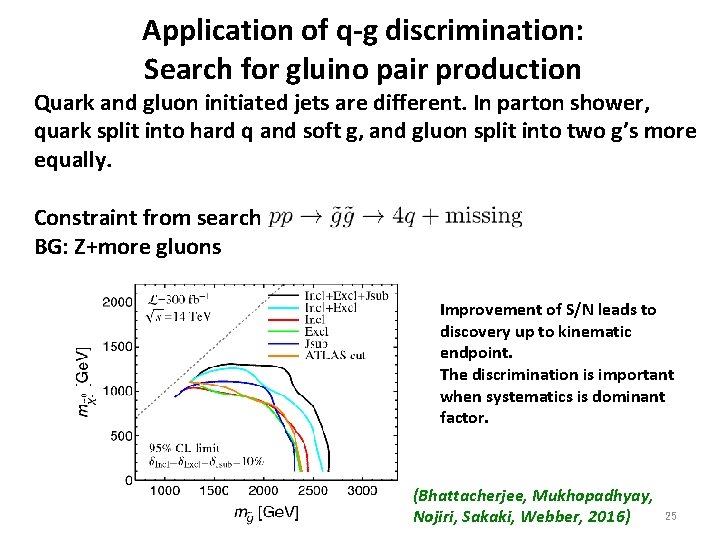
Application of q-g discrimination: Search for gluino pair production Quark and gluon initiated jets are different. In parton shower, quark split into hard q and soft g, and gluon split into two g’s more equally. Constraint from search BG: Z+more gluons Improvement of S/N leads to discovery up to kinematic endpoint. The discrimination is important when systematics is dominant factor. (Bhattacherjee, Mukhopadhyay, Nojiri, Sakaki, Webber, 2016) 25
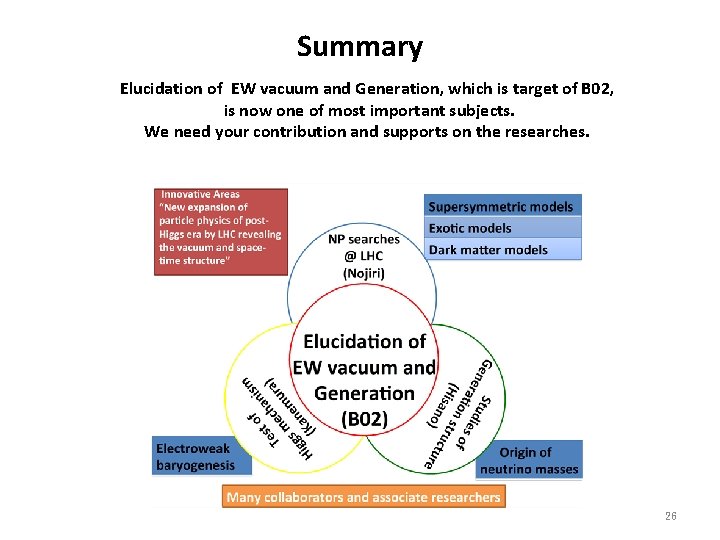
Summary Elucidation of EW vacuum and Generation, which is target of B 02, is now one of most important subjects. We need your contribution and supports on the researches. 26
- Slides: 25