
Unified Modeling Language User Guide Section 1Getting Started
- Slides: 49
Unified Modeling Language User Guide Section 1—Getting Started
Paper • • Konsep Object dan Class Intro UML Enrollkey: pbotik-h Minngu depan – Review intro UML – Object oriented modeling Sung Kim CS 6359 Slide 2
Overview • Why we model – Importance – Principles – Object-oriented modeling • Introducing UML – UML Overview – Conceptual model of UML – Architecture – Software development life-cycle Sung Kim CS 6359 Slide 3
What is a model? • A model is a simplification of reality. • A set of blueprints of a system. • Semantically closed abstraction of the system. • A model is an abstraction of something for the purpose of understanding it before building it. Sung Kim CS 6359 Slide 4
Why We Model • Communicate a desired structure and behavior of a software system. • Visualize and control a system’s architecture. • Assist in understanding a system under development. • Expose opportunities for simplification and reuse. • Manage risk. • Document decisions. Sung Kim CS 6359 Slide 5
Importance of Modeling • Proven and accepted engineering technique; divide-and-conquer. • We build models of complex systems because we cannot comprehend such a system in its entirety. • Desire to build the right software right. Sung Kim CS 6359 Slide 6
Principles of Modeling 1. The choice of what models to create has a profound influence on how a problem is attacked and how a solution is shaped. 2. Every model may be expressed at different levels of precision. 3. The best models are connected to reality. 4. No single model is sufficient. Every nontrivial system is best approached through a small set of nearly independent models. Sung Kim CS 6359 Slide 7
Modeling Comparison • Functional – Algorithmic perspective – Building blocks of functions or procedures – Yields brittle systems • Object-Oriented – Building blocks of classes or objects. – Drawn from the vocabulary of the problem space. Sung Kim CS 6359 Slide 8
Object vs. Class • Object – Thing drawn from the problem domain or solution space. – Instantiation of class. – Has identity, state, and behavior. • Class – Description of a set of common objects. Sung Kim CS 6359 Slide 9
Introducing UML • Used to visualize, specify, construct, and document • …appropriate for modeling systems ranging from enterprise information systems to distributed Web-based applications and even to hard real time embedded systems. • Process independent. Sung Kim CS 6359 Slide 10
UML is a Language • Vocabulary and rules for communication. • Focus on conceptual and physical representations of a system. • A language for software blueprints. • Not a process. Sung Kim CS 6359 Slide 11
A UML Compatible Process • • Use case driven Architecture-centric Iterative Incremental Sung Kim CS 6359 Slide 12
UML is for Visualizing • An explicit model facilitates communication. • UML is a graphical language. • UML symbols are based on well-defined semantics. Sung Kim CS 6359 Slide 13
UML is for Specifying • Specifying means building models that are: – Precise – Unambiguous – Complete • UML addresses the specification of all important analysis, design, and implementation decisions. Sung Kim CS 6359 Slide 14
UML is for Constructing • Models are related to OO programming languages. • Round-trip engineering – Forward engineering—direct mapping of a UML model into code. – Reverse engineering—reconstruction of a UML model from an implementation. – Requires tool and human intervention to avoid information loss. Sung Kim CS 6359 Slide 15
UML is for Documenting • • Architecture Requirements Tests Activities – Project planning – Release management Sung Kim CS 6359 Slide 16
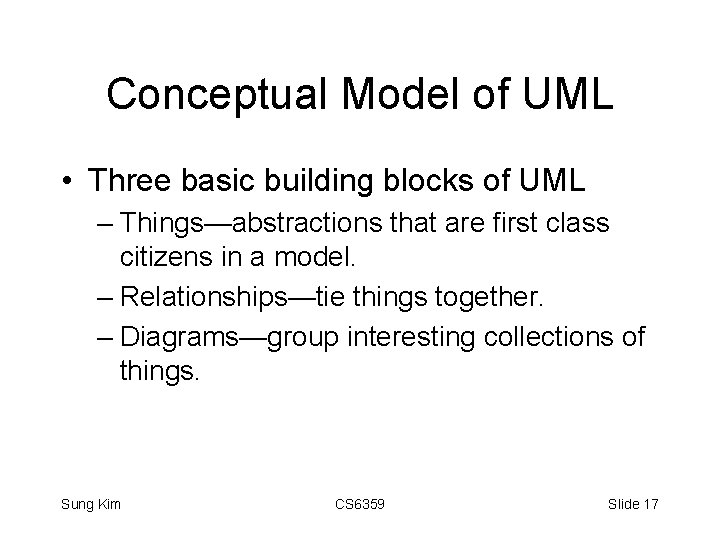
Conceptual Model of UML • Three basic building blocks of UML – Things—abstractions that are first class citizens in a model. – Relationships—tie things together. – Diagrams—group interesting collections of things. Sung Kim CS 6359 Slide 17
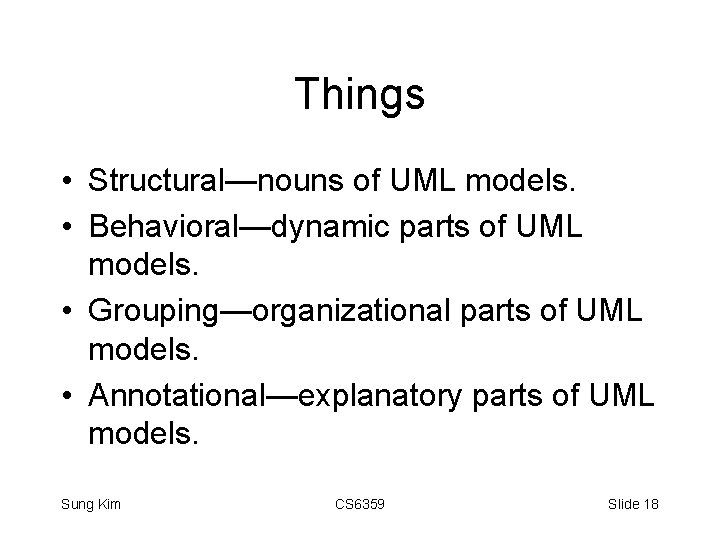
Things • Structural—nouns of UML models. • Behavioral—dynamic parts of UML models. • Grouping—organizational parts of UML models. • Annotational—explanatory parts of UML models. Sung Kim CS 6359 Slide 18
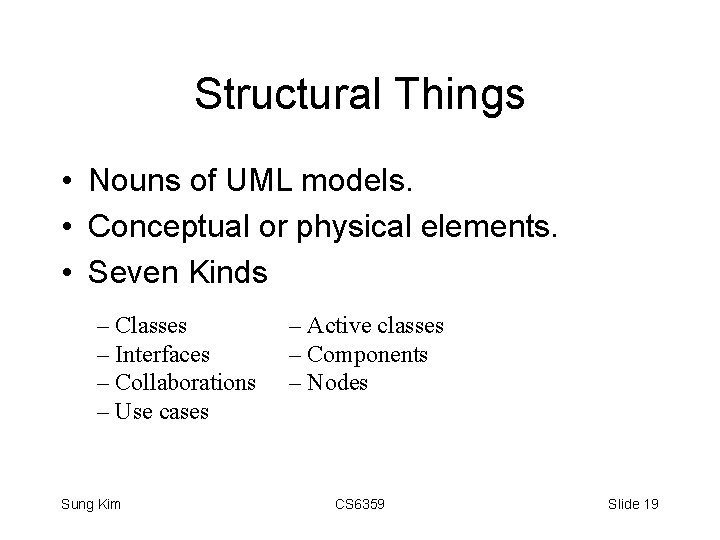
Structural Things • Nouns of UML models. • Conceptual or physical elements. • Seven Kinds – Classes – Interfaces – Collaborations – Use cases Sung Kim – Active classes – Components – Nodes CS 6359 Slide 19
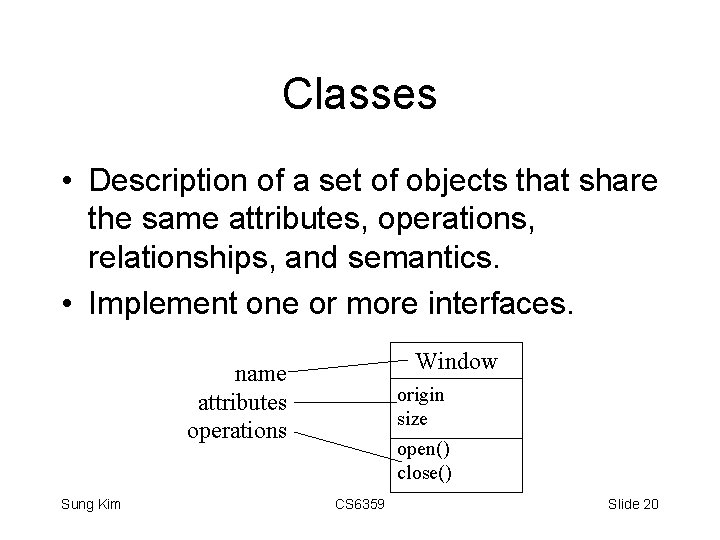
Classes • Description of a set of objects that share the same attributes, operations, relationships, and semantics. • Implement one or more interfaces. Window name attributes operations Sung Kim origin size open() close() CS 6359 Slide 20
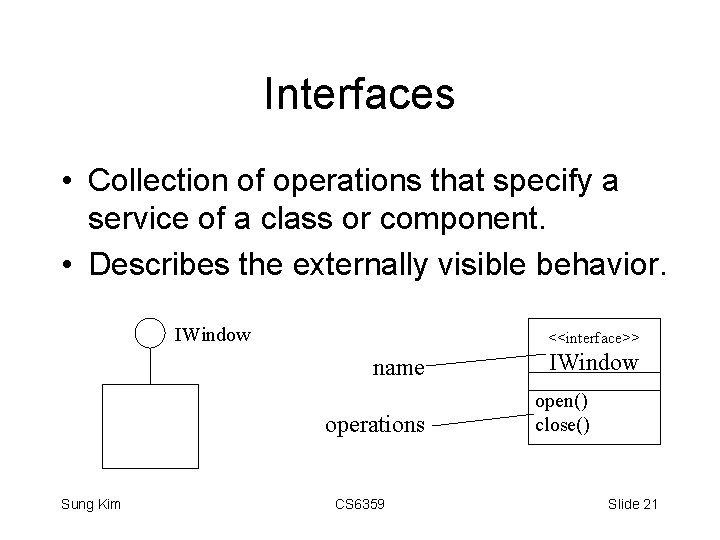
Interfaces • Collection of operations that specify a service of a class or component. • Describes the externally visible behavior. IWindow <<interface>> name operations Sung Kim CS 6359 IWindow open() close() Slide 21
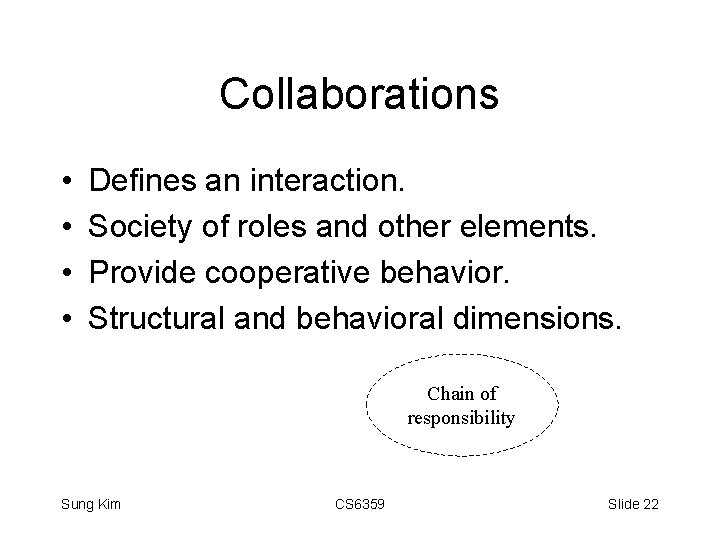
Collaborations • • Defines an interaction. Society of roles and other elements. Provide cooperative behavior. Structural and behavioral dimensions. Chain of responsibility Sung Kim CS 6359 Slide 22
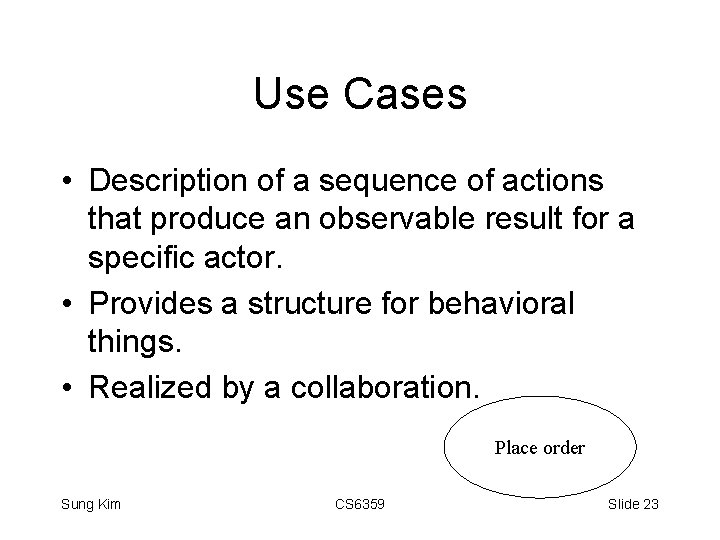
Use Cases • Description of a sequence of actions that produce an observable result for a specific actor. • Provides a structure for behavioral things. • Realized by a collaboration. Place order Sung Kim CS 6359 Slide 23
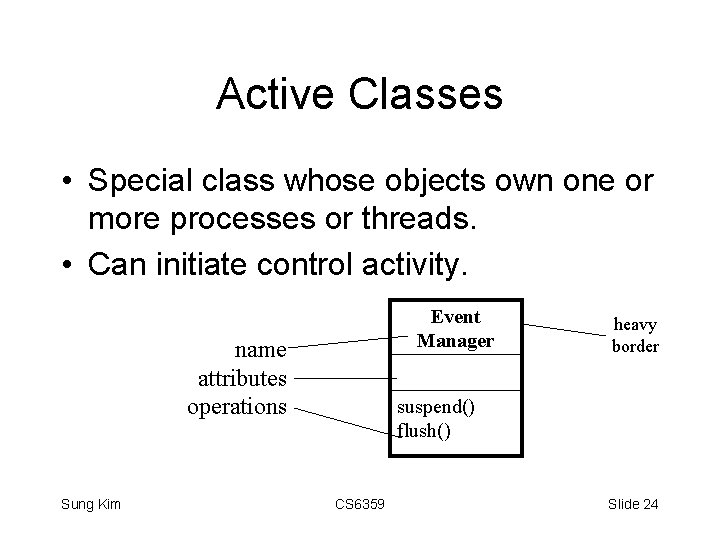
Active Classes • Special class whose objects own one or more processes or threads. • Can initiate control activity. Event Manager name attributes operations Sung Kim heavy border suspend() flush() CS 6359 Slide 24
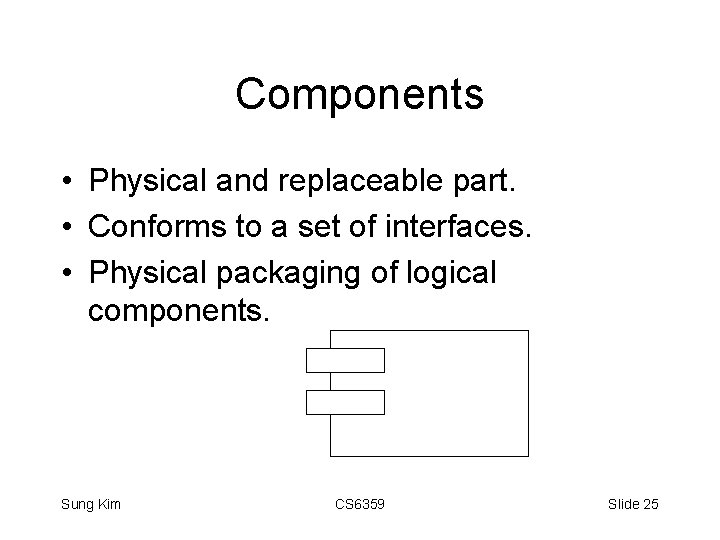
Components • Physical and replaceable part. • Conforms to a set of interfaces. • Physical packaging of logical components. Sung Kim CS 6359 Slide 25
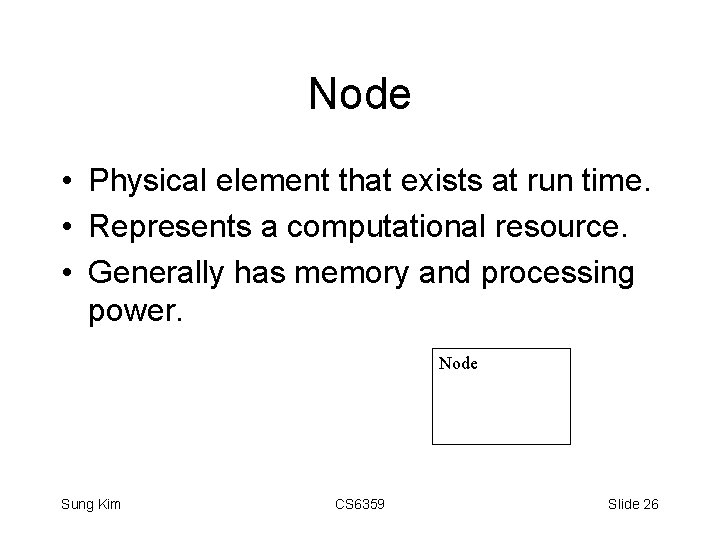
Node • Physical element that exists at run time. • Represents a computational resource. • Generally has memory and processing power. Node Sung Kim CS 6359 Slide 26
Variations on Structural Things • • Actors Signals Utilities Processes and Threads Applications Documents etc. Sung Kim CS 6359 Slide 27
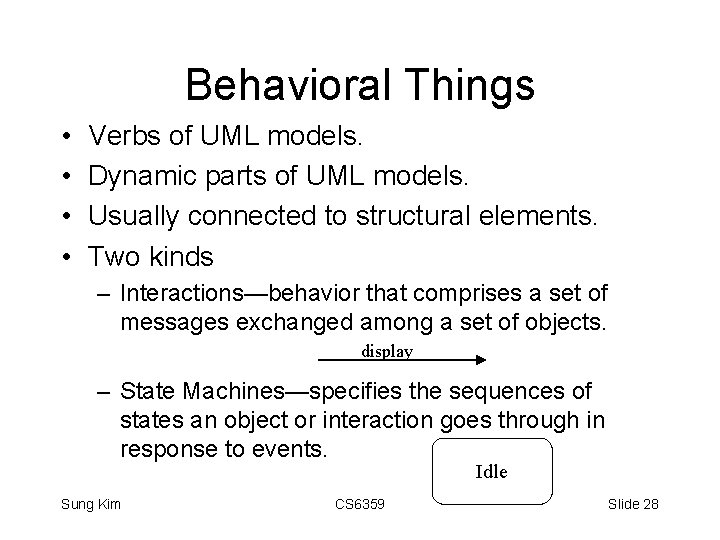
Behavioral Things • • Verbs of UML models. Dynamic parts of UML models. Usually connected to structural elements. Two kinds – Interactions—behavior that comprises a set of messages exchanged among a set of objects. display – State Machines—specifies the sequences of states an object or interaction goes through in response to events. Idle Sung Kim CS 6359 Slide 28
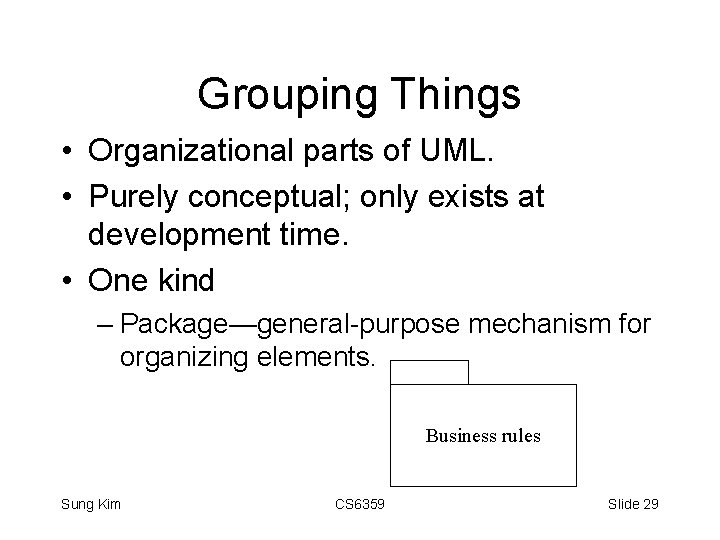
Grouping Things • Organizational parts of UML. • Purely conceptual; only exists at development time. • One kind – Package—general-purpose mechanism for organizing elements. Business rules Sung Kim CS 6359 Slide 29
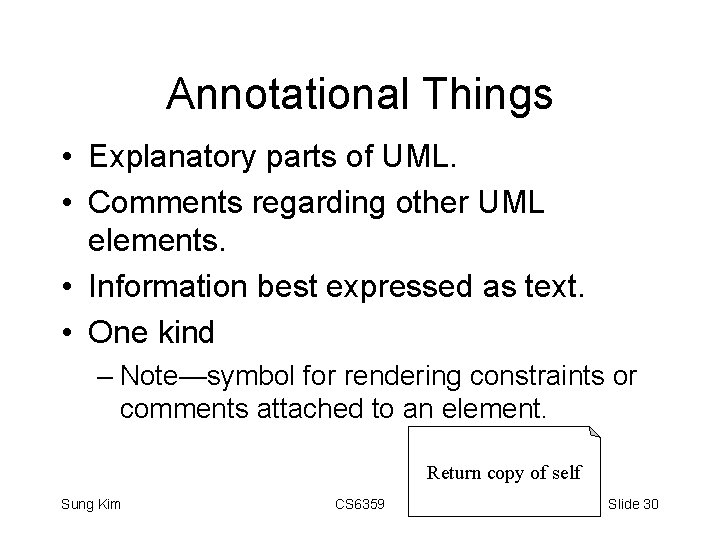
Annotational Things • Explanatory parts of UML. • Comments regarding other UML elements. • Information best expressed as text. • One kind – Note—symbol for rendering constraints or comments attached to an element. Return copy of self Sung Kim CS 6359 Slide 30
Relationships in UML • • Dependency Association Generalization Realization Sung Kim CS 6359 Slide 31
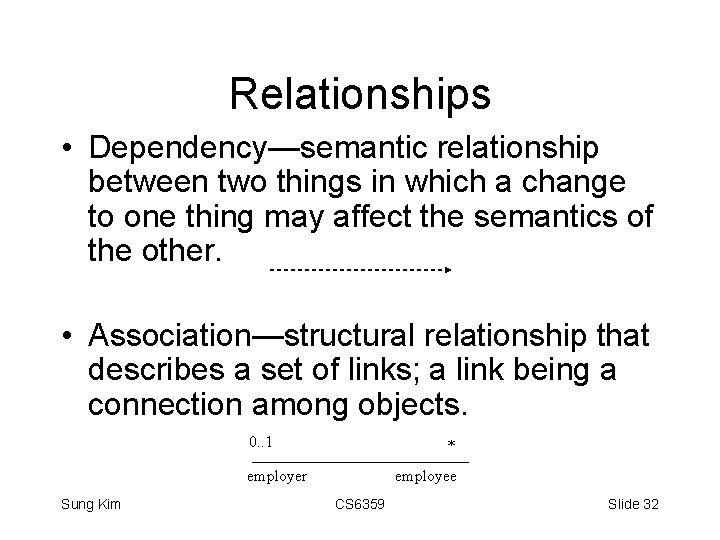
Relationships • Dependency—semantic relationship between two things in which a change to one thing may affect the semantics of the other. • Association—structural relationship that describes a set of links; a link being a connection among objects. 0. . 1 * employer Sung Kim employee CS 6359 Slide 32
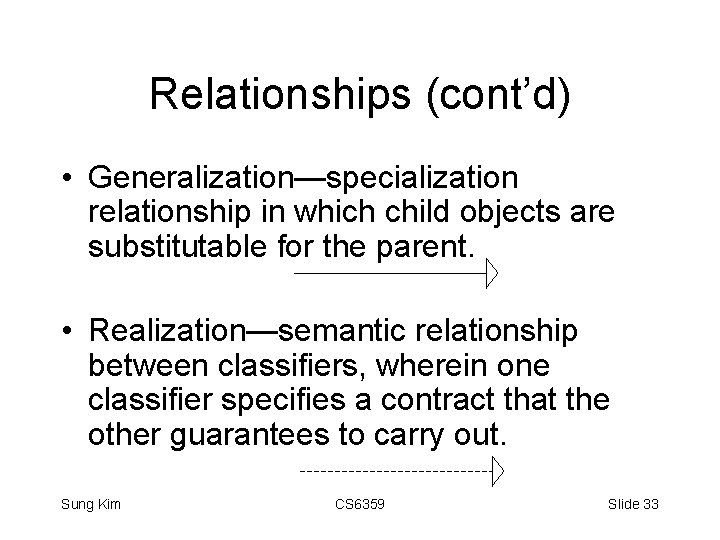
Relationships (cont’d) • Generalization—specialization relationship in which child objects are substitutable for the parent. • Realization—semantic relationship between classifiers, wherein one classifier specifies a contract that the other guarantees to carry out. Sung Kim CS 6359 Slide 33
Diagrams • Graphical representation of a set of elements. • Rendered as a connected graph – Vertices are things. – Arcs are behaviors. • Projection into a system form a specific perspective. • Five most common views built from nine diagram types. Sung Kim CS 6359 Slide 34
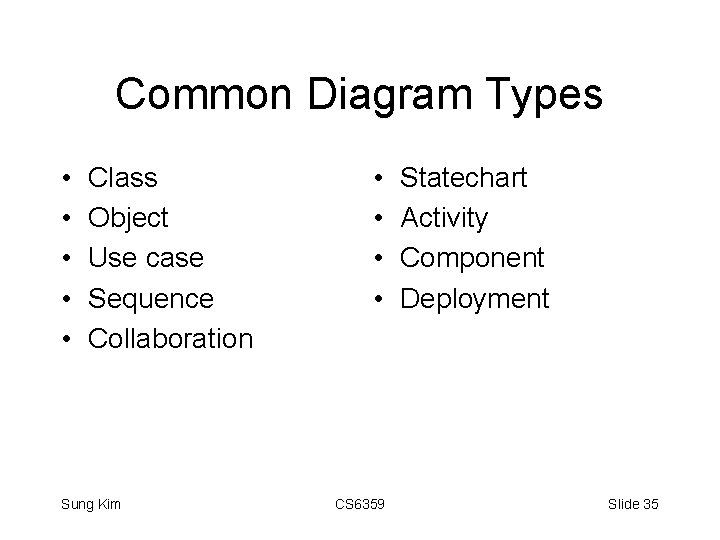
Common Diagram Types • • • Class Object Use case Sequence Collaboration Sung Kim • • CS 6359 Statechart Activity Component Deployment Slide 35
Rules of UML • Well formed models—semantically selfconsistent and in harmony with all its related models. • Semantic rules for: – – Names—what you can call things. Scope—context that gives meaning to a name. Visibility—how names can be seen and used. Integrity—how things properly and consistently relate to one another. – Execution—what it means to run or simulate a dynamic model. Sung Kim CS 6359 Slide 36
Models in Development • Elided—certain elements are hidden for simplicity. • Incomplete—certain elements may be missing. • Inconsistent—no guarantee of integrity. UML encourages the most important aspects such that models become well-formed over time. Sung Kim CS 6359 Slide 37
Common Mechanisms in UML • Specifications—textual statement of the syntax and semantics of a building block. • Adornments—other details attached to UML elements. • Common divisions—dichotomy representation of elements (i. e. Class vs. Object) Sung Kim CS 6359 Slide 38
Common Mechanisms (cont’d) • Extensibility mechanisms – Stereotypes—extends vocabulary. – Tagged values—extends properties of UML building blocks. – Constraints—extend the semantics of UML building blocks. Sung Kim CS 6359 Slide 39
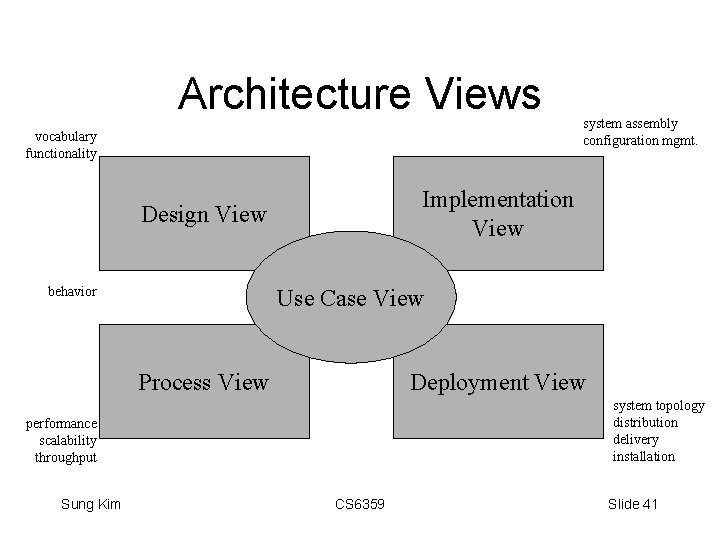
Architecture • Set of significant decisions regarding: – Organization of a software system. – Selection of structural elements and interfaces from which a system is composed. – Behavior or collaboration of elements. – Composition of structural and behavioral elements. – Architectural style guiding the system. Sung Kim CS 6359 Slide 40
Architecture Views vocabulary functionality Implementation View Design View behavior Use Case View Process View Deployment View system topology distribution delivery installation performance scalability throughput Sung Kim system assembly configuration mgmt. CS 6359 Slide 41
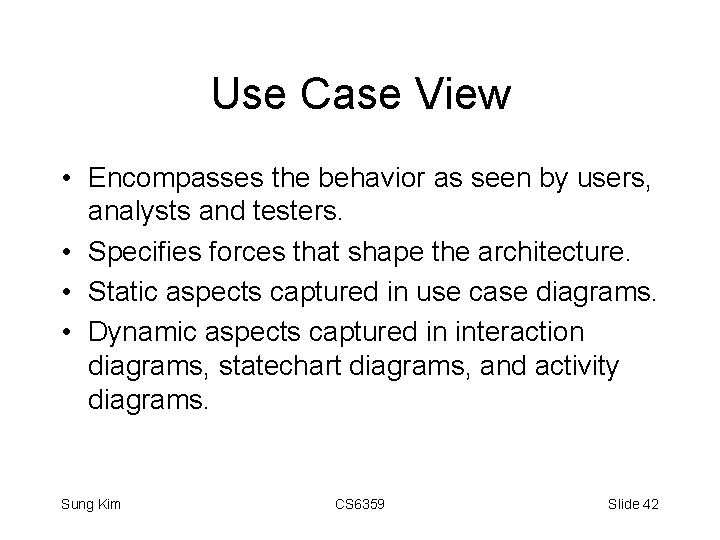
Use Case View • Encompasses the behavior as seen by users, analysts and testers. • Specifies forces that shape the architecture. • Static aspects captured in use case diagrams. • Dynamic aspects captured in interaction diagrams, statechart diagrams, and activity diagrams. Sung Kim CS 6359 Slide 42
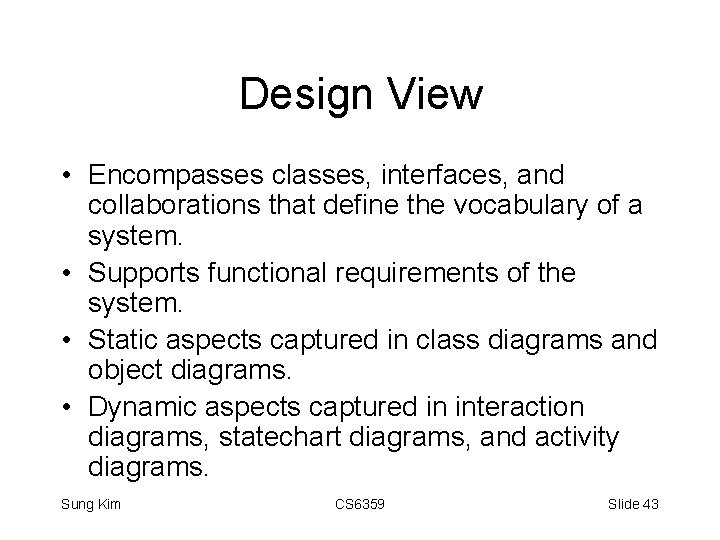
Design View • Encompasses classes, interfaces, and collaborations that define the vocabulary of a system. • Supports functional requirements of the system. • Static aspects captured in class diagrams and object diagrams. • Dynamic aspects captured in interaction diagrams, statechart diagrams, and activity diagrams. Sung Kim CS 6359 Slide 43
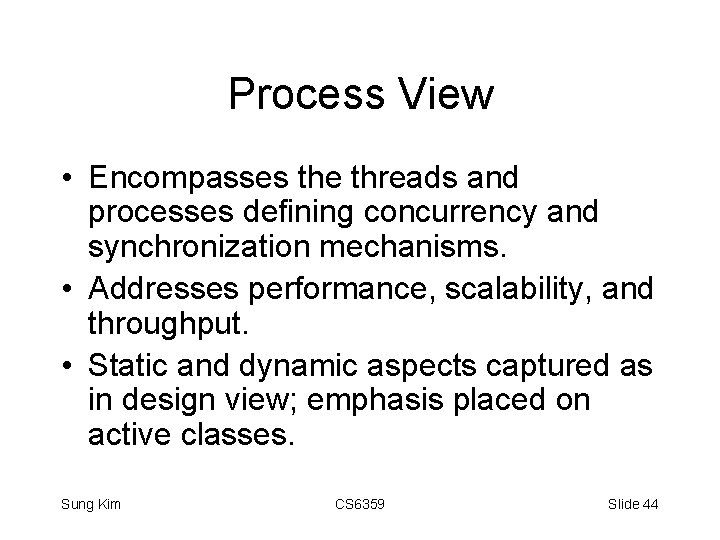
Process View • Encompasses the threads and processes defining concurrency and synchronization mechanisms. • Addresses performance, scalability, and throughput. • Static and dynamic aspects captured as in design view; emphasis placed on active classes. Sung Kim CS 6359 Slide 44
Implementation View • Encompasses components and files used to assemble and release a physical system. • Addresses configuration management. • Static aspects captured in component diagrams. • Dynamic aspects captured in interaction diagrams, statechart diagrams, and activity diagrams. Sung Kim CS 6359 Slide 45
Deployment View • Encompasses the nodes that form the system hardware topology. • Addresses distribution, delivery, and installation. • Static aspects captured in deployment diagrams. • Dynamic aspects captured in interaction diagrams, statechart diagrams, and activity diagrams. Sung Kim CS 6359 Slide 46
Software Process • Use case driven—use cases are primary artifact for defining behavior of the system. • Architecture-centric—the system’s architecture is primary artifact for conceptualizing, constructing, managing, and evolving the system. • Iterative and incremental—managing streams of executable releases with increasing parts of the architecture included. Sung Kim CS 6359 Slide 47
Phases • Span of time between two major milestones. • Primary phases – Inception—seed idea is brought up to point of being a viable project. – Elaboration—product vision and architecture are defined. – Construction—brought from architectural baseline to point of deployment into user community. – Transition—turned over to the user community. Sung Kim CS 6359 Slide 48
Summary • • Modeling. UML introduction. Building blocks of UML. Rules of UML. Common UML mechanisms. Architectural views. Software lifecycle. Sung Kim CS 6359 Slide 49