
Unified Fall Protection Systems and Methods Module 4


- Slides: 23
Unified Fall Protection Systems and Methods – Module 4 Positioning Devices and Fall Arrest Systems September, 2020
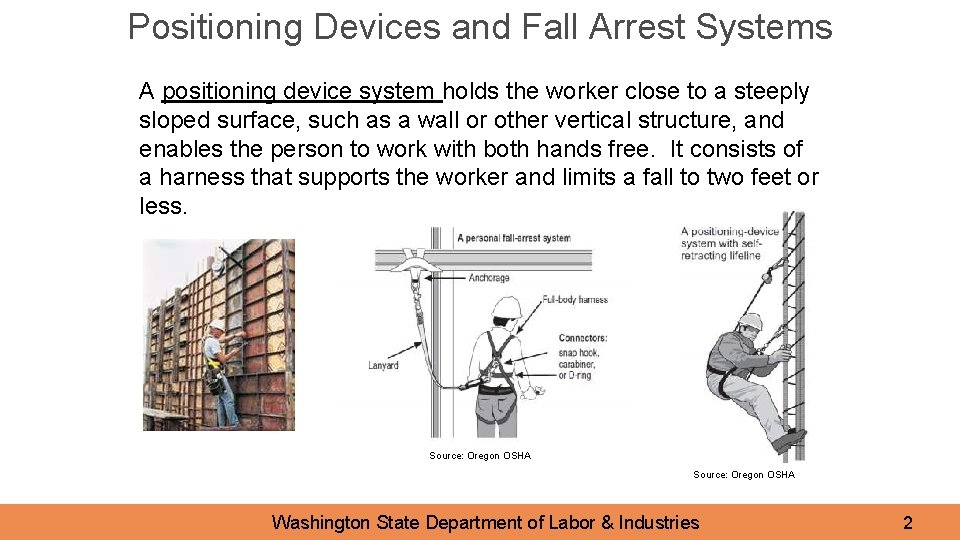
Positioning Devices and Fall Arrest Systems A positioning device system holds the worker close to a steeply sloped surface, such as a wall or other vertical structure, and enables the person to work with both hands free. It consists of a harness that supports the worker and limits a fall to two feet or less. Source: Oregon OSHA Washington State Department of Labor & Industries 2
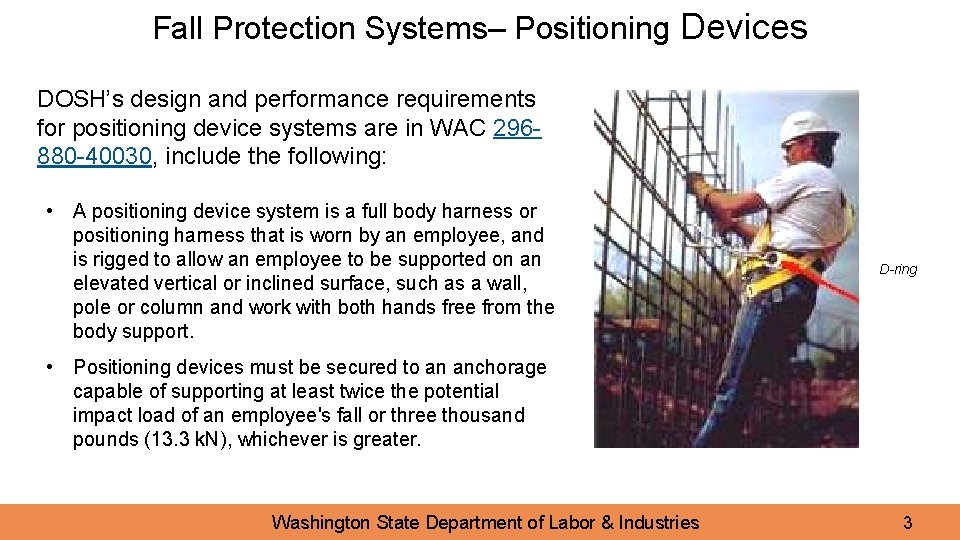
Fall Protection Systems– Positioning Devices DOSH’s design and performance requirements for positioning device systems are in WAC 296880 -40030, include the following: • A positioning device system is a full body harness or positioning harness that is worn by an employee, and is rigged to allow an employee to be supported on an elevated vertical or inclined surface, such as a wall, pole or column and work with both hands free from the body support. D-ring • Positioning devices must be secured to an anchorage capable of supporting at least twice the potential impact load of an employee's fall or three thousand pounds (13. 3 k. N), whichever is greater. Washington State Department of Labor & Industries 3
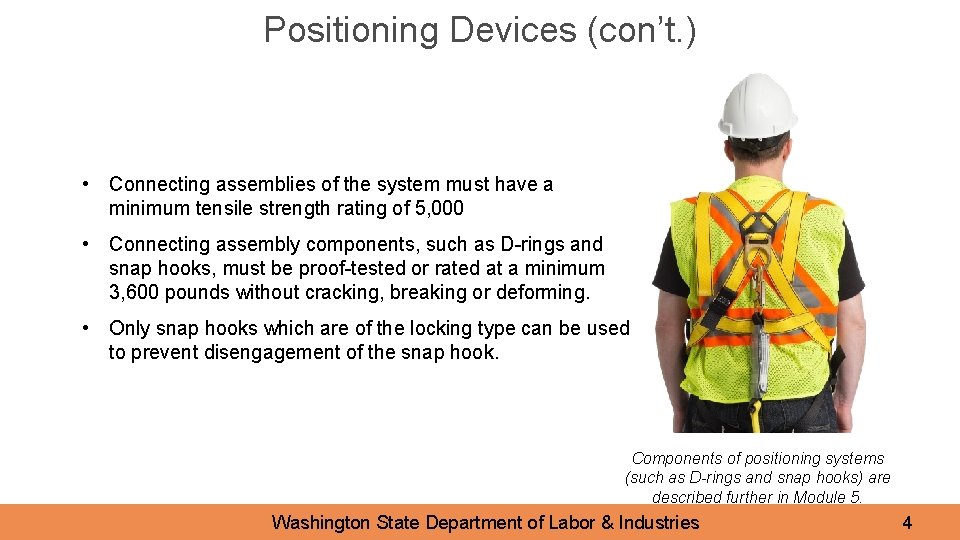
Positioning Devices (con’t. ) • Connecting assemblies of the system must have a minimum tensile strength rating of 5, 000 • Connecting assembly components, such as D-rings and snap hooks, must be proof-tested or rated at a minimum 3, 600 pounds without cracking, breaking or deforming. • Only snap hooks which are of the locking type can be used to prevent disengagement of the snap hook. Components of positioning systems (such as D-rings and snap hooks) are described further in Module 5. Washington State Department of Labor & Industries 4
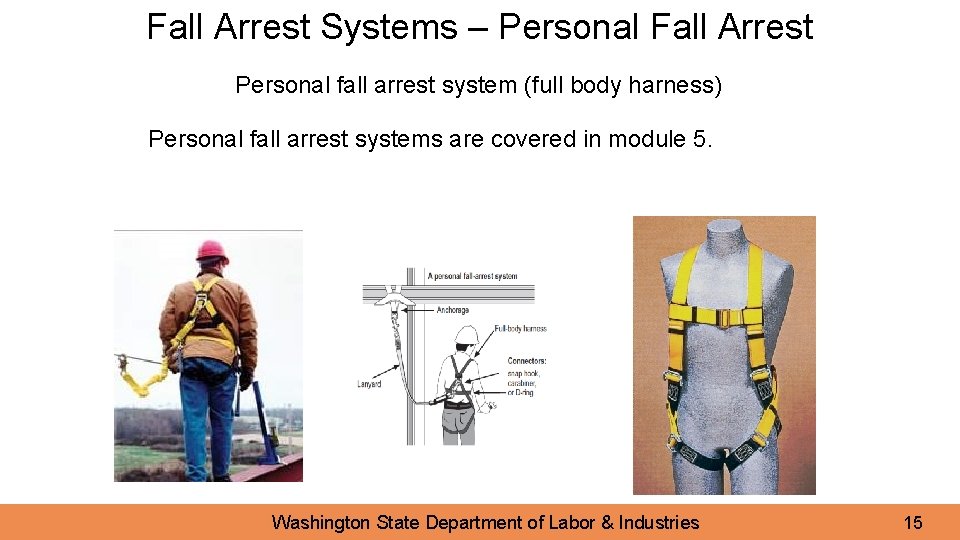
Fall Arrest Systems A fall arrest system does not prevent a fall from occurring, but is designed to catch a person who has already fallen. It must be strong enough to catch the weight of a falling body without causing serious injury. Types of fall arrest systems include: • Safety net • Catch platform • Personal fall arrest system (full body harness) Washington State Department of Labor & Industries 5
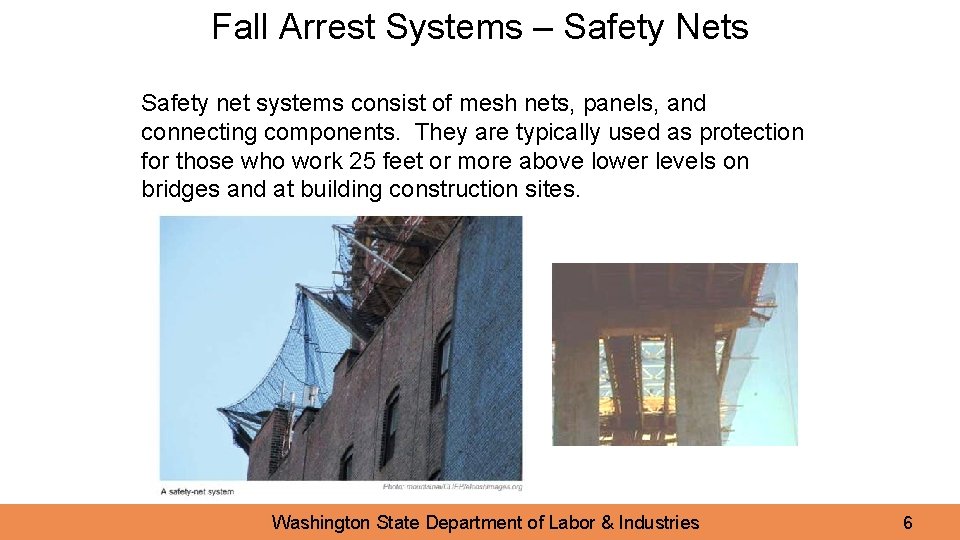
Fall Arrest Systems – Safety Nets Safety net systems consist of mesh nets, panels, and connecting components. They are typically used as protection for those who work 25 feet or more above lower levels on bridges and at building construction sites. Washington State Department of Labor & Industries 6
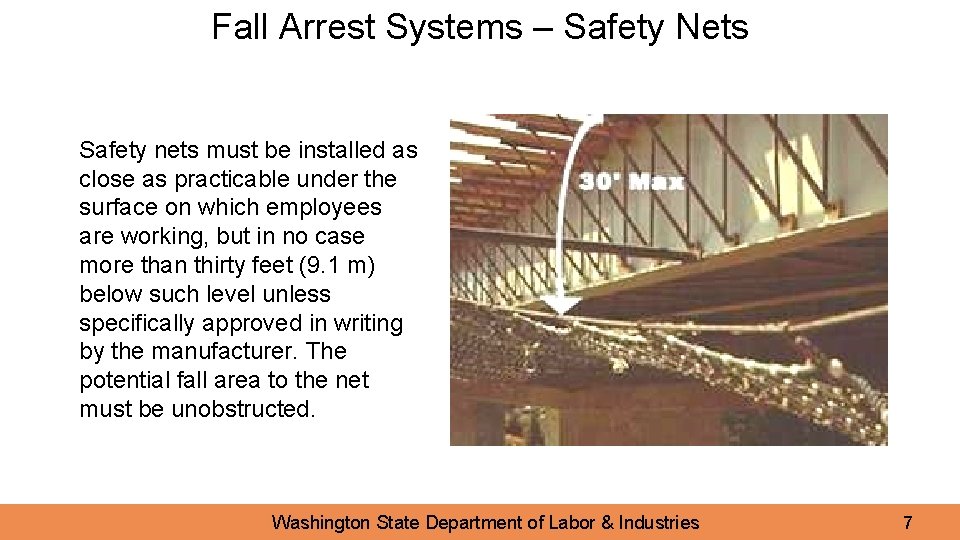
Fall Arrest Systems – Safety Nets Safety nets must be installed as close as practicable under the surface on which employees are working, but in no case more than thirty feet (9. 1 m) below such level unless specifically approved in writing by the manufacturer. The potential fall area to the net must be unobstructed. Washington State Department of Labor & Industries 7
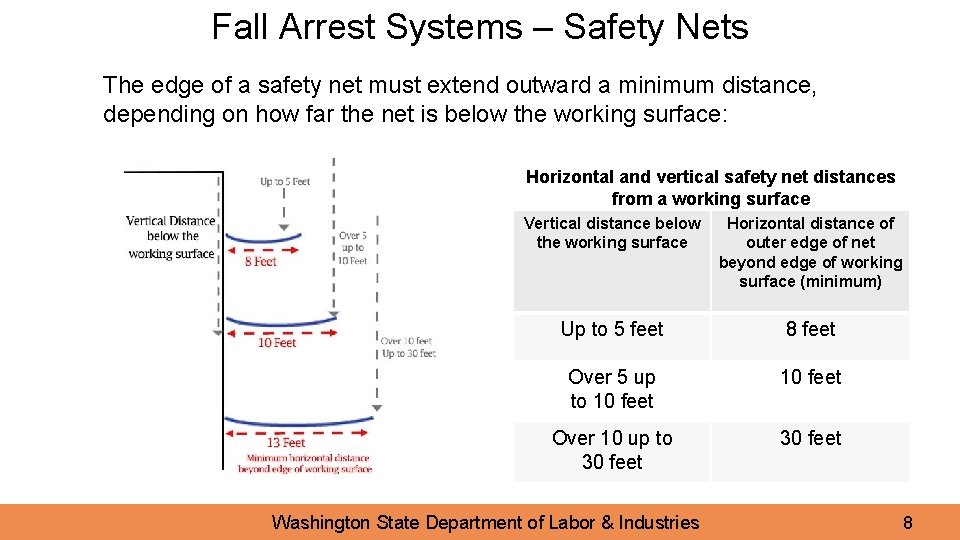
Fall Arrest Systems – Safety Nets The edge of a safety net must extend outward a minimum distance, depending on how far the net is below the working surface: Horizontal and vertical safety net distances from a working surface Vertical distance below the working surface Horizontal distance of outer edge of net beyond edge of working surface (minimum) Up to 5 feet 8 feet Over 5 up to 10 feet Over 10 up to 30 feet Washington State Department of Labor & Industries 8
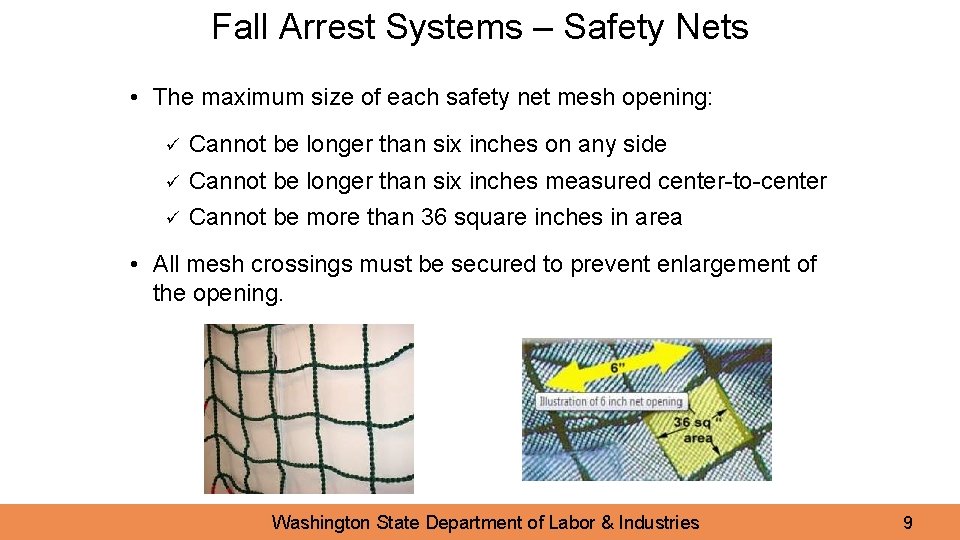
Fall Arrest Systems – Safety Nets • The maximum size of each safety net mesh opening: ü Cannot be longer than six inches on any side ü Cannot be longer than six inches measured center-to-center ü Cannot be more than 36 square inches in area • All mesh crossings must be secured to prevent enlargement of the opening. Washington State Department of Labor & Industries 9
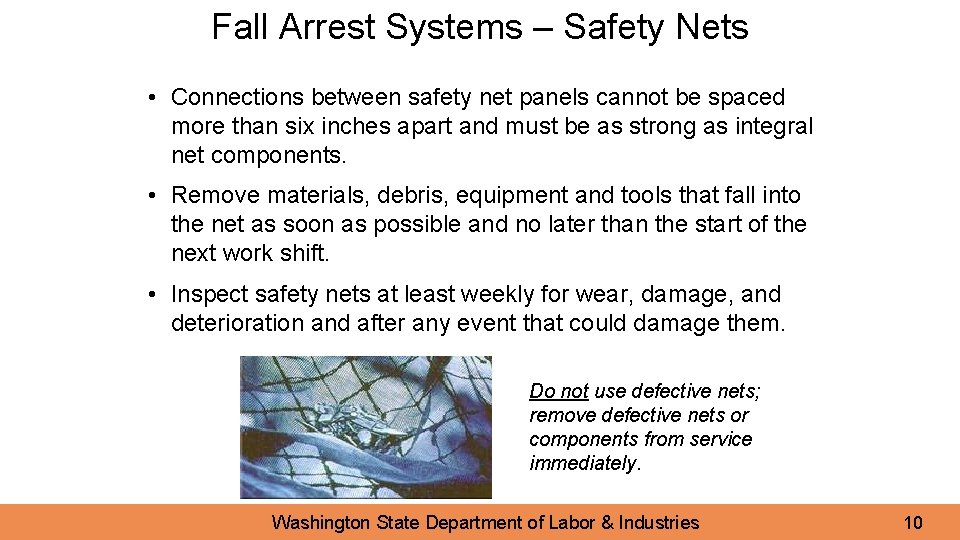
Fall Arrest Systems – Safety Nets • Connections between safety net panels cannot be spaced more than six inches apart and must be as strong as integral net components. • Remove materials, debris, equipment and tools that fall into the net as soon as possible and no later than the start of the next work shift. • Inspect safety nets at least weekly for wear, damage, and deterioration and after any event that could damage them. Do not use defective nets; remove defective nets or components from service immediately. Washington State Department of Labor & Industries 10
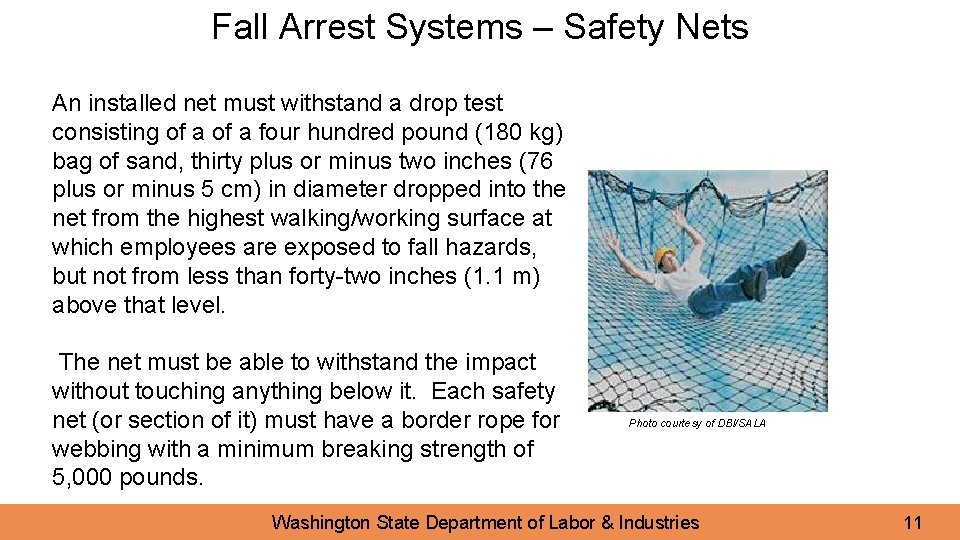
Fall Arrest Systems – Safety Nets An installed net must withstand a drop test consisting of a four hundred pound (180 kg) bag of sand, thirty plus or minus two inches (76 plus or minus 5 cm) in diameter dropped into the net from the highest walking/working surface at which employees are exposed to fall hazards, but not from less than forty-two inches (1. 1 m) above that level. The net must be able to withstand the impact without touching anything below it. Each safety net (or section of it) must have a border rope for webbing with a minimum breaking strength of 5, 000 pounds. Photo courtesy of DBI/SALA Washington State Department of Labor & Industries 11
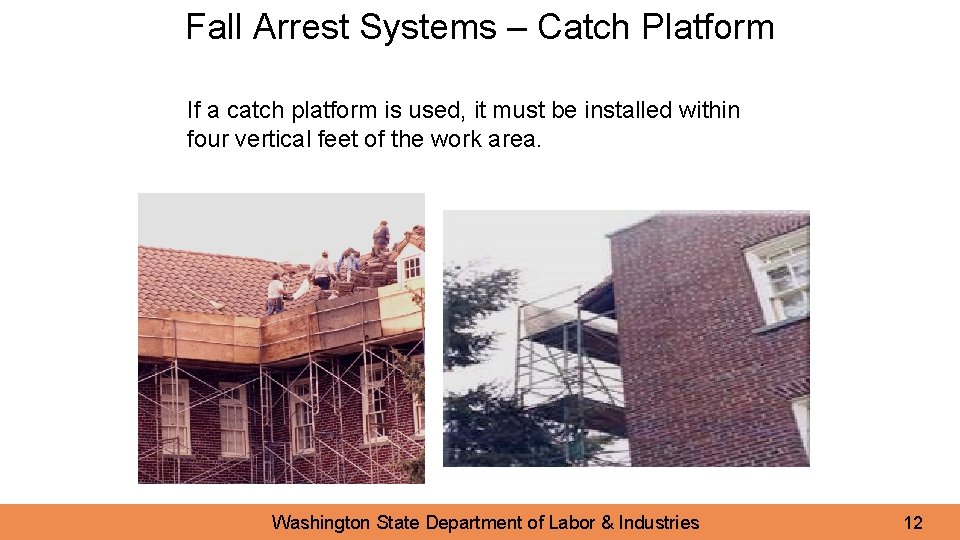
Fall Arrest Systems – Catch Platform If a catch platform is used, it must be installed within four vertical feet of the work area. Washington State Department of Labor & Industries 12
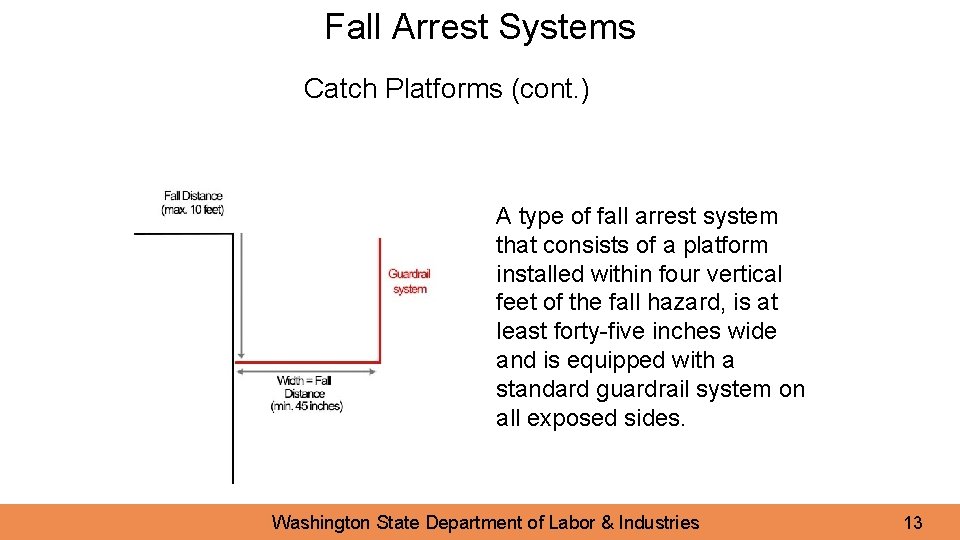
Fall Arrest Systems Catch Platforms (cont. ) A type of fall arrest system that consists of a platform installed within four vertical feet of the fall hazard, is at least forty-five inches wide and is equipped with a standard guardrail system on all exposed sides. Washington State Department of Labor & Industries 13
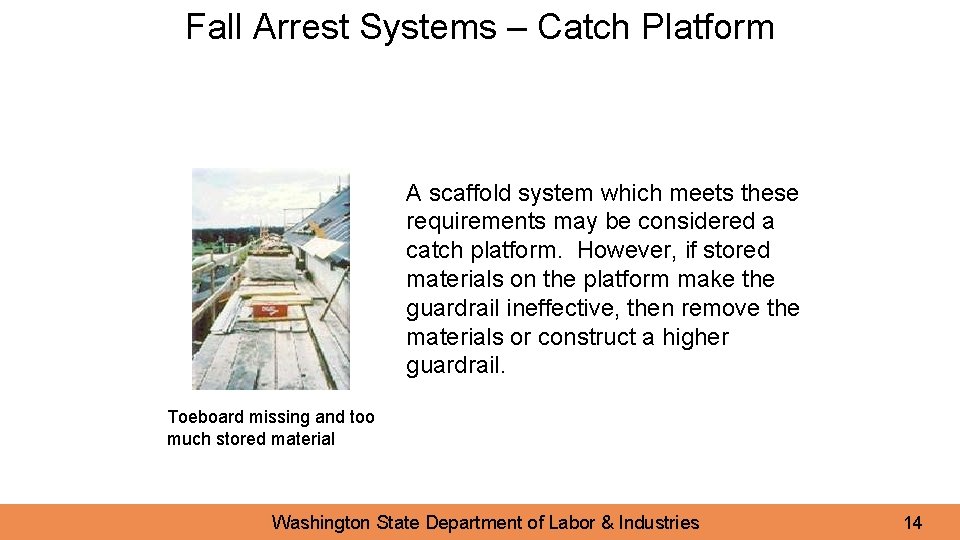
Fall Arrest Systems – Catch Platform A scaffold system which meets these requirements may be considered a catch platform. However, if stored materials on the platform make the guardrail ineffective, then remove the materials or construct a higher guardrail. Toeboard missing and too much stored material Washington State Department of Labor & Industries 14
Fall Arrest Systems – Personal Fall Arrest Personal fall arrest system (full body harness) Personal fall arrest systems are covered in module 5. Washington State Department of Labor & Industries 15
Fall Protection Systems and Methods Question 1 A positioning device system holds a worker close to a vertical or steeply-sloped structure and limits a fall to 3 feet or less. q True q False Washington State Department of Labor & Industries 16
Fall Protection Systems and Methods Question 1 - Answer A positioning device system holds a worker close to a vertical or steeply-sloped structure and limits a fall to 3 feet or less. q True q False A positioning device system must limit a fall to 2 feet or less. Washington State Department of Labor & Industries 17
Fall Protection Systems and Methods Question 2 A fall arrest system must be strong enough to catch the weight of a falling body without causing serious injury. q True q False Washington State Department of Labor & Industries 18
Fall Protection Systems and Methods Question 2 – Answer A fall arrest system must be strong enough to catch the weight of a falling body without causing serious injury. q True q False A fall arrest system must not only be able to catch a worker who has fallen, but also minimize potential injuries resulting from the catch. Washington State Department of Labor & Industries 19
Fall Protection Systems and Methods Question 3 When using safety nets for fall arrest: q Remove materials, debris, equipment and tools that fall into the net as soon as possible and no later than the start of the next work shift. q Inspect safety nets at least monthly for wear, damage and deterioration q Safety nets must be installed as close as possible below working surfaces, but not more than 40 feet. q All of the above Washington State Department of Labor & Industries 20
Fall Protection Systems and Methods Question 3 When using safety nets for fall arrest: q Remove materials, debris, equipment and tools that fall into the net as soon as possible and no later than the start of the next work shift. q Inspect safety nets at least monthly for wear, damage and deterioration q Safety nets must be installed as close as possible below working surfaces, but not more than 40 feet. q All of the above A worker can get injured by falling directly onto materials left in the net or by materials getting bounced up. Washington State Department of Labor & Industries 21
Fall Protection Systems and Methods Question 4 A scaffold system may be used as a catch platform if: q It is within 10 vertical feet of the work area. q It has standard guardrails installed on all open sides q The width of the platform is at least equal to the distance of the fall, at least 45 inches wide. q All of the above Washington State Department of Labor & Industries 22
Fall Protection Systems and Methods Question 4 A scaffold system may be used as a catch platform if: q It is within 10 vertical feet of the work area. q It has standard guardrails installed on all open sides q The width of the platform is at least equal to the distance of the fall, at least 45 inches wide. q All of the above are true. Washington State Department of Labor & Industries 23