
UNIFIED AND STABLE PROJECT USHERING IN THE FUTURE

UNIFIED AND STABLE PROJECT “USHERING IN THE FUTURE” FUTURE TECHNOLOGIES CONFERENCE (FTC) 25 OCTOBER 2019, SAN FRANCISCO, CA 1
Contact Information Gaurav Kuppa, B. S. in Computer Engineering San Jose State University gaurav. kuppa@sjsu. edu [1] Fayad, M. E. , Kuppa, G, and Hamu, D. Unified and Stable Privacy Model. International Journal of Advanced Trends in Computer Science and Engineering ( IJATCSE ), Vol. 8 No. 4, July -August 2019 [2] Fayad, M. E. , Kuppa, G, and Hamu, D. Unified and Stable Privacy Model. International Conference on Innovations in Computer Science and Engineering (i. CSE 2019), 26 - 28 June 2019, Miri Sarawak, MALAYSIA [3] Fayad, M. E. , Kuppa, G, and Hamu. Unified and Stable Project – “Ushering in the Future”. FTC 2019 - Future Technologies Conference 2019, San Francisco, California, USA, 24 -25 October 2019. [4] Fayad, M. E. , Kuppa, G, Jindal, S. , and Hamu. A Cutting-Edge Unified and Stable Rule Design Pattern. FTC 2019 - Future Technologies Conference 2019, San Francisco, California, USA, 24 -25 October 2019 2
Table of Contents ■ Introduction ■ Any. Project Stable Design Pattern ■ Scenarios ■ Conclusion 3
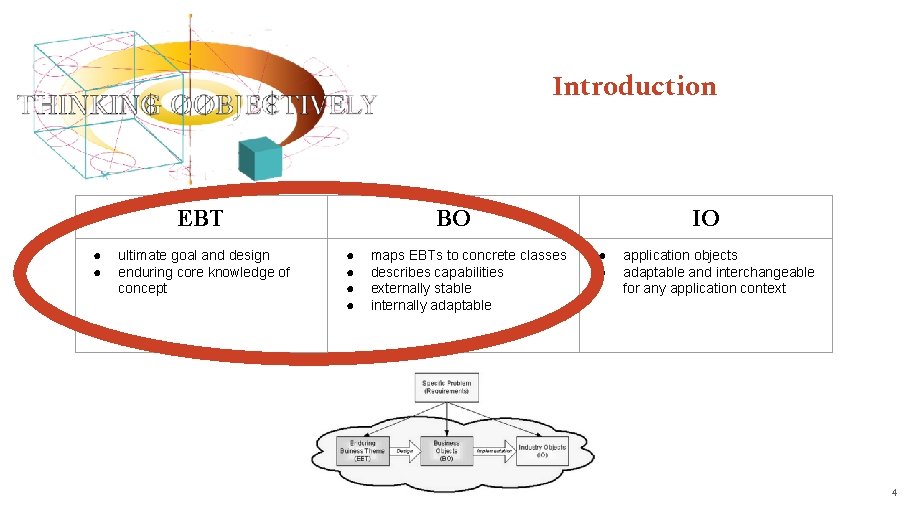
Introduction EBT ● ● ultimate goal and design enduring core knowledge of concept BO ● ● maps EBTs to concrete classes describes capabilities externally stable internally adaptable IO ● ● application objects adaptable and interchangeable for any application context 4

Any. Project Stable Design Pattern 5
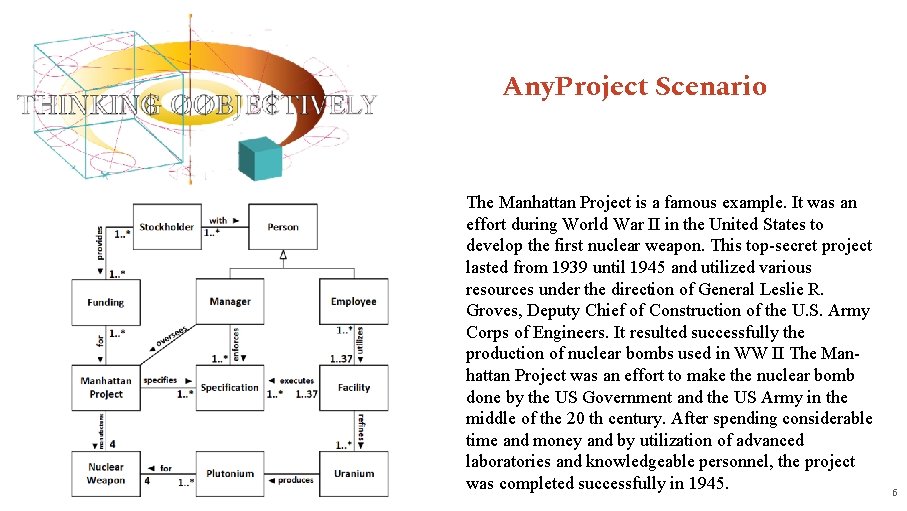
Any. Project Scenario The Manhattan Project is a famous example. It was an effort during World War II in the United States to develop the first nuclear weapon. This top-secret project lasted from 1939 until 1945 and utilized various resources under the direction of General Leslie R. Groves, Deputy Chief of Construction of the U. S. Army Corps of Engineers. It resulted successfully the production of nuclear bombs used in WW II The Manhattan Project was an effort to make the nuclear bomb done by the US Government and the US Army in the middle of the 20 th century. After spending considerable time and money and by utilization of advanced laboratories and knowledgeable personnel, the project was completed successfully in 1945. 6
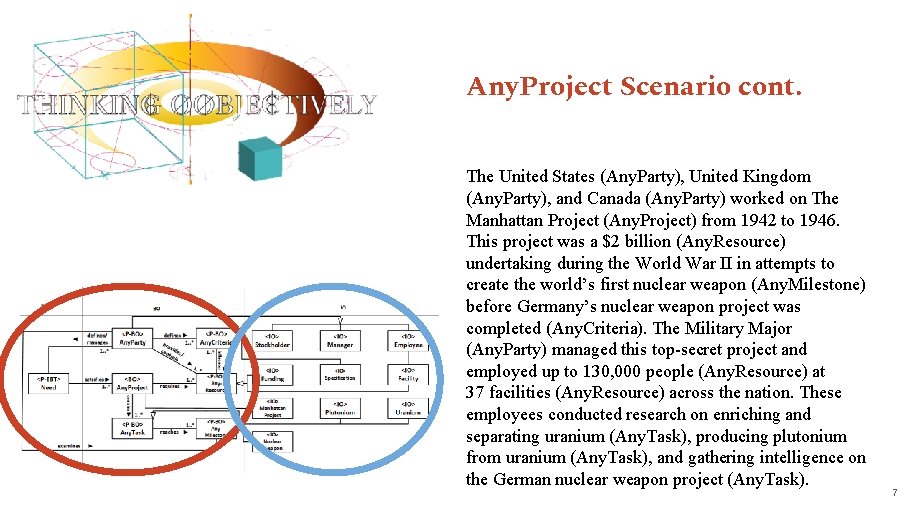
Any. Project Scenario cont. The United States (Any. Party), United Kingdom (Any. Party), and Canada (Any. Party) worked on The Manhattan Project (Any. Project) from 1942 to 1946. This project was a $2 billion (Any. Resource) undertaking during the World War II in attempts to create the world’s first nuclear weapon (Any. Milestone) before Germany’s nuclear weapon project was completed (Any. Criteria). The Military Major (Any. Party) managed this top-secret project and employed up to 130, 000 people (Any. Resource) at 37 facilities (Any. Resource) across the nation. These employees conducted research on enriching and separating uranium (Any. Task), producing plutonium from uranium (Any. Task), and gathering intelligence on the German nuclear weapon project (Any. Task). 7
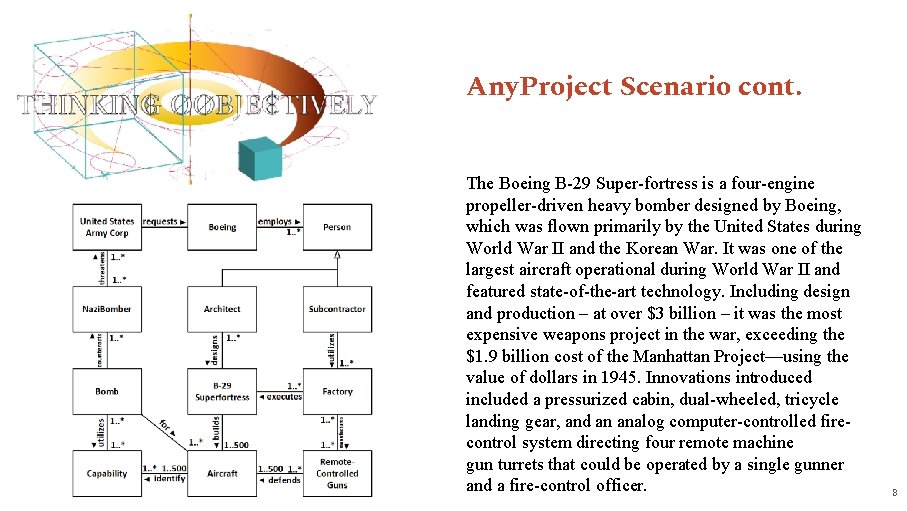
Any. Project Scenario cont. The Boeing B-29 Super-fortress is a four-engine propeller-driven heavy bomber designed by Boeing, which was flown primarily by the United States during World War II and the Korean War. It was one of the largest aircraft operational during World War II and featured state-of-the-art technology. Including design and production – at over $3 billion – it was the most expensive weapons project in the war, exceeding the $1. 9 billion cost of the Manhattan Project—using the value of dollars in 1945. Innovations introduced included a pressurized cabin, dual-wheeled, tricycle landing gear, and an analog computer-controlled firecontrol system directing four remote machine gun turrets that could be operated by a single gunner and a fire-control officer. 8
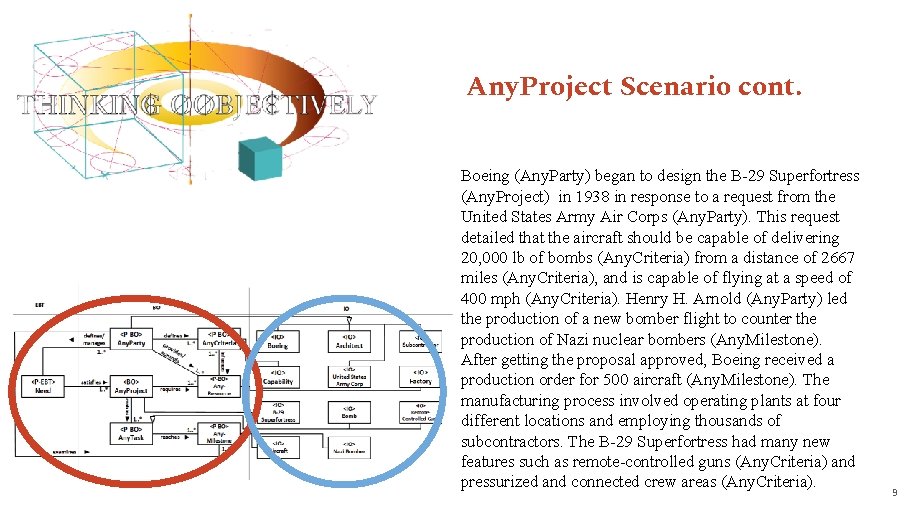
Any. Project Scenario cont. Boeing (Any. Party) began to design the B-29 Superfortress (Any. Project) in 1938 in response to a request from the United States Army Air Corps (Any. Party). This request detailed that the aircraft should be capable of delivering 20, 000 lb of bombs (Any. Criteria) from a distance of 2667 miles (Any. Criteria), and is capable of flying at a speed of 400 mph (Any. Criteria). Henry H. Arnold (Any. Party) led the production of a new bomber flight to counter the production of Nazi nuclear bombers (Any. Milestone). After getting the proposal approved, Boeing received a production order for 500 aircraft (Any. Milestone). The manufacturing process involved operating plants at four different locations and employing thousands of subcontractors. The B-29 Superfortress had many new features such as remote-controlled guns (Any. Criteria) and pressurized and connected crew areas (Any. Criteria). 9

Conclusion ● Thus, the enduring concepts help build a solid foundation for solutions and implement a better way of software stability model. Hence, the stability model is preferred as a design model for any application. ● Nonfunctional Requirements: ○ Practical ○ Manageable ○ Growth 10
![References [1] A. Mahdy, M. E. Fayad, H. Hamza, and P. Tugnawat “Stable and](http://slidetodoc.com/presentation_image_h2/5cc5d3b928f77108a8945b94fb5b34c6/image-11.jpg "References [1] A. Mahdy, M. E. Fayad, H. Hamza, and P. Tugnawat “Stable and")
References [1] A. Mahdy, M. E. Fayad, H. Hamza, and P. Tugnawat “Stable and Reusable Model-Based Architectures” ECOOP 2002, Workshop on Model-based Software Reuse, June 2002, Malaga, Spain [2] H. Hamza and M. E. Fayad. “Model-base Software Reuse Using Stable Analysis Patterns” ECOOP 2002, Workshop on Model-based Software Reuse, June 2002, Malaga, Spain [3] Fayad, M. E. , “Stable Design Patterns for Software and Systems”. Boca Raton, FL: Auerbach Publications, July 2015. 11
- Slides: 11