
Unification and Isolation of Japan Quick Refresh In

- Slides: 11
Unification and Isolation of Japan
Quick Refresh � In you groups come up with a few of the things we’ve talked about over the last several classes (Samurai, Early Rulers, First Inhabitants, Feudal Japan) � Vocabulary: ◦ ◦ ◦ Daimyo Shogun and Shogunate Isolation Incarceration Ethnocentric
Unification and Isolation Activity � In pairs, read through the documents and answer the questions on your note sheet � We will go over what we have as a class after about 5 minutes time per document
� In 1600, a general named Tokugawa Ieyasu won an important military victory and united all of Japan under a central government. He had the emperor name him shogun and took measures to ensure that the title and the power that went with the title stayed in the Tokugawa family. The center of Tokugawa government was the village of Edo, which later became known as Tokyo.
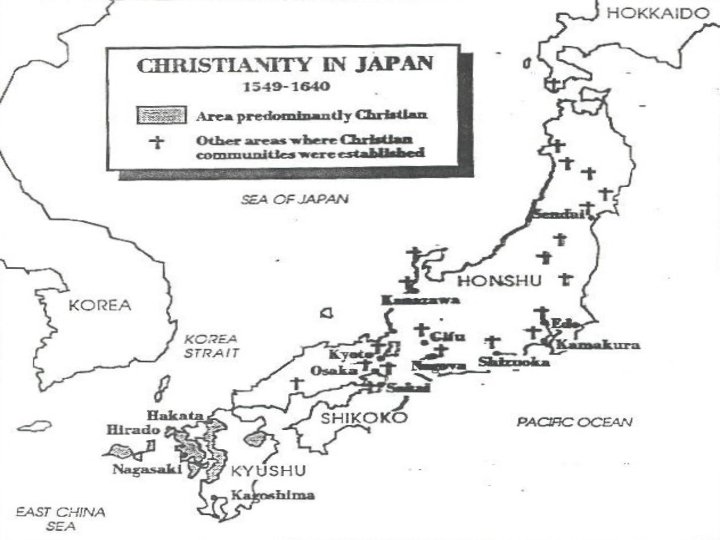
� The Tokugawa Shogun’s Laws Restricting Christianity, 1587: � Japan is the country of gods, but has been receiving false teachings from Christian countries. This cannot be tolerated any further. � The missionaries approach people in provinces and districts to make them their followers, and let them destroy shrines and temples. This is an unheard-of outrage. � They commit the illegal act of destroying the teachings of Buddha prevailing in Japan. These padres cannot be permitted to remain in Japan.
The Closed Country Policy, enacted 1635: Japanese ships are strictly forbidden to leave foreign countries. � No Japanese is permitted to go abroad. If there is anyone who attempts to do so secretly, he must be executed. � If there is any place where the teachings of padres (Christianity) is practiced, the two you must order a thorough investigation. � If there any Southern Barbarians (Westerners) who propagate the teachings of padres, or otherwise commit crimes, they may be incarcerated in prison. � All incoming ships must be carefully searched for the followers of padres. � All foreigners are excluded from trade with Japanese, except for the Chinese and the Dutch, who may trade only at Nagasaki. �
Sankin-Kotai System � All daimyo were obligated to spend several months each year at the shogun’s court in Edo (former name of Tokyo) leaving their wives and children behind. This meant that the daimyo had to spend large amounts of money and time traveling to and from Edo. � Movement around the country was controlled with barriers on the main routes at which travelers would be stopped to have their travel permits examined. � The Tokugawa proved to be very effective and Japan enjoyed a long spell of Peace. This left a dilemma for the samurai: the job of a warrior is to fight, and without war the samurai needed something to do.
� � � � Although a Samurai acquired skills in the art of war, in times of peace he was to cultivate more peaceful pursuits. “Though Bushido naturally involves the qualities of strength and forcefulness, to have this one side developed is to be nothing but a rustic (simple) samurai of no great account” – Budo Shoshinshu, 17 th century Over the centuries many Samurai became accomplished poets. The samurai class a whole was expected to act moral (honest) and spiritual examples for the nation. Kabuki Theater: During Pax Tokugawa, the image of the samurai changed from that of the noble warrior to that of a character in a Kabuki Play, to be cheered or laughed at by theater goers from the despised merchant class. This is one of the best known samurai roles, that of the title role in the play “Shibaraku. ” Extravagant make-up, costumes, and swords were used.
Comparative Civilizations � For the rest of class you have time to work on your Comparative Civilizations Assignment � If you need another copy of the assignment I have it � Any questions feel free to ask, I will be coming around to make sure everyone is progressing with their work.
Quiz Next Class � Next class there will be a quiz � Very similar to the quiz we’ve done before, answer 5 questions out of 8 or 9 � Covers the first THREE (3) lessons we had, all on the website ◦ Land of the Rising Sun ◦ Early Periods of Japan (page 183 -185 of textbook) ◦ The Samurai