
UNIDOs Industrial Energy Efficiency Programme Rana Ghoneim UNIDO
- Slides: 18
UNIDO’s Industrial Energy Efficiency Programme Rana Ghoneim UNIDO Department of Energy Opportunities, methodology and results 28 June 2016, Vienna - Austria
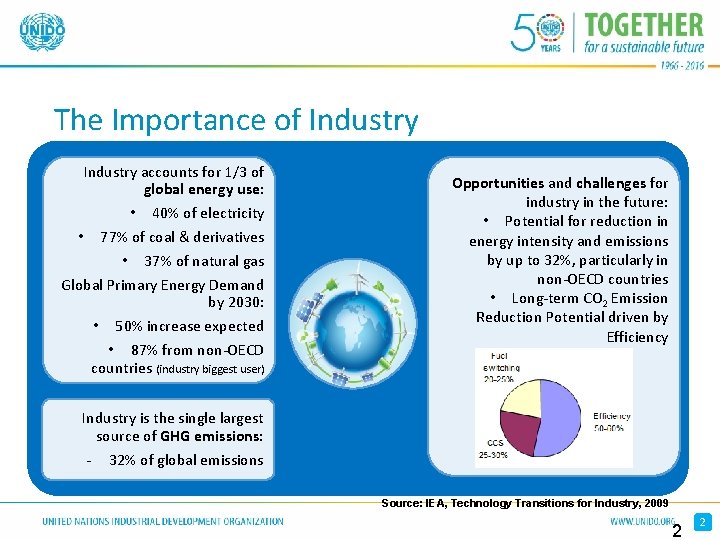
The Importance of Industry accounts for 1/3 of global energy use: • 40% of electricity • 77% of coal & derivatives • 37% of natural gas Global Primary Energy Demand by 2030: • 50% increase expected • 87% from non-OECD countries (industry biggest user) Opportunities and challenges for industry in the future: • Potential for reduction in energy intensity and emissions by up to 32%, particularly in non-OECD countries • Long-term CO 2 Emission Reduction Potential driven by Efficiency Industry is the single largest source of GHG emissions: - 32% of global emissions Source: IEA, Technology Transitions for Industry, 2009 2 2
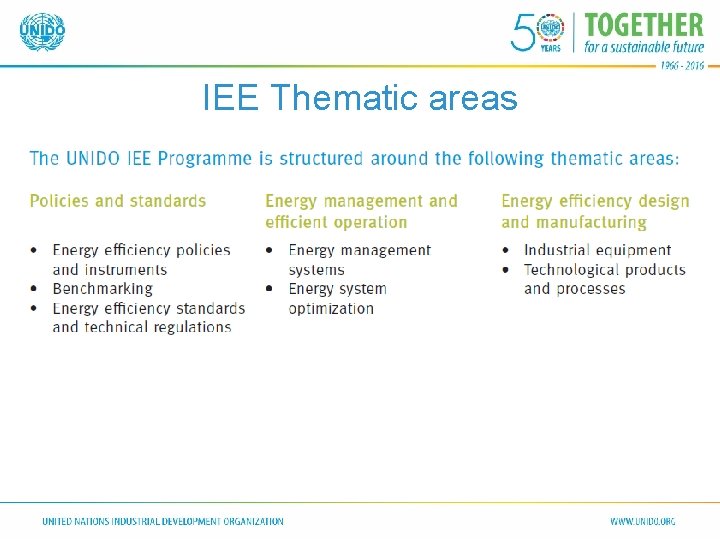
IEE Thematic areas 3
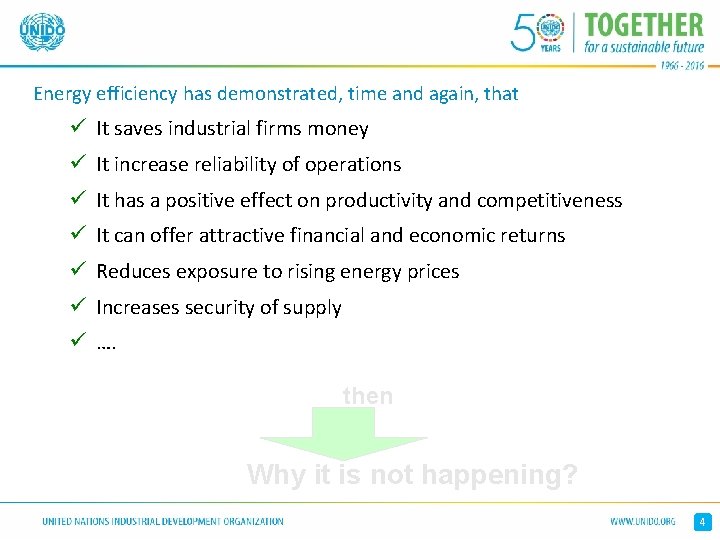
Energy efficiency has demonstrated, time and again, that ü It saves industrial firms money ü It increase reliability of operations ü It has a positive effect on productivity and competitiveness ü It can offer attractive financial and economic returns ü Reduces exposure to rising energy prices ü Increases security of supply ü …. then Why it is not happening? 4
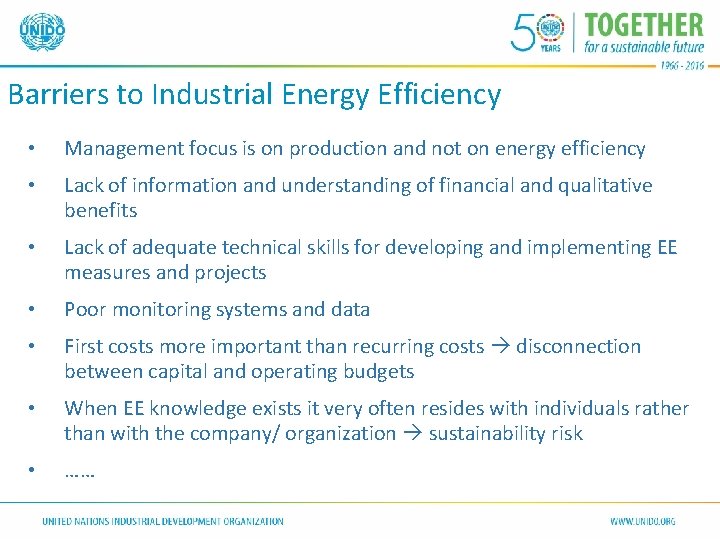
Barriers to Industrial Energy Efficiency • Management focus is on production and not on energy efficiency • Lack of information and understanding of financial and qualitative benefits • Lack of adequate technical skills for developing and implementing EE measures and projects • Poor monitoring systems and data • First costs more important than recurring costs disconnection between capital and operating budgets • When EE knowledge exists it very often resides with individuals rather than with the company/ organization sustainability risk • …… 55
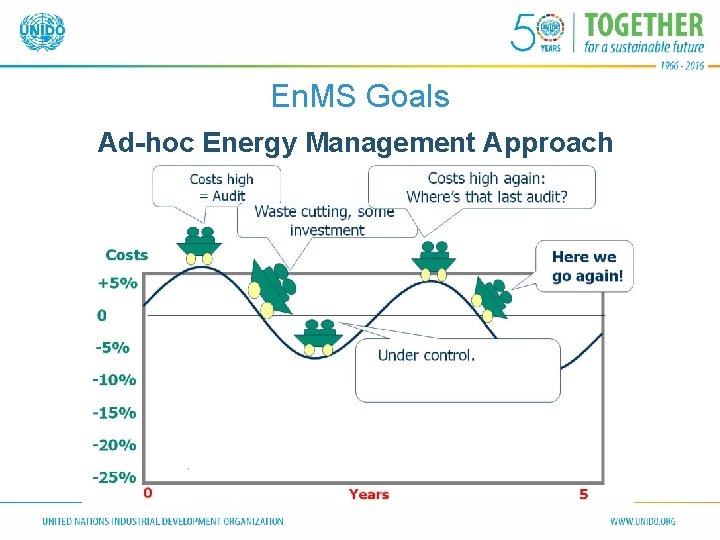
En. MS Goals Ad-hoc Energy Management Approach 6
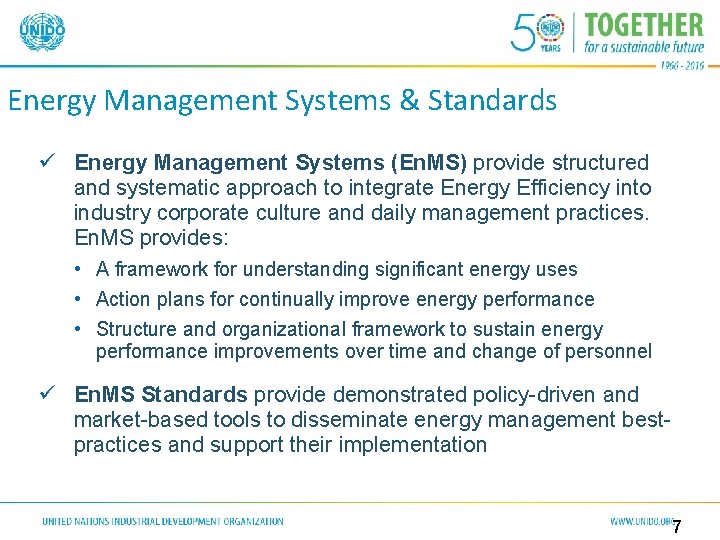
Energy Management Systems & Standards ü Energy Management Systems (En. MS) provide structured and systematic approach to integrate Energy Efficiency into industry corporate culture and daily management practices. En. MS provides: • A framework for understanding significant energy uses • Action plans for continually improve energy performance • Structure and organizational framework to sustain energy performance improvements over time and change of personnel ü En. MS Standards provide demonstrated policy-driven and market-based tools to disseminate energy management bestpractices and support their implementation 7
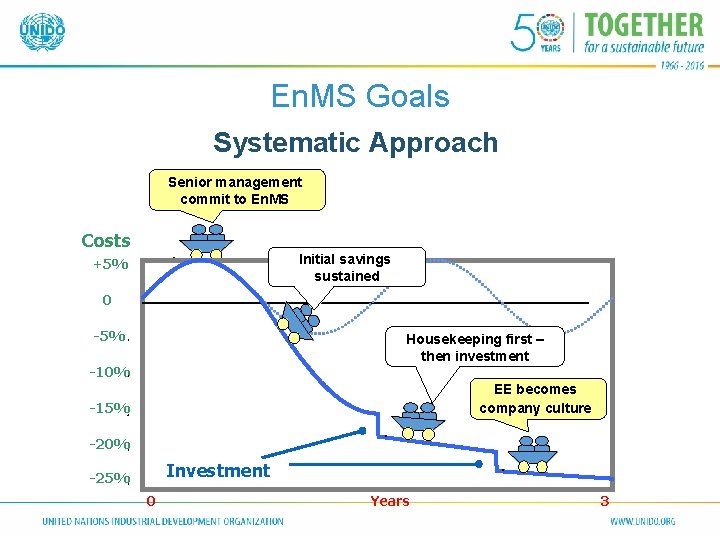
En. MS Goals Systematic Approach Senior management commit to En. MS Costs Initial savings sustained +5% 0 -5% Housekeeping first – then investment -10% EE becomes company culture -15% -20% Investment -25% 0 Years 3 8
Component v system approach • Component approach involves segregating components and analyzing in isolation • Can result from education by particular technology sales engineer, e. g. variable speed drive, steam trap, etc. • System approach involves looking at how the whole group functions together and how changing one can help or impact another • Requires more knowledge of the system and its interactions • The energy savings opportunities from systems are far greater than from individual components • 2 -5 % efficiency gains for individual components against 15 -30% average efficiency gains through system optimization 9
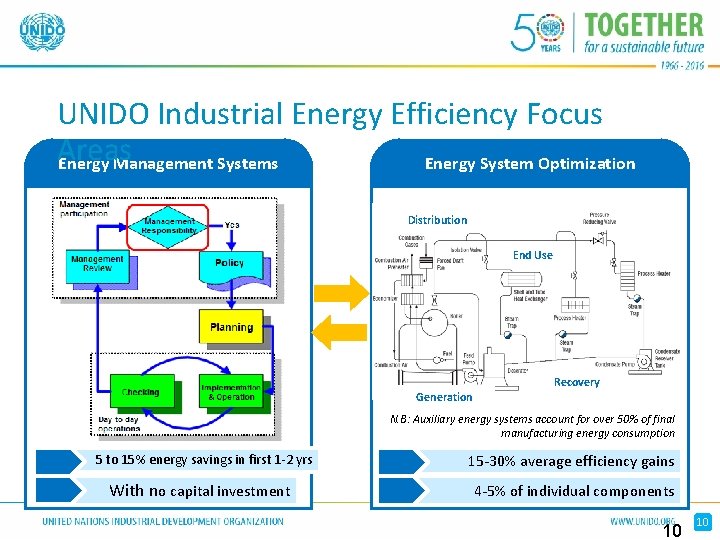
UNIDO Industrial Energy Efficiency Focus Areas Energy Management Systems Energy System Optimization Distribution End Use by 2030 Generation by 2030 Recovery N. B: Auxiliary energy systems account for over 50% of final manufacturing energy consumption 5 to 15% energy savings in first 1 -2 yrs With no capital investment 15 -30% average efficiency gains 4 -5% of individual components 10 10
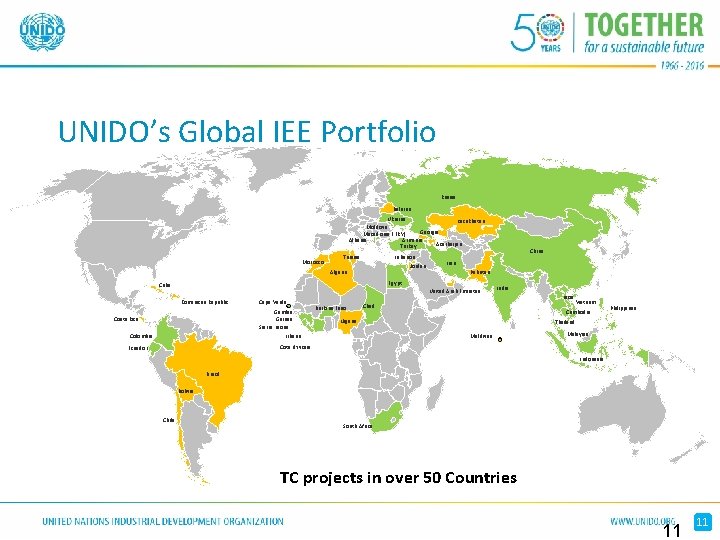
UNIDO’s Global IEE Portfolio Russia Belarus Ukraine Kazakhstan Moldova Georgia Macedonia ( FRY) Armenia Albania Azerbaijan Turkey Morocco Tunisia Lebanon Jordan Algeria Pakistan Egypt Cuba United Arab Emirates Dominican Republic Cape Verde Gambia Guinea Sierra Leone Liberia Costa Rica Colombia Burkina Faso China Iran India Chad Laos Vietnam Cambodia Nigeria Philippines Thailand Maldives Malaysia Cote d‘Ivoire Ecuador Indonesia Brazil Bolivia Chile South Africa TC projects in over 50 Countries 11 11
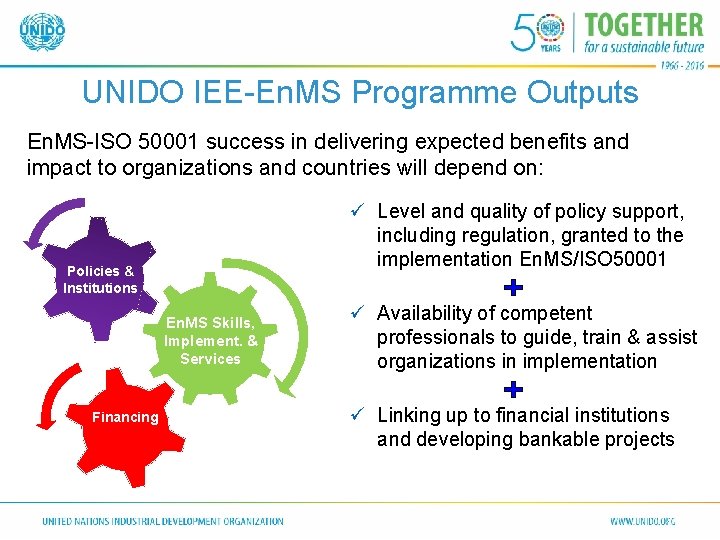
UNIDO IEE-En. MS Programme Outputs En. MS-ISO 50001 success in delivering expected benefits and impact to organizations and countries will depend on: ü Level and quality of policy support, including regulation, granted to the implementation En. MS/ISO 50001 Policies & Institutions En. MS Skills, Implement. & Services Financing ü Availability of competent professionals to guide, train & assist organizations in implementation ü Linking up to financial institutions and developing bankable projects 12
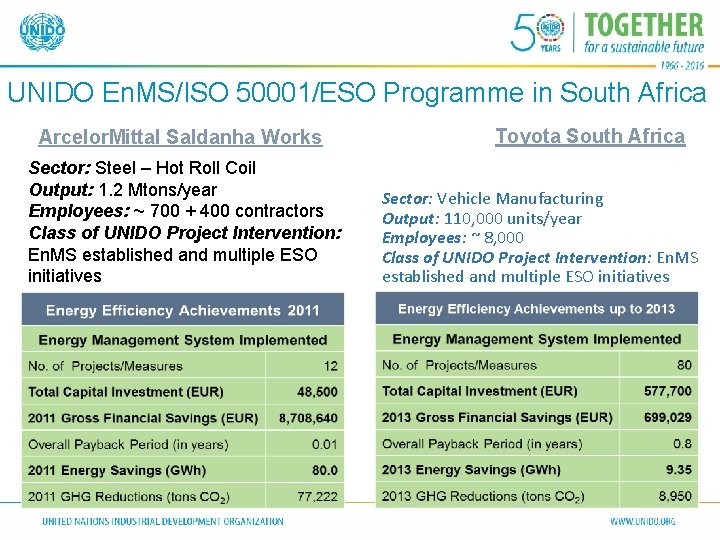
UNIDO En. MS/ISO 50001/ESO Programme in South Africa Arcelor. Mittal Saldanha Works Sector: Steel – Hot Roll Coil Output: 1. 2 Mtons/year Employees: ~ 700 + 400 contractors Class of UNIDO Project Intervention: En. MS established and multiple ESO initiatives Toyota South Africa Sector: Vehicle Manufacturing Output: 110, 000 units/year Employees: ~ 8, 000 Class of UNIDO Project Intervention: En. MS established and multiple ESO initiatives
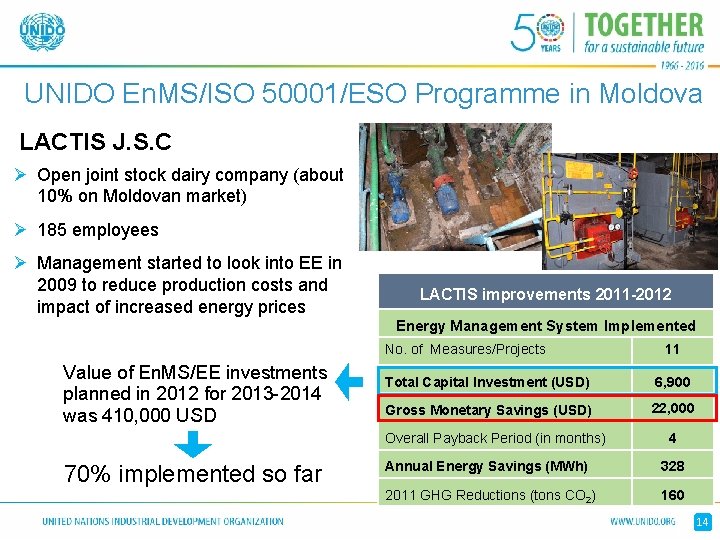
UNIDO En. MS/ISO 50001/ESO Programme in Moldova LACTIS J. S. C Ø Open joint stock dairy company (about 10% on Moldovan market) Ø 185 employees Ø Management started to look into EE in 2009 to reduce production costs and impact of increased energy prices LACTIS improvements 2011 -2012 Energy Management System Implemented No. of Measures/Projects Value of En. MS/EE investments planned in 2012 for 2013 -2014 was 410, 000 USD Total Capital Investment (USD) 6, 900 Gross Monetary Savings (USD) 22, 000 Overall Payback Period (in months) 70% implemented so far 11 4 Annual Energy Savings (MWh) 328 2011 GHG Reductions (tons CO 2) 160 14 14
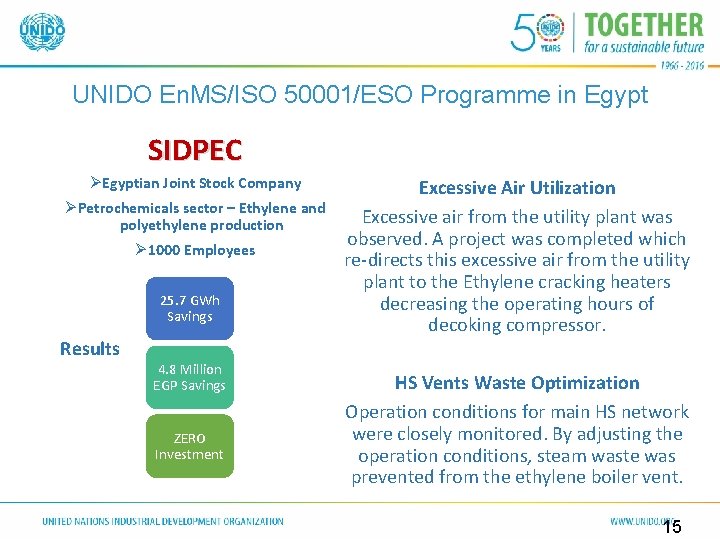
UNIDO En. MS/ISO 50001/ESO Programme in Egypt SIDPEC ØEgyptian Joint Stock Company ØPetrochemicals sector – Ethylene and polyethylene production Ø 1000 Employees 25. 7 GWh Savings Results 4. 8 Million EGP Savings ZERO Investment Excessive Air Utilization Excessive air from the utility plant was observed. A project was completed which re-directs this excessive air from the utility plant to the Ethylene cracking heaters decreasing the operating hours of decoking compressor. HS Vents Waste Optimization Operation conditions for main HS network were closely monitored. By adjusting the operation conditions, steam waste was prevented from the ethylene boiler vent. 15
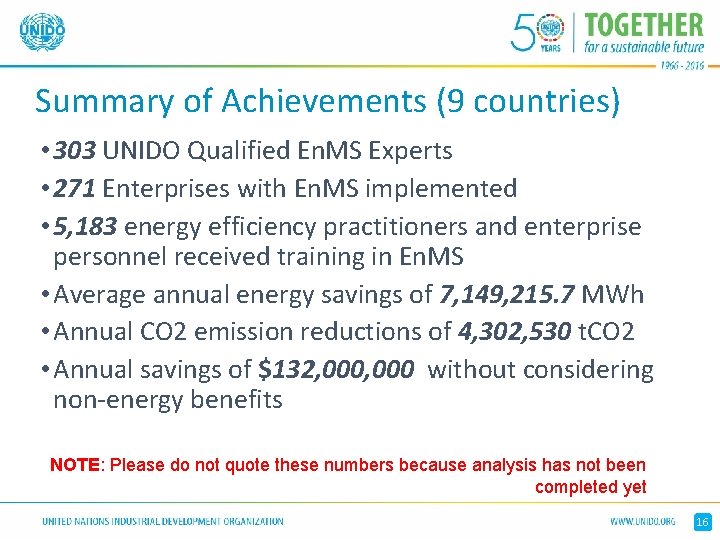
Summary of Achievements (9 countries) • 303 UNIDO Qualified En. MS Experts • 271 Enterprises with En. MS implemented • 5, 183 energy efficiency practitioners and enterprise personnel received training in En. MS • Average annual energy savings of 7, 149, 215. 7 MWh • Annual CO 2 emission reductions of 4, 302, 530 t. CO 2 • Annual savings of $132, 000 without considering non-energy benefits NOTE: Please do not quote these numbers because analysis has not been completed yet 16
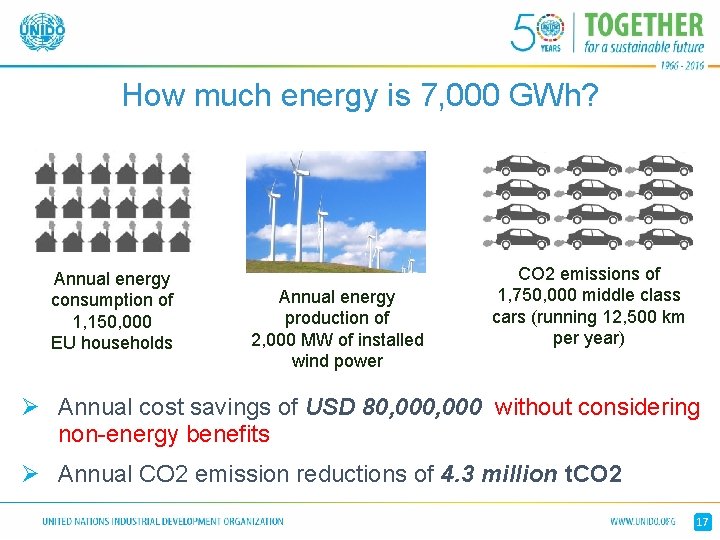
How much energy is 7, 000 GWh? Annual energy consumption of 1, 150, 000 EU households Annual energy production of 2, 000 MW of installed wind power CO 2 emissions of 1, 750, 000 middle class cars (running 12, 500 km per year) Ø Annual cost savings of USD 80, 000 without considering non-energy benefits Ø Annual CO 2 emission reductions of 4. 3 million t. CO 2 17 17
Thank you for your attention For more information: Rana Ghoneim Industrial Energy Efficiency Division Energy Department UNIDO Vienna International Centre P. O. Box 300 A-1400 Vienna, Austria E-mail: R. Ghoneim@unido. org 18