
Unidata University Data Provide data tools and community
- Slides: 16
Unidata (University Data) Provide data, tools, and community leadership for enhanced Earth-system education and research. EPA Data Summit February 2008 Ben Domenico Unidata Program Center UCAR Office of Programs Boulder, CO 1
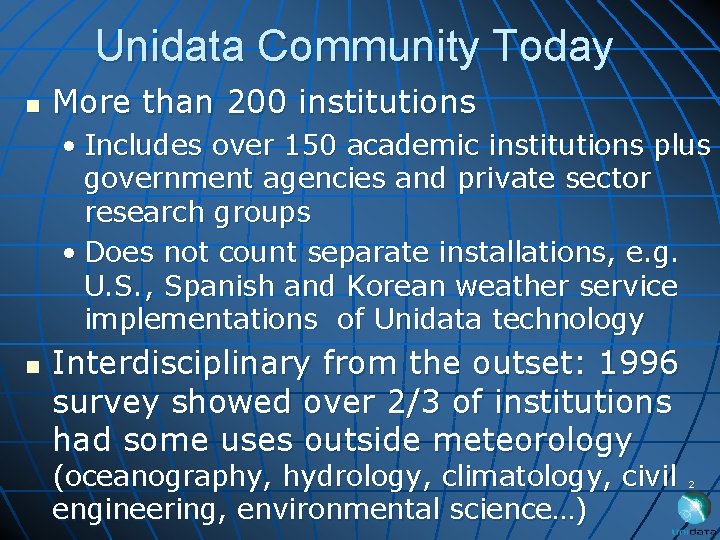
Unidata Community Today n More than 200 institutions • Includes over 150 academic institutions plus government agencies and private sector research groups • Does not count separate installations, e. g. U. S. , Spanish and Korean weather service implementations of Unidata technology n Interdisciplinary from the outset: 1996 survey showed over 2/3 of institutions had some uses outside meteorology (oceanography, hydrology, climatology, civil engineering, environmental science…) 2
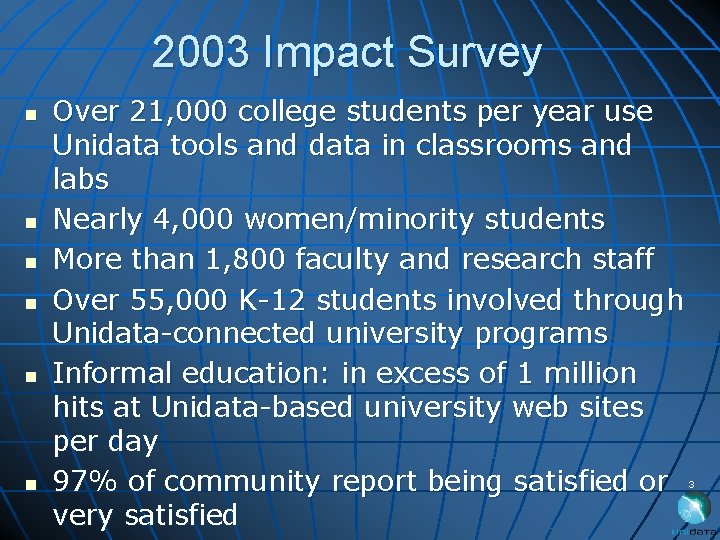
2003 Impact Survey n n n Over 21, 000 college students per year use Unidata tools and data in classrooms and labs Nearly 4, 000 women/minority students More than 1, 800 faculty and research staff Over 55, 000 K-12 students involved through Unidata-connected university programs Informal education: in excess of 1 million hits at Unidata-based university web sites per day 97% of community report being satisfied or very satisfied 3
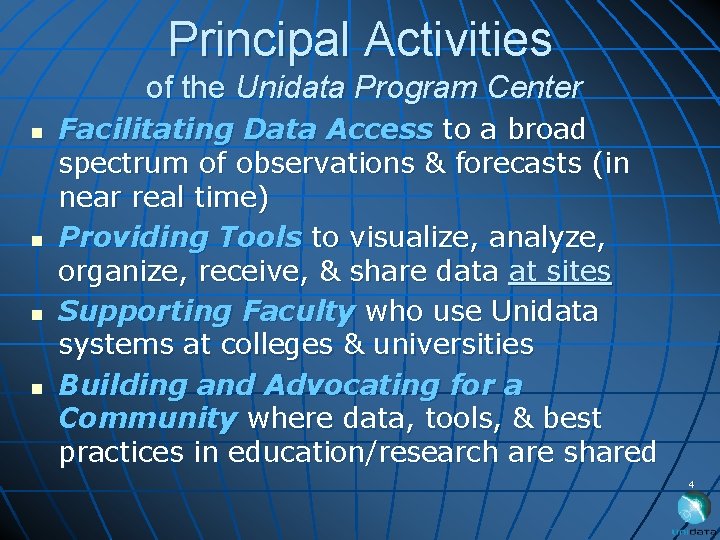
Principal Activities of the Unidata Program Center n n Facilitating Data Access to a broad spectrum of observations & forecasts (in near real time) Providing Tools to visualize, analyze, organize, receive, & share data at sites Supporting Faculty who use Unidata systems at colleges & universities Building and Advocating for a Community where data, tools, & best practices in education/research are shared 4
IDD: The Community in Action n n The Internet-based system by which universities acquire huge quantities of weather data in real-time (i. e. ASAP) typifies Unidata’s community orientation. The system has no data center -- all tasks are performed on the participants’ own (small) computers. Currently the most used “advanced application” on the Abilene network Surpassed FTP in data and packets transferred on Internet 2 a couple years ago 5
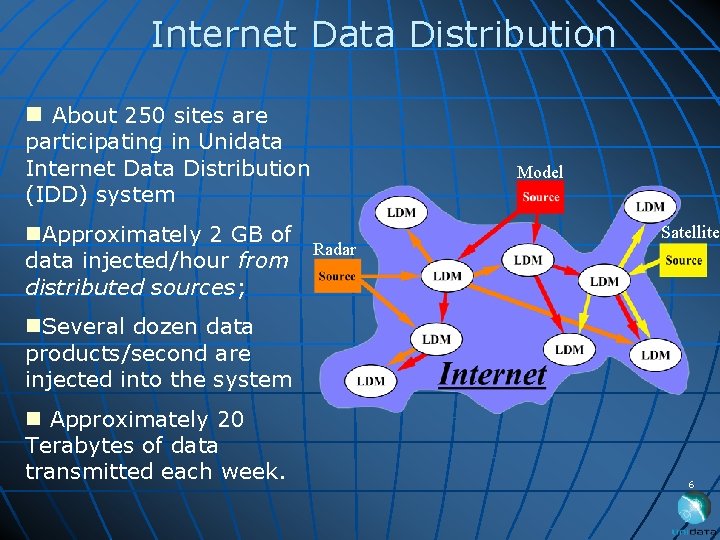
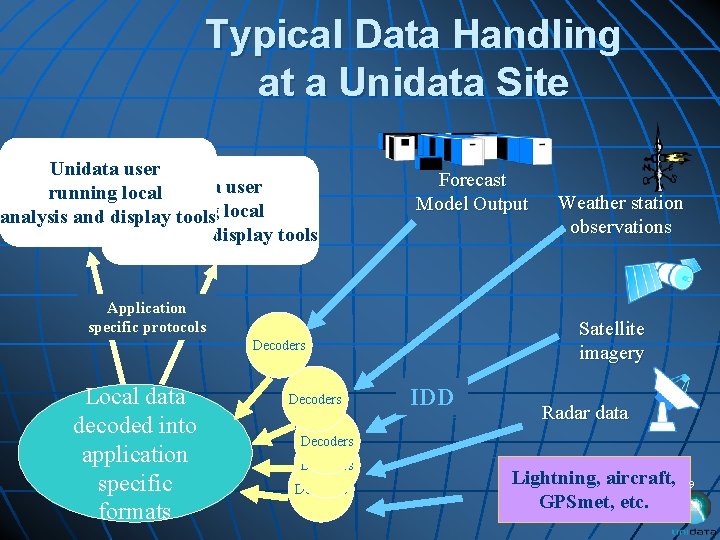
Internet Data Distribution n About 250 sites are participating in Unidata Internet Data Distribution (IDD) system n. Approximately 2 GB of data injected/hour from distributed sources; Model Radar Satellite n. Several dozen data products/second are injected into the system n Approximately 20 Terabytes of data transmitted each week. 6
Types of Data n n n Traditional observations from weather stations around the globe Satellite imagery Radar data from 150+ NEXRAD radars Output from forecast model runs at the National Centers for Environmental Prediction Lightning strike data Measurements from sensors on commercial aircraft 7
IDD: Fanout from Source for Scalability 8
Typical Data Handling at a Unidata Site Unidata user running local running analysis and display tools local analysis and display tools Forecast Model Output Application specific protocols Satellite imagery Decoders Local data decoded into application specific formats Decoders Weather station observations IDD Radar data Decoders Lightning, aircraft, GPSmet, etc. 9
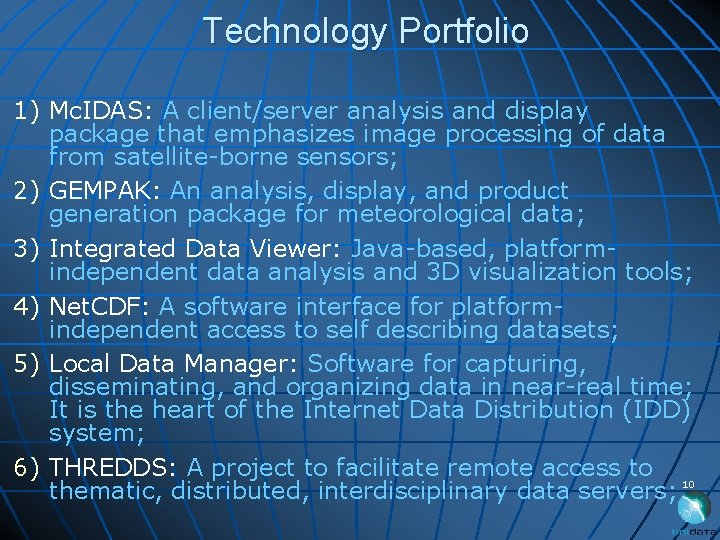
Technology Portfolio 1) Mc. IDAS: A client/server analysis and display package that emphasizes image processing of data from satellite-borne sensors; 2) GEMPAK: An analysis, display, and product generation package for meteorological data; 3) Integrated Data Viewer: Java-based, platformindependent data analysis and 3 D visualization tools; 4) Net. CDF: A software interface for platformindependent access to self describing datasets; 5) Local Data Manager: Software for capturing, disseminating, and organizing data in near-real time; It is the heart of the Internet Data Distribution (IDD) system; 6) THREDDS: A project to facilitate remote access to 10 thematic, distributed, interdisciplinary data servers;
Technology Transfer: Operational NWS Use for Collecting and Distributing Level 2 NEXRAD Data LDMs also used to collect and distribute GPSmet data from 150+11 GPS ground stations instrumented to measure atmospheric water vapor and ionospheric electron density in Suominet
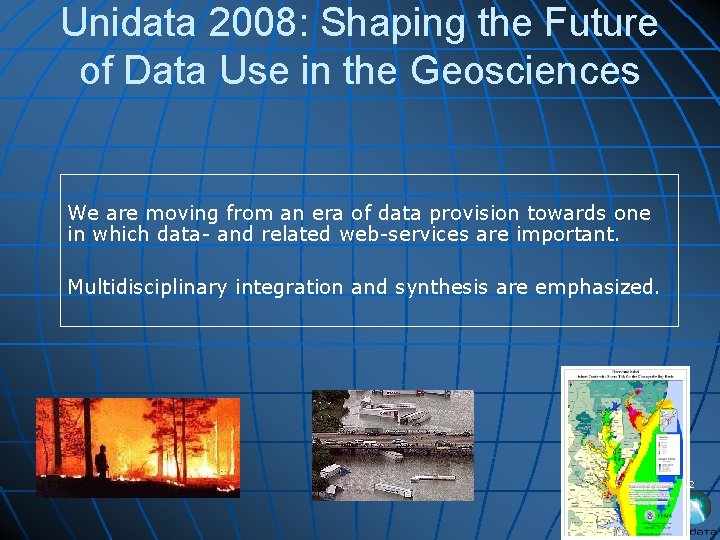
Unidata 2008: Shaping the Future of Data Use in the Geosciences We are moving from an era of data provision towards one in which data- and related web-services are important. Multidisciplinary integration and synthesis are emphasized. 12
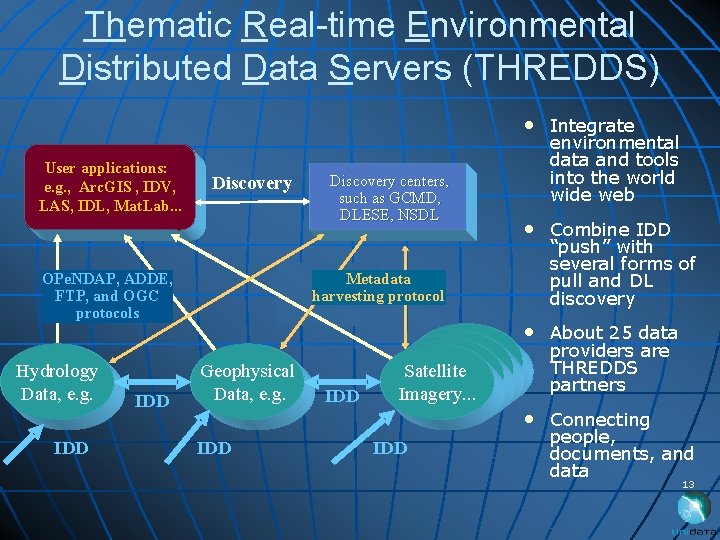
Thematic Real-time Environmental Distributed Data Servers (THREDDS) • Integrate User applications: e. g. , Mc. IDAS, Arc. GIS , IDV, LAS, IDL, Mat. Lab. . . Discovery OPe. NDAP, ADDE, FTP, and OGC protocols Hydrology Data, e. g. IDD Discovery centers, DLESE such as GCMD, Digital Library for DLESE, NSDL Earth-System Education Metadata harvesting protocol Geophysical Data, e. g. IDD Satellite Images, e. g. Imagery. . . IDD environmental data and tools into the world wide web • Combine IDD “push” with several forms of pull and DL discovery • About 25 data providers are THREDDS partners • Connecting people, documents, and data 13
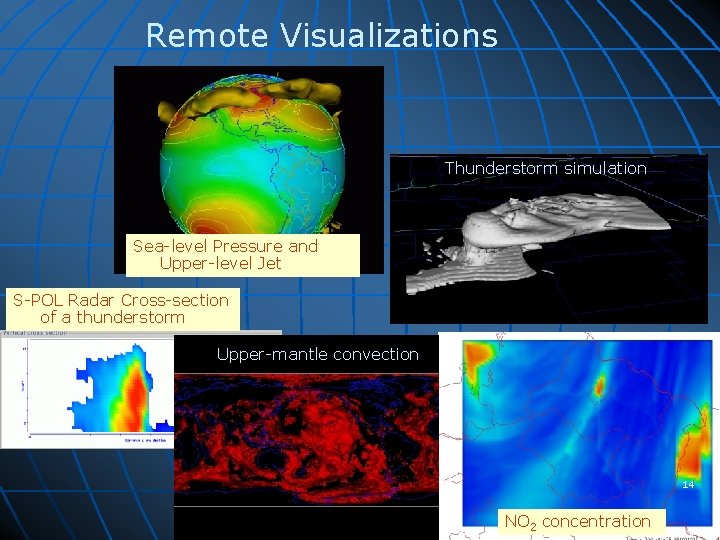
Remote Visualizations Thunderstorm simulation Sea-level Pressure and Upper-level Jet S-POL Radar Cross-section of a thunderstorm Upper-mantle convection 14 NO 2 concentration
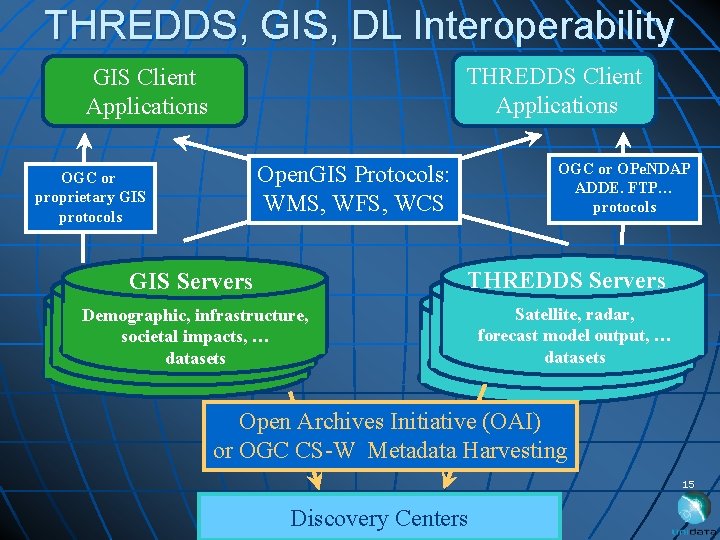
THREDDS, GIS, DL Interoperability THREDDS Client Applications GIS Client Applications OGC or proprietary GIS protocols Open. GIS Protocols: WMS, WFS, WCS GIS Servers GIS Server Demographic, infrastructure, GIS Server OGC or OPe. NDAP ADDE. FTP… protocols THREDDS Server Satellite, radar, societal impacts, … datasets forecast model output, … datasets Open Archives Initiative (OAI) or OGC CS-W Metadata Harvesting 15 Discovery Centers
More Information n http: //www. unidata. ucar. edu/ n ben@unidata. ucar. edu 17