
UNICEFWG Child Functioning Module CFM Washington Group Secretariat
- Slides: 29
UNICEF/WG Child Functioning Module (CFM) Washington Group Secretariat, National Center for Health Statistics, USA 10/16/2021 1
Summary of Presentation This presentation provides an overview of the development of a question set specifically designed to capture functioning and disability among children. Topics covered include: • The need for accurate and reliable data on child functioning and disability • Issues of measuring disability during child development • Background to the development of the UNICEF/WG CFM • Disability determination using the CFM • Validation and testing of the CFM • Supporting documentation • The CFM in the MICS (Multiple Indicator Cluster Surveys) 10/16/2021 2
Why and do We Need Data on Child Disability? (1) Demonstrate the extent of functional difficulties among children across the range of functional domains. Document the impact of functional difficulties on children's participation in society. Assess the barriers children with functional difficulties face in attending school and identify the facilitators that enhance school participation. 10/16/2021 3
Why do We Need Data on Child Disability? (2) Prioritize interventions: to provide decision-makers with basic information that can be used to set priorities related to children with disabilities and their families. Monitor progress: data collected over time can be used: ü to monitor outcomes on national policies and interventions in order to expand effective programs and modify/delete ineffective ones and ü to fulfill the requirements of the UN Conventions and the Sustainable Development Goals (SDGs). 10/16/2021 4
Data on Child Disability Varies Widely Across the World due to: 1. different priority given to children and/or to disability in the political agenda at national level 2. different level of local resources available for data collection at national level 3. cultural factors influence how child disabilities are reported in surveys 4. lack of a standardized approach to data collection: such as definition of disability, purpose of measurement, and data collection method. 10/16/2021 5
Some Factors Affecting the International Comparability of Survey Data • Questions designed specifically to target children vs applying questions designed for adults to children • Questions that ask about “disability” or “impairment” vs questions on “difficulties in functioning” • Age range of target population • Reporting prevalence on different age ranges • Answer categories: dichotomous vs graded responses The result is: No international comparability 10/16/2021 6
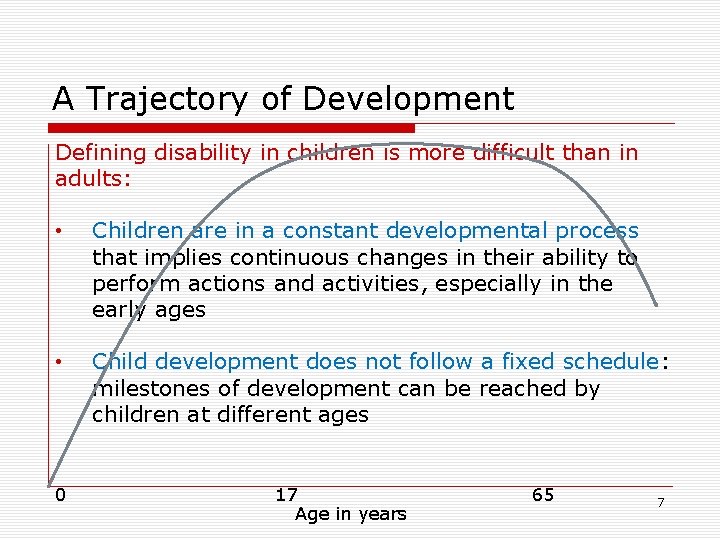
A Trajectory of Development Defining disability in children is more difficult than in adults: • Children are in a constant developmental process that implies continuous changes in their ability to perform actions and activities, especially in the early ages • Child development does not follow a fixed schedule: milestones of development can be reached by children at different ages 0 17 Age in years 65 7
Challenges in Developing Questions: The WG and UNICEF wanted to build a question set for children based on experience from the WG-SS, but • not all of the 6 WG short set questions/domains are applicable to young children • nor do they cover the full range of domains of particular interest in child development • Disability measurement often takes place through the filter of a parent or another adult 10/16/2021 8
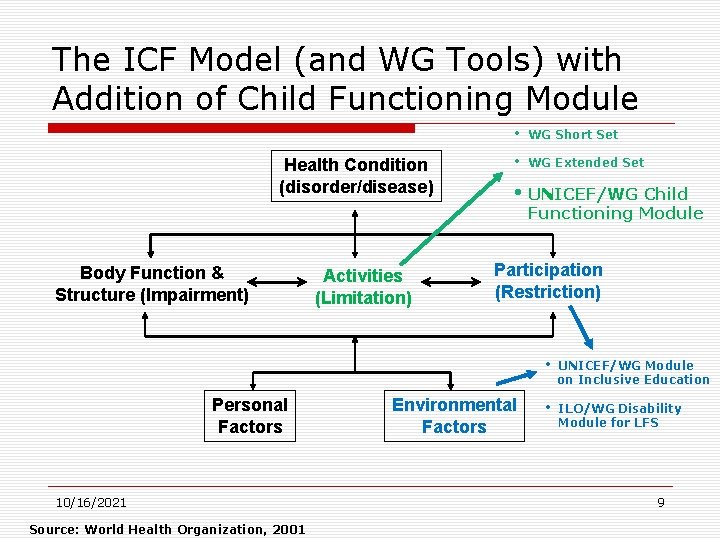
The ICF Model (and WG Tools) with Addition of Child Functioning Module Health Condition (disorder/disease) • WG Short Set • WG Extended Set • UNICEF/WG Child Functioning Module Body Function & Structure (Impairment) Personal Factors 10/16/2021 Source: World Health Organization, 2001 Activities (Limitation) Participation (Restriction) Environmental Factors • UNICEF/WG Module on Inclusive Education • ILO/WG Disability Module for LFS 9
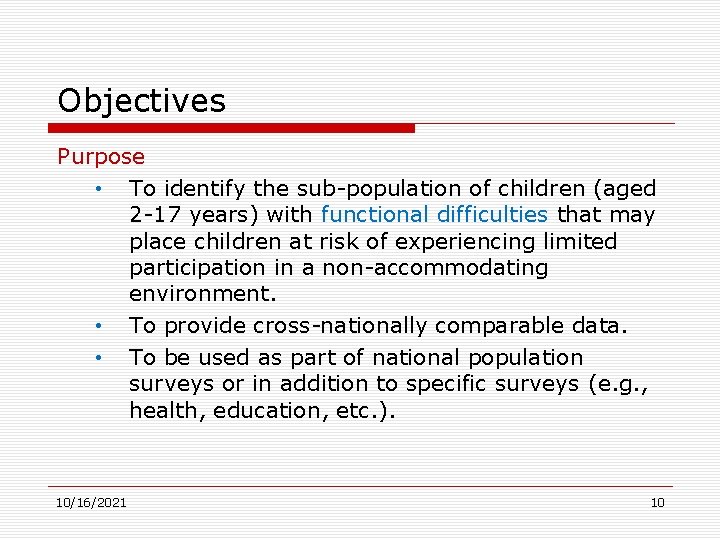
Objectives Purpose • To identify the sub-population of children (aged 2 -17 years) with functional difficulties that may place children at risk of experiencing limited participation in a non-accommodating environment. • To provide cross-nationally comparable data. • To be used as part of national population surveys or in addition to specific surveys (e. g. , health, education, etc. ). 10/16/2021 10
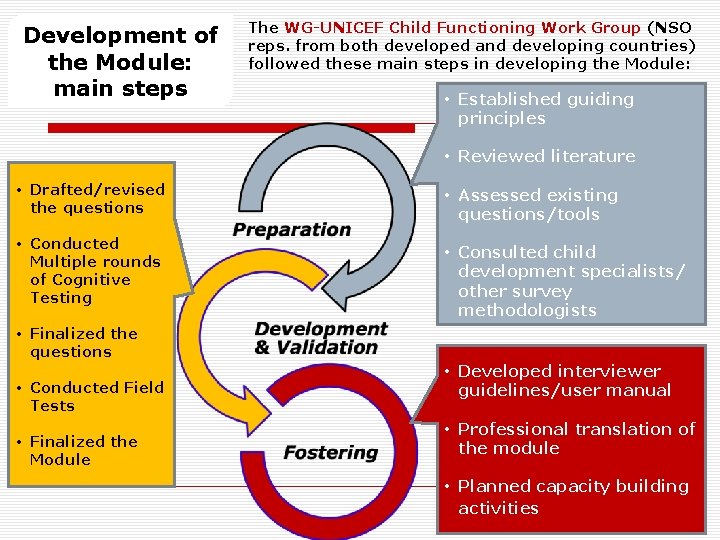
Development of the Module: main steps The WG-UNICEF Child Functioning Work Group (NSO reps. from both developed and developing countries) followed these main steps in developing the Module: • Established guiding principles • Reviewed literature • Drafted/revised the questions • Conducted Multiple rounds of Cognitive Testing • Assessed existing questions/tools • Consulted child development specialists/ other survey methodologists • Finalized the questions • Conducted Field Tests • Finalized the Module • Developed interviewer guidelines/user manual • Professional translation of the module • Planned capacity building activities
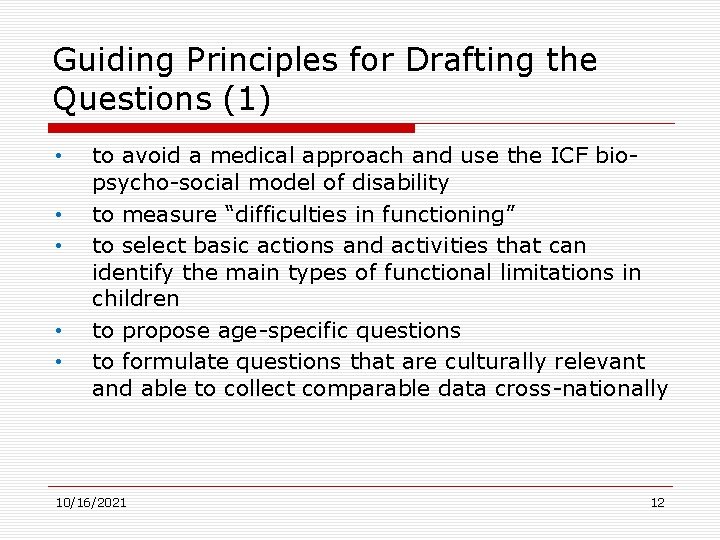
Guiding Principles for Drafting the Questions (1) • • • to avoid a medical approach and use the ICF biopsycho-social model of disability to measure “difficulties in functioning” to select basic actions and activities that can identify the main types of functional limitations in children to propose age-specific questions to formulate questions that are culturally relevant and able to collect comparable data cross-nationally 10/16/2021 12
Guiding Principles for Drafting the Questions (2) • • to adopt, where applicable, questions already tested including those of the WG short and extended sets to use answer categories able to get the severity of the activities limitation in order to reflect the disability continuum to include, when appropriate, the reference “Compared with children of the same age…” to ask questions to parents or primary caregivers. 10/16/2021 13
UNICEF/WG Child Functioning Module (CFM) WG/UNICEF CFM adopted 2016 • module for children aged 2 -4 consists of 16 questions max covering 8 core domains of functioning • module for children aged 5 -17 consists of 24 questions max covering 12 core domains of functioning • Domains were selected based on their universality and commonality across cultures and countries at various stages of economic development. 10/16/2021 14
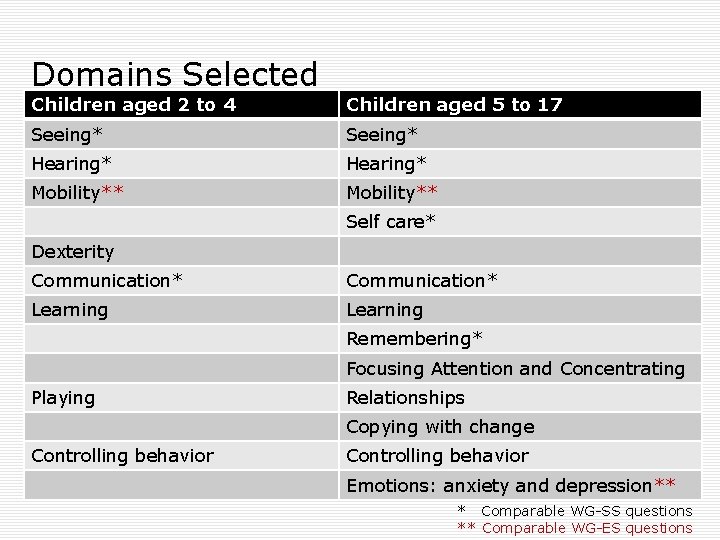
Domains Selected Children aged 2 to 4 Children aged 5 to 17 Seeing* Hearing* Mobility** Self care* Dexterity Communication* Learning Remembering* Focusing Attention and Concentrating Playing Relationships Copying with change Controlling behavior Emotions: anxiety and depression** * Comparable WG-SS questions ** Comparable WG-ES questions
Content and Structure • Preamble: I would like to ask you some questions about difficulties your child may have • Unless noted otherwise, all response categories are: • No difficulty • Some difficulty • A lot of difficulty • Cannot do at all • Questions on vision/hearing and mobility include questions on the use of glasses/hearing aids/ assistance with walking 10/16/2021 16
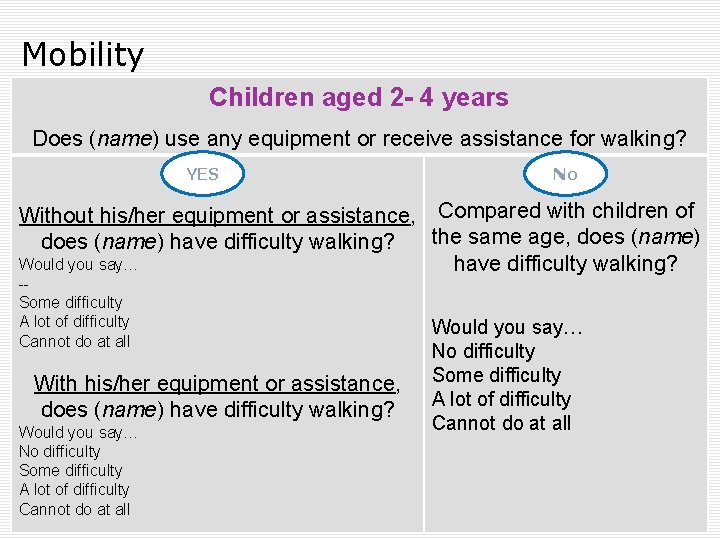
Mobility Children aged 2 - 4 years Does (name) use any equipment or receive assistance for walking? YES No Without his/her equipment or assistance, Compared with children of the same age, does (name) have difficulty walking? Would you say… have difficulty walking? -Some difficulty A lot of difficulty Cannot do at all With his/her equipment or assistance, does (name) have difficulty walking? Would you say… No difficulty Some difficulty A lot of difficulty Cannot do at all
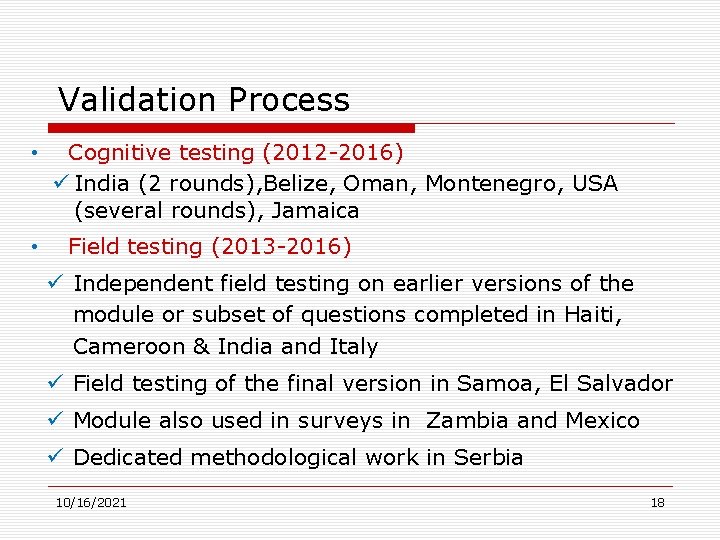
Validation Process • • Cognitive testing (2012 -2016) ü India (2 rounds), Belize, Oman, Montenegro, USA (several rounds), Jamaica Field testing (2013 -2016) ü Independent field testing on earlier versions of the module or subset of questions completed in Haiti, Cameroon & India and Italy ü Field testing of the final version in Samoa, El Salvador ü Module also used in surveys in Zambia and Mexico ü Dedicated methodological work in Serbia 10/16/2021 18
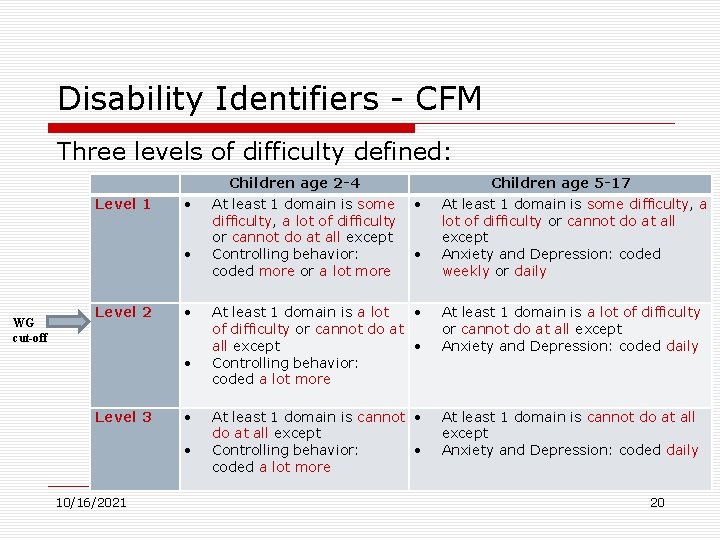
Disability Identifiers - CFM Three levels of difficulty defined: Level 1 WG cut-off Level 2 Level 3 10/16/2021 Children age 2 -4 At least 1 domain is some difficulty, a lot of difficulty or cannot do at all except Controlling behavior: coded more or a lot more Children age 5 -17 At least 1 domain is some difficulty, a lot of difficulty or cannot do at all except Anxiety and Depression: coded weekly or daily At least 1 domain is a lot of difficulty or cannot do at all except Controlling behavior: coded a lot more At least 1 domain is a lot of difficulty or cannot do at all except Anxiety and Depression: coded daily At least 1 domain is cannot do at all except Controlling behavior: coded a lot more At least 1 domain is cannot do at all except Anxiety and Depression: coded daily 20
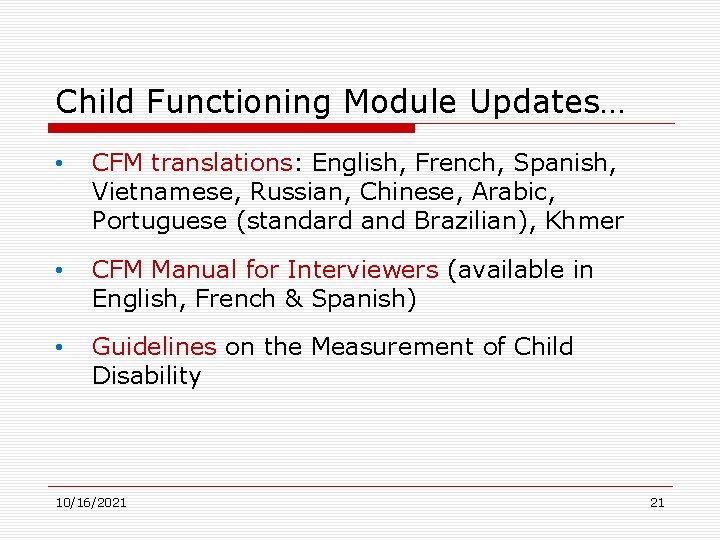
Child Functioning Module Updates… • CFM translations: English, French, Spanish, Vietnamese, Russian, Chinese, Arabic, Portuguese (standard and Brazilian), Khmer • CFM Manual for Interviewers (available in English, French & Spanish) • Guidelines on the Measurement of Child Disability 10/16/2021 21
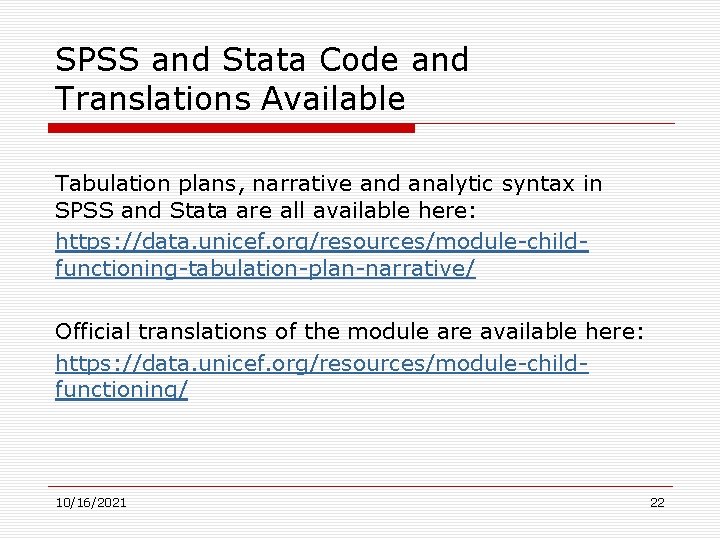
SPSS and Stata Code and Translations Available Tabulation plans, narrative and analytic syntax in SPSS and Stata are all available here: https: //data. unicef. org/resources/module-childfunctioning-tabulation-plan-narrative/ Official translations of the module are available here: https: //data. unicef. org/resources/module-childfunctioning/ 10/16/2021 22
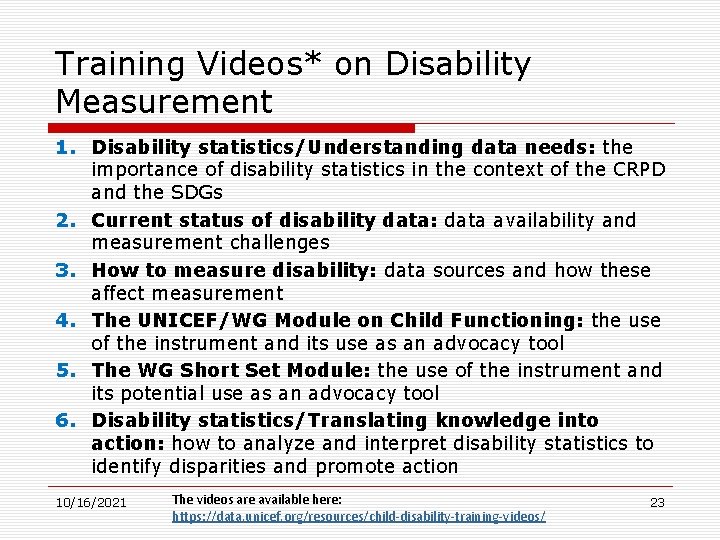
Training Videos* on Disability Measurement 1. Disability statistics/Understanding data needs: the importance of disability statistics in the context of the CRPD and the SDGs 2. Current status of disability data: data availability and measurement challenges 3. How to measure disability: data sources and how these affect measurement 4. The UNICEF/WG Module on Child Functioning: the use of the instrument and its use as an advocacy tool 5. The WG Short Set Module: the use of the instrument and its potential use as an advocacy tool 6. Disability statistics/Translating knowledge into action: how to analyze and interpret disability statistics to identify disparities and promote action 10/16/2021 The videos are available here: https: //data. unicef. org/resources/child-disability-training-videos/ 23
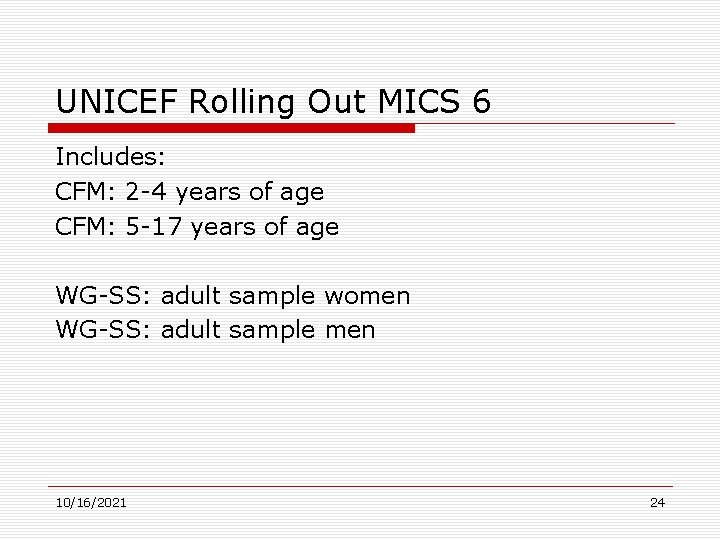
UNICEF Rolling Out MICS 6 Includes: CFM: 2 -4 years of age CFM: 5 -17 years of age WG-SS: adult sample women WG-SS: adult sample men 10/16/2021 24
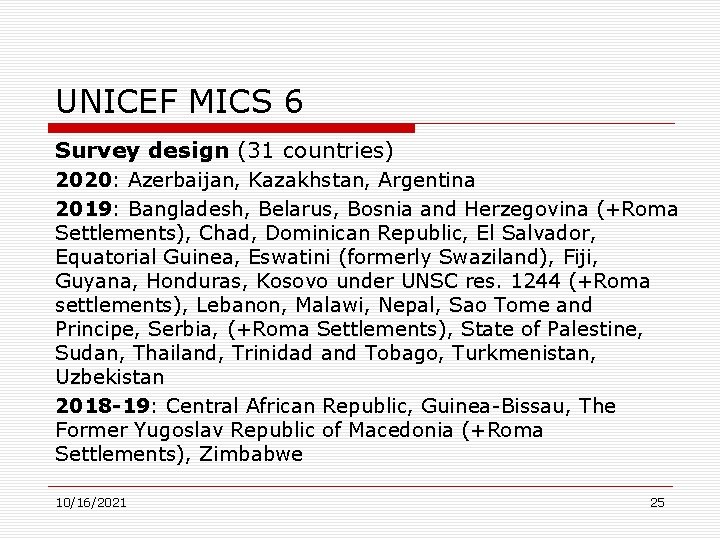
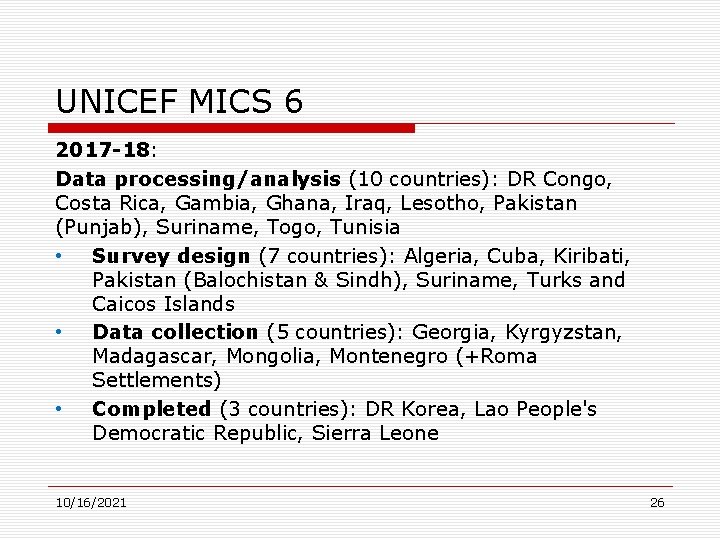
UNICEF MICS 6 Survey design (31 countries) 2020: Azerbaijan, Kazakhstan, Argentina 2019: Bangladesh, Belarus, Bosnia and Herzegovina (+Roma Settlements), Chad, Dominican Republic, El Salvador, Equatorial Guinea, Eswatini (formerly Swaziland), Fiji, Guyana, Honduras, Kosovo under UNSC res. 1244 (+Roma settlements), Lebanon, Malawi, Nepal, Sao Tome and Principe, Serbia, (+Roma Settlements), State of Palestine, Sudan, Thailand, Trinidad and Tobago, Turkmenistan, Uzbekistan 2018 -19: Central African Republic, Guinea-Bissau, The Former Yugoslav Republic of Macedonia (+Roma Settlements), Zimbabwe 10/16/2021 25
UNICEF MICS 6 2017 -18: Data processing/analysis (10 countries): DR Congo, Costa Rica, Gambia, Ghana, Iraq, Lesotho, Pakistan (Punjab), Suriname, Togo, Tunisia • Survey design (7 countries): Algeria, Cuba, Kiribati, Pakistan (Balochistan & Sindh), Suriname, Turks and Caicos Islands • Data collection (5 countries): Georgia, Kyrgyzstan, Madagascar, Mongolia, Montenegro (+Roma Settlements) • Completed (3 countries): DR Korea, Lao People's Democratic Republic, Sierra Leone 10/16/2021 26
Summary - CFM • The UNICEF/WG Child Functioning Module was developed in response to an internationally recognized need for comparable data. • It was built with input from a variety of experts and stakeholders to be in line with the ICF and UNCRPD concept of disability. • It has undergone a series of cognitive and field tests that have proven the questions to be straightforward to administer and well understood by respondents across contexts and cultures. 10/16/2021 27
UNICEF/WG CFM for EMIS Education Management Information System is an administrative data system used for monitoring aspects of the education system. EMIS is a fundamental source of information for advancing inclusive education. An EMIS should collect data on children with disabilities and on the school environment but, by and large, in most countries currently these data are not collected. A version of the UNICEF/WG CFM for teachers (CFM-TV) is currently under development. 10/16/2021 28
Selected References • Crialesi R, De Palma E, Battisti A. (2016), Building a Module on Child Functioning and Disability in Altman B. (ed. ) International Measurement of Disability: Purpose, Method and Application, Social Indicators Series n. 61, Springer. • Massey M, et al. (2014), Analysis of Cognitive Interview Testing of Child Disability Questions in Five Countries, NCHS, available at http: //wwwn. cdc. gov/qbank/New. Reports. aspx • Massey M, et al. (2015), Analysis of Cognitive Testing of Child Disability Questions: Parent-Proxy vs. Teen Self. Report, NCHS, available at http: //wwwn. cdc. gov/qbank/New. Reports. aspx 10/16/2021 29
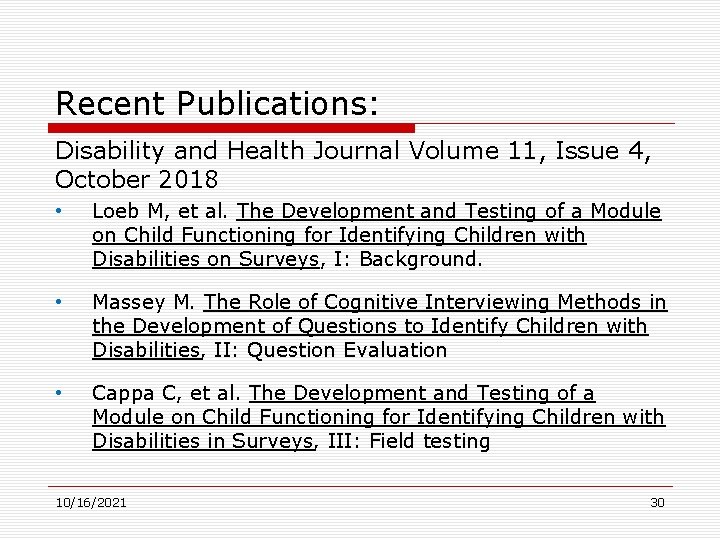
Recent Publications: Disability and Health Journal Volume 11, Issue 4, October 2018 • Loeb M, et al. The Development and Testing of a Module on Child Functioning for Identifying Children with Disabilities on Surveys, I: Background. • Massey M. The Role of Cognitive Interviewing Methods in the Development of Questions to Identify Children with Disabilities, II: Question Evaluation • Cappa C, et al. The Development and Testing of a Module on Child Functioning for Identifying Children with Disabilities in Surveys, III: Field testing 10/16/2021 30