
UNICEF Nonprofit Team 1 April 25 2018 OGL
- Slides: 12
UNICEF Non-profit Team 1 April 25, 2018 OGL 355 Dr. Jay Klagge
Agenda ● Vision and Mission Statement ● Organizational Structure ● Leadership ● Competitive Advantage ● SWOT Analysis ● Environmental Analysis ● Strategic Options for Existing Locations ● Recommended Strategies
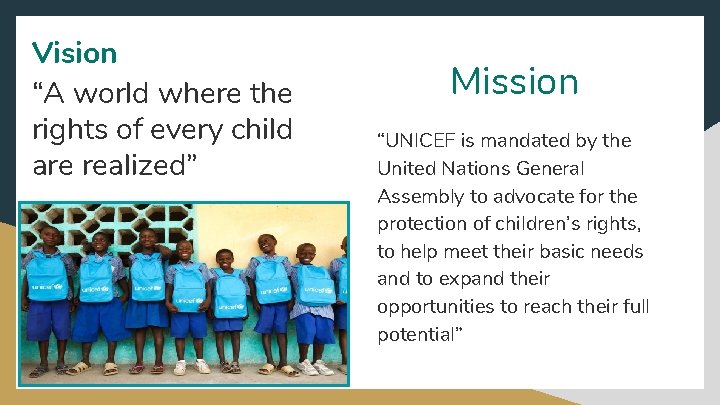
Vision “A world where the rights of every child are realized” Mission “UNICEF is mandated by the United Nations General Assembly to advocate for the protection of children’s rights, to help meet their basic needs and to expand their opportunities to reach their full potential”
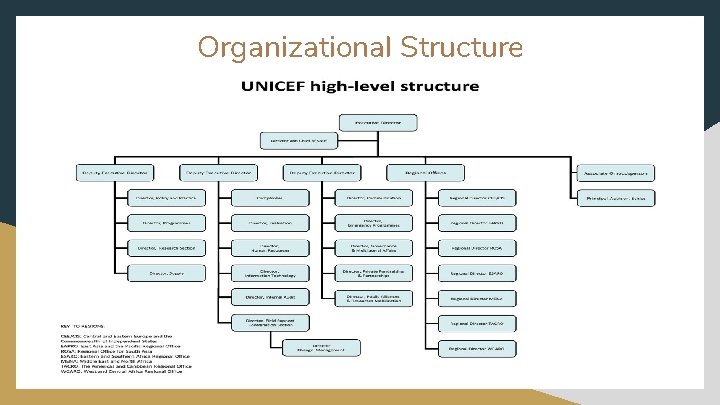
Organizational Structure
Leadership “UNICEF was created with a distinct purpose in mind: to work with others to overcome the obstacles that poverty, violence, disease and discrimination place in a child’s path. We advocate for measures to give children the best start in life, because proper care at the youngest age forms the strongest foundation for a person’s future” UNICEF. ORG
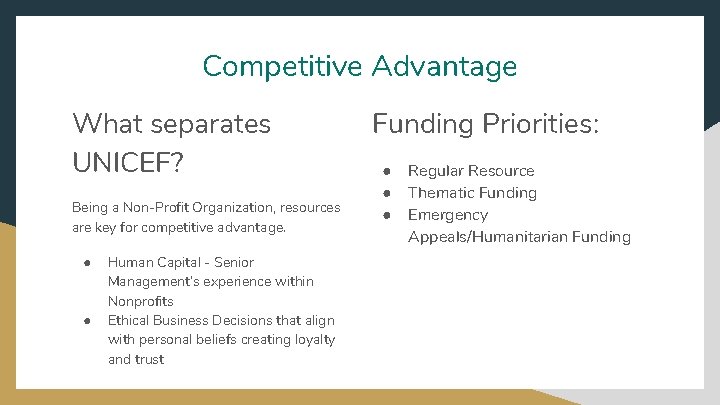
Competitive Advantage What separates UNICEF? Being a Non-Profit Organization, resources are key for competitive advantage. ● ● Human Capital - Senior Management’s experience within Nonprofits Ethical Business Decisions that align with personal beliefs creating loyalty and trust Funding Priorities: ● ● ● Regular Resource Thematic Funding Emergency Appeals/Humanitarian Funding
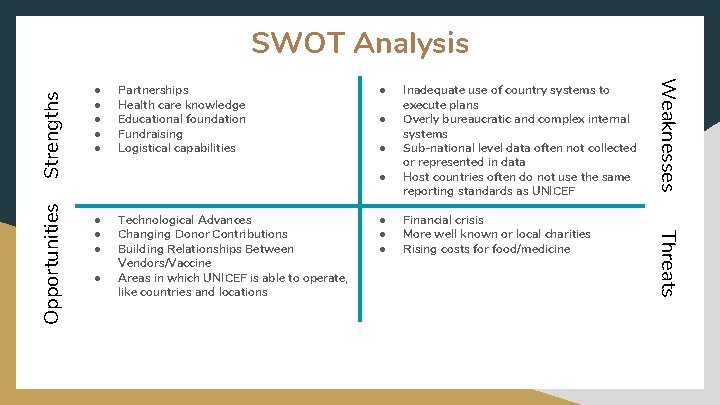
Partnerships Health care knowledge Educational foundation Fundraising Logistical capabilities ● ● ● ● Technological Advances Changing Donor Contributions Building Relationships Between Vendors/Vaccine Areas in which UNICEF is able to operate, like countries and locations ● ● ● Inadequate use of country systems to execute plans Overly bureaucratic and complex internal systems Sub-national level data often not collected or represented in data Host countries often do not use the same reporting standards as UNICEF Financial crisis More well known or local charities Rising costs for food/medicine Threats Opportunities ● ● ● Weaknesses Strengths SWOT Analysis
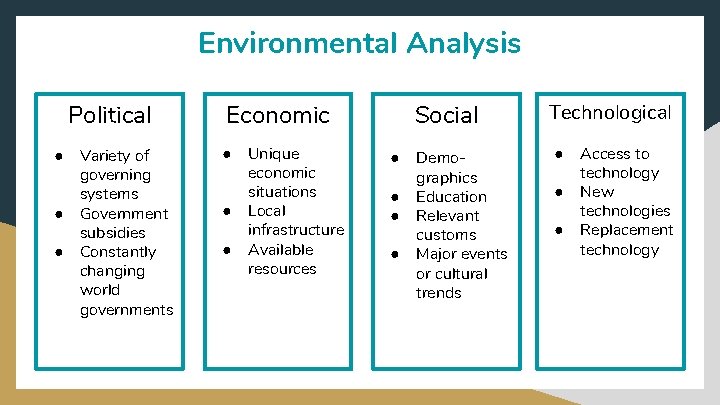
Environmental Analysis Political ● ● ● Variety of governing systems Government subsidies Constantly changing world governments Economic ● ● ● Unique economic situations Local infrastructure Available resources Social ● ● Demographics Education Relevant customs Major events or cultural trends Technological ● ● ● Access to technology New technologies Replacement technology
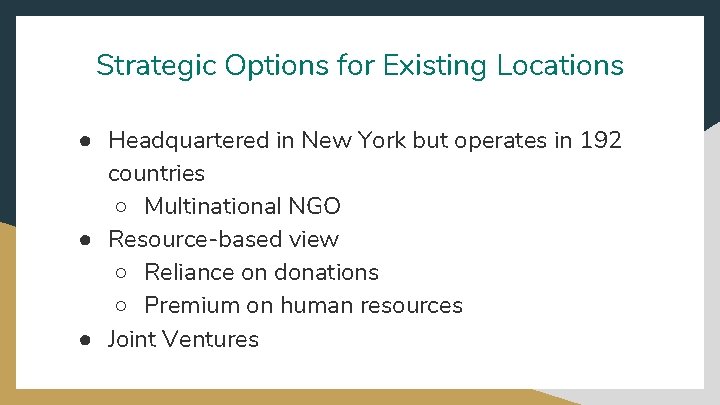
Strategic Options for Existing Locations ● Headquartered in New York but operates in 192 countries ○ Multinational NGO ● Resource-based view ○ Reliance on donations ○ Premium on human resources ● Joint Ventures
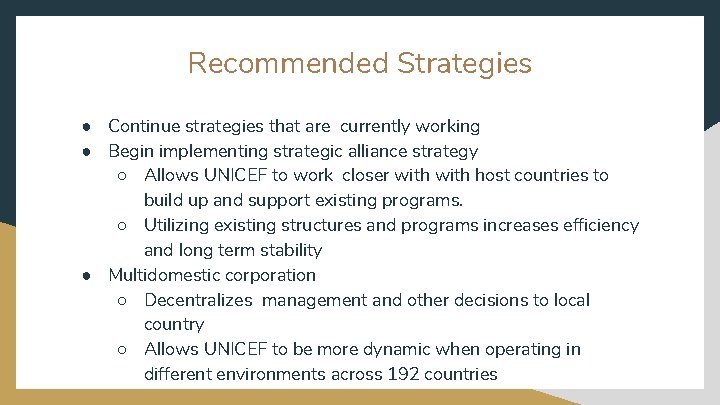
Recommended Strategies ● Continue strategies that are currently working ● Begin implementing strategic alliance strategy ○ Allows UNICEF to work closer with host countries to build up and support existing programs. ○ Utilizing existing structures and programs increases efficiency and long term stability ● Multidomestic corporation ○ Decentralizes management and other decisions to local country ○ Allows UNICEF to be more dynamic when operating in different environments across 192 countries
References AID, A. (2012). Australian Multilateral Assessment March 2012 United Nations Children's Fund (UNICEF). Australian Government. Arch (Designer). (2011). Ambidextrous [digital image] Retrieved from https: //commons. wikimedia. org/wiki/File: Ambidextrie. svg BNETvideo. (2009, October 20). Burn Your Org Chart. Retrieved from https: //www. youtube. com/watch? v=Kx_Vfx 3 y 7 n. Q Coulter, M. K. (2013). Strategic Management In Action (6 th ed. ). New York, NY: Pearson. Funding for UNICEF. (n. d. ). Retrieved from https: //www. globalpolicy. org/home/133 -tables-and-charts/51068 -funding-for-unicef. html How UNICEF Helped Save Millions of Children’s Lives Last Year. (2017). Retrieved from https: //www. unicefusa. org/stories/how-unicef-helped-save-millionschildrens-lives-last-year/32095 Knowledge Exchange. (n. d. ) Retrieved from https: //www. unicef. org/knowledge-exchange/files/SWOT_and_PESTEL_production. pdf Leadership bios and photos. (2010, July 13). Retrieved from https: //www. unicef. org/about/structure/index_54283. html Learning from experience (n. d. ). Retrieved from https: //wcmsprod. unicef. org/stories/learning-experience-1946 -1979 Murray, C. , & Newby, H. (2012). Data Resource Profile: United Nations Children’s Fund (UNICEF). International Journal of Epidemiology, 41(6), 1595– 1601. http: //doi. org/10. 1093/ije/dys 185 Office, U. E. (2004). UNICEFS's Strengths and Weaknesses. UNICEF Evaluation Office. Partnerships. (n. d. ). Retrieved from https: //www. unicef. org/partners/ Regular Resources. (n. d. ). Retrieved from https: //www. unicef. org/publicpartnerships/66662_66850. html
References cont. . . Senior Management. (n. d. ). Retrieved from https: //www. unicefusa. org/about/people/management Thematic Funding. (n. d. ). Retrieved from https: //www. unicef. org/publicpartnerships/66662_66851. html The UNICEF Vision and Mission for Children. (2015, June. ) Retrieved from https: //www. unicef. org/publicpartnerships/files/UNICEF_Mission(1). pdf UNICEF (Designer). (2018). UNICEF for every child [digital image] Retrieved from https: //www. unicef. org/media_102792. html UNICEF Executive Board (n. d. ). Retrieved from https: //www. unicef. org/about/execboard/ UNICEF high-level structure. (2015, January 13). Retrieved from http: //civic-city. org/blog/organigrams-of-io-and-ngo/unicef-high-level-structure/ UNICEF Resources. (n. d. ). Retrieved from https: //www. unicef. org/health/index_resources. html UNICEF Statistics. (n. d. ) Retrieved from https: //data. unicef. org/ United Nations Children’s Fund (UNICEF) [digital image]. Retrieved from http: //www. unbrussels. org/united-nations-childrens-fund-unicef/ United Nations International Children’s Emergency Fund [digital image]. Retrieved from https: //infograph. venngage. com/p/230879/unicef Where we work. (n. d. ). Retrieved from https: //www. unicef. org/where-we-work