
UNICEF Initiatives to Increase Access to Oxygen Therapy


- Slides: 34
UNICEF Initiatives to Increase Access to Oxygen Therapy Systems in Low-resource Settings 4 th WHO Global Forum on Medical Devices 15 December 2018 Heta Kosenen Mulugeta Mideksa Bev Bradley Markets, Supplier Financing & Innovation Centre © UNICEF/UNI 197921/Schermbrucker
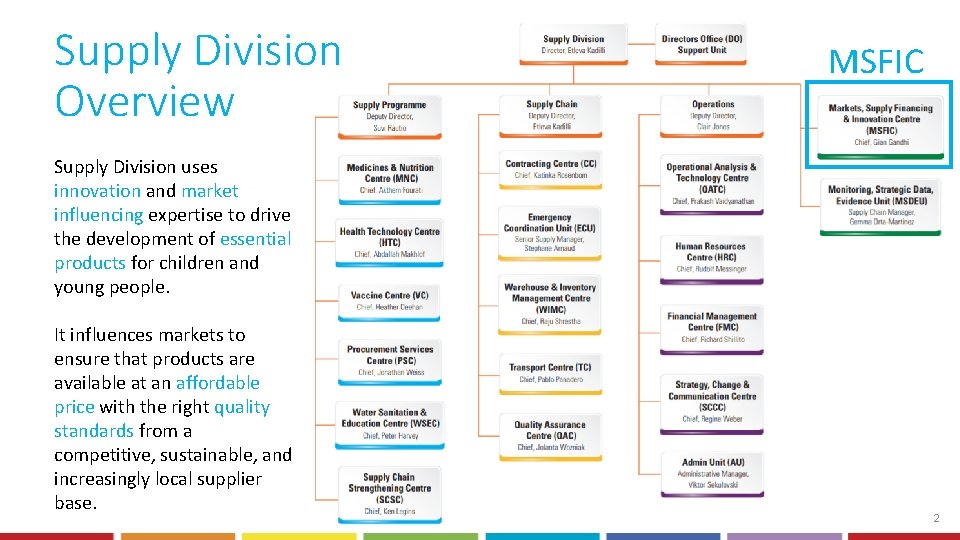
Supply Division Overview MSFIC Supply Division uses innovation and market influencing expertise to drive the development of essential products for children and young people. It influences markets to ensure that products are available at an affordable price with the right quality standards from a competitive, sustainable, and increasingly local supplier base. 2
3
4
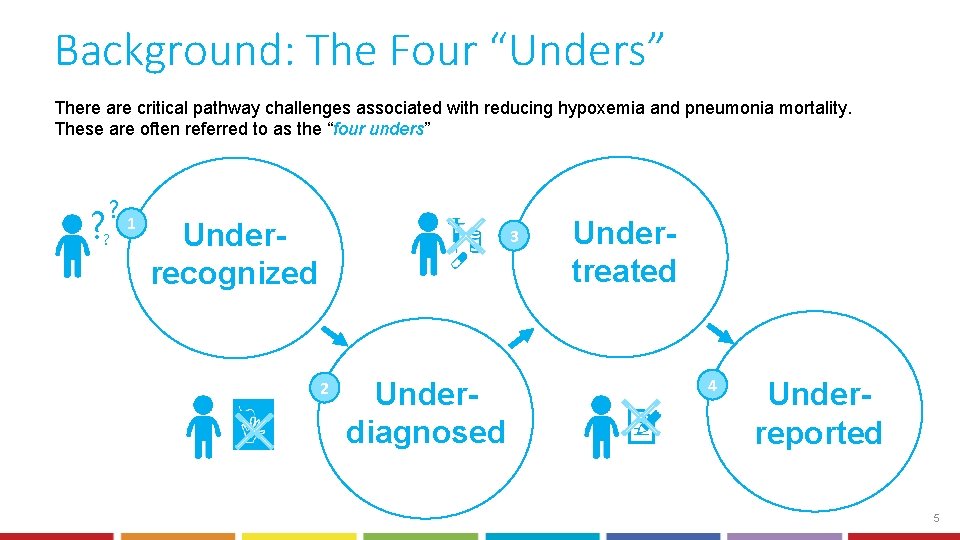
Background: The Four “Unders” There are critical pathway challenges associated with reducing hypoxemia and pneumonia mortality. These are often referred to as the “four unders” ? ? ? 1 Underrecognized 3 2 Underdiagnosed Undertreated 4 Underreported 5
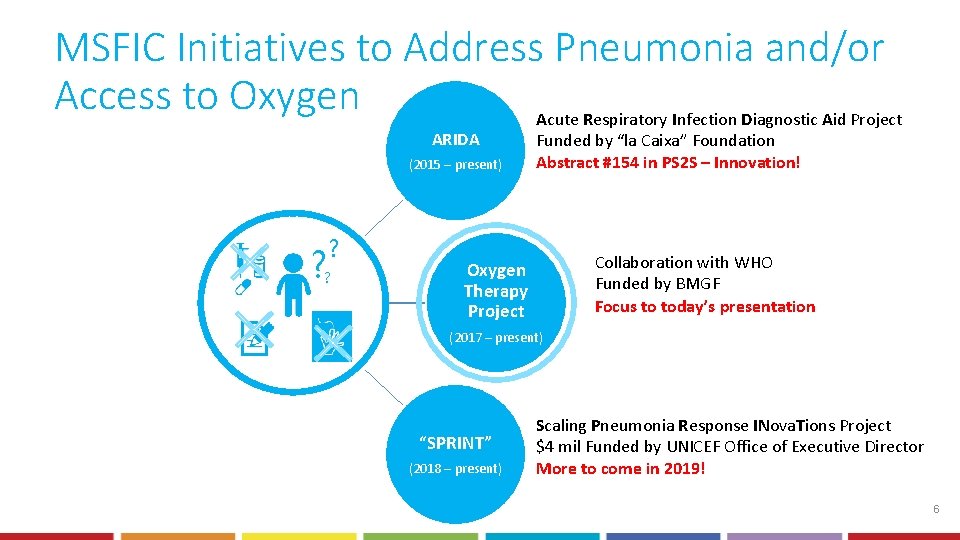
MSFIC Initiatives to Address Pneumonia and/or Access to Oxygen Acute Respiratory Infection Diagnostic Aid Project ARIDA (2015 – present) ? ? ? Funded by “la Caixa” Foundation Abstract #154 in PS 2 S – Innovation! Collaboration with WHO Funded by BMGF Focus to today’s presentation Oxygen Therapy Project (2017 – present) “SPRINT” (2018 – present) Scaling Pneumonia Response INova. Tions Project $4 mil Funded by UNICEF Office of Executive Director More to come in 2019! 6
Oxygen Therapy Project In 2017, the Bill & Melinda Gates Foundation funded a strategic collaboration between UNICEF and WHO to improve access to and utilization of oxygen therapy systems Assumptions: Want to leverage the great work of others: • Commercially available oxygen products are sufficient to significantly close the oxygen access gap • Future products may be needed for health equity, to fully optimize impact at the periphery • Planning, market analysis, policy & advocacy, tools, and implementation 7
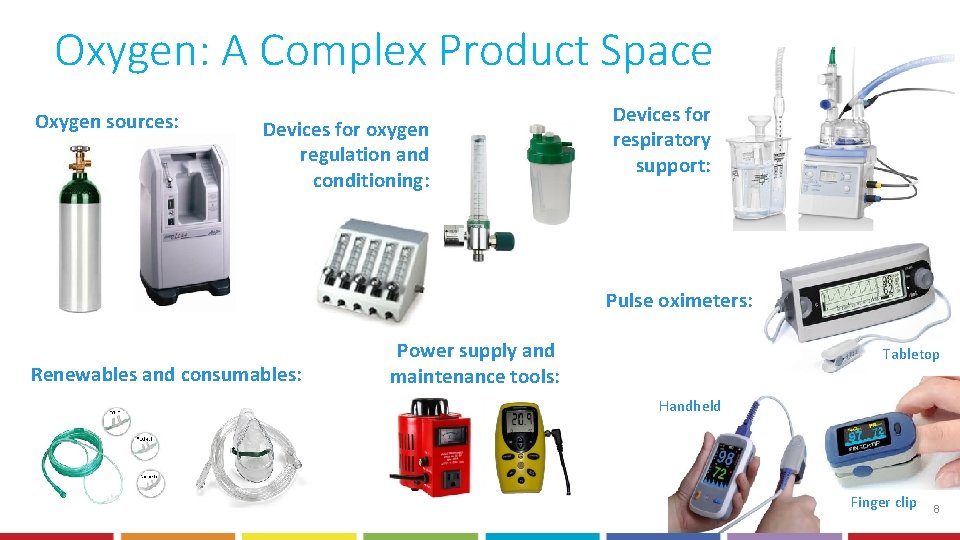
Oxygen: A Complex Product Space Oxygen sources: Devices for oxygen regulation and conditioning: Devices for respiratory support: Pulse oximeters: Renewables and consumables: Power supply and maintenance tools: Tabletop Handheld Finger clip 8
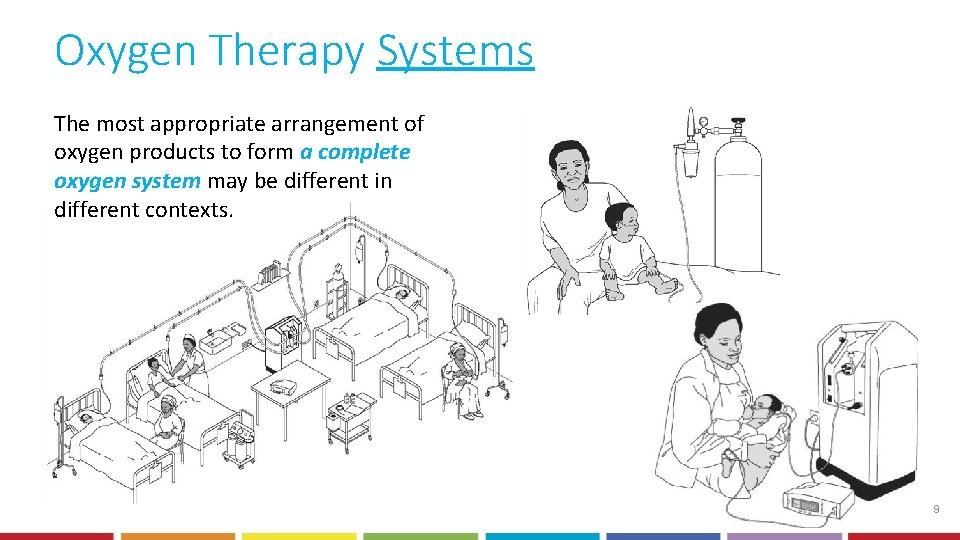
Oxygen Therapy Systems The most appropriate arrangement of oxygen products to form a complete oxygen system may be different in different contexts. 9
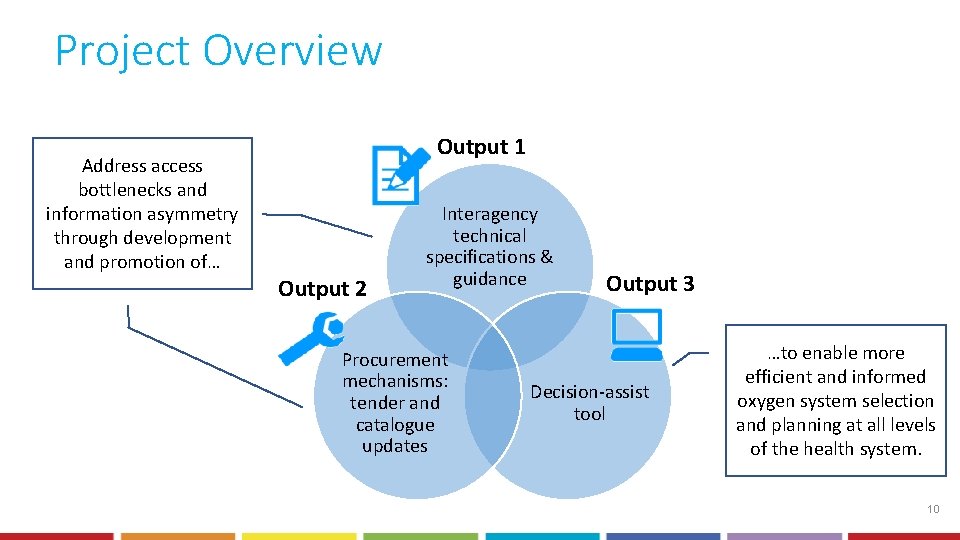
Project Overview Address access bottlenecks and information asymmetry through development and promotion of… Output 1 Output 2 Interagency technical specifications & guidance Procurement mechanisms: tender and catalogue updates Output 3 Decision-assist tool …to enable more efficient and informed oxygen system selection and planning at all levels of the health system. 10
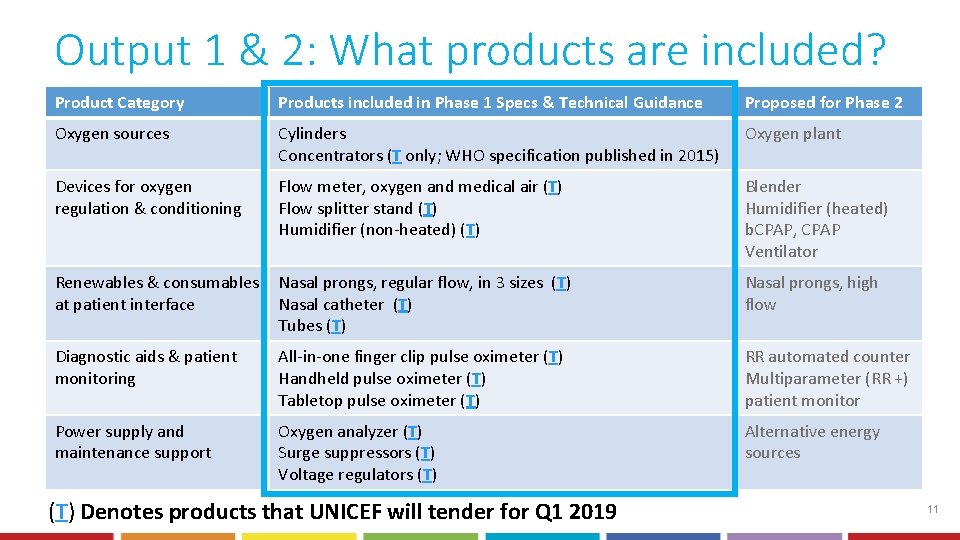
Output 1 & 2: What products are included? Product Category Products included in Phase 1 Specs & Technical Guidance Proposed for Phase 2 Oxygen sources Cylinders Concentrators (T only; WHO specification published in 2015) Oxygen plant Devices for oxygen regulation & conditioning Flow meter, oxygen and medical air (T) Flow splitter stand (T) Humidifier (non-heated) (T) Blender Humidifier (heated) b. CPAP, CPAP Ventilator Renewables & consumables Nasal prongs, regular flow, in 3 sizes (T) at patient interface Nasal catheter (T) Tubes (T) Nasal prongs, high flow Diagnostic aids & patient monitoring All-in-one finger clip pulse oximeter (T) Handheld pulse oximeter (T) Tabletop pulse oximeter (T) RR automated counter Multiparameter (RR +) patient monitor Power supply and maintenance support Oxygen analyzer (T) Surge suppressors (T) Voltage regulators (T) Alternative energy sources (T) Denotes products that UNICEF will tender for Q 1 2019 11
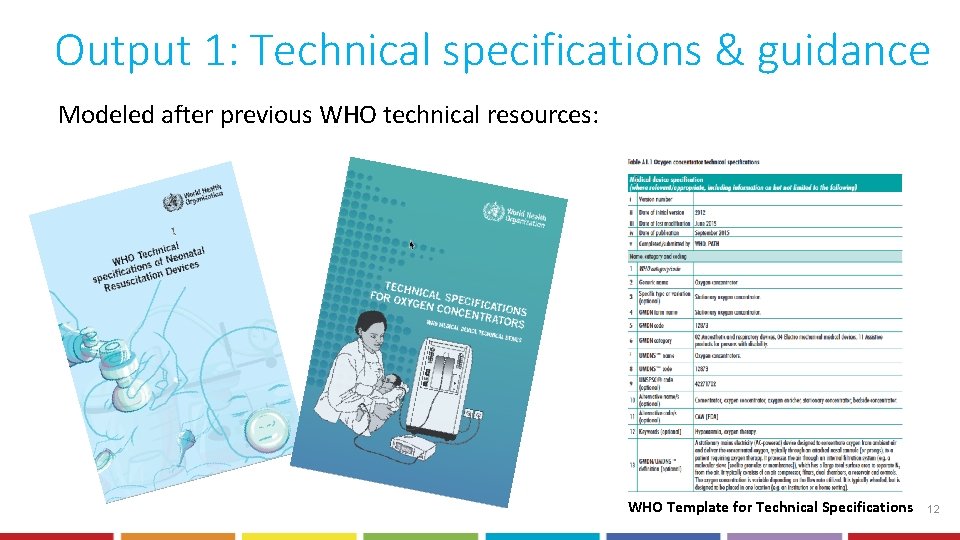
Output 1: Technical specifications & guidance Modeled after previous WHO technical resources: WHO Template for Technical Specifications 12
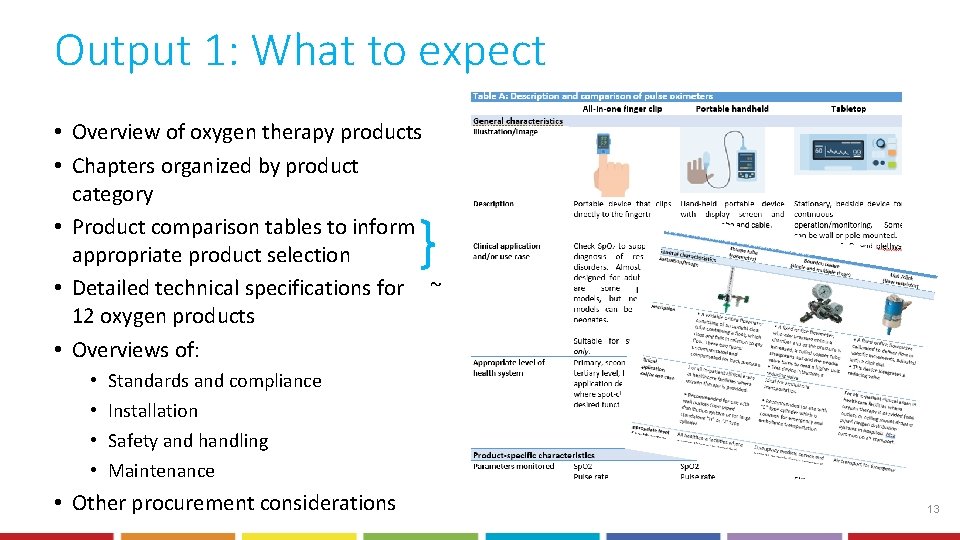
Output 1: What to expect • Overview of oxygen therapy products • Chapters organized by product category • Product comparison tables to inform appropriate product selection • Detailed technical specifications for ~ 12 oxygen products • Overviews of: • • Standards and compliance Installation Safety and handling Maintenance • Other procurement considerations 13
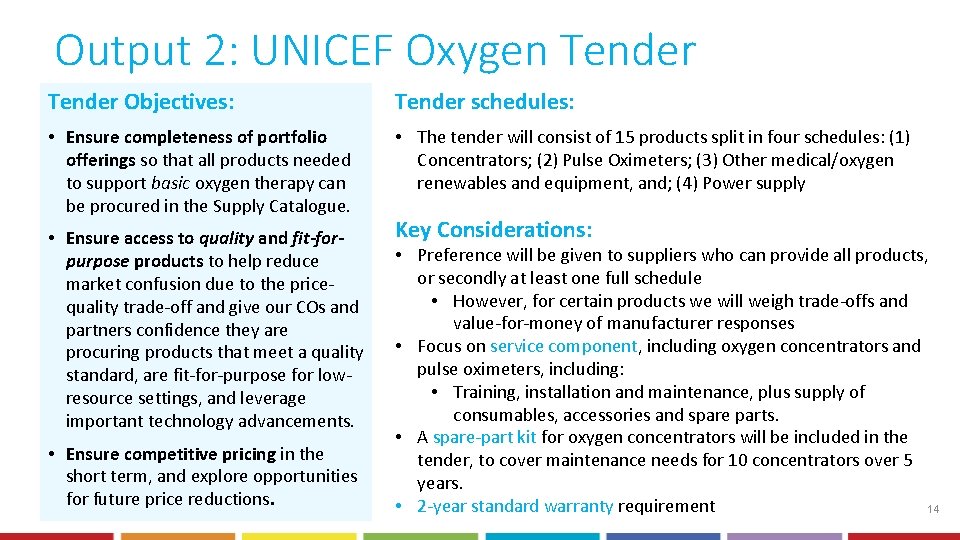
Output 2: UNICEF Oxygen Tender Objectives: Tender schedules: • Ensure completeness of portfolio offerings so that all products needed to support basic oxygen therapy can be procured in the Supply Catalogue. • The tender will consist of 15 products split in four schedules: (1) Concentrators; (2) Pulse Oximeters; (3) Other medical/oxygen renewables and equipment, and; (4) Power supply • Ensure access to quality and fit-forpurpose products to help reduce market confusion due to the pricequality trade-off and give our COs and partners confidence they are procuring products that meet a quality standard, are fit-for-purpose for lowresource settings, and leverage important technology advancements. • Ensure competitive pricing in the short term, and explore opportunities for future price reductions. Key Considerations: • Preference will be given to suppliers who can provide all products, or secondly at least one full schedule • However, for certain products we will weigh trade-offs and value-for-money of manufacturer responses • Focus on service component, including oxygen concentrators and pulse oximeters, including: • Training, installation and maintenance, plus supply of consumables, accessories and spare parts. • A spare-part kit for oxygen concentrators will be included in the tender, to cover maintenance needs for 10 concentrators over 5 years. • 2 -year standard warranty requirement 14
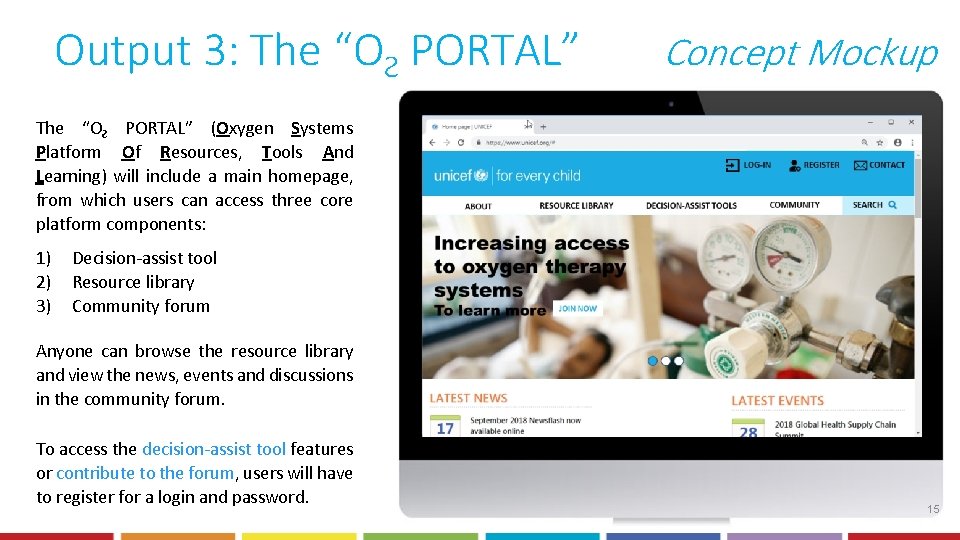
Output 3: The “OƧ PORTAL” Concept Mockup The “OƧ PORTAL” (Oxygen Systems Platform Of Resources, Tools And Learning) will include a main homepage, from which users can access three core platform components: 1) 2) 3) Decision-assist tool Resource library Community forum Anyone can browse the resource library and view the news, events and discussions in the community forum. To access the decision-assist tool features or contribute to the forum, users will have to register for a login and password. 15
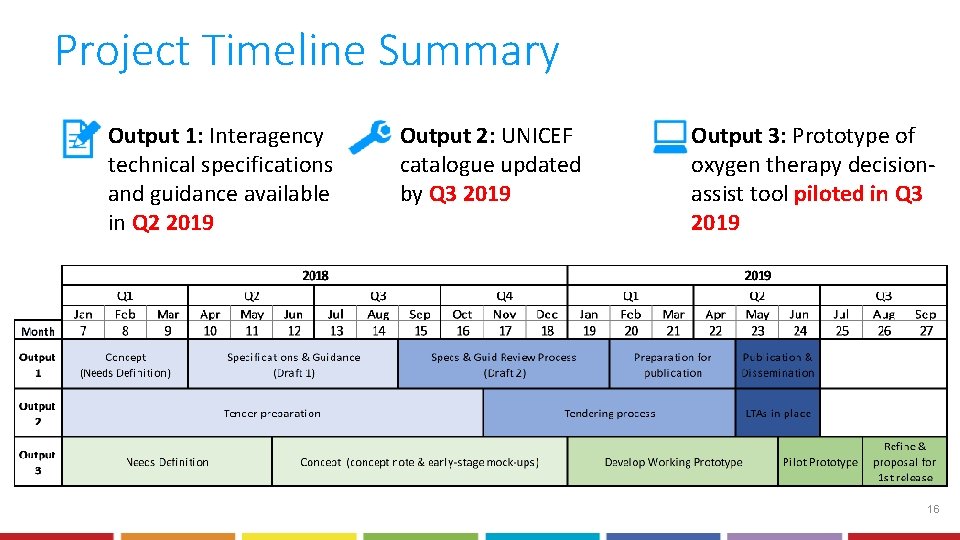
Project Timeline Summary Output 1: Interagency technical specifications and guidance available in Q 2 2019 Output 2: UNICEF catalogue updated by Q 3 2019 Output 3: Prototype of oxygen therapy decisionassist tool piloted in Q 3 2019 16
Questions? For more information contact: Bev Bradley Paul La. Barre bbradley@unicef. org plabarre@unicef. org Programme Coordinator, Oxygen Therapy Health Innovation Manager
Oxygen project Q & A Extra slides 18
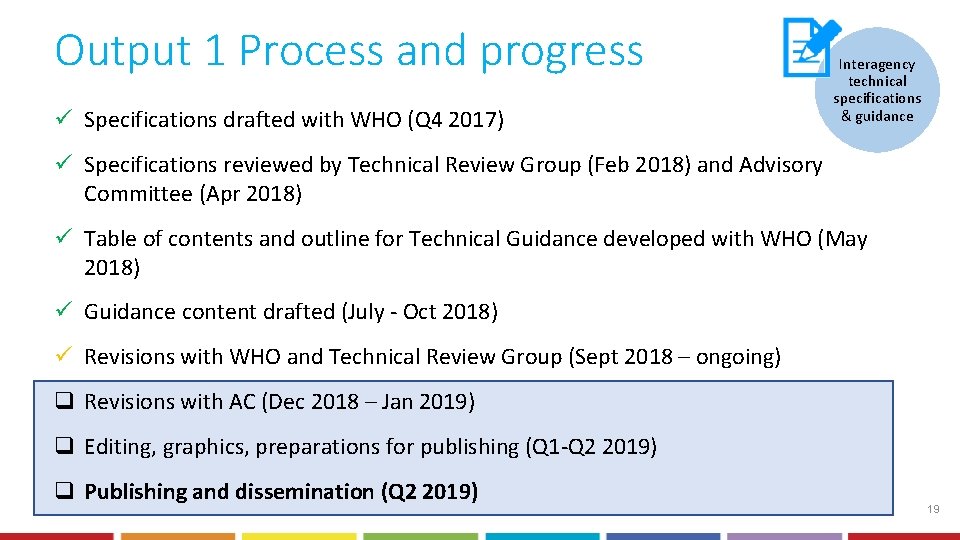
Output 1 Process and progress ü Specifications drafted with WHO (Q 4 2017) Interagency technical specifications & guidance ü Specifications reviewed by Technical Review Group (Feb 2018) and Advisory Committee (Apr 2018) ü Table of contents and outline for Technical Guidance developed with WHO (May 2018) ü Guidance content drafted (July - Oct 2018) ü Revisions with WHO and Technical Review Group (Sept 2018 – ongoing) q Revisions with AC (Dec 2018 – Jan 2019) q Editing, graphics, preparations for publishing (Q 1 -Q 2 2019) q Publishing and dissemination (Q 2 2019) 19
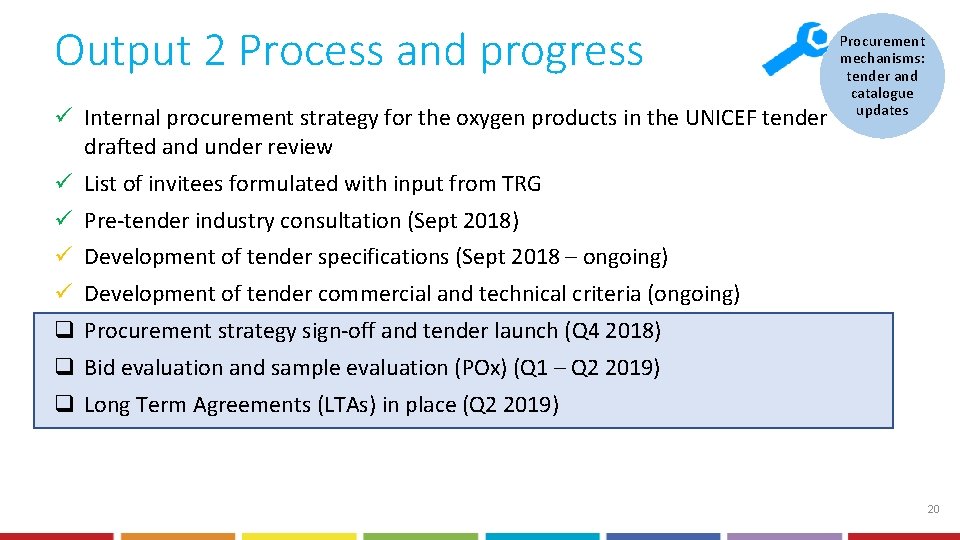
Output 2 Process and progress ü Internal procurement strategy for the oxygen products in the UNICEF tender drafted and under review Procurement mechanisms: tender and catalogue updates ü List of invitees formulated with input from TRG ü Pre-tender industry consultation (Sept 2018) ü Development of tender specifications (Sept 2018 – ongoing) ü Development of tender commercial and technical criteria (ongoing) q Procurement strategy sign-off and tender launch (Q 4 2018) q Bid evaluation and sample evaluation (POx) (Q 1 – Q 2 2019) q Long Term Agreements (LTAs) in place (Q 2 2019) 20
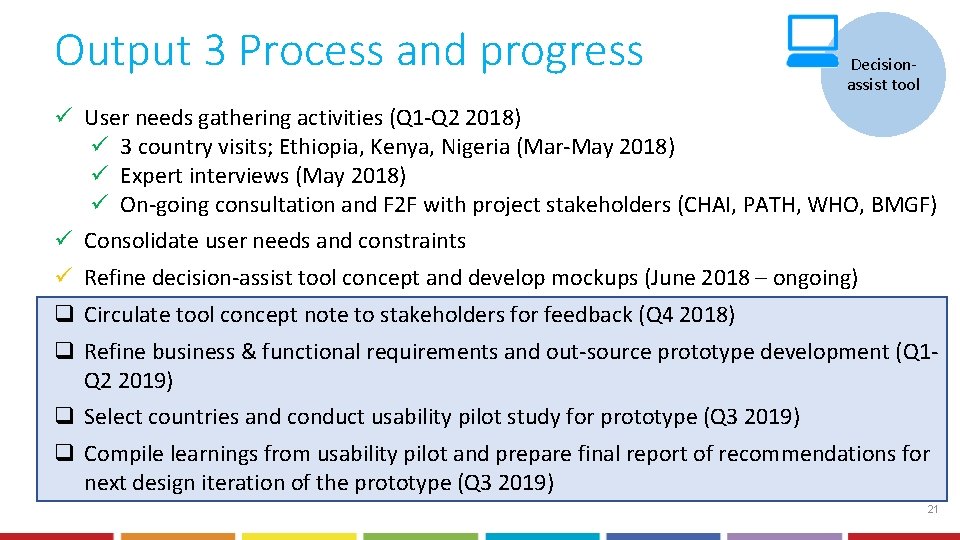
Output 3 Process and progress Decisionassist tool ü User needs gathering activities (Q 1 -Q 2 2018) ü 3 country visits; Ethiopia, Kenya, Nigeria (Mar-May 2018) ü Expert interviews (May 2018) ü On-going consultation and F 2 F with project stakeholders (CHAI, PATH, WHO, BMGF) ü Consolidate user needs and constraints ü Refine decision-assist tool concept and develop mockups (June 2018 – ongoing) q Circulate tool concept note to stakeholders for feedback (Q 4 2018) q Refine business & functional requirements and out-source prototype development (Q 1 Q 2 2019) q Select countries and conduct usability pilot study for prototype (Q 3 2019) q Compile learnings from usability pilot and prepare final report of recommendations for next design iteration of the prototype (Q 3 2019) 21
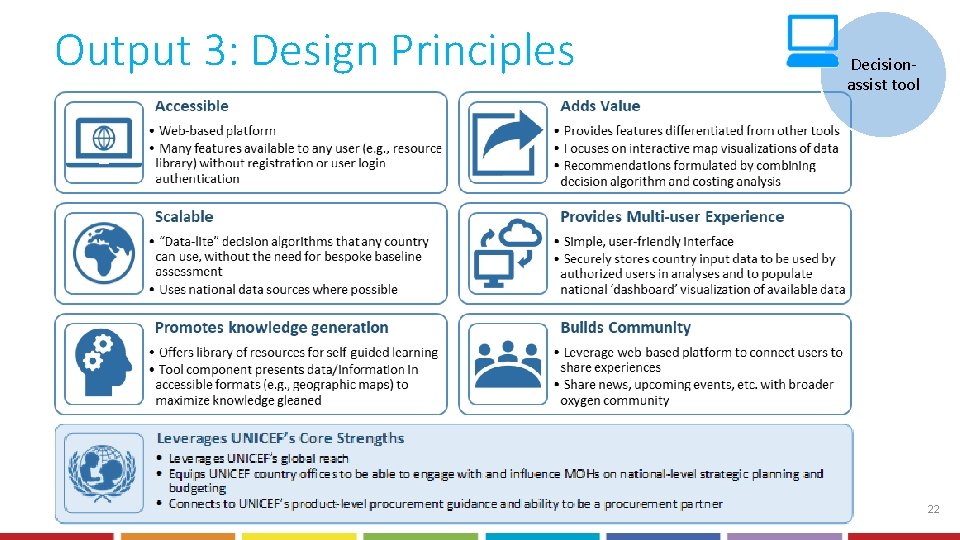
Output 3: Design Principles Decisionassist tool 22
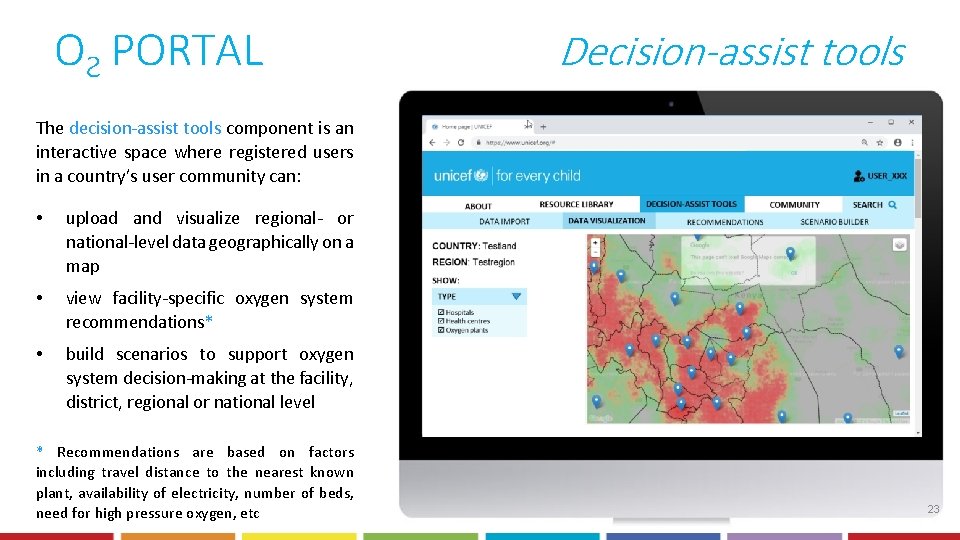
OƧ PORTAL Decision-assist tools The decision-assist tools component is an interactive space where registered users in a country’s user community can: • upload and visualize regional- or national-level data geographically on a map • view facility-specific oxygen system recommendations* • build scenarios to support oxygen system decision-making at the facility, district, regional or national level * Recommendations are based on factors including travel distance to the nearest known plant, availability of electricity, number of beds, need for high pressure oxygen, etc 23
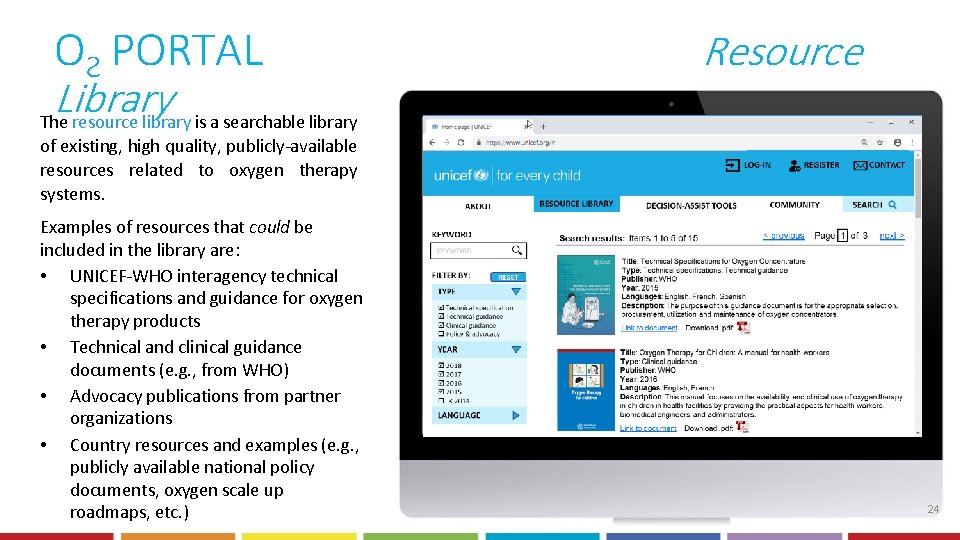
OƧ PORTAL Library The resource library is a searchable library Resource of existing, high quality, publicly-available resources related to oxygen therapy systems. Examples of resources that could be included in the library are: • UNICEF-WHO interagency technical specifications and guidance for oxygen therapy products • Technical and clinical guidance documents (e. g. , from WHO) • Advocacy publications from partner organizations • Country resources and examples (e. g. , publicly available national policy documents, oxygen scale up roadmaps, etc. ) 24
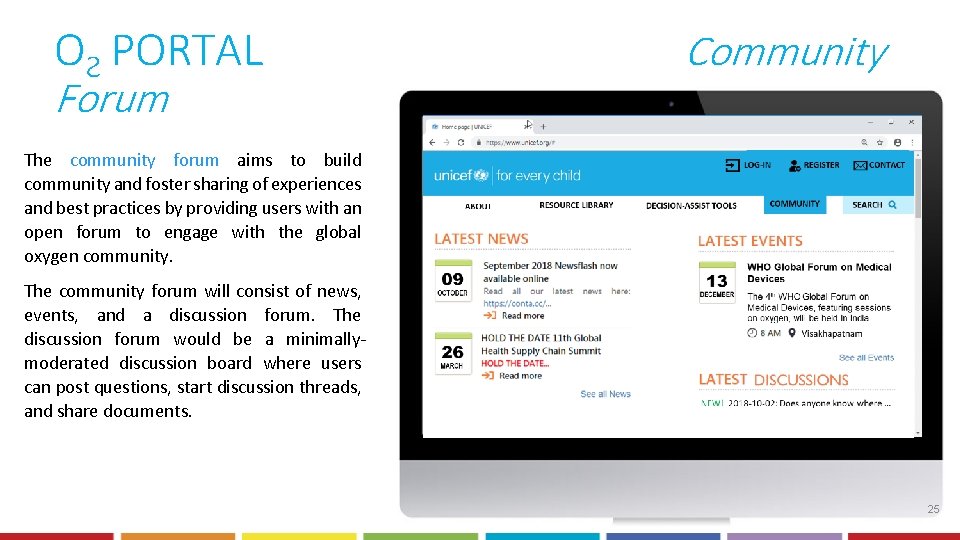
OƧ PORTAL Forum Community The community forum aims to build community and foster sharing of experiences and best practices by providing users with an open forum to engage with the global oxygen community. The community forum will consist of news, events, and a discussion forum. The discussion forum would be a minimallymoderated discussion board where users can post questions, start discussion threads, and share documents. 25
ARIDA project Q & A Extra slides 26
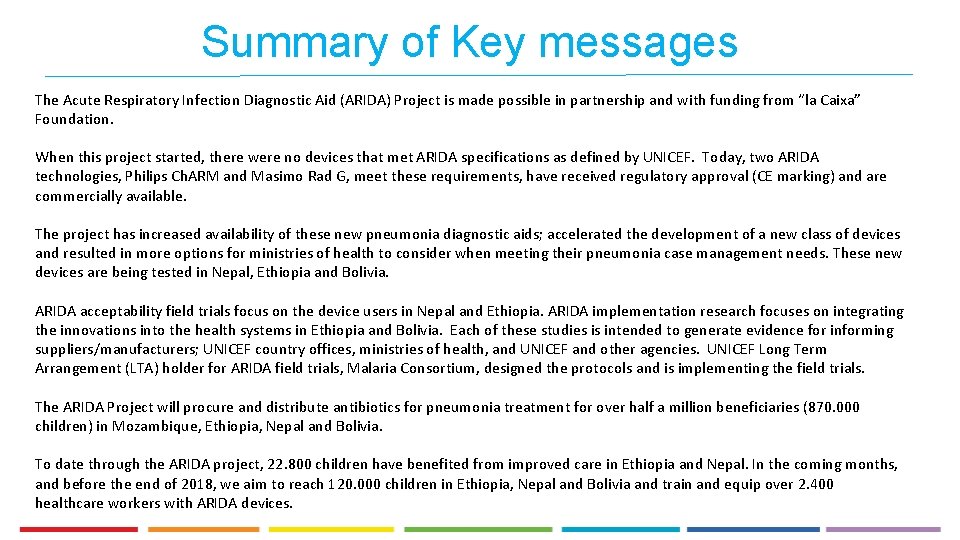
Summary of Key messages The Acute Respiratory Infection Diagnostic Aid (ARIDA) Project is made possible in partnership and with funding from “la Caixa” Foundation. When this project started, there were no devices that met ARIDA specifications as defined by UNICEF. Today, two ARIDA technologies, Philips Ch. ARM and Masimo Rad G, meet these requirements, have received regulatory approval (CE marking) and are commercially available. The project has increased availability of these new pneumonia diagnostic aids; accelerated the development of a new class of devices and resulted in more options for ministries of health to consider when meeting their pneumonia case management needs. These new devices are being tested in Nepal, Ethiopia and Bolivia. ARIDA acceptability field trials focus on the device users in Nepal and Ethiopia. ARIDA implementation research focuses on integrating the innovations into the health systems in Ethiopia and Bolivia. Each of these studies is intended to generate evidence for informing suppliers/manufacturers; UNICEF country offices, ministries of health, and UNICEF and other agencies. UNICEF Long Term Arrangement (LTA) holder for ARIDA field trials, Malaria Consortium, designed the protocols and is implementing the field trials. The ARIDA Project will procure and distribute antibiotics for pneumonia treatment for over half a million beneficiaries (870. 000 children) in Mozambique, Ethiopia, Nepal and Bolivia. To date through the ARIDA project, 22. 800 children have benefited from improved care in Ethiopia and Nepal. In the coming months, and before the end of 2018, we aim to reach 120. 000 children in Ethiopia, Nepal and Bolivia and train and equip over 2. 400 healthcare workers with ARIDA devices.
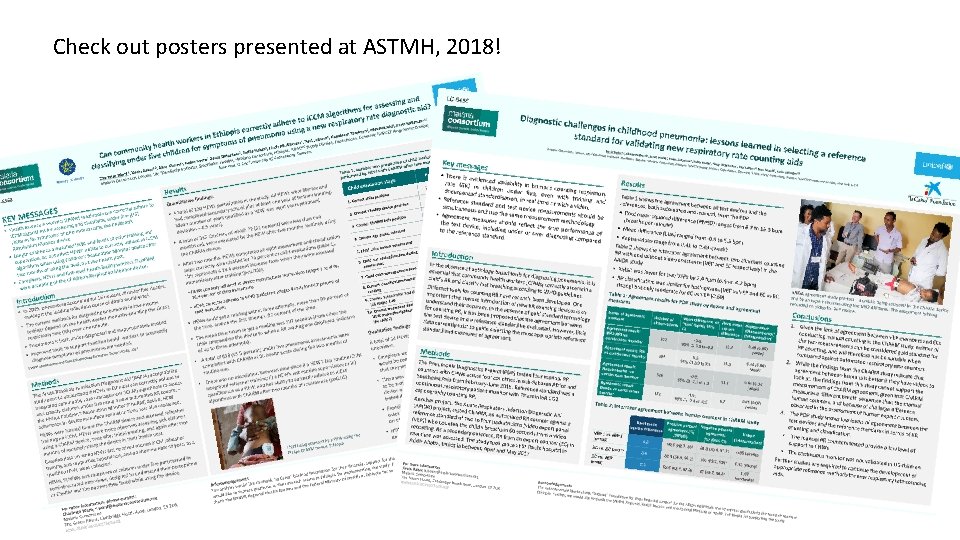
Check out posters presented at ASTMH, 2018!
SPRINT project Q & A Extra slides 29
SPRINT: Project goal and outcomes Goal: Gain, analyze and apply real-world experience on scaling medical oxygen and Amoxicillin DT, bundled as main components of a service delivery package. Develop the scaling model and attract partners to fill gaps in their capacity to scale. Outcomes: Outcome 1: Optimized use of medical oxygen and Amoxicillin DT in one or two districts in two countries (optimized use of these treatments derives from implementation of the package and refinement of the model). Outcome 2: Enabled replication of the innovation model through: Sufficient demonstration & open source documentation for easy adoption/adaption & delivery by UNICEF programs & by other organizations in new geographies. Stage 4 learnings applied to global and regional policy development. Advocacy that leads to significant financial partner engagement for stage 5 activities. Advocacy that leads to Stage 4 countries recognizing the solution model and expressing interest in spreading scale within their country
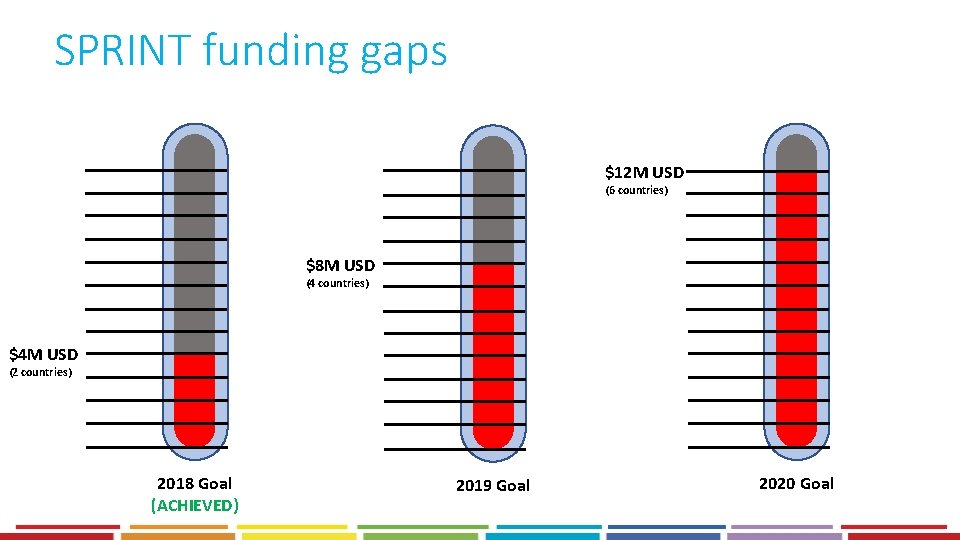
SPRINT funding gaps $12 M USD (6 countries) $8 M USD (4 countries) $4 M USD (2 countries) 2018 Goal (ACHIEVED) 2019 Goal 2020 Goal
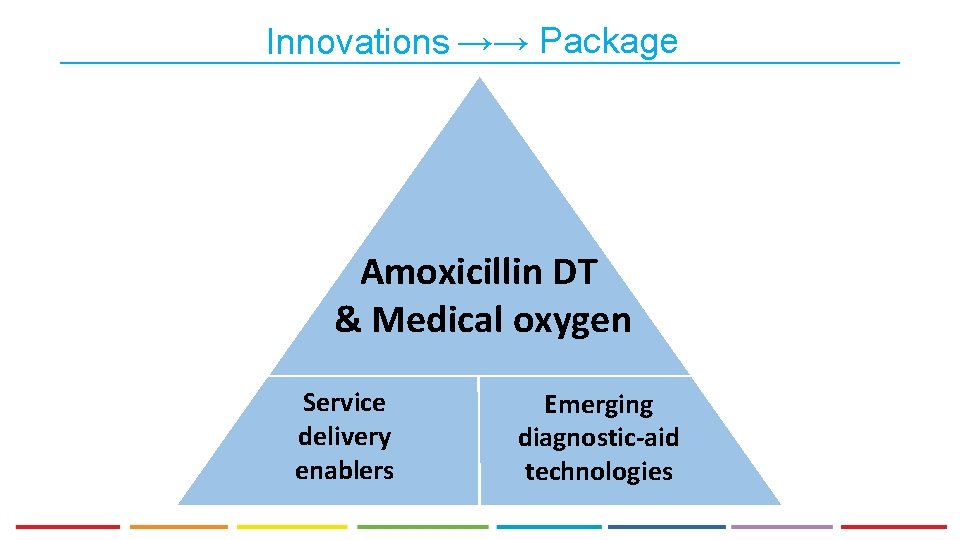
Innovations →→ Package Amoxicillin DT & Medical oxygen Service delivery enablers Emerging diagnostic-aid technologies
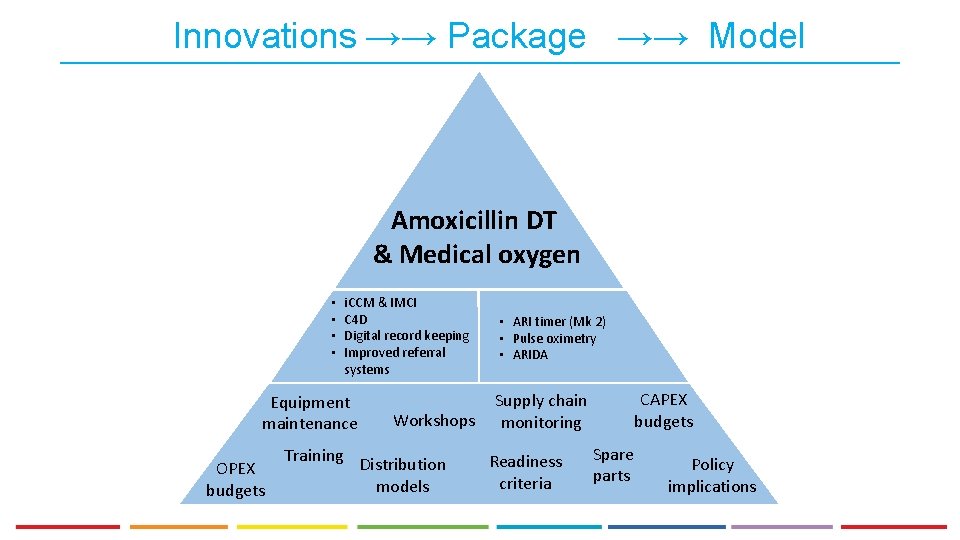
Innovations →→ Package →→ Model Amoxicillin DT & Medical oxygen • • i. CCM & IMCI C 4 D Digital record keeping Improved referral systems Equipment maintenance OPEX budgets Workshops Training Distribution models • ARI timer (Mk 2) • Pulse oximetry • ARIDA CAPEX budgets Supply chain monitoring Readiness criteria Spare parts Policy implications
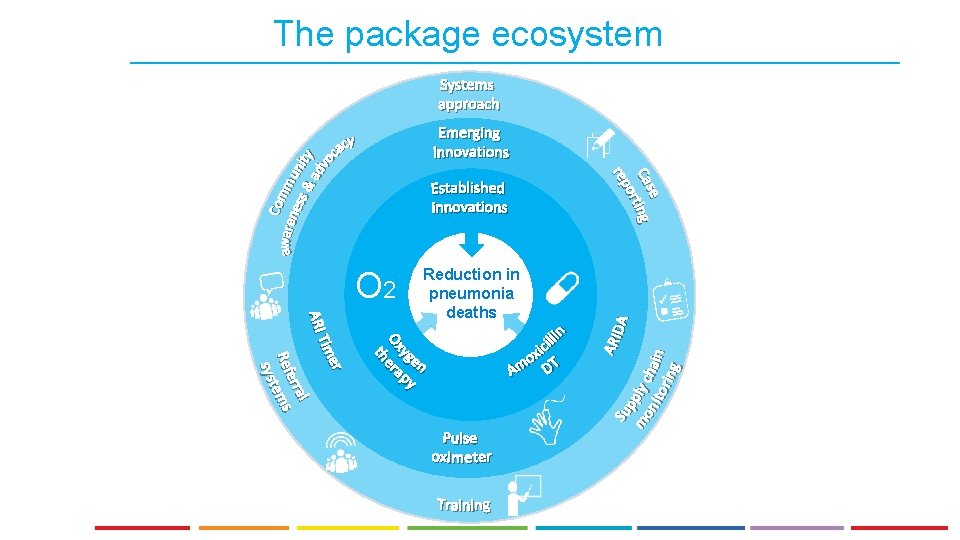
The package ecosystem Fortunately, there are proven innovations: medical oxygen and Amoxicillin dispersible tablets (Amoxicillin DT) that are ready-to-scale for treatment of hypoxemia and pneumonia, respectively. O 2 Reduction in pneumonia deaths