
Uni KV Toward HighPerformance and Scalable KV Storage
Uni. KV: Toward High-Performance and Scalable KV Storage in Mixed Workloads via Unified Indexing Qiang Zhang†, Yongkun Li†, Patrick P. C. Lee‡, Yinlong Xu†, Qiu Cui*, Liu Tang* †University of Science and Technology of China ‡The Chinese University of Hong Kong *Ping. CAP 1
Background Ø Data volume is growing exponentially • 33 ZB in 2018 44 ZB in 2020 175 ZB in 2025[1] • Various data types (structured, semi-structured and unstructured) Ø Key-value (KV) stores are widely used in many applications • Flexible data model & high scalability Level. DB @ Google Rocks. DB @ Facebook [1] Internet Data Center, Nov 2018, https: //www. idc. com/. Cassandra @ Apache 2
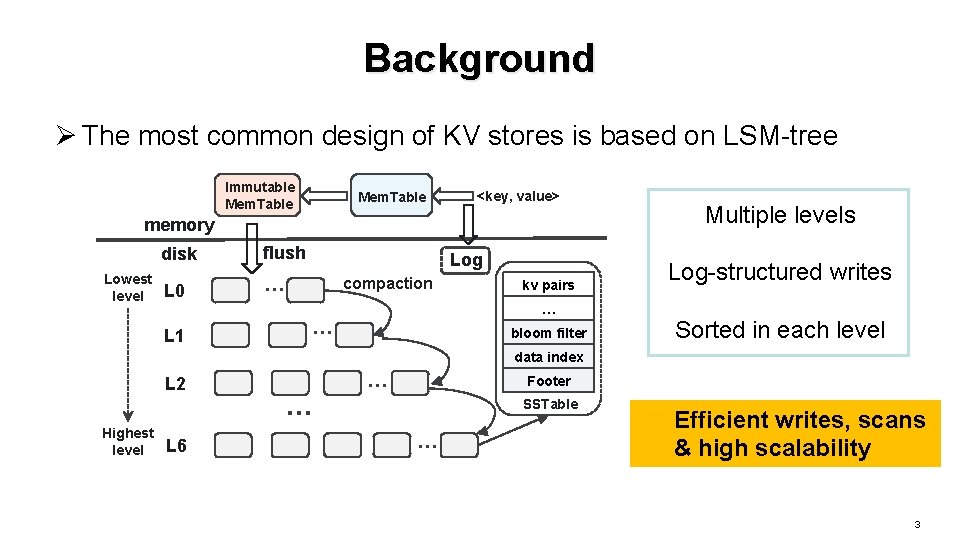
Background Ø The most common design of KV stores is based on LSM-tree Immutable Mem. Table <key, value> memory Lowest level disk flush L 0 … L 1 Log compaction kv pairs … … bloom filter Multiple levels Log-structured writes Sorted in each level data index L 2 Highest level L 6 … … Footer SSTable … Efficient writes, scans & high scalability 3
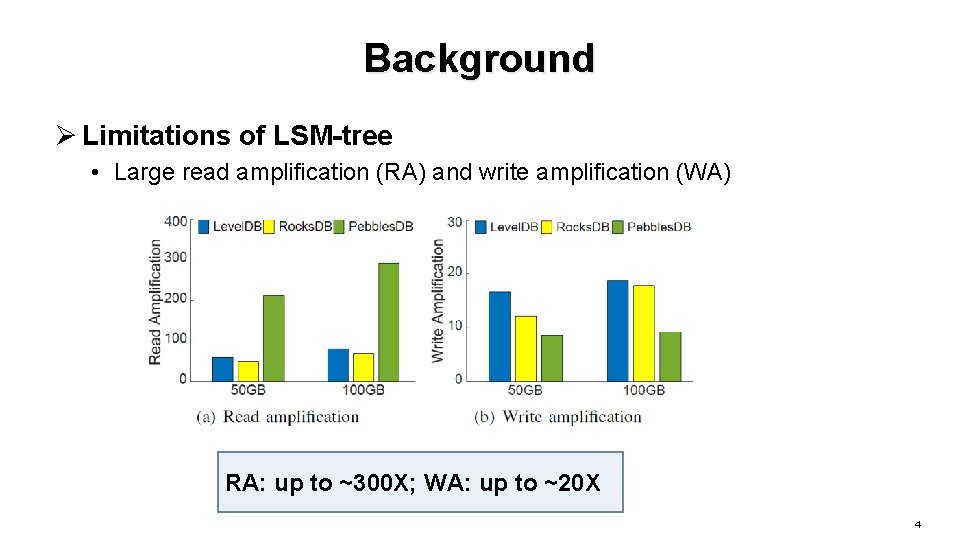
Background Ø Limitations of LSM-tree • Large read amplification (RA) and write amplification (WA) RA: up to ~300 X; WA: up to ~20 X 4
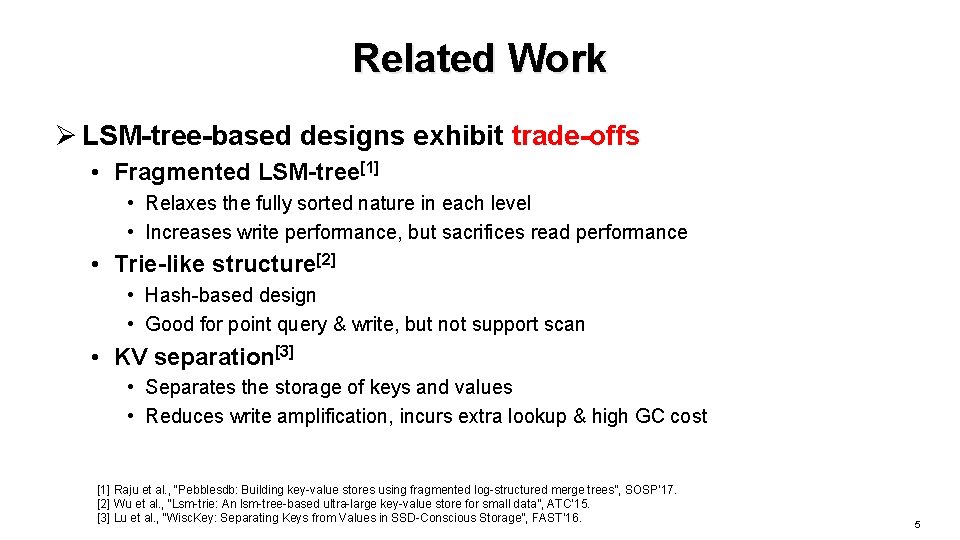
Related Work Ø LSM-tree-based designs exhibit trade-offs • Fragmented LSM-tree[1] • Relaxes the fully sorted nature in each level • Increases write performance, but sacrifices read performance • Trie-like structure[2] • Hash-based design • Good for point query & write, but not support scan • KV separation[3] • Separates the storage of keys and values • Reduces write amplification, incurs extra lookup & high GC cost [1] Raju et al. , “Pebblesdb: Building key-value stores using fragmented log-structured merge trees”, SOSP’ 17. [2] Wu et al. , “Lsm-trie: An lsm-tree-based ultra-large key-value store for small data”, ATC’ 15. [3] Lu et al. , “Wisc. Key: Separating Keys from Values in SSD-Conscious Storage”, FAST’ 16. 5
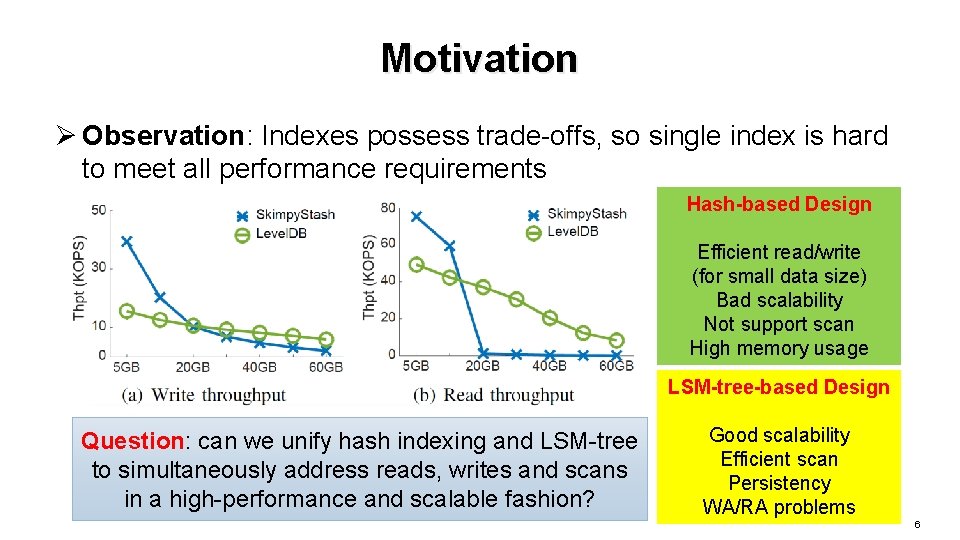
Motivation Ø Observation: Indexes possess trade-offs, so single index is hard to meet all performance requirements Hash-based Design Efficient read/write (for small data size) Bad scalability Not support scan High memory usage LSM-tree-based Design Question: can we unify hash indexing and LSM-tree to simultaneously address reads, writes and scans in a high-performance and scalable fashion? Good scalability Efficient scan Persistency WA/RA problems 6
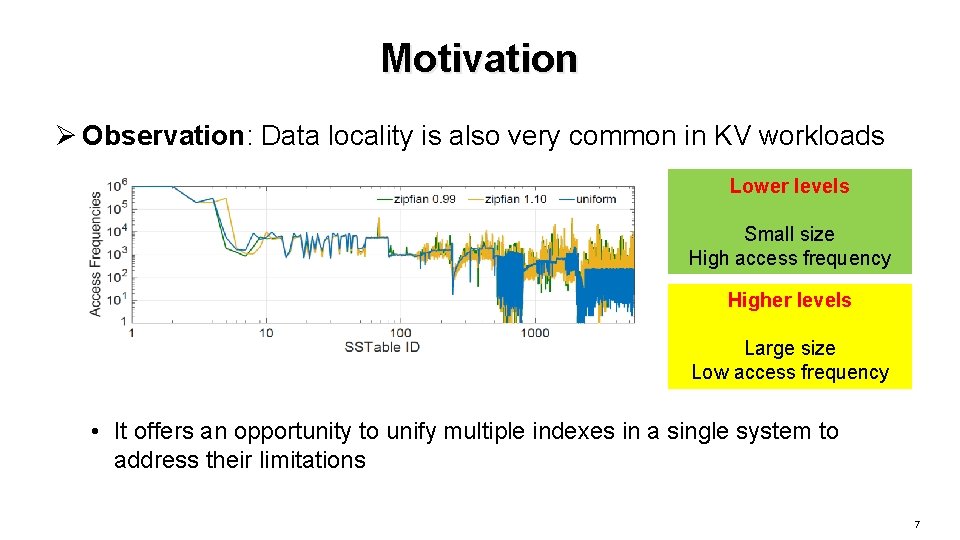
Motivation Ø Observation: Data locality is also very common in KV workloads Lower levels Small size High access frequency Higher levels Large size Low access frequency • It offers an opportunity to unify multiple indexes in a single system to address their limitations 7
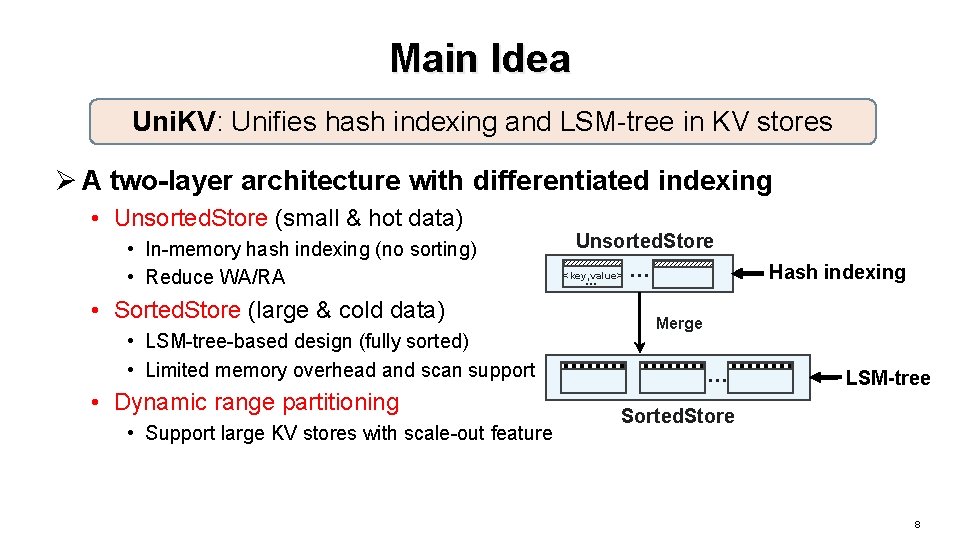
Main Idea Uni. KV: Unifies hash indexing and LSM-tree in KV stores Ø A two-layer architecture with differentiated indexing • Unsorted. Store (small & hot data) • In-memory hash indexing (no sorting) • Reduce WA/RA • Sorted. Store (large & cold data) • LSM-tree-based design (fully sorted) • Limited memory overhead and scan support • Dynamic range partitioning • Support large KV stores with scale-out feature Unsorted. Store <key, value> … … Hash indexing Merge … LSM-tree Sorted. Store 8
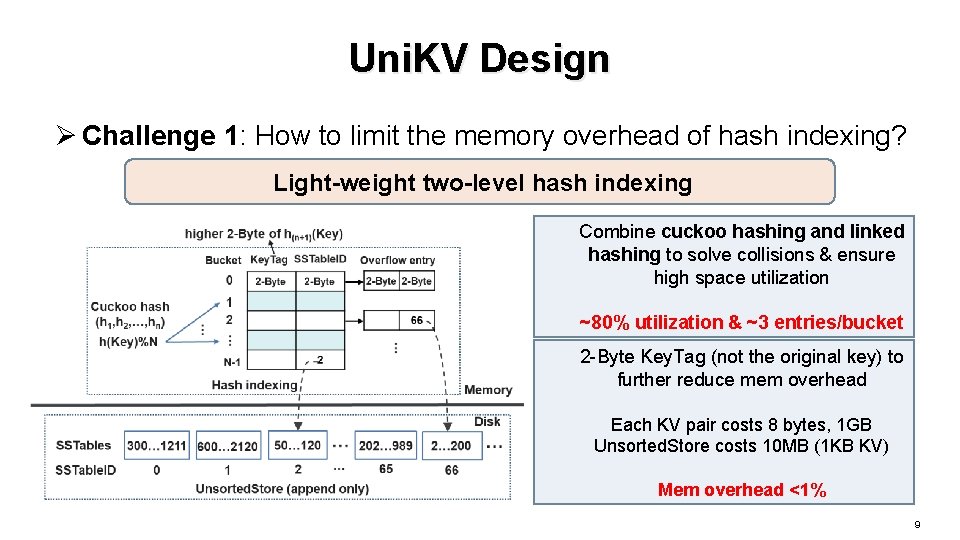
Uni. KV Design Ø Challenge 1: How to limit the memory overhead of hash indexing? Light-weight two-level hash indexing Combine cuckoo hashing and linked hashing to solve collisions & ensure high space utilization ~80% utilization & ~3 entries/bucket 2 -Byte Key. Tag (not the original key) to further reduce mem overhead Each KV pair costs 8 bytes, 1 GB Unsorted. Store costs 10 MB (1 KB KV) Mem overhead <1% 9
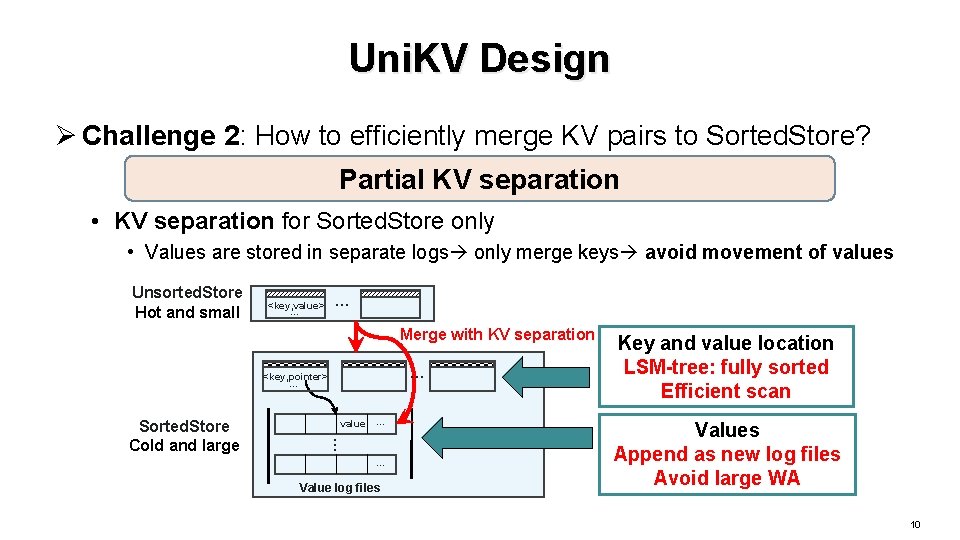
Uni. KV Design Ø Challenge 2: How to efficiently merge KV pairs to Sorted. Store? Partial KV separation • KV separation for Sorted. Store only • Values are stored in separate logs only merge keys avoid movement of values Unsorted. Store Hot and small <key, value> … … Merge with KV separation … <key, pointer> … value … … Sorted. Store Cold and large … Value log files Key and value location LSM-tree: fully sorted Efficient scan Values Append as new log files Avoid large WA 10
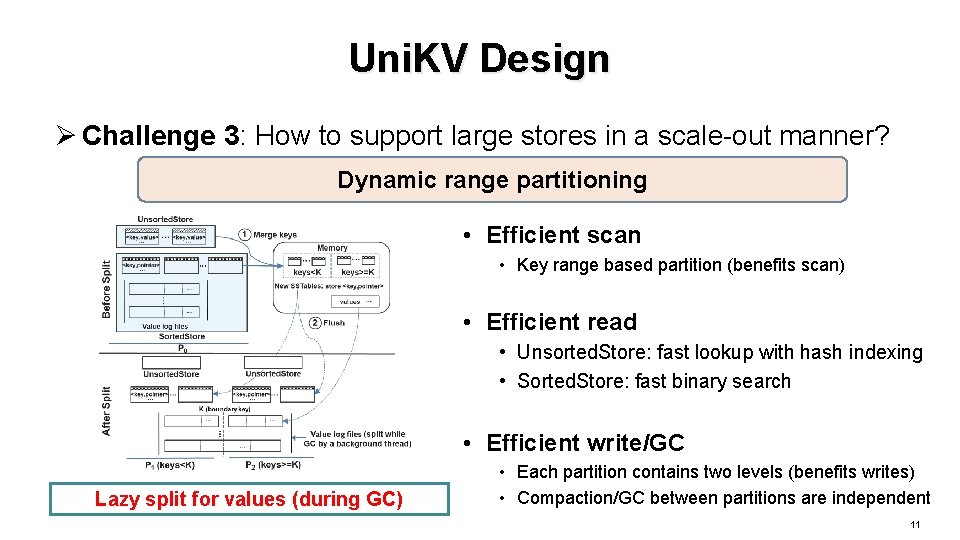
Uni. KV Design Ø Challenge 3: How to support large stores in a scale-out manner? Dynamic range partitioning • Efficient scan • Key range based partition (benefits scan) • Efficient read • Unsorted. Store: fast lookup with hash indexing • Sorted. Store: fast binary search • Efficient write/GC Lazy split for values (during GC) • Each partition contains two levels (benefits writes) • Compaction/GC between partitions are independent 11
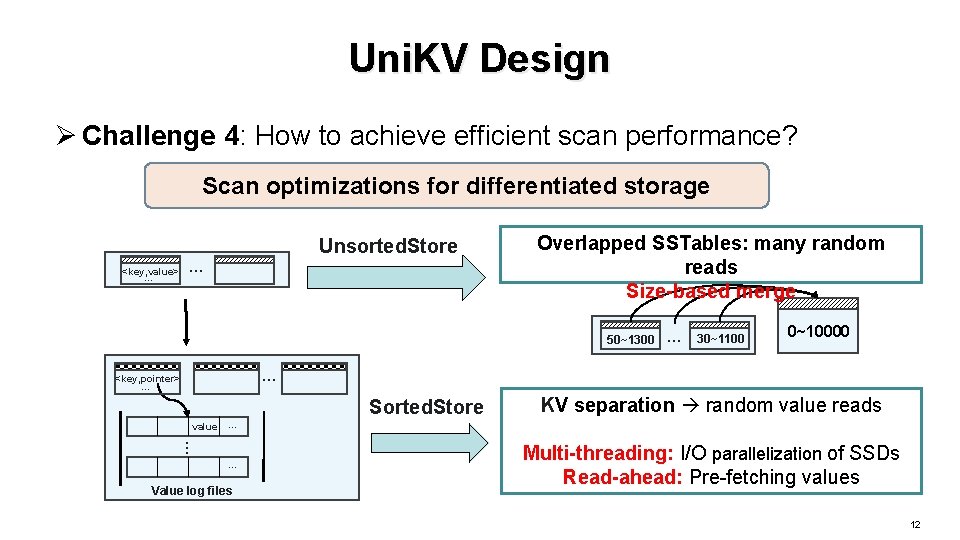
Uni. KV Design Ø Challenge 4: How to achieve efficient scan performance? Scan optimizations for differentiated storage Unsorted. Store <key, value> … … Overlapped SSTables: many random reads Size-based merge 50~1300 … 30~1100 0~10000 … <key, pointer> … Sorted. Store value KV separation random value reads … … … Value log files Multi-threading: I/O parallelization of SSDs Read-ahead: Pre-fetching values 12
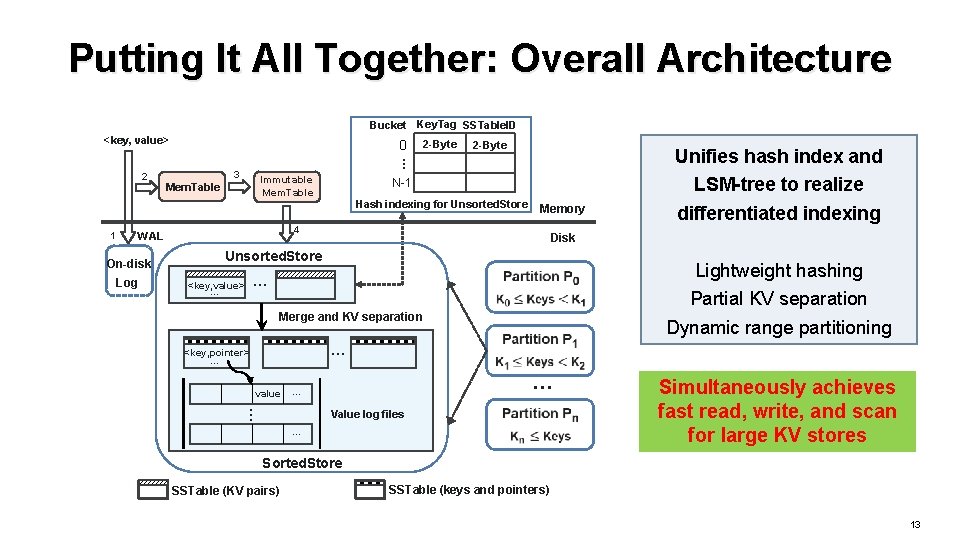
Putting It All Together: Overall Architecture Bucket Key. Tag SSTable. ID <key, value> 1 3 Immutable Mem. Table 2 -Byte Unifies hash index and N-1 Hash indexing for Unsorted. Store Memory 4 WAL … Lightweight hashing Partial KV separation Dynamic range partitioning … <key, value> Merge and KV separation … <key, pointer> … value LSM-tree to realize differentiated indexing Disk Unsorted. Store On-disk Log 2 -Byte … 2 0 … … … Value log files … Simultaneously achieves fast read, write, and scan for large KV stores Sorted. Store SSTable (KV pairs) SSTable (keys and pointers) 13
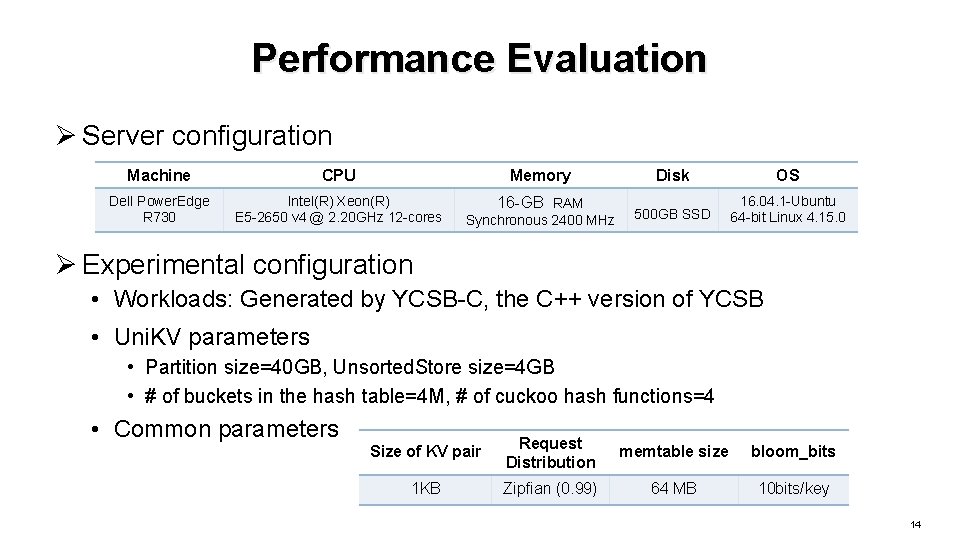
Performance Evaluation Ø Server configuration Machine CPU Memory Dell Power. Edge R 730 Intel(R) Xeon(R) E 5 -2650 v 4 @ 2. 20 GHz 12 -cores 16 -GB RAM Synchronous 2400 MHz Disk OS 500 GB SSD 16. 04. 1 -Ubuntu 64 -bit Linux 4. 15. 0 Ø Experimental configuration • Workloads: Generated by YCSB-C, the C++ version of YCSB • Uni. KV parameters • Partition size=40 GB, Unsorted. Store size=4 GB • # of buckets in the hash table=4 M, # of cuckoo hash functions=4 • Common parameters Size of KV pair Request Distribution memtable size bloom_bits 1 KB Zipfian (0. 99) 64 MB 10 bits/key 14
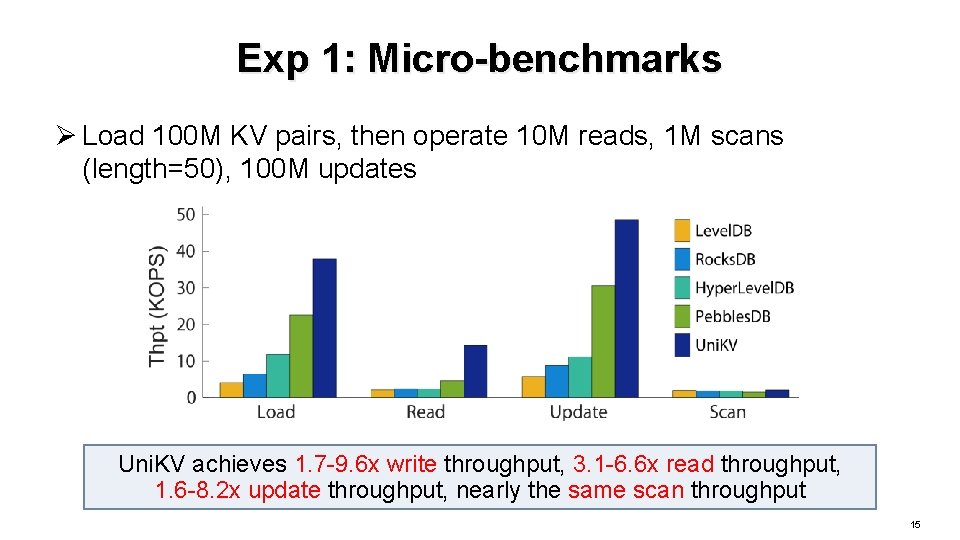
Exp 1: Micro-benchmarks Ø Load 100 M KV pairs, then operate 10 M reads, 1 M scans (length=50), 100 M updates Uni. KV achieves 1. 7 -9. 6 x write throughput, 3. 1 -6. 6 x read throughput, 1. 6 -8. 2 x update throughput, nearly the same scan throughput 15
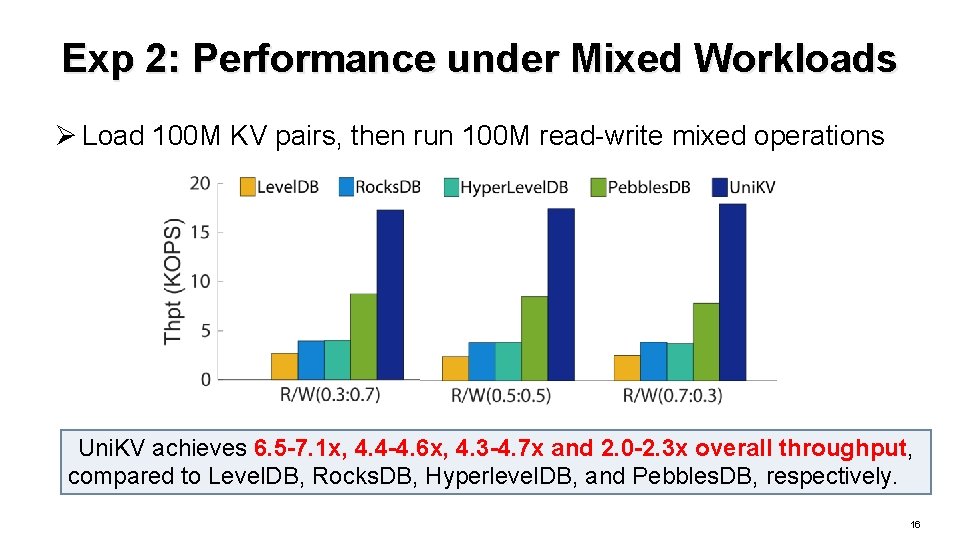
Exp 2: Performance under Mixed Workloads Ø Load 100 M KV pairs, then run 100 M read-write mixed operations Uni. KV achieves 6. 5 -7. 1 x, 4. 4 -4. 6 x, 4. 3 -4. 7 x and 2. 0 -2. 3 x overall throughput, compared to Level. DB, Rocks. DB, Hyperlevel. DB, and Pebbles. DB, respectively. 16
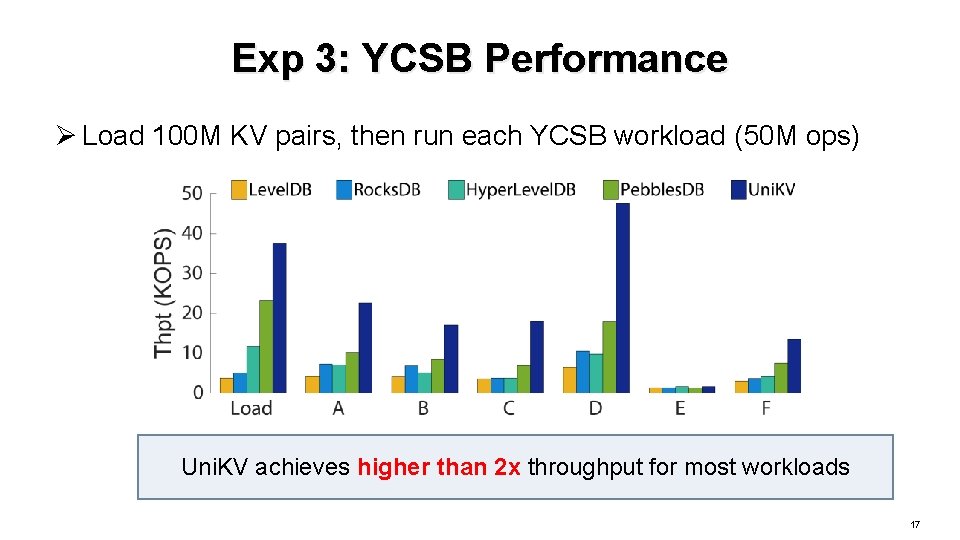
Exp 3: YCSB Performance Ø Load 100 M KV pairs, then run each YCSB workload (50 M ops) Uni. KV achieves higher than 2 x throughput for most workloads 17
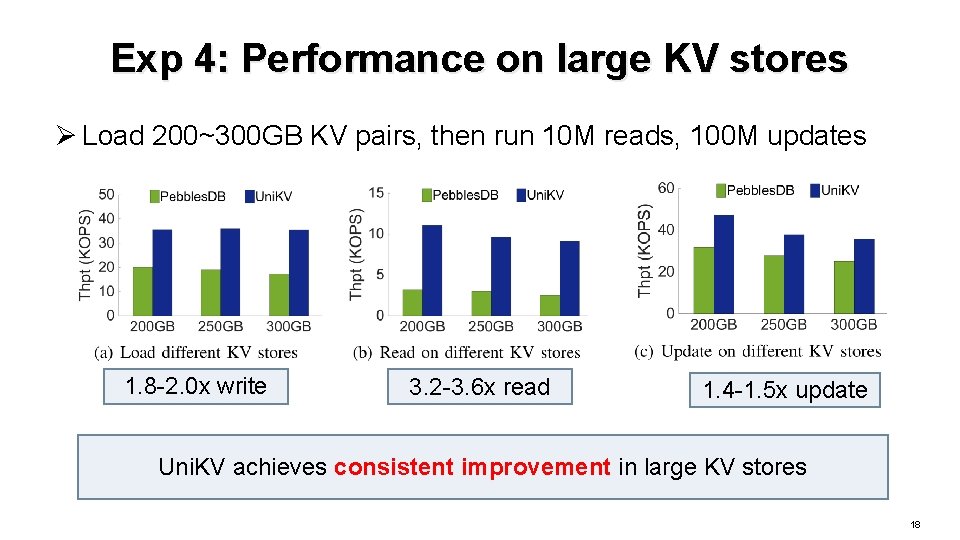
Exp 4: Performance on large KV stores Ø Load 200~300 GB KV pairs, then run 10 M reads, 100 M updates 1. 8 -2. 0 x write 3. 2 -3. 6 x read 1. 4 -1. 5 x update Uni. KV achieves consistent improvement in large KV stores 18
Conclusions Ø Uni. KV: unifies hash indexing and the LSM-tree in a single system to enable high-performance and scalable KV storage • • A two-layer architecture with differentiated indexing Lightweight hash index to limit memory usage Partial KV separation to reduce merge overhead Dynamic range partitioning to support large store Ø More evaluation results and analysis are in the paper Ø The source code is at https: //github. com/ustcadsl/unikv 19

Thanks for your attention! Q&A Yongkun Li@USTC http: //staff. ustc. edu. cn/~ykli/ 20
- Slides: 20