
Uni Innsbruck Informatik 1 Grid Inter Networking Michael
Uni Innsbruck Informatik - 1 Grid Inter. Networking Michael Welzl http: //www. welzl. at DPS NSG Team http: //dps. uibk. ac. at/nsg Institute of Computer Science University of Innsbruck Grid. Nets 2006 San Jose, CA USA 1/2 October, 2006
Uni Innsbruck Informatik - 2 Outline • Problem scope • Proposed solutions – Example 1: Network Measurement – Example 2: Grid-Network-Simulation – Example 3: Qo. S for the Grid • Conclusion

Uni Innsbruck Informatik - 3 Problem scope Shrinking the problem space
Uni Innsbruck Informatik - 4 What is the Grid? • Metaphor: power grid – just plug in, don‘t care where (processing) power comes from, don‘t care how it reaches you • Common definition: The real and specific problem that underlies the Grid concept is coordinated resource sharing and problem solving in dynamic, multi institutional virtual organizations [Ian Foster, Carl Kesselman and Steven Tuecke, “The Anatomy of the Grid – Enabling Scalable Virtual Organizations”, International Journal on Supercomputer Applications, 2001] • Common terms: Virtual Team - members of one or several Virtual Organizations who use a Grid • Most of the time. . . – the real and specific goal is High Performance Computing – virtual organizations and virtual teams are well defined (as opposed to the SETI@Home usage scenario) – i. e. not an „open“ system, security is a big issue
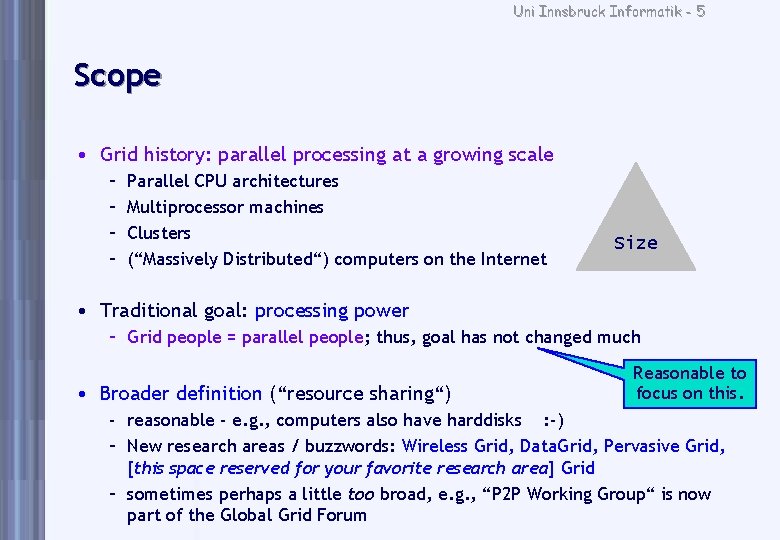
Uni Innsbruck Informatik - 5 Scope • Grid history: parallel processing at a growing scale – – Parallel CPU architectures Multiprocessor machines Clusters (“Massively Distributed“) computers on the Internet Size • Traditional goal: processing power – Grid people = parallel people; thus, goal has not changed much • Broader definition (“resource sharing“) Reasonable to focus on this. - reasonable - e. g. , computers also have harddisks : -) – New research areas / buzzwords: Wireless Grid, Data. Grid, Pervasive Grid, [this space reserved for your favorite research area] Grid – sometimes perhaps a little too broad, e. g. , “P 2 P Working Group“ is now part of the Global Grid Forum
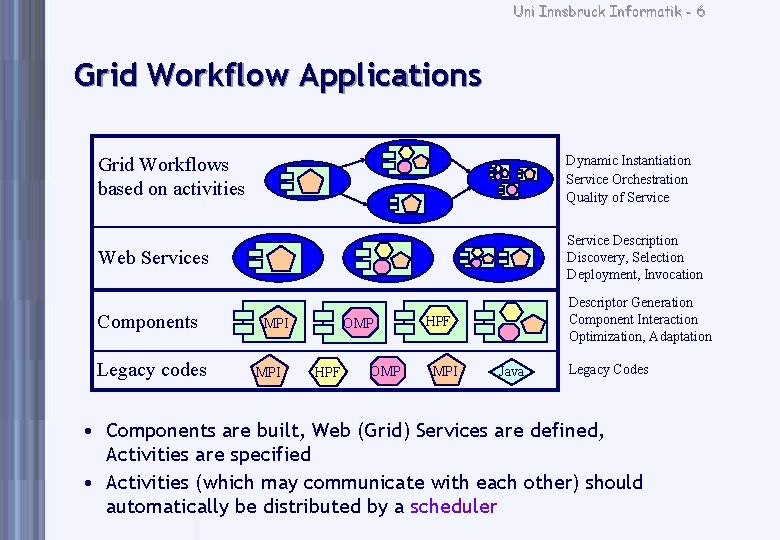
Uni Innsbruck Informatik - 6 Grid Workflow Applications Grid Workflows based on activities Dynamic Instantiation Service Orchestration Quality of Service Web Services Service Description Discovery, Selection Deployment, Invocation Components Descriptor Generation Component Interaction Optimization, Adaptation Legacy codes OMP MPI HPF OMP HPF MPI Java Legacy Codes • Components are built, Web (Grid) Services are defined, Activities are specified • Activities (which may communicate with each other) should automatically be distributed by a scheduler
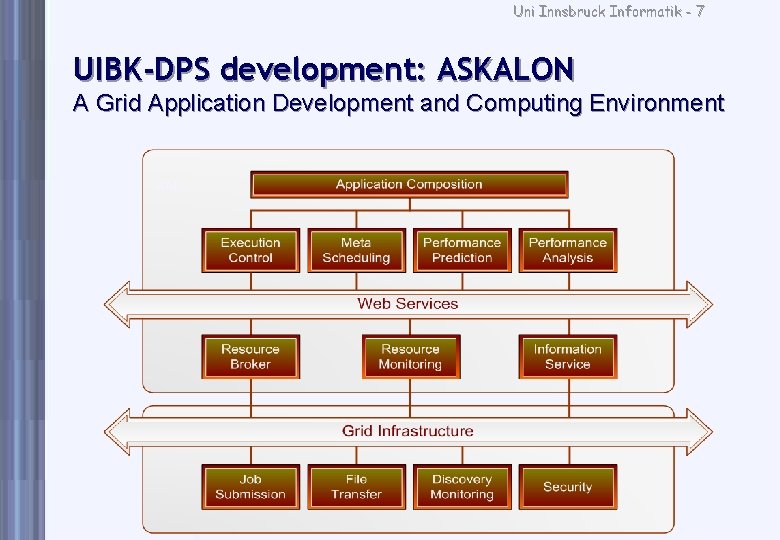
Uni Innsbruck Informatik - 7 UIBK-DPS development: ASKALON A Grid Application Development and Computing Environment XML
Uni Innsbruck Informatik - 8 Grid requirements • Efficiency + ease of use – Programmer should not worry (too much) about the Grid • Underlying system has to deal with – – – Error management Authentification, Authorization and Accounting (AAA) Efficient Scheduling / Load Balancing Resource finding and brokerage Naming Resource access and monitoring • No problem: we do it all - in Middleware • de facto standard: “Globus Toolkit“ – installation of GT 3 in our high performance system: 1 1/2 hours or so. . . – yes, it truly does it all : ) 1000 s of addons - Grid. FTP, MDS, NWS, GRAM, . . – this is just the basis - e. g. , ASKALON is layered on top of Globus
Uni Innsbruck Informatik - 9 Grid-network peculiarities • Special behavior – Predictable traffic pattern - this is totally new to the Internet! – Web: users create traffic – FTP download: starts. . . ends – Streaming video: either CBR or depends on content! (head movement, . . ) • Could be exploited by congestion control mechanisms – Distinction: Bulk data transfer (e. g. Grid. FTP) vs. control messages (e. g. SOAP) – File transfers are often “pushed“ and not “pulled“ – Distributed System which is active for a while • overlay based network enhancements possible – Multicast – P 2 P paradigm: “do work for others for the sake of enhancing the whole system (in your own interest)“ can be applied - e. g. act as a PEP, . . . • sophisticated network measurements possible – can exploit longevity and distributed infrastructure • Special requirements – file transfer delay predictions • note: useless without knowing about shared bottlenecks – Qo. S, but for file transfers only (“advance reservation“)
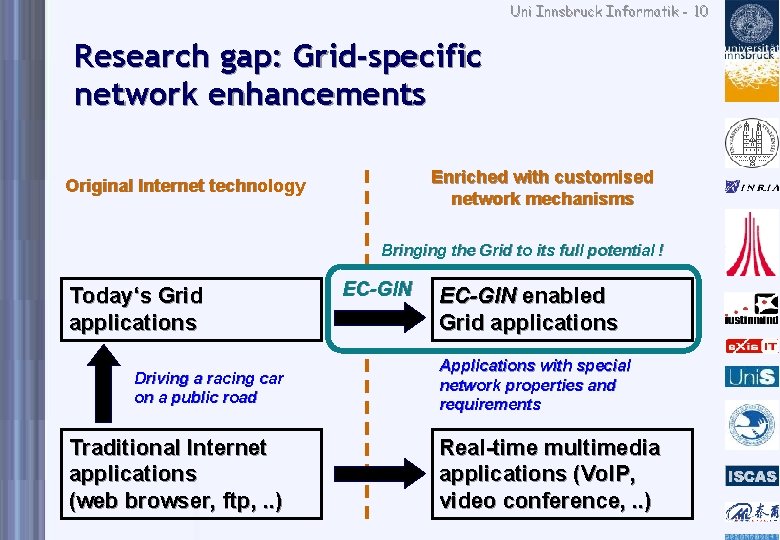
Uni Innsbruck Informatik - 10 Research gap: Grid-specific network enhancements Enriched with customised network mechanisms Original Internet technology Bringing the Grid to its full potential ! Today‘s Grid applications Driving a racing car on a public road Traditional Internet applications (web browser, ftp, . . ) EC-GIN enabled Grid applications Applications with special network properties and requirements Real-time multimedia applications (Vo. IP, video conference, . . )
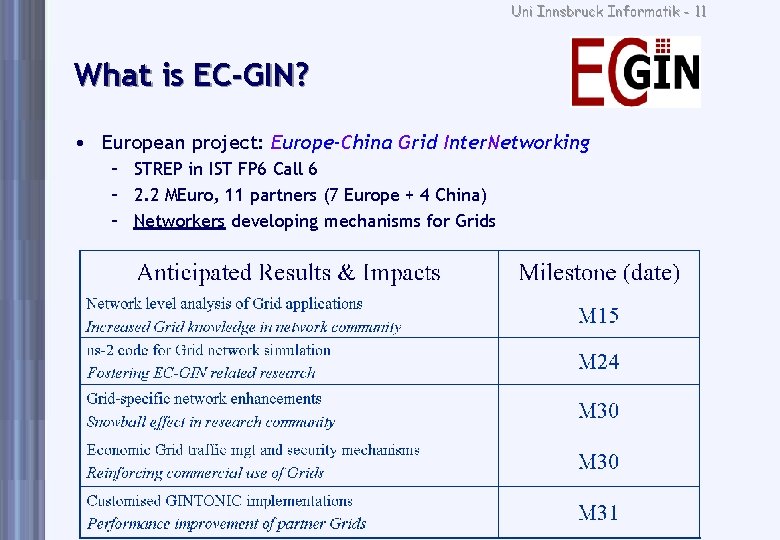
Uni Innsbruck Informatik - 11 What is EC-GIN? • European project: Europe-China Grid Inter. Networking – STREP in IST FP 6 Call 6 – 2. 2 MEuro, 11 partners (7 Europe + 4 China) – Networkers developing mechanisms for Grids
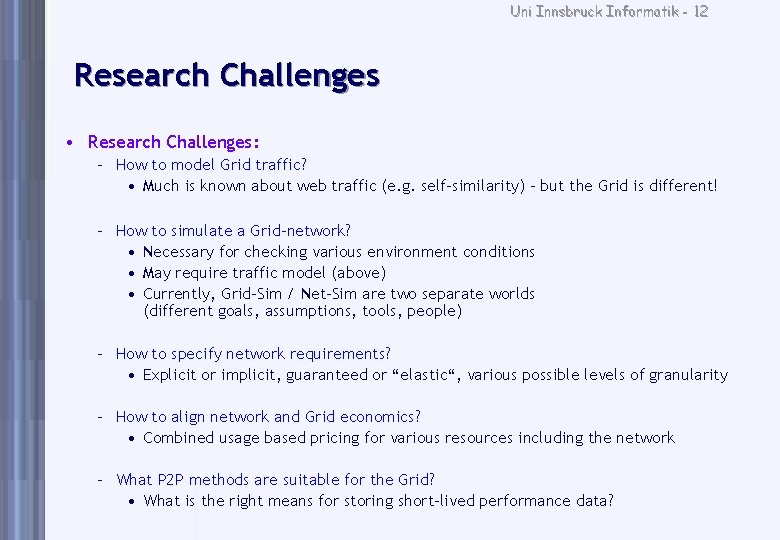
Uni Innsbruck Informatik - 12 Research Challenges • Research Challenges: – How to model Grid traffic? • Much is known about web traffic (e. g. self-similarity) - but the Grid is different! – How to simulate a Grid-network? • Necessary for checking various environment conditions • May require traffic model (above) • Currently, Grid-Sim / Net-Sim are two separate worlds (different goals, assumptions, tools, people) – How to specify network requirements? • Explicit or implicit, guaranteed or “elastic“, various possible levels of granularity – How to align network and Grid economics? • Combined usage based pricing for various resources including the network – What P 2 P methods are suitable for the Grid? • What is the right means for storing short-lived performance data?
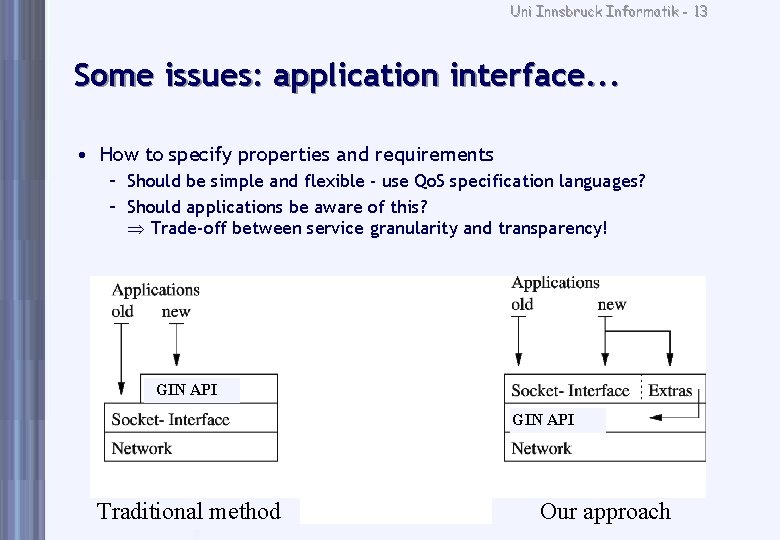
Uni Innsbruck Informatik - 13 Some issues: application interface. . . • How to specify properties and requirements – Should be simple and flexible - use Qo. S specification languages? – Should applications be aware of this? Trade-off between service granularity and transparency! GIN API Traditional method Our approach
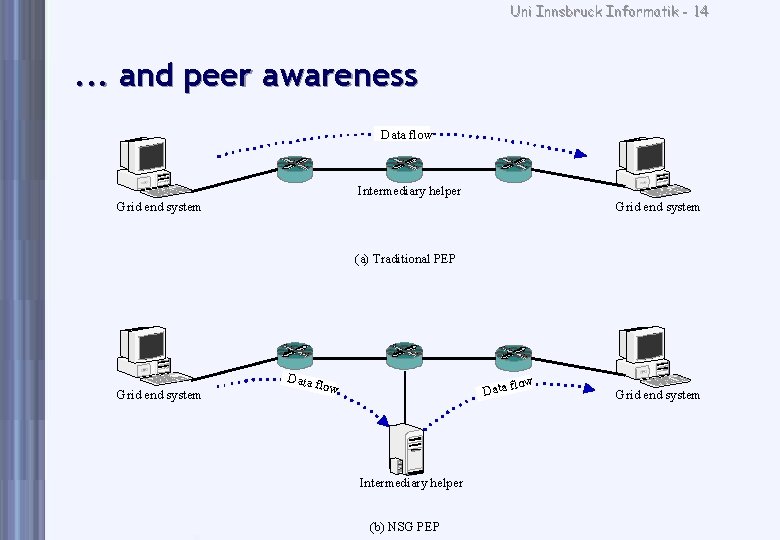
Uni Innsbruck Informatik - 14 . . . and peer awareness Data flow Intermediary helper Grid end system (a) Traditional PEP Grid end system Data f low Data f Intermediary helper (b) NSG PEP Grid end system
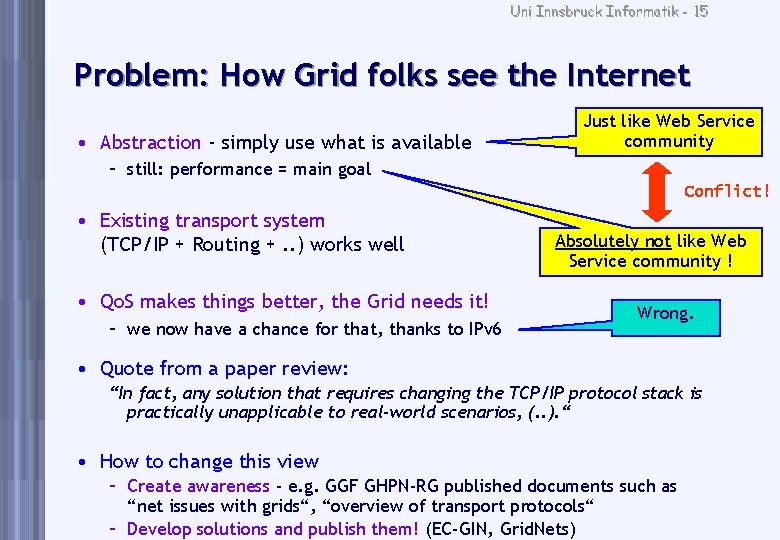
Uni Innsbruck Informatik - 15 Problem: How Grid folks see the Internet • Abstraction - simply use what is available Just like Web Service community – still: performance = main goal Conflict! • Existing transport system (TCP/IP + Routing +. . ) works well • Qo. S makes things better, the Grid needs it! – we now have a chance for that, thanks to IPv 6 Absolutely not like Web Service community ! Wrong. • Quote from a paper review: “In fact, any solution that requires changing the TCP/IP protocol stack is practically unapplicable to real-world scenarios, (. . ). “ • How to change this view – Create awareness - e. g. GGF GHPN-RG published documents such as “net issues with grids“, “overview of transport protocols“ – Develop solutions and publish them! (EC-GIN, Grid. Nets)
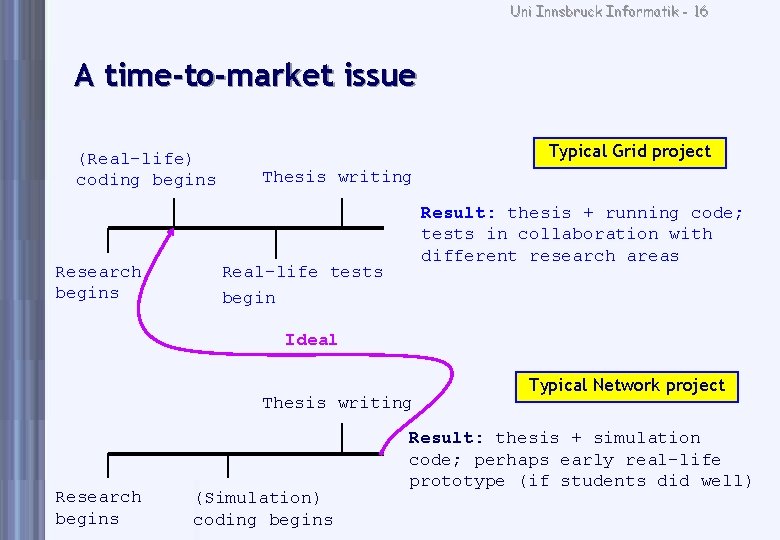
Uni Innsbruck Informatik - 16 A time-to-market issue (Real-life) coding begins Research begins Typical Grid project Thesis writing Result: thesis + running code; tests in collaboration with different research areas Real-life tests begin Ideal Thesis writing Research begins (Simulation) coding begins Typical Network project Result: thesis + simulation code; perhaps early real-life prototype (if students did well)
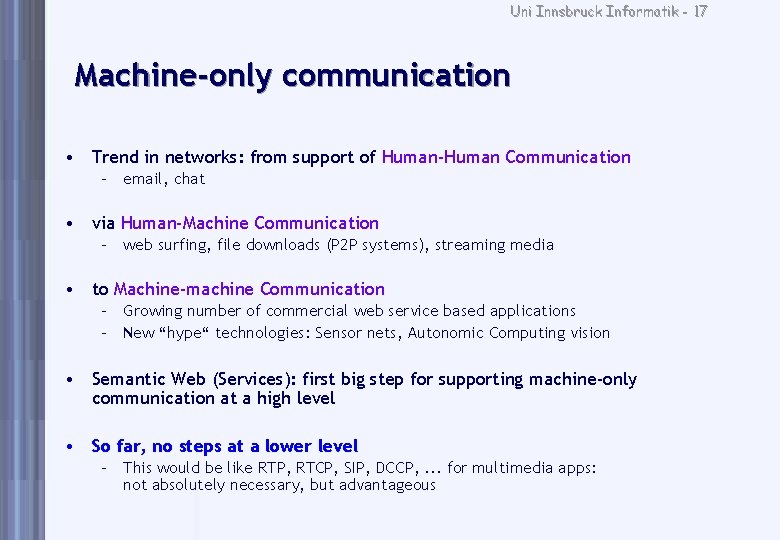
Uni Innsbruck Informatik - 17 Machine-only communication • Trend in networks: from support of Human-Human Communication – email, chat • via Human-Machine Communication – web surfing, file downloads (P 2 P systems), streaming media • to Machine-machine Communication – Growing number of commercial web service based applications – New “hype“ technologies: Sensor nets, Autonomic Computing vision • Semantic Web (Services): first big step for supporting machine-only communication at a high level • So far, no steps at a lower level – This would be like RTP, RTCP, SIP, DCCP, . . . for multimedia apps: not absolutely necessary, but advantageous
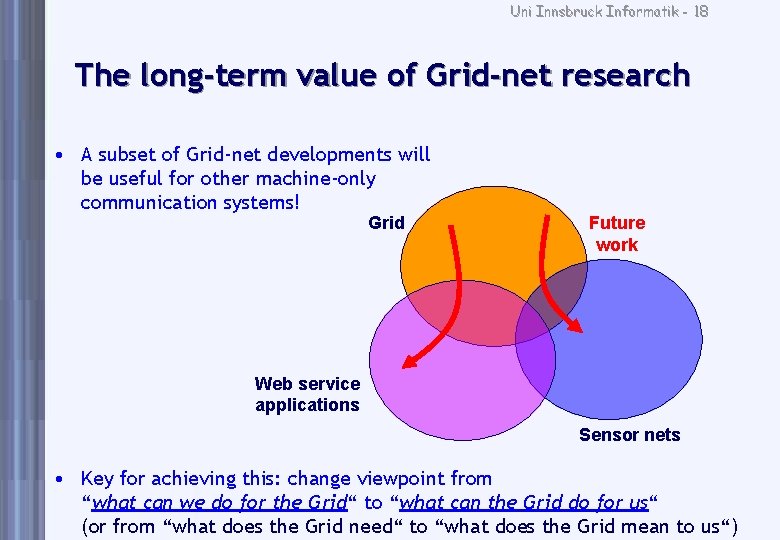
Uni Innsbruck Informatik - 18 The long-term value of Grid-net research • A subset of Grid-net developments will be useful for other machine-only communication systems! Grid Future work Web service applications Sensor nets • Key for achieving this: change viewpoint from “what can we do for the Grid“ to “what can the Grid do for us“ (or from “what does the Grid need“ to “what does the Grid mean to us“)

Uni Innsbruck Informatik - 19 Proposed solutions
Uni Innsbruck Informatik - 20 Example 1: Network Measurement
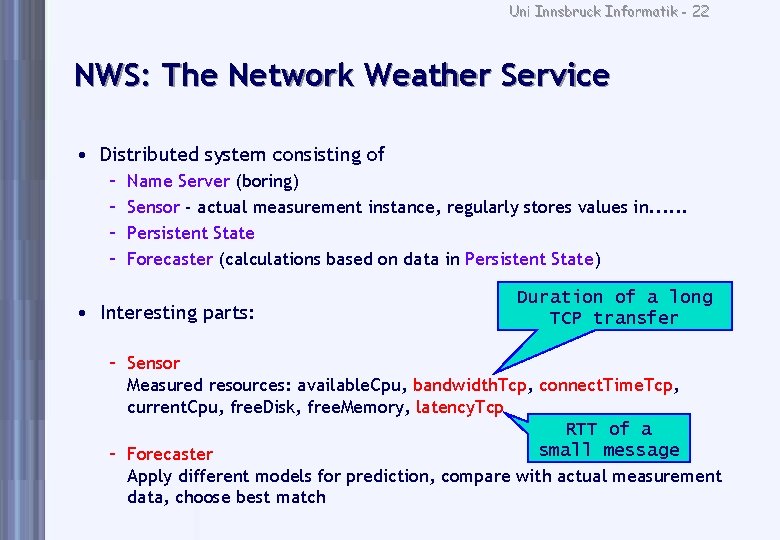
Uni Innsbruck Informatik - 22 NWS: The Network Weather Service • Distributed system consisting of – – Name Server (boring) Sensor - actual measurement instance, regularly stores values in. . . Persistent State Forecaster (calculations based on data in Persistent State) • Interesting parts: Duration of a long TCP transfer – Sensor Measured resources: available. Cpu, bandwidth. Tcp, connect. Time. Tcp, current. Cpu, free. Disk, free. Memory, latency. Tcp RTT of a small message – Forecaster Apply different models for prediction, compare with actual measurement data, choose best match
Uni Innsbruck Informatik - 23 NWS critique • Architecture (splitting into sensors, forecaster etc. ) seems reasonable; open source consider integrating new work in NWS • Sensor – active measurements even though non-intrusiveness was an important design goal - does not passively monitor TCP (i. e. ignores available data) – strange methodology: (Large message throughput) “Empirically, we have observed that a message size of 64 K bytes (. . ) yields meaningful results“ – ignores packet size ( = measurement granularity ) and path characteristics – trivial method - much more sophisticated methods available (e. g. packet pair - later!) – point-to-point measurements: distributed infrastructure not taken into account • Forecaster – relies on these weird measurements, where we don‘t know much about the distribution (but we do know some things about net traffic IFF properly measured) – uses quite trivial models (but they may in fact suffice. . . )
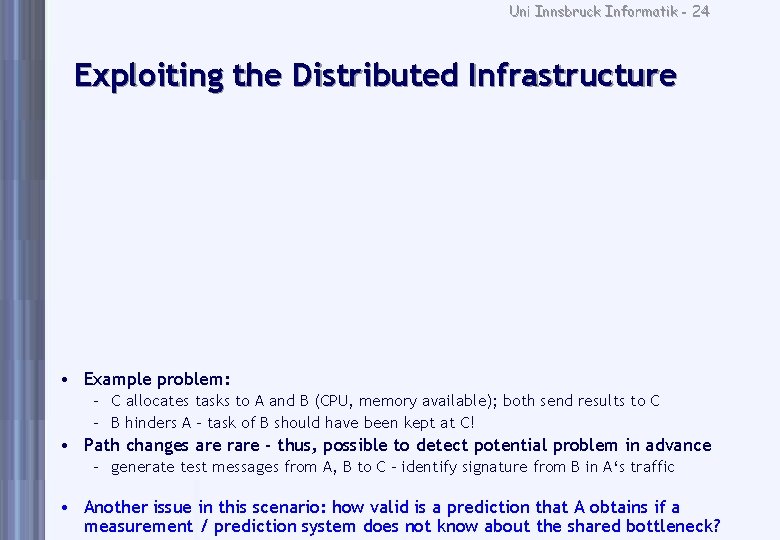
Uni Innsbruck Informatik - 24 Exploiting the Distributed Infrastructure • Example problem: – C allocates tasks to A and B (CPU, memory available); both send results to C – B hinders A - task of B should have been kept at C! • Path changes are rare - thus, possible to detect potential problem in advance – generate test messages from A, B to C - identify signature from B in A‘s traffic • Another issue in this scenario: how valid is a prediction that A obtains if a measurement / prediction system does not know about the shared bottleneck?
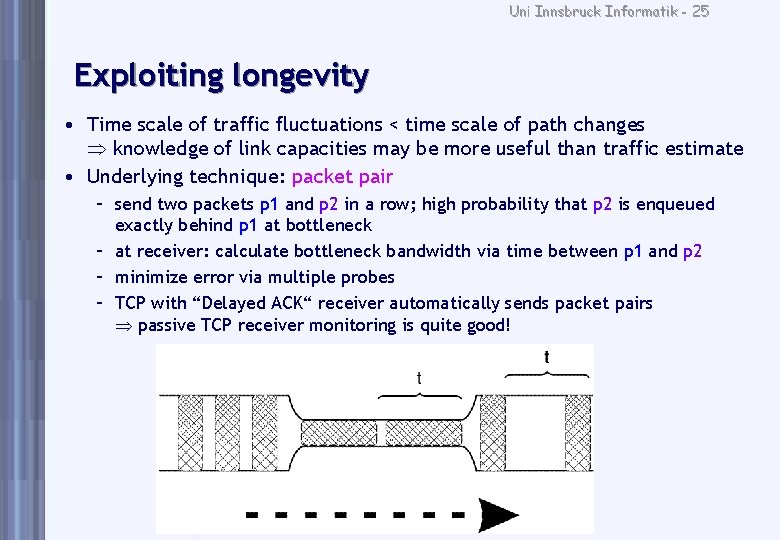
Uni Innsbruck Informatik - 25 Exploiting longevity • Time scale of traffic fluctuations < time scale of path changes knowledge of link capacities may be more useful than traffic estimate • Underlying technique: packet pair – send two packets p 1 and p 2 in a row; high probability that p 2 is enqueued exactly behind p 1 at bottleneck – at receiver: calculate bottleneck bandwidth via time between p 1 and p 2 – minimize error via multiple probes – TCP with “Delayed ACK“ receiver automatically sends packet pairs passive TCP receiver monitoring is quite good!
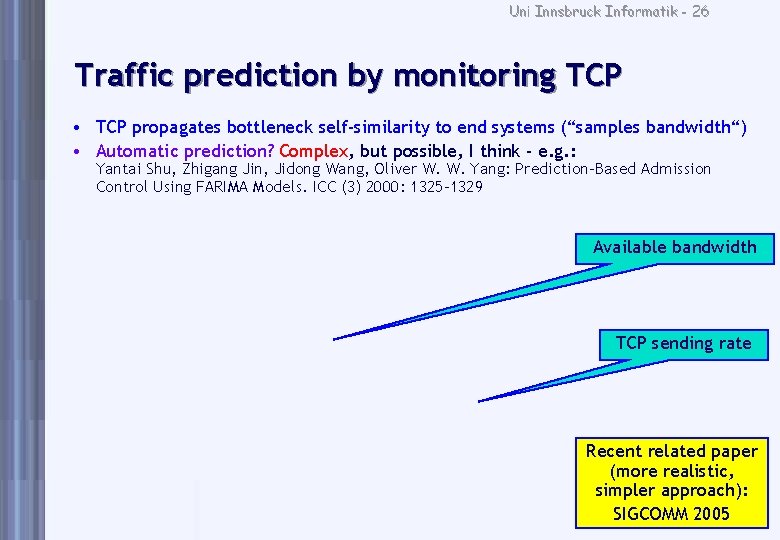
Uni Innsbruck Informatik - 26 Traffic prediction by monitoring TCP • TCP propagates bottleneck self-similarity to end systems (“samples bandwidth“) • Automatic prediction? Complex, but possible, I think - e. g. : Yantai Shu, Zhigang Jin, Jidong Wang, Oliver W. W. Yang: Prediction-Based Admission Control Using FARIMA Models. ICC (3) 2000: 1325 -1329 Available bandwidth TCP sending rate Recent related paper (more realistic, simpler approach): SIGCOMM 2005
Uni Innsbruck Informatik - 27 Grid-Network Simulation
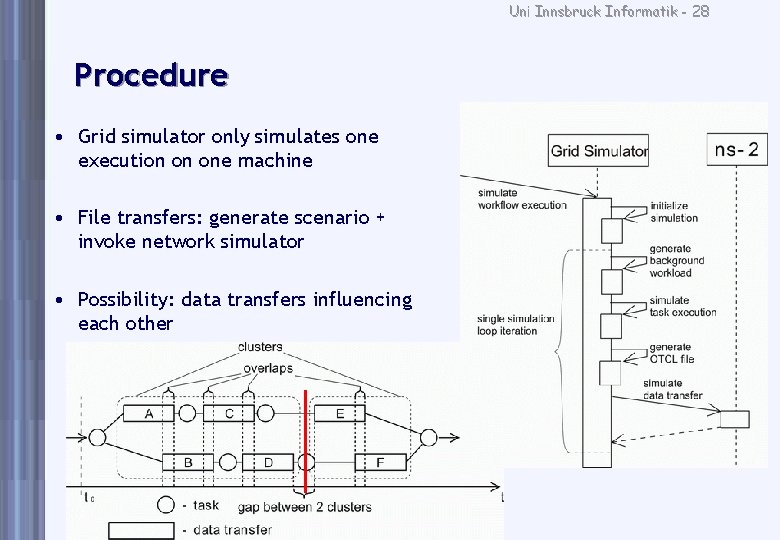
Uni Innsbruck Informatik - 28 Procedure • Grid simulator only simulates one execution on one machine • File transfers: generate scenario + invoke network simulator • Possibility: data transfers influencing each other
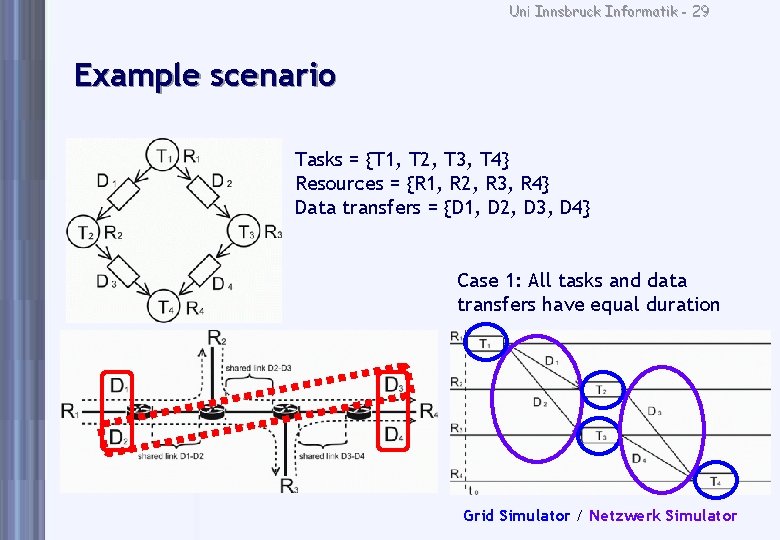
Uni Innsbruck Informatik - 29 Example scenario Tasks = {T 1, T 2, T 3, T 4} Resources = {R 1, R 2, R 3, R 4} Data transfers = {D 1, D 2, D 3, D 4} Case 1: All tasks and data transfers have equal duration Grid Simulator / Netzwerk Simulator
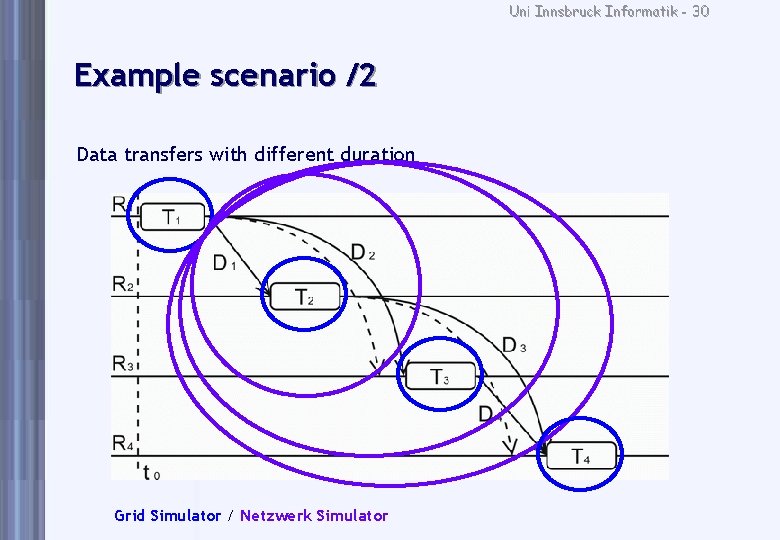
Uni Innsbruck Informatik - 30 Example scenario /2 Data transfers with different duration Grid Simulator / Netzwerk Simulator
Uni Innsbruck Informatik - 31 Conclusion • Implementation in the works • Method tackles an important and current problem, but. . . • Open question: how much time needed between two clusters? – Depends on background traffic and network topology • Time consuming – Repeated simulation of data transfers – Total # parameters = (# Grid parameters) * (# network parameters) • On the other hand. . . – User = Research group which also runs a Grid – Easy to distribute (parameter study) Grid simulation on the Grid – Seems strange (recursion), but makes sense: one Grid application for carrying out an analysis with numerous environment conditions

Uni Innsbruck Informatik - 32 Qo. S for the Grid
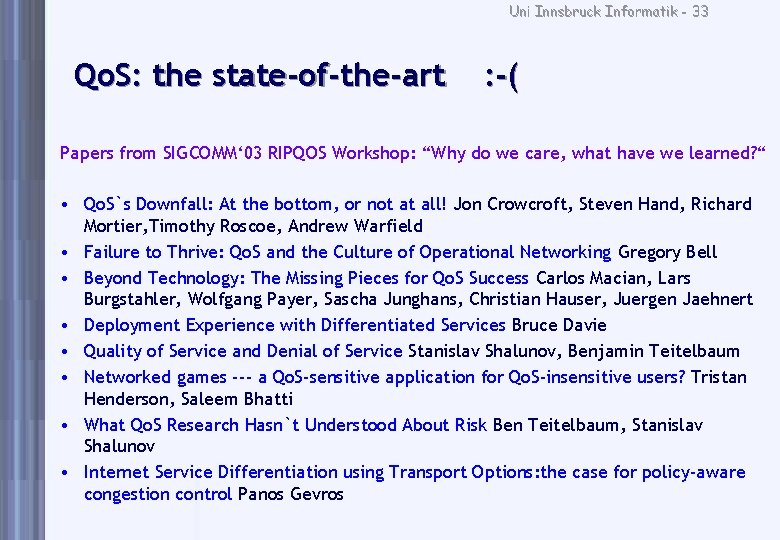
Uni Innsbruck Informatik - 33 Qo. S: the state-of-the-art : -( Papers from SIGCOMM‘ 03 RIPQOS Workshop: “Why do we care, what have we learned? “ • Qo. S`s Downfall: At the bottom, or not at all! Jon Crowcroft, Steven Hand, Richard Mortier, Timothy Roscoe, Andrew Warfield • Failure to Thrive: Qo. S and the Culture of Operational Networking Gregory Bell • Beyond Technology: The Missing Pieces for Qo. S Success Carlos Macian, Lars Burgstahler, Wolfgang Payer, Sascha Junghans, Christian Hauser, Juergen Jaehnert • Deployment Experience with Differentiated Services Bruce Davie • Quality of Service and Denial of Service Stanislav Shalunov, Benjamin Teitelbaum • Networked games --- a Qo. S-sensitive application for Qo. S-insensitive users? Tristan Henderson, Saleem Bhatti • What Qo. S Research Hasn`t Understood About Risk Ben Teitelbaum, Stanislav Shalunov • Internet Service Differentiation using Transport Options: the case for policy-aware congestion control Panos Gevros
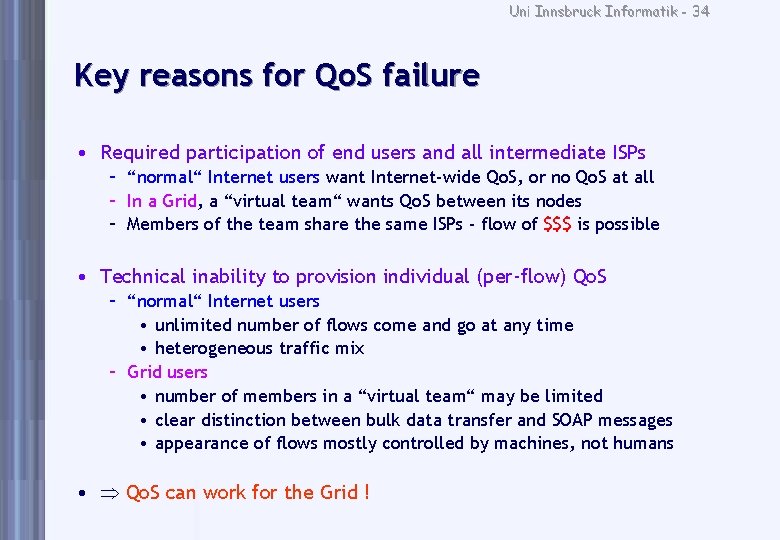
Uni Innsbruck Informatik - 34 Key reasons for Qo. S failure • Required participation of end users and all intermediate ISPs – “normal“ Internet users want Internet-wide Qo. S, or no Qo. S at all – In a Grid, a “virtual team“ wants Qo. S between its nodes – Members of the team share the same ISPs - flow of $$$ is possible • Technical inability to provision individual (per-flow) Qo. S – “normal“ Internet users • unlimited number of flows come and go at any time • heterogeneous traffic mix – Grid users • number of members in a “virtual team“ may be limited • clear distinction between bulk data transfer and SOAP messages • appearance of flows mostly controlled by machines, not humans • Qo. S can work for the Grid !
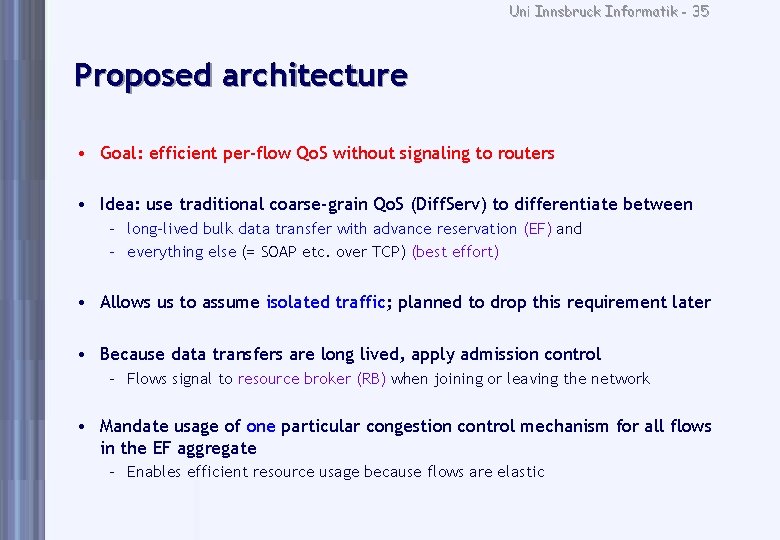
Uni Innsbruck Informatik - 35 Proposed architecture • Goal: efficient per-flow Qo. S without signaling to routers • Idea: use traditional coarse-grain Qo. S (Diff. Serv) to differentiate between – long-lived bulk data transfer with advance reservation (EF) and – everything else (= SOAP etc. over TCP) (best effort) • Allows us to assume isolated traffic; planned to drop this requirement later • Because data transfers are long lived, apply admission control – Flows signal to resource broker (RB) when joining or leaving the network • Mandate usage of one particular congestion control mechanism for all flows in the EF aggregate – Enables efficient resource usage because flows are elastic
Uni Innsbruck Informatik - 36 Key ingredients of our Qo. S soup • Link capacities must be known, paths should be stable (capacity information should be updated upon routing change) • Shared bottlenecks must be known • Bottlenecks must be fairly shared by congestion control mechanism irrespective of RTT (max-main fairness required, i. e. all flows must increase their rates until they reach their limit) • No signaling to routers = no way to enforce proper behavior there must be no cheaters – User incentive: fair behavior among cooperating nodes among which Grid application is distributed – Unfair behavior between Grid application 1 and 2 in same Grid neglected (usually acceptable, as used by same Virtual Organization)
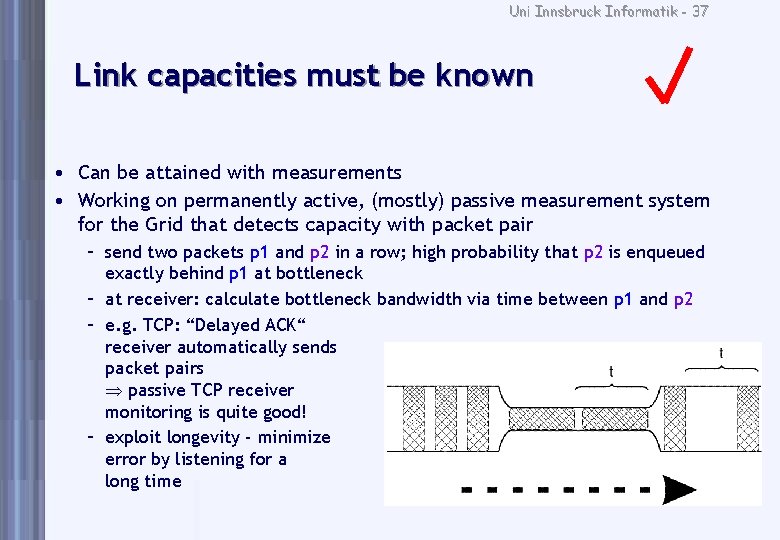
Uni Innsbruck Informatik - 37 Link capacities must be known • Can be attained with measurements • Working on permanently active, (mostly) passive measurement system for the Grid that detects capacity with packet pair – send two packets p 1 and p 2 in a row; high probability that p 2 is enqueued exactly behind p 1 at bottleneck – at receiver: calculate bottleneck bandwidth via time between p 1 and p 2 – e. g. TCP: “Delayed ACK“ receiver automatically sends packet pairs passive TCP receiver monitoring is quite good! – exploit longevity - minimize error by listening for a long time
Uni Innsbruck Informatik - 38 Shared bottlenecks must be known • Simple basis: distributed traceroute tool – enhancement: traceroute terminates early upon detection of known hop • Handle “black holes“ in traceroute – generate test messages from A, B to C - identify signature from B in A‘s traffic – method has worked in the past: “controlled flooding“ for DDo. S detection
Uni Innsbruck Informatik - 39 Congestion Control mechanism must be max-min fair • Was once said to be impossible without per-flow state in routers – – • not true; XCP and some others but these explicit require router support. . . Main problem: dependence on RTT – three good indications that this can be removed without router support 1. CADPC/PTP (my Ph. D. thesis). . . • max-min fairness based on router feedback, but only capacity and available bandwidth (could also be obtain by measuring) 2. Personal comment by Sally Floyd • Reference to old paper on “phase effects“ 3. TCP Libra • increase/decrease factors are f(RTT) Problem: efficiency - no max-min fair “high-speed“ CC mechanism without router support – – searched for a long time now: plan to change existing one based on knowledge from above examples
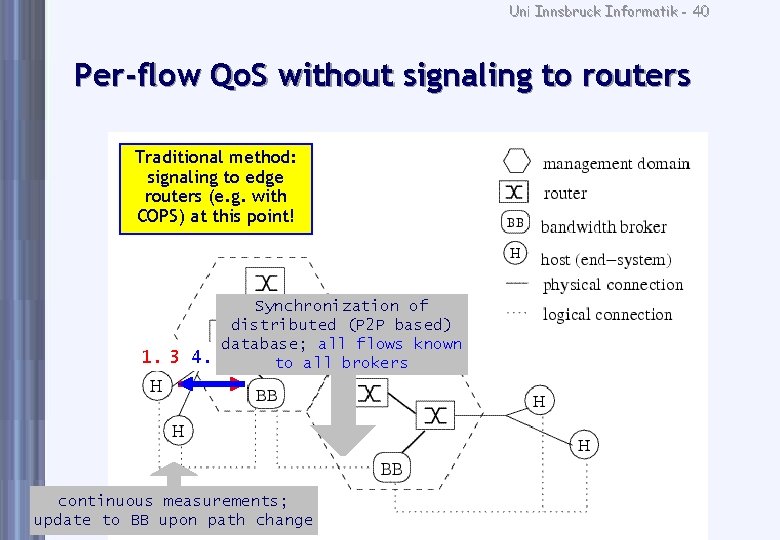
Uni Innsbruck Informatik - 40 Per-flow Qo. S without signaling to routers Traditional method: signaling to edge routers (e. g. with COPS) at this point! Synchronization of of distributed (P 2 P based) database; all linkflows capacities known 1. 3. may 2. 4. II yes ok quit join? known to all brokers continuous measurements; update to BB upon path change
Uni Innsbruck Informatik - 41 Efficiency via elasticity • Qo. S guarantees in Grid: „File will be transferred within X seconds“ enables flexible resource usage
Uni Innsbruck Informatik - 42 Efficiency via elasticity /2 • Flow 1 stopped, flows 2 -4 automatically increase their rates – leading to earlier termination times E 2‘-E 4‘; known to (calculated by) BB
Uni Innsbruck Informatik - 43 Efficiency via elasticity /3 • Flow 5 asks BB for admission – BB knows about current rates and promised E 2 -E 4, grants access
Uni Innsbruck Informatik - 44 Efficiency via elasticity /4 • Flow 2 terminates in time – Flows 3 -5 will also terminate in time Additional flow admitted and earlier termination times than promised!
Uni Innsbruck Informatik - 45 Elasticity without Congestion Control? • Significant amount of additional signaling necessary As flow 5 is admitted, signal “reduce your rates“ to flows 2 -4 required! As Flow-1 stops, Flows 2 -4 could increase their rates Without congestion control, signal “increase your rates“ to flows 2 -4 required!
Uni Innsbruck Informatik - 46 Additional considerations • How to assign different rates to different flows? – – max-min fairness: if a sender “acts“ like two, it obtains twice the rate consider rate consisting of slots (e. g. 1 kbit/s = 1 slot) flows can consist of several slots let congestion control mechanism operate on slots • Possibility: admit new flows even in scenario below Must introduce unfairness: only flow 2 can reduce rate Disadvantage: more signaling again!
Uni Innsbruck Informatik - 47 Difficult & distant future work • Drop requirement of traffic isolation via Diff. Serv – constantly obtain and update conservative estimate of available bandwidth using packet pair (works without saturating link) – ensure that limit is never exceeded; “condition red“ otherwise! – Some open questions. . . • does this require the CC mechanism to be TCP-friendly? • condition red: reduce slots, or let flows be aggressive for a short time? • How to handle routing changes – will be noticed, but can reduce capacity break Qo. S guarantee – condition red; can happen in worst case, but to be avoided at all cost – mitigation methods • very conservative estimate of available bandwidth; leave headroom • tell senders to reroute via intermediate end systems • Bottom line: lots of complicated issues, but possible to solve them

Uni Innsbruck Informatik - 48 Conclusion
Uni Innsbruck Informatik - 49 Conclusion • Grid applications show special requirements and properties from a network perspective – and it is reasonable to develop tailored Internet technology for them. • There is another class of such applications. . . • Multimedia. • For multimedia applications, an immense number of network enhancements (even IETF standards) exist. • For the Grid, there is nothing. • This is a research gap; let‘s fill it together! – submit a paper to Grid. Nets 2007 ! Reminder: if done right, such research is also applicable to other systems with machine-only traffic

Uni Innsbruck Informatik - 50 Thank you! Questions?
- Slides: 49